Machine learning doesn’t fail because models cannot learn. It fails because learning is poorly defined, poorly tested, or poorly maintained. Teams often focus on algorithms and tools while ignoring the rules that decide whether learning can be trusted in real systems. That’s where machine learning methodology matters. It defines how models learn from data, how results are evaluated, how knowledge is stored, and how systems adapt over time.
Without this structure, even accurate models become unstable once they move beyond experimentation. If you’re dealing with result drift, unreliable predictions, or declining model quality, the issue is rarely the model itself. It is the methodology behind it. Get into the breakdown of ML methodology so you can understand where things go wrong and how to fix them.
What Is Machine Learning Methodology?
Machine learning methodology is the structured way you design, train, evaluate, store, and maintain machine learning systems. It sets the rules for how learning happens, how results are judged, and how decisions remain consistent as data and conditions change. Each stage in a full methodology exists to control learning risk. You define the problem so learning has direction. You prepare data with intent so models learn the right signals.
Training follows agreed rules, evaluation acts as a checkpoint, learned parameters are stored for reuse, and updates are managed as conditions shift. A solid machine learning methodology framework exists to keep this structure intact. It removes guesswork and keeps learning dependable when models move from experiments into real use.
Methodology vs Algorithm vs Workflow
Most confusion around ML methodology comes from mixing these three terms and treating them as the same thing. But each of these terms has their own definitions and purpose. Here is a comparison table given below to clear such confusion:
| Aspect | Methodology | Algorithm | Workflow |
|---|---|---|---|
| What it is | The governing structure and rules | The mathematical learning mechanism | The sequence of execution steps |
| Core role | Defines how learning is designed, evaluated, stored, and maintained | Defines how learning happens mathematically | Defines how tasks are carried out |
| Level | Conceptual and strategic | Technical and mathematical | Operational and procedural |
| Changes when | Business goals, risks, or data conditions change | Model performance or learning behavior changes | Tools, teams, or processes change |
| What they answer | Why this learning approach is valid | How the model learns | What happens next |
| Example | Rules for evaluation, retraining, and validation | Gradient descent, decision trees | Data prep → training → deployment |
If you’re still confused about their roles and want to clear it before investing in a ML service, consult with Webisoft’s machine learning experts to discuss all your questions.
Learning Models and Their Role in Machine Learning Methodology
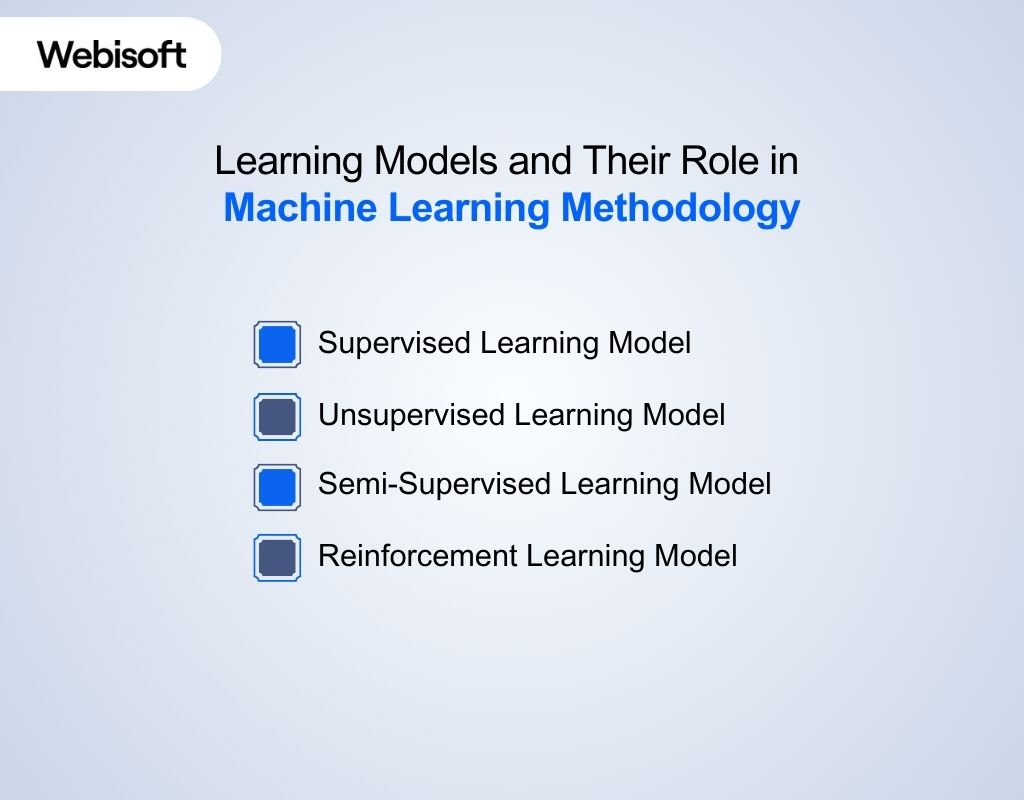
Different learning models require different methodological rules, which is why this distinction matters in practice. The way a model receives feedback determines how learning must be governed, evaluated, and updated. These machine learning models are:
1. Supervised Learning Model
Supervised learning falls under methodology because it depends on labeled data. That dependency forces methodological rules around label quality, validation against ground truth, and retraining schedules tied to label updates. If labels change or degrade, the methodology must change with them.
2. Unsupervised Learning Model
Unsupervised learning belongs to methodology because there is no ground truth to validate against. Methodology shifts toward pattern stability, human review, and indirect metrics. Updates are governed by insight and discovery, not performance scores.
3. Semi-Supervised Learning Model
Semi-supervised learning creates methodological risk by mixing labeled and unlabeled data. Methodology must control how labels propagate, how evaluation isolates trusted data, and how updates prevent error amplification across the system.
4. Reinforcement Learning Model
This learning model requires a different methodology because learning comes from interaction, not datasets. Evaluation focuses on reward stability, updates happen continuously, and methodology governs policy safety instead of static accuracy.
How a Machine Learning Model Learns From Data During Training
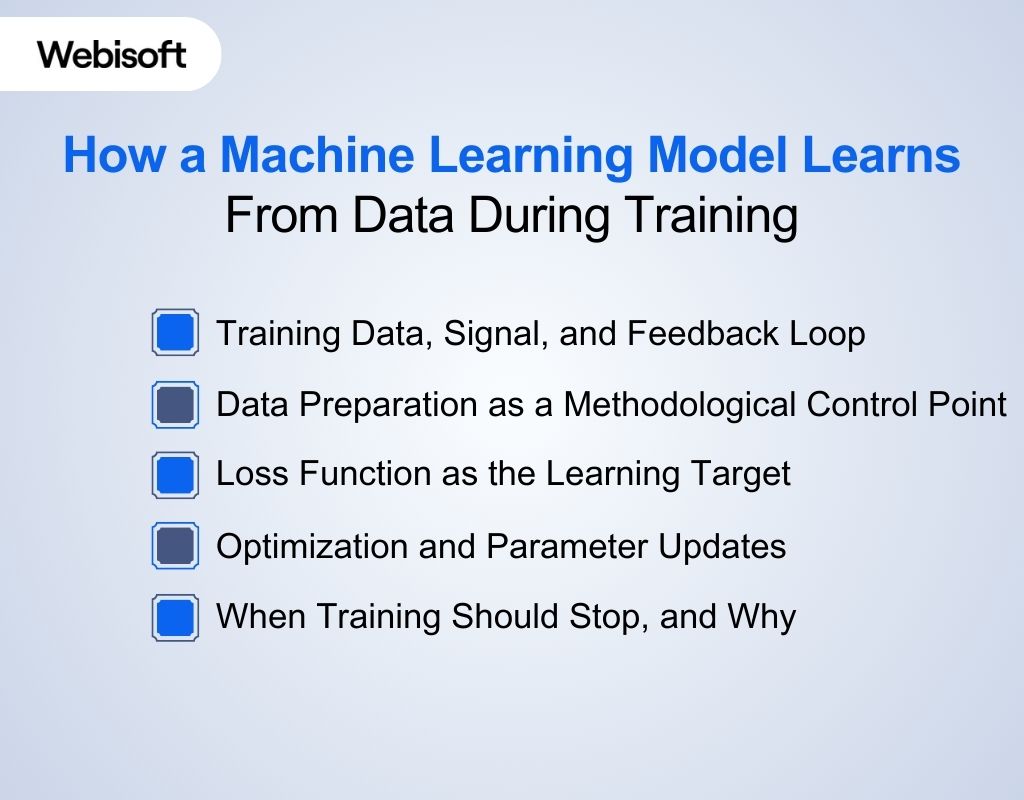
Training is where learning actually happens, but within machine learning methodology, it is never left uncontrolled. Methodology defines how data becomes knowledge, how errors are corrected, and when learning is considered complete. Here’s how:
Training Data, Signal, and Feedback Loop
Training data provides the signal a model learns from. Inputs generate predictions, and feedback tells the model how far it missed the target. Methodology controls this loop so learning follows clear rules instead of trial and error. This control is what turns training into a reliable machine learning model training methodology.
Data Preparation as a Methodological Control Point
ML methodology guides data preparation by defining acceptance rules, quality checks, and consistency standards before training starts. It decides which data is valid, how bias is handled, and when datasets are approved. This prevents unstable learning caused by noisy or misaligned inputs.
Loss Function as the Learning Target
The loss function defines what the model is trying to improve. It translates mistakes into a measurable signal the model can act on. Methodology decides which loss reflects goals, not just mathematical convenience, so learning stays aligned with actual use.
Optimization and Parameter Updates
Optimization adjusts model parameters based on feedback from the loss function. Each update nudges the model toward better performance. Methodology controls update behavior, learning rates, and stability to prevent models from learning noise instead of patterns.
When Training Should Stop, and Why
Training doesn’t stop when results look good. It stops when methodology says the learning has stabilized. Validation behavior, not intuition, defines stopping points. This protects downstream decisions and keeps machine learning evaluation methodology honest and dependable.
How Learning Is Evaluated Using Metrics and Validation Data
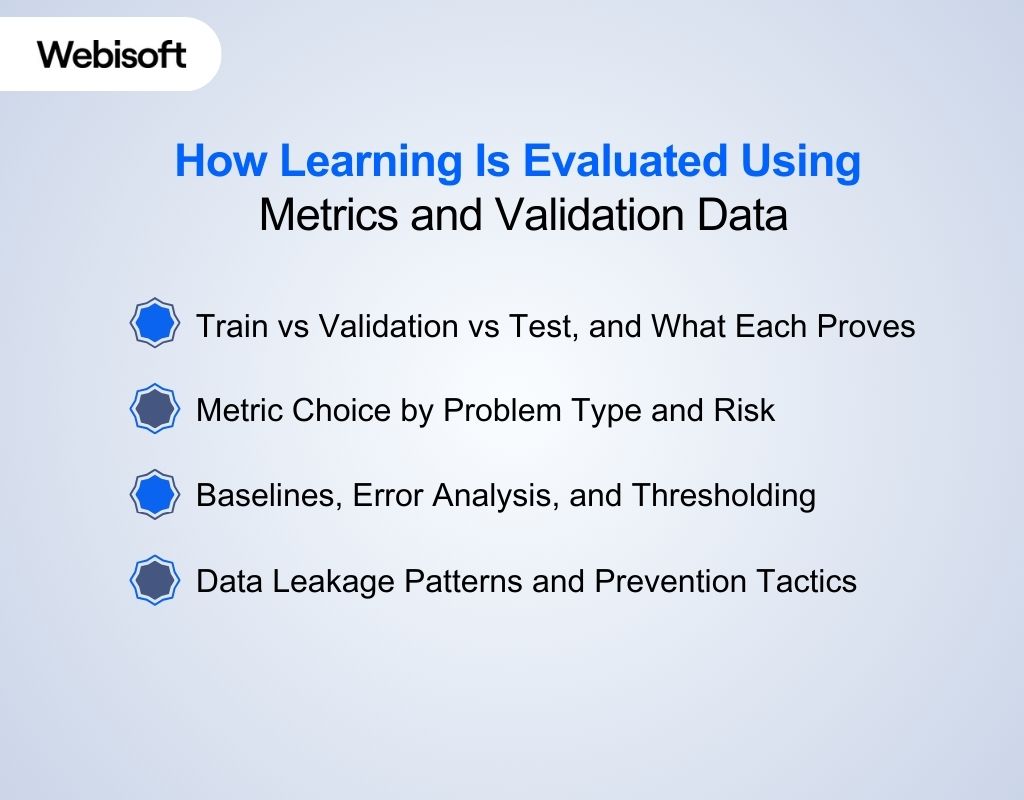
Evaluation is where machine learning methodology proves its value. This stage decides whether learning is real, useful, and safe to rely on, not just whether numbers look good.
Train vs Validation vs Test, and What Each Proves
Each dataset plays a different methodological role, and mixing them breaks evaluation credibility. Here’s the purpose of each dataset:
| Dataset | Purpose in Methodology | What It Proves |
|---|---|---|
| Training data | Used to fit the model and adjust parameters | What the model is capable of learning |
| Validation data | Used during tuning and decision making | How learning behaves while being refined |
| Test data | Used only after training is complete | Whether learning generalizes to unseen data |
Machine learning methodology enforces this separation so evaluation reflects real performance, not memorized patterns.
Metric Choice by Problem Type and Risk
Metrics are not neutral. Accuracy might work in low risk cases, but it fails fast when errors carry real consequences. In a supervised learning methodology, evaluation depends on metrics that reflect actual cost, not just correctness. Methodology decides what failure looks like before models are trusted.
Baselines, Error Analysis, and Thresholding
Evaluation doesn’t start with the model but with a baseline. Methodology requires comparing results against simple references so progress is real. Error analysis then shows where learning breaks, and thresholds define when predictions are acceptable in real use.
Data Leakage Patterns and Prevention Tactics
Data leakage silently destroys evaluation. It happens when future information leaks into training or validation without notice. Methodology exists to prevent this through strict data separation rules, audit checks, and repeatable validation setups.
How Learned Parameters Are Stored as Model Weights
In machine learning methodology, storage is not a technical afterthought. It’s a controlled decision about what knowledge is preserved, how it can be reused, and how learning remains trustworthy over time.
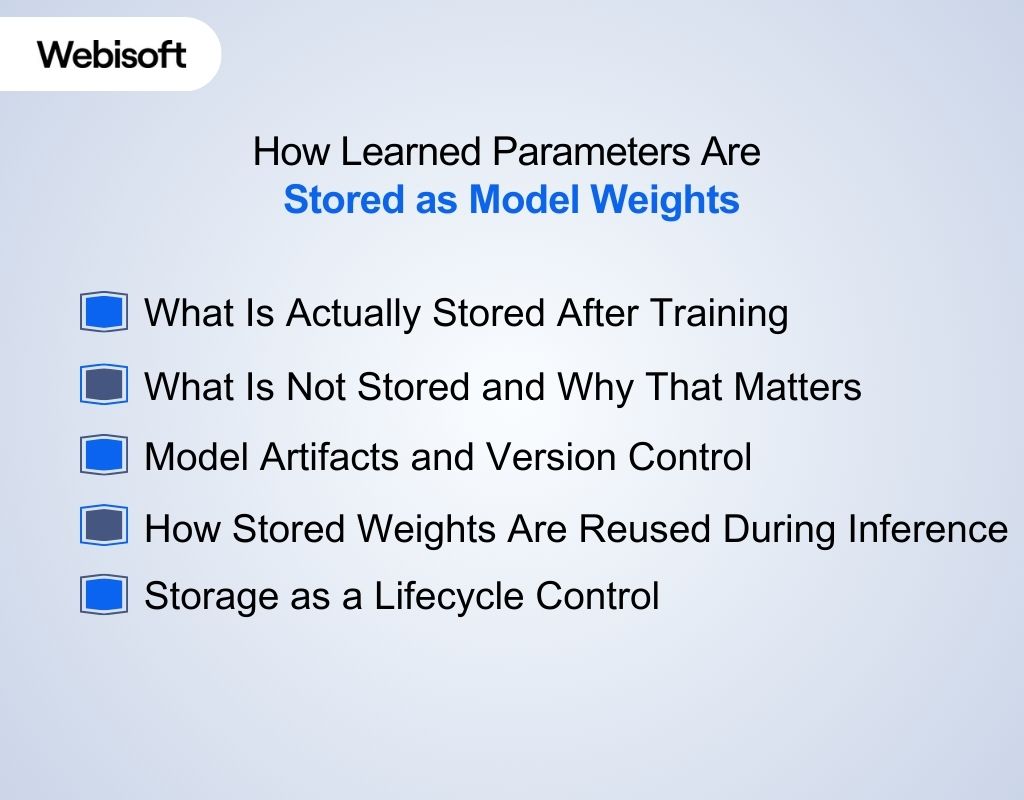
What Is Actually Stored After Training
After training, an ML model stores only the information it needs to reproduce its learning. This includes numerical weights, bias values, and internal configuration state that control how inputs are transformed into outputs.
Methodology defines this boundary on purpose. By storing parameters instead of examples, learning becomes reusable across systems, auditable over time, and independent of the original training data.
What Is Not Stored and Why That Matters
Raw training data is never part of the stored model. Methodology enforces this separation to prevent privacy risks, hidden dependencies, and irreproducible behavior. Learning must stand on its parameters alone, or it cannot be trusted later.
Model Artifacts and Version Control
Stored weights are packaged as model artifacts. Methodology governs how these artifacts are versioned, documented, and linked to training conditions. This makes sure every model can be traced back to how and why it learned what it did.
How Stored Weights Are Reused During Inference
During inference, stored weights are applied to new inputs to generate predictions. Methodology enforces that the same parameters, preprocessing steps, and configurations are used as during training. If this alignment breaks, outputs drift quietly and learning becomes unreliable.
Storage as a Lifecycle Control
Storage decisions also affect when models are promoted, rolled back, or retired. Methodology defines these rules so learning remains stable as systems evolve and data shifts.
How Machine Learning Models Reuse or Update Learning Over Time
Machine learning methodology explains how learning stays useful after deployment. Reuse and updates follow defined rules so models don’t drift quietly or change without control. Here are more details:
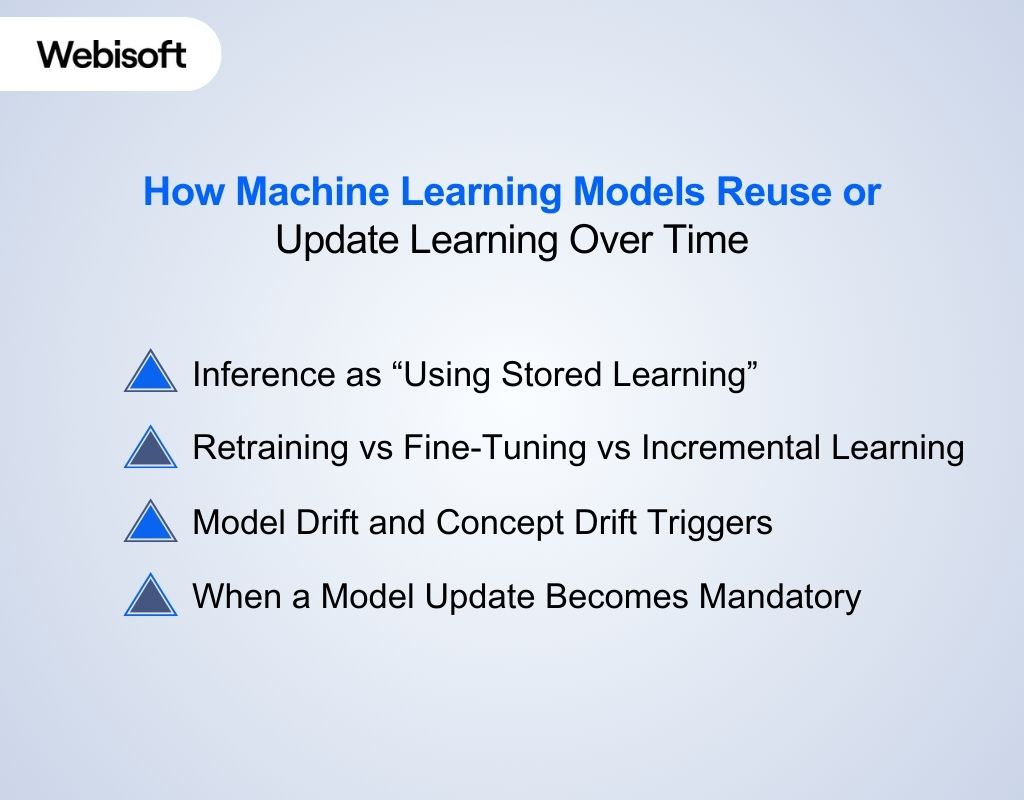
Inference as “Using Stored Learning”
Inference applies learned parameters to fresh data without modifying them. Methodology carries out this boundary so predictions reflect validated learning, not accidental updates. Here’s how the process flow:
- Stored model weights → New input data → Prediction output
Retraining vs Fine-Tuning vs Incremental Learning
These aren’t interchangeable techniques. In machine learning methodology, each update approach exists for a specific condition and risk level.
- Retraining replaces the model completely. It is required when data distributions or problem definitions change significantly, making existing learning unreliable.
- Fine-tuning adjusts an existing model using new data. Methodology allows this when performance drops slightly but core patterns of machine learning still hold.
- Incremental learning updates the model continuously in small steps. It is used when data arrives steadily and learning must adapt without full retraining.
Methodology decides which path is valid based on evidence, risk, and system impact, not convenience. This process flows as:
- Stable performance → No change
- Minor degradation → Fine-tuning
- Major data shift → Full retraining
- Continuous signals → Incremental updates
Model Drift and Concept Drift Triggers
In methodology, these signals exist to protect systems from silently failing after deployment. For example, model drift appears when incoming data changes, even if the underlying problem stays the same. Concept drift occurs when the relationship between inputs and outcomes shifts. Methodology defines what changes matter, how they are measured, and when learning is considered outdated. Here is the methodological flow of this process:
- Incoming data → Drift detection checks → Threshold breached → Review required
When a Model Update Becomes Mandatory
When performance drops below accepted limits, updates are no longer optional. In production systems, MLOps methodology enforces these decisions so learning remains controlled, traceable, and reliable over time.
The Methodology Decisions That Control Model Quality
If a model performs well one day and fails the next, the issue is rarely the machine learning algorithm. Most quality problems come from early decisions that shape how learning is allowed to happen. Here’s how the quality is determined:
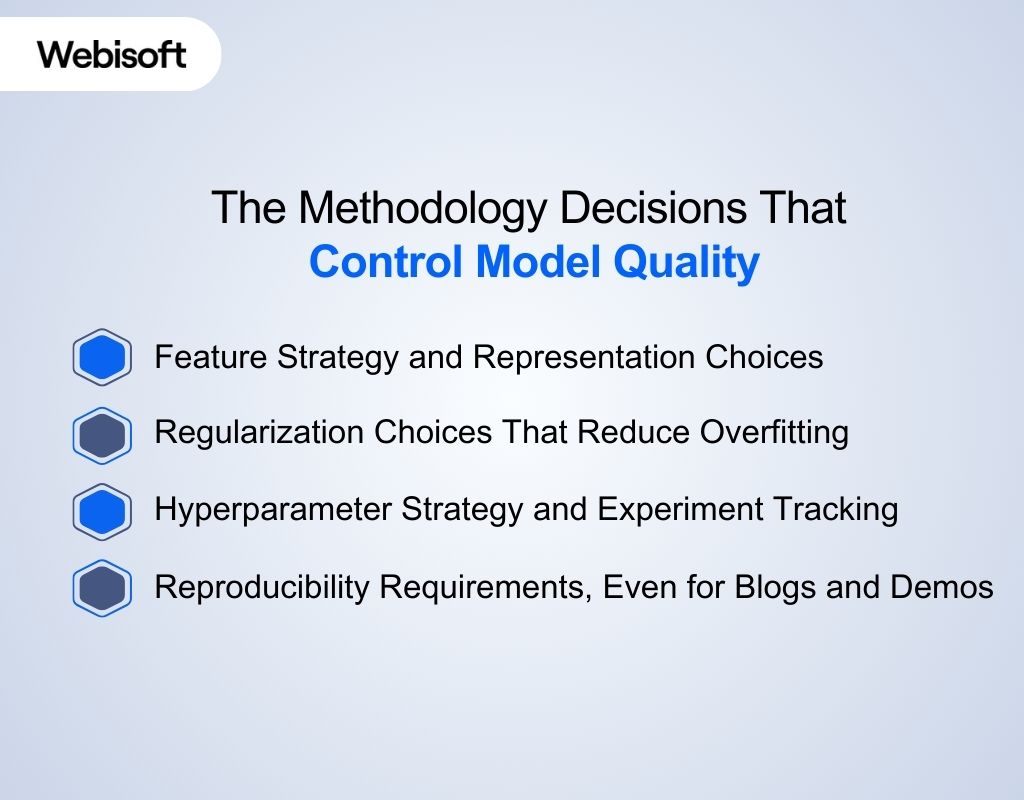
Feature Strategy and Representation Choices
Features decide what the model can even notice. Methodology commands which inputs are allowed, how they are transformed, and what context is preserved. When this step is careless, models learn shortcuts. When it is disciplined, learning stays grounded in reality.
Regularization Choices That Reduce Overfitting
Some models learn too much, too fast. Regularization exists to slow them down. Methodology defines when learning needs limits and how strong those limits should be, based on data size, risk, and expected change.
Hyperparameter Strategy and Experiment Tracking
Hyperparameters influence how learning behaves under pressure. Methodology stops random guessing by setting boundaries, comparison rules, and tracking standards. If you cannot trace why a model improved, you cannot trust the improvement.
Reproducibility Requirements, Even for Blogs and Demos
If results cannot be repeated, they do not count. Methodology requires fixed settings, documented choices, and version awareness, even in small demos. Otherwise, learning turns into coincidence instead of evidence.
Machine Learning Methodology Frameworks You Should Know
Most ML teams don’t fail because they lack tools. They fail because everyone follows a different process. Frameworks exist to bring those processes under one set of rules and keep methodology consistent.
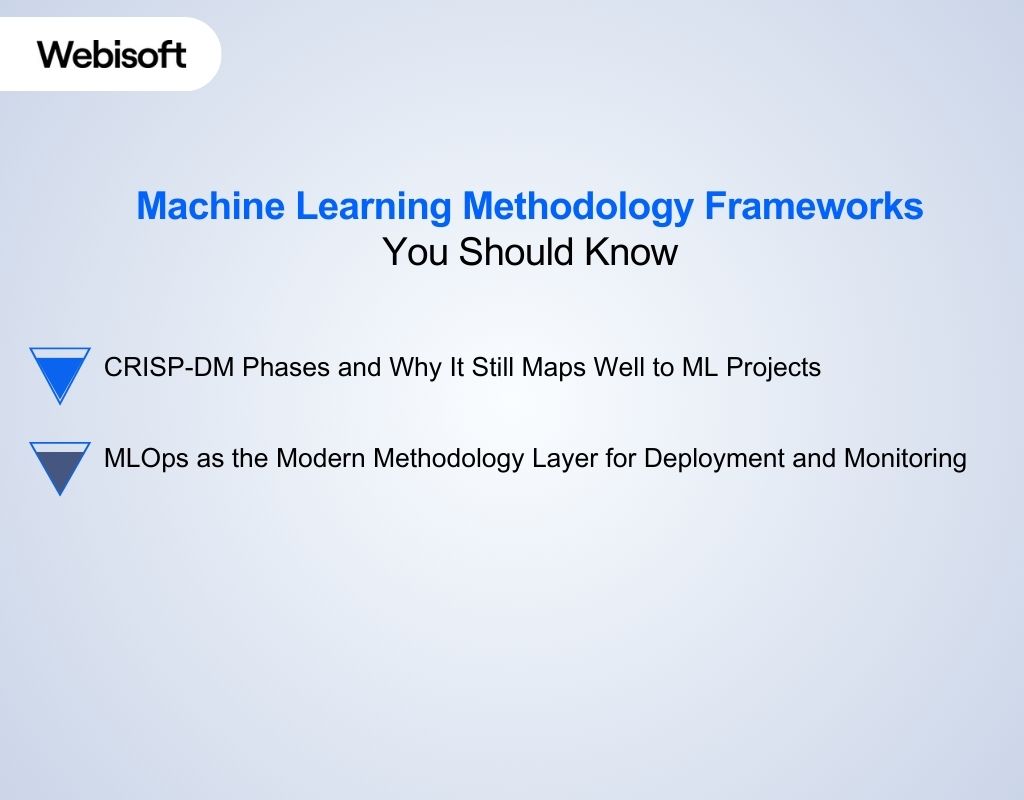
CRISP-DM Phases and Why It Still Maps Well to ML Projects
CRISP-DM breaks work into clear phases, from understanding the problem to deployment. It still maps well to ML because it forces teams to define goals, validate results, and treat deployment as part of learning. As a machine learning methodology framework, it adds structure where projects often start informally.
MLOps as the Modern Methodology Layer for Deployment and Monitoring
MLOps extends methodology beyond training. It defines how models are monitored, updated, rolled back, and audited after deployment. Instead of treating release as the finish line, it makes lifecycle control part of everyday practice.
Methodology Failures That Break Machine Learning in Production
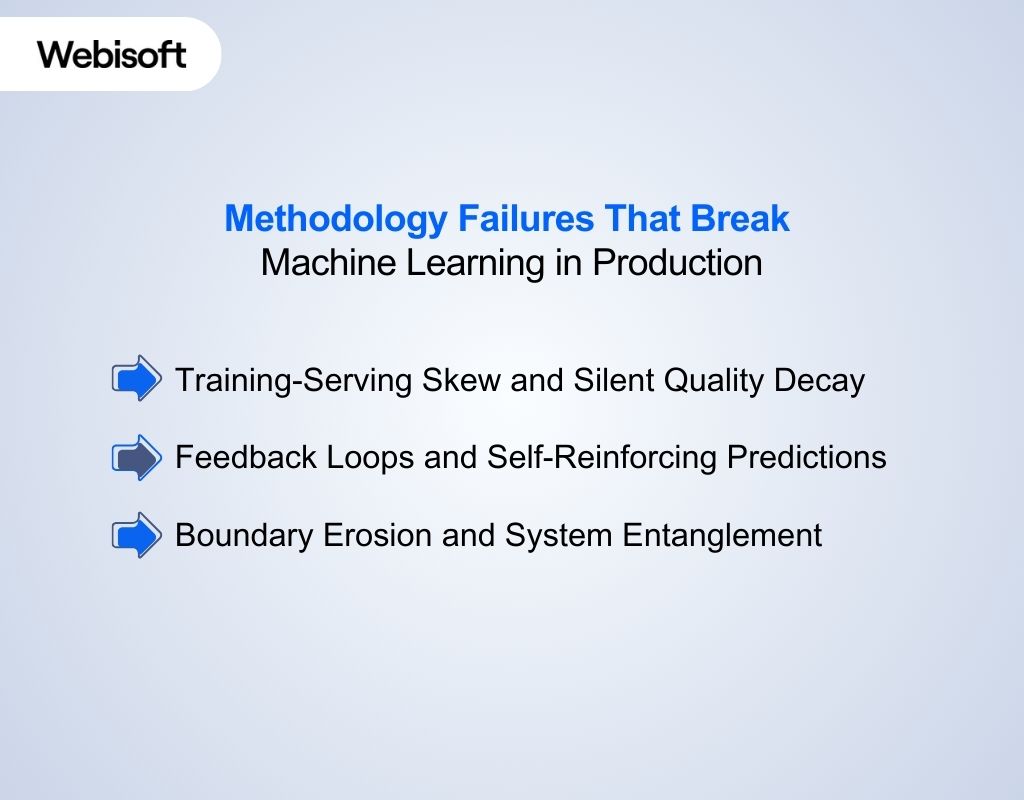
Most real-world ML failures are not caused by bad algorithms. They happen when the machine learning methodology process breaks quietly at one or more stages, often without immediate warning. Here are shortcomings of methodology:
Training-Serving Skew and Silent Quality Decay
Training data and production data rarely behave the same way. When preprocessing, feature logic, or assumptions differ between training and serving, models slowly lose accuracy. Methodology exists to enforce alignment, but when that control slips, decay happens without alarms.
Feedback Loops and Self-Reinforcing Predictions
Some models influence the data they later learn from. Recommendations shape user behavior, predictions affect decisions, and new data reflects old outputs. Without methodological safeguards, models start learning their own bias instead of reality.
Boundary Erosion and System Entanglement
As models evolve, their original boundaries blur. One model feeds another. Outputs become inputs elsewhere. Over time, learning logic spreads across systems. When methodology does not enforce clear ownership and interfaces, failures become hard to trace and harder to fix.
Why These Become Long-Term Technical Debt
These issues compound because they are structural, not visible bugs. Each workaround adds complexity, and each unchecked update increases risk. Weak methodology turns learning systems into fragile dependencies that cost more to maintain than to rebuild.
Applying Machine Learning Methodology in Practice
Understanding machine learning methodology is one thing. Applying it consistently is where most teams struggle. For most teams, the real challenge is applying machine learning methodology consistently across projects. In practice, methodology works as a decision system that guides how learning is approved, tested, deployed, and updated, so models stay dependable beyond initial experiments. Such as:
- Define the problem: Methodology sets objectives, success criteria, and constraints so learning has direction from day one.
- Prepare and approve data: Methodology controls which data is valid, how quality is checked, and when datasets are cleared for learning.
- Train under defined rules: Models are trained within agreed limits, ensuring learning follows policy rather than experimentation.
- Evaluate with gates: Results pass validation thresholds before being trusted or promoted.
- Deploy with oversight: Methodology enforces monitoring, version control, and rollback readiness.
- Update based on evidence: Retraining or tuning happens only when data proves it is necessary.
How Webisoft Help You with Machine Learning Development Service
At this point, you understand how machine learning methodology works and why it matters. The next step is execution. That is where many teams struggle, not because of ideas, but because turning methodology into a working system takes experience. Webisoft provides machine learning development services built for real production use, not experiments. They apply ML methodology at every stage, from design to long-term maintenance. Here is how Webisoft helps you:
- Machine learning consulting and solution design: Define use cases, technical scope, and system architecture based on your data and goals
- Custom machine learning model development: Design and train models tailored to your datasets, constraints, and performance needs
- Model integration and deployment: Embed models into existing products, platforms, and workflows with minimal disruption
- Performance optimization and tuning: Improve accuracy, latency, and stability as data patterns evolve
- Scalable enterprise ML systems: Build solutions that support growth, higher data volume, and long-term maintenance
- Ongoing model support: Manage retraining, version control, and production updates to keep models reliable.
If you are ready to move to deploying systems that work in real conditions, Webisoft can build and maintain those models for you. Reach out to book your machine learning development after discussing your requirements and get a solution designed for your specific use case.
Conclusion
To sum up, machine learning methodology controls the full lifecycle from design, training, and evaluation to storage, deployment, and updates. This controlled process makes sure that each model learns reliably and adapts without failure.
By enforcing structured rules via frameworks like CRISP-DM or MLOps, it prevents drift, boosts reproducibility, and minimizes risks. Implement these for production success and choose Webisoft for an expert and reliable service.
FAQs
Here are some commonly asked questions regarding machine learning methodology:
Yes. Methodology does not depend on data volume alone. It defines how learning is validated, when results are acceptable, and how uncertainty is handled. With limited data, methodology places more emphasis on evaluation discipline, assumptions, and error analysis.
Methodology reduces risk by enforcing clear rules for evaluation, storage, reuse, and updates. It ensures models are retrained only when needed, prevents silent performance decay, and keeps learning decisions traceable as data and conditions change.
Yes. When regulations apply, methodology must include additional controls such as audit trails, explainability requirements, restricted data handling, and approval checkpoints. These rules influence how models are evaluated, stored, and updated so learning decisions remain defensible and compliant over time.