Research and surprisingly a lot of YouTube videos have shown that humans are still monkeys when it comes to maintaining uniformity on a mass scale. Machines, on the other hand, are much quicker in talking to each other and adjusting for minor errors. Cars can now park themselves reliably. Soon it will be the case for the entire road. And machine learning is at the core of it. And it’s not only road traffic we are talking about.
Machine learning will make long-haul trucks move goods and even ships. And don’t think it is limited to driving the vehicle. Transportation is more than just moving. It is the optimum answer for when, where, what, and how to move. And machine learning in transportation is going to be one of the first industries totally revolutionized.
What Is Machine Learning in Transportation?
Machine learning in transportation refers to the use of algorithms that learn from data to make predictions, automate decisions, and optimize operations within transportation systems. Unlike traditional rule-based systems, these models detect patterns in large datasets and improve performance over time without being manually programmed for every scenario. In transportation, this involves analyzing historical and real-time data from sensors, cameras, GPS, telematics, and passenger systems.
The goal is to support traffic forecasting, route optimization, vehicle automation, demand prediction, safety monitoring, and operational efficiency across road, rail, air, and logistics networks. Integrated into intelligent transportation systems (ITS), machine learning enables data-driven mobility and reduces congestion. It also improves safety and increases overall system efficiency by turning complex transport data into actionable insights.
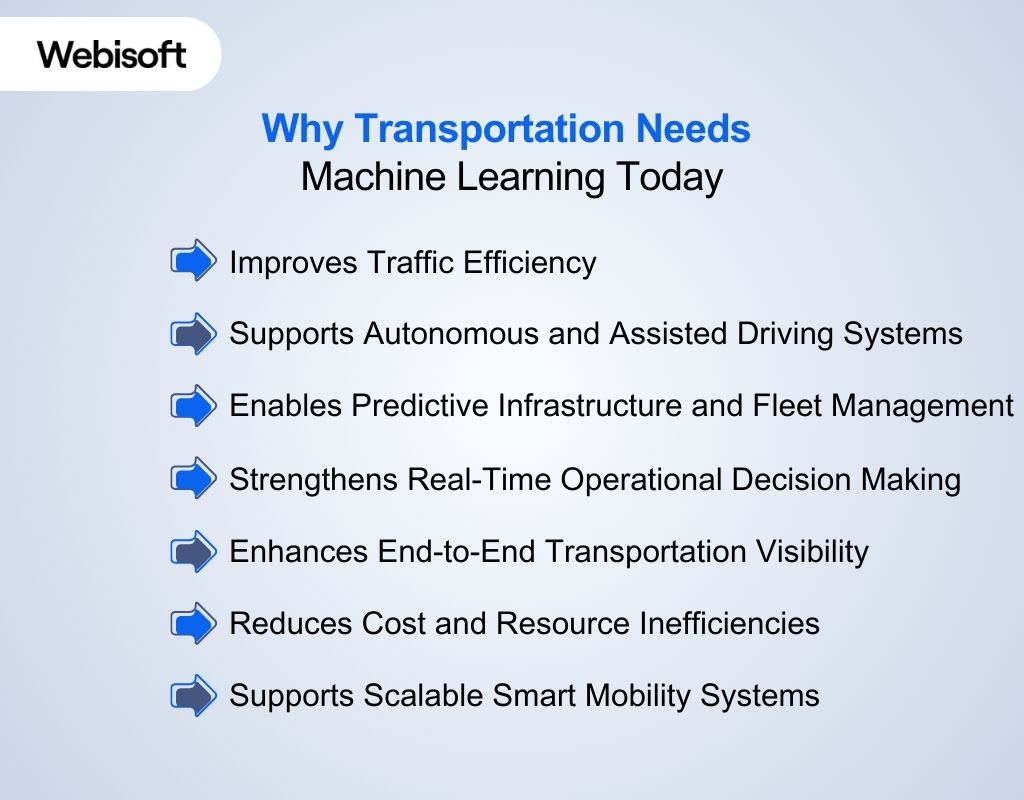
Why Transportation Needs Machine Learning Today
It needs machine learning because this is the next step in efficiency. This sector is always looking for ways to improve operational efficiency. And rule-based systems often require human input, which can take more time or cost more money. Machine learning will be able to understand the requirement and deliver without human input.
Improves Traffic Efficiency
Transportation networks generate continuous streams of traffic data that reflect congestion patterns, peak-hour surges, and unexpected disruptions. Machine learning analyzes these patterns to anticipate flow changes and support dynamic adjustments, reducing bottlenecks and stabilizing network performance.
Supports Autonomous and Assisted Driving Systems
Modern vehicles rely on perception and decision systems that must interpret complex environments instantly. Machine learning processes sensor inputs such as cameras and radar to assist braking, lane management, obstacle detection, and driver support functions under varying road conditions.
Enables Predictive Infrastructure and Fleet Management
Roadways, rail systems, aircraft, and vehicle fleets experience gradual wear that can lead to sudden failures. Machine learning models detect subtle behavioral shifts in performance data, allowing operators to identify risks early and plan maintenance before breakdowns disrupt service.
Strengthens Real-Time Operational Decision Making
Transportation environments change rapidly due to weather, incidents, passenger demand, and route constraints. Machine learning systems continuously evaluate incoming data to support faster operational responses, reducing delays and improving coordination across control centers.
Enhances End-to-End Transportation Visibility
Large transportation ecosystems involve multiple stakeholders, vehicles, hubs, and control systems. Machine learning integrates fragmented datasets into unified insights, improving transparency across supply chains, transit systems, and multimodal networks.
Reduces Cost and Resource Inefficiencies
Fuel consumption, idle time, route deviations, and underutilized assets increase operational expenses. Adaptive optimization models help transportation providers allocate vehicles, routes, and schedules more effectively under changing demand and constraint conditions.
Supports Scalable Smart Mobility Systems
Urban expansion and digital mobility platforms require systems that can scale without proportional increases in manual oversight. Machine learning enables automated coordination across signals, fleets, and passenger systems, supporting long-term growth in smart mobility infrastructure.
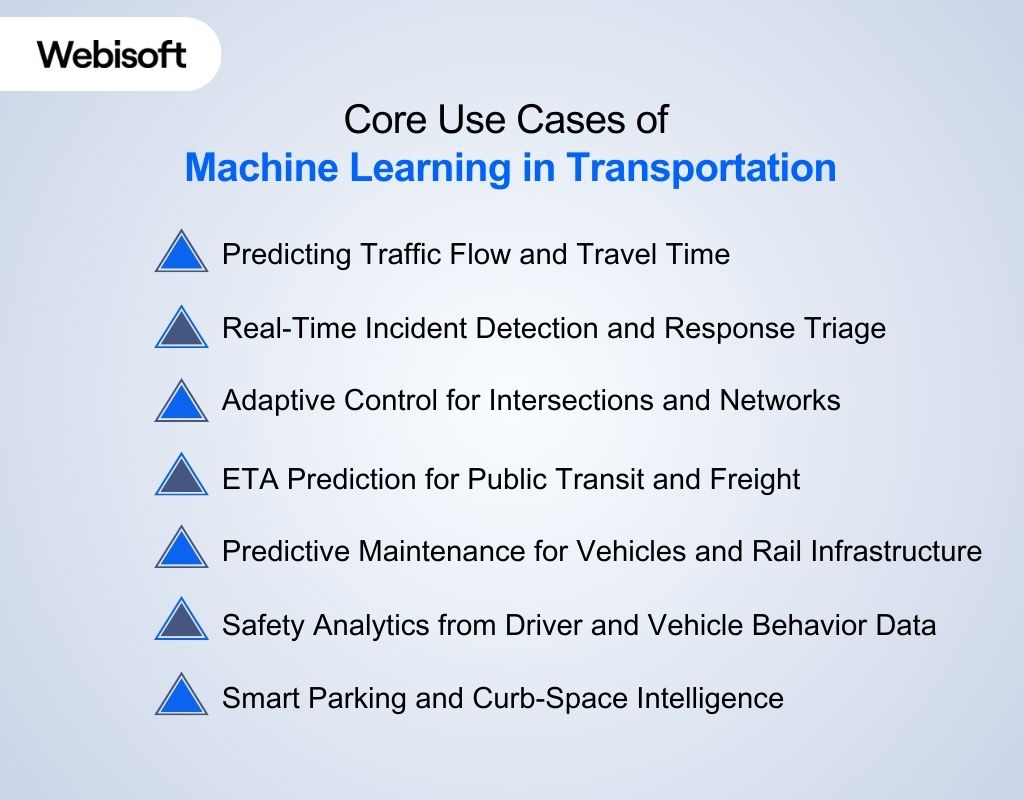
Core Use Cases of Machine Learning in Transportation
The application of machine learning in transportation now plays a direct role in everyday mobility systems. From traffic control to freight operations, data-driven models improve prediction and operational decisions. Here are the core use cases behind this shift.
Predicting Traffic Flow and Travel Time
Machine learning models analyze traffic speed, congestion history, and location-based patterns to forecast how roads will behave in the near future. Instead of relying only on averages, these models account for recurring patterns, sudden surges, and localized disruptions to generate more accurate travel-time estimates.
Real-Time Incident Detection and Response Triage
Transportation agencies use computer vision and pattern recognition models to detect accidents, stalled vehicles, and abnormal traffic conditions from camera feeds and roadway data. Automated alerts allow control centers to respond faster compared to manual monitoring.
Adaptive Control for Intersections and Networks
Research and pilot programs use reinforcement learning to test smarter signal timing and incident response strategies. These systems adjust based on changing traffic conditions rather than following fixed schedules.
ETA Prediction for Public Transit and Freight
Arrival-time prediction models combine historical trip data, route behavior, and external variables to estimate when vehicles will arrive. This improves reliability for passengers, logistics coordinators, and supply chain planners.
Predictive Maintenance for Vehicles and Rail Infrastructure
Sensor data from engines, rail tracks, and mechanical components is analyzed to identify early signs of wear or failure. Instead of waiting for breakdowns, operators can schedule maintenance based on actual risk patterns.
Safety Analytics from Driver and Vehicle Behavior Data
Telematics systems collect behavioral signals such as braking intensity, acceleration patterns, and speed variation. Machine learning models analyze these signals to detect risky driving behaviors and potential safety threats.
Smart Parking and Curb-Space Intelligence
Parking systems use sensors and vision models to detect space occupancy and forecast availability. This helps drivers locate parking more efficiently and reduces congestion caused by vehicles searching for spaces.
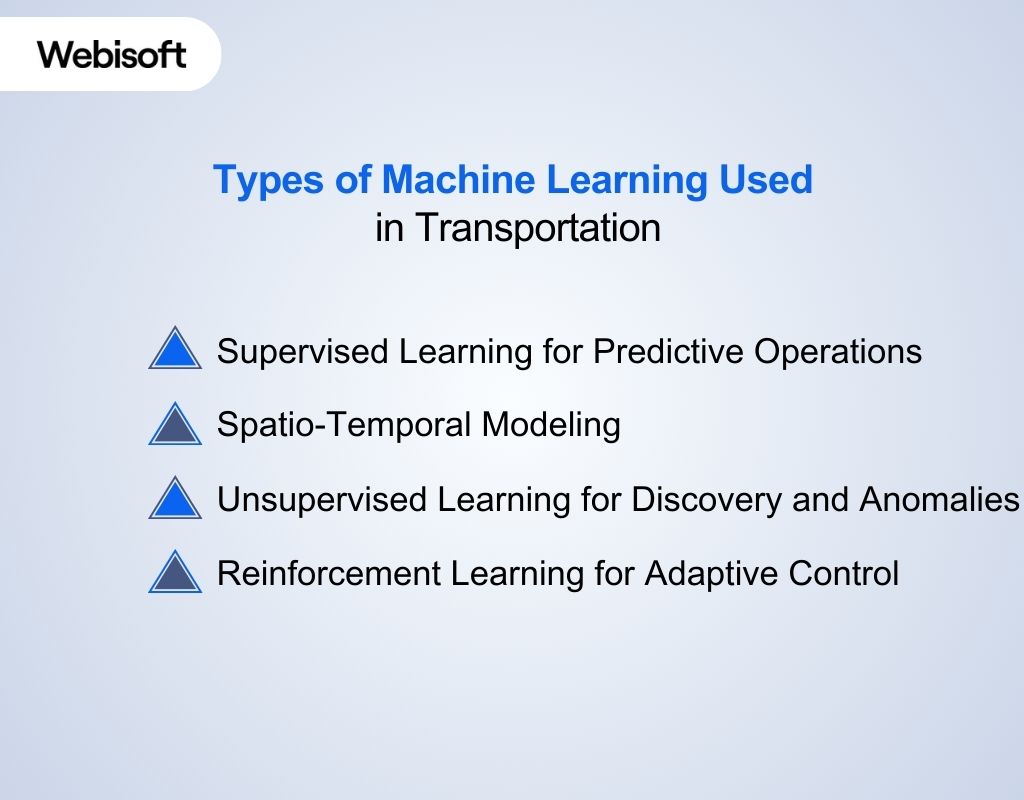
Types of Machine Learning Used in Transportation
Transportation ML is shaped by the data it sees and the decisions it must support. Some methods learn from labeled outcomes, while others learn from patterns, images, or trial-and-error control. Each ML type fits a different transportation environment and risk level.
1. Supervised Learning for Predictive Operations
Supervised models learn from past labeled outcomes (e.g., historical delay minutes or crash logs). This is the standard for independent operational tasks.
- Typical inputs: GPS traces, maintenance logs, weather, and schedules.
- Typical outputs: Estimated Time of Arrival (ETA), equipment failure risk, travel demand.
- Common models: Gradient Boosting Machines (XGBoost), Random Forests, and Logistic Regression.
- Key Distinction: Best for “static” predictions where data points are relatively independent.
2. Spatio-Temporal Modeling (The Network Core)
This is the most critical area of transportation ML. It merges Time-Series, Graph ML, and Deep Learning into a single framework to account for the fact that traffic at one point in time and space is inherently linked to others.
- Typical inputs: Road network graphs, speed/volume history from loop detectors, LiDAR/Video streams.
- Typical outputs: Short-term traffic flow, network-wide congestion heatmaps, trajectory prediction.
- Common models: ST-GNNs (Spatio-Temporal Graph Neural Networks), ConvLSTMs, and Transformers.
- Key Distinction: Captures the “ripple effect” of traffic across a connected city-scale network.
3. Unsupervised Learning for Discovery and Anomalies
Used when “ground truth” labels are missing. These models learn the “normal” state of a system to identify when something unusual happens.
- Typical inputs: High-frequency raw sensor telemetry, infrastructure vibration data.
- Typical outputs: Anomaly scores, vehicle behavior clusters, sensor fault detection.
- Common models: Isolation Forests, Autoencoders, K-Means Clustering.
- Key Distinction: Provides early warnings and monitoring without requiring human-labeled training data.
4. Reinforcement Learning for Adaptive Control
Unlike predictive models, Reinforcement Learning learns through action and feedback. It is used for systems that must make real-time decisions to optimize a specific goal.
- Typical inputs: Real-time queue lengths, signal phase states, vehicle positions.
- Typical outputs: Optimal signal timing policies, autonomous routing decisions.
- Common models: Deep Q-Networks, Proximal Policy Optimization.
- Key Distinction: Moves beyond “forecasting” to “active control” of the transportation environment.
How Machine Learning in Transportation Works
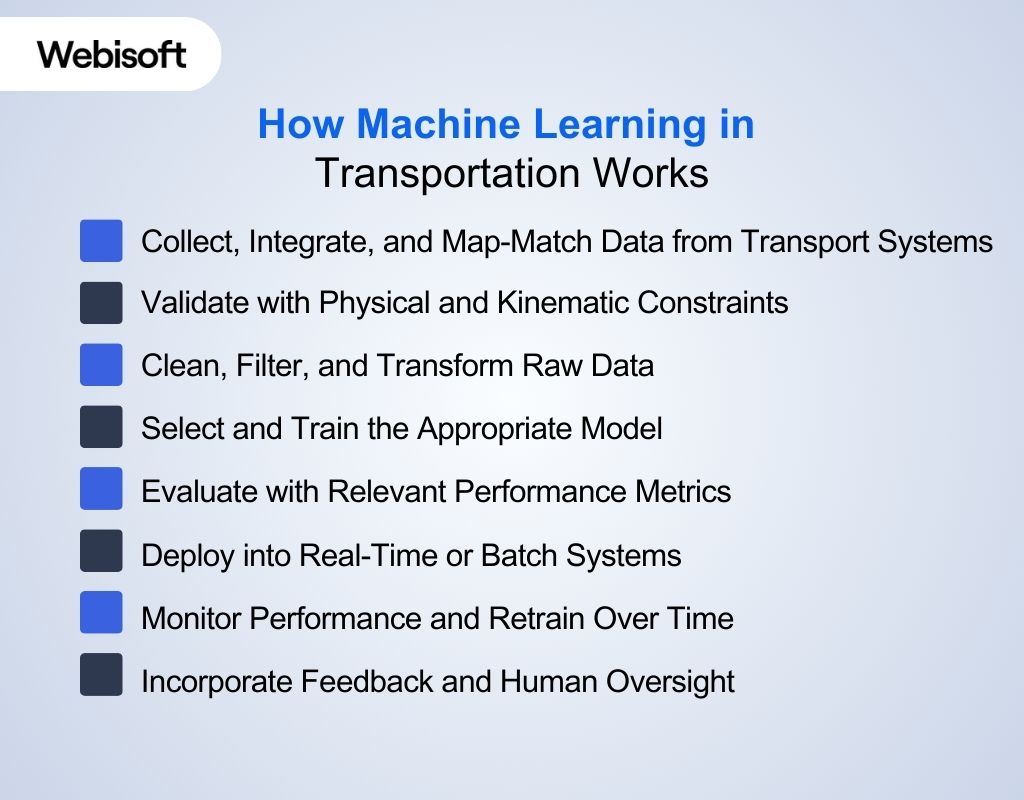
Machine learning in transportation converts raw mobility data into decisions while respecting physical laws and network constraints. Machine learning in transportation and logistics follows a structured process that converts raw mobility data into operational decisions. It moves from data preparation to model training and deployment to ensure reliable performance in real-world environments. Here are the key steps involved.
Collect, Integrate, and Map-Match Data from Transport Systems
Successful machine learning begins with gathering diverse data sources produced by transportation networks. This includes data from GPS devices, cameras, inductive loop detectors, public transit logs, telematics, infrastructure sensors, and weather feeds.
- What’s captured: Speed, location, delay records, sensor signals, incident logs
- Integration goal: Unify formats and align timestamps across sources
- Why it matters: Coherent input data enables models to learn meaningful patterns
Validate with Physical and Kinematic Constraints
Clean data by filtering out errors that violate the laws of physics.
- Tasks involved: Kinematic filtering (rejecting impossible speeds/accelerations) and topology validation.
- Feature engineering: Creating spatial lags measuring what happened 5 minutes ago at the previous intersection.
Clean, Filter, and Transform Raw Data
Raw sensor and vehicle data often contain errors, missing values, and noise. Preparing the data involves cleaning, filtering outliers, and transforming signals into structured features that ML models can process effectively.
- Tasks involved: Imputation, normalization, timestamp alignment
- Feature engineering: Extracting meaningful variables like rolling averages or peak indicators
- Outcome: structured datasets ready for model training
Select and Train the Appropriate Model
Each transportation problem requires choosing a modeling approach that fits the decision task. Supervised learning may forecast travel times, unsupervised methods detect anomalies, while deep learning supports image and sequence interpretation.
- Model choices: Regression models, tree ensembles, neural networks
- Training process: Optimize parameters using labeled examples or patterns
- Validation: Hold-out tests and cross-validation to measure performance
Evaluate with Relevant Performance Metrics
Evaluating models in transportation requires metrics aligned with real-world needs. Mean absolute errors may assess forecast accuracy, while recall and precision matter in safety detection tasks.
- Forecasting focus: MAE, RMSE
- Classification focus: Accuracy, recall, precision
- Operational focus: Latency and real-time throughput
Deploy into Real-Time or Batch Systems
After evaluation, models are integrated into operational systems. In transportation, this often means real-time pipelines that stream data and return predictions continuously, or periodic batch runs for planning tasks.
- Deployment modes: Real-time streaming, edge inference, batch jobs
- Systems integrated: Control centers, fleet dashboards, navigation services
- Goal: Timely insights that support decisions
Monitor Performance and Retrain Over Time
Transportation environments change; weather, demand patterns, and infrastructure updates affect system behavior. Continuous monitoring ensures models adapt to new conditions without degrading.
- Monitoring focus: Prediction drift, data quality changes
- Retraining: Update models with recent data to maintain accuracy
- Alerts: Automated alarms when performance drops
Incorporate Feedback and Human Oversight
Real-world transportation ML applications often operate alongside human operators. Feedback loops capture corrections or overrides to improve future performance and maintain safety.
- Feedback sources: Operator inputs, incident resolutions
- Human checks: Threshold limits, override mechanisms
- Purpose: Balance automation with accountability
This structured process moves machine learning systems from prototypes to reliable components of transportation operations, supporting efficiency, safety, and responsiveness.
Machine Learning vs Traditional Transportation Analytics
Transportation systems have long relied on statistical reports and rule-based models to guide decisions. As data volume and operational complexity increase, machine learning introduces a different analytical approach. The comparison below highlights how these methods differ in capability and scope.
| Aspect | Traditional Transportation Analytics | Machine Learning in Transportation |
|---|---|---|
| Data Handling | Works with aggregated, simplified datasets | Handles large, high-dimensional real-time and historical data |
| Adaptability | Static models with fixed rules | Continuously updates and adapts to new data |
| Prediction Accuracy | Limited forecasting capability | Strong predictive power with complex pattern recognition |
| Real-Time Processing | Often batch updates with a delay | Real-time inference for dynamic decision-making |
| Scalability | Struggles with scale and multiple data sources | Designed to scale across network sensors and fleets |
| Pattern Recognition | Limited to predefined relationships | Discovers nonlinear and hidden correlations |
| Failure Detection | Rule-based thresholds are prone to false alarms | Anomaly detection with probabilistic scoring |
| Decision Support | Descriptive reporting and simple alerts | Predictive insights and automated recommendations |
| Uncertainty Management | Minimal handling of uncertainty | Models quantify uncertainty in forecasts |
| Deployment Context | Retrofitted dashboards and summaries | Integrated into control loops and operational pipelines |
Traditional analytics can only optimize what is already known. When you’re ready to engineer intelligent machine learning systems for transportation, Webisoft can help you design, integrate, and scale solutions built for real operational demands.
Safety and Compliance in ML-Driven Transportation
AI and machine learning in transportation operate in safety-critical environments where errors can directly affect human life and infrastructure. Beyond technical performance, deployment requires strict safety validation, regulatory adherence, and transparent operational controls to maintain trust and accountability.
- Regulatory Alignment: ML-driven transportation systems must comply with national and regional transportation laws, autonomous vehicle guidelines, and safety standards. Regulatory frameworks vary by jurisdiction, requiring structured compliance planning during development and deployment.
- Safety Validation and Assurance: Models must undergo rigorous verification and validation before live deployment. Scenario testing, stress simulations, and risk assessments help confirm predictable behavior under normal and extreme operating conditions.
- Explainability and Decision Transparency: Safety-sensitive environments require interpretable model outputs. Operators and regulators must understand why a system made a specific decision, especially in incident investigations or liability reviews.
- Accountability Frameworks: Clear responsibility structures are necessary when automated systems influence operational decisions. Governance policies define human oversight, escalation paths, and system override protocols.
- Fail-Safe Mechanisms and Redundancy: Redundant sensors, fallback logic, and manual override options reduce risk during unexpected failures. These mechanisms prevent single-point failures from escalating into safety incidents.
- Data Privacy and Protection Controls: Transportation systems collect sensitive location and behavioral data. Compliance requires secure data storage, access controls, and privacy safeguards to prevent misuse.
- Continuous Monitoring and Recertification: ML models must be monitored after deployment to detect performance drift or behavioral anomalies. Periodic reassessment ensures ongoing compliance as environments and regulations evolve.
Common Mistakes When Implementing Machine Learning in Transportation
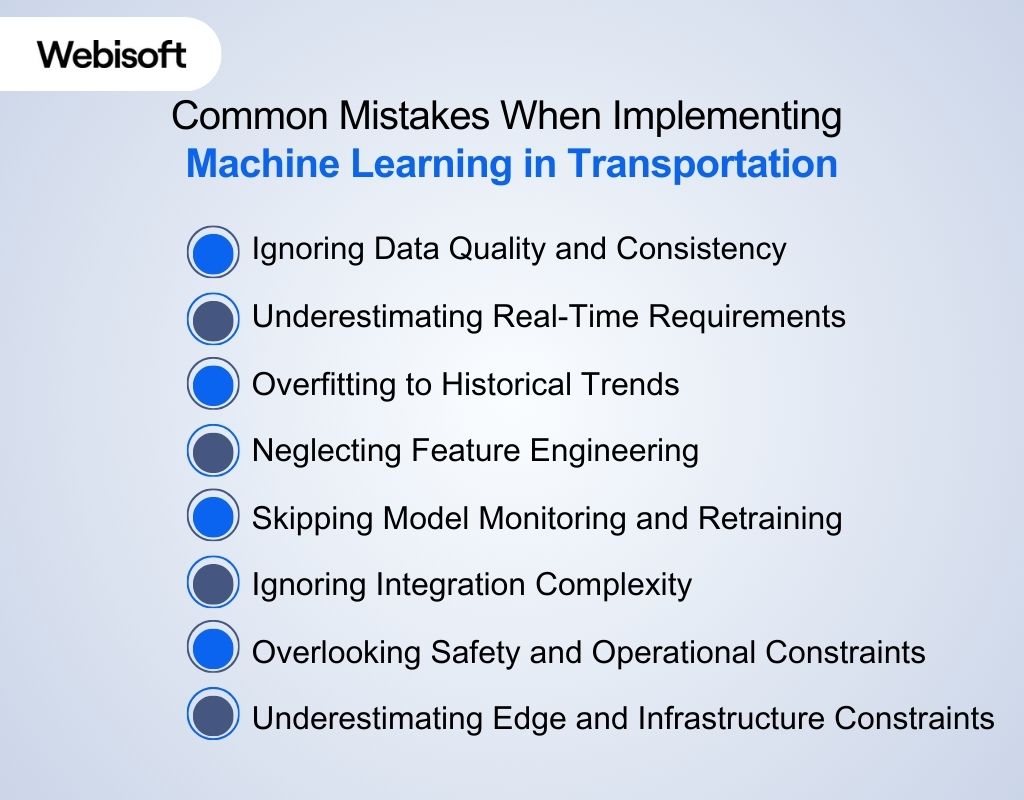
Implementing ML in transportation is technically demanding and operationally sensitive. Many projects fall short not due to model limitations, but because implementation gaps reduce accuracy, reliability, scalability, and system integration.
Ignoring Data Quality and Consistency
Poor or inconsistent datasets reduce model effectiveness. Transportation data often comes from disparate sensors with varying formats and missing entries. Without proper cleaning, imputation, and normalization, models learn inaccurate patterns.
Underestimating Real-Time Requirements
Many transportation applications require near-instant predictions and decisions. Failing to optimize models and systems for low-latency processing can lead to outdated or unusable outputs, especially in dynamic environments like traffic control or fleet dispatching.
Overfitting to Historical Trends
Overemphasis on fitting historical data without adequate validation leads to models that perform poorly in real-world variability. Transportation patterns change with weather, events, policy shifts, and infrastructure changes, making generalization critical.
Neglecting Feature Engineering
Raw data seldom captures domain-specific context. Failing to create relevant features such as peak-hour indicators, spatial lag variables, or modal interaction signals reduces model performance and interpretability.
Skipping Model Monitoring and Retraining
Transportation systems evolve over time. Without continuous monitoring and regular retraining, models become stale, leading to degraded accuracy and loss of operational value.
Ignoring Integration Complexity
Machine learning systems must interface with control centers, dispatch systems, and data pipelines. Neglecting integration requirements, APIs, and compatibility constraints leads to deployment delays and costly rework.
Overlooking Safety and Operational Constraints
Treating ML outputs as final commands without human oversight or safety filters can cause operational risk. Systems should include guardrails, thresholds, and fallback mechanisms to protect against erroneous decisions.
Underestimating Edge and Infrastructure Constraints
Deployment on edge devices or legacy infrastructure often has bandwidth, compute, and memory limits. Designing models without considering these constraints results in unusable solutions for real-time transportation environments.
End-to-End Machine Learning in Transportation with Webisoft
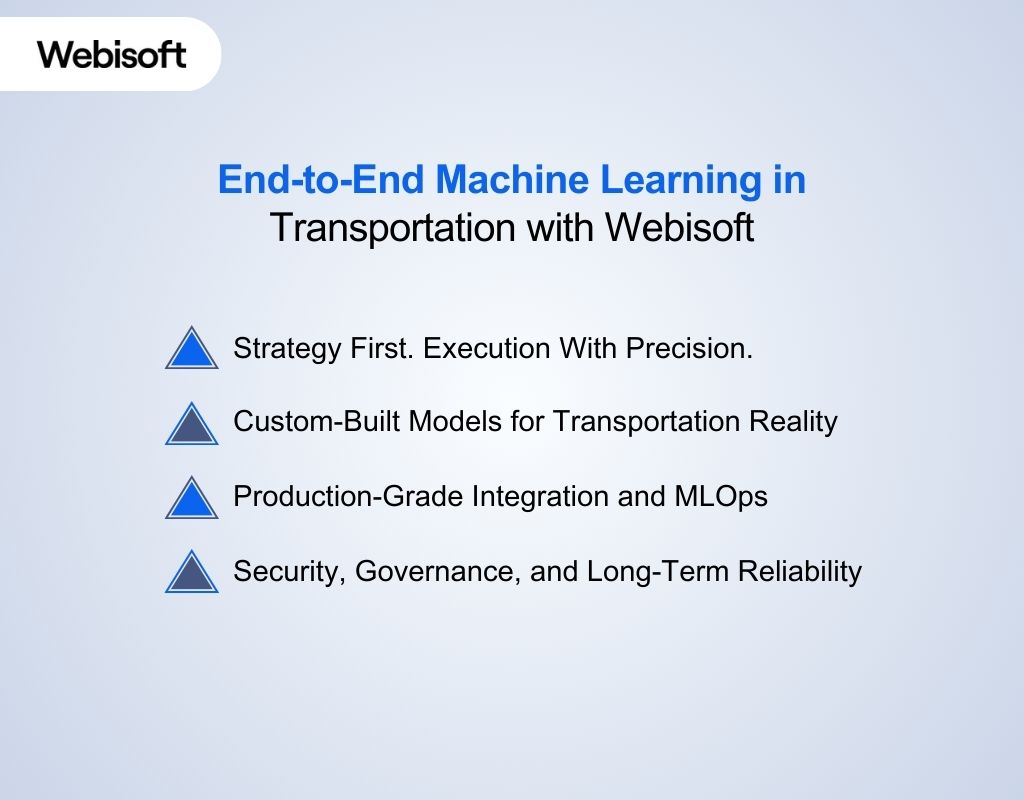
Deploying ML in transportation requires more than strong models. It demands production-ready engineering, integration discipline, and long-term reliability. Webisoft brings that end-to-end capability, helping transportation teams move from concept to fully operational ML systems with confidence. Here’s what we offer.
Strategy First. Execution With Precision.
Every transportation network is different. Traffic density, fleet size, data quality, regulatory requirements, and latency constraints all shape the solution. We begin with:
- Operational gap analysis
- Data maturity assessment
- Risk and compliance review
- Clear KPI definition
This ensures that your ML initiative targets the right problem and produces measurable operational improvement.
Custom-Built Models for Transportation Reality
Generic ML models do not survive transportation environments. We design solutions around your specific operational context. Our team builds:
- Forecasting systems tuned for spatiotemporal traffic patterns
- Anomaly detection engines for fleet and infrastructure monitoring
- Optimization models that operate under real-world constraints
- Adaptive control systems for dynamic mobility networks
At Webisoft, every model is stress-tested against realistic transport scenarios before deployment.
Production-Grade Integration and MLOps
A strong model must integrate seamlessly into live systems. We engineer:
- Real-time data pipelines
- API integrations with control centers and fleet platforms
- Edge-ready deployment when required
- Automated monitoring and retraining workflows
Your machine learning system remains accurate, responsive, and stable as operational conditions evolve.
Security, Governance, and Long-Term Reliability
Transportation systems are safety-sensitive and regulation-driven. We design with that responsibility in mind. Our approach includes:
- Structured validation frameworks
- Controlled deployment stages
- Human oversight integration
- Secure data handling and access controls
Your system remains accountable, auditable, and aligned with compliance expectations. Transportation systems do not wait politely while models catch up, and neither should you. If you’re serious about building machine learning that survives real traffic, real constraints, and real deadlines, connect with Webisoft and let’s engineer it properly.
Conclusion
Transportation will never be perfectly predictable, and that’s fine. The goal is not perfection, but control. Machine learning in transportation gives operators the ability to anticipate disruptions, improve coordination, and make decisions grounded in real-time data rather than instinct.
Turning that potential into dependable infrastructure requires more than models on paper. Webisoft builds and deploys transportation ML systems that perform under real operational pressure. Because in mobility, intelligence is useful only when it actually works.
Frequently Asked Question
Yes. Many transportation machine learning systems are built for real-time prediction and operational decision support. They process live traffic, fleet, or sensor data to generate timely outputs that help operators respond quickly to changing road and network conditions.
Yes, initial implementation can require investment in data infrastructure, model development, and system integration. However, phased deployment strategies and clearly defined performance metrics help control costs and improve long-term operational returns.
Yes. Machine learning optimization reduces unnecessary fuel consumption, idle time, and inefficient routing. By improving traffic flow and fleet coordination, ML contributes to lower emissions and supports more sustainable transportation planning.