Telecom networks generate more data in a minute than most industries do in a day. Every signal drop, billing event, and usage spike leaves a digital footprint. Machine learning in telecommunications turns that noise into patterns operators can actually act on.
At the same time, 5G complexity and rising customer expectations are exposing the limits of manual monitoring. Static dashboards cannot keep up. ML in telecom shifts decision-making from reactive troubleshooting to predictive operations. But applying it effectively requires more than algorithms.
You need the right data, integration strategy, and deployment discipline. This article breaks down real use cases, OSS and BSS integration, deployment steps, common pitfalls, and what it takes to operationalize telecom ML at scale.
What is Machine Learning in Telecommunications?
Machine learning in telecommunications refers to the use of algorithms that analyze network and customer data to make predictions and support automated decisions. Telecom operators generate large volumes of data from network equipment, usage records, billing systems, and customer interactions.
Machine learning models process this data to detect patterns, forecast behavior, and identify risks. In practice, machine learning in telecommunications is used to improve network performance, predict subscriber churn, detect fraud, and optimize service delivery. It enables operators to shift from reactive problem-solving to data-driven planning and operational efficiency.
Why Telecom Operators Are Turning to Machine Learning
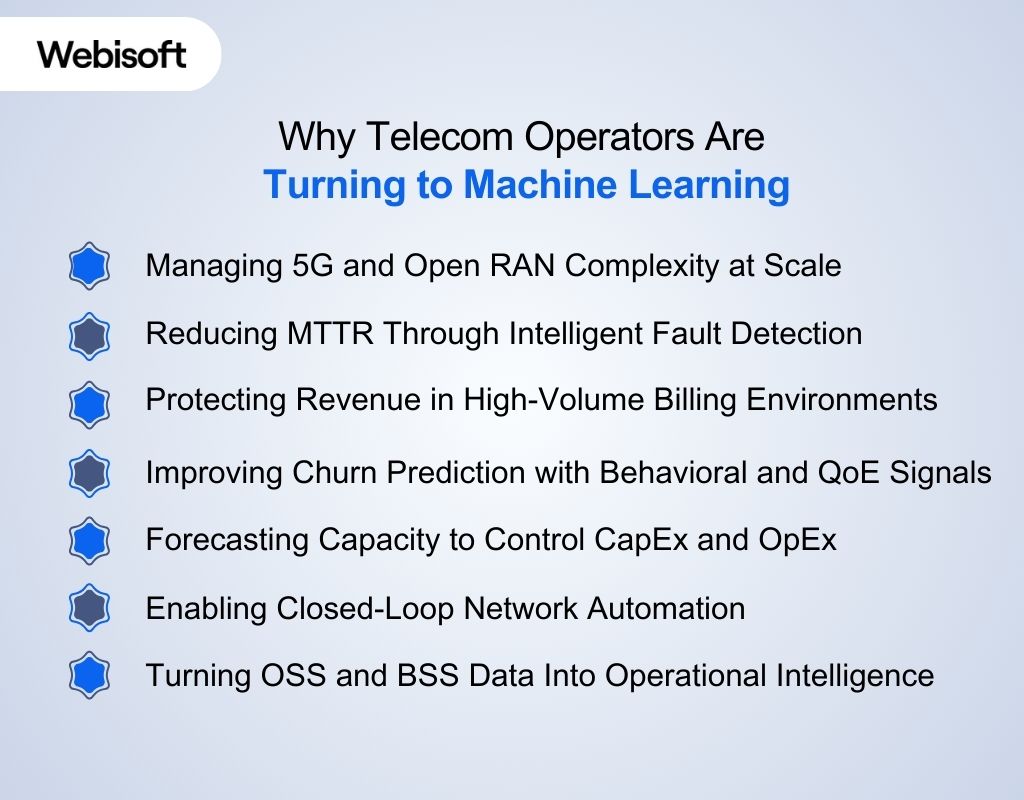
Telecom operators face rising data volumes, complex 5G architectures, and increasing pressure to protect margins. Machine learning helps them convert operational data into faster decisions, lower risk, and measurable performance gains.
Managing 5G and Open RAN Complexity at Scale
5G networks introduce network slicing, massive IoT traffic, and virtualized RAN components that generate far more telemetry than legacy systems.
Machine learning helps operators detect micro-congestion, predict cell overloads, and optimize spectrum allocation across distributed infrastructure without relying only on static thresholds.
Reducing MTTR Through Intelligent Fault Detection
Traditional rule-based monitoring floods Network Operations Centers with alerts. Machine learning correlates alarms, performance counters, and historical incidents to isolate probable root causes faster. This shortens the mean time to repair and reduces cascading outages across core and access layers.
Protecting Revenue in High-Volume Billing Environments
Telecom billing systems process millions of transactions daily. Machine learning models identify anomalous usage patterns, subscription abuse, SIM box fraud, and billing inconsistencies that rule-based systems often miss. This strengthens revenue assurance in complex prepaid and postpaid ecosystems.
Improving Churn Prediction with Behavioral and QoE Signals
Subscriber churn is rarely driven by pricing alone. Machine learning combines usage trends, complaint history, network quality indicators, and payment behavior to identify early dissatisfaction signals. Operators use these risk scores to intervene before customers migrate to competitors.
Forecasting Capacity to Control CapEx and OpEx
Traffic demand fluctuates across geography, time, and device types. Machine learning improves short- and medium-term forecasting accuracy for cell load, backhaul demand, and edge capacity. Better forecasts reduce overprovisioning while maintaining service quality.
Enabling Closed-Loop Network Automation
Telecom operators are shifting toward self-optimizing networks as outlined in the ITU’s framework. Machine learning models can recommend or trigger configuration changes based on performance deviations. When paired with governance controls, this creates semi-autonomous operational loops that improve service stability.
Turning OSS and BSS Data Into Operational Intelligence
Operations Support Systems (OSS) and Business Support Systems (BSS) systems store years of operational and customer records.
Machine learning extracts structured insights from tickets, logs, and transaction histories to identify systemic weaknesses, recurring failure patterns, and customer lifecycle risks.
Telecom Data Sources That Power Machine Learning
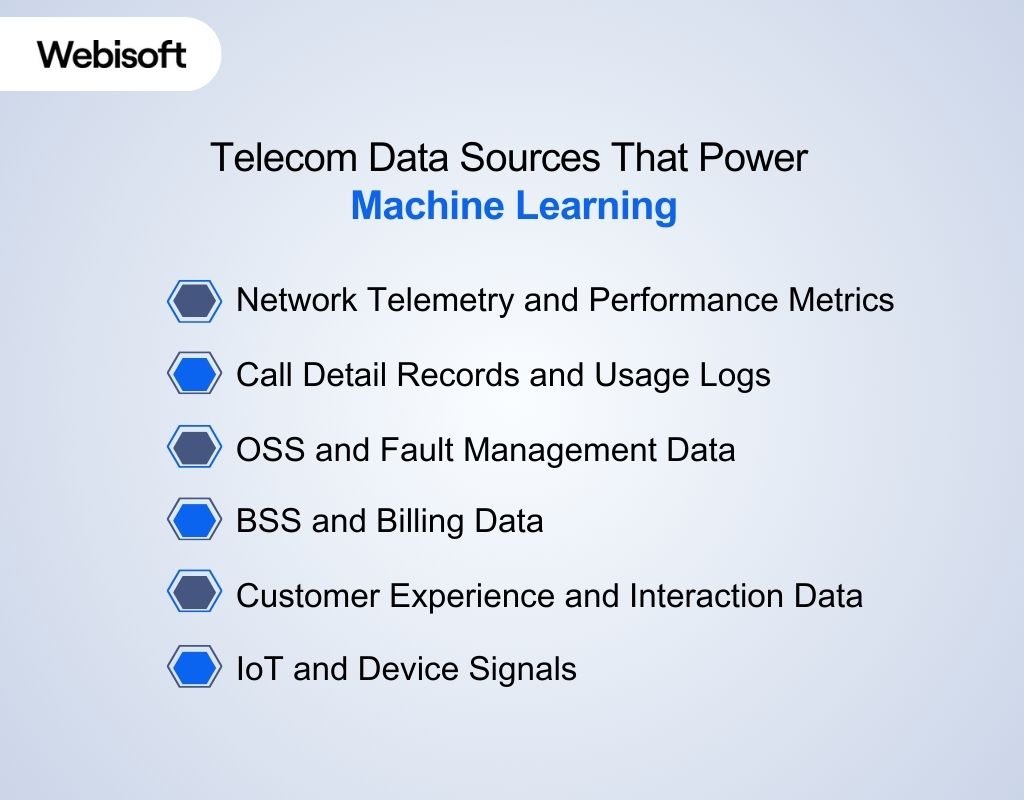
Machine learning in telecommunications depends on access to reliable and diverse operational data. The performance gains discussed earlier are only possible when models learn from real network, customer, and system signals. These data sources form the foundation of every telecom ML initiative.
Network Telemetry and Performance Metrics
Network equipment and radio access nodes generate continuous streams of performance indicators, including signal strength, traffic load, packet loss, latency, and cell utilization.
These telemetry streams are essential for models that monitor quality of service, predict congestion, and trigger proactive optimization in real time.
Call Detail Records and Usage Logs
Call Detail Records (CDRs) capture detailed transactional data about phone calls, messages, and data sessions, such as duration, timestamps, and service type.
This structured usage data is a rich source for machine learning models that analyze consumption patterns, segment subscribers, and forecast demand or churn.
OSS and Fault Management Data
OSS tracks network events, fault tickets, alarms, and historical resolution records. Machine learning uses this event history to correlate faults, detect complex anomalies, and reduce troubleshooting times. Combining OSS logs with performance data improves reliability analytics.
BSS and Billing Data
BSS datasets include billing records, subscription plans, payment histories, and customer account attributes. These financial and subscriber records help models detect billing anomalies, predict churn risk, and strengthen revenue assurance across customer and network interactions.
Customer Experience and Interaction Data
Customer support tickets, drop call reports, service ratings, and feedback surveys reflect real user experience. When machine learning models combine these signals with network and usage metrics, they identify dissatisfaction trends. They also flag service quality issues and guide targeted retention efforts.
IoT and Device Signals
The proliferation of connected devices in 5G and IoT environments generates diverse datasets such as sensor readings, device status updates, and mobility patterns.
Operators use this data to forecast demand, optimize resource allocation, and improve service personalization across different endpoints.
Machine Learning Use Cases in Telecommunications
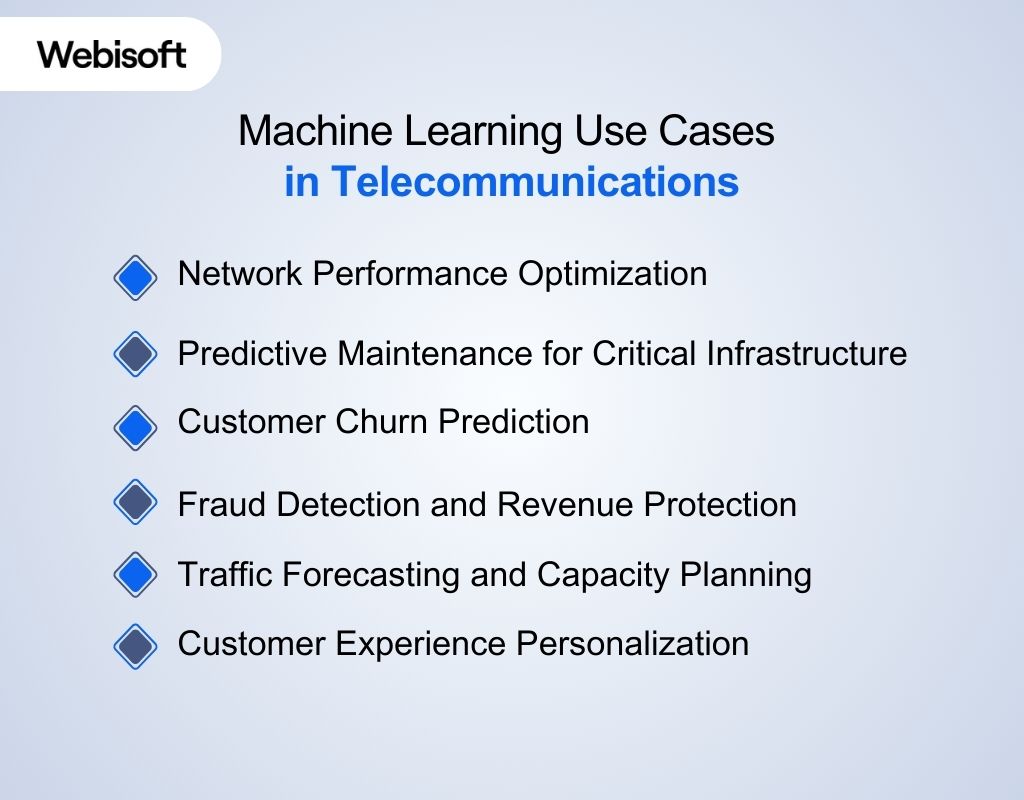
Telecom operators apply machine learning, which directly improves network stability, customer retention, and revenue protection.
Looking at real machine learning in telecommunications examples makes it easier to see how these models deliver measurable results in everyday operations.
Network Performance Optimization
Modern telecom networks generate constant performance signals. Machine learning analyzes these signals to keep service levels stable even during unpredictable traffic shifts.
- Detects congestion patterns before service degradation occurs
- Adjusts bandwidth allocation based on live usage
- Identifies underperforming cells or routing paths
- Supports self-optimizing behavior in 5G and Open RAN networks
This reduces manual monitoring pressure and improves consistency across regions.
Predictive Maintenance for Critical Infrastructure
Network hardware does not fail randomly. It shows patterns before the breakdown. Machine learning identifies these early signals.
- Analyzes equipment logs and environmental factors
- Flags abnormal behavior in towers, routers, and switches
- Predicts failure windows for scheduled intervention
- Reduces emergency repairs and unplanned outages
This shifts operations from reactive fixes to planned maintenance cycles.
Customer Churn Prediction
Churn rarely happens overnight. There are behavioral signals that appear weeks before cancellation.
- Tracks declining usage and repeated service complaints
- Combines billing irregularities with quality indicators
- Assigns churn risk scores to subscriber segments
- Enables targeted retention outreach before contract expiration
Operators use these insights to reduce subscriber loss in competitive markets.
Fraud Detection and Revenue Protection
Telecom fraud evolves constantly. Static rules are often too slow to respond. Machine learning adapts faster.
- Detects unusual SIM activity and traffic routing behavior
- Identifies suspicious billing or subscription patterns
- Flags anomalies across prepaid and postpaid systems
- Strengthens revenue assurance monitoring
This protects margins in high-volume transaction environments.
Traffic Forecasting and Capacity Planning
Demand changes by hour, location, and device type. Machine learning improves forecasting accuracy.
- Predicts short-term and seasonal traffic spikes
- Supports spectrum and backhaul planning
- Reduces overprovisioning of infrastructure
- Improves planning for IoT and data-heavy services
Better forecasts mean better control over capital and operational spending.
Customer Experience Personalization
Usage behavior varies widely across subscribers. Machine learning helps operators respond to those differences.
- Recommends plan upgrades based on real consumption
- Personalizes offers tied to data usage patterns
- Supports intelligent customer support routing
- Improves satisfaction through tailored service responses
This increases engagement without relying only on broad marketing campaigns. Use cases only matter when they survive real-world traffic and production constraints.
See how at Webisoft, we integrate machine learning directly into live telecom workflows without disrupting OSS, BSS, or core network stability.
How Machine Learning Integrates with OSS and BSS Systems
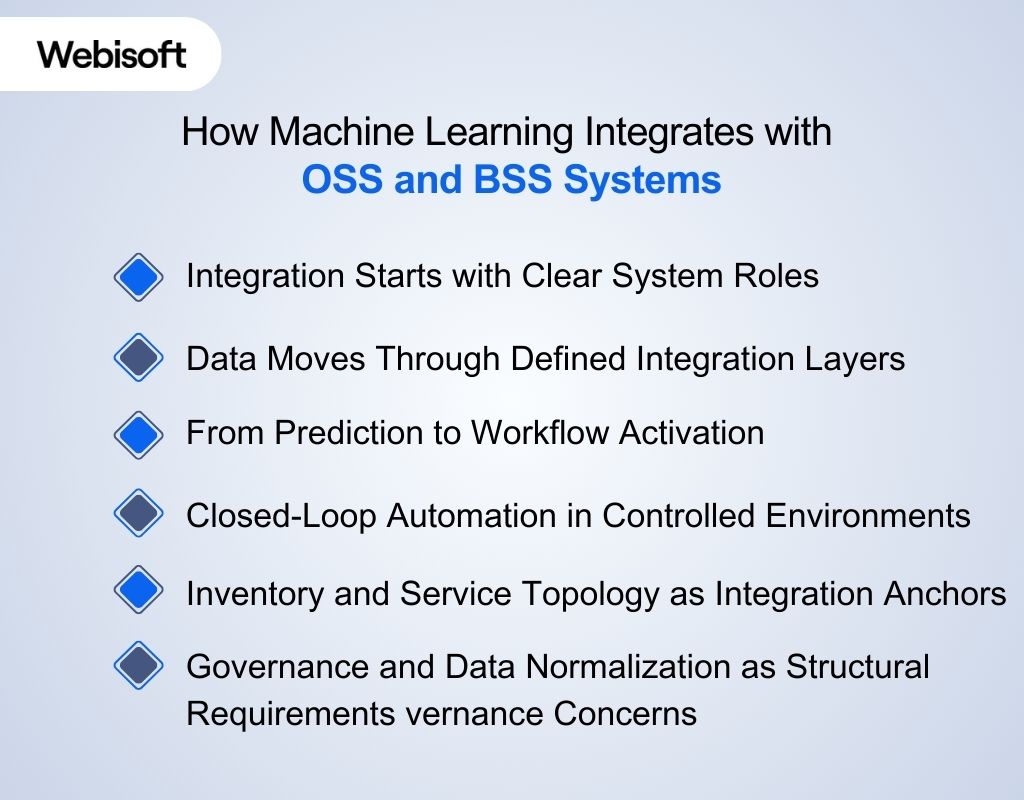
Machine learning becomes operationally valuable only when it connects directly to the systems telecom teams already use. In practice, this means tight integration with OSS for network operations and BSS for customer and revenue management.
Integration Starts with Clear System Roles
- OSS (Operations Support Systems) manages faults, performance, inventory, and service provisioning across the network.
- BSS (Business Support Systems) manages orders, billing, customer accounts, subscriptions, and payments.
Machine learning systems do not replace these platforms. They consume their data and return intelligence back into their workflows.
Data Moves Through Defined Integration Layers
Machine learning services typically connect to OSS and BSS through structured interfaces.
- APIs enable secure reading and writing of operational and customer records.
- Event streaming platforms allow real-time triggers based on alarms, usage events, or billing transactions.
- Batch pipelines support periodic model scoring when real-time decisions are not required.
This structured connectivity ensures ML outputs are usable inside production systems.
From Prediction to Workflow Activation
Integration is not just about data ingestion. It is about activating decisions.
- In OSS environments, predictions can enrich trouble tickets with probable root causes and impacted services.
- In assurance systems, risk scores can prioritize incidents based on service criticality.
- In BSS platforms, churn or fraud scores can trigger CRM workflows or revenue protection reviews.
The value appears when predictions translate into actions inside established operational flows.
Closed-Loop Automation in Controlled Environments
Some telecom operators move toward semi-automated or automated resolution loops.
- An anomaly is detected.
- A recommended configuration adjustment is generated.
- The orchestration system applies the change under defined governance controls.
Approval gates and monitoring safeguards are often added for high-impact network changes.
Inventory and Service Topology as Integration Anchors
Machine learning outputs gain precision when mapped to accurate service and network inventories.
- Linking predictions to service topology clarifies customer impact.
- Associating insights with physical and virtual assets improves accountability.
Without consistent inventory references, integration becomes fragmented.
Governance and Data Normalization as Structural Requirements
Telecom OSS and BSS landscapes are often heterogeneous and vendor-diverse.
- Data must be standardized across systems before models can use it reliably.
- Access controls and audit trails must be enforced when ML interacts with operational environments.
Integration, therefore, includes both technical connectivity and governance alignment. When properly integrated, machine learning operates inside OSS and BSS systems as a decision-support layer rather than a separate analytics tool.
It augments existing workflows, strengthens operational precision, and embeds intelligence directly into network and customer management processes.
Avoiding Common Failures in Telecom Machine Learning
Machine learning projects can deliver strong results in telecommunications, but without careful planning they often fail in production.
Recognizing common pitfalls helps operators avoid unstable models and unreliable outcomes across operational systems.
- Poor Data Quality and Consistency: When training data contains errors, missing values, or inconsistent formatting across sources, models learn noise instead of signal. This leads to inaccurate predictions that operators cannot trust for important decisions.
- Ignoring Real-Time Data Latency: Telecom environments often require near-real-time insights, but many ML solutions are built on stale or delayed datasets. If models do not account for data freshness, predictions will lag behind actual network conditions and lose relevance.
- Lack of Contextual Feature Engineering: Raw metrics such as counters, logs, and usage records lack meaningful interpretation until they are transformed into features that capture trends and patterns. Failing to engineer telecom-specific features reduces model effectiveness.
- Overfitting to Historical Conditions: Models trained only on past data without consideration for future shifts (new devices, spectrum changes, traffic patterns) perform poorly in live settings. This results in brittle solutions that fail when conditions evolve.
- Incomplete Integration with OSS/BSS Workflows: When predictions are generated in isolation and not mapped back into operational systems, insights go unused. ML must tie directly into event triggers, ticketing, CRM actions, and orchestration calls to be actionable.
- Underestimating Model Monitoring Needs: Performance drift occurs as networks change, devices evolve, or subscriber behavior shifts. Without ongoing monitoring of accuracy, bias, and input distributions, models degrade and produce misleading outputs.
- Insufficient Governance and Security Controls: Mobile networks and billing systems contain sensitive data. Inadequate controls expose data to risk or violate compliance requirements, undermining trust and blocking deployment.
- Failing to Define Clear Success Metrics: Teams sometimes launch ML projects without quantifying expected impact or establishing baseline KPIs. Without measurable targets, it becomes difficult to know when a model truly improves operations.
- Inadequate Change Management and Operator Training: Even high-performing models fail when staff do not understand how to interpret scores, alerts, or recommended actions. Clear training and documentation help operators use ML outputs effectively.
How to Deploy Machine Learning in Telecommunications
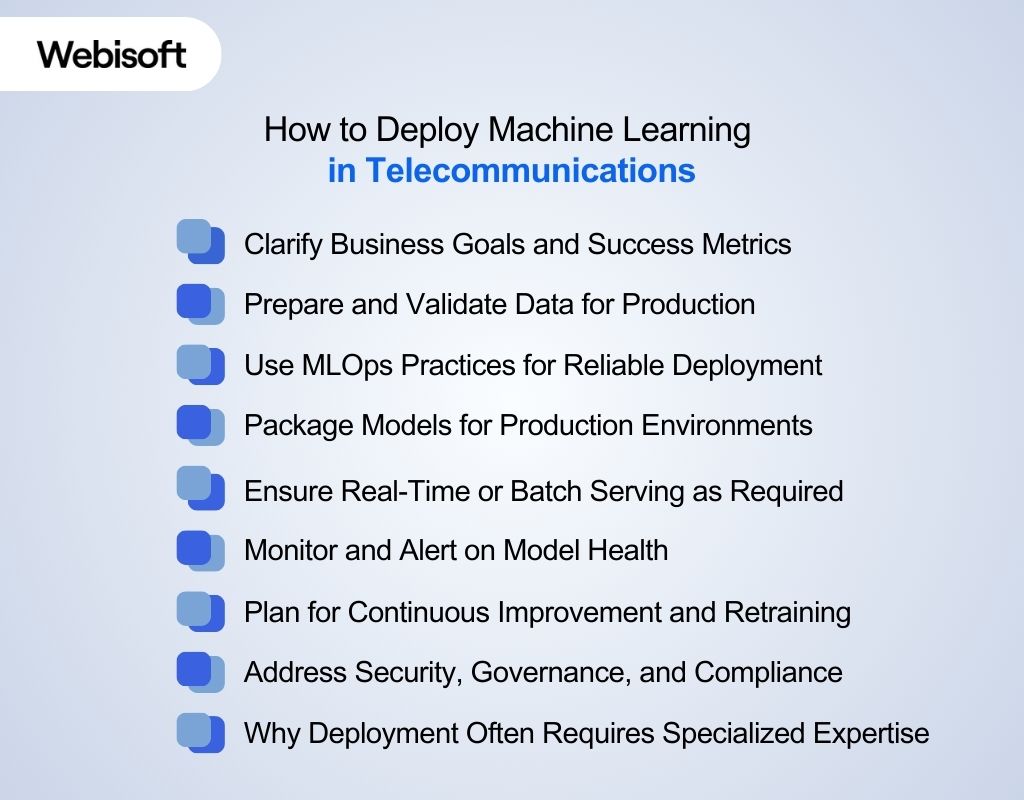
Machine learning can offer transformative benefits for telecom operators and integration with artificial intelligence in telecom, but turning a trained model into a production-ready system requires careful steps, infrastructure planning, and collaborative processes.
The focus is not just on code but on making ML dependable, scalable, and aligned with operational and business workflows.
Clarify Business Goals and Success Metrics
Before deployment, define clear telecom objectives, such as reducing churn rates, shortening fault resolution times, or improving anomaly detection accuracy in operations. Clear goals anchor technical decisions to measurable outcomes.
Prepare and Validate Data for Production
Telecom deployments require consistent, quality data from OSS, BSS, and network telemetry sources. Data must be cleaned, normalized, and linked to production data feeds so the model sees real-world conditions it will encounter after rollout.
Use MLOps Practices for Reliable Deployment
Production ML needs collaboration between data scientists and platform engineers. Implement machine learning in operations (MLOps) best practices like version control, continuous integration and delivery (CI/CD), model registries, and automated testing to reduce errors and accelerate delivery.
Package Models for Production Environments
Wrap models in scalable components such as containers or microservices to make them accessible to telecom systems. This often involves containerization (e.g., Docker) and APIs so other applications, like fraud engines or fault monitors, can query predictions.
Ensure Real-Time or Batch Serving as Required
Decide whether models will run in real time for anomaly detection and SLA alerts. Or schedule them as batch jobs, such as generating daily churn scores, and design the serving layer accordingly. Real-time ML requires low-latency infrastructure and streaming support.
Monitor and Alert on Model Health
Once live, monitor key performance indicators such as accuracy, latency, and data drift. Automated observability and logging help catch model degradation early so teams can retrain or roll back as needed.
Plan for Continuous Improvement and Retraining
Telecom environments change rapidly with new devices, traffic patterns, and service plans. Build feedback loops so models are retrained on fresh data and adapted to current network behavior, not just historical snapshots.
Address Security, Governance, and Compliance
Deploying ML in live telecom systems introduces security and compliance obligations, such as protecting subscriber data and ensuring model predictions cannot be manipulated. Embedding MLSecOps practices into the deployment pipeline mitigates these risks.
Why Deployment Often Requires Specialized Expertise
Telecom ML deployment spans distributed systems, domain knowledge, compliance, and production DevOps. Integrating models into legacy OSS and BSS environments often exceeds internal capacity, making experienced ML partners essential for reducing risk and accelerating results.
Choosing the Right Partner for Telecom Machine Learning Projects
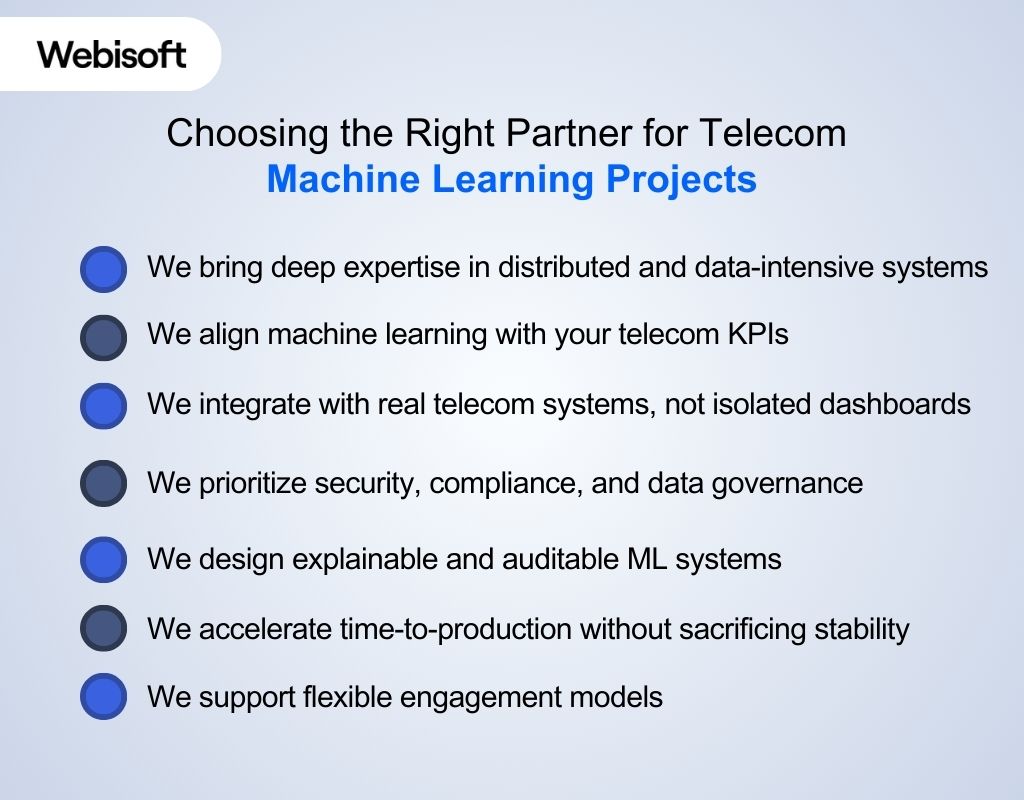
Deploying machine learning in telecommunications is not just a technical upgrade. It is a long-term operational commitment.
At Webisoft, we work with telecom teams to turn ML strategy into secure, production-ready systems that deliver measurable results.
We bring deep expertise in distributed and data-intensive systems
Telecom environments generate massive real-time data streams across distributed architectures. We design ML systems that:
- Handle high-volume telemetry ingestion
- Process streaming and batch data reliably
- Support low-latency decision environments
- Scale across cloud and hybrid infrastructures
Our engineering background in distributed systems ensures your ML platform remains stable under load.
We align machine learning with your telecom KPIs
Before building anything, we define what success looks like for you.
- Reduce churn by a measurable percentage
- Improve MTTR across network layers
- Strengthen fraud detection accuracy
- Optimize capacity planning decisions
Every model we develop is tied directly to business and operational impact.
We integrate with real telecom systems, not isolated dashboards
Machine learning only delivers value when it operates inside OSS, BSS, CRM, and network workflows. We design systems that:
- Connect securely with operational platforms
- Feed predictions into live decision processes
- Support controlled automation where appropriate
- Maintain auditability and governance
Our goal is usable intelligence, not disconnected analytics.
We prioritize security, compliance, and data governance
Telecom data includes sensitive subscriber and financial records. We implement:
- Role-based access control across ML pipelines
- Encryption for data in transit and at rest
- Audit trails for model decisions
- Compliance-aware architecture design
This protects your customers while protecting your brand.
We design explainable and auditable ML systems
Telecom operators cannot rely on black-box decisions. We build models that:
- Provide interpretable outputs
- Offer reason codes for risk scores
- Support regulatory audits
- Enable human-in-the-loop validation
You remain in control of every automated decision.
We accelerate time-to-production without sacrificing stability
Telecom initiatives often stall between prototype and rollout. We reduce that gap through:
- Structured deployment frameworks
- Controlled pilot launches
- Performance benchmarking
- Continuous monitoring strategies
This shortens your path from idea to measurable value.
We support flexible engagement models
Every telecom organization operates differently. We can:
- Work alongside your internal data teams
- Lead full-cycle ML implementation
- Provide dedicated AI engineers
- Deliver project-based deployments
Our engagement adapts to your operational model, not the other way around. Telecom machine learning succeeds when strategy, infrastructure, and execution move together.
Start that conversation with us through the Webisoft contact page, and let’s design a production-grade ML roadmap tailored to your network, systems, and growth goals.
Conclusion
In closing, machine learning in telecommunications is not about trends or another analytics layer. It makes networks smarter, faster, and more responsive to technical signals and subscriber behavior.
Operators who treat ML as an operational discipline manage complexity with greater confidence. If you are ready to move beyond pilots and build ML systems that perform inside real telecom environments,
Webisoft can support that transition. The right expertise, applied at the right stage, turns machine learning from promise into measurable impact.
Frequently Asked Question
No. While machine learning is especially valuable in 5G due to higher complexity and data volumes, it is widely used in 4G and even legacy telecom systems. Operators apply it for network optimization, predictive maintenance, and churn analysis across generations.
Deployment timelines depend on data readiness, integration complexity, and infrastructure maturity. Smaller pilots may take a few weeks, while full production deployments across OSS and BSS systems can extend over several months.
Emerging trends include AI-driven network orchestration and automated closed-loop optimization. Federated learning is gaining attention for privacy preservation, while edge-based intelligence and early 6G research are expanding ML capabilities in distributed telecom environments.