Containers move across oceans with precision, yet behind the scenes, shipping still struggles with delays, fuel volatility, and port congestion. Static rules and spreadsheets rarely keep pace with such complexity. Against this backdrop, machine learning in shipping industry becomes more than a technical upgrade. Analyzing vessel movements, engine signals, and operational patterns, it helps operators anticipate disruptions instead of reacting after the damage is done.
Building on this shift, this article shows how ML in the shipping industry actually works and where it makes a real difference in day-to-day operations. It also explains what it takes to apply it effectively across fleets and ports without disrupting existing workflows.
What is Machine Learning in Shipping Industry?
Machine learning in shipping industry refers to applying data-driven models to analyze maritime operations and improve decision-making across fleets, ports, and logistics networks. It uses historical and real-time vessel, engine, weather, port, and transport data, supporting digital transformation aligned with International Maritime Organization frameworks.
Unlike traditional rule-based systems, machine learning identifies patterns in operational behavior and updates predictions as new data arrives. In shipping, this helps organizations anticipate delays, monitor vessel performance, detect irregularities, and support planning in uncertain conditions.
At its core, machine learning in shipping converts fragmented maritime data into measurable operational intelligence that improves efficiency, reliability, and safety.
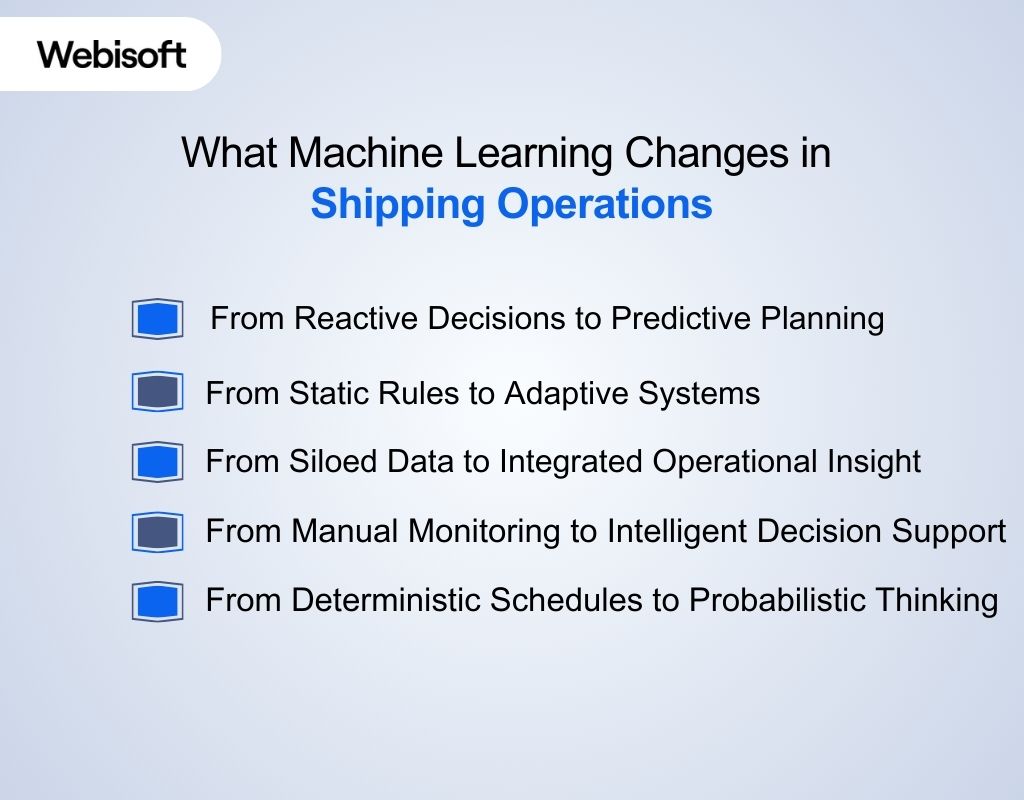
What Machine Learning Changes in Shipping Operations
Shipping operations have traditionally relied on fixed rules, static planning models, and manual coordination. Machine learning changes the way decisions are made by introducing adaptive systems that respond to patterns rather than assumptions.
From Reactive Decisions to Predictive Planning
Instead of responding after delays, breakdowns, or congestion occur, shipping teams can anticipate potential disruptions. Machine learning shifts operations toward forward-looking planning, where uncertainty is quantified and managed earlier.
From Static Rules to Adaptive Systems
Traditional systems depend on predefined thresholds and human-set parameters. Machine learning models continuously adjust based on new operational data, allowing decisions to evolve as routes, demand, and conditions change.
From Siloed Data to Integrated Operational Insight
Shipping data often exists across separate systems such as fleet management, port coordination, and logistics platforms. Machine learning enables cross-system pattern recognition, creating a more unified operational view.
From Manual Monitoring to Intelligent Decision Support
Operations teams cannot manually analyze thousands of signals in real time. Machine learning systems surface relevant insights automatically, helping teams focus on high-impact decisions instead of routine tracking.
From Deterministic Schedules to Probabilistic Thinking
Shipping has long relied on fixed schedules and estimated timelines. Machine learning introduces probability-based forecasting, helping operators understand risk ranges instead of relying on single-point estimates.
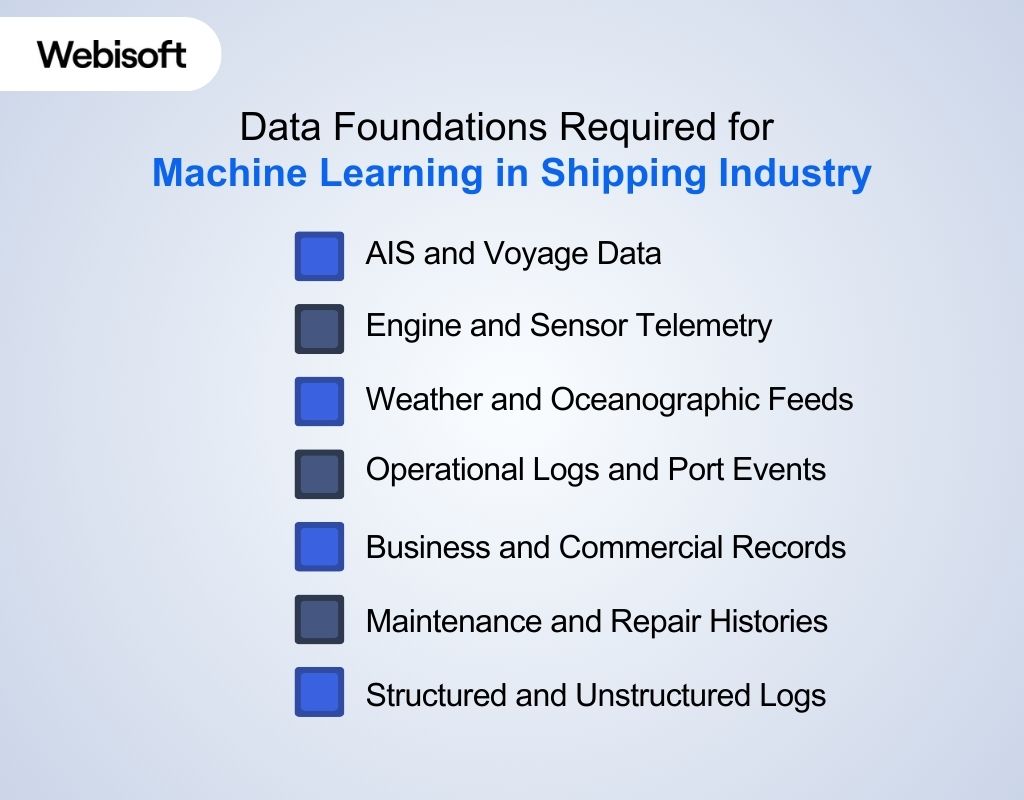
Data Foundations Required for Machine Learning in Shipping Industry
Accurate predictions and meaningful operational insights rely on the quality and breadth of the data feeding machine learning systems. In shipping, diverse sources must work together to reflect the true behavior of vessels, ports, and supporting systems so models can learn patterns that matter.
AIS and Voyage Data
Automatic Identification System (AIS) signals provide timestamped location, speed, and heading information for vessels. When aligned with voyage histories, AIS data becomes the backbone of models that forecast arrival times, track traffic density, and detect navigational irregularities.
Engine and Sensor Telemetry
Marine engines and onboard systems generate continuous telemetry; temperatures, pressures, RPMs, fuel flow, alarms, and more. This data is essential for understanding vessel performance and powering predictive maintenance models that learn from equipment behavior before failures occur.
Weather and Oceanographic Feeds
Weather forecasts, wind patterns, wave heights, and sea state influence speed choices, fuel consumption, and safety decisions. Integrating these environmental datasets helps machine learning account for conditions that affect operational outcomes more accurately.
Operational Logs and Port Events
Detailed port call information, berth assignments, cargo handovers, and turnaround timestamps form a structured record of operational flow. These events help models differentiate between delays caused by port constraints versus those from vessel performance or external factors.
Business and Commercial Records
Transport Management Systems (TMS), enterprise resource systems, and cargo documentation hold booking data, freight details, and service-level signals. These commercial records enrich models that link operational decisions to business priorities and customer commitments.
Maintenance and Repair Histories
Work orders, maintenance logs, and parts replacement records capture how systems degrade over time. When combined with sensor telemetry, this data helps models learn which patterns precede faults and when interventions will be most effective.
Structured and Unstructured Logs
Shipping operations produce both structured data (tables, records) and unstructured streams (text reports, emails, hand annotations). Machine learning systems must be fed both types so models can extract patterns from narrative accounts and structured inputs alike.
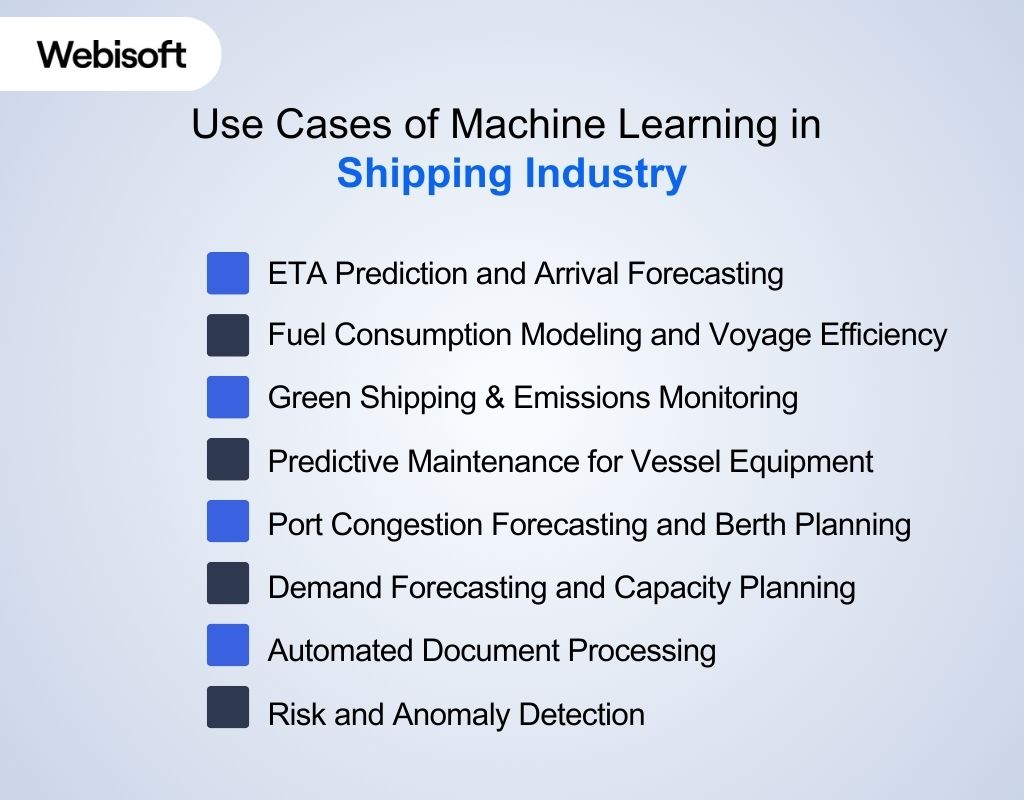
Use Cases of Machine Learning in Shipping Industry
With the right data foundations in place, practical applications become clearer. These machine learning in shipping industry examples illustrate how operators and technology providers use predictive models to improve reliability, efficiency, and operational control across fleets.
ETA Prediction and Arrival Forecasting
Machine learning models analyze historical AIS tracks, speed patterns, port turnaround times, and weather data to produce continuously updated ETA forecasts. Instead of static calculations, these systems adjust predictions as conditions change, reducing uncertainty for carriers and terminals.
- Maersk uses large-scale operational data and analytics to improve schedule reliability and arrival visibility across global trade routes.
- MarineTraffic applies AIS-based analytics to provide real-time vessel tracking and arrival intelligence.
Fuel Consumption Modeling and Voyage Efficiency
Fuel optimization models combine engine telemetry, draft, speed profiles, and environmental conditions to estimate fuel burn under different voyage scenarios. This helps operators balance cost, emissions targets, and schedule commitments.
- StormGeo provides weather-integrated voyage optimization tools that recommend routing and speed adjustments to reduce fuel consumption.
- Major carriers such as Hapag-Lloyd have invested in digital analytics to support more efficient fleet deployment.
Green Shipping & Emissions Monitoring
Machine learning models optimize fuel consumption and route planning to help vessels maintain high Carbon Intensity Indicator ratings and meet EEXI compliance. By processing real-time data on hull fouling, sea state, and engine load, these systems provide dynamic speed recommendations that minimize carbon footprints. This converts emissions reporting from a retrospective compliance task into a proactive strategy for “green” operational efficiency.
- ZeroNorth uses machine learning to integrate weather data and vessel performance, helping operators like Cargill reduce CO2 emissions by optimizing voyages for both profit and sustainabilit
Predictive Maintenance for Vessel Equipment
By analyzing vibration data, temperature trends, pressure readings, and maintenance logs, machine learning detects early signs of equipment degradation. This supports condition-based maintenance rather than reactive repairs.
- Carnival Corporation has implemented predictive maintenance analytics to monitor mechanical systems and reduce unexpected downtime.
Port Congestion Forecasting and Berth Planning
Machine learning analyzes vessel density, port call history, and turnaround durations to anticipate congestion before vessels arrive. This improves berth allocation and reduces idle waiting time.
- The Port of Rotterdam has invested in data-driven port optimization initiatives and digital twin projects to improve traffic flow and resource planning.
Demand Forecasting and Capacity Planning
Machine learning models analyze booking data, lane performance, seasonal patterns, and macro signals to forecast demand shifts. This helps shipping lines deploy vessels more strategically and reduce empty repositioning.
- Maersk and Hapag-Lloyd both use advanced analytics to improve network planning and demand forecasting accuracy.
Automated Document Processing
Machine learning systems extract structured information from bills of lading, customs forms, and invoices. This reduces manual data entry and speeds up compliance workflows.
- INTTRA, now part of E2open, enables digital booking and documentation processes across carriers and shippers.
Risk and Anomaly Detection
Models trained on AIS movement patterns and operational logs can flag route deviations, unusual speed behavior, or other irregularities. This supports earlier risk identification and faster response.
- MarineTraffic uses large-scale AIS analytics to monitor vessel movements and detect unusual patterns.
How to Implement Machine Learning in Shipping Step by Step
As interest in artificial intelligence in maritime industry continues to grow, execution matters more than experimentation. Shipping companies need a focused approach that connects operational goals, data readiness, and measurable outcomes without disrupting daily workflows.
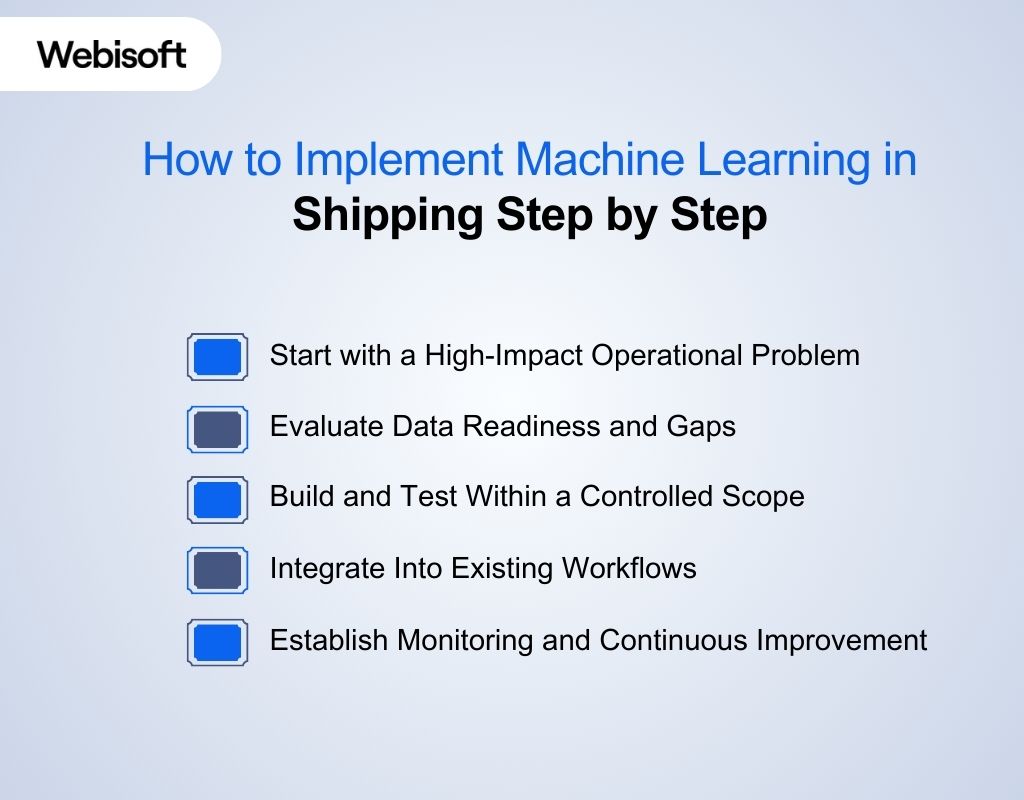
Start with a High-Impact Operational Problem
Implementation should begin with a clearly defined business objective. Instead of “adopting AI,” focus on a specific issue such as unreliable arrival times or rising fuel costs. Clear KPIs align the technical effort with operational impact.
Evaluate Data Readiness and Gaps
Before building models, assess whether the necessary operational data is available, consistent, and historically reliable. This includes movement records, equipment logs, and structured event data. Identifying gaps early prevents model failure later.
Build and Test Within a Controlled Scope
Launch the first model as a limited pilot, such as a single route or vessel segment. Testing in a contained environment allows teams to measure performance, validate outputs, and adjust thresholds before wider deployment.
Integrate Into Existing Workflows
Machine learning should support decisions inside current operational systems, not sit in isolation. Outputs must flow into planning dashboards, fleet systems, or coordination tools so teams can act on insights immediately.
Establish Monitoring and Continuous Improvement
Once deployed, models require oversight. Operational conditions shift, routes change, and new data patterns emerge. Ongoing monitoring and periodic retraining keep systems aligned with real-world maritime activity.
Shipping ML projects lose momentum when execution remains theoretical. If you’re ready to build ML systems around your fleet data, explore how Webisoft engineers scalable solutions for real maritime operations.
How Machine Learning Models Actually Work in Shipping Environments
Once problems and implementation steps are defined, the next step is understanding what happens under the hood. Machine learning models in shipping convert operational data into predictions that reflect real maritime behavior. Here is how it works:
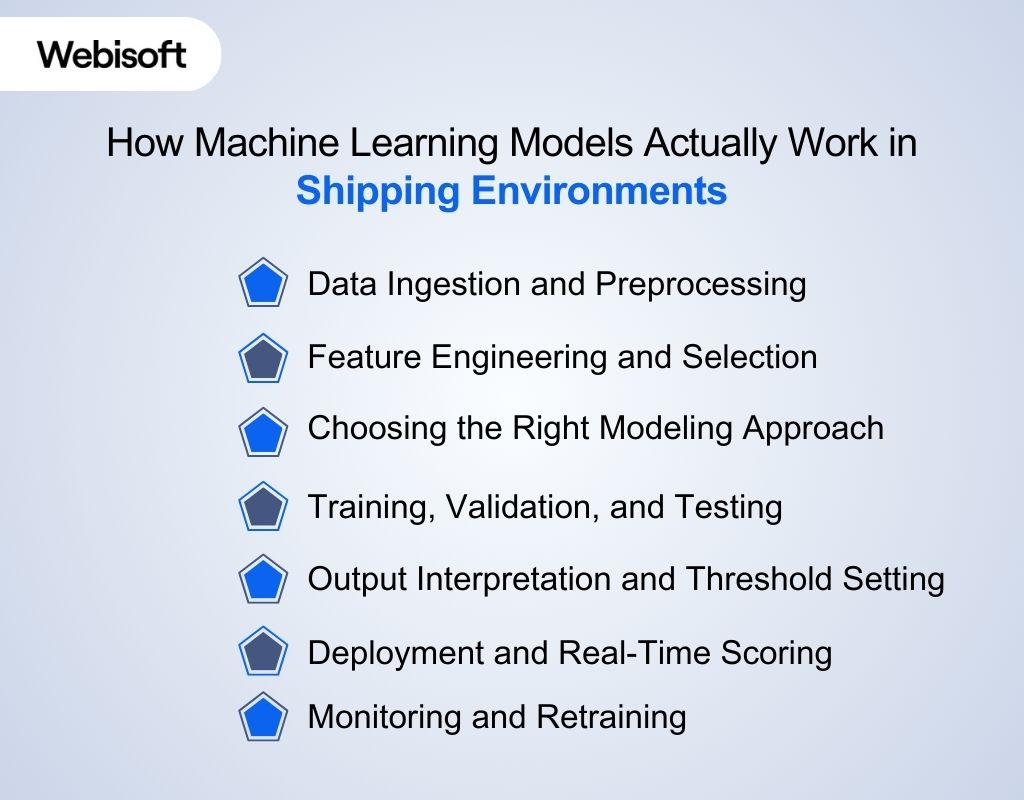
Data Ingestion and Preprocessing
Machine learning models begin with gathering and preparing the right data. In shipping, this includes structured logs and time-series records that must be cleaned, aligned, and formatted before use. Machine learning models in shipping require consistent, high-quality inputs.
Raw data from various sources rarely aligns perfectly, so preprocessing ensures that models learn from reliable patterns rather than noise. Key activities in this stage include:
- Data cleaning: Fix missing values, duplicate entries, and incorrect timestamps.
- Normalization: Standardize scales for speed, fuel, time, and distance.
- Time alignment: Sync datasets so measurements across sources refer to the same operational window.
- Labeling: For supervised tasks, assign ground truth outcomes such as delay or no delay.
Feature Engineering and Selection
After preprocessing, models can only learn from features, meaningful representations extracted from raw data. Good features capture the dynamics of shipping operations. In shipping environments, feature engineering makes data predictive rather than just descriptive. The right features connect raw measurements to decisions. Examples of features used in models:
- Average speed over recent voyage segments
- Port dwell time and turnaround duration
- Weather severity scores aggregated into voyage legs
- Historical deviation patterns from the planned route
- Engine load statistics over time windows
Choosing the Right Modeling Approach
Different use cases require different ML model types. There is no one-size-fits-all, and the choice depends on problem type and data characteristics. Models in shipping often fit into these categories:
- Regression models: Predict a continuous outcome, like arrival time deviation.
- Time-series forecasting: Capture temporal patterns for future values, such as fuel use.
- Classification models: Identify whether a risk is present, such as an equipment anomaly.
- Ensemble methods: Combine multiple models for stronger predictions.
Factors guiding model choice include:
- Nature of the output (continuous vs categorical)
- Volume and quality of historical data
- Seasonality and route variation
- Interpretability needs for operations teams
Training, Validation, and Testing
Once features and models are selected, the next step is teaching the model how to make predictions. This involves feeding it historical data until it can generalize from patterns. Proper evaluation ensures models aren’t memorizing history but truly learning to predict unseen conditions. Core steps here are:
- Training: Fit the model on labeled historical data.
- Validation: Tune hyperparameters and avoid overfitting.
- Testing: Evaluate on held-out data to estimate real-world performance.
- Cross-validation: Rotate training/testing splits for stability across conditions.
Output Interpretation and Threshold Setting
Model outputs must be operationally actionable. Raw predictions on their own are often not immediately useful; they require context and thresholds. Shipping teams and data scientists collaborate to translate model scores into decisions. This stage includes:
- Probability thresholds: Deciding when a predicted risk should trigger action.
- Confidence bands: Understanding uncertainty in predictions.
- Explainability tools: Highlighting which features influenced a specific output.
- Visualization: Plotting forecasts and anomaly scores for easy operational use.
Deployment and Real-Time Scoring
After models are validated and aligned with operational needs, they must be integrated so they can score new data as it arrives. In a shipping environment this often spans asynchronous data feeds and edge/cloud infrastructures. Deployment considerations include:
- Batch vs real-time scoring: Depends on whether predictions update periodically or continuously.
- Integration points: Fleet systems, port dashboards, planning tools.
- Latency constraints: Some predictions must arrive before key decisions.
- Fail-safe operations: What happens when model input is missing or corrupted?
Monitoring and Retraining
Shipping environments evolve. Routes change, vessel behavior shifts, and data sources update. Models must be monitored so they stay accurate. Continuous evaluation detects performance drift and triggers retraining when necessary. Monitoring tasks include:
- Tracking prediction errors over time.
- Identifying data distribution shifts.
- Re-labeling new data for retraining cycles.
- Version control and rollback policies.
Operational Risks of Machine Learning in Maritime Systems
Even with well-designed models and strong implementation plans, machine learning in shipping industry carries operational risks that must be understood and managed. These risks stem from data quality, changing conditions, model behavior, and how outputs are used in real operations.
- Data Inconsistency: Incomplete, noisy, or misaligned data can mislead models, causing inaccurate predictions that erode trust and lead to poor decisions.
- Model Drift: Shipping conditions such as route changes, seasonal patterns, or new vessel types can shift data distributions over time, reducing model accuracy if not monitored and retrained.
- Overfitting to Historical Patterns: Models trained too closely on past data may perform well in hindsight but fail when unexpected events or new traffic patterns emerge.
- False Positives and Alert Fatigue: Excessive or incorrect risk flags (for anomalies or delays) can overwhelm operations teams, leading them to ignore truly critical alerts.
- Lack of Interpretability: Complex models like deep learning or ensembles can be difficult for non-technical staff to interpret, slowing adoption and reducing confidence in recommendations.
- Integration Failures: Seamless data flow between maritime systems, fleet software, and decision dashboards is essential; integration gaps can lead to latency, mismatches, or loss of actionable insights.
- Security and Compliance Exposures: Exposing data pipelines and model endpoints without adequate safeguards increases vulnerability to unauthorized access or tampering, especially in joint carrier-port environments.
- Regulatory and Operational Misalignment: Without alignment to maritime safety standards and regulatory requirements, model outputs may conflict with compliance needs, causing operational friction.
- Human-Machine Interaction Errors: Misunderstanding how to interpret or act on model output can lead to inappropriate decisions, especially under stress or when outputs conflict with human judgment.
Custom ML Development vs Off-the-Shelf Solutions in Shipping
After evaluating operational risks and technical complexity, shipping leaders must decide how to execute machine learning initiatives. The core decision often comes down to buying a ready-made platform or building a solution customized to specific maritime operations and data realities.
| Decision Factor | Custom Build | Buy Off-the-Shelf Solution |
|---|---|---|
| Fit to Maritime Workflows | Designed around specific fleet operations, port coordination, and internal systems | Built for broad market use; may require adapting workflows to the tool |
| Control Over Models and Data | Full ownership of models, features, and architecture | Limited control; vendor controls core model logic |
| Integration Depth | Deep integration with existing fleet, port, and logistics systems | Integration depends on vendor APIs and configuration limits |
| Flexibility Over Time | Can evolve as routes, regulations, or strategies change | Bound to vendor roadmap and feature releases |
| Time to Initial Deployment | Longer setup phase but aligned to operational needs | Faster initial rollout with prebuilt capabilities |
| Internal Expertise Required | Requires collaboration with experienced ML engineers | Minimal internal ML capability required |
| Long-Term Cost Structure | Higher upfront investment; cost aligns with scope and scale | Subscription or licensing costs that grow with usage |
| Strategic Differentiation | Enables competitive advantage through proprietary models | Limited differentiation if competitors use the same platform |
Selecting the Right Technical Partner for Shipping ML Projects
Shipping ML projects demand more than model accuracy; they require stable deployment and operational integration. Webisoft collaborates with maritime organizations to deliver machine learning systems designed for long-term reliability and measurable impact. Here’s what we offer:
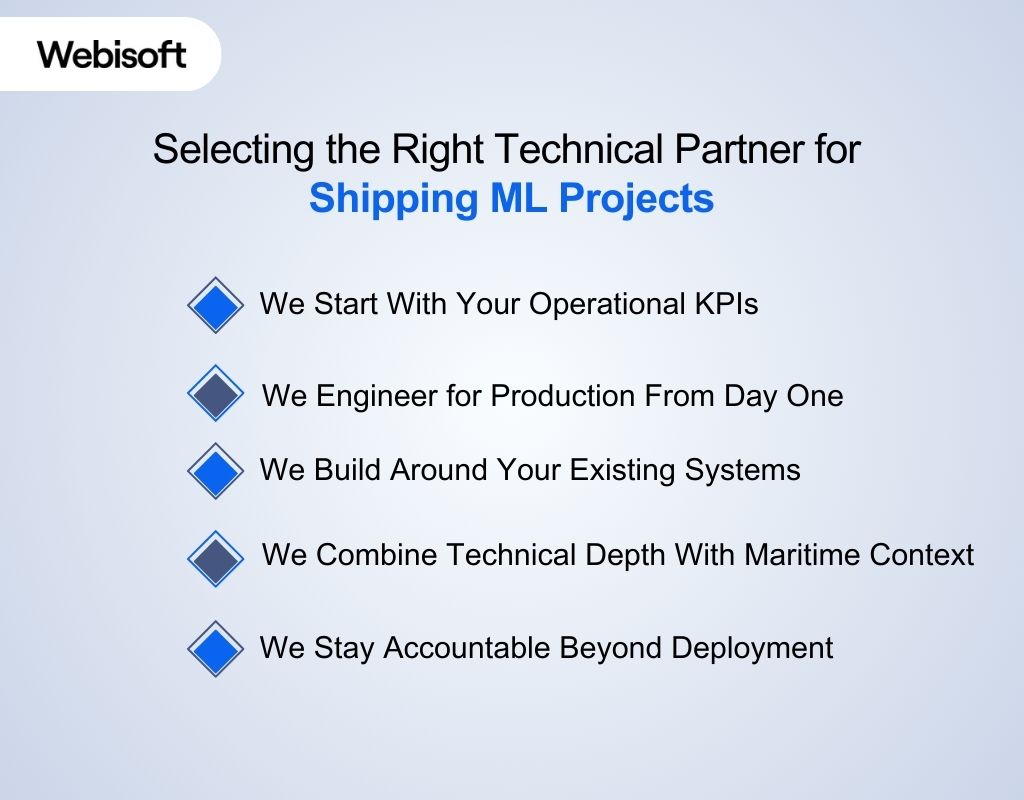
We Start With Your Operational KPIs
We do not begin with algorithms. We begin with your operational priorities and measurable performance targets. Every ML system we design is anchored to business impact, not theoretical accuracy.
- Mapping model outputs directly to schedule reliability and fuel KPIs
- Aligning predictions with maintenance and congestion exposure goals
- Defining measurable ROI before development begins
We Engineer for Production From Day One
Shipping ML systems must operate under real-world constraints. Our approach treats data pipelines, model logic, deployment, and monitoring as one continuous engineering system.
- Designing scalable data architecture around your fleet data
- Validating models using realistic maritime time splits
- Deploying secure, resilient infrastructure
- Implementing monitoring and drift detection from launch
We Build Around Your Existing Systems
Machine learning creates value only when it integrates with operational workflows. We design every solution to fit into your existing planning, fleet, and coordination systems.
- API integration with fleet management platforms
- Seamless connection to dashboards and reporting tools
- Minimal disruption to operational workflows
- Outputs structured for real-time decision use
We Combine Technical Depth With Maritime Context
Shipping operations are complex and data-heavy. Our engineers collaborate closely with your domain experts to ensure models reflect real operational behavior.
- Translating operational knowledge into feature logic
- Ensuring model outputs remain interpretable
- Aligning thresholds with real decision-making processes
We Stay Accountable Beyond Deployment
Machine learning in shipping is not a one-time build. Conditions change, routes shift, and systems must adapt. We remain engaged to sustain performance over time.
- Continuous performance monitoring
- Scheduled retraining cycles
- Infrastructure scaling as fleet scope expands
- Ongoing technical collaboration
If operational alignment, production-grade engineering, and long-term reliability are non-negotiable for your shipping ML initiative, we should continue this conversation. Connect with Webisoft and let’s define a deployment plan that fits your fleet, your systems, and your performance targets.
Conclusion
To bring it all together, machine learning in shipping industry is no longer about experimentation. It replaces guesswork with informed, data-backed decisions. Operators who apply it effectively do more than improve efficiency; they redefine how shipping performance is measured and managed.
Real value appears when these systems become part of daily operations and continue delivering over time. If you are ready to make that shift across your fleet and port environments, Webisoft is ready to build it with you and turn strategy into measurable results.
Frequently Asked Question
No. Machine learning systems are designed to support operational teams, not replace them. They provide predictive insights and risk signals, while final decisions remain with planners, engineers, and maritime professionals.
Maritime machine learning uses regression models for forecasting, along with random forests and gradient boosting methods for various prediction tasks. It also applies LSTM networks for time-series analysis and clustering algorithms like DBSCAN for AIS pattern detection and route modeling.
AI in the shipping industry is used to analyze operational data and improve decision-making across fleets and ports. It supports arrival forecasting, fuel optimization, predictive maintenance, congestion planning, and automated document processing to reduce uncertainty and improve efficiency.