Machine learning in robotics is the reason robots no longer behave like obedient but clueless machines. Today’s robots can adjust to messy environments, recover from mistakes, and make decisions when the world does not follow a script.
In practice, more than 70 percent of modern industrial robots rely on machine learning for perception, motion planning, or adaptive control. That shift explains why robots now handle tasks that traditional automation consistently failed to manage. This article breaks the topic down clearly, showing how learning-driven systems function inside robots and why they matter in real deployments.
What Is Machine Learning in Robotics?
Machine learning in robotics refers to the integration of learning algorithms that allow robots to derive behavior from data rather than relying only on predefined rules. Instead of executing fixed instructions, robots use learned models to interpret sensor inputs, recognize patterns, and make decisions during operation.
Traditional robotic systems depend on precise environment modeling and deterministic control logic, which limits their effectiveness in unpredictable settings. Machine learning addresses this limitation by enabling robots to adapt when conditions change, data is incomplete, or exact system dynamics are difficult to define.
By embedding learning models within perception, decision-making, and control processes, robots can improve performance through experience. This capability allows robotic systems to operate more reliably in real-world environments where variability and uncertainty are unavoidable.
How Machine Learning Fits Into a Robotic System
Machine learning fits into a robotic system as a decision-support layer that connects raw sensor data with meaningful action. A robot continuously collects input from multiple sources, including:
- Cameras
- LiDAR
- Force sensors
- Encoders
These signals alone do not produce intelligent behavior. Machine learning models process this data to identify patterns, estimate the robot’s state, and reduce uncertainty before any action is taken. Within the system, learning-based components usually operate inside key stages such as perception, planning, and control:
- Perception: Models convert sensor data into usable information, such as object locations or surface properties.
- Planning and control: Learned policies help the robot choose actions based on past outcomes rather than fixed rules.
This explains what is the role of machine learning in robotics at a system level. It allows robots to move beyond rigid execution and respond more effectively to changing conditions. Machine learning does not replace classical robotics components. It works alongside established elements such as:
- Kinematic models
- Control algorithms
- Safety and constraint logic
This combination allows robots to follow physical and safety constraints while still adjusting to environmental changes, task variation, and unexpected situations during real-world operation.
Types of Machine Learning in Robotics
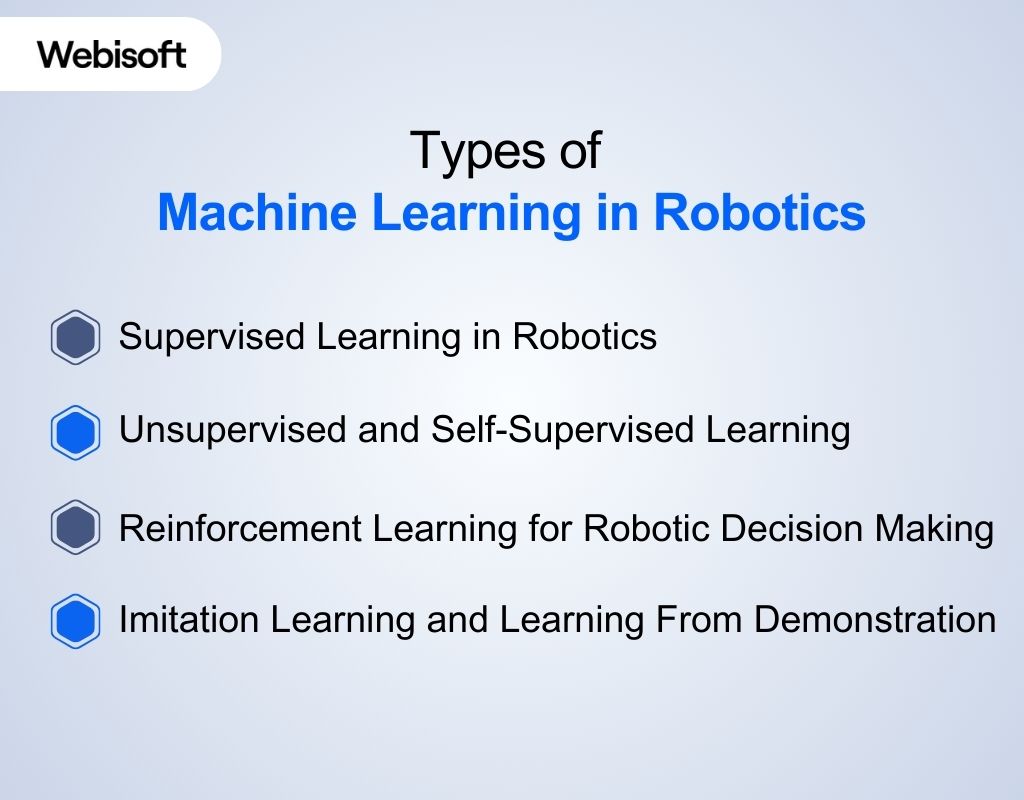
Different machine learning approaches support different robotic functions, depending on how data is collected, decisions are made, and actions are evaluated. Each machine learning type fits specific stages of a robotic system and addresses distinct operational challenges.
Supervised Learning in Robotics
Supervised learning relies on labeled datasets to train robots for recognition and prediction tasks. In robotics, it is commonly applied where outcomes are known in advance and consistency matters. Common uses include:
- Object detection and classification
- Pose estimation and localization
- Quality inspection in manufacturing
- Sensor calibration and error correction
Engineers provide example inputs with known outputs, allowing models to learn direct mappings between sensor data and expected results. This approach performs best in controlled environments where labeled data is accurate and stable.
Unsupervised and Self-Supervised Learning
Unsupervised and self-supervised learning enable robots to extract structure from data without explicit labels. These approaches help robots understand patterns that are not predefined by human input. Typical applications include:
- Feature discovery from raw sensor data
- Environment representation and mapping
- Anomaly and fault detection
- Data compression and clustering
In robotics, these methods are valuable when labeled datasets are limited or impractical to produce, allowing robots to learn directly from continuous observation.
Reinforcement Learning for Robotic Decision Making
Reinforcement learning allows robots to learn actions through interaction with their environment rather than predefined instructions, a concept widely studied in reinforcement learning for robotics. The robot performs actions, observes outcomes, and updates behavior based on feedback signals. This approach is often used for:
- Motion and control optimization
- Autonomous navigation
- Manipulation and grasping tasks
- Sequential decision making under uncertainty
Reinforcement learning is effective for complex tasks where modeling every possible scenario is unrealistic, though it requires careful training and validation to ensure safety.
Imitation Learning and Learning From Demonstration
Imitation learning enables robots to acquire skills by observing human demonstrations instead of learning through trial and error. Engineers capture expert behavior and train models to reproduce similar actions. This method is especially useful for:
- Tasks requiring precision and consistency
- Human-robot collaboration scenarios
- Reducing training time and risk
- Transferring expert knowledge to robots
By learning from demonstrations, robots can achieve functional behavior faster while avoiding unsafe exploration during training.
Real-World Applications of Machine Learning in Robotics
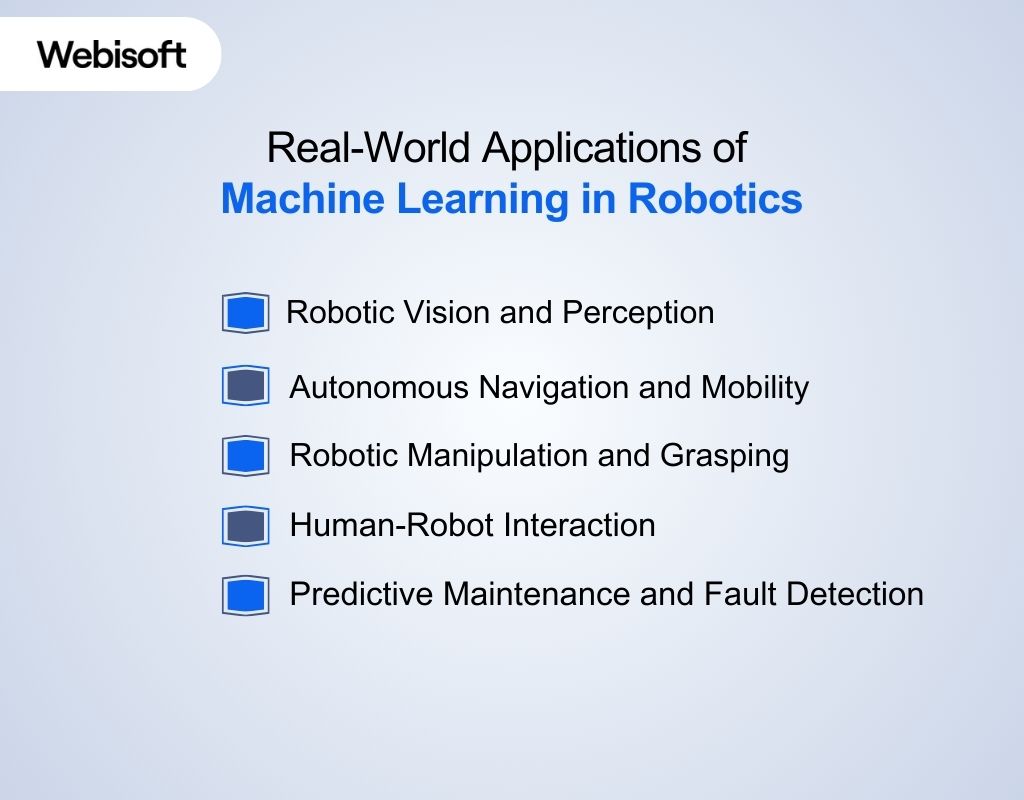
Machine learning enables robots to operate in environments where variability, uncertainty, and real-time decision making are unavoidable. These applications show how learning-based systems extend robotics beyond fixed automation into tasks that require perception, adaptation, and contextual response.
Robotic Vision and Perception
Machine learning allows robots to interpret visual and sensory input rather than relying on predefined visual rules. Models trained on images and sensor data help robots identify objects, estimate positions, and understand surroundings even when lighting, orientation, or appearance changes.
- Used for object recognition, pose estimation, and visual inspection tasks.
Autonomous Navigation and Mobility
Robots use machine learning to move safely through dynamic environments by learning from sensor feedback and past motion outcomes. This enables continuous adjustment of paths, obstacle avoidance, and localization when maps are incomplete or conditions change during operation.
- Applied in mobile robots, warehouses, and autonomous delivery systems.
Robotic Manipulation and Grasping
Manipulation tasks benefit from machine learning when object shape, size, or placement cannot be predicted precisely. Learning-based models help robots select stable grasps, adjust force, and recover from failed attempts during physical interaction.
- Common in pick-and-place, assembly, and material handling scenarios.
Human-Robot Interaction
Machine learning enables robots to interpret human behavior and respond appropriately during shared tasks. By learning patterns in speech, movement, or proximity, robots can adjust actions without rigid interaction scripts.
- Relevant in collaborative robots, healthcare systems, and service robotics.
Predictive Maintenance and Fault Detection
Robotic systems generate continuous operational data that machine learning models analyze for early signs of failure. This allows issues to be detected before breakdowns occur, improving reliability and system uptime.
- Used for condition monitoring and maintenance planning in industrial robots.
Applying machine learning to real robotics systems introduces complexity that theory alone cannot solve. At Webisoft, we support practical machine learning execution, helping teams move from use cases to production-ready robotics.
A Practical Example of Machine Learning in Robotics
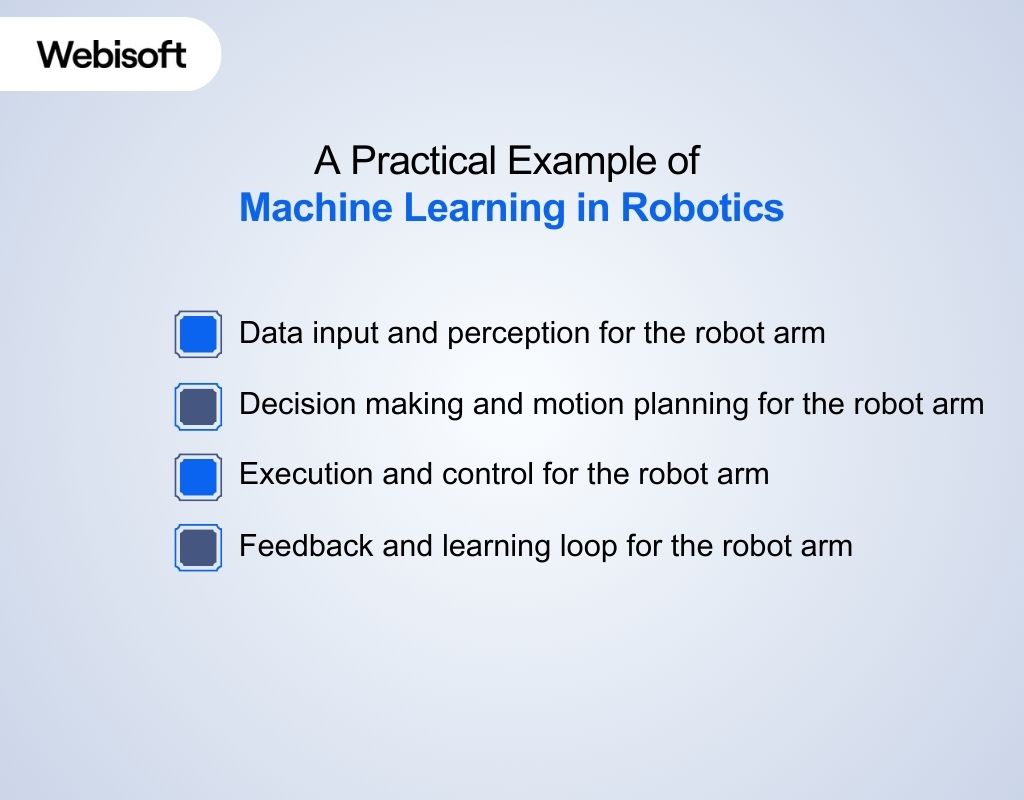
A practical way to understand how to use machine learning in robotics is to follow a single task from data input to physical action. Consider a robotic arm in a warehouse that identifies objects on a conveyor belt and picks them for sorting.
Data input and perception for the robot arm
The process begins with sensor data collection. Cameras and depth sensors capture images of incoming objects, which are passed to a trained perception model. The model identifies object type, estimates position, and predicts a suitable grasp based on learned patterns.
Decision making and motion planning for the robot arm
Once perception is complete, the planning component uses these predictions to decide the robot’s next action. Instead of following a fixed motion path, the robot selects movements based on previous outcomes, adjusting grip angle or force when conditions change.
Execution and control for the robot arm
The selected action is carried out by the control system, which converts decisions into motor commands while respecting physical constraints. This ensures stable movement and safe interaction with objects during execution.
Feedback and learning loop for the robot arm
After the action, sensor feedback records whether the grasp succeeded or failed. These outcomes feed back into the learning process, allowing the system to refine future decisions. This continuous improvement cycle is one of the most common machine learning in robotics examples, showing how robots adapt without manual reprogramming.
Key Challenges of Using Machine Learning in Robotics
Applying machine learning in robotics introduces challenges that go beyond model accuracy or training success. Real-world robots must handle uncertainty, physical risk, and system constraints, making reliable deployment more complex than software-only machine learning systems.
- Data quality and coverage: Robots depend on sensor data that reflects real operating conditions. Limited, biased, or poorly labeled data can lead to fragile models that fail when environments, objects, or lighting conditions change.
- Sim-to-real performance gaps: Models trained in simulation often behave differently on physical robots. Differences in physics, sensor noise, timing, and calibration create performance drops when systems move from virtual training to real-world execution.
- Safety and predictability constraints: Learning-based behavior can be difficult to anticipate in edge cases. In robotics, unexpected actions can cause physical damage, making safety validation and fallback mechanisms essential.
- Real-time and compute limitations: Robotic systems operate under strict latency and power constraints. Machine learning models must produce decisions fast enough to support motion and control without overwhelming on-device compute resources.
- System maintenance and long-term reliability: Robot performance can degrade as environments evolve or hardware wears down. Learning models require monitoring, retraining, and validation to remain effective throughout a robot’s operational lifecycle.
How Engineers Evaluate Machine Learning Models in Robotics
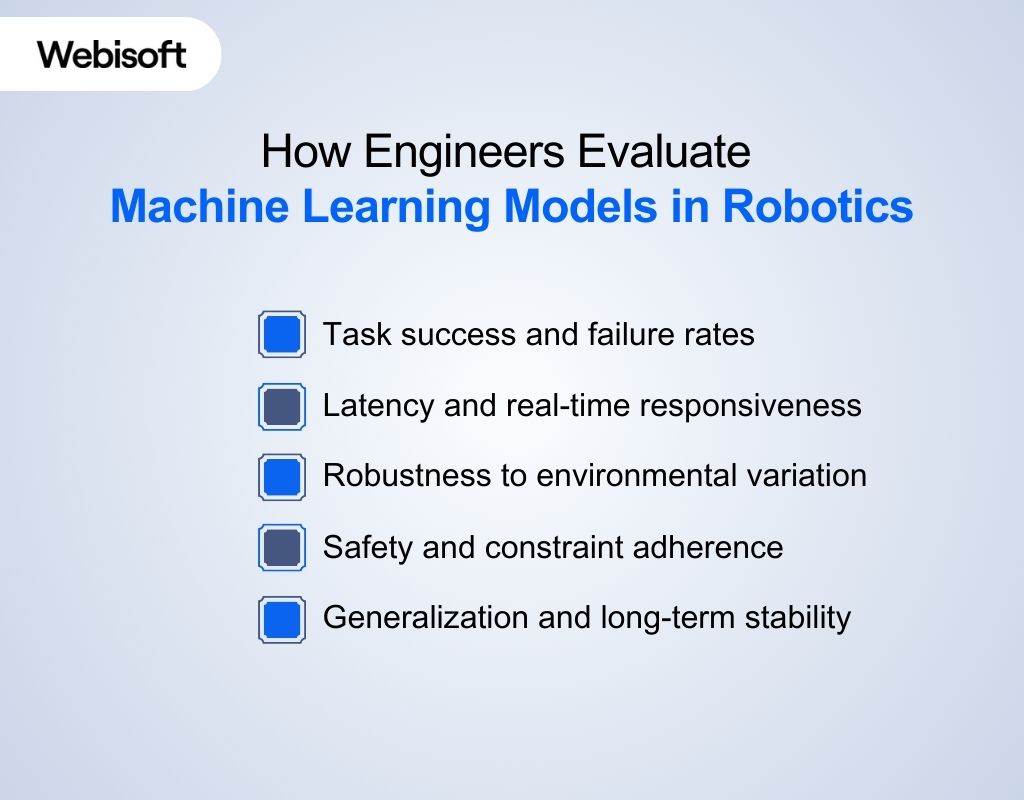
After addressing data limits, safety risks, and real-world constraints, engineers must determine whether a learning-based robotic system can be trusted in operation. Evaluation focuses on observable behavior, system stability, and performance under real deployment conditions.
Task success and failure rates
Engineers measure how often a robot completes its intended task correctly and under what conditions it fails. This includes tracking partial failures, recovery attempts, and consistency across repeated executions.
Latency and real-time responsiveness
Robotic decisions must occur within strict time limits. Evaluation includes measuring inference time, control loop delays, and whether model outputs arrive fast enough to support stable motion and interaction.
Robustness to environmental variation
Models are tested across changes in lighting, object placement, surface properties, and sensor noise. A reliable robotics model maintains acceptable performance when conditions differ from training data.
Safety and constraint adherence
Engineers assess whether learned behavior respects physical limits, collision boundaries, and safety rules. This includes monitoring unexpected actions and verifying that fallback mechanisms activate when predictions become unreliable.
Generalization and long-term stability
Evaluation continues after deployment. Engineers monitor performance drift, error trends, and adaptation over time to ensure the model remains effective as hardware ages or operating conditions evolve.
Building Reliable Robotics Systems With Machine Learning at Webisoft
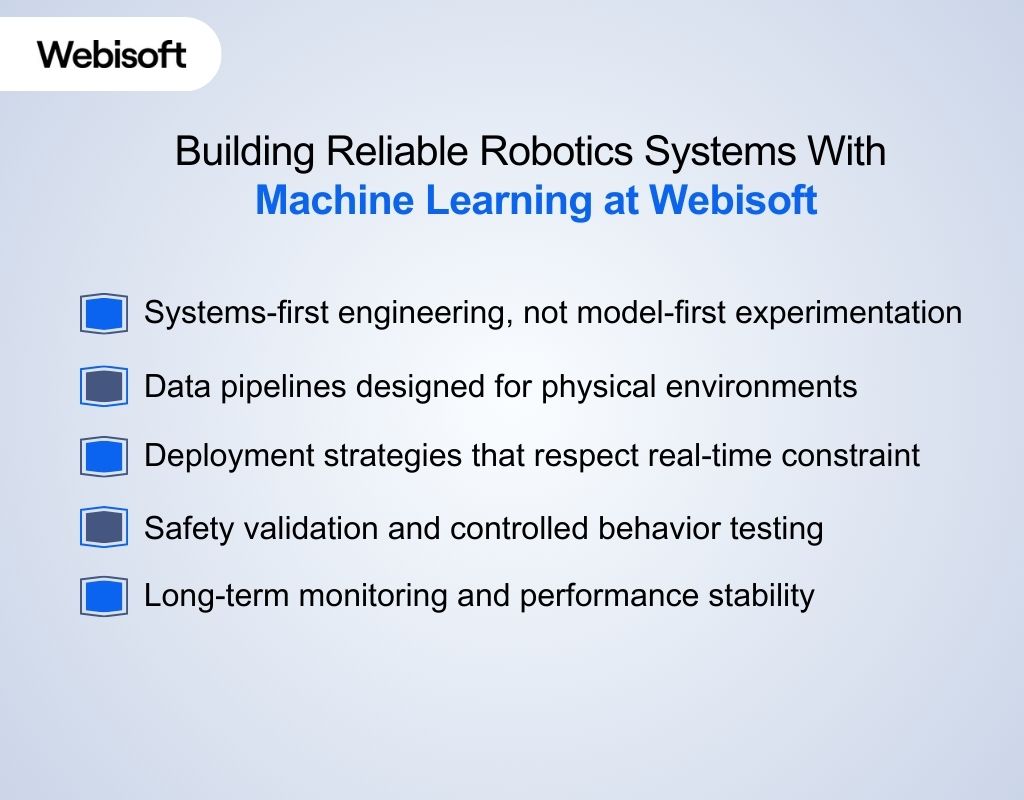
When machine learning moves into physical robots, reliability becomes the difference between experimentation and real-world success. At Webisoft, we help you turn learning-based robotics into dependable systems by focusing on behavior, safety, and long-term stability from the start.
Systems-first engineering, not model-first experimentation
We approach robotics by looking at the entire system rather than isolated models. By mapping interactions between sensors, perception modules, planning logic, and control layers, we ensure machine learning supports robot behavior beyond scenarios in practice.
Data pipelines designed for physical environments
Robotic data behaves differently from traditional software data due to sensor noise, environmental variation, and hardware drift. Our data pipelines are designed to capture realistic operating conditions and edge cases, helping your learning models reflect how robots actually function in the field.
Deployment strategies that respect real-time constraints
Machine learning in robotics must operate within strict timing, power, and compute limits. We account for inference latency, control loop timing, and on-device constraints early. So your deployed models deliver decisions fast enough to support safe and stable robotic motion.
Safety validation and controlled behavior testing
When robots interact with the physical world, predictable behavior becomes essential. We validate learned behavior against safety constraints and operational boundaries, so you can rely on consistent system responses even when inputs fall outside expected ranges.
Long-term monitoring and performance stability
Robotic systems evolve after deployment as environments change and hardware ages. Our monitoring approaches track performance drift and behavior changes over time, helping you maintain stability while improving performance through controlled updates.
Turning learning-based robots into reliable systems requires the same discipline described above, from system design to long-term stability. Talk with the Webisoft team to apply these principles to your robotics project and move confidently from experimentation to real-world deployment.
Final Thoughts
Machine learning in robotics has moved robots from rigid execution to adaptive behavior in real environments. What matters now is not whether robots can learn, but whether that learning remains reliable under uncertainty, physical constraints, and long-term operation.
This is where the right engineering partner makes the difference. Applying the discipline discussed here turns learning-driven robotics into systems you can trust in real operations, making Webisoft a natural next step.
Frequently Asked Question
Training time depends on task complexity, data availability, and learning method. Simple perception tasks may train in days, while control or reinforcement learning can take weeks. Simulation, transfer learning, and data quality significantly influence overall training duration.
Robotics machine learning requires sensor data such as images, depth readings, force signals, and motion logs. Data should represent real operating conditions, including edge cases and failures. Labeled examples, simulations, and continuous feedback are commonly combined.
Yes, robots can learn without direct human input using reinforcement or self supervised learning. They improve through interaction, feedback signals, or environmental observation. However, safety constraints, simulations, and occasional human guidance remain important in practice.