Machine learning in retail uses data-driven algorithms to predict demand, optimize pricing, manage inventory, personalize recommendations, and detect fraud. It studies sales records, customer behavior, promotions, and external factors like seasonality to generate accurate business insights. Because retailers face constant challenges. Demand shifts quickly due to trends, weather, and promotions. Overstock reduces margins, while stockouts drive customers away. Pricing mistakes hurt profitability, and weak personalization lowers conversion rates. That is why predictive intelligence has become essential for modern retail operations. In this blog, we will discuss how machine learning works in retail, its core use cases, real-world examples, benefits, challenges, and how businesses can implement it effectively.
What Is Machine Learning in Retail?
Machine learning in retail means using computer models to study retail data and predict outcomes without writing fixed rules for every situation. Retailers feed these models sales history, product prices, customer clicks, loyalty data, and even weather forecasts. The system studies patterns in that data and predicts what customers will buy, when they will buy, and at what price. Machine learning differs from traditional analytics because it does not stop at reporting past results. Traditional dashboards tell you what sold yesterday. Machine learning models use that same data to predict tomorrow’s demand and adjust automatically when new data arrives. Retailers use this method because retail conditions shift fast. A weekend promotion, a sudden heatwave, or a viral social media post can change demand within hours. Walmart confirmed that its AI systems helped reroute shipments during Hurricane Lane in 2018 to reduce disruptions. The process follows a simple flow: data goes in, a model learns patterns, and predictions come out. For example, a retailer combines point-of-sale data, promotion schedules, and weather forecasts. The model then predicts store-level sales for the next day.
Why Retail Is Structurally Ideal for Machine Learning
Machine learning in retail is ideal because it produces dense, continuous data. Every sale, return, click, and price change creates a usable signal. In the United States alone, retail sales reached $7.2 trillion in 2023, which means billions of transaction records feed retail systems each year. Because of this data density, retailers also face the SKU explosion problem. Large chains manage tens of thousands of products across stores, regions, and online channels. Walmart operates over 10,800 stores globally, as noted in its 2024 annual report, which makes manual forecasting and pricing unrealistic at scale. At the same time, retail demand rarely stays stable. Weather changes, social media trends, and local events shift buying behavior within hours. According to a report, AI-based forecasting can improve accuracy by 20%-50% in volatile categories such as fresh food and fashion. On top of that, promotions create layered complexity. A single discount can increase demand for one item while reducing sales of another. Models must measure these cross-effects instantly to prevent overstock and missed sales. Finally, retail margins leave little room for error. For that reason, retailers depend on precision tools like AI-powered retail analytics to protect profits and control inventory risk.
The Retail Machine Learning Architecture
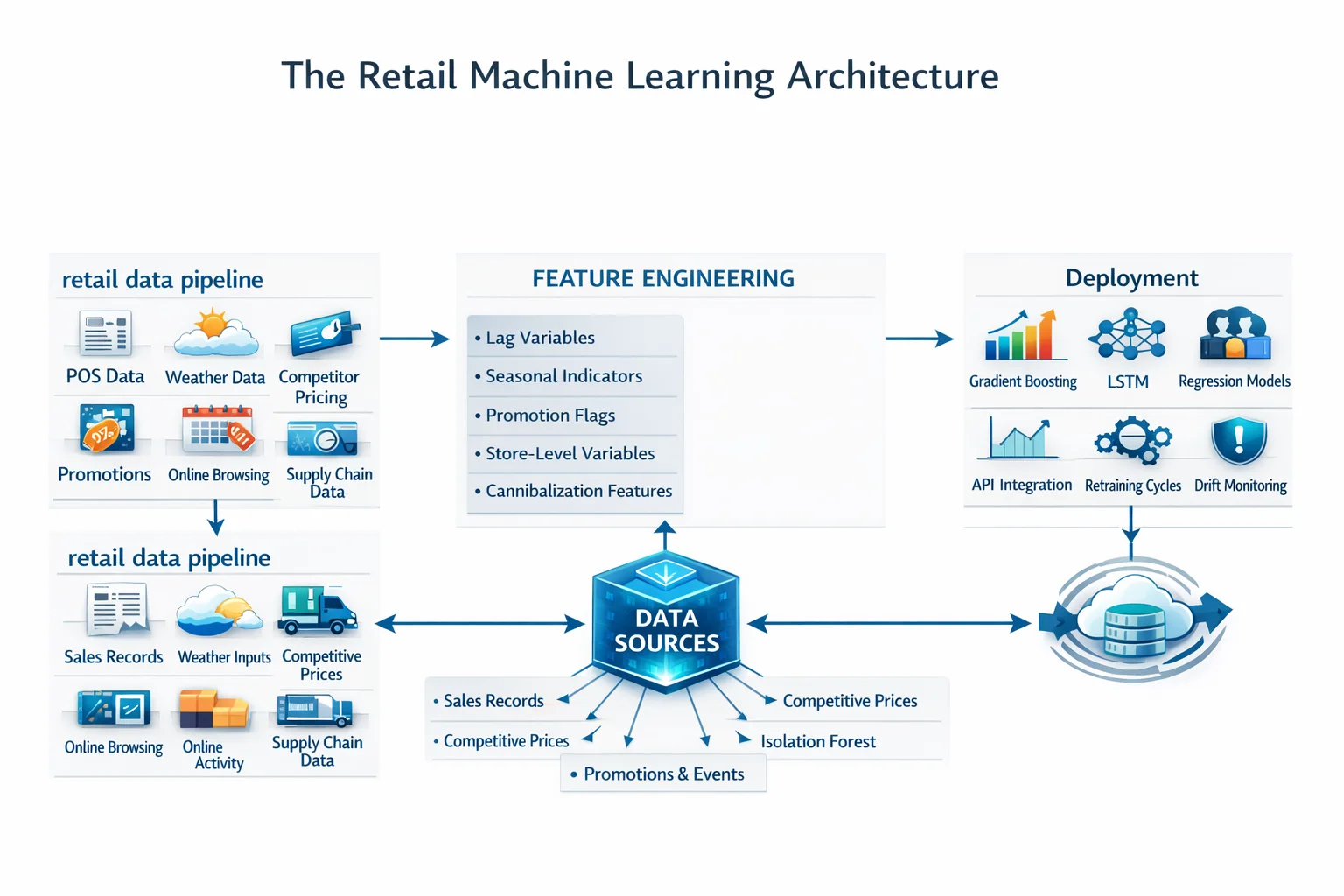
Machine learning in retail runs through a structured pipeline. Companies collect data, refine it, train models, and then push predictions into pricing, inventory, and supply systems:
Data Sources That Power Retail Models
The foundation starts with point-of-sale records because transactions reflect real buying behavior. Each receipt logs time, price, store, and quantity sold. Weather inputs come next because climate directly affects purchasing patterns. Data from the National Oceanic and Atmospheric Administration helps businesses anticipate spikes during heatwaves or storms. For instance, beverage sales often rise sharply during sustained high temperatures. Competitor pricing also feeds the system since price shifts influence short-term demand. Research shows that competitive promotions significantly alter elasticity. These signals enter the retail data pipeline alongside internal pricing updates. Promotion calendars add critical context. Discounts and bundles temporarily distort normal demand levels. Clear labeling prevents models from confusing short-term uplift with permanent trend changes. Online browsing activity strengthens predictions further. Adobe’s Digital Economy Index reported over $1 trillion in U.S. online sales, generating detailed behavioral signals before checkout. Clickstream data often reveals intent earlier than transaction data. Supply chain inputs close the loop. Lead times, warehouse stock levels, and shipment delays shape replenishment decisions. When demand forecasts align with logistics data, stockouts decrease.
Feature Engineering and SKU Complexity
Feature engineering converts raw inputs into structured signals. Lag variables use recent sales from prior days or weeks to capture momentum. This helps models detect trend shifts early. Seasonal indicators mark repeating cycles such as holidays and weekends. The National Retail Federation reported that holiday retail sales in 2023 grew to a record $964.4 billion during the holiday season. This confirms predictable annual surges. Encoding these cycles improves forecast stability. Promotion flags isolate campaign effects. These markers separate baseline demand from temporary uplift. Without them, systems misread sales spikes as long-term growth. Store-level variables capture geographic differences. Urban branches often outperform rural locations, and regional climate affects product mix. This precision supports accurate SKU-level forecasting. Cannibalization features track substitution effects. A discount on one brand can reduce demand for another. Including these relationships prevents excess stock accumulation.
Model Selection by Retail Use Case
Model choice depends on the problem at hand. Gradient Boosting performs well for structured demand data, and research shows it improves prediction accuracy in retail settings. Many chains apply it for short-term sales planning. LSTM networks handle longer time-series patterns. They capture seasonal shifts and sudden demand changes better than simple averages. This makes them useful for multi-year trend analysis. Regression models estimate price sensitivity. They measure how quantity changes when price moves, forming the basis of price elasticity modeling. This statistical clarity guides smarter markdown decisions. Isolation Forest detects unusual transactions quickly. Anomaly detection improves fraud identification compared to static rules. This reduces manual review workload. Collaborative filtering powers recommendation systems. It compares customer behavior to similar profiles to rank products. Major e-commerce platforms credit this method for measurable conversion gains.
Deployment and Continuous Learning
Deployment connects predictions to operational systems through APIs. Forecast outputs feed directly into inventory or pricing platforms. This reduces manual intervention. Retraining cycles keep models aligned with new data. Demand shifts with season, inflation, and trends. Regular updates maintain reliability. Drift monitoring protects performance. When forecast errors rise, teams retrain or adjust features quickly. This avoids silent performance decline. CI/CD pipelines automate testing and rollout. Engineers validate each update before release. This structured process defines MLOps in retail, which keeps models dependable in live operations.
Application of Machine Learning in Retail
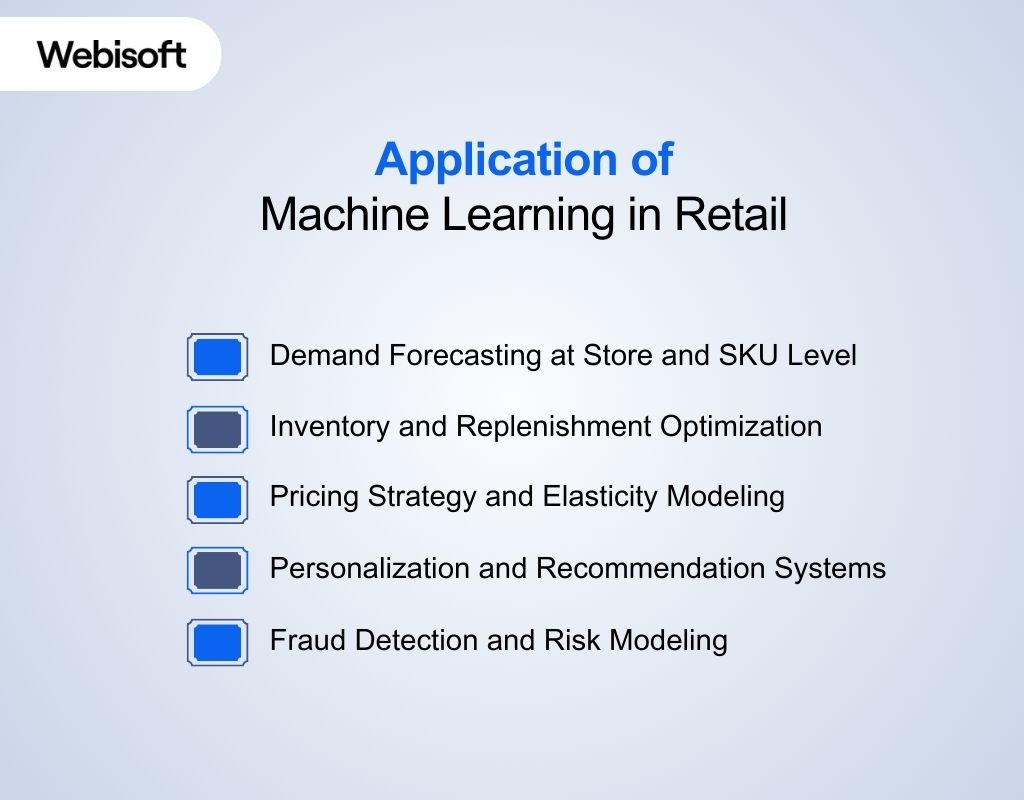
Machine learning in retail delivers value only when it solves clear business problems. It connects predictions directly to revenue, cost control, and risk reduction. That is why most real-world adoption centers around forecasting, inventory, pricing, personalization, and fraud control.
Demand Forecasting at Store and SKU Level
Demand forecasting answers a simple question: how much will each store sell tomorrow? The math relies on probability, past sales trends, and error minimization. Retailers refer to this process as retail demand forecasting. Traditional time-series models mainly extrapolate historical averages and seasonal cycles. Machine learning improves this by adding external signals such as promotions and weather. AI-driven supply chain forecasting can reduce errors by up to 50 percent in complex networks Seasonal spikes require special modeling because sales surge within short windows. The weather further complicates predictions. NOAA climate data shows temperature changes influence demand for categories such as grocery and apparel These inputs allow models to move beyond static averages and produce store-level accuracy.
Inventory and Replenishment Optimization
Once demand becomes predictable, inventory decisions improve. Safety stock formulas combine average demand with variability and supplier delay risk. Companies strengthen this logic through inventory optimization using machine learning. Automated replenishment systems then convert predictions into action. When projected stock falls below threshold, systems trigger purchase orders automatically. It is reported that AI-enabled supply chains can reduce stockouts by up to 25 percent. Lead time prediction adds another layer of control. Models study supplier performance and transport history to estimate delivery accuracy. As a result, retailers avoid overordering while protecting shelf availability.
Pricing Strategy and Elasticity Modeling
Pricing decisions build on demand behavior. When prices rise, demand typically falls, but the decline rate varies across products. Regression models measure this sensitivity and form the basis of dynamic pricing in retail. Elasticity estimation quantifies percentage change in demand relative to price movement. Firms using advanced pricing analytics improve profitability when elasticity is measured precisely However, price changes rarely affect one product alone. Cannibalization occurs when a discount on one item reduces sales of substitutes. Models calculate these cross-effects before adjusting prices to protect overall margin.
Personalization and Recommendation Systems
Customer behavior generates signals beyond transactions. Collaborative filtering compares one shopper’s activity to similar profiles. McKinsey reported that personalization strategies can lift revenue by 10 to 15 percent. Segmentation strengthens targeting further. Models group customers by frequency, spend, and browsing depth. Feature vectors translate those traits into numerical inputs for ranking systems. Ranking algorithms then order products by predicted relevance through a retail personalization engine. As a result, customers see items aligned with real purchase intent rather than generic promotions.
Fraud Detection and Risk Modeling
Revenue growth means little without risk control. Anomaly detection models scan transaction attributes such as device ID, location, and purchase value. Retailers rely on retail fraud detection AI to flag suspicious behavior instantly. Yet fraud systems must balance caution and convenience. False positives block legitimate buyers, while false negatives allow fraud losses. The National Retail Federation reported retail shrinkage reached $112.1 billion, highlighting the scale of financial exposure Chargeback pattern analysis strengthens detection further. Models identify repeated dispute behavior tied to fraudulent activity. Continuous monitoring, therefore, protects revenue while maintaining customer trust. At Webisoft, we help retailers turn these use cases into structured, production-ready systems. Our team builds scalable forecasting, pricing, personalization, and fraud models that integrate directly into your existing retail workflows. We focus on clean data architecture, reliable model deployment, and long-term performance monitoring. This ensures machine learning delivers measurable impact, not just technical experimentation.
Machine Learning in Retail Real World Use Cases
Large retailers do not treat machine learning as theory. They use it daily across forecasting, pricing, personalization, and fraud control. The examples below show how real companies apply machine learning in retail to solve operational problems at scale.
Nike: Demand Forecasting and Personalization at Scale
Nike uses predictive analytics to understand buying behavior across stores and apps. The company analyzes transaction history, app engagement, and regional demand signals to strengthen retail demand forecasting. This helps Nike allocate inventory more accurately and reduce excess stock. Nike also improves digital engagement through its retail personalization engine. Recommendation systems study browsing behavior and past purchases to rank products for each user. As a result, customers receive relevant suggestions instead of generic promotions.
Zara: Fast Fashion Powered by Inventory Intelligence
Zara relies on rapid sales feedback from stores worldwide. The company collects daily store-level data to adjust production and distribution quickly. This reflects strong inventory optimization using machine learning, which reduces overproduction risk. Zara also reacts to demand shifts through flexible pricing and supply decisions. When trends change, the company adjusts stock allocation instead of waiting for seasonal cycles. That speed limits markdown losses.
Amazon: Pricing, Automation, and Fraud Control
Amazon applies predictive systems across checkout, recommendations, and pricing. Its pricing engines update rates constantly, which supports dynamic pricing in retail. This approach balances demand, inventory, and competitor pricing signals. Amazon also invests heavily in transaction monitoring. Its internal systems apply retail fraud detection AI to flag abnormal payment behavior in real time. This protects both revenue and customer trust.
H&M: Forecasting and Elasticity Modeling
H&M uses historical sales and regional preferences to refine product allocation. The company applies detailed SKU-level forecasting to match assortments with local demand patterns. This prevents stock imbalances across stores. H&M also measures price sensitivity before running markdown campaigns. Its structured models support accurate price elasticity modeling, which guides seasonal clearance strategies. That precision helps protect margin while clearing inventory.
Walmart: Supply Chain and Analytics Integration
Walmart integrates forecasting into its supply chain network. The company uses large-scale predictive systems to support replenishment and distribution planning. These systems operate under advanced AI-powered retail analytics frameworks. Walmart also analyzes supplier lead times and logistics signals continuously. This integration improves delivery timing and reduces stock disruptions. Over time, predictive systems strengthen operational resilience.
Benefits of Machine Learning in Retail
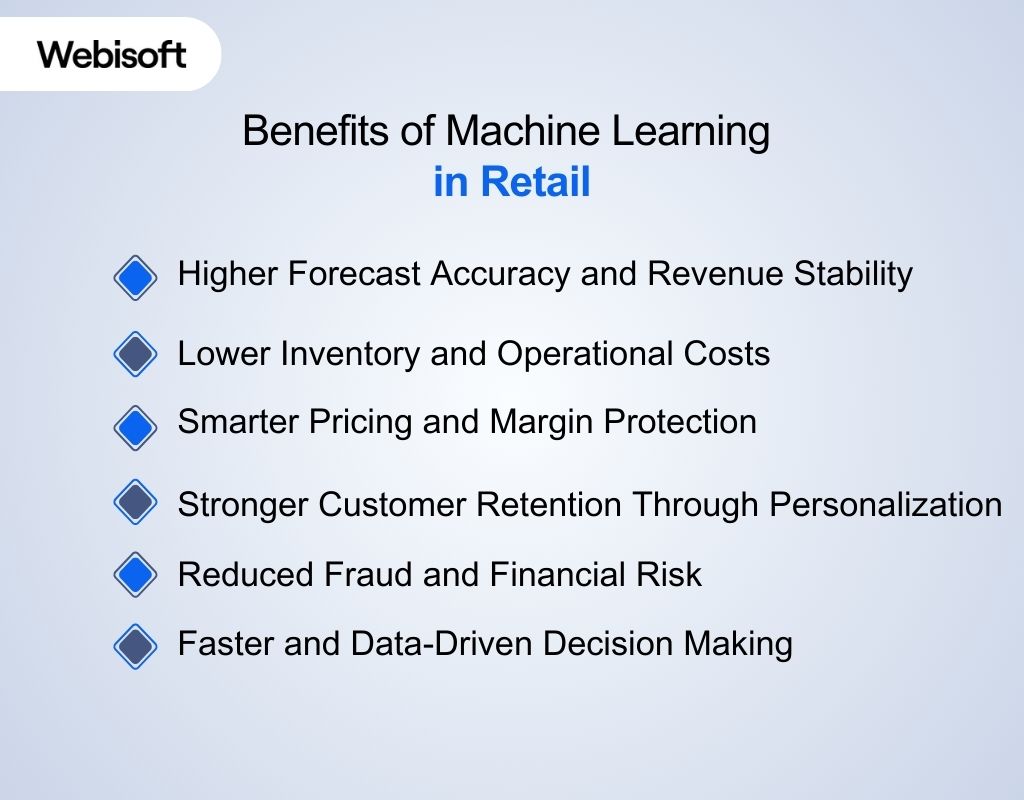
Machine learning in retail delivers clear business advantages across forecasting, pricing, inventory, and customer engagement. It converts transaction data, behavior signals, and operational inputs into measurable outcomes. As a result, retailers improve accuracy, protect margins, and reduce waste. Retail operates on thin margins and high competition. Even small forecasting or pricing errors can create large financial losses. That is why many retailers now depend on predictive systems and AI-powered retail analytics to support daily decisions. Below are the core benefits that explain how this impact appears in real operations.
Higher Forecast Accuracy and Revenue Stability
Higher forecast accuracy improves revenue stability at store and product level. Advanced retail demand forecasting models combine past sales, seasonality, promotions, and weather to predict demand more precisely. When shelves stay stocked with the right items, sales remain consistent. Improved prediction also reduces emergency decisions. Instead of reacting late, teams plan inventory based on forward-looking insights. This planning protects working capital.
Lower Inventory and Operational Costs
Lower inventory costs follow better prediction and replenishment logic. Systems using inventory optimization using machine learning adjust stock levels dynamically instead of relying on fixed safety buffers. This prevents overstock and reduces storage expenses. Accurate replenishment also lowers urgent shipping costs. Automated purchase triggers replace manual checks. That efficiency improves operational discipline.
Smarter Pricing and Margin Protection
Smarter pricing strengthens margin control in competitive markets. Data-driven pricing systems analyze demand sensitivity through price elasticity modeling before adjusting rates. This prevents unnecessary discounts. Retailers also apply dynamic pricing in retail to respond to supply shifts and competitor changes. When demand rises, prices adjust carefully instead of leaving profit untapped. When demand drops, controlled discounts stimulate sales without damaging long-term value.
Stronger Customer Retention Through Personalization
Personalization increases loyalty and repeat purchases. A well-designed retail personalization engine studies browsing history, purchase frequency, and product preferences to recommend relevant items. Customers respond positively to tailored suggestions. Better segmentation improves campaign effectiveness. Instead of broad marketing, retailers target specific customer groups with relevant offers. Over time, retention improves lifetime value.
Reduced Fraud and Financial Risk
Fraud prevention protects revenue from payment abuse and chargebacks. Retailers deploy retail fraud detection AI to monitor transaction patterns and flag suspicious behavior instantly. Early detection prevents financial leakage. Balanced fraud controls also protect customer experience. Systems analyze behavior context to reduce false alerts. This keeps checkout smooth while protecting profit.
Faster and Data-Driven Decision Making
Faster decisions improve competitive positioning. Predictive dashboards replace delayed reports and manual reviews. Managers act on live signals instead of outdated summaries. Continuous model updates strengthen planning accuracy. As data flows into systems daily, predictions refine automatically. Over time, smarter decisions compound into sustainable growth.
Common Challenges in Adopting Machine Learning in Retail Industry
Adopting machine learning in retail looks promising on paper, but real-world execution brings serious obstacles. Retailers must align data, systems, skills, and compliance before models deliver results. Without that foundation, even advanced algorithms fail to create impact.
Poor Data Quality and Weak Retail Data Pipelines
Poor data quality limits performance from the beginning. Predictive systems depend on clean and structured data flowing through a stable retail data pipeline. When sales logs contain missing entries or pricing updates fail to sync, forecasts become unreliable. Retail data often lives across POS, e-commerce, warehouse, and supplier systems. These silos create format mismatches and duplicate records. If data remains fragmented, even strong AI-powered retail analytics cannot produce consistent insights.
Inaccurate Forecasting at SKU Level
Forecasting becomes difficult when retailers manage thousands of products. Long-tail items sell irregularly, which makes SKU-level forecasting unstable. Sparse data increases error rates. Retailers also struggle with volatile categories like fashion and perishables. Promotions, holidays, and regional trends shift demand quickly. Weak forecasting affects both replenishment and retail demand forecasting accuracy.
Inventory Complexity and Replenishment Errors
Inventory systems must respond instantly to demand changes. Without inventory optimization using machine learning, retailers rely on static safety stock formulas. Static logic fails during demand spikes or supply delays. Lead time variability increases complexity further. If supplier delays occur, outdated predictions create overstock or stockouts. Inventory inefficiency directly reduces margin.
Pricing Sensitivity and Elasticity Misjudgment
Pricing errors quickly damage profitability. If retailers miscalculate price elasticity modeling, they either over-discount or overprice products. Both outcomes reduce total revenue. Implementing dynamic pricing in retail also requires real-time competitor and demand signals. Without integrated systems, price adjustments lag behind market changes. Delayed updates weaken competitive positioning.
Personalization Limitations and Data Bias
Personalization requires high-quality behavioral data. A poorly configured retail personalization engine may recommend irrelevant products. This reduces trust instead of increasing engagement. Bias in historical data also affects recommendations. If models learn from skewed past behavior, future suggestions remain inaccurate. Continuous monitoring becomes essential.
Fraud Detection Trade-Offs
Fraud systems must balance accuracy and customer experience. Aggressive filters in retail fraud detection AI block legitimate transactions. Loose filters allow fraudulent payments. False positives frustrate customers, while false negatives create financial loss. Retailers must tune detection thresholds carefully to avoid both risks.
Operationalization and MLOps Gaps
Deploying models into daily operations presents another challenge. Retailers need structured processes for testing, monitoring, and retraining models. Without disciplined MLOps in retail, performance declines over time. Many organizations launch pilot projects but fail to scale them. Model drift, outdated features, and system misalignment reduce long-term value. Sustainable adoption requires continuous oversight and technical maturity.
How Webisoft Implement Machine Learning in Retail Industry?
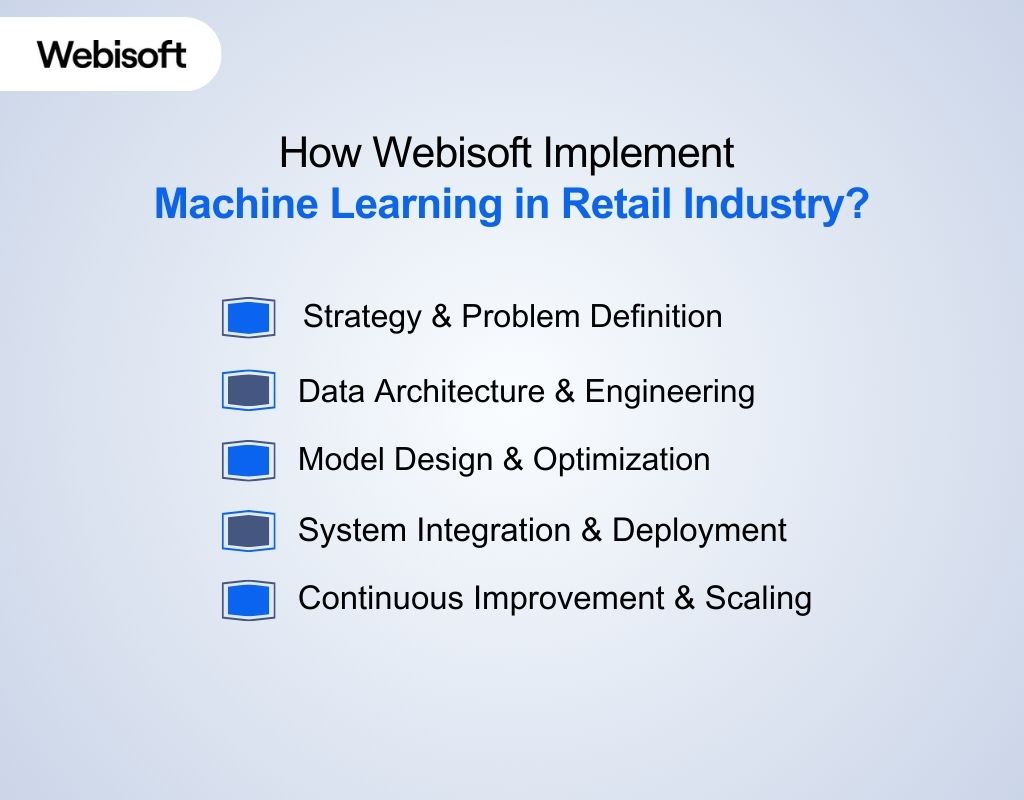
Machine learning in retail delivers results only when strategy, engineering, and execution align properly. At Webisoft, we approach retail transformation as a system-level upgrade, not just a model deployment. Our objective is to connect predictive intelligence directly to measurable business impact.
Strategy & Problem Definition
We begin by identifying performance gaps that affect revenue and efficiency. These may include unstable demand forecasts, pricing inefficiencies, weak personalization, or stock imbalances. Every initiative starts with clearly defined business KPIs. Our experience delivering AI and SaaS platforms such as Maxa AI, ConQuerence AI, and Edigo strengthens our ability to align technical systems with commercial outcomes.
Data Architecture & Engineering
We design a unified data backbone before building predictive models. This includes consolidating POS data, behavioral signals, pricing logs, and supply chain inputs into structured pipelines. Clean architecture improves model reliability and scalability. Our work on large-scale platforms like Proprio Direct, Choreography Online, and Spafax reflects our expertise in managing complex, high-volume data environments.
Model Design & Optimization
We develop custom forecasting, pricing, and segmentation systems tailored to retail operations. Our models analyze historical trends, demand variability, and customer behavior to improve planning accuracy and margin control. Our AI-focused projects, including ConQuerence AI and Maxa AI, demonstrate our ability to build adaptive intelligence systems that evolve with business needs.
System Integration & Deployment
We embed predictive outputs directly into operational systems. Forecasting connects to inventory tools, pricing engines link to ERP systems, and personalization integrates with CRM platforms through secure APIs. Our experience building transactional platforms such as BidAction and BidXpert supports reliable, real-time integration across enterprise environments.
Continuous Improvement & Scaling
We treat predictive systems as long-term assets. We monitor model performance, retrain when demand shifts, and refine logic to maintain accuracy. This ensures sustained operational impact. Our enterprise platforms, including Genium 360 and Exmar, reflect our capability to manage and scale complex digital ecosystems. When we implement machine learning for retail, we build for long-term growth.
Conclusion
Machine learning in retail helps businesses move from reactive decisions to proactive strategy. It reduces uncertainty, protects margins, and improves customer experience at scale. However, success depends on clean data, strong integration, and continuous improvement. Retailers that invest in the right architecture and expertise position themselves for long-term growth in an increasingly competitive market.
FAQs
Dynamic pricing uses predictive models to adjust product prices based on demand, competition, inventory levels, and customer behavior. When demand rises, prices may increase to protect margin. When demand slows, controlled discounts stimulate sales while avoiding unnecessary markdown losses.
Machine learning improves inventory management by predicting demand more accurately. It analyzes past sales, seasonality, promotions, and supplier lead times to estimate future stock needs. As a result, retailers reduce stockouts, lower excess inventory, and improve turnover rates.
Retail ML models need structured and historical data. This typically includes POS transactions, product details, pricing history, promotions, inventory levels, and customer behavior data. External inputs such as weather, holidays, and regional trends can further improve prediction accuracy.
Retail demand forecasting accuracy depends on data quality and model design. Advanced predictive models often outperform traditional statistical methods by incorporating multiple variables beyond historical averages. When properly implemented, forecasting error rates can drop significantly compared to manual planning.
Small retailers can adopt machine learning through cloud-based tools and SaaS platforms. They do not need large in-house data science teams to begin. Starting with basic demand forecasting or recommendation engines often delivers measurable improvements.
AI in retail carries risks such as data privacy issues, biased recommendations, and model drift. Poor data quality can lead to inaccurate forecasts or pricing errors. Retailers must monitor models continuously and follow compliance standards to reduce risk.