
Financiers stopped guessing the future long ago. Everyone knows they have to take in all kinds of data to properly value assets and markets. You cannot do a lot about unquantifiable data. But for the data that can be translated into numbers, it is just a case of how much data you can process.
The more you can, the better you are at your game. And as you can already understand, this scene is screaming for help from advanced machine learning. Because machine learning in quantitative finance can run mathematical models much faster and in a higher quantity than a human ever can.
That’s why machine learning and artificial intelligence are the race to win for this industry. And we are going to discuss everything about this topic in this article.
What is Quantitative Finance?
Most people are not financially literate let alone quantitative finance. So, let’s learn about it before understanding how machine learning is used in quantitative finance. CFA Institute defines Quantitative Finance as the application of mathematical and statistical methods to financial and risk management problems.
It is basically applying mathematical models on extremely large data sets to price assets, manage risks and predict market behavior. It involves finance, statistics, mathematics, and computer science.
Machine Learning in Quantitative Finance
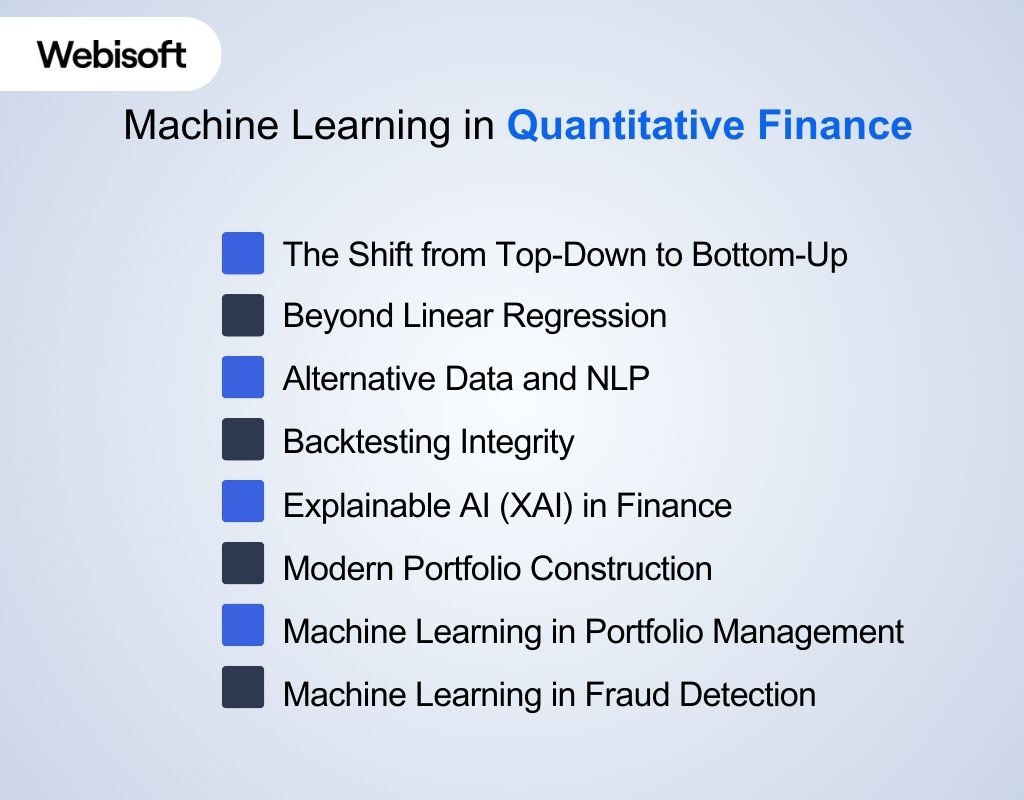
The Shift from Top-Down to Bottom-Up
Traditionally, quantitative finance relied on a top-down approach. Researchers formulated hypotheses based on economic theory such as interest rate impacts on equity and built linear models to test them. This method prioritizes deductive reasoning, where the model is strictly constrained by human assumptions. The shift toward Machine Learning (ML) introduces a bottom-up paradigm driven by inductive reasoning. Instead of starting with a theory, quants feed vast datasets into algorithms to let the data speak. These models identify complex, non-linear patterns and high-dimensional interactions that human researchers might overlook. While top-down models offer high interpretability, they often miss the micro-structures of modern markets. The bottom-up approach excels at capturing these nuances but risks overfitting noise. Modern firms now favor a hybrid: bottom-up ML for signal discovery, governed by top-down risk management.
Beyond Linear Regression
Modern quantitative stacks have evolved beyond the limitations of linear models to capture non-linear market dependencies. Gradient Boosting Decision Trees , specifically XGBoost and LightGBM, have become industry standards for tabular financial data.
XGBoost is favored for its robustness and precise handling of smaller datasets, while LightGBM’s leaf-wise growth and histogram-based binning provide the extreme speed required for large-scale, high-dimensional feature sets. Simultaneously, Deep Learning is being integrated for unstructured data and complex time-series forecasting.
LSTMs and Transformers excel at capturing long-term temporal dependencies, while Reinforcement Learning is increasingly used for end-to-end portfolio optimization.
While GBDTs often outperform neural networks on structured price data due to better signal-to-noise handling, the most sophisticated quant mentalities now utilize hybrid architectures using Deep Learning for feature extraction and Gradient Boosting for final signal generation.
Alternative Data and NLP: Quantifying Sentiment and Unstructured Text
Traditional quantitative models primarily ingest structured data like price and volume. However, Machine Learning has unlocked Alternative Data, allowing quants to extract signals from the 80% of financial information that is unstructured.
Natural Language Processing is the primary tool here, transforming news headlines, earnings call transcripts, and social media feeds into tradable numerical features. Early sentiment analysis relied on simple word counts (lexicon-based), but modern stacks utilize Large Language Models and BERT-based architectures to understand context, sarcasm, and financial nuances.
Beyond sentiment, NLP identifies thematic shifts in central bank communications or supply chain disruptions hidden in satellite imagery metadata. The challenge lies in the high decay rate of these signals; as more firms adopt NLP, the alpha from a breaking news sentiment score compresses rapidly.
Backtesting Integrity: Solving the Overfitting Challenge
While selecting the right algorithm is vital, Machine Learning’s role in quantitative finance extends deeply into the validation process. Unlike physical sciences, financial data is noisy and non-stationary, meaning the rules of the market change over time.
This creates a massive risk of overfitting, where a model becomes a history teacher that memorizes the past but fails to predict the future. To combat this, ML practitioners use advanced validation techniques like Combinatorial Purged Cross-Validation.
This goes beyond simple testing by purging data points to prevent look-ahead bias and the accidental leakage of future information into the training set.
By treating backtesting as a rigorous ML experiment rather than a simple historical simulation, quants can distinguish between a lucky path-dependent fluke and a statistically robust strategy. In modern finance, Machine Learning isn’t just used to generate signals; it is the primary tool used to prove those signals are actually real.
Explainable AI (XAI) in Finance: Meeting Regulatory Demands
In the highly regulated world of quantitative finance, a model that performs well is not enough; it must also be explainable. Regulators and risk managers often reject black box models like deep neural networks if their decision-making process cannot be audited.
To bridge the gap between high performance and transparency, quants use Explainable AI (XAI) techniques to decompose complex model outputs into human-readable insights. Two primary frameworks dominate this space: SHAP (SHapley Additive exPlanations) and LIME (Local Interpretable Model-agnostic Explanations).
- SHAP is grounded in game theory, treating each input (e.g., inflation rates, volatility) as a player and calculating its fair contribution to the final payoff (the prediction). It provides a mathematically consistent global view of what drives the model.
- LIME takes a local approach, perturbing a specific data point to see how the model reacts, effectively creating a simple linear proxy to explain a single trade or credit decision.
By integrating these tools, firms can fulfill right to explanation mandates under regulations like GDPR or the EU AI Act, ensuring that every automated signal can be defended during a regulatory audit.
Modern Portfolio Construction: Reinforcement Learning and Deep Hedging
For decades, Mean-Variance Optimization was the industry standard, but it often fails by assuming markets are static. Modern quantitative finance has shifted toward Reinforcement Learning, which treats portfolio management as a dynamic, sequential decision-making process.
Unlike static models, an RL agent learns an optimal policy by interacting with market simulators, directly accounting for transaction costs and liquidity constraints that traditional formulas ignore.
A key breakthrough is Deep Hedging. While classical hedging relies on the restrictive assumptions of the Black-Scholes model, Deep Hedging uses neural networks to minimize risk across thousands of stressed scenarios.
This allows firms to manage derivatives in a model-free way, adapting to non-linear correlations and volatile regimes. By replacing rigid formulas with adaptive ML agents, quants can build portfolios that are resilient to real-world market complexities.
Machine Learning in Portfolio Management
In modern quantitative finance, Machine Learning provides another way for managers to navigate the limitations of classical asset allocation. Traditional methods often rely on static correlations that break down during market stress. ML models, particularly Clustering Algorithms and Reinforcement Learning, allow for a more dynamic approach.
By grouping assets based on high-dimensional features rather than just industry sectors, quants can build Hierarchical Risk Parity portfolios. These models adapt to shifting market regimes, optimizing the balance between risk and return without the restrictive assumptions of normal distribution found in traditional finance.
Machine Learning in Fraud Detection
Another way Machine Learning is playing a part in quantitative finance is through the real-time identification of anomalous trading activity and financial fraud.
Traditional rule-based systems are often too rigid to catch sophisticated, evolving tactics. Instead, financial institutions deploy Anomaly Detection algorithms and Neural Networks that learn the baseline behavior of market participants.
These models can flag spoofing in order books or identify suspicious transaction patterns across millions of data points in milliseconds. This proactive ML layer is essential for maintaining market integrity and protecting institutional assets from increasingly complex cyber-threats.
Classical Econometrics VS Machine Learning in Quantitative Finance
Machine Learning (ML) has shifted quantitative finance from theory-driven top-down modeling to data-driven bottom-up discovery. While classical econometrics focuses on causal inference and statistical significance, modern ML prioritizes out-of-sample predictive accuracy.
This transition allows quants to move beyond linear regressions to capture non-linear market patterns using architectures like XGBoost for tabular data and LSTMs for complex time-series forecasting.
| Feature | Classical Econometrics | Machine Learning |
|---|---|---|
| Primary Logic | Inference-based: Focuses on hypothesis testing and the statistical significance of coefficients. | Prediction-based: Prioritizes minimizing error and maximizing out-of-sample predictive accuracy. |
| Data Nature | Structured & Static: Best suited for smaller, clean datasets where variables have clear theoretical meanings. | Unstructured & Large: Efficiently processes massive, noisy datasets including text, images, and high-frequency ticks. |
| Model Structure | Linear & Parametric: Relies on rigid assumptions like normality and homoscedasticity to define relationships. | Non-linear & Adaptive: Utilizes non-parametric architectures that learn complex, evolving dependencies directly from data. |
| Feature Goal | Parsimony: Prefers simple models with few variables to avoid multicollinearity and ensure interpretability. | Dimensionality: Capable of handling thousands of features simultaneously to find alpha in weak, hidden signals. |
| Market Regime | Stationary: Assumes the underlying rules governing the market remain constant over time. | Non-Stationary: Designed to adapt to changing regimes and structural breaks through continuous learning. |
Bayesian Machine Learning in Quantitative Finance
While standard deep learning thrives on massive datasets, Bayesian machine learning in quantitative finance is essential for quantifying uncertainty in volatile markets. Unlike frequentist models, Bayesian methods treat parameters as probability distributions, allowing quants to incorporate prior economic beliefs and update them dynamically as new data arrives.
This approach is a frequent highlight at any major machine learning & ai in quantitative finance conference, where the focus is on building robust models for risk management and hierarchical asset allocation that can survive fat-tail market events.
By providing a distribution of outcomes rather than a single point estimate, Bayesian frameworks offer a mathematically rigorous path to transparency, moving beyond the limitations of black-box models.
At Webisoft, we specialize in building these complex probabilistic architectures, helping firms deploy and scale world-class intelligence. Explore our Artificial Intelligence Development Services today to leverage custom Bayesian frameworks and elite engineering for your next project.
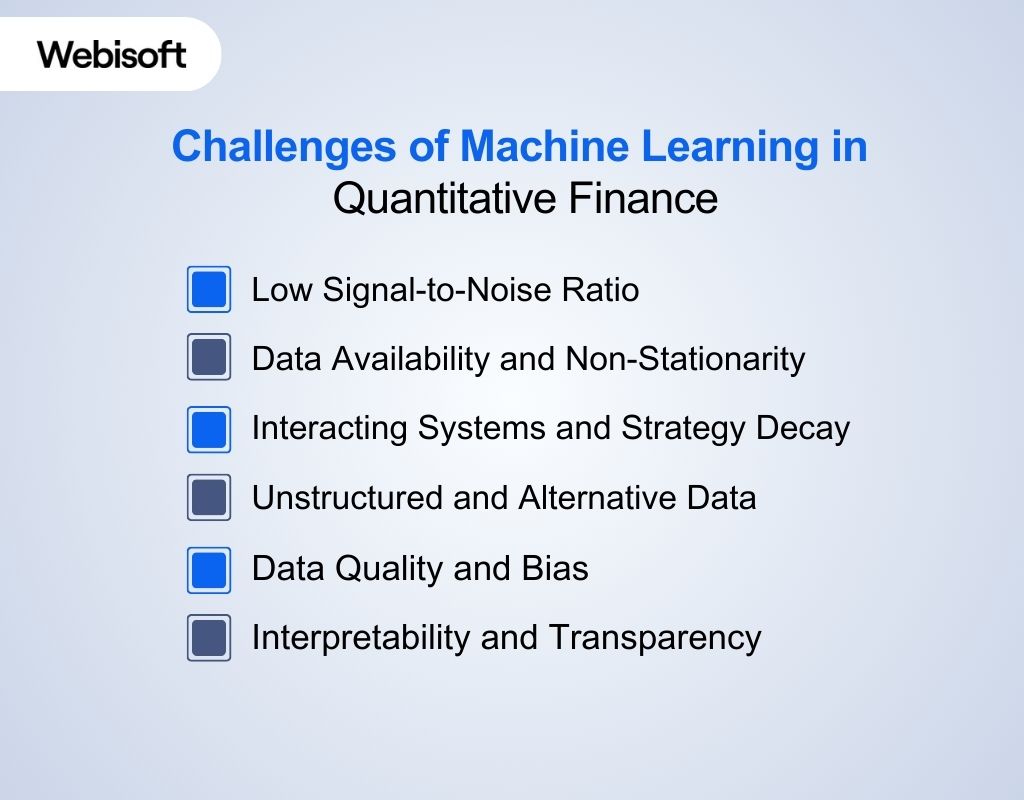
Challenges of Machine Learning in Quantitative Finance
While machine learning has revolutionized various industries, its application in quantitative finance presents unique and formidable obstacles. These challenges stem from the inherent nature of financial markets and the data they generate.
Low Signal-to-Noise Ratio
Financial markets are defined by high levels of uncertainty. Unlike computer vision, where a child can easily identify a number, financial signals are incredibly weak compared to the surrounding noise of market volatility.
This inherent randomness makes consistent success rare and led to the Nobel-winning work of Fama and French. For ML models, this low ratio often leads to severe overfitting, where the algorithm mistakes random noise for predictive patterns.
Data Availability and Non-Stationarity
Some financial instruments exist only for short durations, providing insufficient history for deep learning or complex architectures. Financial data is non-stationary; its statistical properties change over time. As market regimes shift, older data may become irrelevant or misleading for future predictions.
Interacting Systems and Strategy Decay
Financial markets are adversarial and competitive. Unlike image recognition, where the rules of what constitutes a face are static, financial markets react to the actors within them.
Once a profitable ML strategy is deployed and recognized, it is often exploited by competitors until the alpha vanishes. This makes long-term consistency incredibly difficult.
Unstructured and Alternative Data
There is a growing reliance on alternative data, such as satellite imagery, financial news, and social media sentiment. While potentially high-alpha, these unstructured sources cannot be analyzed via traditional statistical methods, necessitating advanced ML pipelines that introduce their own technical complexities.
Data Quality and Bias
The Garbage In, Garbage Out principle is amplified in finance. Even minor errors, outdated figures, or geographic/industry skews can lead to models that favor specific stocks while ignoring others. Addressing this requires:
- Rigorous data cleansing and infrastructure.
- Deep understanding of source limitations to prevent excessive risk exposure.
Interpretability and Transparency
ML models, especially black box algorithms, can be difficult to explain. Financial institutions face the challenge of making these models transparent to regulators and clients. Building trust and ensuring accountability is critical when significant capital is at risk.
The Evolution of Machine Learning in Quantitative Finance
The trajectory of machine learning in quantitative finance represents a move from simple heuristic-based automation to complex, autonomous intelligence. This evolution is defined by the increasing capacity of algorithms to handle the high dimensionality and non-linearity of market data.
Early Integration (1990s–2000s): The first wave of ML was primarily focused on linear supervised learning. Practitioners utilized simple regressions and basic decision trees to automate trade execution and capture high-frequency arbitrage.
During this phase, neural networks remained largely academic due to significant computational constraints, and the demand for specialized machine learning quant jobs was only just beginning to emerge. The
Rise of Statistical Learning (2010s): As data volume exploded, the industry shifted toward ensemble learning. Robust algorithms like Random Forests and Gradient Boosting Machines became industry standards.
These models allowed quants to map complex, non-linear relationships that traditional models failed to detect. This period solidified the role of machine learning for trading, as firms realized the competitive advantage of predictive modeling over static rule-based systems.
The Deep Learning and Autonomous Era (Present): Modern applications leverage sophisticated Deep Learning architectures. Recurrent Neural Networks (RNNs) and LSTMs are used for time-series forecasting, while Transformers (such as FinBERT) process unstructured alternative data.
Additionally, Reinforcement Learning is being deployed to create autonomous agents for portfolio optimization. This technological shift has transformed the labor market, making proficiency in deep learning a prerequisite for top-tier machine learning quant jobs in the current landscape.
How Webisoft Drives Value with Machine Learning in Quantitative Finance
Applying machine learning to the complexities of quant trading requires more than technical proficiency; it requires an understanding of where alpha hides and how market anomalies surface.
Webisoft applies ML through a risk-aware, performance-driven lens, shifting the focus from abstract model building to actionable trade signals and operational control. We support quantitative finance and risk-focused initiatives through:
- Risk Trend Forecasting: We leverage historical market data and behavioral order flow to anticipate emerging risk patterns, allowing your team to act before exposure materializes in volatile environments.
- Anomaly-Driven ML for Quant Trading: We build custom systems that convert raw, unstructured activity from alternative data to order book imbalances into clear risk indicators and signals tied to real-world execution decisions.
- Predictive Performance Monitoring: Our models detect early degradation in alpha signals or execution processes, signaling rising operational risks or strategy decay before they impact the bottom line.
- Neural System Pattern Detection: We utilize advanced neural networks to identify non-linear risk interactions across massive, multi-variable financial datasets that traditional rule-based controls often miss.
- Outlier Discovery & Alpha Protection: From identifying hidden dependencies in high-frequency data to detecting abnormal execution patterns, our learning systems provide a robust defense for your proprietary strategies.
Transition your machine learning initiatives from experimental prototypes to essential production systems. Whether you are optimizing a quant trading desk or hardening your risk infrastructure, Webisoft provides the specialized engineering talent to deliver high-performance results. Ready to start your machine learning journey in risk reduction? Partner with a leading Machine Learning Development Company and book your consultation with Webisoft today!
Frequently Asked Questions
Conclusion
The integration of machine learning in quantitative finance represents a paradigm shift from rigid, theory-constrained models to adaptive, data-driven intelligence.
By leveraging advanced architectures like Transformers and Bayesian frameworks, firms can now unlock alpha within unstructured alternative data and manage risk with unprecedented precision.
As markets become increasingly adversarial and high-dimensional, the ability to deploy robust, explainable AI is no longer a luxury but a prerequisite for institutional survival. At Webisoft, we provide the specialized engineering expertise required to turn these complex probabilistic theories into high-performance production systems.
The industry is currently moving toward Generative AI for synthetic data generation and Reinforcement Learning for autonomous trade execution. Another major trend is the use of Graph Neural Networks to map complex supply chain dependencies and systemic risk across global markets.
NLP allows firms to quantify the unstructured world. By using models like FinBERT to analyze earnings calls and news, quants can capture market sentiment and thematic shifts before they are reflected in price data.
The explosion of alternative data has shifted the requirements for machine learning quant jobs. Firms now prioritize candidates who can build complex ETL pipelines and multi-modal models that combine text, image, and tabular data.