Large-scale IT projects fall apart faster than anyone expects. Resources get misallocated, warning signs go unnoticed, and damage only surfaces when budgets are already broken. Even the reports say that 70% of projects worldwide fail to meet their original deadline or budget. Machine learning directly addresses this problem.
It analyzes historical project data, detects risk signals weeks in advance, and forecasts budget deviations before they compound. If you’re managing tight deadlines and rising costs, this isn’t just theory. It’s a practical advantage. Read on to learn exactly how to implement machine learning in project management today.
What is Machine Learning in Project Management?
Machine learning in project management is the use of data-driven algorithms to predict project outcomes. These systems analyze historical performance to forecast future risks and resource needs. This technology acts as a digital advisor for your complex planning tasks. You gain the ability to spot trends before they impact your budget. It transforms raw project archives into a roadmap for future success. It also
➜Identifies which tasks frequently slip past their original deadlines.
➜Sets more realistic expectations with your clients using data-backed insights.
➜Automates the tedious work of tracking daily progress updates.
➜Frees your team to focus on creative problem-solving and leadership.
➜Achieves more consistent delivery across your entire project portfolio.
How Machine Learning Models Actually Work in Project Environments
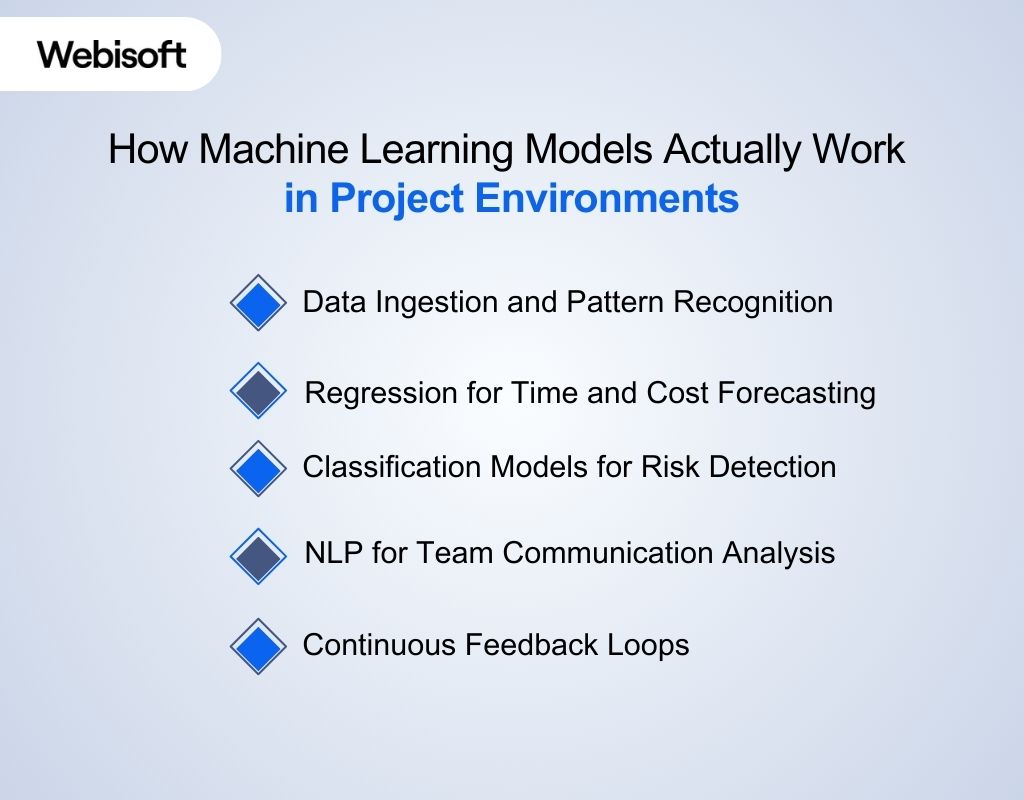
Machine learning models in the project management process use vast amounts of historical data to uncover hidden patterns. They use these insights to forecast future performance and identify risks. Here is how it converts past experiences into reliable, forward-looking guidance for your team.
1. Data Ingestion and Pattern Recognition:
First, the model ingests your past project data, like timelines, task durations, budget logs, and scope changes. Then it scans thousands of data points to find hidden patterns. For instance, it might discover that projects with more than 8 stakeholders consistently run 20% over schedule. Once found, that pattern becomes a direct prediction rule for your next project.
2. Regression for Time and Cost Forecasting:
Once the data is clean, regression algorithms take over. These algorithms map relationships between your input variables and outcomes. So when you feed it your project scope and team size, it outputs a predicted completion date and cost range. In fact, ML techniques analyze historical and real-time metrics to forecast timelines and costs with high accuracy. That’s far more reliable than any gut estimate alone.
3. Classification Models for Risk Detection:
Even so, not every risk looks obvious on the surface. That’s exactly where classification models step in. Logistic regression calculates the probability that a specific failure event will occur and outputs a score between 0 and 1. Meanwhile, it simultaneously scans your risk register, team velocity, and budget burn rate. As a result, you catch problems weeks before they derail the project.
4. NLP for Team Communication Analysis:
Beyond numbers, your Slack messages and emails carry hidden signals too. Natural Language Processing models read this unstructured text and detect negative sentiment, confusion, or repeated blockers. For example, tools like Forecast use pre-trained transformer models to classify tasks and recommend assignees in real time.
5. Continuous Feedback Loops:
Every completed task serves as new training data for the system. Your predictions become more precise with every project your team finishes. The software literally gets smarter as your company grows and evolves. This creates a compounding benefit for your project management office over time.
Note: A study by the Project Management Institute (PMI) found that “AI Innovators” deliver 61% of projects on time. In contrast, those not using the technology only hit their marks 47% of the time.
Traditional Project Management vs Machine Learning–Driven Project Management
Traditional management relies on subjective human intuition and linear planning to forecast project outcomes. Machine learning-driven management instead utilizes high-dimensional data and predictive algorithms to automate risk detection and scheduling
| Area | Traditional Project Management | AI-Driven Project Management |
|---|---|---|
| Forecasting | Relies on human intuition and manual “best guesses.” | Uses supervised learning to analyze thousands of past data points. |
| Risk Detection | Reactive; issues are flagged after they impact the project. | Proactive; identifies “project drift” patterns weeks in advance. |
| Resource Allocation | Managers assign tasks based on visible availability only. | Algorithms match tasks to competency and past performance. |
| Scheduling | Static Gantt charts that require manual daily updates. | Dynamic, self-healing timelines that adjust to real-time velocity. |
| Budgeting | Top-down estimates with a high risk of human bias. | 85% accuracy in cost forecasting using regression models. |
| Reporting | Time-consuming manual synthesis of weekly status updates. | Instant, automated dashboards with predictive health metrics. |
| Decision Support | Decisions are made based on limited, siloed information. | Integrated insights pulled from the entire company’s project history. |
Core Problems Machine Learning Solves in Projects
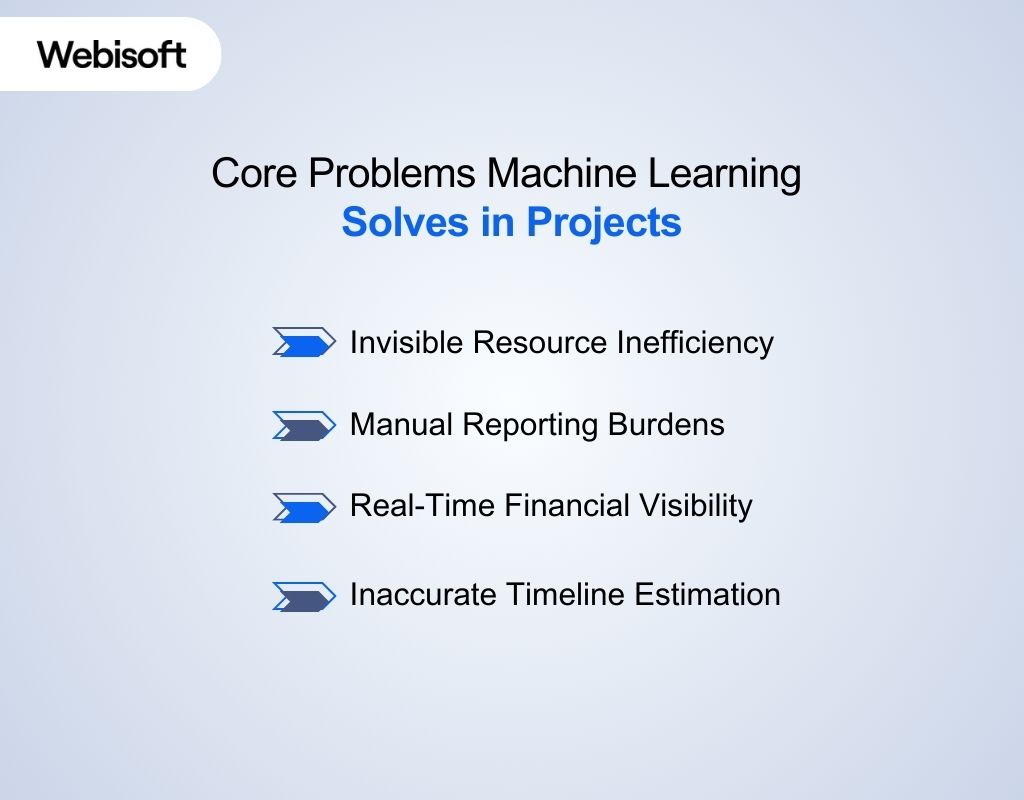
Machine learning solves core project problems by turning historical data into predictive intelligence. It reduces uncertainty in forecasting, detects risks early, optimizes resource allocation, improves budget accuracy, and supports faster, data-driven decisions.
Invisible Resource Inefficiency
It is difficult to see when your top talent is burning out or sitting idle across different silos. Algorithms optimize person-to-task matching, which can improve your resource utilization efficiency by up to 15% over traditional allocation methods.
Manual Reporting Burdens
You shouldn’t spend your Fridays chasing status updates and building spreadsheets. Gartner predicts that 80% of traditional project management tasks will be eliminated by 2030, allowing you to focus on leading people instead of tracking data.
Real-Time Financial Visibility
Instead of waiting for a monthly report to see that you are over budget, AI dashboards track spending in real-time. This allows for immediate intervention, leading to an average 20% reduction in overall project costs. You can stop cost overruns before they damage your final results.
Inaccurate Timeline Estimation
Managers estimate deadlines based on experience. For instance, one wrong assumption cascades into missed milestones. AI machine learning analyzes hundreds of past project timelines and calculates realistic, data-backed delivery dates automatically.
High-impact Use Cases of Machine Learning in Project Management
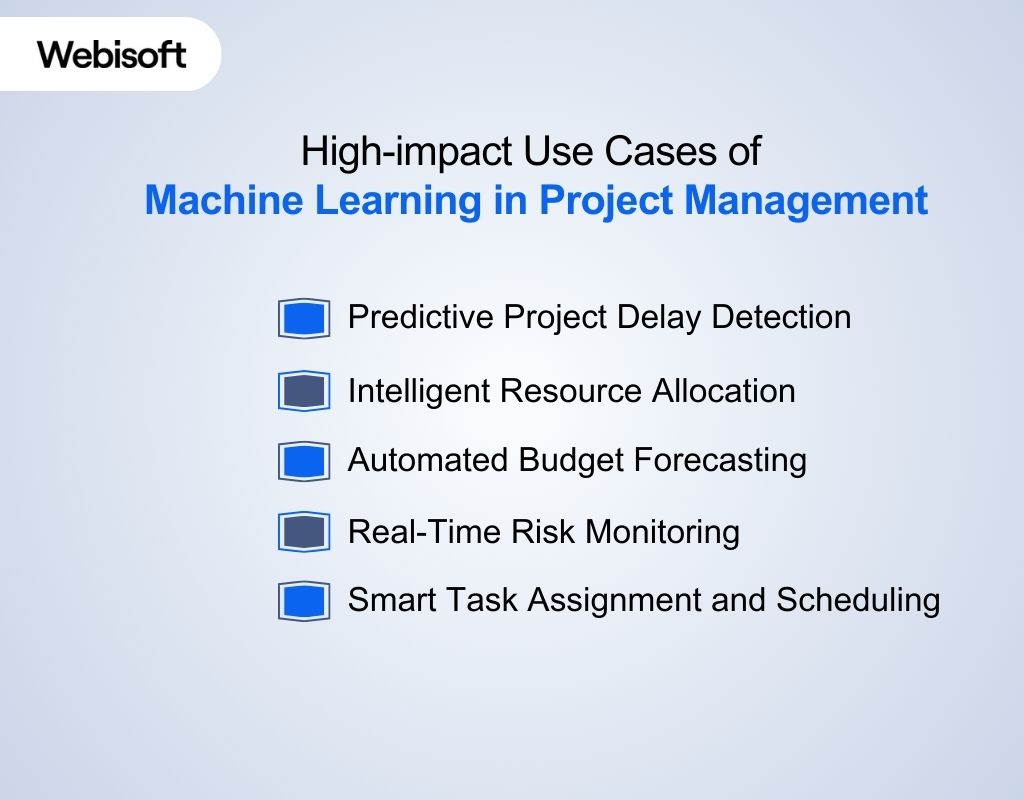
Machine learning isn’t theoretical in project management. It’s already running inside real tools and real projects. Here are the highest-impact areas where it’s actively delivering measurable results right now.
1. Predictive Project Delay Detection
ML models analyze variables like task complexity, team size, and dependencies to predict delay risks before they happen. For instance, one data scientist analyzed 5,000 Jira tickets and predicted 41% of delays in advance. That’s weeks of early warning, not a post-mortem report.
2. Intelligent Resource Allocation
Poor resource planning silently kills project timelines. ML models trained on past productivity and demand patterns match labor, equipment, and materials to the right project phases, directly reducing idle time. As a result, teams stay productive without burning out.
3. Automated Budget Forecasting
Spreadsheet-based cost estimates miss hidden variables every time. Tools like Projectworks use ML models to track live spending patterns and flag cost overruns before they occur. This is particularly powerful for PMOs managing large portfolios with complex, interconnected financial needs. You get a live cost forecast, not a monthly surprise.
4. Real-Time Risk Monitoring
Traditional risk reviews happen weekly or monthly, and are often far too slow. ML surfaces early signals like procurement bottlenecks, quality issues, and scheduling risks. Teams can plan mitigation strategies before problems escalate. Furthermore, it monitors live field data continuously, not just during scheduled check-ins.
5. Smart Task Assignment and Scheduling
Assigning tasks manually means relying on whoever seems available. ML changes that completely. AI-powered tools like Asana and Monday use ML to automate scheduling and workload balancing based on real-time availability and skill data. Consequently, the right person gets the right task, every single time, without manager intervention.
Step-by-Step Roadmap for Implementing Machine Learning in Project Management
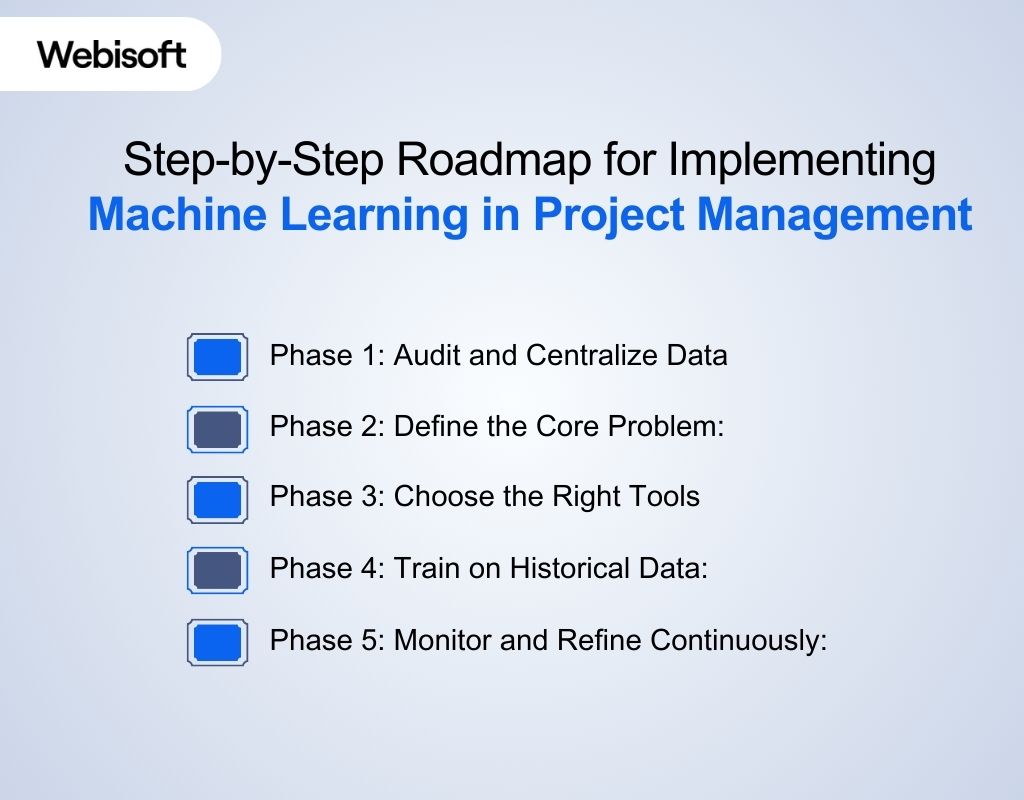
Implementing ML in project management starts with clean data, the right tools, and a phased approach. You don’t need a data science team. You need a clear process, the right stack, and consistent execution.
Phase 1: Audit and Centralize Data
Start by auditing your existing project data, like timelines, budgets, task logs, and team performance records. Then centralize everything into one unified source. For example, a construction firm might pull data from Excel sheets, Procore, and emails, and then consolidate it all into a single data warehouse.
Phase 2: Define the Core Problem:
Don’t implement ML broadly, and that’s where most teams fail. Pick one specific problem first. For instance, a software agency struggling with missed sprint deadlines should focus purely on delay prediction first. A focused problem produces a focused, accurate model. Once that model proves results, you expand it to tackle budget forecasting or resource conflicts next.
Phase 3: Choose the Right Tools
You don’t need to build models from scratch. Tools like Forecast.app, Celoxis, and Microsoft Project with AI integrations already have pre-built ML capabilities. For example, a marketing agency managing 20+ simultaneous campaigns can use Forecast.app to automatically predict task durations and assign team members. Match the tool directly to your specific problem.
Phase 4: Train on Historical Data:
Feed your centralized data into the chosen tool or model. The model studies patterns, which project types ran late, which teams overspent, and where risks first appeared. For example, an IT firm feeds 3 years of software project data into their model. It immediately identifies that projects with unclear requirements in Week 1 consistently overrun by 35%. That single insight alone changes how they scope future projects.
Phase 5: Monitor and Refine Continuously:
Launching the model is not the finish line. It’s the starting point. Track its predictions against real outcomes every sprint. For example, if your model predicts a March 10 delivery but the project finishes March 18, investigate that gap immediately. Feed the corrected data back into the model. Over time, each correction sharpens accuracy, and your project decisions steadily improve with it.
Essential Data Requirements for ML Implementation
Implementing machine learning in projects requires structured historical, operational, and performance data. The quality, consistency, and volume of past project records determine how accurately models can forecast outcomes, detect risks, and optimize decisions.
| Data Category | Specific Data Points Required |
|---|---|
| Historical Performance | Actual start/end dates, past task durations, and historical velocity |
| Resource Metrics | Team skill sets, seniority levels, past performance ratings, and availability |
| Financial Records | Planned vs. actual costs, vendor invoices, and material price fluctuations |
| Project Metadata | Project type, industry sector, client priority, and team size |
| Communication Logs | Email frequency, meeting notes, and Slack/Teams sentiment analysis |
| Risk & Issue Logs | Past project blockers, bug reports, and weather/external delay records |
Is Machine Learning in Project Management Worth the Investment?
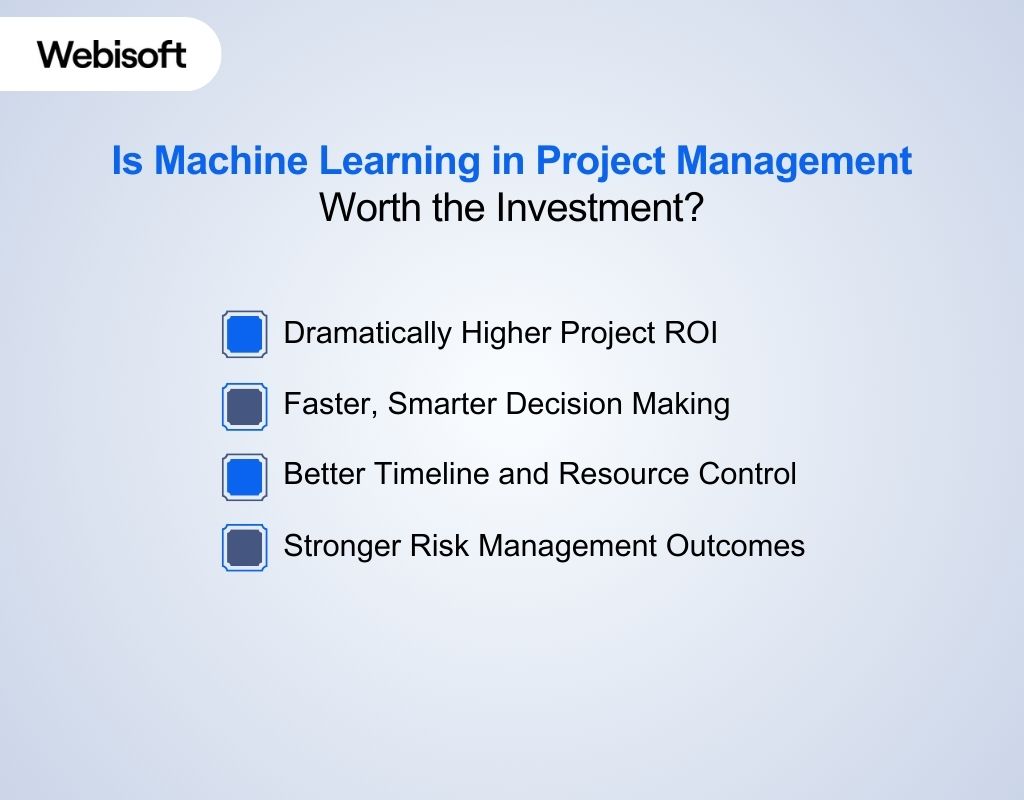
Machine learning in project management cuts costs, reduces failures, and accelerates delivery. Here’s what real adoption data actually shows. Here is more you can expect:
1. Dramatically Higher Project ROI
Machine learning investments deliver returns faster than most teams expect. 90% of project managers reported a positive ROI from AI within just 12 months of adoption. You can recover your investment quickly while building a smarter, more predictable project environment for long-term growth.
2. Faster, Smarter Decision Making
Slow decisions kill project momentum before risks even fully develop. ML feeds decision-makers real-time data instantly, eliminating the wait for weekly reports.
3. Better Timeline and Resource Control
63% of project managers confirmed that AI positively impacted their project timelines and resource utilization. Machine learning models analyze past schedules to predict task delays before they happen. You can rebalance workloads early instead of reacting at the last minute.
4. Stronger Risk Management Outcomes
Risk management is where ML proves its real value. Today, 54% of project managers use AI mainly to manage risks. These systems spot warning signs in budgets, timelines, and team performance early, so you can fix problems before they grow.
Note: If you want better cost control, smarter risk prediction, and data-driven project decisions, partnering with Webisoft’s expert ML team is the next step. Our specialists transform scattered project data into actionable insights and build ML systems that continuously improve as your projects, teams, and priorities evolve.
Risks and Limitations of Machine Learning in Project Management
While machine learning offers immense advantages, its successful implementation requires managing data privacy, algorithmic bias, and the loss of human intuition. Addressing these risks ensures your strategy remains ethically sound and technically reliable.
Risks and Limitations
- Data Quality and Bias: Algorithms learn from past project logs, which may contain human prejudices or “padded” estimates. If your historical data is flawed, the model will replicate those errors, leading to skewed timelines and unrealistic expectations. This creates a cycle where bad data leads to poor strategic decisions.
- The “Black Box” Problem: Complex neural networks often provide a prediction without explaining the “why” behind it. For project leads, this lack of transparency makes it difficult to justify budget shifts or schedule changes to stakeholders. You must ensure your tools prioritize “Explainable AI” to maintain professional accountability.
- Over-Reliance on Technology: Automated systems can miss nuances like team morale or sudden interpersonal conflicts. Relying solely on a dashboard for decision-making risks ignoring the “human element” that often drives project success. You must balance algorithmic insights with your own leadership intuition and cultural awareness.
The Future of Machine Learning in Project Management
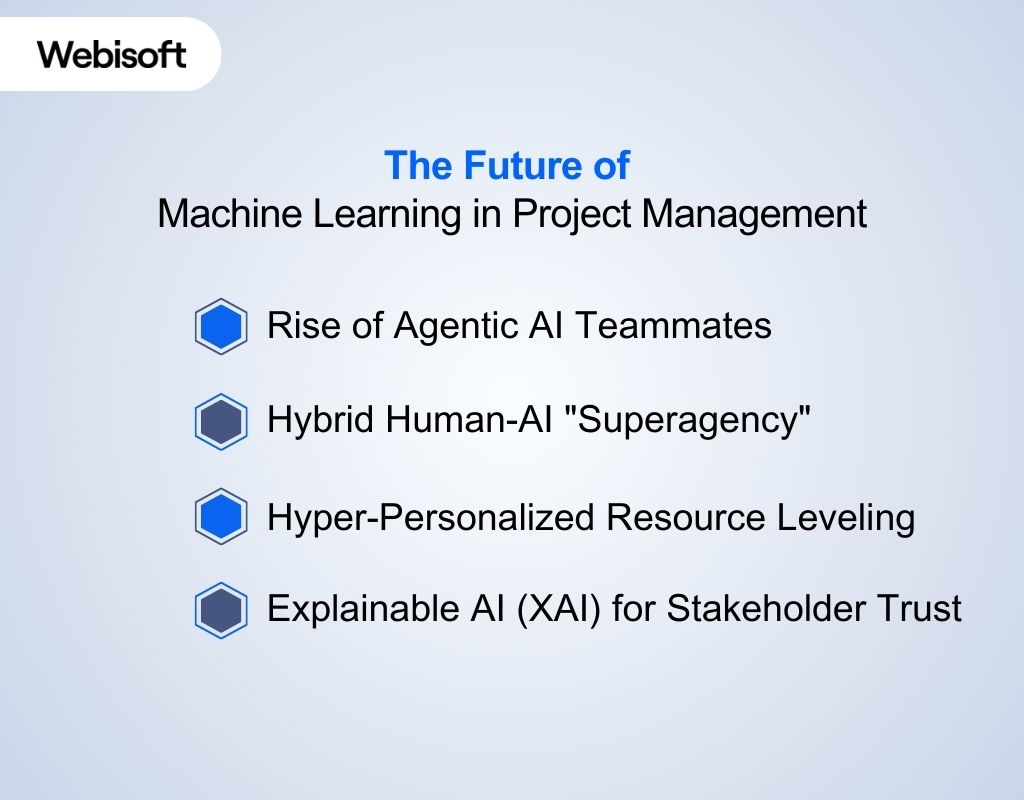
Machine learning is evolving from a simple data tool into an active collaborator. The future focuses on autonomous systems and “human-centered AI” to drive efficiency while maintaining high-level strategic leadership.
Rise of Agentic AI Teammates
We are moving beyond static software toward autonomous “agents” that don’t just alert you to problems. They act. By 2026, AI agents will autonomously reschedule tasks, negotiate with suppliers, and update stakeholders. You can focus entirely on high-stakes human negotiations and strategy.
Hybrid Human-AI “Superagency”
The future isn’t about replacing project managers. It’s about empowering them. You act as the “orchestrator” of a digital workforce, using AI to summarize complex discussions and turn them into clear action plans. Machines handle speed and analysis, while you lead with judgment, strategy, and empathy.
Hyper-Personalized Resource Leveling
Future systems will use multimodal learning to understand team sentiment alongside technical velocity. Instead of just matching a skill to a task, the AI will predict which team combination has the highest “emotional compatibility” for a specific project phase.
Explainable AI (XAI) for Stakeholder Trust
As we move toward 2030, the “black box” of AI is opening. Explainable AI will provide clear, logical reasons for every forecast or budget adjustment. This transparency allows you to confidently defend data-driven pivots to your board of directors with mathematical and logical clarity.
Want ML in Your Project Management Stack? Build It Right With Webisoft

Implementing ML in project management sounds straightforward. In reality, most companies hit the same walls, like unreliable models and systems that break under real complexity. We at Webisoft solve exactly that.
1. 90%+ Senior Engineering Team
Over 90% of our team are senior ML specialists with deep engineering expertise. We architect your system with precision, foresight, and long-term reliability in mind. Your ML investment gets built right, from day one.
2. Domain-Deep Project Intelligence
Our engineers go deep into real project dynamics, like resource dependencies, budget cycles, and risk escalation patterns. We embed that domain knowledge directly into your model’s architecture. The result thinks like a project manager, backed by ML precision.
3. Full ML Lifecycle Management
We handle everything, starting from data refinement, model design, deployment to continuous performance monitoring. As your projects scale, your system keeps learning and stays accurate. You never inherit a model that quietly degrades over time.
4. Direct Senior Engineer Collaboration
Our Montreal-based senior engineers work in your timezone, available for real-time decisions and live collaboration. No offshore delays or communication gaps. You always know exactly who is building your system and why.
In Closing
Machine Learning in Project Management gives you sharper forecasts, stronger risk control, and fewer budget surprises. It replaces guesswork with data-backed decisions and helps your team deliver with confidence.
If you’re ready to implement ML the right way, Webisoft can design and deploy a solution tailored to your projects. Start building your AI-powered system with Webisoft today.
Frequently Asked Questions
ML analyzes past task performance and team capacity to suggest the optimal allocation of resources, preventing overallocation and idle time.
Yes, ML identifies patterns and early warning signals in project data, helping you address potential delays weeks in advance.
Absolutely. Even smaller projects benefit from ML insights to optimize schedules, forecast risks, and manage budgets efficiently.
ML systems can be built with strict data privacy and encryption standards, ensuring sensitive project information remains protected.