Machine learning in neuroscience exists for one simple reason: brain data refuses to cooperate. Signals overlap, neurons misfire, experiments drift, and clean statistical assumptions collapse almost immediately. Instead of fighting that reality, machine learning works with it. These models tolerate noise, scale across massive datasets, and adapt to biological variability without forcing the brain into neat equations it never agreed to follow.
This article explains ML in neuroscience by breaking down the data involved and the methods researchers use. It also covers real applications and the limits that matter, so you know what holds up beyond theory.
What is Machine Learning in Neuroscience?
Machine learning in neuroscience refers to the use of data-driven models to study and interpret brain data. These models learn patterns directly from data rather than relying only on fixed rules or predefined statistical assumptions. Neuroscience data is often complex, high dimensional, and difficult to describe with simple mathematical relationships.
Machine learning provides a way to work with this complexity by identifying structure and regularities that may not be obvious through manual analysis. This approach sits at the intersection of computational modeling and brain science. It allows researchers to analyze neural data at scale while keeping the focus on understanding brain function rather than hand-crafted analytical rules.
Why Neuroscience Needs Machine Learning
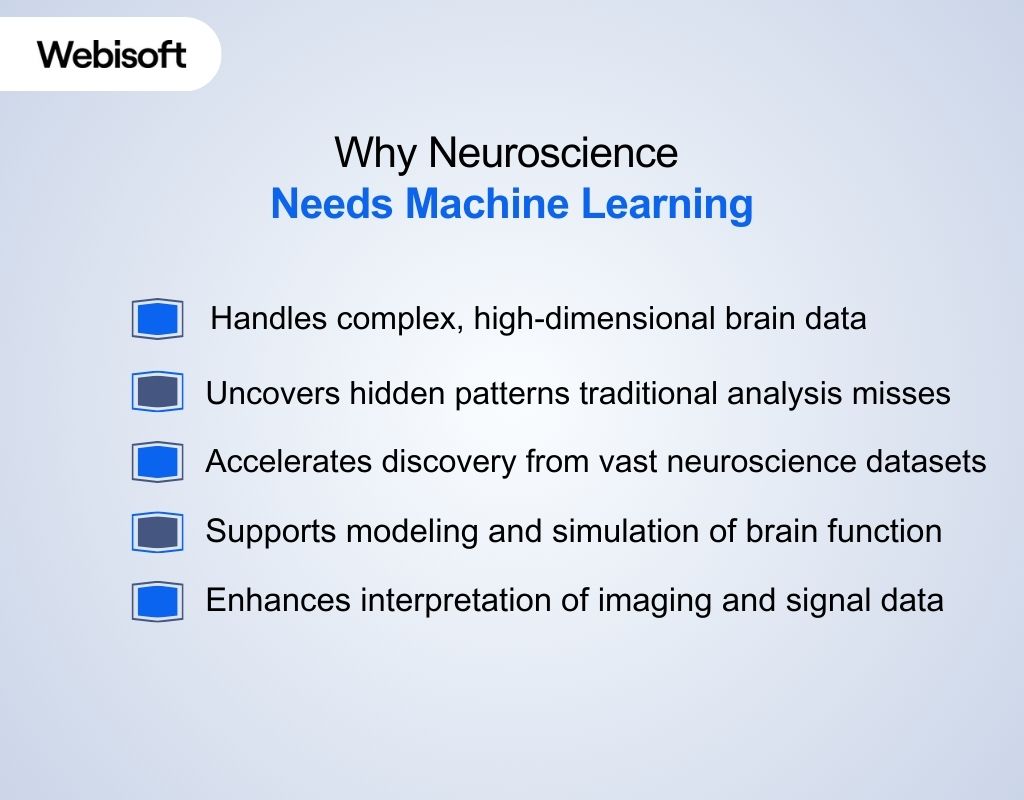
Neuroscience generates data that is too complex for traditional analysis alone. Brain signals are noisy, high dimensional, and highly variable across subjects. Machine learning provides the flexibility needed to analyze this data and extract structure that manual methods struggle to capture.
Handles complex, high-dimensional brain data
Brain research involves data from EEG, MEG, and fMRI that is often noisy and multidimensional. Machine learning can process these large datasets efficiently and identify patterns that basic statistical tools cannot reveal.
Uncovers hidden patterns traditional analysis misses
Patterns in neural data may be subtle or nonlinear. Machine learning models can learn these complex relationships directly from data, revealing insights that manual interpretation or simple models would not detect.
Accelerates discovery from vast neuroscience datasets
Modern neuroscience experiments can generate millions of data points. Machine learning workflows scale to this volume, enabling faster analysis and reducing the time from data collection to insight.
Supports modeling and simulation of brain function
Computational approaches augmented with machine learning can simulate neural processes and model brain function at multiple scales. Thus helping researchers frame and test hypotheses more effectively.
Enhances interpretation of imaging and signal data
Machine learning techniques improve the extraction of meaningful features from imaging and electrophysiological signals. This helps to make sense of raw measurements and refining research conclusions.
The Main Types of Neuroscience Data Machine Learning Works With
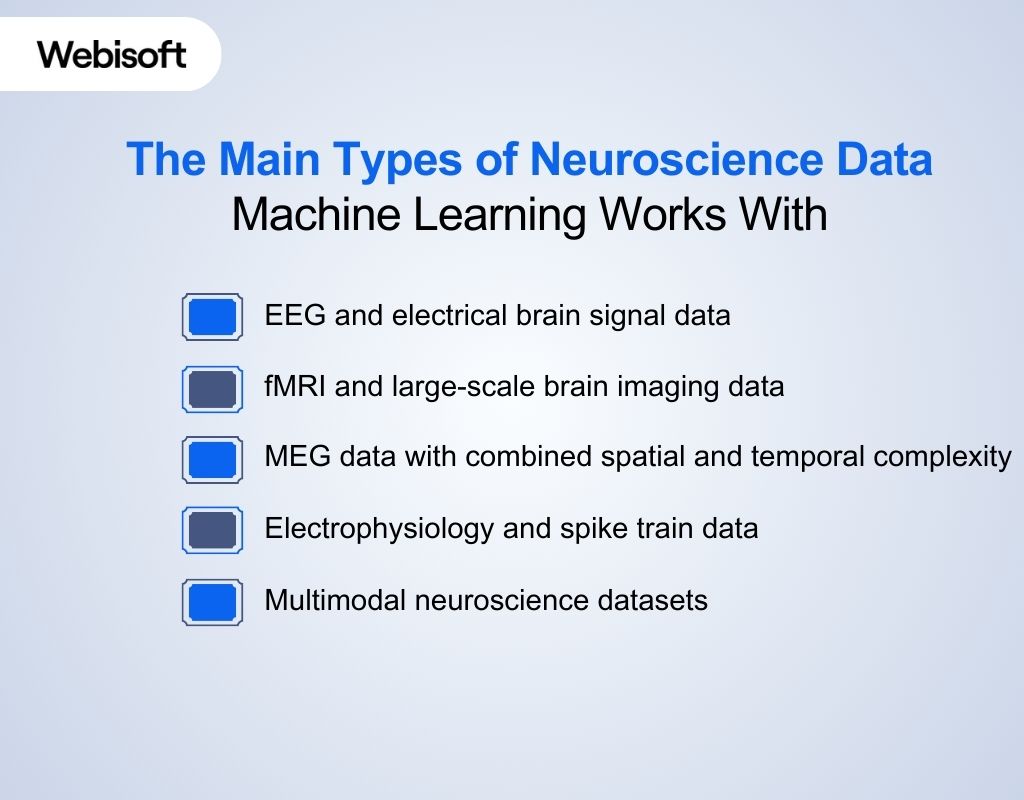
Neuroscience relies on multiple forms of brain data because neural activity cannot be captured through a single measurement. Many applications of machine learning in neuroscience exist because each data type introduces scale, noise, and structural complexity that traditional analysis cannot manage consistently.
EEG and electrical brain signal data
EEG records rapid electrical fluctuations from large neuron populations, and researchers use platforms like the Neuroimaging Informatics Tools and Resources Clearinghouse (NITRC) for datasets. These signals change over milliseconds and vary strongly across subjects, sessions, and recording conditions. Machine learning helps with EEG by:
- Learning temporal patterns that span many time points instead of relying on fixed frequency bands.
- Combining information across channels to capture spatial structure in scalp recordings.
- Adapting to subject variability by learning representations that generalize beyond a single individual.
Instead of forcing EEG into handcrafted features, ML models learn signal structure directly from data, which improves consistency across experiments.
fMRI and large-scale brain imaging data
fMRI produces high-dimensional spatial data, often with tens of thousands of voxels per scan but relatively few subjects. Neural activity is distributed across regions rather than isolated in single locations. Machine learning helps with fMRI by:
- Reducing dimensionality while preserving meaningful spatial patterns.
- Learning distributed representations of brain networks rather than isolated activations.
- Handling correlations across regions that violate assumptions of independence.
This allows researchers to analyze whole-brain patterns without oversimplifying the underlying neural processes.
MEG data with combined spatial and temporal complexity
MEG captures magnetic fields generated by neural currents, offering precise timing with improved spatial localization in certain contexts. The resulting datasets are large, multivariate, and computationally demanding. Machine learning helps with MEG by:
- Modeling spatial and temporal relationships jointly rather than separately.
- Extracting consistent patterns across sensors and time windows.
- Supporting decoding tasks that require fine temporal precision.
These capabilities make ML particularly suited for MEG studies that focus on dynamic brain processes.
Electrophysiology and spike train data
Spike data records discrete firing events from individual neurons. These signals are sparse, irregular, and sensitive to recording noise and experimental conditions. Machine learning helps with spike data by:
- Separating neural units during spike sorting using learned clustering patterns.
- Modeling firing variability across trials and conditions.
- Identifying coordinated activity across neuron populations.
ML allows researchers to move from raw spike events to interpretable population-level behavior.
Multimodal neuroscience datasets
Modern neuroscience increasingly combines EEG, fMRI, behavioral data, and physiological measurements within the same study. These datasets differ in resolution, timing, and signal structure. Machine learning helps with multimodal data by:
- Aligning signals with different temporal and spatial scales.
- Learning shared representations that link brain activity to behavior.
- Integrating complementary information without manual synchronization rules.
This integration is difficult to achieve with traditional pipelines, but learning-based models adapt naturally to cross-modal complexity.
How Machine Learning is Used in Neuroscience Research and Practice
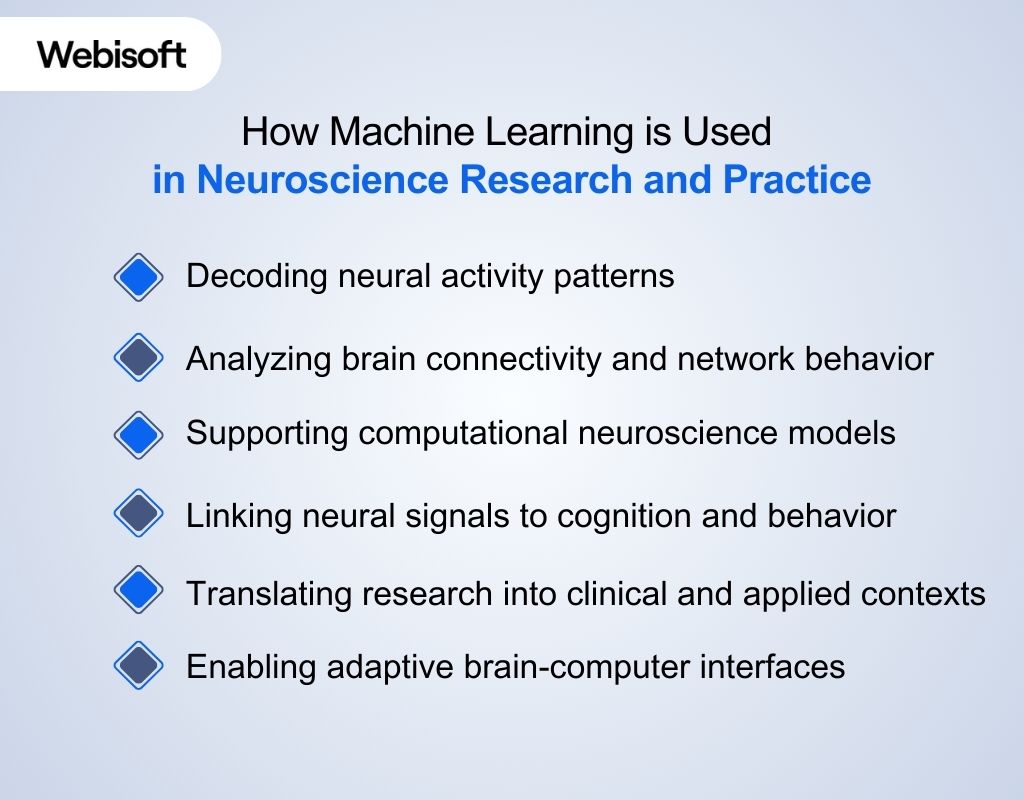
Working with diverse neuroscience data is only useful if it leads to meaningful analysis. AI and machine learning in neuroscience translate these signals into interpretable patterns. Here is how researchers apply these methods across studies and real-world practice today.
Decoding neural activity patterns
Machine learning is widely used to decode information from neural signals. Instead of summarizing data through averages or predefined features, models learn patterns that differentiate brain states, stimuli, or experimental conditions. This allows researchers to examine how neural activity changes over time and across tasks without assuming a fixed signal structure.
Analyzing brain connectivity and network behavior
Many neuroscience studies focus on how brain regions interact rather than how single regions behave. Machine learning helps identify functional and structural relationships between regions by learning patterns across subjects and sessions. This supports network-level analysis that would be difficult to construct manually in large datasets.
Supporting computational neuroscience models
In computational neuroscience, machine learning is used to complement traditional mathematical models. Data-driven approaches help fit complex neural responses, explore alternative model behaviors, and test hypotheses when analytical solutions are not practical. This allows models to stay closer to observed neural dynamics.
Linking neural signals to cognition and behavior
Machine learning is applied to relate patterns of brain activity to cognitive processes such as perception, memory, and decision-making. By learning mappings between neural measurements and behavioral outcomes, researchers can study how information is represented and processed in the brain under different conditions.
Translating research into clinical and applied contexts
Beyond basic research, machine learning supports applied neuroscience by identifying signal patterns associated with neurological conditions and functional changes. These models assist in research pipelines that aim to detect early indicators, track progression, or support decision-making without replacing clinical judgment.
Enabling adaptive brain-computer interfaces
Machine learning plays a central role in brain-computer interfaces by learning relationships between neural activity and intended actions. These systems improve through continued exposure to individual neural patterns, allowing interfaces to adapt to users rather than requiring rigid calibration.
Machine Learning Methods Commonly Used in Neuroscience
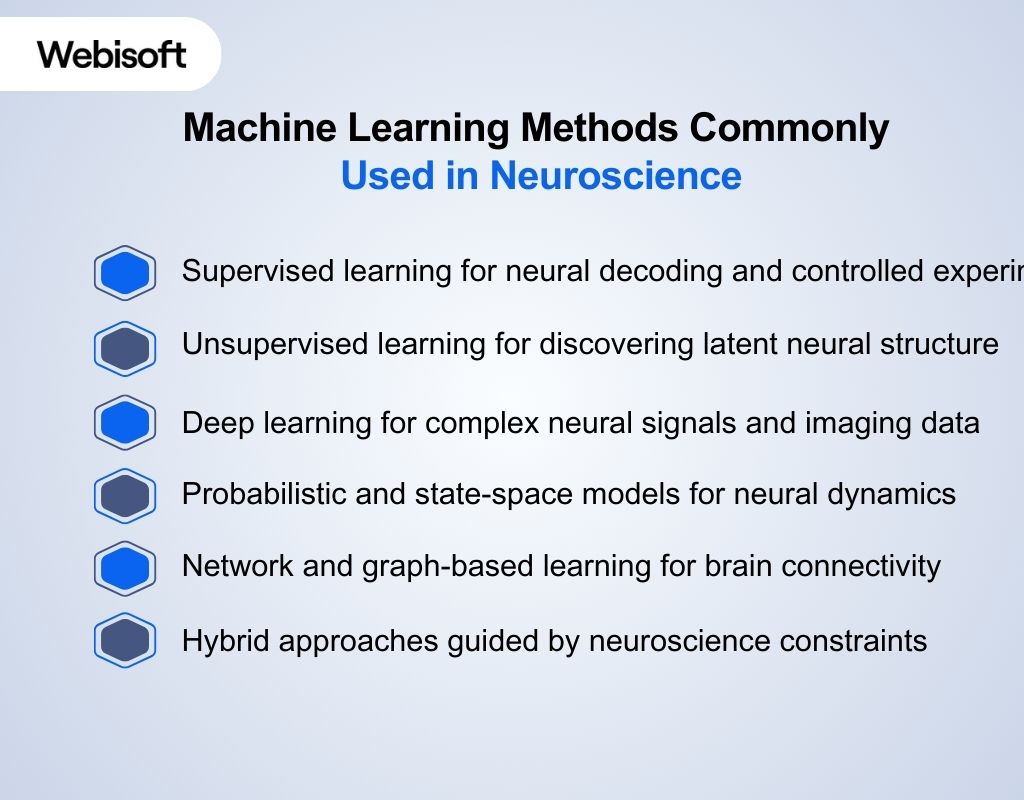
Machine learning methods in neuroscience are selected based on how brain data is generated, recorded, and interpreted. Unlike standard ML tasks, neuroscience problems involve noisy biological signals, limited samples, and strong demands for scientific validity, which shape how these methods are actually used.
Supervised learning for neural decoding and controlled experiments
Supervised learning is used when neuroscience studies involve clearly defined experimental labels, such as task conditions, stimulus categories, or diagnostic groups. In this setting, the priority is linking neural activity to known variables while maintaining biological interpretability. Supervised methods are well suited for neuroscience because they help:
- Isolate task-related neural signals from background variability
- Work effectively with limited trial counts and high-dimensional features
- Support hypothesis-driven analysis where model behavior must align with experimental design
Unsupervised learning for discovering latent neural structure
Many neuroscience datasets lack explicit labels or contain structure that is not known in advance. Unsupervised learning allows researchers to explore how neural activity organizes itself across time, brain regions, or neuron populations without imposing predefined categories. These methods are used to address:
- Hidden neural states that emerge across trials or conditions
- Grouping of neurons or brain regions with similar response patterns
- Dimensionality reduction for complex signals that resist manual interpretation
Deep learning for complex neural signals and imaging data
Deep learning is applied when neural data is too complex for handcrafted features, such as raw EEG time series or high-resolution neuroimaging. These models learn hierarchical representations directly from data, capturing nonlinear relationships across space and time. Deep learning in neuroscience helps research by:
- Modeling spatial patterns across whole-brain imaging data
- Capturing long-range temporal dependencies in neural signals
- Reducing reliance on manually engineered features that may bias analysis
Probabilistic and state-space models for neural dynamics
Neural activity evolves over time and varies across trials and subjects. Probabilistic and state-space learning methods treat brain signals as dynamic processes rather than fixed outputs, which aligns closely with how neural systems operate. These methods are particularly useful for:
- Tracking latent neural states during tasks or behavior
- Modeling uncertainty in neural measurements and predictions
- Analyzing trial-to-trial variability without collapsing temporal structure
Network and graph-based learning for brain connectivity
Modern neuroscience increasingly studies the brain as a network of interacting regions. Graph-based learning methods focus on relationships between neural components rather than isolated signals. They are applied to neuroscience problems involving:
- Functional and structural connectivity analysis
- Network-level changes across tasks or disease states
- Coordinated activity between distant brain regions
Hybrid approaches guided by neuroscience constraints
In practice, neuroscience research rarely relies on a single learning method. Researchers often combine classical machine learning, deep learning, and domain-specific constraints to balance performance with interpretability. Hybrid approaches are chosen when:
- Multiple neural data types must be analyzed together
- Biological plausibility must guide model behavior
- Strong results require cross-method validation
Neuroscience insights matter only when they translate into dependable outcomes. If you want to turn neuroscience research into production-grade ML systems, Webisoft helps you design, validate, and operationalize pipelines that hold up across constraints.
Common Machine Learning Tools for Neuroscience and Future Trends
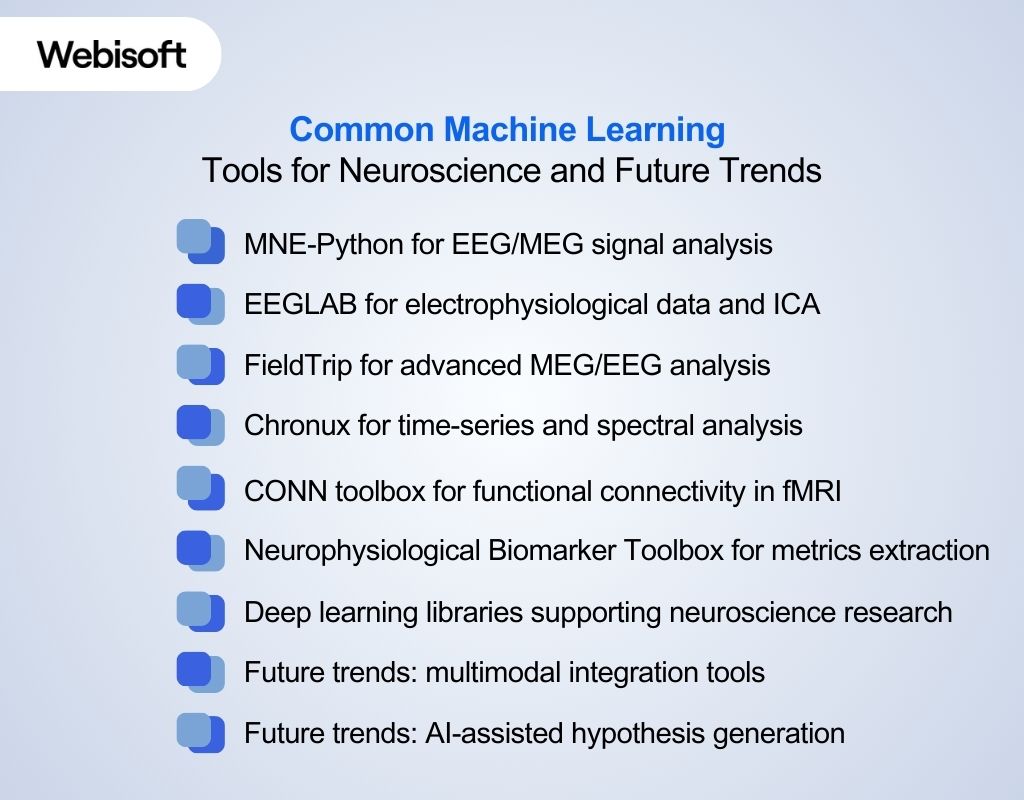
Machine learning tools are essential for working with diverse neural data, from EEG and MEG to brain imaging. Alongside established platforms, emerging trends are reshaping how researchers integrate multimodal data and apply advanced models in neuroscience.
MNE-Python for EEG/MEG signal analysis
MNE-Python is a widely used open-source Python library for processing and analyzing EEG and MEG data. It supports preprocessing, visualization, source reconstruction, and multimodal signal operations, making it a staple for neuroscience ML workflows that involve electrophysiological data.
EEGLAB for electrophysiological data and ICA
EEGLAB is a MATLAB toolbox designed for processing EEG and other electrophysiological signals, featuring independent component analysis (ICA), artifact rejection, and visualization tools. Its integration with research workflows makes it a common choice for machine learning pipelines in neural signal decoding.
FieldTrip for advanced MEG/EEG analysis
FieldTrip is another open-source MATLAB toolbox that offers advanced analysis techniques for MEG, EEG, and electrophysiological recordings. It enables time–frequency analysis, source reconstruction, and statistical testing, which are often prerequisites before ML modeling.
Chronux for time-series and spectral analysis
Chronux is a software package tailored to neural time-series analysis such as LFP, EEG, and MEG recordings. It provides smoothing, spectral analysis, spike sorting, and visualization, helping researchers clean and prepare data before machine learning is applied.
CONN toolbox for functional connectivity in fMRI
The CONN toolbox focuses on functional connectivity analysis in fMRI, offering preprocessing, noise correction, and network measure estimation. These features support machine learning tasks that aim to classify or model brain network dynamics.
Neurophysiological Biomarker Toolbox for metrics extraction
The Neurophysiological Biomarker Toolbox (NBT) provides tools for computing and integrating biomarkers from EEG/MEG recordings. Its pipeline includes artifact rejection, statistical testing, and standardized data storage, which can be combined with ML workflows.
Deep learning libraries supporting neuroscience research
General ML libraries like TensorFlow, PyTorch, and specialized deep learning modules are increasingly used for hierarchical feature learning, sequence modeling, and representation learning in neuroscience. These tools enable deep neural network architectures that handle high-dimensional imaging and time series data.
Future trends: multimodal integration tools
Emerging research aims to combine EEG, fMRI, and other signals into unified ML models. These approaches often rely on foundation models or transfer learning to bridge modalities and tasks. Large models trained on broad datasets show potential for generalized neural prediction.
Future trends: AI-assisted hypothesis generation
Large language models and AI tools are becoming useful not just for data modeling, but also for synthesizing literature, suggesting hypotheses, and supporting meta-analysis. Thus helping researchers prioritize experiments and research directions more efficiently.
What Makes Machine Learning in Neuroscience Difficult
Applying machine learning to neuroscience introduces challenges that go beyond model selection or training accuracy. Brain data reflects biological systems with inherent variability and uncertainty. These constraints shape how models behave, how results are validated, and how conclusions can be trusted.
- High feature-to-sample imbalance: Neuroscience datasets often contain thousands of signal dimensions but relatively few subjects or trials. This imbalance increases overfitting risk and makes it difficult for models to generalize beyond the training data.
- Biological noise that is not random: Neural signals include structured noise from physiology, movement, and recording conditions. Unlike typical sensor noise, this variability can mimic meaningful patterns, confusing models during training and evaluation.
- Strong subject-to-subject variability: Brain activity patterns differ significantly across individuals due to anatomy, cognition, and experience. Models trained on one group may fail when applied to new subjects without careful normalization and validation strategies.
- Sensitivity to preprocessing choices: Small changes in filtering, normalization, or feature extraction can lead to large differences in model outcomes. This makes reproducibility difficult and increases dependence on undocumented analytical decisions.
- Limited ground truth availability: Many neuroscience questions lack definitive labels or objective outcomes. Models are often trained on proxy signals or experimental conditions, which limits how confidently results can be interpreted.
- Interpretability requirements tied to biology: Neuroscience demands explanations that align with known brain mechanisms. Models that perform well but cannot be related back to neural processes are difficult to trust or publish, especially in scientific settings.
- Cross-study and cross-lab reproducibility: Differences in hardware, protocols, and experimental design across labs make it hard to replicate results. Models that perform well in one dataset may degrade sharply when conditions change.
- Ethical and privacy constraints: Neuroscience data contains sensitive cognitive and health information. Consent rules, anonymization limits, and regulations restrict data sharing, reducing dataset size and complicating large-scale model training.
- Interdisciplinary learning curve: Neuroscience ML requires knowledge of brain science, signal processing, and machine learning. Professionals trained in only one domain may struggle with validation, interpretation, and cross-disciplinary collaboration.
Supporting Dependable Neuroscience ML Systems with Webisoft
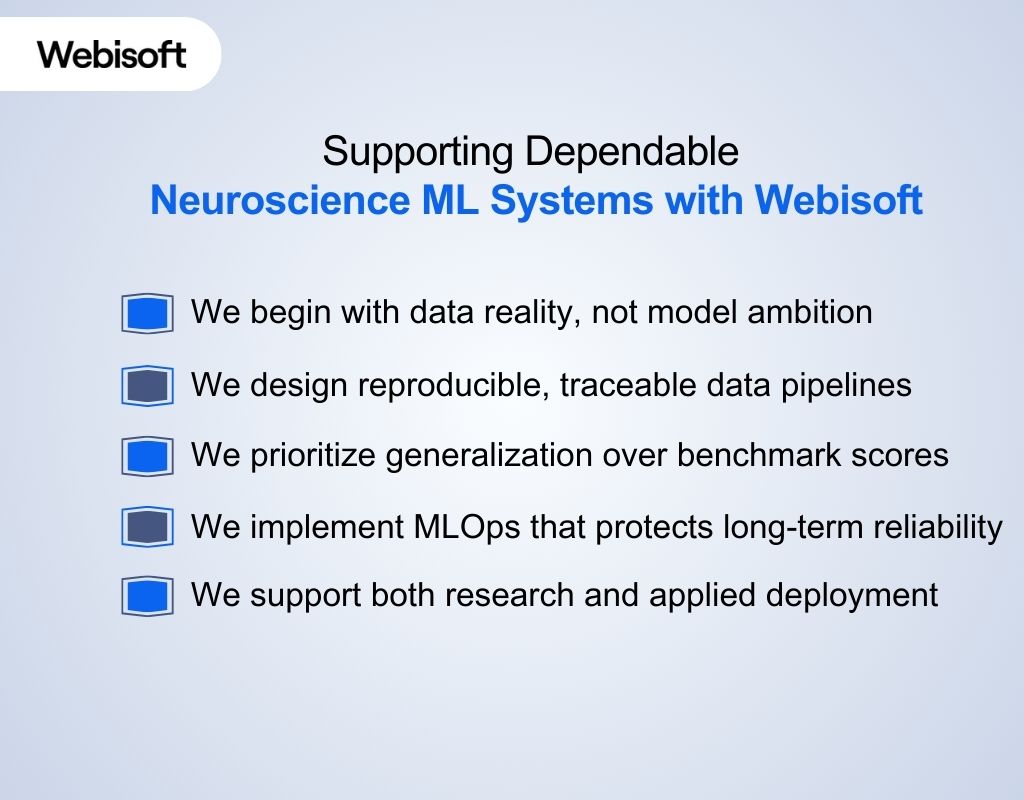
By this point, it is clear that applying machine learning to neuroscience is not just a modeling challenge. It is a systems challenge. At Webisoft, we help research teams and product builders turn neuroscience ML from fragile experiments into dependable systems that hold up across real-world conditions.
We begin with data reality, not model ambition
Neuroscience projects often fail when modeling starts before feasibility is validated. We assess signal quality, subject variability, labeling constraints, and leakage risks first. That foundation defines goals grounded in what the data can truly support.
We design reproducible, traceable data pipelines
Small preprocessing shifts can invalidate entire results. We build structured pipelines with:
- Versioned datasets
- Documented transformations
- Controlled feature generation
This keeps outputs stable across reruns, collaborators, and research phases.
We prioritize generalization over benchmark scores
High accuracy on one split proves little. We structure evaluation around real neuroscience usage patterns:
- Across subjects
- Across sessions
- Across experimental conditions
The goal is dependable behavior, not impressive screenshots.
We implement MLOps that protects long-term reliability
Neural data changes. Hardware changes. Populations change. We deploy monitoring systems that track:
- Data drift
- Prediction stability
- Performance degradation
Retraining and rollback are built in from the start.
We support both research and applied deployment
Some teams need reproducible research infrastructure. Others require production-ready systems integrated into products or clinical workflows. We design systems that fit your stack today while remaining flexible as your neuroscience programs expand.
With that same systems-level discipline in place, building dependable neuroscience ML becomes achievable. Work with Webisoft to design reproducible pipelines, validate performance across conditions, and deploy machine learning systems that remain stable beyond controlled experiments.
Conclusion
In the end, machine learning in neuroscience succeeds or fails on discipline, not ambition. The field rewards careful methods, honest evaluation, and systems that respect how brain data behaves in reality.
When those conditions are met, ML becomes a reliable scientific tool rather than a fragile experiment. That is where Webisoft fits in. We help teams carry neuroscience ML from research into dependable systems, focusing on validation, reproducibility, and long-term reliability so results remain useful well beyond initial analysis.
Frequently Asked Question
No. Deep learning performs well with large, well-structured datasets, but classical methods often outperform it when data is limited. Traditional models also provide stronger interpretability, which is important for scientific validation and biological understanding.
Yes, but only under strict conditions. Neuroscience ML models require extensive validation, regulatory approval, and ongoing monitoring. As a result, most current systems support research and clinical insight rather than direct medical decision-making.
No. Machine learning complements traditional statistics but does not replace them. Statistical models remain essential for hypothesis testing, inference, and controlled experimental interpretation.