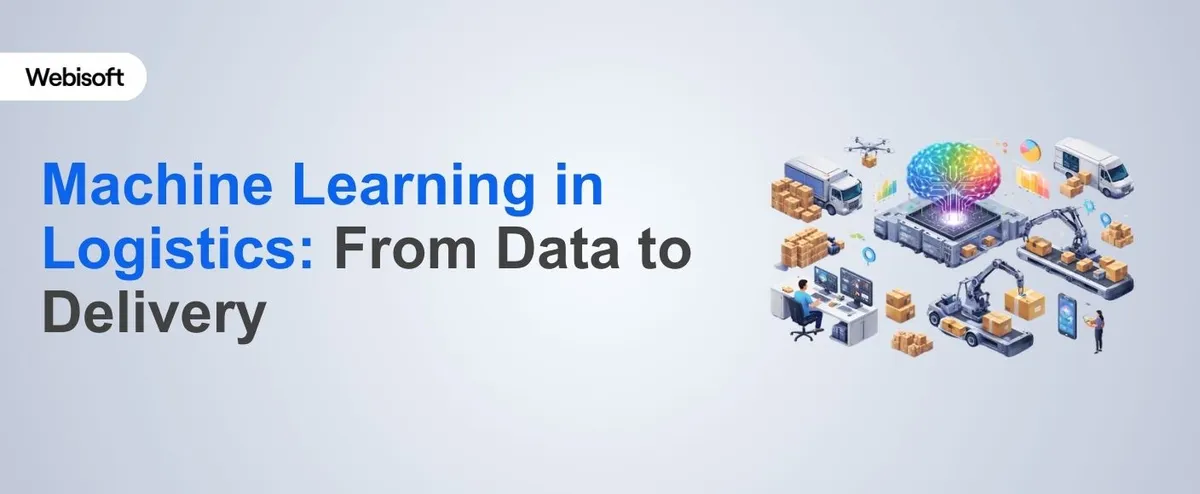
Today’s supply chains face pressure from every direction. Demand shifts without warning, disruptions arrive without notice, and manual processes can no longer keep pace with the speed of modern commerce. Machine Learning in logistics is changing that. It gives teams the ability to predict disruptions, optimize routes, and manage inventory with a level of accuracy that was impossible just a few years ago. Leading companies are now moving beyond basic optimization toward fully autonomous supply chains powered by continuous, self-improving ML systems. Read on to learn how Machine Learning is reshaping logistics from the ground up.
What is Machine Learning in Logistics?
Machine learning in logistics is a specialized branch of data science that automates decision-making across the supply chain. This technology uses advanced algorithms to identify patterns in shipping, storage, and distribution. It transforms raw historical data into predictive models for future demand. Managers use these insights to optimize fleet routes and manage inventory levels. These systems continuously improve their accuracy through constant data feedback loops. This approach reduces manual errors and strengthens overall operational efficiency.
The Growing Limitations of Traditional Logistics Models in 2026
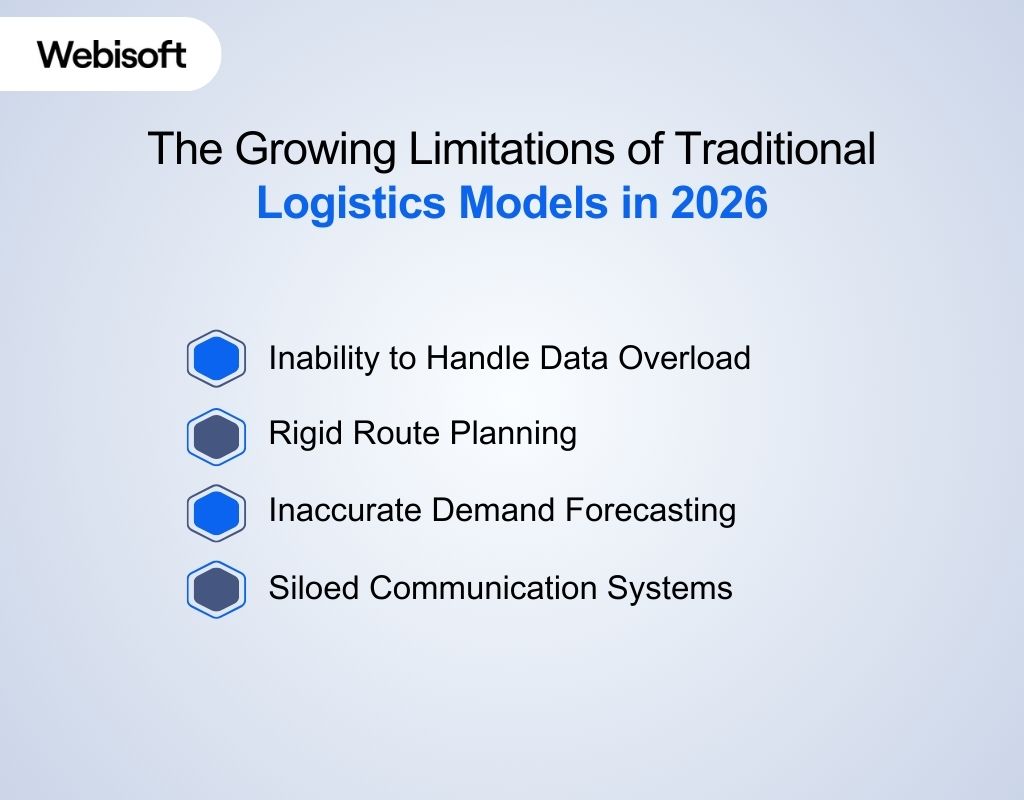
Traditional logistics models were built for a simpler time. They function well when supply chains were smaller, slower, and more predictable. Here are some must-know limitations that delay shipments and increase operational costs.
1. Inability to Handle Data Overload
Traditional systems hardly process massive real-time data volumes. Today, IoT sensors, GPS trackers, and customer platforms generate large amounts of information continuously. As a result, these outdated systems struggle to keep up, leading directly to poor decisions and costly operational blind spots.
2. Rigid Route Planning
Traditional route planning works well under stable, predictable conditions. However, it struggles to adapt when sudden traffic shifts, weather changes, or regional disruptions occur. This failure causes late arrivals and wastes expensive fuel on every single journey. Research shows that companies using AI-powered dynamic routing report an average 10-15% reduction in fuel costs.
3. Inaccurate Demand Forecasting
Traditional forecasting relies on oversimplified models with limited predictive ability. They fail to account for market volatility, seasonal spikes, or global disruptions. Because of this, companies constantly struggle with overstocking or understocking.
4. Siloed Communication Systems
Many traditional logistics setups store warehouse and transport data in separate, disconnected systems. Planners often cannot view the full supply chain picture from a single place. This lack of joined-up visibility makes it harder to spot issues early.
How Machine Learning Actually Works for Logistics
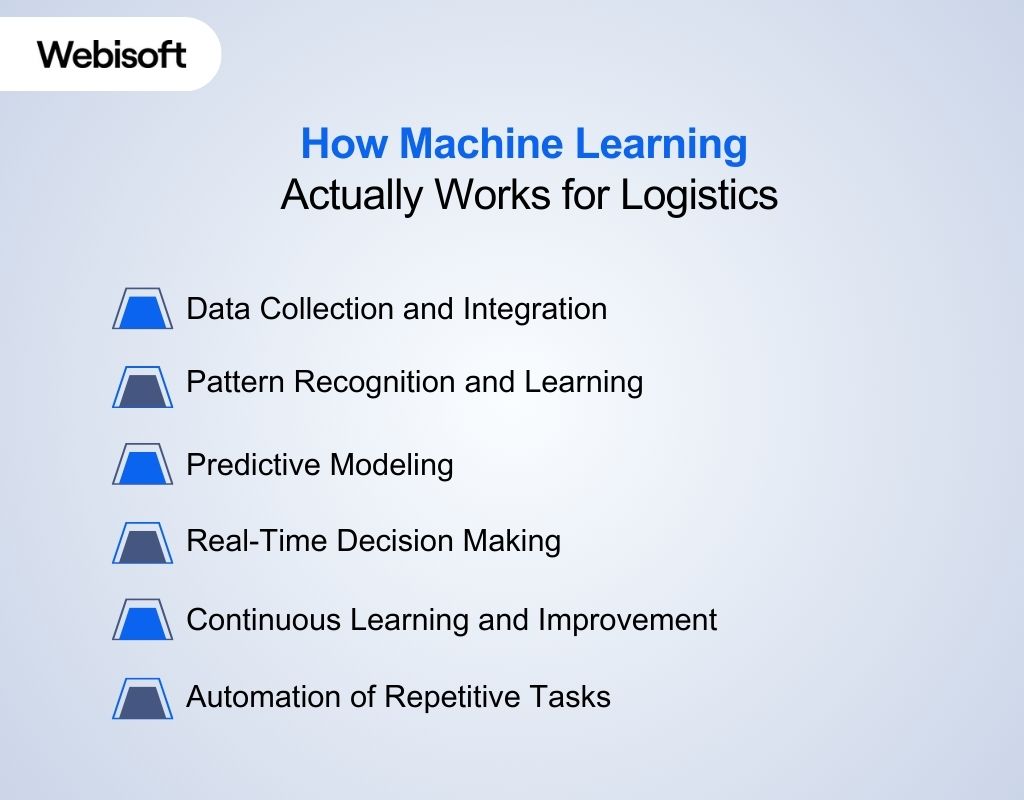
Machine Learning implementation in logistics works by continuously analyzing historical and real-time data, identifying patterns, and making intelligent predictions. This enables smarter routing, forecasting, and automation across every supply chain operation. Now let’s break down how it actually works:
1. Data Collection and Integration
ML techniques start by gathering data from multiple sources. These include GPS trackers, warehouse systems, customer orders, and IoT sensors. All this raw information is then unified into one structured pipeline. For example, Amazon collects millions of daily data points from click-to-order time to last-mile delivery speed, feeding it all into one central system.
2. Pattern Recognition and Learning
Once data is collected, ML algorithms analyze it deeply. They identify hidden patterns across past deliveries, demand cycles, and operational behaviors. Over time, the system grows smarter. For instance, it may learn that orders spike every Friday evening in a specific city and prepare accordingly.
3. Predictive Modeling
After recognizing patterns, ML builds predictive models. These models forecast future demand, potential delays, or inventory shortages. As a result, managers act proactively. For example, UPS uses ML models to predict package volume surges during holidays, adjusting staffing and routes weeks in advance.
4. Real-Time Decision Making
ML doesn’t just predict, it acts instantly. When live data shifts, say a sudden traffic jam appears, the system immediately recalculates the best alternate route. This happens in seconds. Traditional systems, by contrast, would require a dispatcher to manually intervene and redirect the driver.
5. Continuous Learning and Improvement
Every new data point feeds back into the model. Each delivery, disruption, or delay becomes a new lesson. Therefore, accuracy improves automatically over time. For example, FedEx’s ML systems become sharper each quarter, reducing failed delivery attempts by learning from previous address or timing errors.
6. Automation of Repetitive Tasks
Finally, ML automates time-consuming tasks. Stock replenishment, shipment scheduling, and invoice processing all run automatically. This reduces human error significantly. Moreover, it frees logistics teams for strategic work. For example, DHL uses ML to auto-trigger restocking orders when warehouse inventory drops below a predicted threshold.
Challenges Machine Learning Solves In Logistics
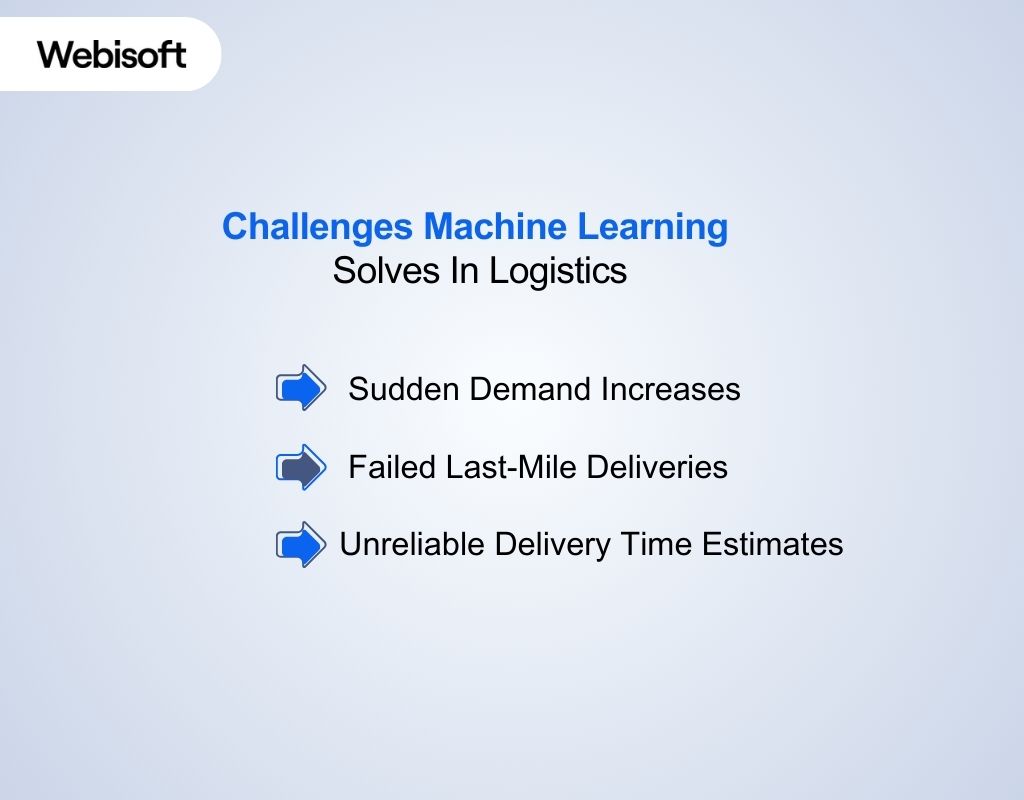
Machine Learning directly tackles logistics’ most painful problems. From unpredictable demand to last-mile failures, it turns slow, reactive operations into fast, intelligent ones that consistently deliver results.
1. Sudden Demand Increases
Traditional systems cannot adjust fast enough when customer demand rises unexpectedly. AI machine learning reads early buying signals and updates inventory levels automatically. It also learns from past demand cycles to get better over time. According to Walmart’s official newsroom, Walmart’s ML systems improve demand forecasting and reduce empty shelves. They also save 30 million unnecessary driving miles annually. On top of that, they handle supplier negotiations with 68% success rates and 3% average cost savings.
2. Failed Last-Mile Deliveries
Last-mile delivery is the most expensive and error-prone part of the entire logistics process. ML studies customer behavior, location data, and preferred delivery times. It then adjusts delivery schedules to match real conditions. According to DHL’s AI logistics report, DHL’s ML software plans 120-stop routes in seconds. It also reaches up to 95% accuracy on expected shipping volumes. As a result, successful first-attempt deliveries increase noticeably.
3. Unreliable Delivery Time Estimates.
Inaccurate delivery estimates frustrate customers and push them toward competitors. ML pulls in live traffic data, weather updates, and carrier performance records. It calculates realistic delivery windows based on actual conditions. Businesses use street-level and time-of-day traffic data to build their estimates. This produces up to 20% in cost savings. Drivers and customers both receive delivery times they can rely on.
Machine Learning vs Traditional Logistics Analysis
Machine Learning outperforms traditional logistics analysis. It replaces slow, manual, and reactive processes with fast, data-driven decision-making. Unlike traditional methods, it continuously improves and adapts to real-world conditions automatically.
| Factor | Traditional Logistics | Machine Learning Logistics |
|---|---|---|
| Decision Making | Manual, slow, and experience-based | Automated, fast, and data-driven |
| Demand Forecasting | Based on simple historical averages | Predictive models using real-time and historical data |
| Route Planning | Fixed and pre-scheduled routes | Dynamic, real-time route optimization |
| Error Rate | High due to manual data entry and human judgment | Significantly lower through automation and pattern recognition |
| Adaptability | Rigid and slow to respond to disruptions | Instantly adapts to weather, traffic, and demand shifts |
| Cost Efficiency | Higher operational costs due to inefficiencies | Reduces costs through optimized resources and automation |
| Scalability | Difficult and expensive to scale operations | Easily scales with growing data and business demands |
Use Cases of Machine Learning in Logistics
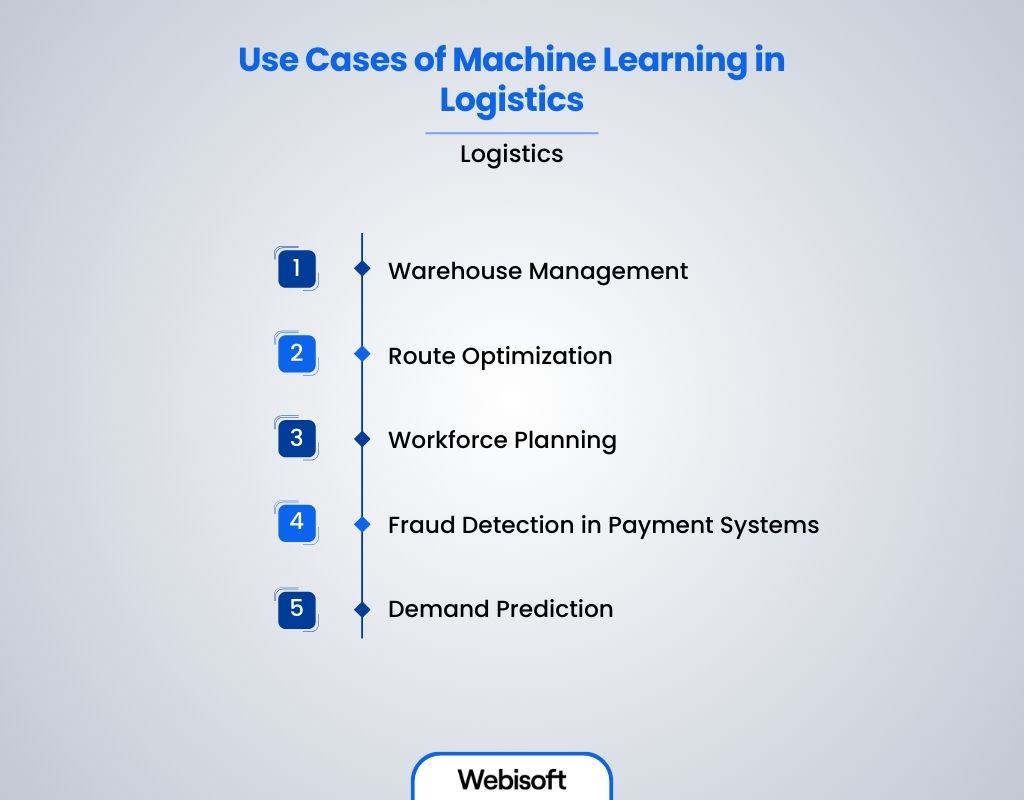
Machine learning improves logistics by automating complex decisions and predicting future supply chain needs. This technology enables companies to optimize warehouse space, reduce fuel consumption, and prevent costly equipment failures instantly.
1. Warehouse Management
Smart systems guide robotics to the most efficient storage locations for incoming goods. These algorithms analyze product demand to place high-frequency items closer to packing stations for faster shipping.
2. Route Optimization
Algorithms process real-time traffic, port delays, and delivery windows to calculate the most efficient path for every driver. These tools update routes instantly to bypass sudden road closures or changing weather events.
3. Workforce Planning
Predictive tools analyze past shipping cycles to determine exactly how many workers are needed for upcoming peak seasons. This ensures that warehouses remain fully staffed without overspending on unnecessary overtime during slow periods.
4. Fraud Detection in Payment Systems
Machine learning solutions monitor millions of transactions to spot suspicious payment activity or unusual shipping patterns instantly. These models identify subtle behavioral signals that often escape the notice of manual human auditors.
5. Demand Prediction
Algorithms analyze historical sales and market shifts to predict future shipping volumes with high precision. This allows managers to secure carrier capacity early and avoid expensive last-minute spot market rates.
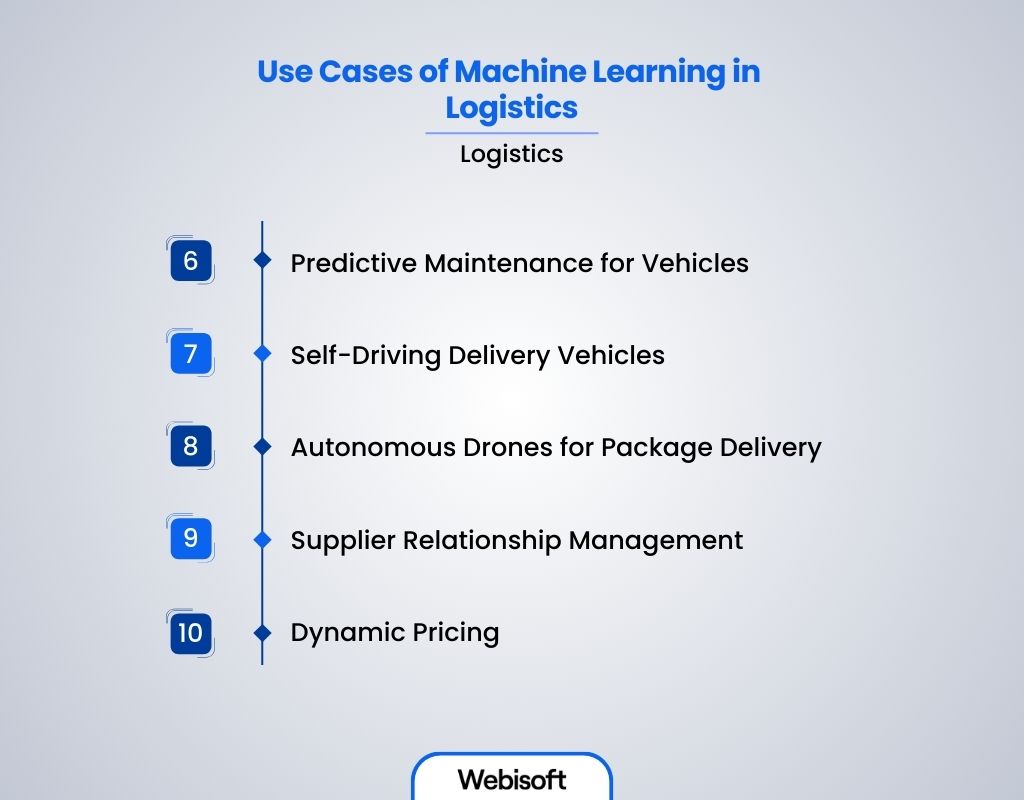
6. Predictive Maintenance for Vehicles
Sensors monitor engine health and transmission data to identify mechanical failures before they cause a breakdown. Instead of using fixed schedules, the system alerts technicians only when a specific part requires attention.
7. Self-Driving Delivery Vehicles
Autonomous trucks and vans use advanced vision systems to navigate busy highways and urban streets safely. These vehicles reduce the physical strain on human drivers while maximizing the hours of operation for the fleet.
8. Autonomous Drones for Package Delivery
Drones provide a fast and contactless solution for last-mile delivery in both urban and rural areas. These machines bypass ground traffic entirely to deliver small parcels directly to a customer’s doorstep.
9. Supplier Relationship Management
Smart platforms track supplier delivery times, pricing trends, and compliance with quality standards in real time. These systems provide early warnings about potential vendor risks before they impact the final customer.
10. Dynamic Pricing
Machine learning models automatically adjust shipping rates based on fuel costs, competitor prices, and current demand. This flexibility allows carriers to maximize their revenue by filling empty cargo space during slower periods.
Real-Life Examples of ML in Logistics
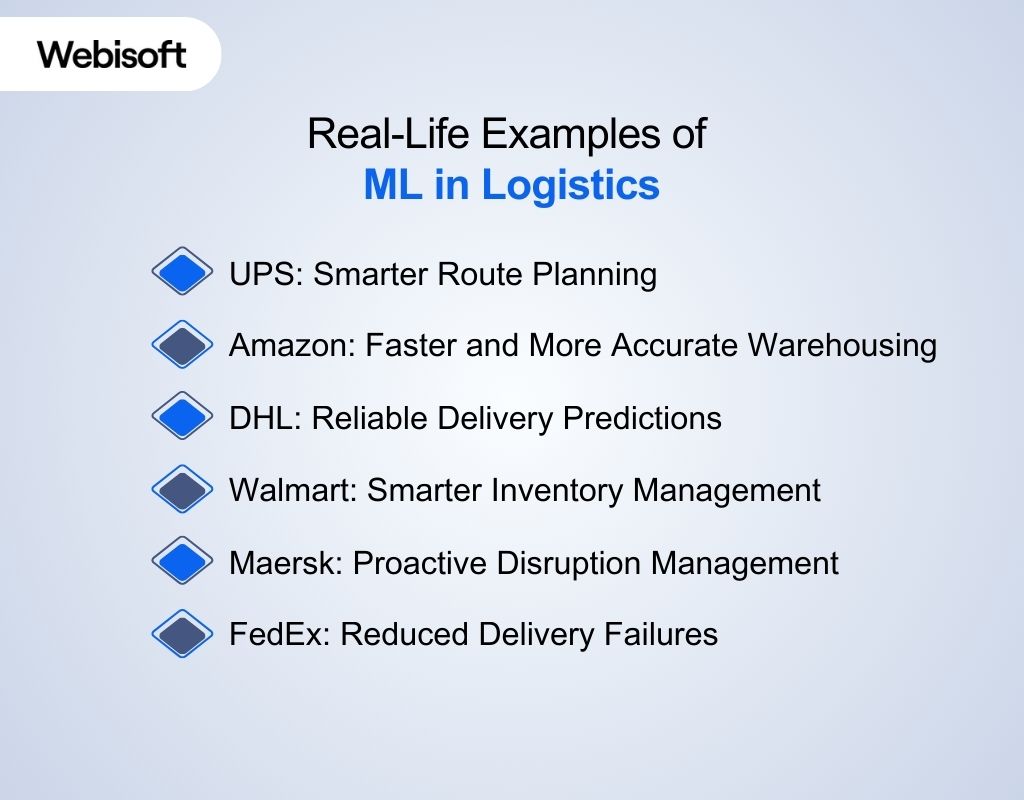
Machine Learning gives logistics companies a measurable competitive edge. It reduces costs, improves accuracy, and builds supply chains that respond intelligently to real-world conditions.
| Company | ML Use Case | Key Result |
|---|---|---|
| UPS | Route optimization via ORION | Saves 100M miles and 10M gallons of fuel annually, cutting costs by $300–$400M |
| Amazon | Warehouse and fulfillment automation | 25% operational efficiency increase |
| DHL | Last-mile delivery planning | 95% shipping volume accuracy, 20% cost savings |
| Walmart | Inventory and supplier management | 30M driving miles saved, 68% negotiation success rate |
| Maersk | Shipping route and disruption management | 15% fuel savings, 20% faster delivery on key routes |
| FedEx | Delivery prediction and routing | 20% faster deliveries, 15% fuel reduction |
1. UPS: Smarter Route Planning
UPS built its ML-based ORION system to solve one specific problem: inefficient delivery routes. The system analyzes over 250 million address data points daily. It also evaluates more than 200,000 possible routing combinations per driver. According to INFORMS, ORION saves 100 million miles and 10 million gallons of fuel every year. It also cuts CO2 emissions by 100,000 metric tons and reduces operating costs by up to $400 million annually.
2. Amazon: Faster and More Accurate Warehousing
Amazon uses ML across its fulfillment network to predict order volumes, organize inventory, and cut picking time. Its systems also anticipate customer orders before they are placed. According to IEEE Spectrum, Amazon’s integration of ML-powered robotics is estimated to increase overall operational efficiency by 25%.
3. DHL: Reliable Delivery Predictions
DHL uses ML to forecast shipment volumes and improve last-mile route planning in real time. Its systems process live traffic, weather, and delivery history simultaneously. According to DHL’s AI logistics report, DHL’s ML software plans 120-stop routes in seconds. It also achieves up to 95% accuracy in predicting incoming shipping volumes and delivers up to 20% in cost savings per route.
4. Walmart: Smarter Inventory Management
Walmart applies ML across its entire supply chain to keep shelves stocked and reduce waste. Its systems learn from purchasing patterns across thousands of store locations at once. According to Walmart’s official newsroom, ML saves 30 million unnecessary driving miles each year. It also automates supplier negotiations with a 68% success rate and delivers 3% average cost savings per negotiation.
5. Maersk: Proactive Disruption Management
Maersk uses ML to monitor global shipping routes, weather patterns, and port conditions around the clock. Its systems analyze data from across its entire vessel fleet continuously. According to CodeX Team’s 2024 analysis, Maersk’s ML-powered route optimization saved up to 15% on fuel costs in 2024. It also reduced shipping times on critical routes by approximately 20%.
6. FedEx: Reduced Delivery Failures
FedEx uses ML to improve delivery accuracy and provide more reliable estimated delivery times. Its deep learning models factor in weather patterns, traffic conditions, and historical delivery data. According to DigitalDefynd, FedEx’s AI routing tools reduced delivery times by up to 20% and cut fuel consumption by 15% across several pilot regions.
How to Deploy Machine Learning in Logistics Organizations
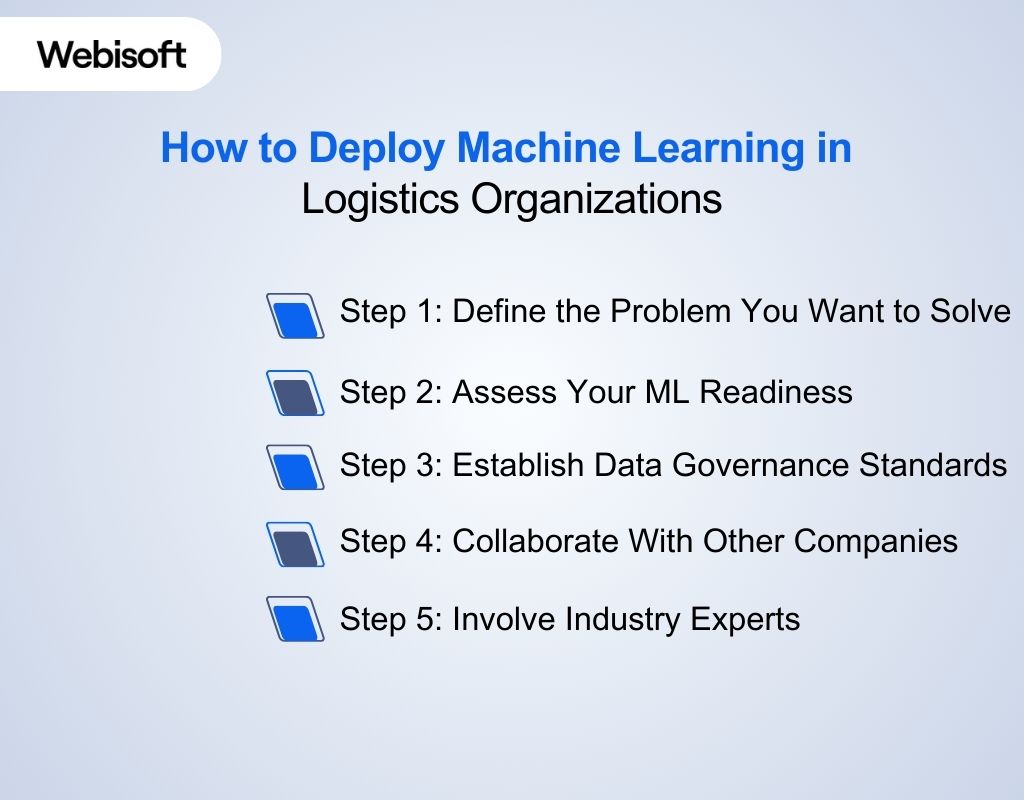
Implementing Machine Learning in logistics starts with clean data, the right infrastructure, and a clear business problem to solve.
Step 1: Define the Problem You Want to Solve
Before touching any technology, get specific about what needs fixing. Technology leaders must collaborate closely with supply chain experts to identify which problems are most disruptive to the business.
- Is the problem slow delivery routes?
- Is it inaccurate demand forecasting?
- Is it high warehouse error rates?
The clearer the problem, the easier it is to choose the right ML approach and measure success later.
Step 2: Assess Your ML Readiness
Before building anything, organizations need to honestly evaluate how prepared they are for ML adoption. This step is often skipped, and it causes costly failures later.
- Assess the impact of ML adoption on existing workflows and staff roles
- Identify personnel gaps in data science and engineering
- Set realistic expectations around ML implementation timelines
- Calculate long-term ML return on investment before committing resources
Step 3: Establish Data Governance Standards
ML performs well only when fed enough quality data. Logistics companies need to sort out where and how they acquire, store, and manage data before model training begins.
- Identify the most relevant data sets for the specific problem being solved
- Remove duplicate, incomplete, or outdated entries
- Standardize formats across all data sources
- Remember: the more relevant and clean the data, the stronger the model
Step 4: Collaborate With Other Companies
The key to getting maximum value from ML lies in building a strong partner ecosystem. Sharing region-specific and niche data with trusted partners significantly improves model accuracy.
- Partner with suppliers, carriers, and logistics platforms to exchange operational data
- Build data-sharing agreements that benefit all parties involved
- Use partner data to fill gaps in your own data sets
- With an abundance of actionable data, ML models have the highest chances of adding real value
Step 5: Involve Industry Experts
ML development in logistics is not purely a technology challenge. It requires both data science expertise and deep industry knowledge to work together.
- Involve supply chain professionals early in the model design process
- Data scientists alone cannot account for real-world logistics variability
- Industry experts help build forecasting models that reflect actual operational conditions
- Accurate ML models require programming skills, domain knowledge, and hands-on logistics experience combined.
Machine Learning Techniques Used in the Logistics Industry
Machine Learning relies on a specific set of technologies to deliver results in logistics. Each one offers a distinct purpose, from predicting demand to automating physical warehouse operations.
Predictive Analytics
Predictive analytics uses historical and real-time data that is used to predict future logistics outcomes. It can easily anticipate demand changes, supplier delays, and equipment failures before they occur. This offers the operations team the opportunity to take action before the problem escalates.
Computer Vision
With precise computer vision, businesses can easily inspect packages, read labels, and monitor warehouse activity in real time. It reduces manual scanning errors and speeds up the sorting operations. Even the system detects dents, tears, or broken packaging before shipping. It makes the logistics more accurate and efficient.
Natural Language Processing (NLP)
With NLP, teams can automatically process and understand large volumes of text-based communication. It helps logistics companies manage customer emails, chat inquiries, shipment instructions, and support tickets more efficiently. NLP-powered systems can extract key details such as delivery addresses, order numbers, and complaint types without manual input.
Internet of Things (IoT)
IoT devices collect and transmit real-time data from connected vehicles, warehouses, and shipments continuously. By combining with ML, this data is used to optimize supply chain routes, predict demand, and anticipate flow disruptions. This overall helps improve the customer delivery experience.
Advantages of Machine Learning in Logistics
Machine Learning brings measurable, real-world advantages to logistics operations. It cuts costs, reduces errors, and helps companies make faster and smarter decisions across every part of the supply chain.
1. Significant Cost Reduction
ML removes inefficiencies across routing, warehousing, and fuel consumption simultaneously. It automates tasks that previously required large teams. Over time, these savings compound. Companies that fully deploy ML across their logistics operations report hundreds of millions in annual cost reductions.
2. Faster and More Accurate Decision Making
Traditional logistics decisions rely on human judgment and outdated reports. ML processes live data from multiple sources at once. It then delivers actionable recommendations in seconds. This speed allows logistics managers to respond to disruptions, delays, and demand changes before they escalate into bigger problems.
3. Improved Delivery Reliability
Late deliveries damage customer trust quickly and permanently. ML analyzes traffic, weather, and carrier performance in real time. It adjusts routes and delivery windows automatically based on actual conditions. As a result, on-time delivery rates improve consistently and customers receive accurate estimated arrival times they can rely on.
4. Smarter Inventory Management
Overstocking wastes money. Understocking loses sales. ML finds the balance by learning from past demand patterns and current market signals. It adjusts stock levels automatically across multiple locations. This keeps shelves stocked at the right levels while cutting unnecessary inventory carrying costs across the entire network.
5. Stronger Supply Chain Resilience
Unexpected disruptions used to catch logistics teams completely off guard. ML monitors risk signals across weather, geopolitics, and supplier performance continuously. It identifies vulnerabilities early and recommends backup plans proactively. Companies using ML-powered risk tools navigate global disruptions faster and with far less financial damage than those relying on manual processes.
The Hidden Challenges of Machine Learning in Logistics
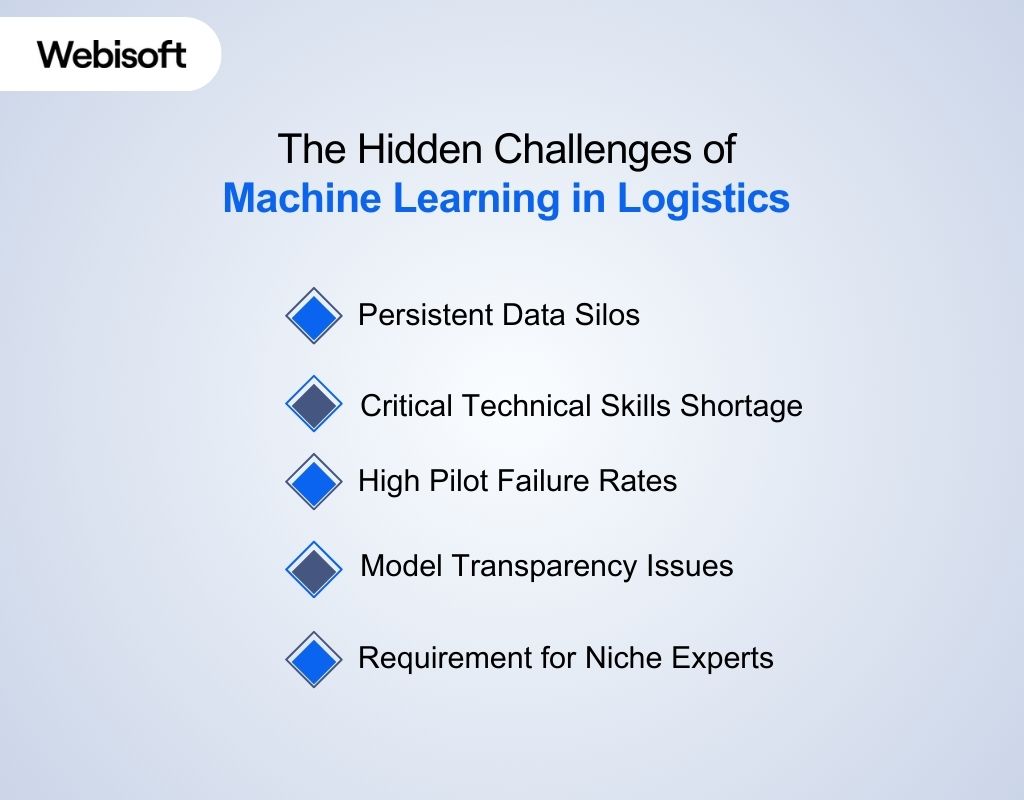
Machine learning fails when organizations ignore underlying data fragmentation and the specialized talent required for maintenance. Success in 2026 depends on solving these invisible structural hurdles before scaling complex autonomous systems.
1. Persistent Data Silos
Fragmented information across disconnected software platforms prevents models from seeing a single version of the truth. Without a unified stream, the AI cannot accurately predict outcomes across the entire supply chain network.
2. Critical Technical Skills Shortage
Deploying these systems requires professionals who understand both complex data science and physical operations. Most firms find it difficult to hire experts who can bridge the gap between code and cargo.
3. High Pilot Failure Rates
Many companies launch technology projects without defining clear financial goals or operational pain points first. This lack of direction leads to expensive “science experiments” that never actually reach the production floor.
4. Model Transparency Issues
Complex algorithms can make decisions that human managers cannot easily explain or audit during a crisis. This “black box” nature makes it hard to trust the AI when it suggests radical changes.
5. Requirement for Niche Experts
Successful deployment demands rare specialists who can maintain and tune algorithms as market conditions shift. Without these dedicated experts, the system’s accuracy quickly decays, turning a smart tool into a liability.
Note:
If you want intelligent logistics forecasting, resilient supply chain automation, and AI systems that actually perform in real-world conditions, partnering with Webisoft is the next step.
The Future of Machine Learning in Logistics: What to Expect Next
The future of logistics centers on “agentic” systems that don’t just predict delays but autonomously resolve them. Expect a shift toward fully decentralized, self-healing supply chains that require minimal human intervention to maintain efficiency.
1. Hyper-Local Autonomous Delivery
Last-mile delivery will move toward localized micro-hubs managed entirely by autonomous drones and ground robots. These systems will use real-time neighborhood data to navigate sidewalk traffic and deliver parcels within minutes of an order.
2. Generative Supply Chain Orchestration
Managers will use natural language interfaces to “chat” with their supply chains, asking complex questions about risk. The system will then generate multiple recovery scenarios and execute the chosen strategy across all global partners instantly.
3. Digital Twin Synchronization
Every physical asset, from a single pallet to a massive cargo ship, will have a real-time digital twin. Machine learning will simulate millions of “what-if” scenarios daily, allowing companies to test disruptions in a virtual world first.
4. Sustainable “Green” Optimization
Future algorithms will prioritize carbon footprints alongside cost and speed during every routing decision. Systems will automatically select the lowest-emission carriers and transport modes to meet strict global environmental regulations without sacrificing service.
5. Collaborative AI Networks
Logistics competitors will begin using “federated learning” to train shared models on global risks without exposing private company data. This collective intelligence will create a much more resilient global trade network that anticipates crises together.
Why Logistics Leaders Choose Webisoft for Production-Grade Machine Learning
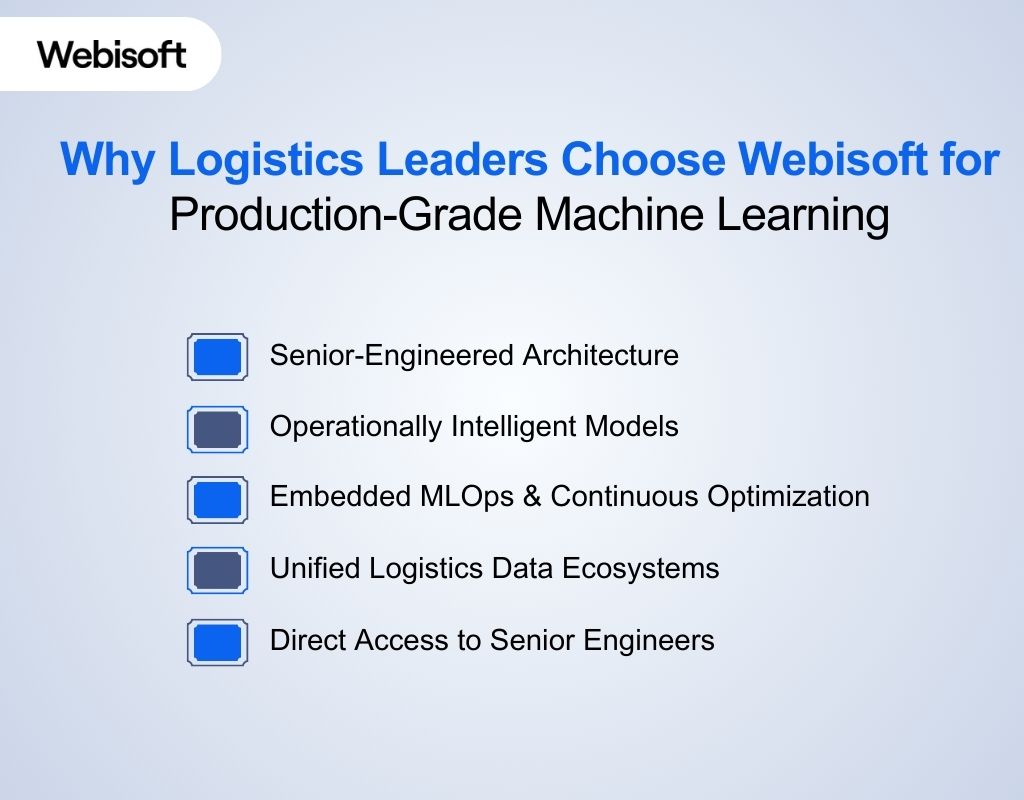
Most logistics ML initiatives stall at the pilot stage. Models look promising in controlled environments, but collapse under real operational pressure. Scaling AI across freight networks requires more than experimentation. It demands disciplined engineering. That’s where Webisoft stands apart.
➔ Senior-Engineered Architecture
We architect systems for real freight volumes, fluctuating fuel prices, and global trade variability. Your infrastructure is designed for durability, not demos.
➔ Operationally Intelligent Models
Our engineers build ML systems that understand routing constraints, warehouse throughput, customs delays, and carrier dynamics, not just historical datasets.
➔ Embedded MLOps & Continuous Optimization
We implement monitoring, retraining, and validation pipelines from day one. Your models stay accurate as demand patterns and supply routes evolve.
➔ Unified Logistics Data Ecosystems
We eliminate silos across ERP, TMS, WMS, and carrier platforms. Your AI operates on a clean, centralized source of truth.
➔ Direct Access to Senior Engineers
You collaborate directly with Montreal-based architects building your system. No outsourcing layers. No communication gaps.
In Closing
Machine learning in logistics is no longer experimental. It’s a competitive necessity. But success depends on clean data architecture, senior engineering oversight, and continuous optimization. Without the right foundation, even advanced models fail under real-world supply chain pressure. If you’re ready to implement machine learning in logistics that scales beyond pilot projects, partner with Webisoft. Our senior engineers build resilient, production-grade ML systems designed for operational performance, accuracy, and long-term growth.
Frequently Asked Questions
Implementation costs vary based on company size and complexity. Small-scale pilots can start from $50,000 while enterprise-wide deployments can reach millions. Cloud-based ML solutions have made entry costs significantly more accessible in recent years.
Most companies see measurable improvements within 6 to 12 months of deployment. Early wins typically appear in route optimization and demand forecasting first. Full operational impact usually becomes visible after 18 to 24 months of continuous model training.
Absolutely. Cloud-based ML platforms have removed the need for large in-house tech teams. Small and mid-sized logistics companies can now access pre-built ML tools at affordable subscription costs. The barrier to entry is far lower than it was even three years ago.