Machine learning in IT is the use of data-driven models within technical systems to analyze behavior, detect patterns, and support operational decisions without relying only on fixed rules. For businesses, machine learning helps reduce downtime, improve incident response, plan infrastructure more accurately, and lower operational overhead by automating analysis that does not scale manually.
However, adoption also brings challenges such as data quality issues, limited model explainability, integration complexity, and the need to build operational trust. This article breaks down how machine learning is applied in real IT environments, where it delivers value, how to implement it step by step, and when it should or should not be used.
What Is Machine Learning in IT
Machine learning in IT works by learning from operational data instead of relying on fixed rules. It analyzes logs, metrics, and historical records to understand real system behavior at scale. This approach aligns with AIOps, where machine learning drives analytics and automation across IT operations.
Because of this flexibility, machine learning helps IT teams manage scale, complexity, and constant change. Industry research shows that modern IT environments generate far more data than traditional monitoring tools can process.
That’s why platforms that combine machine learning with big data are increasingly adopted. Building on this foundation, machine learning for IT automation detects patterns in system behavior and triggers responses without constant manual input. Peer-reviewed research describes how models support tasks like anomaly detection, prediction, and root cause analysis using operational telemetry.
As a result, teams can recognize abnormal activity, anticipate performance issues, and make faster decisions using learned behavior rather than static limits. Analysts and market research confirm that adaptive models outperform fixed thresholds in complex, high-volume environments, leading to more accurate alerts and greater confidence in operational decisions. [Source: Grand View Research]
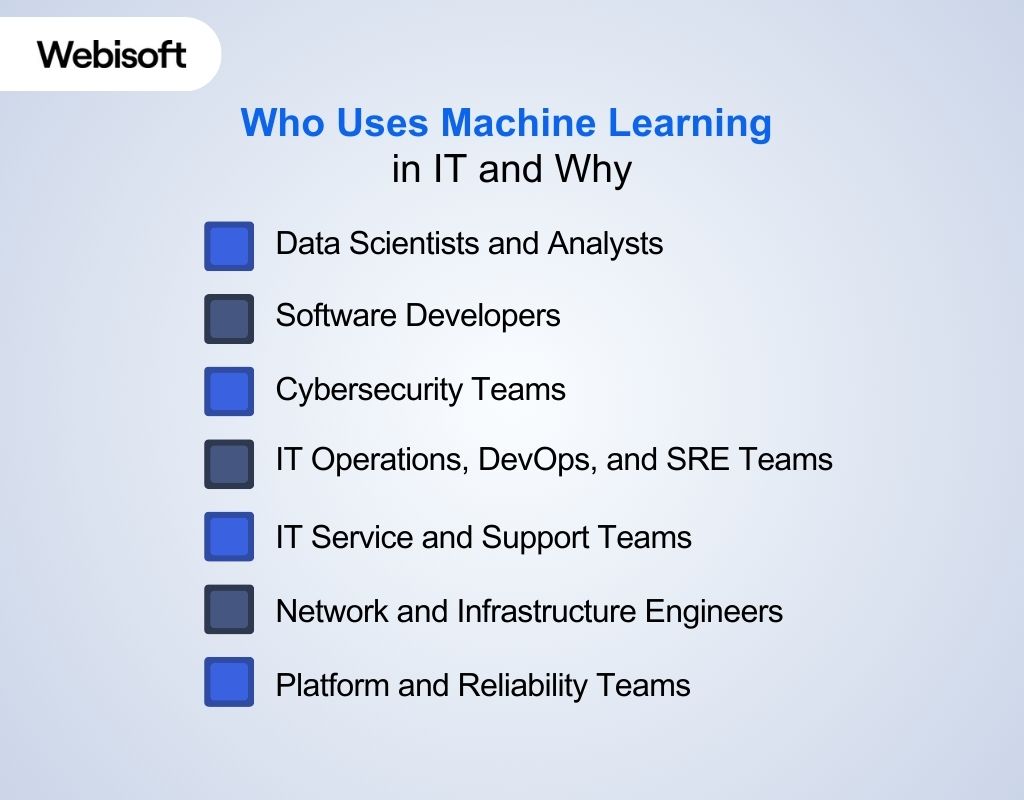
Who Uses Machine Learning in IT and Why
The Machine Learning market in the U.S. in 2026 is expected to achieve a value of USD 299.64 billion. So the market value is increasing day by day. Machine learning in IT is adopted by multiple technical roles because modern IT environments generate more data than humans can process manually. Different teams apply it based on responsibility, system visibility, and risk ownership.
Data Scientists and Analysts
Data scientists focus on building and validating models that learn from historical operational data. In IT contexts, they often support forecasting, behavior modeling, and decision systems that feed into monitoring platforms and internal tools used by engineering teams.
Software Developers
Developers embed machine learning into applications and internal platforms to introduce adaptive behavior. This includes intelligent recommendations, language-based interfaces, and image processing features that improve how users interact with IT-driven systems.
Cybersecurity Teams
Security teams rely on machine learning in IT security to identify abnormal behavior across logs, endpoints, and network traffic. Instead of relying only on known signatures, models learn baseline behavior and support machine learning for threat detection by flagging suspicious activity in real time.
IT Operations, DevOps, and SRE Teams
Operations teams use machine learning in DevOps to analyze deployment data, performance metrics, and failure patterns. These models help teams anticipate outages, reduce alert noise, and maintain system reliability as environments scale.
IT Service and Support Teams
Support and service desks apply machine learning for IT service management to classify tickets, prioritize incidents, and route issues faster. This reduces manual triage effort and improves response times without replacing human oversight.
Network and Infrastructure Engineers
Network engineers use machine learning for network monitoring to understand traffic behavior and detect performance degradation that static thresholds often miss. Infrastructure teams also depend on machine learning for fault detection to identify early signs of hardware or system instability.
Platform and Reliability Teams
When failures occur across interconnected systems, platform teams use machine learning for root cause analysis to correlate signals from multiple sources. This helps narrow down causes faster in environments where manual investigation would take too long. Across these roles, machine learning is not used to replace IT professionals. It is applied to reduce repetitive work, surface risks earlier, and support better operational decisions in complex technical environments.
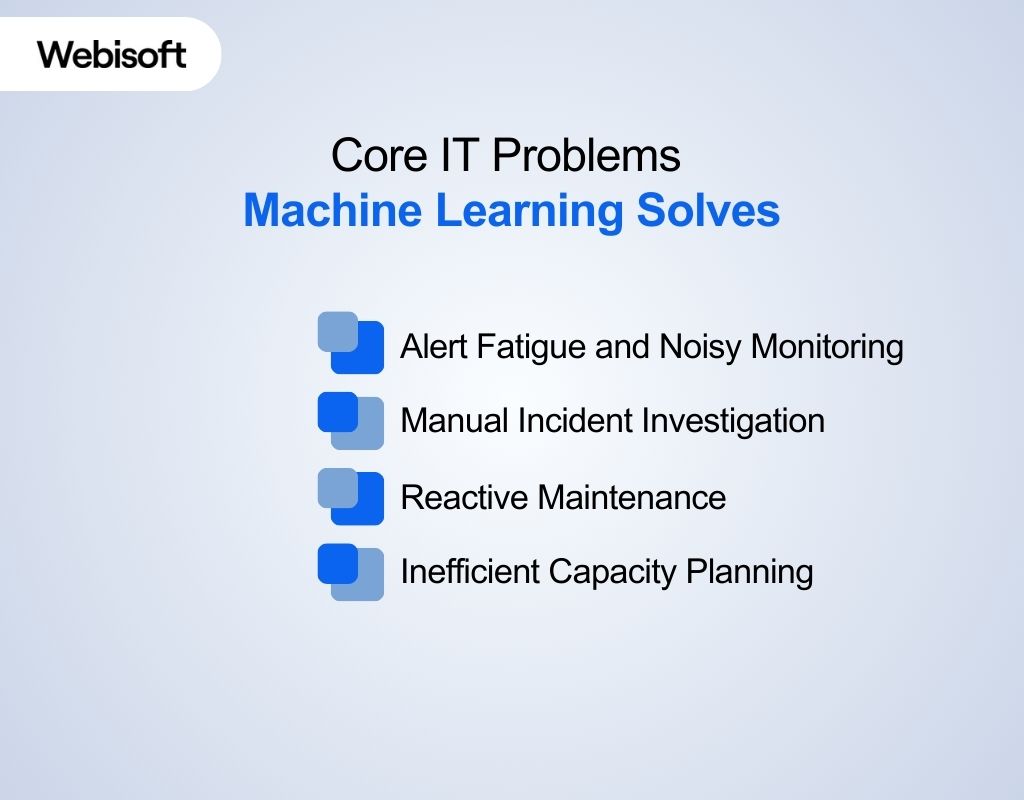
Core IT Problems Machine Learning Solves
As IT environments scale, many operational problems stop being technical and become data-volume problems. Machine learning in IT steps in when traditional monitoring, automation, and analysis cannot keep up with the speed and complexity of modern systems. These challenges are real and show up daily across production environments, alerts, and incident workflows:
Alert Fatigue and Noisy Monitoring
Static thresholds generate excessive alerts that do not reflect real system behavior. Machine learning reduces noise by learning normal operating patterns and identifying deviations that actually matter. This makes monitoring actionable instead of overwhelming and improves response focus.
Manual Incident Investigation
Investigating incidents often requires correlating logs, metrics, and events across disconnected tools. Machine learning automates parts of this process by identifying related signals and surfacing probable causes. This shortens investigation time and reduces dependency on manual analysis.
Reactive Maintenance
Traditional maintenance happens after failures occur. Machine learning models learn from historical performance data to identify early indicators of degradation. This shifts maintenance from reactive response to prevention, reducing unexpected outages and service disruptions.
Inefficient Capacity Planning
Capacity planning based on static assumptions often leads to overprovisioning or shortages. To solve this, machine learning analyzes historical usage trends and forecasts future demand with greater accuracy. As a result, IT teams plan infrastructure growth using real operational data instead of estimates.
Because of these limits, organizations struggle not because of missing tools, but because of poor implementation in live environments. Webisoft works with teams to apply machine learning in IT, where it reduces alert fatigue and improves incident investigation. Plus, it supports maintenance planning and strengthens capacity forecasting.
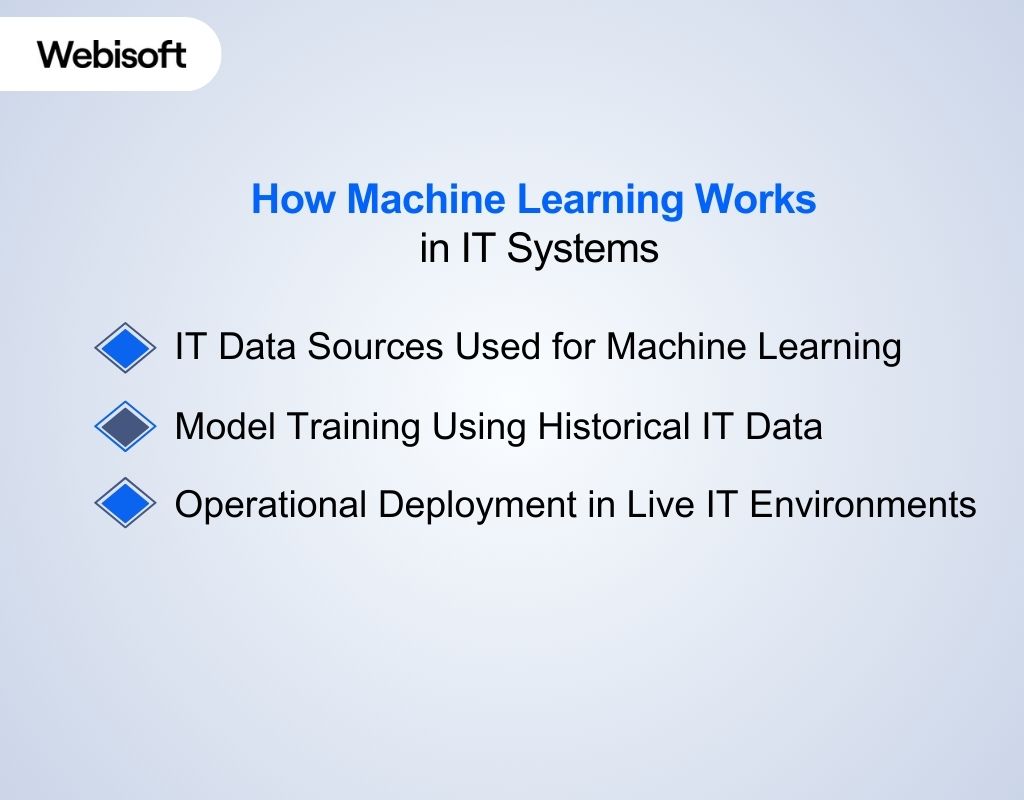
How Machine Learning Works in IT Systems
In real-world environments, machine learning in IT works by learning from everyday operational data from infrastructure, applications, and networks. Instead of fixed logic, models learn from past system behavior to spot patterns, predict issues, and trigger actions inside live workflows:
IT Data Sources Used for Machine Learning
Machine learning models in IT rely on data that systems already generate during normal operation. These sources provide continuous signals about system health, performance, and usage.
- Logs record system activity, errors, and execution details across applications and infrastructure.
- Metrics capture numerical measurements such as CPU usage, memory consumption, latency, and throughput.
- Events represent state changes like service restarts, failures, or configuration updates.
- Configuration data records system settings, policy changes, and deployment updates that influence runtime behavior.
- Real User Monitoring (RUM) captures end-user performance data such as page load time, session latency, and geographic experience.
- Traces follow individual requests across distributed services to show execution paths, delays, and dependency behavior.
- Tickets from service desks document incidents, root causes, and resolution history.
- Network telemetry provides insight into traffic flow, latency, packet loss, and connection behavior.
These inputs form the foundation for machine learning for system monitoring. Thus models learn what normal operation looks like across complex environments.
Model Training Using Historical IT Data
Once collected, historical IT data trains models to recognize patterns in system behavior. Rather than isolated metrics, models study how multiple signals connect and change over time. During training, the model learns normal system behavior and how it shifts during incidents, slowdowns, or failures.
This learning supports machine learning use cases in IT, such as early outage detection, noise reduction, and long-term capacity trend analysis. However, training results depend strongly on data quality, consistency, and coverage across systems. Poor or incomplete data limits accuracy and weakens predictions.
Operational Deployment in Live IT Environments
After training, models run in production environments and analyze new data in real time. At this stage, machine learning supports prediction, detection, and automated action. Prediction forecasts failures, capacity needs, or performance issues before impact.
Detection identifies abnormal behavior by comparing activity to learned baselines. Automated actions handle alert prioritization, ticket routing, or remediation workflows. This phase is where machine learning implementation in IT delivers value as models adapt to changing workloads and systems.
Key Use Cases of Machine Learning in IT Operations
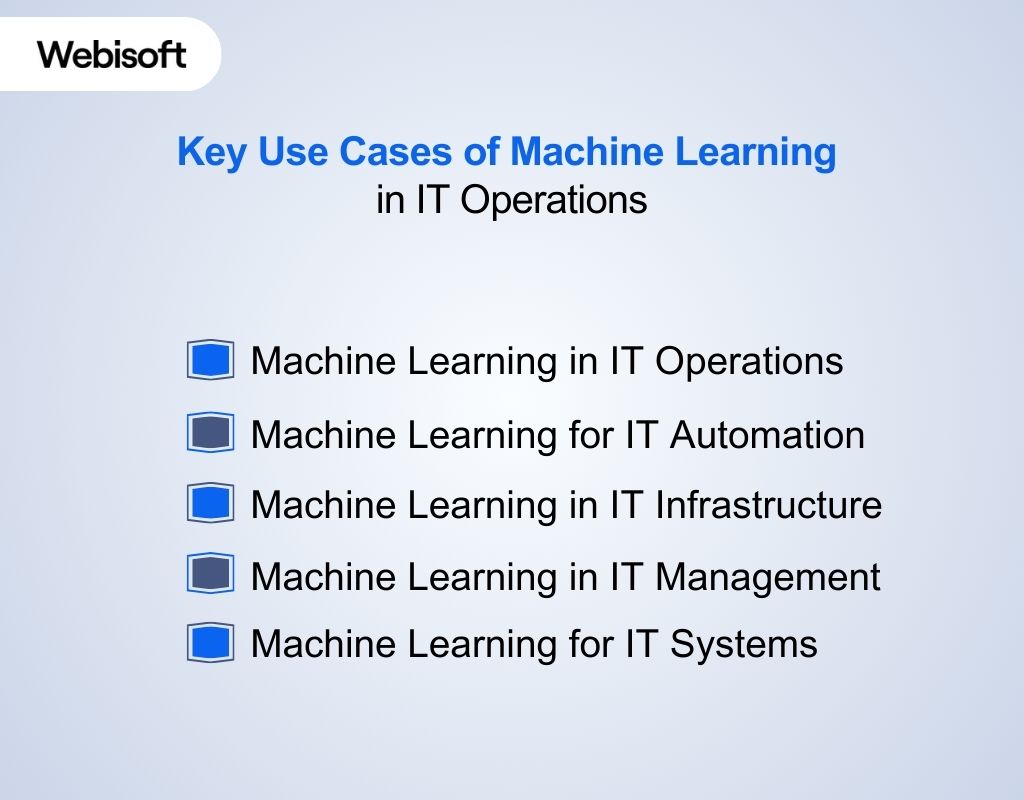
Machine learning in IT helps manage this complexity by learning cross-system patterns, predicting failures, and enabling controlled automation. The following use cases show where machine learning delivers measurable operational value inside real IT environments:
Machine Learning in IT Operations
In day-to-day operations, IT teams need visibility across distributed systems in near real time. Machine learning in IT operations supports this by delivering operational insight instead of isolated alerts.
Models analyze logs, metrics, and events together rather than in silos. This lets them connect related signals from different tools, such as linking a slowdown to a configuration change and rising error logs. This correlation cuts investigation time and clarifies impact faster. It proves especially useful in large environments where manual correlation no longer scales.
Machine Learning for IT Automation
As environments scale, automation based on static rules becomes brittle. Machine learning for IT automation enables adaptive automation that responds to patterns instead of fixed conditions. Common uses include automated incident classification, intelligent alert prioritization, and response orchestration.
When models detect known issue patterns, they trigger remediation steps, adjust resources, or route incidents without manual triage. This approach shortens response time and reduces human error. It also supports self-healing workflows while keeping people in control of high-risk actions.
Machine Learning in IT Infrastructure
Infrastructure layers generate continuous performance and health data across cloud platforms, servers, storage systems, and networks. Machine learning in IT infrastructure uses this data to shift management from reactive responses to predictive actions. Models trained on historical behavior spot early signs of hardware failure, performance degradation, or resource exhaustion.
This supports predictive maintenance, proactive scaling, and more accurate capacity planning across hybrid environments. Instead of reacting to outages, infrastructure teams act earlier. This reduces downtime, improves stability, and avoids unnecessary overprovisioning.
Machine Learning in IT Management
IT management depends on understanding trends across incidents, resources, services, and teams. Machine learning in IT management supports this by turning operational data into clear planning insight. Models analyze ticket history, incident frequency, resolution time, and infrastructure usage to surface recurring risks and inefficiencies.
This helps managers make data-backed decisions on capacity planning, staffing focus, and service reliability goals. Instead of relying on intuition or static reports, leaders base decisions on patterns learned from real operational behavior.
Machine Learning for IT Systems
At the system level, machine learning for IT systems focuses on learning how applications and infrastructure behave under normal and abnormal conditions. Models build behavioral baselines over time and use them to detect deviations that signal emerging issues.
This includes spotting performance anomalies, unusual resource usage, and unexpected interactions between system components. As systems change, models keep learning, which reduces the need for constant manual tuning. By understanding system behavior as a whole, machine learning supports more resilient and responsive IT operations.
Machine Learning Across DevOps, AIOps, and ITSM
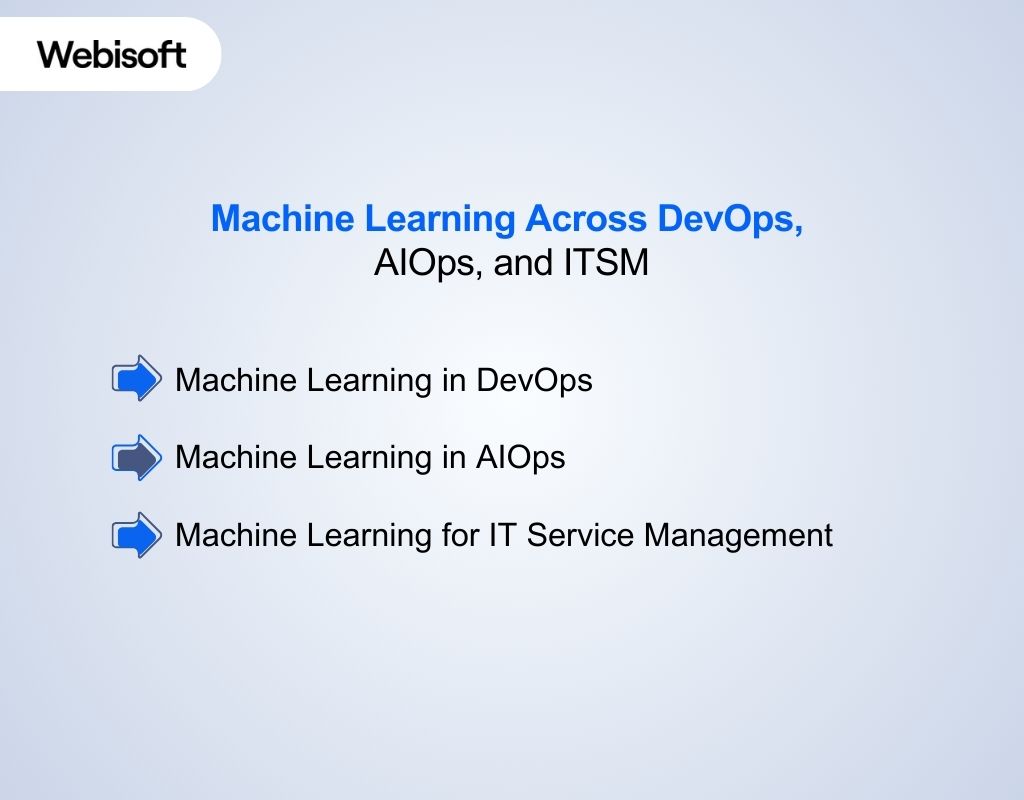
As IT environments become more distributed and fast-moving, development, operations, and service management can no longer work in isolation. Machine learning in IT acts as a connective layer across DevOps, AIOps, and IT service management by learning from shared operational data. Instead of reacting after issues appear, teams use machine learning to predict failures, reduce alert noise, and coordinate responses across the full IT lifecycle.
Machine Learning in DevOps
Within DevOps pipelines, machine learning analyzes signals from build, test, and deployment stages. These signals include CI/CD data, application performance metrics, error logs, and release history.
Machine learning in DevOps helps teams see how code, configuration, or infrastructure changes affect behavior after deployment. Models learn from past releases to spot patterns tied to failed builds, regressions, or unstable deployments. Over time, this approach supports smarter release decisions, targeted testing, and faster rollback detection by linking deployments directly to operational outcomes.
Machine Learning in AIOps
AIOps environments handle massive volumes of alerts, events, logs, and metrics from modern IT systems. Machine learning in AIOps processes this data at scale and separates meaningful signals from background noise. Models correlate events across tools and layers to group related alerts into a single incident view.
By learning normal behavior, they also detect anomalies early, which directly reduces alert fatigue in operations teams. Beyond detection, machine learning supports root cause analysis by spotting patterns that often appear before incidents. This helps teams respond faster and focus on fixing issues instead of manual investigation.
Machine Learning for IT Service Management
In IT service management environments, large volumes of tickets and incident records often overwhelm support teams. Machine learning for IT service management helps streamline these workflows and improve response quality.
Models study past tickets to classify issues, set priority, and route requests to the right teams. By learning from previous resolutions, systems also suggest fixes or flag incidents likely to escalate. This reduces manual triage and shortens response times while keeping human oversight where needed. Over time, machine learning shifts ITSM teams from reactive ticket handling to proactive issue prevention.
Step-by-Step Guide to Implementing Machine Learning in IT
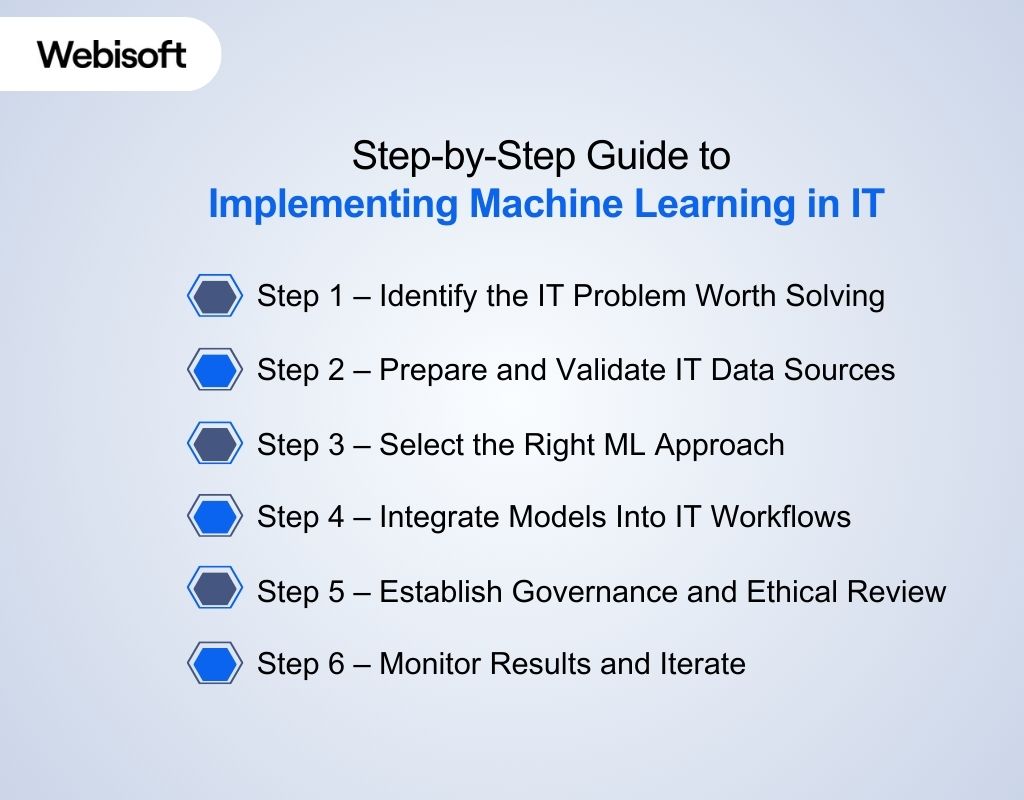
Implementing machine learning in IT is not about building complex models first. It is about solving the right operational problem with the right data, then integrating learning systems into existing workflows without increasing risk or operational overhead. The following steps reflect how ML is applied successfully inside real IT environments.
Step 1 – Identify the IT Problem Worth Solving
The first and most critical step is deciding where machine learning is actually needed. Many IT problems can be solved with simple rules, scripts, or thresholds. Using ML in those cases adds cost and complexity without value. Machine learning should be considered only when:
- The problem involves large volumes of changing data
- Patterns are not obvious or static
- Manual analysis does not scale
- Rule-based automation breaks down
Examples include recurring performance anomalies, unpredictable incident patterns, and long-term capacity forecasting. If a problem can be solved reliably with a fixed rule, ML is usually the wrong choice.
Step 2 – Prepare and Validate IT Data Sources
Once a valid use case is identified, data quality becomes the limiting factor. Machine learning models learn directly from historical behavior, so inaccurate or incomplete data leads to unreliable results. In IT environments, this usually involves:
- Aggregating logs, metrics, events, and tickets from multiple tools
- Normalizing timestamps, formats, and identifiers
- Removing noise, duplicates, and incomplete records
- Verifying that historical data reflects real operational behavior
At this stage, teams often discover gaps in observability. Addressing those gaps early prevents false predictions and builds confidence in later stages.
Step 3 – Select the Right ML Approach
The choice of machine learning approach should be driven by the problem type, not by popularity or complexity. In IT use cases, most models fall into three categories:
- Anomaly detection for identifying abnormal system behavior
- Prediction for forecasting failures, performance degradation, or capacity needs
- Classification for grouping incidents, tickets, or events
Simple models often outperform complex ones in IT settings because they are easier to interpret, maintain, and trust. The goal is operational reliability, not theoretical accuracy.
Step 4 – Integrate Models Into IT Workflows
A model that exists outside operational workflows delivers little value. Integration is where machine learning becomes useful to IT teams. Effective integration typically includes:
- Feeding model output into monitoring platforms
- Linking predictions to ticketing or incident systems
- Triggering automation or remediation workflows
- Providing explainable insights rather than raw scores
This step requires close alignment between data teams and IT operations. Models must fit existing processes rather than forcing teams to adopt entirely new tools.
Step 5 – Establish Governance and Ethical Review
Before scaling deployment, teams must define governance and ethical controls. This ensures machine learning does not introduce hidden risk, bias, or operational harm. Governance typically covers:
- Clear ownership and accountability for models
- Access controls for sensitive operational data
- Auditability of predictions and automated actions
- Guardrails for high-impact or irreversible decisions
Ethical review ensures automation supports teams instead of overriding human judgment.
Step 6 – Monitor Results and Iterate
Machine learning models are not deployed once and forgotten. IT environments change constantly, and models must adapt with them. Post-deployment monitoring focuses on:
- Prediction accuracy over time
- False positives and false negatives
- Model drift caused by changing workloads
- Trust and adoption by IT teams
Regular review and retraining ensure models remain useful and credible. Feedback from operators is essential, as trust determines whether insights are acted on or ignored.
Benefits of Machine Learning in IT
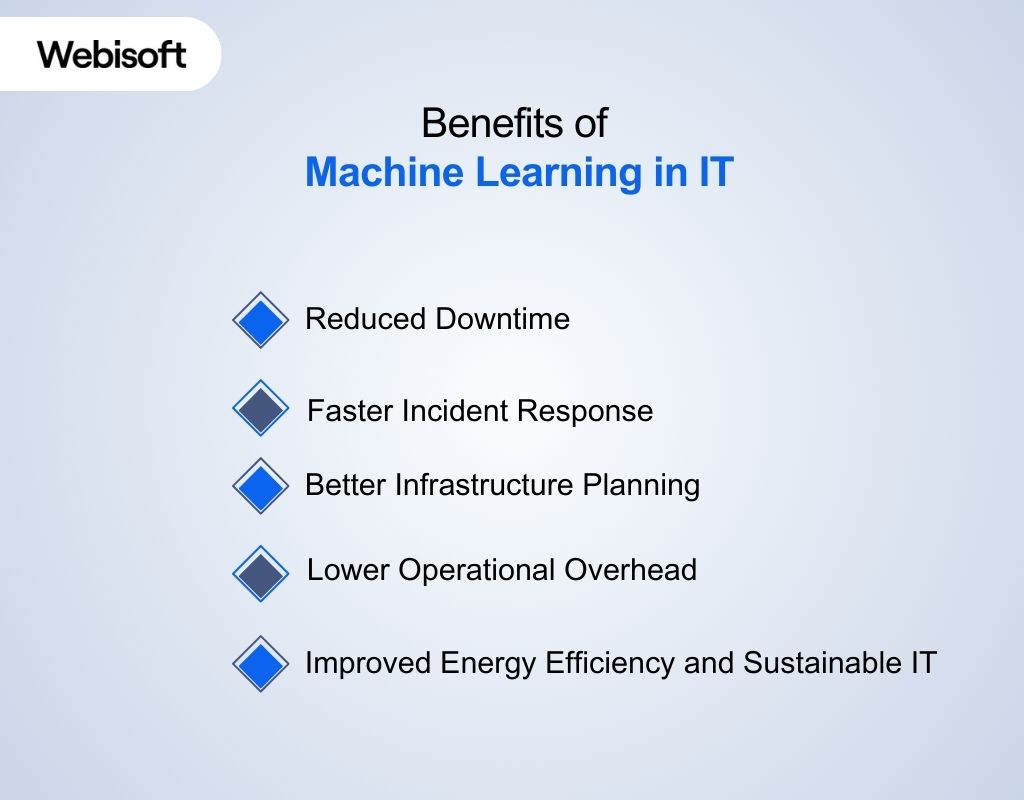
When applied correctly, machine learning improves IT operations by solving problems that rule-based systems and manual processes cannot scale. Some benefits of machine learning in IT are:
Reduced Downtime
Downtime in IT environments often results from issues that develop gradually and go unnoticed until failure occurs. Machine learning reduces downtime by learning patterns in historical performance data and identifying early indicators of degradation.
Instead of reacting to outages, IT teams receive early warnings about potential failures in infrastructure, applications, or networks. This enables preventive maintenance and controlled intervention, minimizing service disruption and improving overall system availability.
Faster Incident Response
Incident response is frequently slowed by alert noise, fragmented data, and manual investigation. Machine learning improves response speed by correlating signals across logs, metrics, and events to surface actionable insights faster.
By identifying related alerts and highlighting probable causes, machine learning reduces the time spent on triage and investigation. IT teams can move directly to resolution rather than sorting through large volumes of unprioritized data.
Better Infrastructure Planning
Infrastructure planning based on static assumptions often leads to inefficiencies. Machine learning supports more accurate planning by analyzing historical usage trends, workload patterns, and growth behavior.
This allows IT teams to forecast capacity needs with greater confidence, align resources with actual demand, and avoid both overprovisioning and resource shortages. Planning decisions become data-driven rather than reactive.
Lower Operational Overhead
Manual monitoring, repetitive troubleshooting, and routine maintenance place a constant burden on IT teams. Machine learning reduces this overhead by automating tasks that do not require human judgment.
Automated anomaly detection, intelligent alerting, and workflow automation reduce the volume of manual work required to keep systems stable. This allows IT professionals to focus on higher-value activities such as optimization, architecture improvement, and risk management.
Improved Energy Efficiency and Sustainable IT
IT environments often waste energy due to overprovisioned resources and inefficient workload placement. Machine learning improves energy efficiency by optimizing resource usage based on real demand patterns.
Models help consolidate workloads, reduce idle capacity, and schedule compute more efficiently. This lowers power consumption and supports sustainable IT operations without sacrificing performance.
Challenges and Limitations of Machine Learning in IT
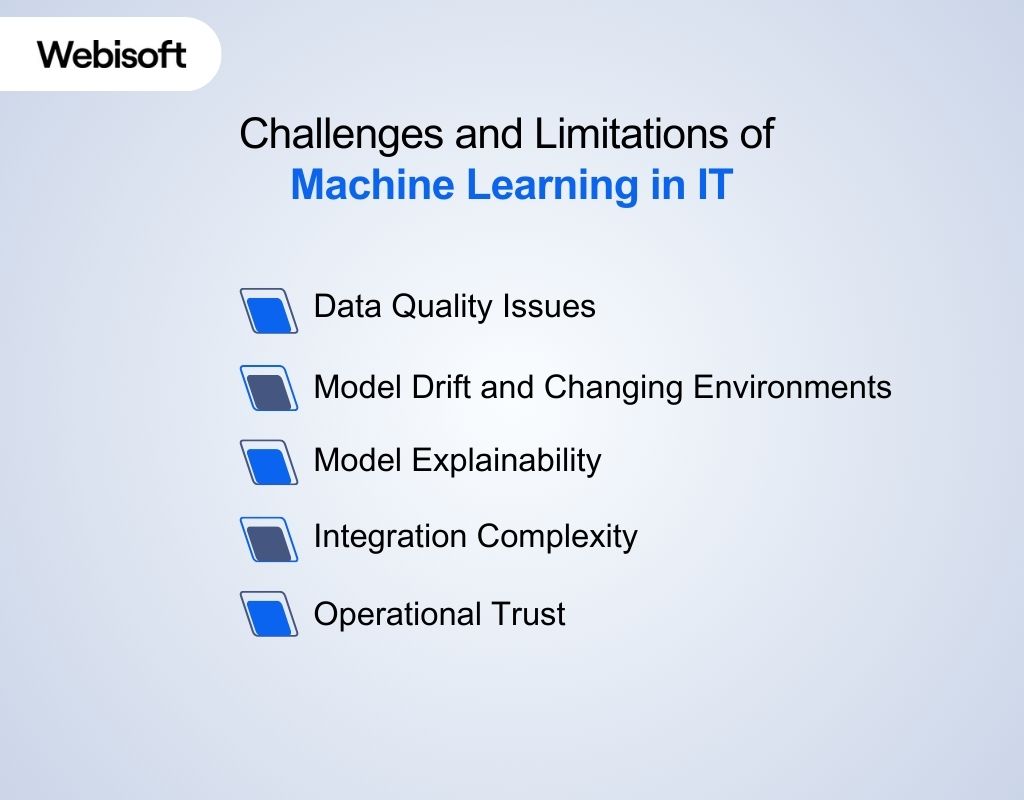
While machine learning in IT delivers strong operational benefits, it also introduces challenges that directly affect reliability, adoption, and long-term value. These limitations are not theoretical.
They surface during deployment, daily operations, and system scaling if not handled deliberately. Understanding these constraints helps IT teams apply machine learning where it genuinely improves outcomes and avoids situations where simpler approaches are more effective.
Data Quality Issues
All machine learning use cases in IT depend on the quality and consistency of operational data. In real environments, logs, metrics, and events are often fragmented across tools, incomplete, or influenced by changing architectures.
When data lacks context or contains bias, models trained for machine learning for system monitoring or prediction can generate unreliable results. This leads to false alerts, missed incidents, or incorrect forecasts. Poor data quality does not just reduce accuracy. It undermines confidence in the entire system.
Model Drift and Changing Environments
IT environments change constantly due to new deployments, traffic patterns, and infrastructure updates. As a result, models trained on past behavior can lose accuracy over time, a problem known as model drift.
When drift goes unchecked, predictions become less reliable and detection accuracy drops. Regular monitoring and retraining are required to keep machine learning in IT operations aligned with current system behavior.
Model Explainability
Many models used in machine learning in IT operations rely on complex statistical behavior that is difficult to interpret. This becomes a problem when IT teams must act on model output without understanding the reasoning behind it.
If a model flags an issue but cannot explain why, operators hesitate to trust it, especially in environments tied to availability, security, or compliance. Lack of explainability slows adoption and limits the effectiveness of machine learning for incident management and automated decision support.
Integration Complexity
Machine learning does not replace existing tools. It must integrate with monitoring platforms, ticketing systems, automation pipelines, and dashboards. This makes machine learning implementation in IT operationally complex.
Changes in infrastructure, tooling, or data pipelines can break model inputs or degrade performance. Without strong integration planning, machine learning adds maintenance overhead instead of reducing it, particularly in environments using multiple vendors and platforms.
Operational Trust
Trust is one of the hardest challenges to establish. Even accurate models can lose credibility if they generate frequent false positives or behave unpredictably during system changes. For machine learning in IT management to be effective, outputs must align with real operational outcomes.
IT teams need consistent performance, clear feedback loops, and the ability to override or validate model-driven actions. Trust develops over time and can be lost quickly if models disrupt established workflows.
How Webisoft Applies Machine Learning in IT Environments
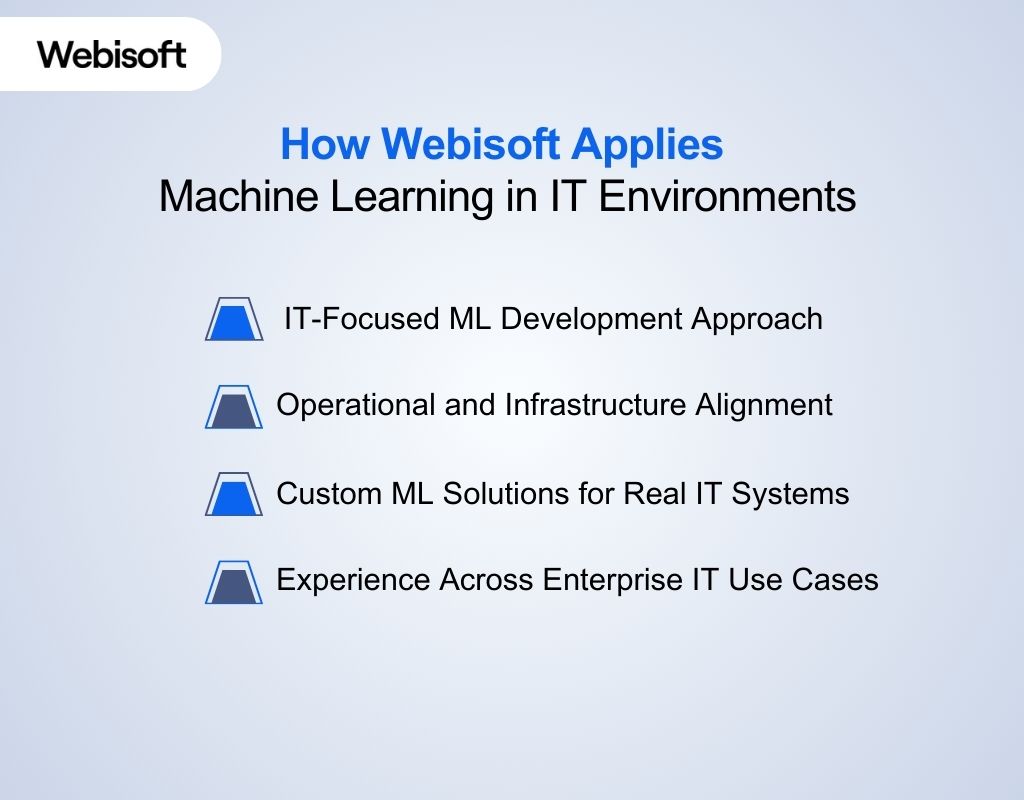
Webisoft applies machine learning in IT with a clear focus on operational reality. The goal is not experimentation or abstract modeling, but deploying learning systems that fit directly into how enterprise IT environments function day to day.
IT-Focused ML Development Approach
Webisoft starts every engagement by anchoring machine learning to a defined IT problem. This includes operational instability, alert overload, performance bottlenecks, or planning inefficiencies. Models are designed around real IT data sources such as logs, metrics, events, and service records, rather than synthetic or isolated datasets. This approach ensures machine learning solutions remain practical, interpretable, and aligned with how IT teams actually work.
Operational and Infrastructure Alignment
Machine learning systems developed by Webisoft are built to integrate with existing infrastructure and workflows. This includes compatibility with monitoring platforms, incident management tools, automation pipelines, and cloud or hybrid environments.
By aligning models with infrastructure realities, Webisoft helps organizations avoid common adoption issues such as brittle integrations, excessive false alerts, or disconnected analytics that operators cannot act on.
Custom ML Solutions for Real IT Systems
Webisoft does not rely on generic models or one-size-fits-all frameworks. Each solution is tailored to the client’s environment, data maturity, and operational goals. Custom models are designed to support use cases such as anomaly detection, predictive analysis, and operational decision support, ensuring outputs are relevant, explainable, and actionable within production IT systems.
Experience Across Enterprise IT Use Cases
Webisoft’s experience spans enterprise-scale IT environments where reliability, security, and scalability matter. This includes working with complex infrastructures, distributed systems, and high-volume operational data. That experience informs how machine learning is scoped, implemented, and maintained, helping organizations apply ML where it delivers measurable value rather than unnecessary complexity.
Conclusion
Machine learning in IT delivers value when teams apply it to real operational problems, not abstract experiments. Across monitoring, incident response, infrastructure planning, and service management, it helps reduce downtime, speed up response, and manage complexity.
The strongest results come from an IT-first approach. Teams start with clear pain points, validate data quality, choose simple and explainable models, and connect outputs to existing workflows. When machine learning matches how IT systems actually run, it improves decisions instead of adding noise.
FAQs
Machine learning fits into IT systems by integrating with existing monitoring, ticketing, and automation tools. Models analyze operational data and feed insights back into workflows rather than replacing current systems or processes.
Machine learning in IT relies on logs, metrics, events, tickets, and network telemetry. Historical data is essential because models learn patterns over time. Without consistent and contextual data, results become unreliable.
Rule-based automation follows fixed conditions and works well for predictable scenarios. Machine learning adapts to changing behavior by learning patterns from data, making it suitable for complex and dynamic IT environments.
Initial value can appear quickly for focused use cases like alert reduction or ticket classification. Long-term value depends on data quality, integration depth, and continuous model tuning as systems evolve.
Machine learning does not fully replace IT teams or decision-making. It supports operations by reducing noise, prioritizing issues, and surfacing insights, while human oversight remains critical for high-impact actions.