Machine learning in IoT means using ML models to learn patterns from that device data and then make smarter decisions automatically. Some examples are predicting equipment failure, detecting abnormal behavior, or optimizing energy usage in real time.
If you are building an IoT product, you already know the hard part is not the “model.” The hard part is the data. IoT data is often noisy, incomplete, and inconsistent across devices. Sensor readings drift, connectivity drops, and telemetry formats vary from one vendor to another.
That makes it difficult to train models that stay reliable after deployment. In this blog, we will discuss how machine learning works in IoT, where it delivers the most value, the best algorithms to use, and how teams can deploy and maintain models safely across cloud, edge, and on-device environments.
What Is Machine Learning in IoT?
Machine learning in IoT is about helping connected devices understand the data they collect and act on it. IoT devices already capture signals like temperature, motion, sound, vibration, or location, but those signals are just measurements . Machine learning ties them together, spots patterns, and turns them into decisions.
Without machine learning, an IoT system mostly reports numbers or triggers simple alerts. When machine learning is added, the system can notice when something looks off, predict what might fail next, or understand what a user is doing, then react on its own. A smartwatch is a good example.
It tracks heart rate and movement throughout the day, and machine learning looks for patterns in that data. Those patterns help the device identify sleep stages, stress signals, or unusual heart rhythms and notify the user. The same idea applies in factories.
Sensors on machines constantly measure vibration and temperature, and machine learning learns what normal operation looks like. When that pattern starts to change, the system can warn the team early, before a breakdown happens.
In smart buildings, sensors monitor occupancy, CO₂ levels, and energy use, and machine learning connects those signals to predict demand. As conditions change, the system adjusts heating, cooling, and lighting automatically, saving energy without sacrificing comfort.
In short, machine learning in IoT is the layer that turns raw sensor data into useful actions, making connected devices smarter instead of just connected.
Who Uses Machine Learning in IoT and Why?
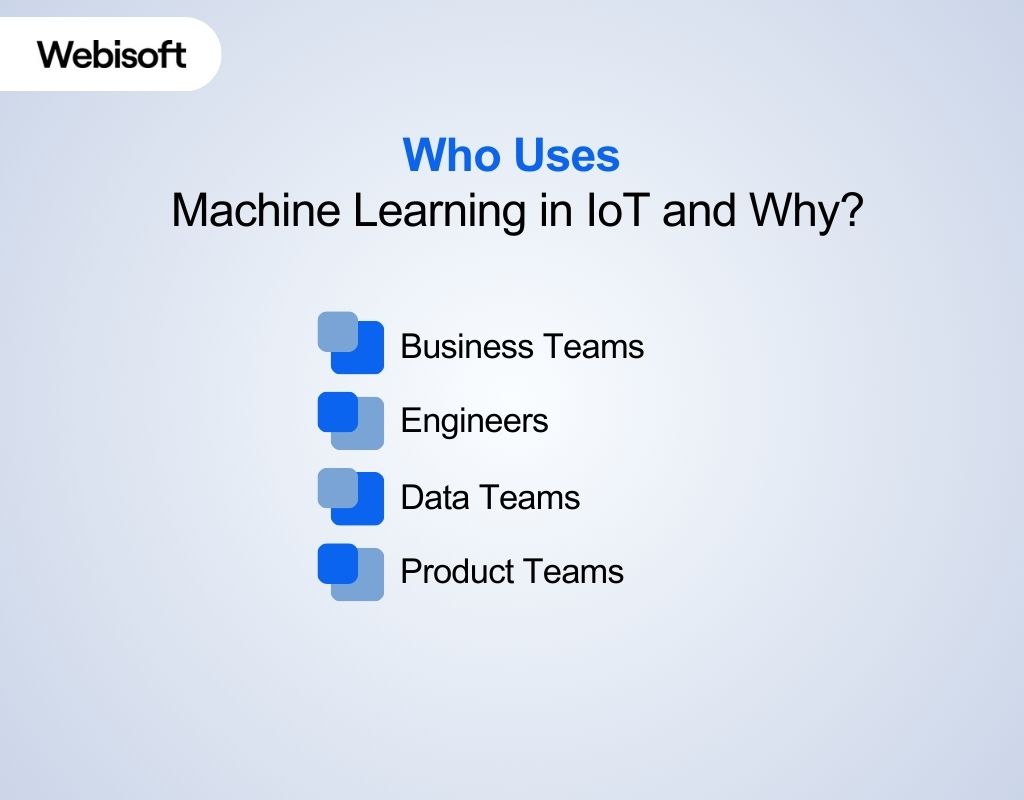
Many teams across organizations use machine learning in iot because it helps turn raw sensor data into decisions that drive business value.
Business Teams
Business teams adopt machine learning for iot to reduce unplanned downtime and lower operating costs. In predictive maintenance applications, IoT sensors paired with ML models help forecast equipment issues before they become failures. Research has found can reduce unexpected downtime and maintenance expenses significantly.
Engineers
Engineers use IoT machine learning to build systems that detect problems as they occur, not after the fact. By analyzing live streams of sensor data, machine learning models alert teams to anomalies in temperature or vibration that can signal a fault, helping avoid cascading breakdowns in continuous processes.
Data Teams
Data teams focus on the complex patterns in IoT data because most sensor output is a time series that changes over time. They use machine learning models tailored to temporal data to spot trends, forecast future behavior, and detect outliers that might indicate a system issue.
Analytics research shows that combining ML with diverse IoT sensor inputs improves predictive performance across manufacturing and transportation environments.
Product Teams
Product teams use edge AI for IoT to make devices smarter and more responsive to individual users. ML models on IoT systems can learn user behavior and adjust device responses automatically, such as tuning climate control or optimizing energy use in smart homes.
This improves user satisfaction by creating products that feel intuitive and adaptive without requiring manual configuration.
How Machine Learning in IoT Works (Architecture That Actually Matches Reality)
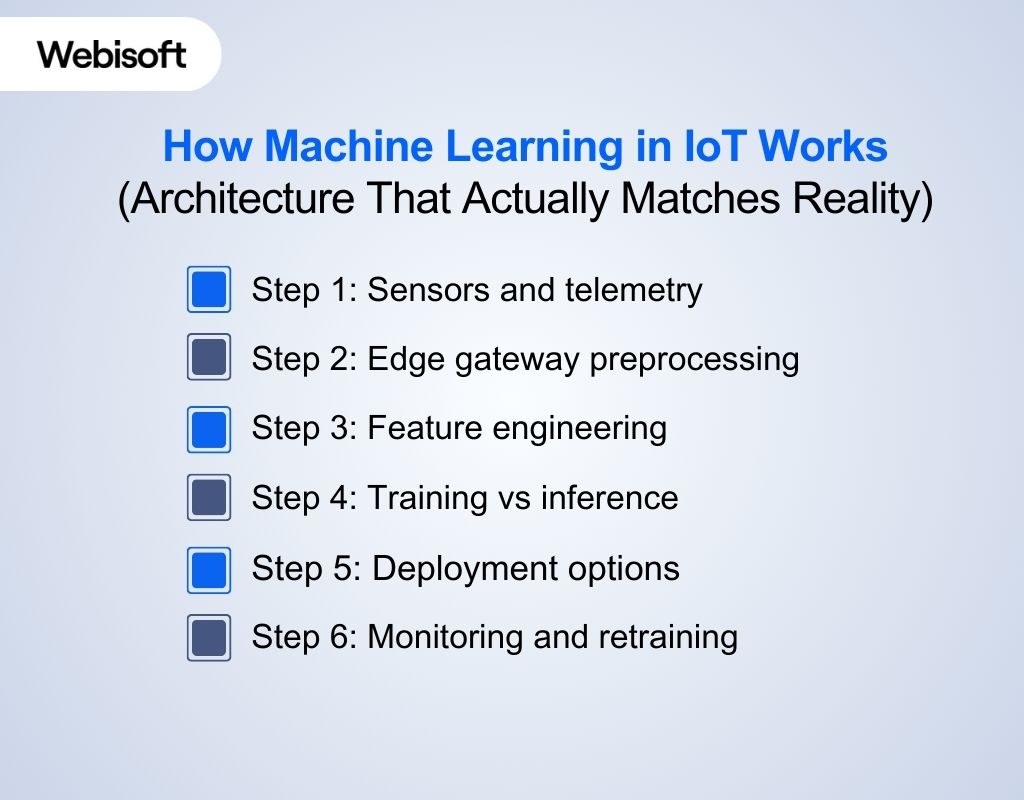
Machine learning in IoT works through a pipeline that starts with raw sensor data and ends with actionable insights.
Step 1: Sensors and telemetry
The system begins at the device level, where IoT sensors continuously capture physical signals such as temperature, motion, vibration, humidity, and sound. These readings flow as time-series telemetry and form the raw input that everything else in the pipeline depends on.
Step 2: Edge gateway preprocessing
Edge gateways are intermediate devices that sit between IoT sensors and cloud or central systems. They collect data from many sensors, manage local connectivity, and handle early processing close to where data is generated.
Before sending data onward, edge gateways clean sensor streams by removing noise, filtering outliers, normalizing values, and compressing data. This reduces bandwidth usage, lowers latency, and ensures machine learning models receive consistent, usable inputs for downstream processing.
Step 3: Feature engineering
Once data is cleaned, the system converts telemetry into features that describe behavior over time. These features summarize patterns such as trends, spikes, cycles, and deviations, creating a structured representation that machine learning models can interpret consistently.
Step 4: Training vs inference
Using historical features, models are trained to learn what normal and abnormal behavior looks like. After training, the same models run inference on incoming features, generating predictions continuously as new sensor data flows through the system.
Step 5: Deployment options
To keep predictions usable, trained models are deployed where inference needs to happen. Cloud deployment supports large-scale analysis, edge deployment supports low-latency decisions, and on-device deployment enables immediate responses directly at the sensor level. This step determines how fast predictions translate into action.
Step 6: Monitoring and retraining
IoT environments change over time, so models that once worked well might start to fail. This is called concept drift. Teams set up monitoring systems to track model accuracy and performance.
When the results drop below a threshold, they retrain models with fresh data so predictions stay accurate. Retraining might happen on scheduled cycles or when performance metrics signal that the model no longer reflects current conditions.
Top Use Cases of Machine Learning in IoT (With Practical Examples)
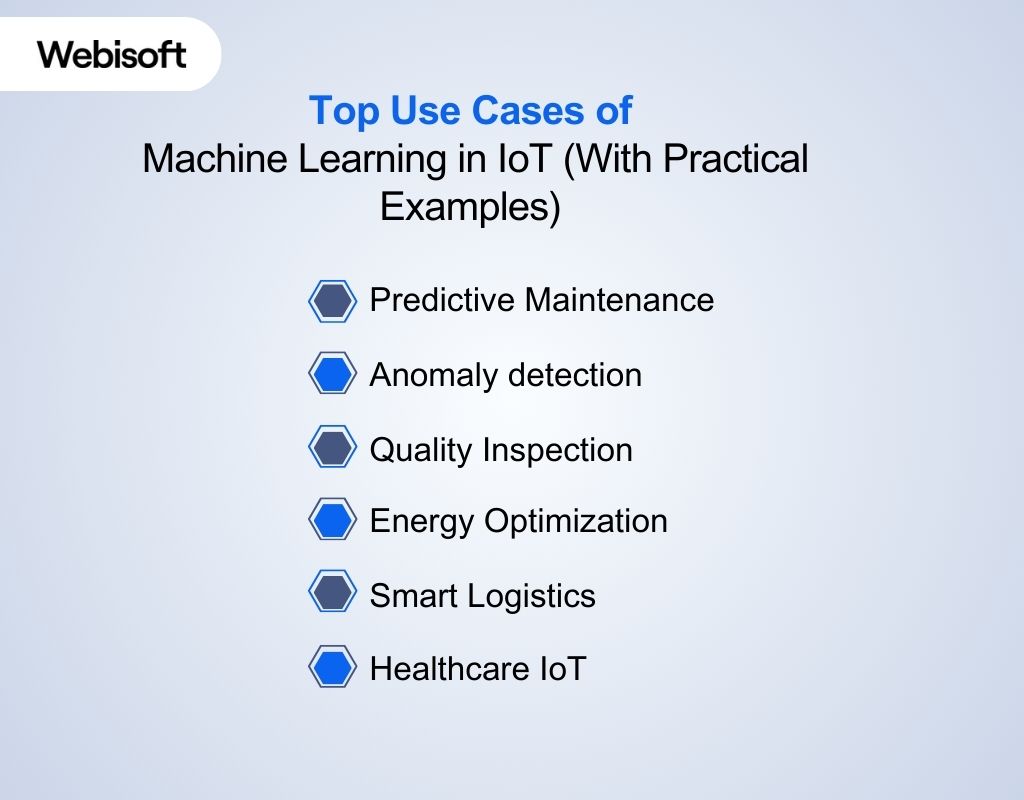
Machine learning makes IoT systems smarter by interpreting raw signals into actions, not just collecting data. In real operations, IoT machine learning models turn endless streams of sensor inputs into patterns, warnings, and decisions that help teams act faster and with confidence.
The examples below show how and where organisations apply this combination to improve outcomes across industries:
Predictive Maintenance
Predictive maintenance uses iot predictive maintenance to reduce sudden equipment failures by analysing sensor readings before problems happen. Sensors on motors and bearings capture vibration, temperature, and pressure data continuously, and ML models learn what “normal” looks like so they can predict faults early.
Research shows that predictive maintenance cuts breakdowns by 30–40 % and lowers maintenance costs by 20–30 %, increasing operational uptime.
Anomaly detection
Anomaly detection systems use anomaly detection in IoT to spot patterns that deviate from the expected behaviour and act on them instantly. For example, ML algorithms can track network traffic from IoT devices and flag when a smart meter or camera starts sending unusual signals, which can indicate faults or attacks.
Beyond hardware health, some organisations use IoT security with machine learning to detect malicious traffic, reducing breach risk where traditional rule-based systems fail to keep up with complex threats. [Source: Springer]
Quality Inspection
Quality inspection uses cameras and vision systems powered by machine learning for iot to check products on production lines as they are made. Instead of slowing down the line for human inspection, ML models review every image in real time and catch defects that are too subtle for the human eye.
Manufacturers adopting this approach report fewer returns and more quality, helping reduce waste and improve consistency at scale.
Energy Optimization
Energy optimization uses IoT sensor data analysis to understand patterns in power use and make systems work more efficiently.
Smart buildings apply models that learn from usage trends. For example, lighting and HVAC, and then adjust setpoints automatically, which lowers utility costs and improves comfort.
Smart Logistics
Logistics teams combine GPS and environmental sensors with deploying ml models on edge devices to optimise fleet routes and protect goods in transit.
In cold chain management, IoT sensors monitor temperature, humidity, and shock, and ML can flag likely spoilage before it happens by learning from patterns across shipments.
Healthcare IoT
Healthcare applications of industrial IoT machine learning, and consumer wearables rely on constant health monitoring to spot early signs of risk.
Devices like smartwatches and medical sensors stream heart rate, blood oxygen, and movement data, and ML models analyse this to detect irregular rhythms or slow changes that might indicate a health issue.
Studies show that algorithms using IoT health data can reach high predictive accuracy for events like atrial fibrillation, enabling earlier intervention and better patient outcomes.
Across these use cases, one thing stays consistent. Machine learning in IoT only delivers value when models reflect how sensors behave in the real world and how decisions are actually made. When data quality, latency, or deployment limits are ignored, even strong models fail to produce usable outcomes.
That is where Webisoft fits into the process. We help teams connect specific IoT use cases, such as predictive maintenance or anomaly detection, to the right data signals, algorithms, and deployment setup.
Which ML Algorithms Work Best for IoT Data?
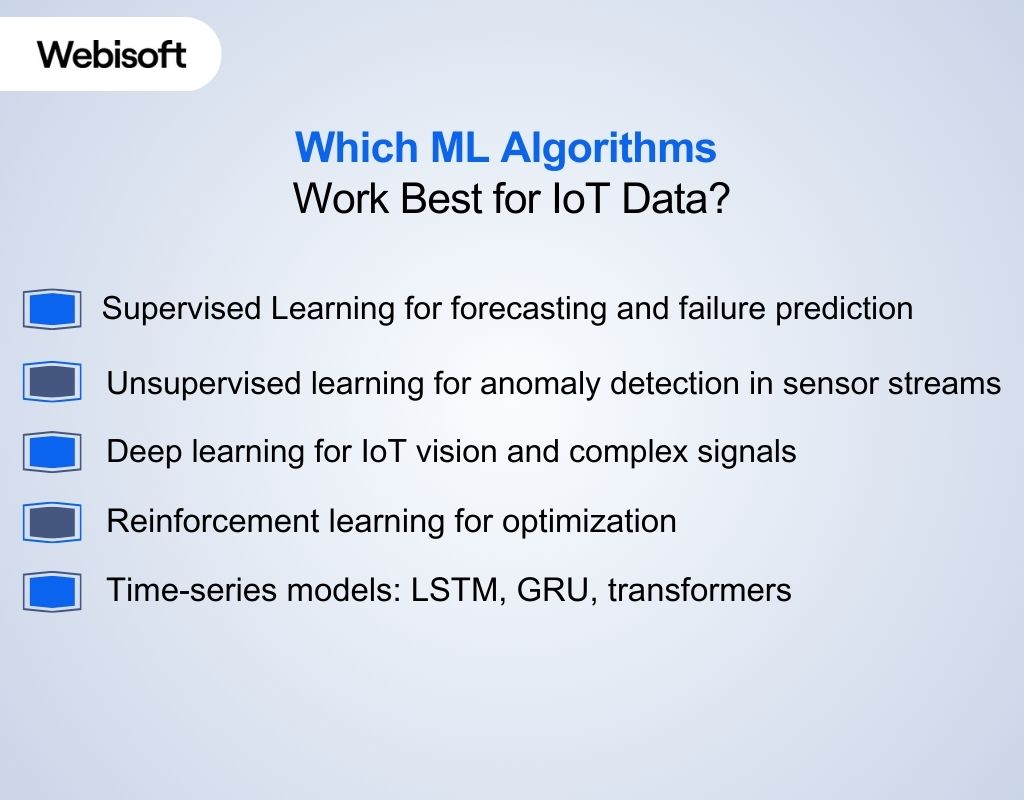
Choosing the right algorithm for IoT depends on one thing first: what kind of data you have and what decision you need. Some projects have labeled sensor history, while others only have raw streams with no clear “correct answer.” That is why teams mix approaches in ML in IoT projects instead of forcing one model everywhere.
Supervised Learning for forecasting and failure prediction
Supervised learning works best when you have labeled outcomes, like “motor failed” or “battery healthy.” This approach fits IoT data analytics because it turns sensor history into a prediction, such as failure risk in the next 7 days.
In real deployments, teams often start with Random Forest or XGBoost because they train fast, explain results clearly, and perform well on structured sensor data.
Unsupervised learning for anomaly detection in sensor streams
Unsupervised learning works best when you do not have labels, which happens often in IoT. This approach fits IoT forecasting using machine learning when your goal is “detect unusual behavior early,” not “predict a fixed target.”
In practice, clustering, PCA, and Isolation Forest help spot drift in device behavior, like a pump drawing more power than usual.
Deep learning for IoT vision and complex signals
Deep learning works best when your IoT data is complex, such as images, audio, or high-frequency vibration signals. This approach fits AI in IoT systems because CNNs and hybrid deep models can detect patterns humans miss, like microcracks on a production line. However, teams must plan compute and memory carefully because deep models can become heavy.
Reinforcement learning for optimization (HVAC, robotics, routing)
Reinforcement learning works best when the system must learn through trial and feedback. This approach fits aiot (artificial intelligence of things) because smart environments and machines can improve decisions over time, like tuning HVAC settings based on comfort and energy use. It also helps robotics and routing systems, where each action changes the next state.
Time-series models: LSTM, GRU, transformers
Time-series models work best when the order of sensor readings matters, which is most IoT data. This approach fits time series forecasting iot because LSTM and GRU can learn long patterns, like seasonal energy demand or slow equipment wear.
You should avoid transformers in small IoT setups unless you compress the model, because they often need more data and compute than edge hardware can handle.
Edge ML vs Cloud ML for IoT: What to Choose?

Edge vs cloud is not a “better vs worse” choice in machine learning in iot. The real question is where your system must make decisions, and how fast it must react. Most teams pick a setup based on latency, privacy, cost, and how often the model needs updates.
When to choose cloud ML
Cloud ML wins when you need heavy training, large datasets, and long-term trend analysis. This works well for tasks like fleet-wide reporting, multi-site forecasting, and training deep models on months of sensor history. Cloud also fits best when your IoT system needs centralized control, like pushing model updates across thousands of devices.
When to choose edge ML
Edge ML wins when decisions must happen immediately, without waiting for a network round-trip. This matters in smart cameras, robotics, and factory safety systems, where a delay can cause damage or risk. Edge ML also supports privacy-first systems because data can stay local instead of being sent to external servers.
On-device ML constraints
On-device ML works only when your model fits strict hardware limits. Small devices often run on low-power CPUs with limited RAM, and they must preserve battery life for weeks or months. This is why teams use model compression methods like quantization and pruning when building tinyml for iot deployments.
Hybrid architecture
Hybrid architecture is the most realistic option for modern IoT systems. Edge devices run fast inference locally, while the cloud collects selected data for deeper analysis and model retraining. This approach supports iot edge computing without losing the benefits of cloud-scale learning and monitoring.
Challenges of Machine Learning in IoT
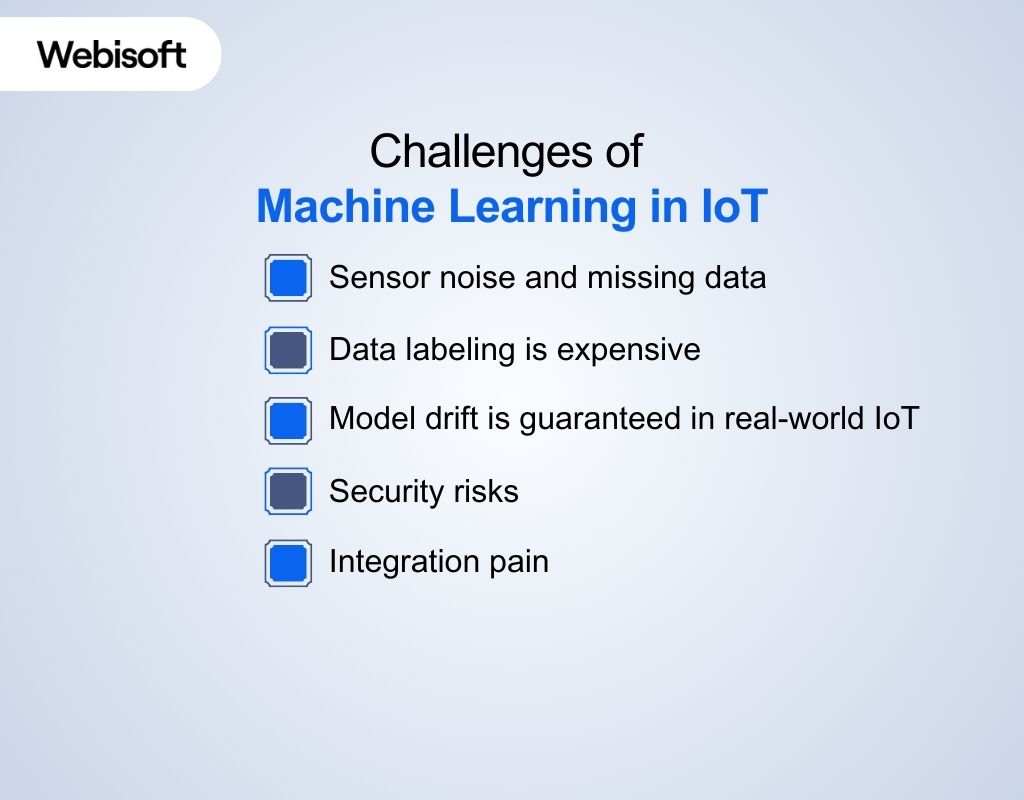
Machine learning makes IoT systems powerful, but it also brings real challenges that teams must solve. These challenges range from messy sensor data and high labeling costs to security threats and integration pain. Below, each key challenge is explained and has real-world relevance, so you know what to expect:
Sensor noise and missing data
Sensor noise and missing data make models less accurate because IoT streams often include spikes or gaps that do not reflect actual conditions.
Data teams must filter, interpolate, or smooth readings before training, and sometimes remove outliers to help models learn the right patterns. Research shows that even small percentages of missing data can skew predictions, so preprocessing is a necessary step in iot data analytics.
Data labeling is expensive
Training supervised models requires correctly labeled data, and labeling IoT streams at scale is costly and slow. Human experts must annotate historical events (like failure vs normal), which can take thousands of hours depending on device type.
As a practical alternative, teams use unsupervised learning combined with periodic expert review to reduce the need for large labeled sets while still finding useful structure in sensor streams.
Model drift is guaranteed in real-world IoT
Model drift occurs when environments change faster than the model can learn, and it is especially relevant in IoT systems that run for months or years.
When sensor behaviour shifts due to wear, seasonality, or software updates, the model’s predictions can degrade unless retrained regularly. Teams monitor performance metrics and schedule retraining cycles so that models stay accurate and reflect current conditions rather than outdated patterns.
Security risks
Security risks in IoT systems extend beyond data leaks to include model poisoning, where attackers subtly alter training data to make the model behave incorrectly. IoT networks also have many entry points, and compromised devices can feed false data back into the system or leak sensitive information.
Because IoT deployments often cover critical infrastructure, teams must combine secure firmware, encrypted transmission, and anomaly detection to protect both models and devices from misuse.
Integration pain
IoT environments are notoriously diverse, with devices from different vendors speaking different protocols and formatting data in incompatible ways. Machine learning models struggle when they must accept inconsistent inputs because misalignment adds preprocessing overhead and potential errors.
Machine learning strengthens IoT systems, but challenges often appear across data quality, drift, security, and integration.
Webisoft mitigates these risks by designing stable data pipelines, limiting unnecessary labeling, monitoring models for drift, and aligning deployments with real device constraints. This approach helps IoT ML systems stay accurate, secure, and reliable as conditions change in production.
How Webisoft Implements Machine Learning in IoT
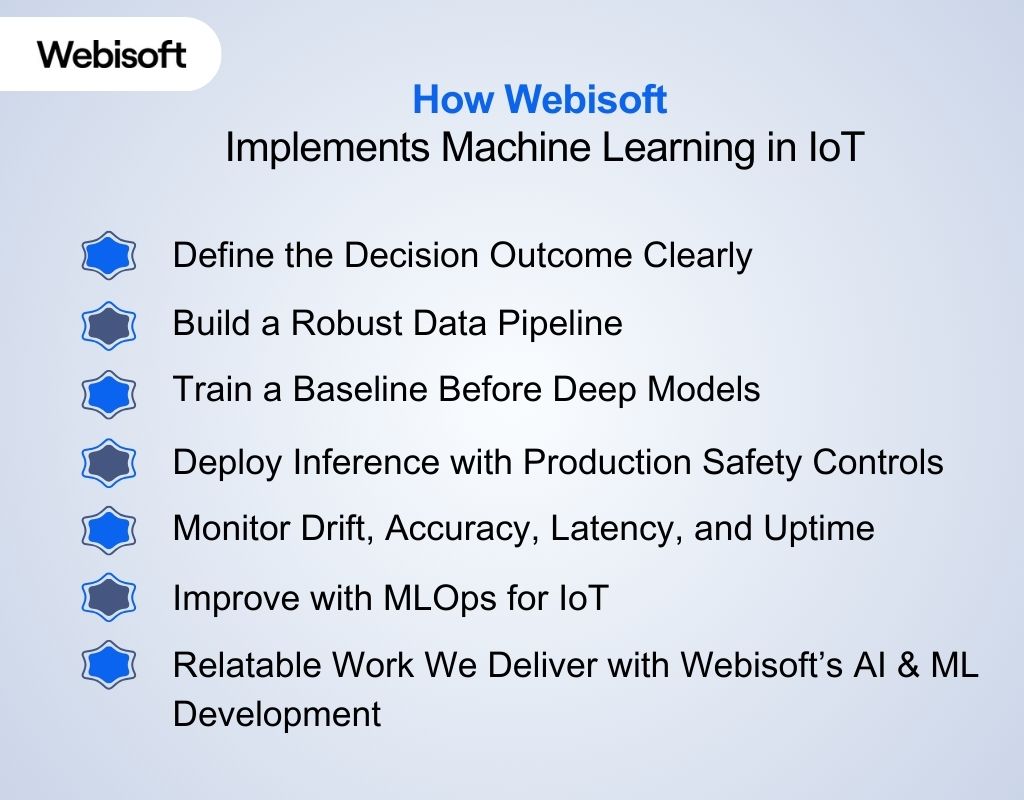
We implement machine learning in IoT with a structured, production-grade workflow that turns connected data into reliable action. Our team focuses on measurable outcomes, safe deployments, and continuous improvement rather than one-off prototypes.
This approach aligns with how modern enterprises build scalable, real-world AI IoT systems that integrate seamlessly with existing operations.
Define the Decision Outcome Clearly
We begin by defining the exact decision your IoT system needs to make, such as predicting failures or identifying unusual behavior.
Our engineers clarify success criteria with business stakeholders to ensure the model solves a real operational need rather than guessing at impact. This early alignment helps prioritize the right signals and avoid unnecessary model complexity.
Build a Robust Data Pipeline
We engineer the data pipeline to feed models with clean, consistent telemetry from your devices. This includes handling sampling rates, syncing timestamps, addressing missing data, and setting retention policies to manage costs and storage.
Our approach ensures that the dataset is ready for training without wasting effort on unusable or erratic data, a step many teams overlook.
Train a Baseline Before Deep Models
We train baseline models first to gauge whether the available data supports predictive power. Using interpretable techniques such as regression or tree-based learners lets us measure value quickly and spot issues before investing in heavy deep learning. This practice reduces risk and sets realistic expectations for model performance.
Deploy Inference with Production Safety Controls
We deploy inference using staged rollouts, confidence thresholds, and fallback logic so predictions don’t disrupt operations. Our team integrates models into your workflows using secure APIs or message queues that fit your architecture. These safeguards help ensure predictions act safely, whether in the cloud, at the edge, or on device.
Monitor Drift, Accuracy, Latency, and Uptime
We treat monitoring as part of the solution, not an afterthought. Systems track key metrics like model accuracy, latency, and uptime, as well as drift indicators that signal when performance is degrading. Early alerts let engineers retrain or adjust models before issues impact operations.
Improve with MLOps for IoT
We incorporate MLOps so models evolve with your data and business needs. This includes dataset versioning, automated retraining, and performance tracking across deployments. Using mature MLOps practices helps ensure your IoT ML systems remain reliable, scalable, and aligned with changing conditions over time.
Relatable Work We Deliver with Webisoft’s AI & ML Development
Our AI and ML capabilities are backed by deep engineering expertise and a track record of delivering solutions that transform operations. For IoT specifically, we have:
- Designed predictive analytics pipelines that forecast device failures and optimize maintenance workflows.
- Developed anomaly detection systems that identify unusual equipment or behavior patterns early.
- Built real-time monitoring dashboards and MLOps infrastructure to ensure sustained performance in field deployments.
- Integrated models into enterprise platforms with secure, scalable pipelines across cloud and edge environments.
This structured process ensures your IoT ML initiative delivers measurable impact, reduces manual work, and improves operational decisions, from the first dataset to continuous optimization.
Conclusion
Machine learning is what turns IoT from “connected devices” into systems that can predict, detect, and respond without waiting for humans. When done right, it helps reduce downtime, improve security, cut energy waste, and create better user experiences.
But real success depends on clean telemetry pipelines, the right architecture (cloud, edge, or on-device), and ongoing monitoring to handle drift and changing conditions.
Machine learning in IoT is not a one-time model build. It is a long-term operational capability that improves over time when supported by strong engineering and MLOps practices.
FAQs
Manufacturing, logistics, utilities, healthcare, and smart buildings benefit the most. These industries generate continuous sensor data and have high-value outcomes like reduced downtime, energy savings, or early risk detection. They also have clear automation opportunities, which makes ML adoption easier to justify.
Yes, it can work offline using edge or on-device inference. The model runs locally and still detects anomalies, predicts events, or triggers actions in real time. Internet access becomes useful mainly for cloud retraining, monitoring, and centralized updates.
It depends on the model size and the latency requirement. Basic sensor models can run on microcontrollers, while computer vision often needs stronger edge hardware like GPUs or NPUs. In many cases, lightweight runtimes like TensorFlow Lite or ONNX Runtime help models run efficiently on limited devices.
You need enough data to capture both “normal” behavior and rare events. For many sensor-based projects, a few weeks to a few months of clean telemetry is a practical starting point. If the goal is failure prediction, you also need enough failure examples, or the model will struggle to learn useful patterns.
Testing should include both offline and real-world validation. Offline testing checks accuracy on historical data, but field testing confirms performance under noise, missing data, and device variability.
A safe rollout uses pilot deployments, monitoring dashboards, and fallback logic so the system stays stable even if predictions fail.