Machine learning in investment is changing how financial decisions are shaped, often quietly and without headlines. Around 64% of investment professionals are already using or planning to use machine learning in their work. This shift is less about replacing human judgment and more about handling complexity.
Markets generate more data than people can process consistently, and traditional analysis often struggles to keep pace with speed, scale, and changing conditions. As a result, here you will see how this shift changes workflows, what systems deliver practically, where limits appear, and why execution matters most.
What is Machine Learning in Investment?
Machine learning in investment refers to the use of algorithms and statistical models to support investment decision-making. Rather than relying on fixed rules or human intuition, these systems learn patterns from historical and real-time market data to identify trends and signals.
Machine learning is a subset of artificial intelligence that enables systems to improve over time, forming a core foundation of AI in investment. In investment use cases, models adapt as new data appears and extract insights from datasets including price history, trading volume, statements, and indicators.
Within investment environments, machine learning supports market forecasting, portfolio allocation, risk analysis, and algorithmic trading by handling complexity and changing market conditions with greater consistency.
Where Machine Learning Is Used Across the Investment Process
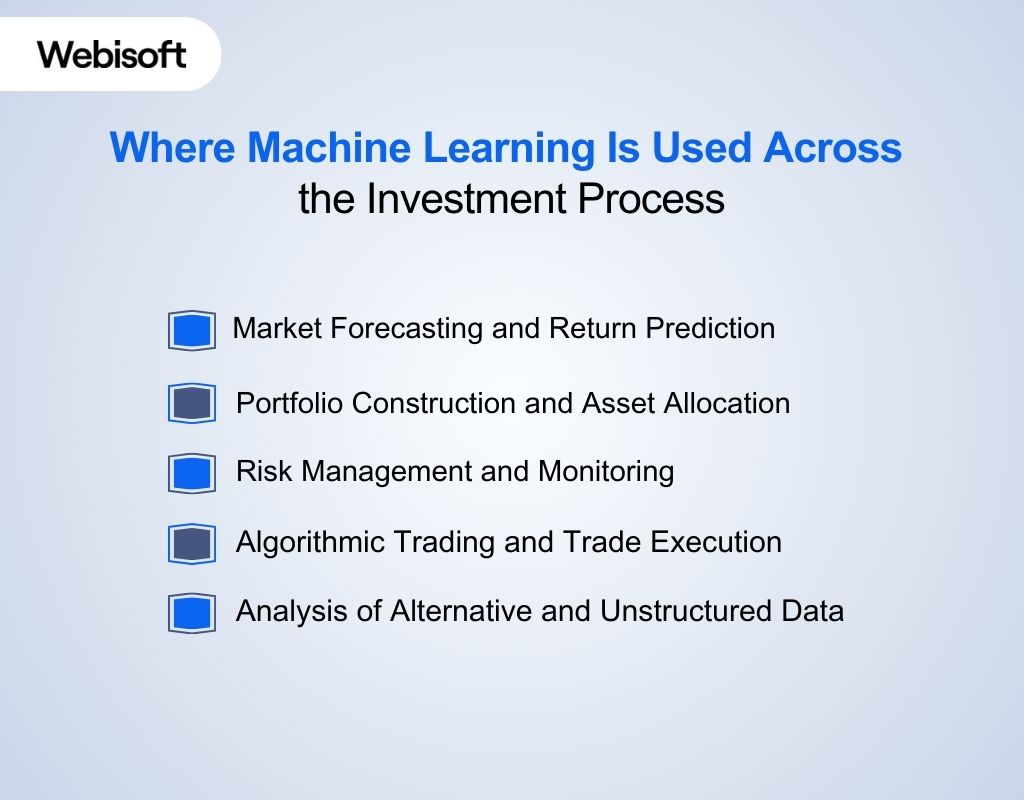
Machine learning is reshaping many parts of the investment lifecycle by enabling data-driven insights, enhanced decision making, and automation that traditional methods struggle to achieve. Below are the key areas where machine learning is making an impact across the investment process:
Market Forecasting and Return Prediction
Machine learning models analyze historical and real time market data to identify patterns linked to future price movements or returns. These forecasts are often used as inputs for research and strategy formation in machine learning in investment strategies rather than direct buy or sell decisions.
Portfolio Construction and Asset Allocation
In portfolio management, machine learning supports asset allocation by evaluating expected returns, correlations, and risk metrics together. Models help adjust portfolio weights dynamically as market conditions and data inputs change.
Risk Management and Monitoring
Machine learning strengthens risk analysis by detecting early signs of volatility, drawdowns, or structural changes in markets. It is commonly used to support risk scoring, stress testing, and ongoing portfolio monitoring.
Algorithmic Trading and Trade Execution
In systematic trading environments, machine learning is used to generate trading signals and improve execution timing. Models can help reduce transaction costs by adjusting order placement based on liquidity and market behavior.
Analysis of Alternative and Unstructured Data
Machine learning enables investors to analyze data beyond prices and fundamentals, including news, sentiment, and macro indicators. This expands the information set used in investment research and decision support.
Common Machine Learning Models Used in Investment
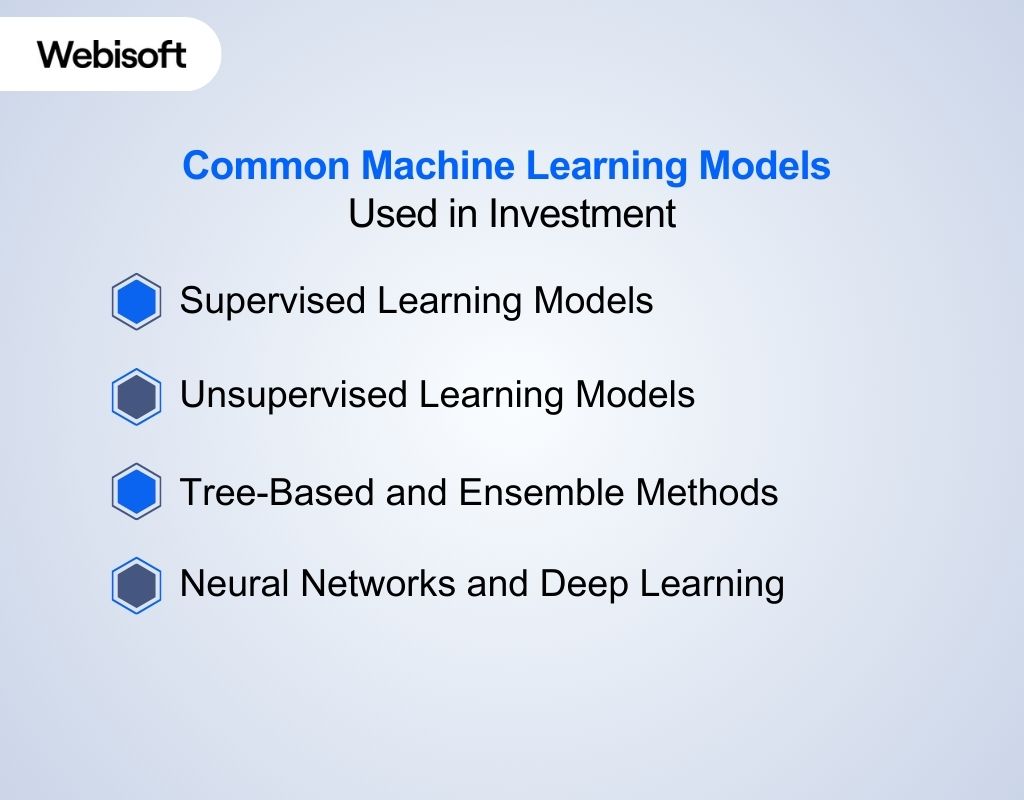
Investors and financial teams use a variety of machine learning models to analyze data and generate insights. Different models are suited to different tasks depending on the type of data, the goal of the analysis, and the need for interpretability. Below are the most commonly used machine learning models in investment contexts.
Supervised Learning Models
Supervised learning uses labeled data to learn relationships between input features and target outcomes. These models are widely used for forecasting returns, classifying investment signals, and ranking assets.
- Linear and Logistic Regression
Linear regression is used for forecasting continuous outcomes like expected returns. While logistic regression helps classify outcomes such as whether an asset will outperform a benchmark.
- Decision Trees and Random Forests
These models split data into decision rules based on feature importance. Random forests extend decision trees by averaging many tree models to improve robustness and reduce overfitting.
- Support Vector Machines (SVM)
SVM models find the best boundary that separates data into classes and are used where classification accuracy is critical and data patterns are complex.
Unsupervised Learning Models
Unsupervised learning finds structure in data without labeled outcomes. It is useful for detecting hidden patterns and grouping similar assets or market conditions.
- Clustering Algorithms
Models like k-means group assets with similar behavior, helping portfolio managers identify segments or regimes in the market.
- Principal Component Analysis (PCA)
PCA reduces the dimensionality of large datasets to reveal the most important factors driving variation, which helps simplify complex financial data for further analysis.
Tree-Based and Ensemble Methods
These models combine multiple simpler models to improve prediction quality and reduce errors.
- Gradient Boosting Machines (GBM)
Boosting algorithms such as XGBoost and LightGBM build strong predictors by combining many weak models sequentially, making them effective for return forecasts.
- Ensembles of Models
Combining model outputs from different techniques often leads to more stable predictions, especially in noisy financial environments.
Neural Networks and Deep Learning
Neural networks are inspired by the structure of the human brain and are powerful for recognizing nonlinear patterns in large datasets.
- Feedforward Neural Networks
These basic networks connect layers of neurons to model complex relationships between inputs and outputs.
- Recurrent Neural Networks (RNN) and Long Short Term Memory (LSTM)
RNN and LSTM architectures are designed for sequence data, making them suitable for time series like price history.
Data Used in Machine Learning Based Investment Systems
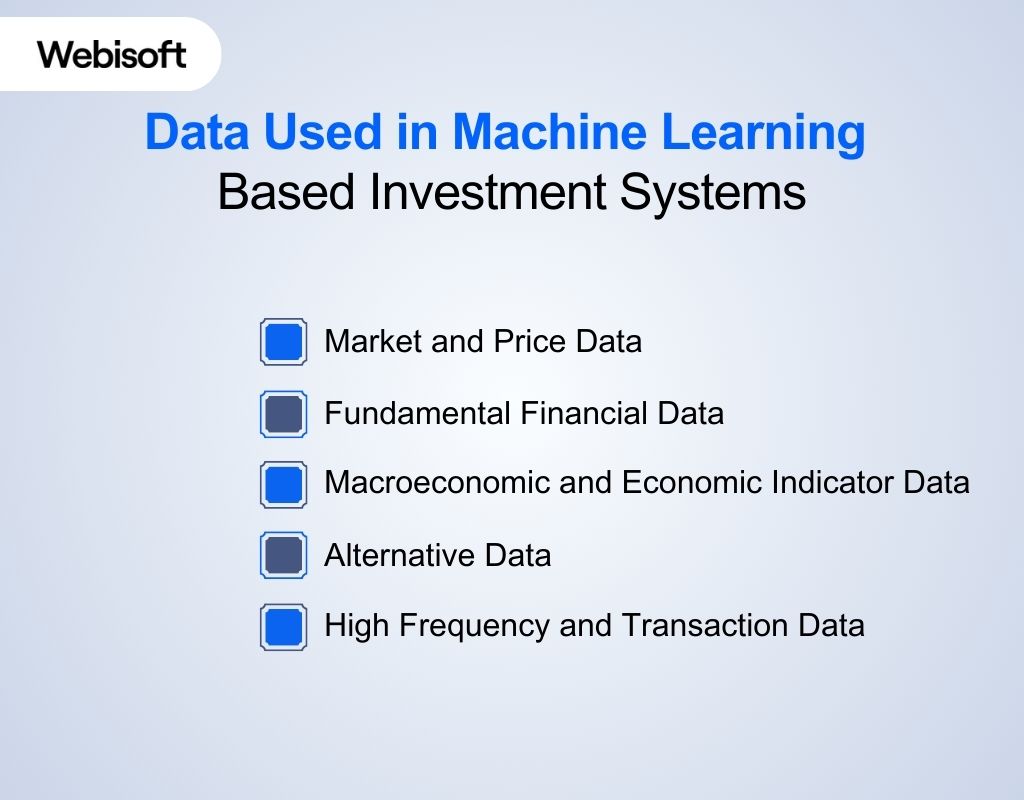
In machine learning driven investment systems, data quality and relevance directly shape model outcomes and reliability. Effective models rely on financial datasets that represent market behavior, company performance, and economic conditions, often combining multiple data types to capture diverse investment signals.
Market and Price Data
This includes historical price information such as open, high, low, and close values, trade volumes, and index movements for stocks, bonds, commodities, or other assets. These time series datasets form the backbone of many financial machine learning models because they directly reflect market activity over time.
Fundamental Financial Data
Fundamental data comes from company financial statements, earnings reports, revenue figures, balance sheets, and cash flow metrics. These structured datasets help models assess long-term value drivers and company health beyond price movements alone.
Macroeconomic and Economic Indicator Data
Economic variables such as GDP growth, interest rates, inflation measures, and unemployment figures provide context about broader economic conditions that influence market trends and investment risks. These datasets help models align market behavior with economic cycles.
Alternative Data
This refers to non-traditional data sources that can provide unique investment insights. Examples include social media sentiment, news feeds, credit card transaction records, satellite imagery, and mobile device location data. Alternative data is often unstructured and requires preprocessing, but it can enhance signal quality when incorporated correctly.
High Frequency and Transaction Data
For models that support short-term price forecasting or algorithmic trading, high frequency data (tick-by-tick trade and quote information) offers detailed views of market micro-structures. This data type helps capture fine-grained patterns in trading behavior. Together, these datasets enable investment machine learning systems to analyze market behavior, identify patterns, and support forecasting, risk assessment, and informed strategy development.
How a Machine Learning Investment Pipeline Works
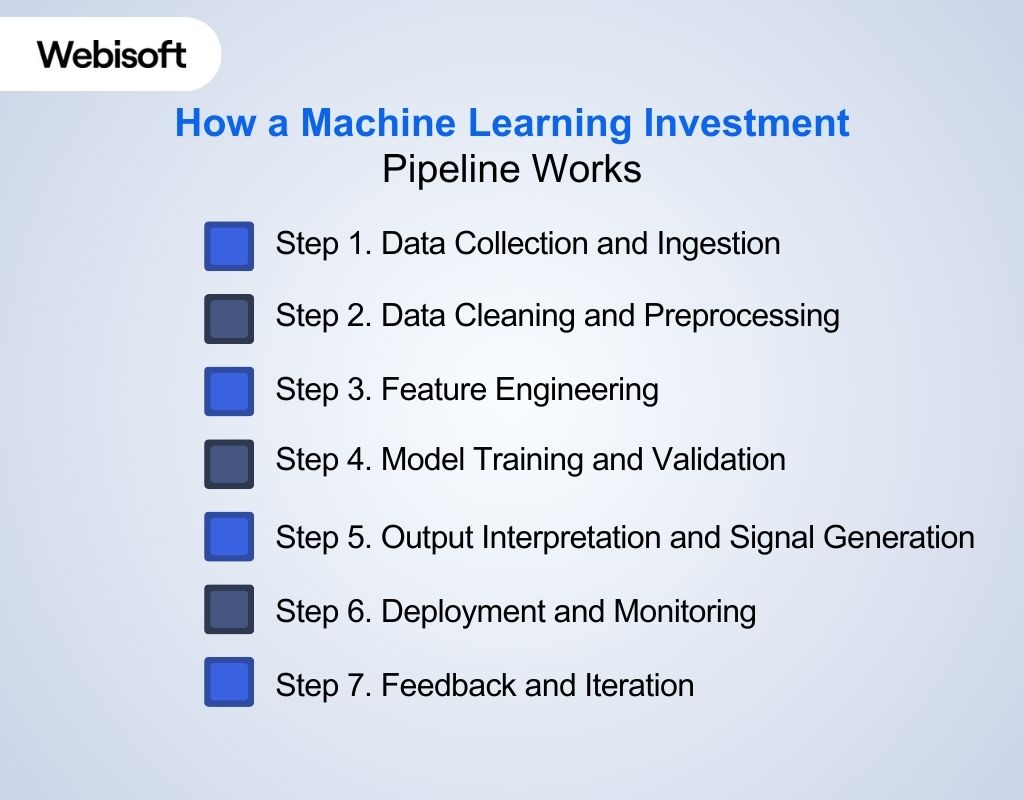
A machine learning investment pipeline is the structured process that turns raw financial data into reliable signals for investment decisions. This flow shows the importance of machine learning in investment through disciplined data validation and ongoing monitoring.
Step 1. Data Collection and Ingestion
The pipeline begins with gathering relevant datasets such as market prices, fundamentals, alternative indicators, and economic variables. Data must be sourced from reliable providers and stored in a way that supports efficient access and processing.
Step 2. Data Cleaning and Preprocessing
Raw financial data often contains gaps, inconsistencies, or errors. Cleaning involves handling missing values, correcting anomalies, and aligning timestamps so that models receive accurate and consistent inputs.
Step 3. Feature Engineering
This step transforms raw data into meaningful inputs for machine learning models. It may involve computing technical indicators, rolling averages, normalized metrics, or regime indicators that help models detect patterns more effectively.
Step 4. Model Training and Validation
Cleaned and engineered data is used to train machine learning models. Validation techniques such as walk-forward testing and cross-validation evaluate whether a model generalizes beyond historical data rather than merely fitting past patterns.
Step 5. Output Interpretation and Signal Generation
Once trained, models generate outputs such as risk scores, return forecasts, or asset rankings. These outputs are interpreted and calibrated to fit investment criteria, transforming raw predictions into decision support signals.
Step 6. Deployment and Monitoring
Approved models are deployed into production environments where they can process live data. Continuous monitoring ensures that model performance remains stable, and alerts are set up to identify performance degradation or data drift.
Step 7. Feedback and Iteration
A mature pipeline includes feedback loops where performance results and new data inform ongoing model improvements. This iteration ensures that machine learning in investment management remains adaptive in evolving market conditions.
Building a reliable investment pipeline requires systems that can be designed, validated, and monitored under real market conditions. Learn how Webisoft develops custom machine learning systems for complex investment use cases by connecting data, models, and governance into a single workflow.
Key Challenges and Risks of Machine Learning in Investment
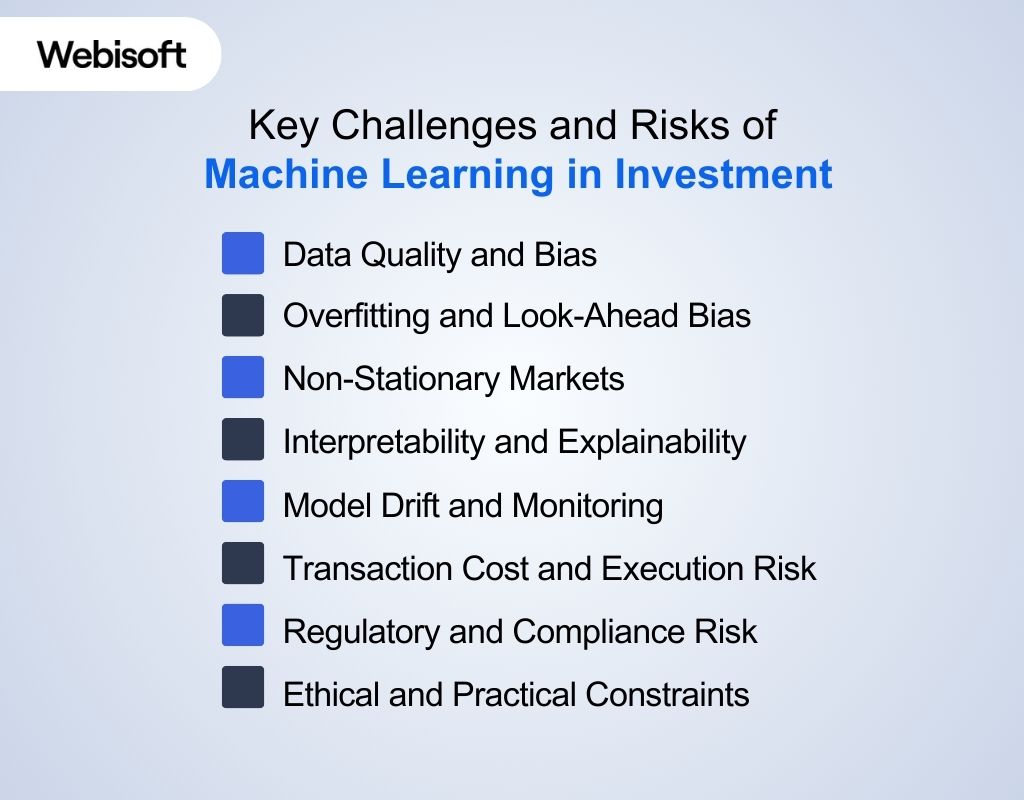
Machine learning provides strong analytical capabilities for investment, but effective use requires attention to risks that can weaken model reliability and decision quality. Recognizing these challenges helps investment teams build safer, resilient systems instead of treating machine learning as plug-and-play.
Data Quality and Bias
- Financial data often contains gaps, errors, and regime changes, leading to biased training results that misguide investment signals.
- Historical data may not capture future market shifts, reducing model validity in new conditions.
Overfitting and Look-Ahead Bias
- Models that perform well on past data can fail in live conditions if they capture noise rather than true signals.
- Look-ahead bias occurs when information unavailable at decision time leaks into the model training process.
Non-Stationary Markets
- Financial markets evolve constantly, and models trained on one regime may degrade quickly in another.
- Structural breaks from events like crises or policy shifts can make previously reliable patterns obsolete.
Interpretability and Explainability
- Complex models such as deep learning lack transparency, making it difficult for investment teams and regulators to justify decisions.
- Poor explainability increases operational risk and can erode stakeholder confidence.
Model Drift and Monitoring
- Performance deterioration over time can go undetected without strong monitoring systems, leading to degraded investment outcomes.
- External conditions like volatility spikes require dynamic recalibration that static models may miss.
Transaction Cost and Execution Risk
- Ignoring realistic trading costs, slippage, and market impact can make model results look stronger in backtests than they are in real trading.
- High frequency or automated strategies may incur unexpected execution issues.
Regulatory and Compliance Risk
- Investment models must meet regulatory standards for fairness, transparency, and auditability, which complex machine learning systems may struggle to satisfy.
- Inadequate documentation or controls can trigger compliance failures.
Ethical and Practical Constraints
- Using alternative data sources can raise privacy concerns or introduce unintended biases.
- Organizational resistance to adopting new technology can slow implementation or lead to misuse.
Machine Learning vs Human Fund Managers
Despite advances in machine learning pipelines and analytics, investment decisions are rarely automated end to end. Comparing machine learning systems with human fund managers highlights how data driven models and human judgment operate differently within modern investment processes.
| Aspect | Machine Learning | Human Fund Managers |
|---|---|---|
| Decision Basis | Data driven patterns and statistical correlations | Experience, judgment, and qualitative interpretation |
| Speed | Processes large datasets rapidly | Slower, limited by human capacity |
| Consistency | High consistency, repeatable outcomes | May vary based on emotion, context, or bias |
| Adaptability | Learns from data but can lag during regime shifts | Can quickly adjust to new macro events or structural changes |
| Explainability | Often opaque, especially with complex models | Easier to interpret and justify verbally |
| Bias Risk | Risk from data bias and model assumptions | Risk from cognitive and emotional bias |
| Scalability | Highly scalable across assets and markets | Limited by individual capacity |
| Risk Assessment | Quantifies risk through statistical measures | Uses judgment and scenario understanding |
| Regulatory Alignment | Challenging with black box models | Easier to document and explain decisions |
Real World Adoption of Machine Learning in Investment Firms Today
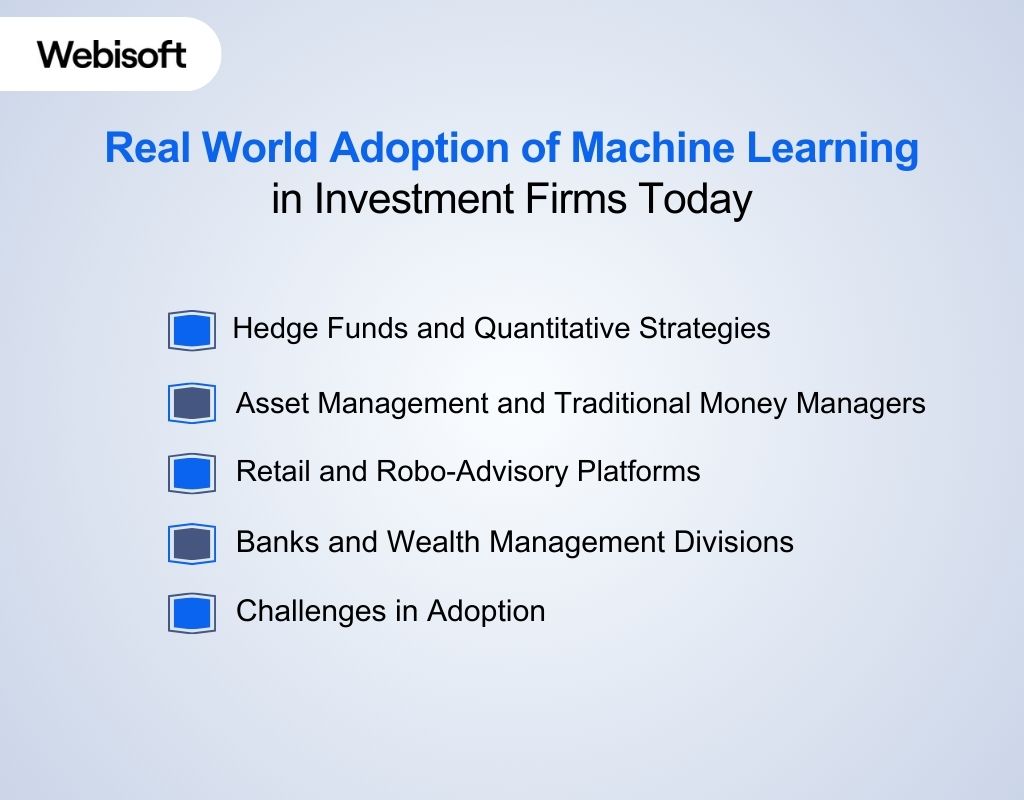
Once machine learning moves beyond experimentation, real value depends on application within operating investment environments, a trend highlighted by the World Economic Forum. In practice, adoption reflects organizational readiness, data maturity, and the ability to integrate models into existing investment workflows.
Hedge Funds and Quantitative Strategies
Leading hedge funds and systematic trading firms use machine learning to generate alpha or pattern-based signals. Models support tasks such as signal extraction from vast datasets, regime detection, and automated execution decisions. These firms often build proprietary platforms that combine alternative data sources with advanced algorithms to gain an edge.
Asset Management and Traditional Money Managers
Large asset managers increasingly embed machine learning into risk modelling, portfolio optimisation, and scenario analysis. While not always fully automated, machine learning outputs are used as enhancements to traditional research, improving forecasts and supporting complex allocation decisions.
Retail and Robo-Advisory Platforms
Retail investing platforms and robo-advisors use machine learning to personalise investment recommendations, automate rebalancing, and tailor portfolios to individual risk profiles. These applications focus more on scalability and user segmentation than on high-frequency trading.
Banks and Wealth Management Divisions
Banks deploy machine learning across credit risk analysis, client segmentation, and market-linked investment products. In wealth management arms, models help advisors with data-driven insights while preserving human oversight.
Challenges in Adoption
Even among firms that embrace machine learning, adoption is often phased rather than wholesale. Many start with analytical augmentation, risk overlays, or model-assisted research before moving to automated execution. Regulatory and compliance concerns also influence how deeply machine learning is embedded.
Machine Learning Investment Solutions Built by Webisoft
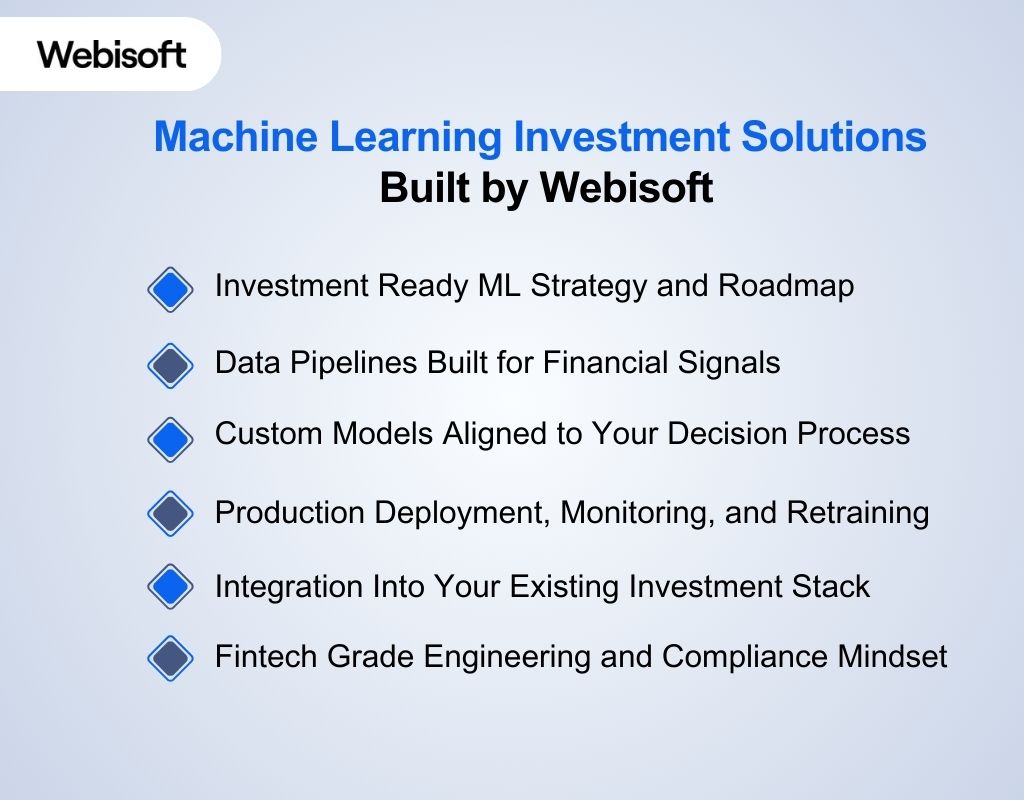
Machine learning adoption is real, but results depend on disciplined execution and controls. At Webisoft, we help you move from ideas to production systems that fit investment workflows, risk limits, and governance needs.
Investment Ready ML Strategy and Roadmap
We start by mapping your investment goals to measurable model outputs and data requirements. Our AI strategy consulting helps define scope, feasibility, and success metrics before build work begins.
Data Pipelines Built for Financial Signals
Our team designs data ingestion and processing pipelines that keep inputs consistent and traceable. We align pipelines to your sources and reporting needs, so teams can trust what the model sees.
Custom Models Aligned to Your Decision Process
We build custom ML models that match your use case and constraints, not generic templates. We focus on validation discipline, so outputs stay meaningful when markets shift.
Production Deployment, Monitoring, and Retraining
We support the full ML lifecycle, including deployment, performance tracking, and retraining workflows. Our consulting services emphasize monitoring for silent degradation and operational reliability post launch.
Integration Into Your Existing Investment Stack
We integrate predictions into your current tools using APIs and workflow friendly delivery methods. This keeps adoption practical for research, risk, or portfolio teams without rebuilding your stack.
Fintech Grade Engineering and Compliance Mindset
Investment ML often sits inside regulated fintech environments with security and audit needs. Our fintech software development practice focuses on secure, scalable systems that support compliance-driven teams.
Building these capabilities into a working investment environment requires deliberate planning and experienced execution. Reach out to Webisoft to discuss how our machine learning investment solutions can be adapted to your data, governance requirements, and long-term investment objectives.
Conclusion
To sum up, machine learning in investment is not about prediction magic or replacing expertise. It is about discipline. The firms seeing results are the ones that respect data limits, test assumptions continuously, and treat models as evolving decision tools rather than static answers.
That is exactly where Webisoft fits. We work with teams who want systems that hold up beyond demos and backtests. Our focus stays on building dependable machine learning foundations that integrate cleanly into investment workflows and remain reliable as markets, data, and risk conditions change.
Frequently Asked Question
Yes. Machine learning is commonly used to identify long-term patterns, factor relationships, and structural risk exposures across assets. Rather than reacting to short-term noise, these models help support strategic allocation and long-horizon decision making.
Retraining frequency depends on data stability, market conditions, and model performance. Some models are updated monthly or quarterly, while others are retrained only when performance metrics or market behavior indicate meaningful degradation.
No. Machine learning models often struggle with rare or unprecedented market events due to limited historical examples. Stress testing, scenario analysis, and human oversight remain essential during periods of market shocks and structural breaks.