Machine learning in finance has moved into a central role as firms handle growing data volumes and rising performance demands. Financial teams use these systems to support scoring, detect risks earlier, strengthen trading logic, and improve internal workflows.
The technology helps institutions work with greater accuracy and react faster to changing conditions. As more firms rely on data-driven methods, understanding how these models operate becomes essential for long-term planning and oversight.
In this blog, we will discuss what machine learning brings to finance, where it delivers the most value. We will also discuss the challenges it introduces and the practices that help teams use it responsibly.
Understanding Machine Learning in Finance
Machine learning, a key component of broader AI systems, supports the way financial teams handle complex data. It studies past behavior, detects patterns, and produces predictions that help you act with more confidence.
When you work in finance, you face constant streams of transactions, price shifts, and customer activity. Machine learning processes that scale without slowing down.
It turns raw data into signals you can use for risk checks, approvals, forecasts, and daily decisions. At its core, machine learning replaces fixed rules with adaptive logic.
A model watches how outcomes change over time and refines its predictions as conditions shift. That flexibility matters when markets move fast or when customer behavior changes in subtle ways.
Machine Learning Applications in Finance
Machine learning sits at the center of many financial workflows because it handles tasks that depend on pattern recognition and prediction. You want cleaner insights, faster decisions, and fewer manual steps.
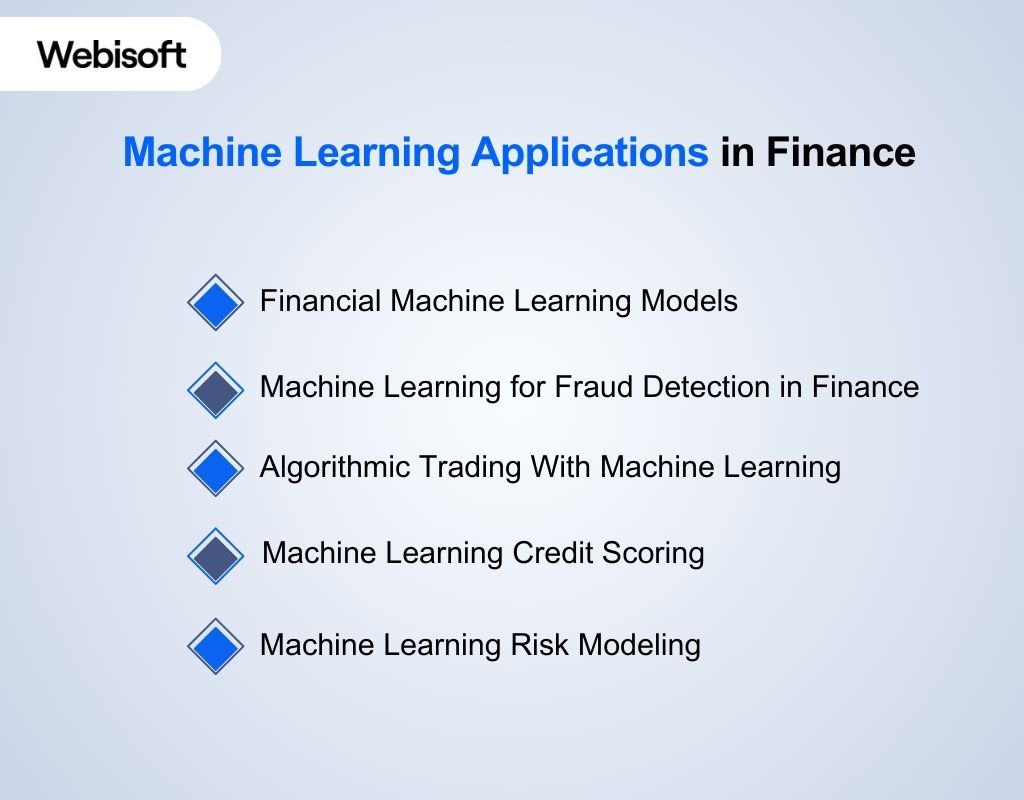
This is also where machine learning models in finance help teams manage complex decisions at scale. Below are the core applications that matter most in today’s financial operations. Here we have discussed the application of machine learning in finance:
Financial Machine Learning Models
Many financial institutions classify these model types within their internal AI pipelines, but the models work on their own. This includes work tied to predictive analytics in finance, where institutions need accurate signals from large datasets. Regression models help you forecast values like credit losses or interest sensitivity.
Classification models sort outcomes such as loan approvals or fraud risk. Clustering groups customers with similar behavior so you can detect unusual patterns faster. Reinforcement models learn from repeated outcomes and adjust actions over time.
Each financial model type solves a different financial problem, yet they all support faster interpretation of complex data.
Machine Learning for Fraud Detection in Finance
About 72% of financial service firms use machine learning for fraud checks, scoring, and trading. Some fraud detection tools sit inside larger AI monitoring systems, though the core work still comes from machine learning. This is also where fraud detection with machine learning provides clearer decision signals for event-level analysis.
The models examine behavior across accounts, devices, and transaction flows. They learn what normal looks like, then flag anything that breaks that pattern. You see higher accuracy because the model updates as fraud tactics change.
It compares each event against past activity and produces alerts that reduce false positives and prevent missed threats. If you are ready to implement fraud detection with machine learning, our team provides the production-ready engineering required for the financial sector.
Algorithmic Trading With Machine Learning
Machine learning supports trading desks by reading market signals that shift too quickly for manual review. It studies price movements, volume changes, and past reactions to similar conditions. You also see firms build algorithmic trading models that run on these outputs.
The model spots patterns and produces signals that guide trade timing and strategy. It helps reduce emotional decisions and keeps execution consistent. You also gain faster reaction times during high-volatility periods. Firms rely on these models to refine entry points, exit plans, and position sizing.
Machine Learning Credit Scoring
ML-based credit models can improve approval accuracy by 20-40%. You can use these models with traditional scorecards or within automated AI decision systems if your institution runs them. Many institutions also classify these tools as ML credit scoring systems because they operate across wider datasets.
The model reviews far more variables than classic credit scoring, including income behavior, payment timing, and spending trends. It evaluates signals that older rules often overlook and adjusts as new data becomes available.
You get cleaner estimates of risk and quicker lending decisions. It also helps identify creditworthy applicants who were missed by fixed rules.
Machine Learning Risk Modeling
Risk teams rely on machine learning to understand exposures that shift throughout the day. You see these methods used alongside ML risk modeling frameworks that support daily oversight. The models examine economic indicators, market reactions, and customer behavior.
They estimate possible outcomes under different conditions and show where losses could occur. This helps you run stress tests, build scenarios, and refine your risk limits with better precision.
Data, Analytics, and Automation in ML-Driven Finance
Financial teams rely on machine learning to read large data sets, support decisions, and automate daily tasks. You also see AI-driven financial analytics take a stronger role here.
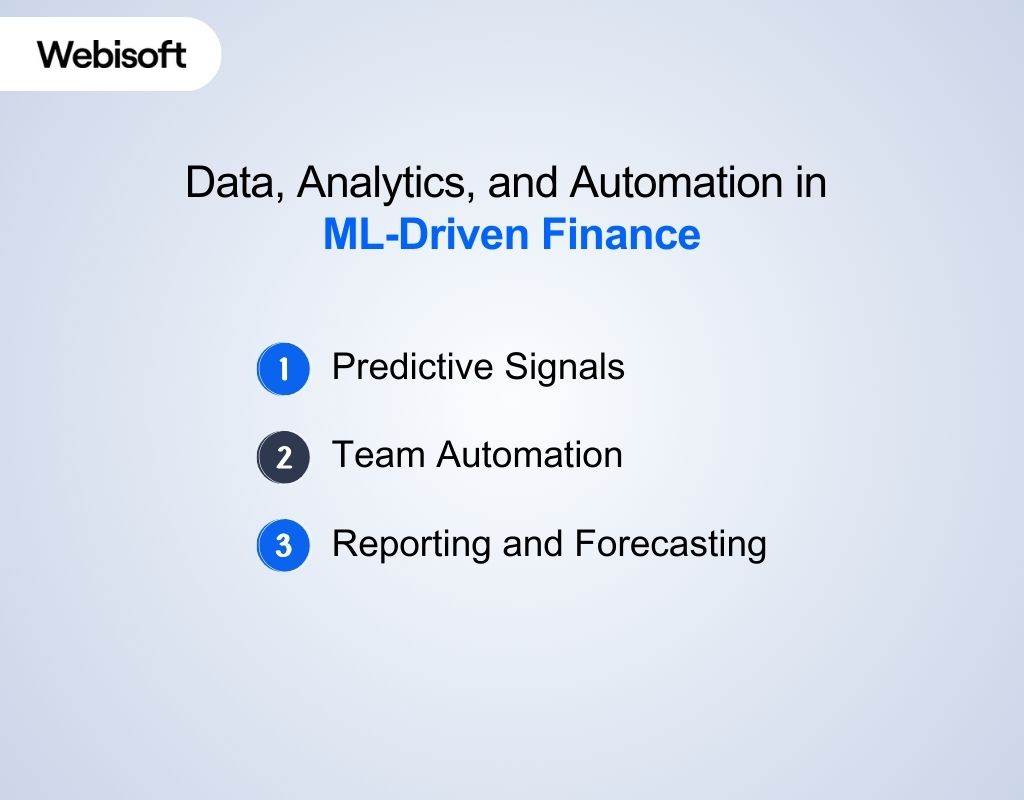
This is also where financial automation tools help scale routine tasks. Below are the areas of machine learning in finance where this combination delivers the most impact:
Predictive Signals
Machine learning studies raw data and turns it into signals you can use for lending, trading, or risk work. ML generates the core predictions while AI systems manage the orchestration.
This process links closely with predictive analytics in finance, since firms depend on accurate signals to manage exposure. You get real-time insight because the model updates as new information arrives. This helps you move from static analysis to active forecasting.
Team Automation
Automation plays a major role once machine learning models are in place. You see it in reconciliation, report generation, onboarding, and compliance checks. These tools fit into AI workflows that coordinate tasks across systems.
Machine learning identifies what needs attention. Automation handles the execution so teams can focus on judgment-heavy work. This is also where financial automation tools support consistency across daily operations.
Reporting and Forecasting
You rely on AI-driven financial analytics when you want cleaner forecasts and faster reporting. Machine learning processes structured and unstructured data, then produces estimates you can use for budget planning or performance reviews.
This workflow supports ML-driven forecasting, since the model adjusts as new information arrives. The system evaluates trends across markets, customers, and internal records.
Bias, Governance, and Regulation in Financial Machine Learning
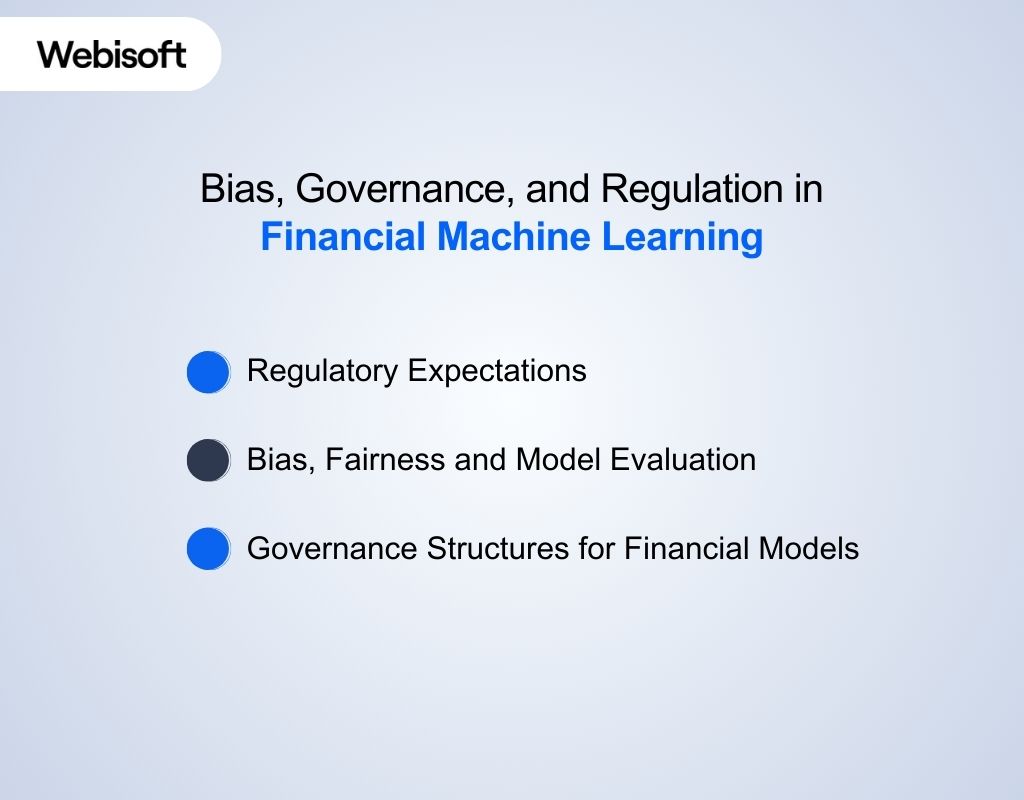
Machine learning sits inside a wider set of AI risk concerns, so bias and governance receive close attention here. Below are the core areas that machine learning in finance teams watches most closely:
Regulatory Expectations
Regulators classify many ML models under AI risk categories, especially when they influence credit, fraud checks, or pricing. You must document inputs, testing, and limits for each model.
Supervisors expect clear explanations that show how the model behaves across different groups. They also want evidence that monitoring continues after deployment. These steps help prevent hidden errors that may create biased or unreliable outputs.
Bias, Fairness, and Model Evaluation
AI bias checks apply to ML scoring models as well, because financial data often reflects past inequality. Bias can enter through historical records, feature choices, or evaluation gaps.
You need tests that compare outcomes across demographic groups and reveal imbalances. Fairness reviews also help identify proxy variables that behave like protected traits. These checks reduce the chance of unfair approvals or rejections.
Governance Structures for Financial Models
Model governance in finance sets the rules for how ML systems are built, tested, and monitored. AI governance frameworks include ML model oversight and require clear roles for developers, reviewers, and risk teams.
You need controls that track data sources, version changes, and performance drift. Explainability tools help teams understand why a model made a decision, which supports compliance reviews and customer inquiries.
Benefits of Machine Learning in Finance
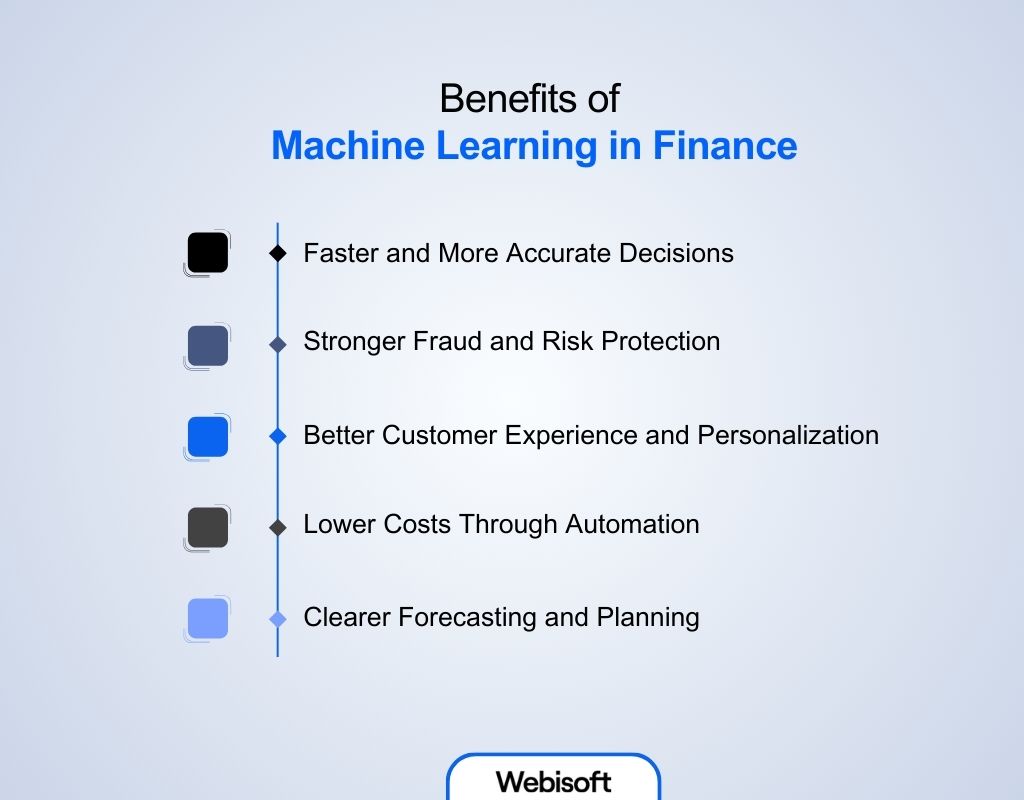
Financial machine learning benefits help you move faster and avoid the delays linked to manual checks. Many firms also see machine learning efficiency gains in tasks that once required long review cycles. Below are the benefits of machine learning in finance that matter most today:
Faster and More Accurate Decisions
Machine learning supports ML-powered decision making by revealing patterns you cannot see manually. The model studies historical behavior and current signals to give you cleaner estimates. This improves the speed and quality of decisions across lending, trading, and risk work.
Stronger Fraud and Risk Protection
The models help you detect unusual behavior early, which strengthens fraud and risk programs. You see events as they form because the system reviews account activity in real time. This leads to quicker responses and fewer missed threats.
Better Customer Experience and Personalization
You also improve engagement through customer personalization with ML, since the models learn how customers behave over time. This helps you offer products, alerts, and guidance that match each client’s needs. It also supports quicker service through automated tools that respond without long wait times.
Lower Costs Through Automation
Machine learning brings clear machine learning automation benefits by completing repetitive work with consistent output. It handles reviews, sorting, and daily checks without slowing down. This reduces cost and lets teams focus on analysis and planning rather than manual tasks.
Clearer Forecasting and Planning
Machine learning reads patterns across markets and customers to build forecasts that adjust with new data. This gives you a more accurate view of future outcomes and reduces time spent on manual prediction work. You gain a planning process that reacts quickly to real conditions.
Challenges in Machine Learning in Finance
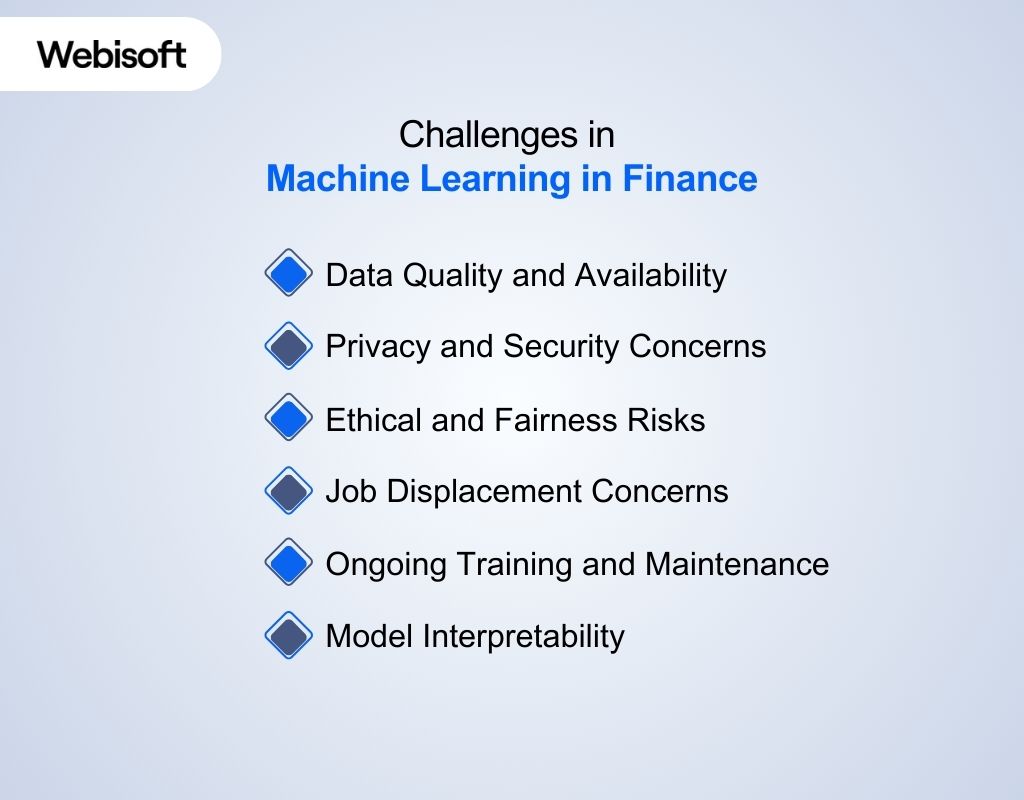
Machine learning can help financial teams work faster, but it also brings real challenges. Below are the challenges in machine learning in finance that you must understand before scaling machine learning across your operations.
Data Quality and Availability
Machine learning models need clean and complete data to produce reliable results. When data is missing or inconsistent, the model learns the wrong patterns and gives weak predictions. You face this often in finance because records come from multiple systems with different formats.
You need strict checks to keep training data accurate and current. Without this, the model can misread behavior and cause costly mistakes.
Privacy and Security Concerns
Financial data contains sensitive customer information, so privacy rules remain strict. You must protect this data as you train and deploy models.
That includes secure storage, limited access, and clear logs that show how information moves through each step. Weak controls expose you to regulatory issues and loss of trust. Strong protection is not optional in this field.
Ethical and Fairness Risks
Machine learning learns from past behavior, so it may repeat past problems. Bias can appear when data reflects old patterns that harmed certain groups.
You need tests that show how the model treats different customers. You also need clear explanations when the model gives a result, especially in credit or fraud work. These steps help you avoid unfair outcomes and support responsible use.
Job Displacement Concerns
As models automate more tasks, some teams worry about losing roles. You can manage this by training staff in new tools and redirecting work toward analysis and planning.
Machine learning reduces manual tasks, but you still need people who understand context and judgment. Clear communication helps teams adjust and build confidence in the changes.
Ongoing Training and Maintenance
Models change as data changes. You cannot train them once and expect stable results. You need scheduled retraining to keep predictions accurate in shifting markets.
Without this, the model may drift from real conditions and weaken its output. Ongoing maintenance is a core part of running machine learning in finance.
Model Interpretability
Many models work well but give results that are hard to explain. This creates problems for risk teams and regulators who need to understand why a decision occurred. You need methods that show the factors behind each result.
Clear explanations help you trust the outputs and defend them during audits or reviews. Interpretability builds confidence across your teams.
How Webisoft Mitigates These Challenges
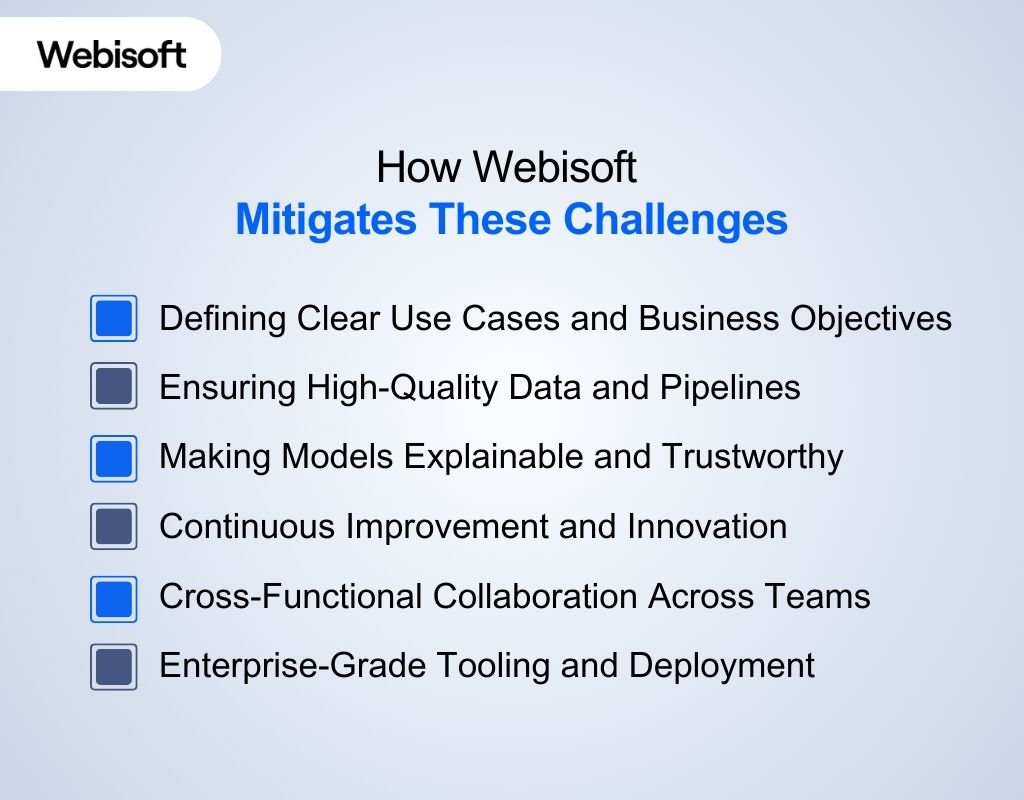
Webisoft does more than build machine learning models. We build resilient, production-grade systems that work in real financial environments.
Our team combines deep engineering experience with practical knowledge of the frameworks and tools that matter most. We help you move beyond experimentation to reliable, measurable outcomes that align with your business goals.
Defining Clear Use Cases and Business Objectives
Getting machine learning right starts with a clear purpose. Webisoft begins every project with workshops that map your goals. We help you define use cases that match business KPIs, not just technical features.
This keeps your investment focused on solving real problems, like improving risk models or automating reconciliations. Webisoft’s AI strategy consultation guides you from discovery to deployment.
Ensuring High-Quality Data and Pipelines
Machine learning is only as good as its data. Webisoft architects secure ETL pipelines that clean, validate, and prepare data for training and prediction. We work with cloud platforms like AWS, Azure, and scalable data stacks that handle large, sensitive datasets while preserving privacy and compliance.
Our data engineers use tools like Apache Airflow and DBT to create repeatable workflows that feed accurate data into your models.
Making Models Explainable and Trustworthy
Finance requires models you can trust and explain. Webisoft implements explainability layers on top of models trained in TensorFlow, PyTorch, and Scikit-learn.
We surface interpretable features so analysts and auditors see exactly why a prediction occurred. Explainability supports compliance and builds confidence across your teams.
Continuous Improvement and Innovation
Machine learning models need ongoing care. Webisoft sets up automated retraining pipelines that update models as market conditions shift. MLOps frameworks and monitoring dashboards track performance, latency, and drift in real time.
This helps you avoid stale predictions and keeps performance sharp long after launch. Our engineers stay active in optimizing models as your data evolves.
Cross-Functional Collaboration Across Teams
Webisoft integrates your risk managers, compliance leads, data scientists, and product owners into a shared development process. We connect ML systems to your existing CRMs, ERPs, and decision tools.
This minimizes disruption and avoids siloed implementations. Regular demos and checkpoints ensure you stay involved and aligned with results through each phase.
Enterprise-Grade Tooling and Deployment
Our solutions are production-ready. We use enterprise-grade frameworks and cloud infrastructure so your models scale securely. Tools like TensorFlow, PyTorch, Scikit-learn, and automated deployment pipelines help us deliver systems that perform under real load.
We pair these with secure observability tools that keep you informed about uptime, latency, and risk exposure every day. While many firms treat machine learning as a research project, Webisoft treats it as a core financial utility. We do more than build models.
We engineer resilient, production-grade systems designed to thrive in high-stakes financial environments. By bridging the gap between complex data science and robust software engineering, we transform machine learning from a technical experiment into a predictable driver of institutional growth.
Conclusion
Machine learning in finance continues to reshape how institutions read data, manage risk, and support daily operations. You now rely on models that improve accuracy, reduce manual effort, and help teams act with more confidence.
As the field expands, firms that understand both the promise and the limits of machine learning will move faster and make better decisions across their portfolios. If you want support or model deployment, contact to Webisoft. We can help you build systems that fit your goals and perform.
FAQs
Traditional models use fixed rules. Machine learning learns from data and adjusts as patterns shift. This flexibility supports better performance in fast or complex markets.
Machine learning is a branch of AI, but financial teams use it mainly for prediction and pattern study. AI comes up when firms describe the wider system around these models.
Key areas include credit scoring, fraud checks, algorithmic trading, forecasting, and workflow automation. These tasks depend on pattern recognition and benefit from continuous learning.
The biggest risks involve data quality, model drift, and limited interpretability. You also need strong controls to avoid biased outcomes and maintain trust in the model’s decisions.
Machine learning studies large data sets and finds patterns that guide lending, trading, and risk work. It helps teams act faster and with more accuracy by updating predictions as new data arrives.