Machine learning in education is transforming the classroom by shrinking the gap between human intent and computer execution. While we often focus on the “intelligence” of the AI we see, that output is entirely derived from the underlying machine learning models that identify patterns in student data.
This technology is improving education by shifting the focus from perfect accuracy to strategic access. By automating mundane tasks and personalizing lesson paths, machine learning in education allows systems to scale individual support that was previously impossible for human teachers alone.
We will explore the importance of machine learning in education through a “cost of error” framework. This guide covers applications of machine learning in education such as adaptive tutoring and early warning systems, while addressing critical risks like data privacy and algorithmic bias.
What Is Machine Learning in Education?
Machine learning in education means using technology that can “learn” from student and classroom data to make learning smarter and more effective. Instead of following fixed rules like traditional education software, machine learning systems look for patterns in student data.
This can include grades, quiz results, time spent on lessons, and learning behavior, then it improves its recommendations over time. In simple terms, it helps education platforms and schools personalize learning, support teachers with faster feedback, and spot learning issues early.
You’ll see it in many modern EdTech tools, from adaptive learning apps and automated grading systems to intelligent tutoring platforms and learning analytics dashboards.
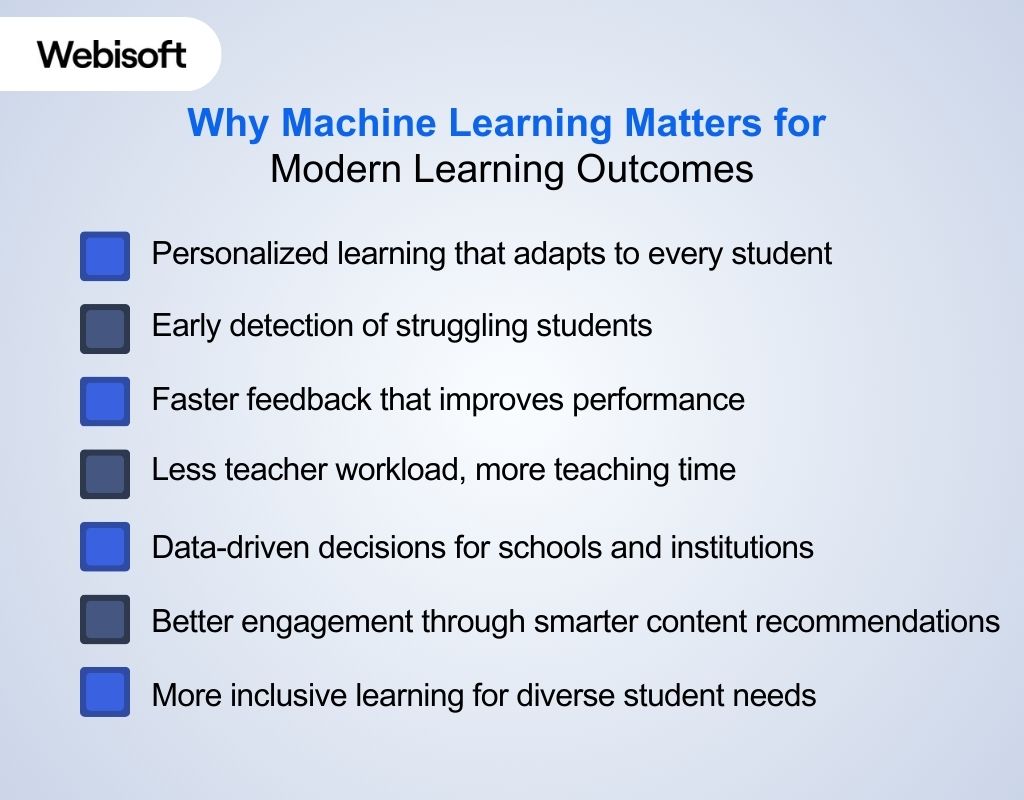
Why Machine Learning Matters for Modern Learning Outcomes
The importance of machine learning in education is growing fast because schools and EdTech platforms now handle massive learning data every day. Machine learning turns that data into actionable insights that improve student support, teaching efficiency, and overall learning outcomes.
Personalized learning that adapts to every student
Machine learning helps platforms adjust lessons based on each learner’s pace, strengths, and weak areas. This makes learning more relevant and reduces the “one-size-fits-all” gap that slows down progress.
Early detection of struggling students
Instead of waiting for final exams or end-of-term reports, machine learning can spot early warning signs like reduced participation, repeated errors, or sudden performance drops. This allows timely interventions before students fall behind.
Faster feedback that improves performance
Students learn better when feedback is quick and specific. Machine learning supports instant quiz feedback, writing suggestions, and targeted practice recommendations, helping learners correct mistakes while the topic is still fresh.
Less teacher workload, more teaching time
Teachers often spend hours on grading, reporting, and repetitive administrative tasks. Machine learning reduces this load through automation and analytics, freeing teachers to focus more on instruction and student support.
Data-driven decisions for schools and institutions
Machine learning helps administrators understand what’s working and what’s not. It can reveal patterns across cohorts, courses, and learning programs, helping institutions improve curriculum planning and resource allocation.
Better engagement through smarter content recommendations
Machine learning recommends content that matches a student’s level and interests. This increases completion rates, reduces drop-offs, and helps learners stay consistent instead of feeling overwhelmed or bored.
More inclusive learning for diverse student needs
Machine learning supports accessibility features like speech-to-text, translation, reading assistance, and adaptive interfaces. This helps learners with disabilities and multilingual backgrounds get a more equal learning experience.
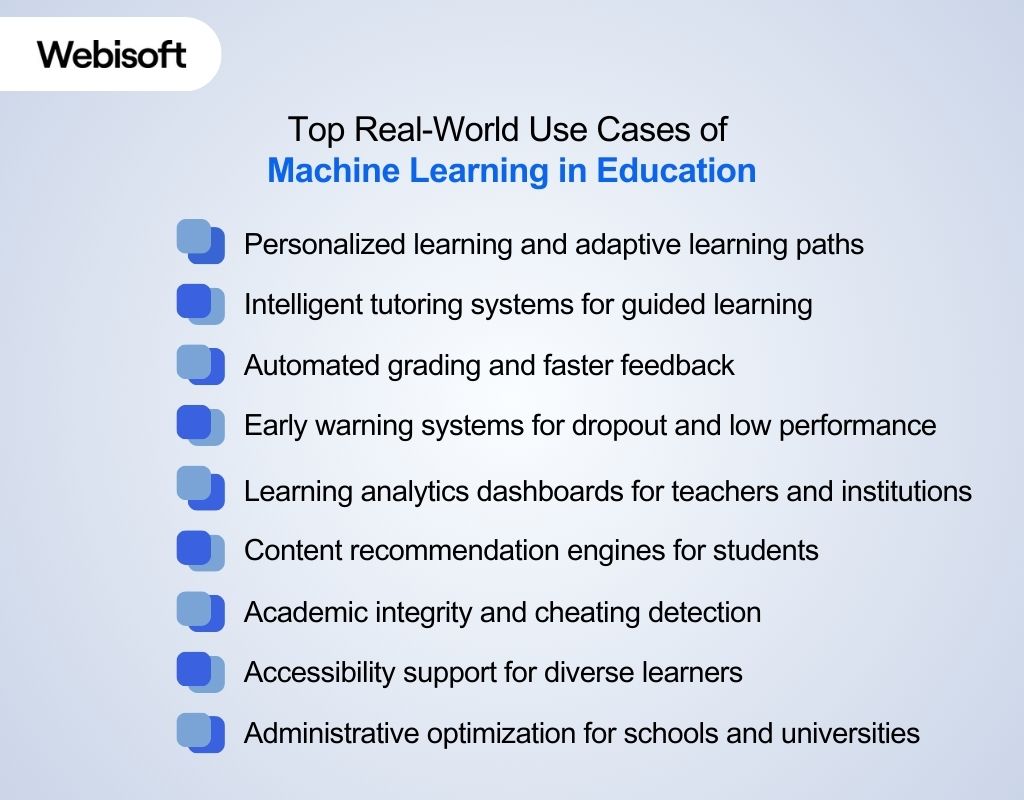
Top Real-World Use Cases of Machine Learning in Education
Machine learning is no longer a “future idea” in education. Today, machine learning in education examples can be seen across real classrooms, learning platforms, and institutional systems. They improve personalization, speed up feedback, and help educators make smarter decisions using data.
Personalized learning and adaptive learning paths
Machine learning helps learning platforms adjust content based on how each student performs, including custom experiences built through EdTech app development solutions. Instead of giving every learner the same next lesson, the system identifies patterns in mistakes, mastery level, and pace. It then recommends the right practice and difficulty level to keep learning on track. Examples include:
- Adaptive practice modules that adjust difficulty based on student accuracy
- Personalized lesson sequencing based on mastery progression
- Skill-gap detection that recommends revision content automatically
- Learning paths that change based on time-on-task and quiz performance
Intelligent tutoring systems for guided learning
ML-powered tutoring systems support students during practice by offering hints, detecting repeated errors, and guiding them through steps. These tools are especially useful in large classrooms and online learning, where teachers cannot provide one-on-one help at every moment. Examples include:
- Step-by-step problem-solving assistance (math, physics, coding)
- Hint generation when students get stuck on a concept
- Practice question suggestions based on weak areas
- Guided revision plans before exams based on past performance
Automated grading and faster feedback
Machine learning can reduce the time spent grading by assisting with evaluation and feedback generation. In education, this is commonly used for objective assessments and structured tasks. For writing and open-ended answers, ML often supports feedback quality and consistency, while teachers remain the final reviewer. Examples include:
- Automated scoring for quizzes and MCQs
- Rubric-assisted grading suggestions for assignments
- Feedback prompts that highlight weak areas (grammar, clarity, structure)
- Faster grading workflows for large classes with consistent evaluation
Early warning systems for dropout and low performance
Machine learning helps institutions identify students who may be at risk of falling behind. It does this by analyzing academic and behavioral signals over time, then generating a risk score or alert. This enables earlier support instead of waiting until students fail or disengage completely. Examples include:
- Risk alerts based on attendance drops and missed submissions
- Performance trend tracking across weeks or semesters
- Intervention recommendations (tutoring, mentoring, extra assignments)
- Engagement monitoring for online courses (logins, participation, activity)
Learning analytics dashboards for teachers and institutions
ML-driven dashboards help educators interpret learning data quickly. Instead of manually reviewing scores and reports, dashboards highlight key insights, including weak topics, students needing support, and underperforming lessons. Examples include:
- Topic-level weakness summaries for a class
- Student progress dashboards showing learning gaps and trends
- Course performance analytics for curriculum improvement
- Teacher dashboards that prioritize students needing immediate support
Content recommendation engines for students
Recommendation systems help learners find the right learning content at the right time. Machine learning can recommend videos, quizzes, readings, or exercises based on skill level, interest, and learning behavior, improving engagement and reducing dropout in online learning. Examples include:
- Recommended videos or readings based on weak topics
- Suggested practice sets after low quiz performance
- Personalized revision playlists before exams
- Learning resource recommendations based on preferred formats (video vs text)
Academic integrity and cheating detection
Machine learning helps detect suspicious behavior in online learning and assessments. It does not “accuse” students directly. Instead, it flags patterns that may require review, helping institutions protect fairness and reduce academic misconduct. Examples include:
- Plagiarism similarity detection for essays and assignments
- Suspicious exam behavior detection in online tests
- Unusual answer-pattern detection across students in the same exam
- Duplicate submission or copy-paste behavior monitoring in digital exams
Accessibility support for diverse learners
Machine learning improves inclusion by supporting learners with different abilities and language needs. These tools help students access content more easily, participate in class, and learn without barriers that traditional systems often fail to address. Examples include:
- Speech-to-text captioning for recorded or live classes
- Text-to-speech reading support for learners with disabilities
- Translation support for multilingual classrooms
- Reading assistance tools that simplify text and highlight key points
Administrative optimization for schools and universities
ML is also used to improve institutional planning and operations. It supports forecasting, scheduling, and resource allocation so schools can make decisions based on real trends rather than assumptions. Examples include:
- Enrollment forecasting to predict student intake and demand
- Course demand prediction for better scheduling and staffing
- Resource planning models for classrooms, labs, and faculty allocation
- Financial and operational analytics for planning budgets and services
Benefits of Machine Learning in Education Sector
The role of machine learning in education is to make learning more effective, support educators with smarter tools, and help institutions make better decisions using data. Here are the important benefits schools and EdTech platforms gain from ML.
-
- Learning becomes more personal, not more complicated: ML helps platforms adjust lessons and practice based on how a student is actually performing, so they don’t get stuck or feel left behind.
- Struggling students get support earlier: Instead of noticing problems after grades drop, ML can flag early signs like missing assignments, lower participation, or repeated mistakes.
- Feedback reaches students faster: ML-supported grading and feedback tools shorten the waiting time between submission and response, which helps students improve while the topic is still fresh.
- Students stay engaged longer: When content matches a student’s level and learning pace, they’re less likely to drop off or lose interest midway through a course.
- Learning gaps become visible and fixable: ML can pinpoint which concepts students keep failing, so practice becomes focused and useful instead of random repetition.
- Teachers spend less time on repetitive tasks: Reporting, performance tracking, and basic assessment workflows can be simplified, so teachers can focus on teaching instead of admin work.
- Institutions make smarter planning decisions: ML supports better forecasting for course demand, scheduling, and student support needs, based on real patterns instead of guesswork.
- Socially appropriate proof: Teachers can always get the student who is falling behind. But not all teachers report them to the system or their parents. This system will automate that process in a socially appropriate way, acting like a third party.
The Machine Learning Workflow Behind EdTech Products
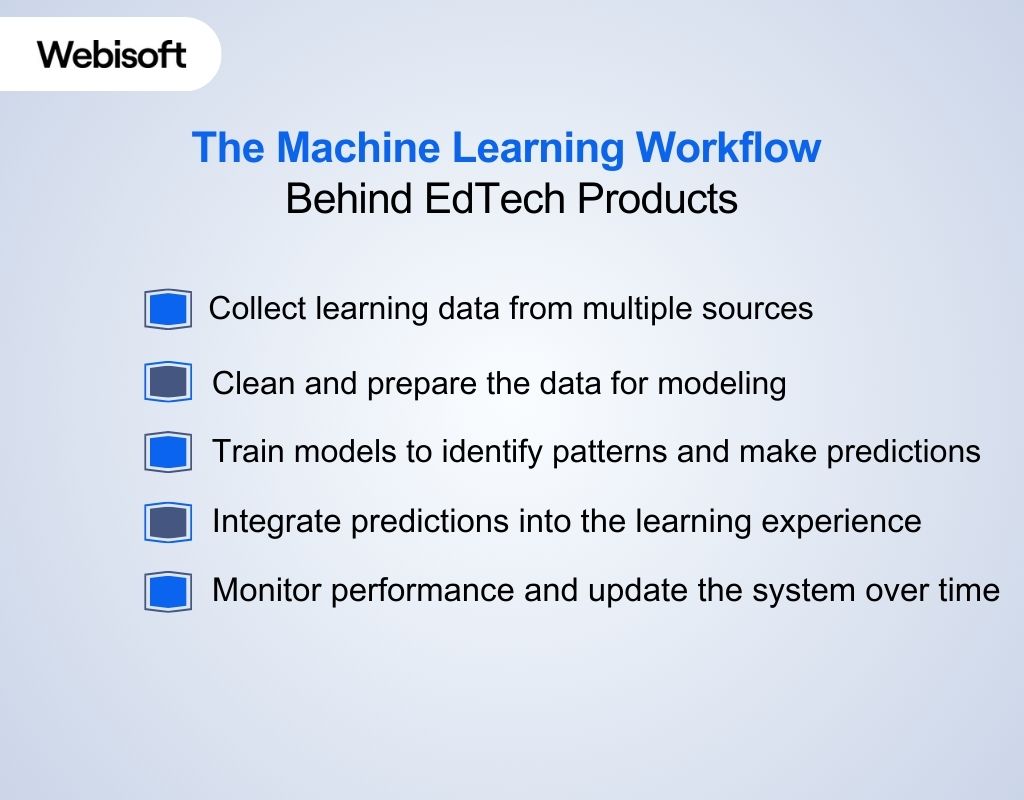
Most EdTech platforms that use machine learning follow a simple workflow behind the scenes. Across many applications of machine learning in education, the process stays similar: collect learning data, train models to detect patterns, and turn insights into product actions.
1) Collect learning data from multiple sources
EdTech products pull data from places like LMS activity, assessment results, assignment submissions, and student engagement signals. This data becomes the foundation for everything the model learns.
2) Clean and prepare the data for modeling
Raw education data is often messy and inconsistent. Before building any model, teams clean it, remove duplicates, handle missing values, and organize it into usable formats so the system learns from accurate signals.
3) Train models to identify patterns and make predictions
Once the data is ready, machine learning models are trained to do specific tasks such as predicting performance risk, recommending content, or detecting learning gaps. The model learns from historical patterns and improves as more training data becomes available.
4) Integrate predictions into the learning experience
The model output is then embedded into the platform through features like personalized recommendations, teacher dashboards, automated feedback, or student support alerts. This is where machine learning becomes useful, because it turns analysis into action.
5) Monitor performance and update the system over time
Learning environments change across semesters, cohorts, and curriculum updates. That’s why EdTech teams monitor model performance, check for bias and accuracy issues, and retrain models regularly to keep results reliable.
Want to turn these ideas into a working education product, not just a concept? Let’s build your ML-powered EdTech solution with Webisoft, from data preparation to deployment and monitoring, so it performs reliably in real learning environments.
Advanced Technologies That Strengthen Machine Learning in Education
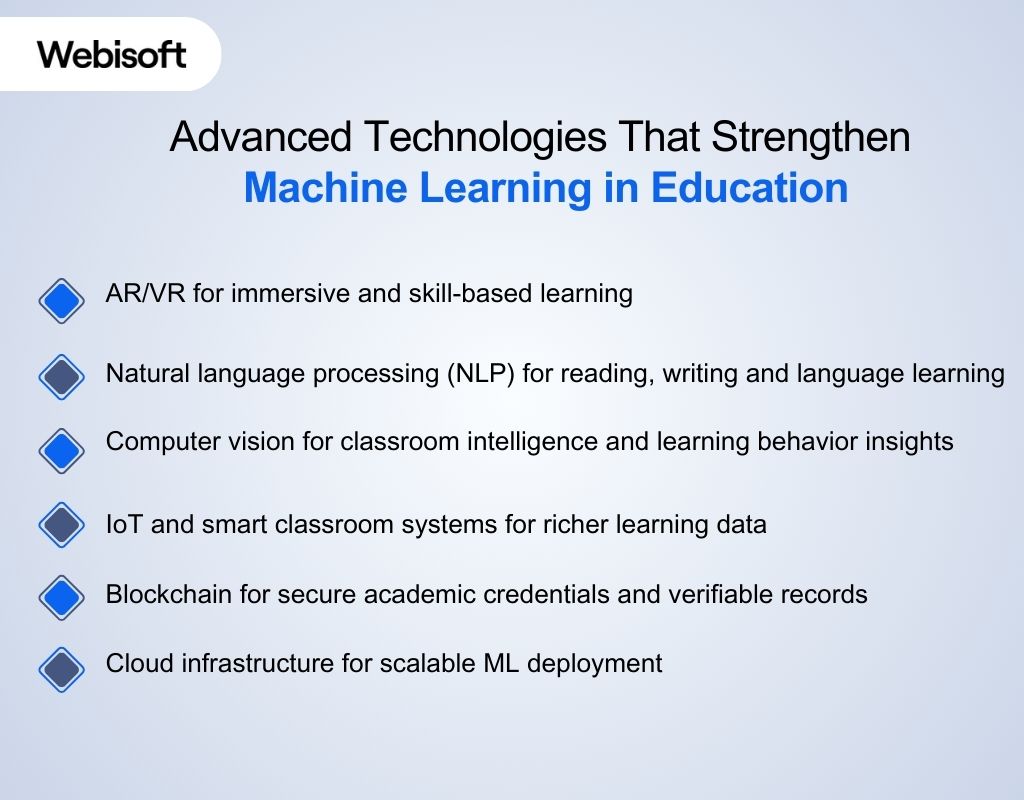
Machine learning becomes much more effective in education when it is supported by the right technologies. The use of machine learning in education relies on tools that improve learning data, enrich experiences, and keep ML systems reliable, scalable, and secure.
AR/VR for immersive and skill-based learning
Augmented reality and virtual reality strengthen ML-powered learning by creating interactive environments where students can practice skills, not just read content. ML can then analyze learner behavior inside these environments and adapt activities based on performance. Common examples include:
- Virtual labs for science and engineering training
- Simulation-based learning for medical and technical education
- AR learning overlays for classroom demonstrations
- Skill training environments that adapt difficulty based on learner progress
Natural language processing (NLP) for reading, writing, and language learning
NLP allows machine learning systems to understand and work with human language, which is essential in education. It supports writing feedback, reading support, and language learning tools that respond to how students communicate and learn. Common examples include:
- Writing assistants that help students improve structure and clarity
- Automated feedback tools for short answers and essays
- Reading support systems that simplify complex text
- Language learning tools with pronunciation and grammar feedback
Computer vision for classroom intelligence and learning behavior insights
Computer vision helps ML systems interpret visual information, which can be useful for both in-person and remote learning environments. It supports engagement insights, learning activity analysis, and exam monitoring when used responsibly. Common examples include:
- Exam proctoring support for online assessments
- Attendance and participation tracking in classroom settings
- Gesture and activity recognition for interactive learning
- Visual learning analytics for lab-based or skill-based training
IoT and smart classroom systems for richer learning data
IoT devices strengthen machine learning by capturing real-time signals from learning environments. When connected properly, these systems provide deeper insights into classroom behavior and learning patterns. Common examples include:
- Smart attendance systems and classroom sensors
- Connected learning devices that track learning activity
- Real-time environment monitoring for better learning conditions
- Classroom tools that automate logistics and session management
Blockchain for secure academic credentials and verifiable records
Blockchain is not directly a machine learning tool, but it strengthens education systems where ML is used by ensuring trust in academic records. It helps prevent credential fraud and enables secure, portable verification. Common examples include:
- Blockchain-based digital diplomas and certificates
- Credential verification systems for employers
- Tamper-proof student records and transcripts
- Skill credentialing for professional learning platforms
Cloud infrastructure for scalable ML deployment
Most ML-driven education platforms rely on cloud infrastructure to train, deploy, and maintain models efficiently. Cloud tools make it easier to scale learning systems across large student populations without performance issues. Common examples include:
- Scalable ML pipelines for training and updating models
- Real-time recommendation systems for online learning platforms
- Centralized data storage for learning analytics dashboards
- Secure APIs that integrate ML into LMS and SIS systems
Risks and Failures: Where ML in Education Goes Wrong
Machine learning can improve learning outcomes, but it can also create real harm when it is rushed, poorly trained, or used without proper oversight. In education, the stakes are high because model decisions can influence student confidence, grades, and long-term opportunities.
- Biased predictions that disadvantage certain student groups: If training data reflects historical inequality, ML models may repeat it. This can lead to unfair recommendations, inaccurate risk scores, or unequal learning support across demographics.
- False “at-risk” flags that label students unfairly: Dropout prediction models can generate false positives. When a student is wrongly flagged, it can create stigma, unnecessary intervention, or lower expectations from educators.
- Low-quality or incomplete data leading to wrong outputs: Education data is often inconsistent. Missing attendance logs, irregular grading, or low LMS usage can cause models to make inaccurate conclusions based on incomplete signals.
- Model drift across semesters and curriculum changes: Student behavior and curriculum structure change over time. A model trained last year may become unreliable this year, leading to wrong predictions and weaker recommendations.
- Privacy failures and misuse of student data: ML systems require data, but education data is sensitive under regulations like FERPA. Weak governance can lead to excessive data collection, poor consent practices, or third-party vendor misuse.
- Security risks in ML-powered education platforms: ML systems can be targeted through data manipulation, unauthorized access, or model exploitation. If attackers influence training data, they can distort predictions and recommendations.
- Misalignment with real learning goals: Some ML systems optimize for easy metrics like clicks or time spent. This can increase engagement numbers while failing to improve actual learning outcomes.
Machine Learning in Education Built with Webisoft
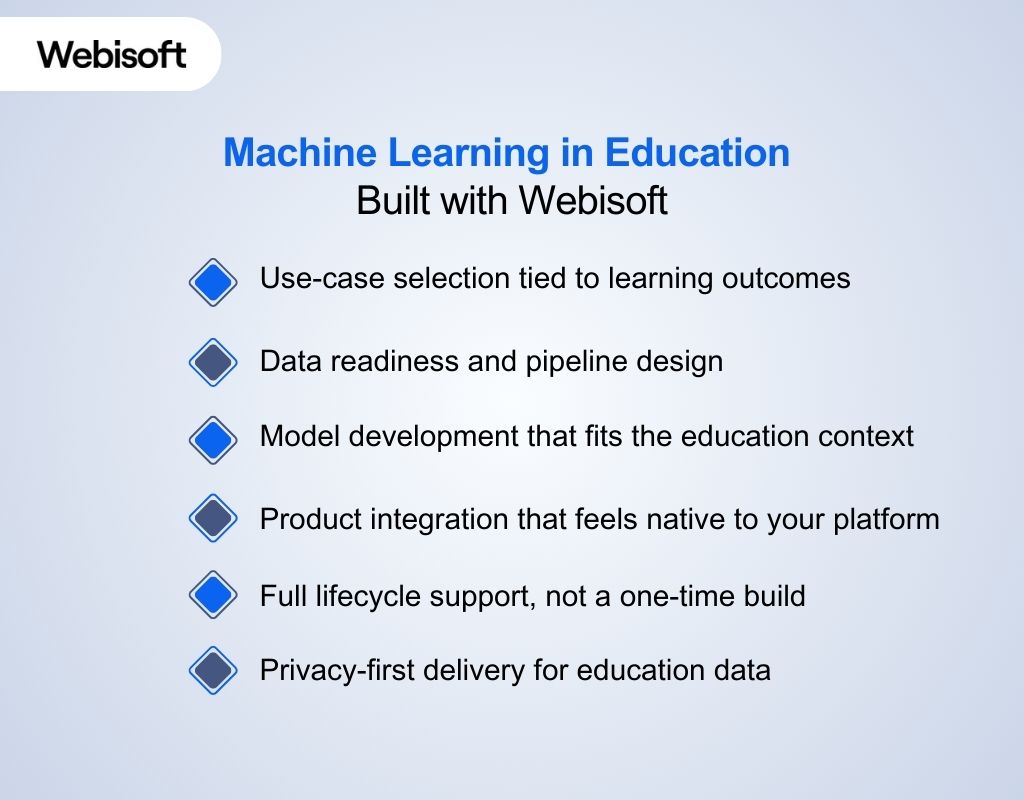
After the risks and guardrails, the next step is building a system that earns trust. At Webisoft, we build ML-driven EdTech products end to end, from data strategy to production deployment with clear governance.
Use-case selection tied to learning outcomes
We help you pick one high-impact use case, then define success metrics before model work starts. Our goal is measurable learning improvement, not a demo that looks good.
Data readiness and pipeline design
Our team maps your LMS, SIS, and assessment data, then builds clean pipelines for training and reporting. This reduces noisy signals that cause weak predictions later.
Model development that fits the education context
We train models for tasks like recommendations, risk scoring, and learning analytics. We also validate performance with the constraints your users face in real classrooms.
Product integration that feels native to your platform
We integrate ML outputs into dashboards, alerts, and personalized flows, without disrupting teacher workflows. Your users get clear actions, not confusing model scores.
Full lifecycle support, not a one-time build
Learning patterns change as new students join, and course content gets updated. We handle monitoring, retraining, and performance tracking so your ML system stays accurate and reliable over time.
Privacy-first delivery for education data
Student data demands careful handling. We build with access controls, auditability, and governance practices that reduce exposure and improve stakeholder trust. We don’t just build ML features; we help you launch education systems that stay accurate, secure, and trusted over time. Contact Webisoft to map your use case, prepare your data, and deploy a privacy-first ML solution that performs in real classrooms.
Conclusion
Machine learning in education is not about replacing teachers or turning classrooms into science experiments. It’s about giving students the right support at the right time, and giving educators clearer signals instead of endless spreadsheets.
When the models are trained responsibly, the impact shows up where it matters: stronger outcomes, better engagement, and fewer students slipping through the cracks. And once you’re ready to move from ideas to implementation, the right partner matters. At Webisoft, we build ML-driven education products that are reliable in production, not just impressive in demos. Let’s build yours.
Frequently Asked Question
Machine learning is a broad field where models learn patterns from data. Deep learning is a subset of ML that uses neural networks and works best with complex data like text, speech, images, and videos. This is useful for tutoring, speech feedback, and content analysis.
Common machine learning model types include classification models for risk prediction and regression models for score forecasting. They also include recommendation models for content suggestions, clustering for grouping learners, and NLP models for text feedback and language learning.
Bias reduction requires using diverse training data, testing fairness across student groups, and monitoring model outcomes over time. Human review is also important so the model does not become the only decision-maker.
