In today’s rapidly changing markets, relying on traditional formulas is no longer sufficient for timely, effective decision-making. While traditional economic models explain the past, they often miss what’s happening right now.
By analyzing unconventional data, like satellite images of trade ports or live news trends, machine learning identifies patterns that standard spreadsheets simply can’t detect. This approach transforms economic analysis from a slow review of historical reports into a real-time guide for action.
As a result, decision-makers can anticipate shocks, allocate resources more smartly, and maintain stability in an unpredictable global economy. Read on to learn how machine learning in economics is reshaping the way businesses and governments plan for the future.
What Is Machine Learning (For Economists)?
Machine learning is a computational framework that allows economists to extract valuable structure from vast, complex datasets. While traditional econometrics focuses on explaining the specific causes behind a result, machine learning prioritizes predicting future outcomes with high accuracy.
It uses flexible algorithms to identify non-linear relationships and patterns that standard linear models often miss. This change enables researchers to analyze unstructured data to generate real-time economic insights.
Why Do Old Economic Models Struggle in a Fast-Moving World? [The Problems that ML solves]
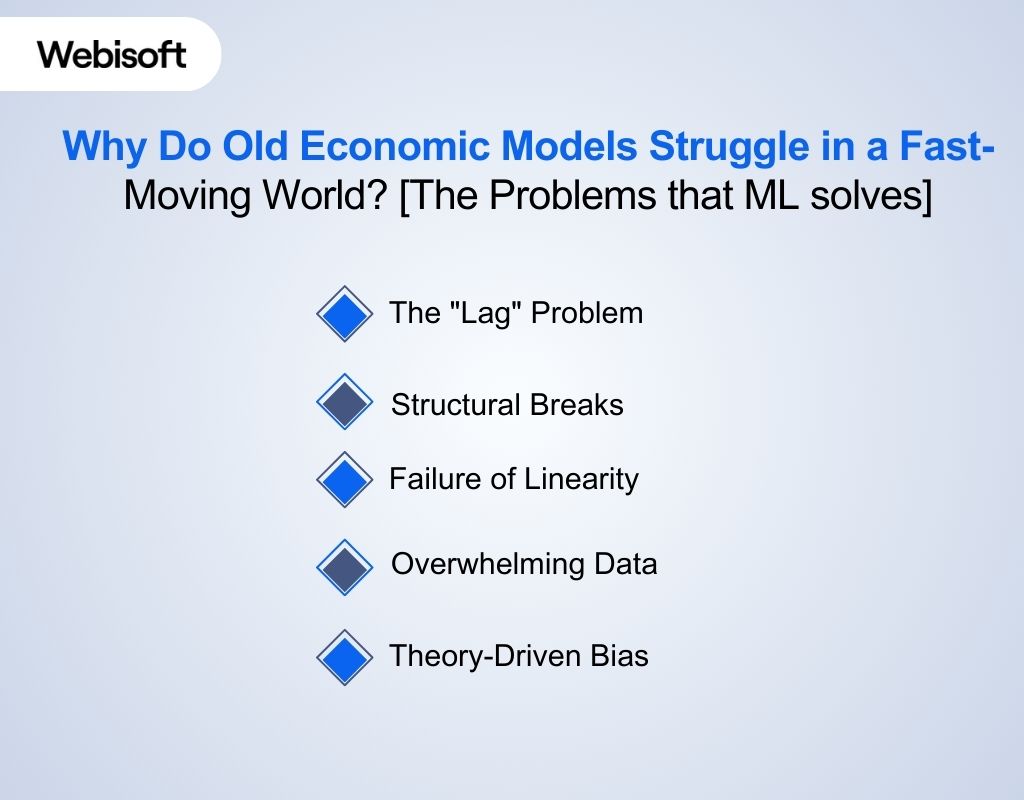
The traditional economic model is built for a slower, more stable era, which often fails to provide the agility required for modern policy.
i) The “Lag” Problem:
Metrics like GDP or unemployment reports reflect conditions from weeks or months ago. They provide a backward-looking view rather than the current state of the economy.
ii) Structural Breaks:
Traditional models assume the “rules” of the economy stay the same over time. However, sudden events like a pandemic or a tech revolution create “structural breaks” that render old historical data irrelevant for future predictions.
iii) Failure of Linearity:
Most classic models assume that if you double $X$, you get a predictable change in $Y$. In reality, modern economies are non-linear; small changes in interest rates can sometimes cause massive, disproportionate shocks to the housing market.
iv) Overwhelming Data:
Traditional tools often cannot handle huge volumes of new data, including GPS information, online transactions, or social media activity. This leaves economists blind to real-time consumer behavior.
v) Theory-Driven Bias:
Many models are designed to fit established economic theories. When reality does not follow the theory, the results become biased, which can lead to poor policy decisions or inefficient allocation of resources.
Machine Learning Inputs vs Traditional Econometrics
Machine learning does not replace the economist’s intuition, but it enhances it. By automating the discovery of patterns, it allows researchers to spend less time on manual data cleaning and more time on high-level interpretation. It fixes the gap between historical analysis and real-time intervention. Here is a quick comparison showing the key differences between traditional econometrics and machine learning in economic analysis:
| Feature | Traditional Econometrics | Machine Learning |
|---|---|---|
| Primary Goal | Understand causal relationships between variables | Accurately predict future trends and uncover hidden patterns |
| Data Requirements | Clean, structured datasets with well-defined variables | Can handle structured and unstructured data, including text, images, and satellite data |
| Model Approach | Theory-driven, linear models | Flexible, non-linear models that adapt to complex patterns |
| Interpretability | High where results are easy to explain and justify | Medium and requires tools like SHAP or feature importance to explain predictions |
| Adaptability | Slow to update, and it needs new models for new data | Highly adaptive and can learn continuously from new data |
| Focus of Analysis | Historical trends and hypothesis testing | Real-time insights, nowcasting, and large-scale pattern recognition |
| Computation | Moderate, usually feasible on standard software | High and often requires advanced computing power for big datasets |
Application Of Machine Learning In Economics
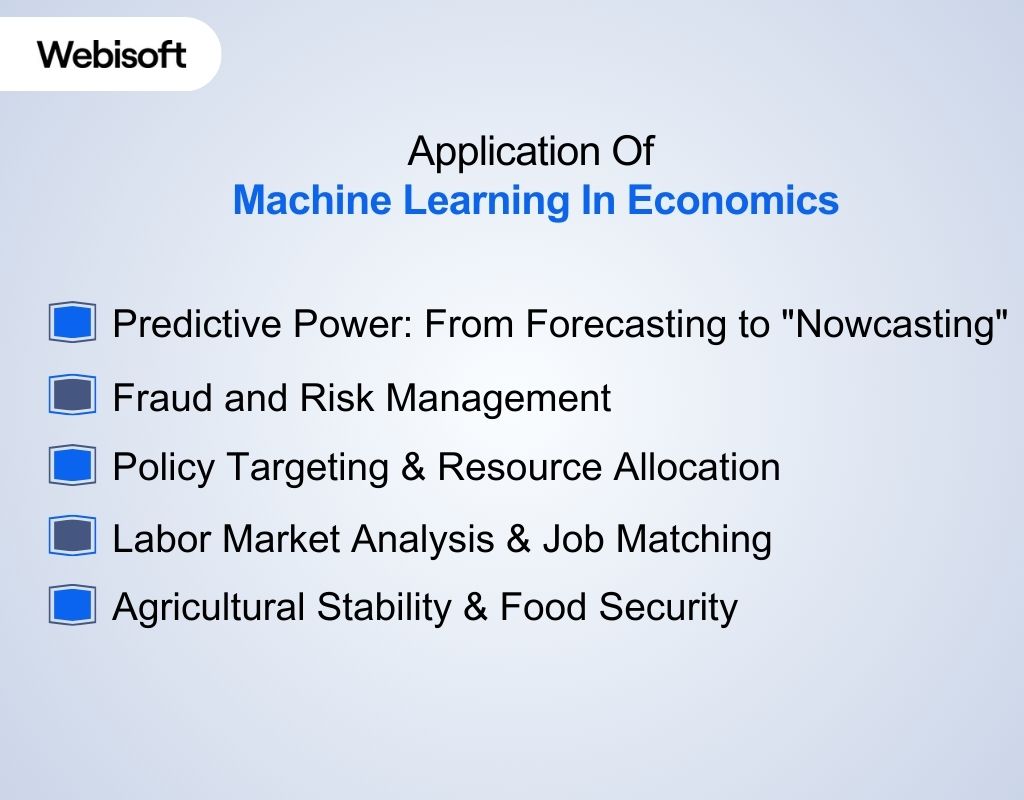
Machine learning models transform economics by processing massive, non-traditional datasets to predict market trends. Businesses can automate financial decisions and evaluate policy impacts with unprecedented accuracy and speed.
1. Predictive Power: From Forecasting to “Nowcasting”
Modern economists no longer wait months for official reports. They use machine learning to “nowcast” economic health by analyzing real-time data. For example, algorithms scan satellite imagery of cargo ports or track electricity consumption to estimate a country’s GDP today.
These models handle thousands of variables at once, far outperforming traditional spreadsheets. Research indicates that using these high-frequency indicators can reduce forecasting errors by nearly 84.2% during volatile periods.
2. Fraud and Risk Management
Traditional systems rely on “if-then” logic. For example, flagging a purchase if it exceeds $5,000. Criminals easily bypass these rigid hurdles. Machine learning uses Anomaly Detection to establish a “digital fingerprint” for every user. It considers:
- Geographic Velocity: Did a card swipe in London and then New York two hours later?
- Behavioral Biometrics: How fast do you type your password? What is the tilt of your phone during a transaction?
- Spending Patterns: Does this $10 gas station charge fit your usual routine?
When a transaction deviates from these learned patterns, the system blocks it instantly or creates a multi-factor authentication request. All in all, machine learning works like a 24/7 security guard for the global financial system. Banks also use these tools to create comprehensive risk profiles that predict loan defaults before they happen. This technology is expected to add up to $340 billion in annual value to the global banking sector
3. Policy Targeting & Resource Allocation
Machine learning helps governments and NGOs make faster, smarter decisions about where money and resources should go. It is based on what’s happening right now, not old data.
- Smarter Resource Distribution → Instead of relying on outdated census data or broad averages, AI uses real-time data to direct funds and support exactly where they’re needed most.
- Poverty mapping → Algorithms study satellite images—like roof types, road conditions, and night-time lights—to quickly spot struggling areas. This saves years of manual surveys and helps aid organizations act sooner.
- Labor economics → By analyzing millions of job ads, AI finds which skills are in demand and which industries are declining. Governments can then invest in retraining programs where they’ll have the biggest impact.
- Public health → Predictive models anticipate disease outbreaks or emergency room overloads. Hospitals can prepare in advance by allocating staff, beds, and equipment before a crisis hits.
Example:
Togo’s Novissi Program During COVID-19, Togo used AI satellite images and mobile data to quickly identify vulnerable people and deliver cash aid without a census. Here is what it actually outperformed the traditional method:
| Metric | Traditional “Blanket” Aid | ML-Targeted Aid | Source |
|---|---|---|---|
| Exclusion Error | High (many poor households missed) | Reduced by 4%–21% | Nature (2022) |
| Accuracy | ~60–70% (estimated) | 84% (canton-level wealth prediction) | PNAS (2022) |
| Deployment Speed | Months of manual surveys | Weeks using digital data | World Bank (2024) |
4. Labor Market Analysis & Job Matching
According to the World Economic Forum’s Future of Jobs Report 2025, approximately 63% of employers now identify “skill gaps” as the primary barrier to business transformation. Machine learning is completely replacing the barrier.
Economists use tools like XGBoost to forecast which skills will be in demand next year. By analyzing employment trends, job postings, and workforce data, these models identify skill shortages and emerging roles before they become critical.This allows companies to proactively upskill employees, target recruitment, and match candidates to roles where they are most likely to succeed.
5. Agricultural Stability & Food Security
Machine learning is upgrading the global food supply by predicting crop yields and commodity prices with pinpoint accuracy. In an era of climate volatility, traditional farming relies on guesswork, but AI machine learning transforms agriculture into a data-driven science. By analyzing weather patterns, soil health, and market signals, algorithms ensure food remains available and affordable for the world’s growing population.
Real-world example:
On a global scale, the World Food Programme (WFP) uses HungerMap LIVE, a machine learning platform that tracks food security in over 90 countries.
- Predicting Food Shortages: AI reads news, social media, and satellite weather data to spot areas at risk of hunger before it happens.
- Early Action: In 2024–2025, this helped aid groups send food to Africa and Asia weeks before shortages became severe.
How Predictions Turn Into Real Decisions Through ML
In 2026, we’ve moved beyond “black box” predictions to Decision Support Systems. It not only forecasts what might happen but also guides the actions needed. Here’s how a prediction turns into a decision in practice:
- Signal Extraction: The system scans high-frequency data, like credit card activity or port traffic, to find early warning signs, such as a sudden drop in regional spending.
- Probability Scoring: Instead of giving a simple yes or no, the model produces a probability. This is like “92% chance this area is entering a local recession”.
- Automated Triggers: Decision-makers set thresholds. If the probability is high enough, the system automatically takes action, like offering small-business loans or adjusting inventory.
- Explainable Auditing: Tools like SHAP show which factors—such as rising fuel costs or labor shortages—caused the decision, so humans can verify it.
- Closed-Loop Learning: After the decision, the outcome is fed back into the model. If the loan helped a business survive, the model learns that this action works, improving future predictions.
Note: SHAP is a method from game theory, created by Nobel laureate Lloyd Shapley in 1953, to fairly divide rewards among players. In economics, SHAP looks at each piece of data, like inflation, employment, or fuel costs, and shows how much each factor affected the final prediction. This makes the normally “black box” model clear and easy to check, showing exactly why it made a decision.
Popular ML Techniques Used by Economists
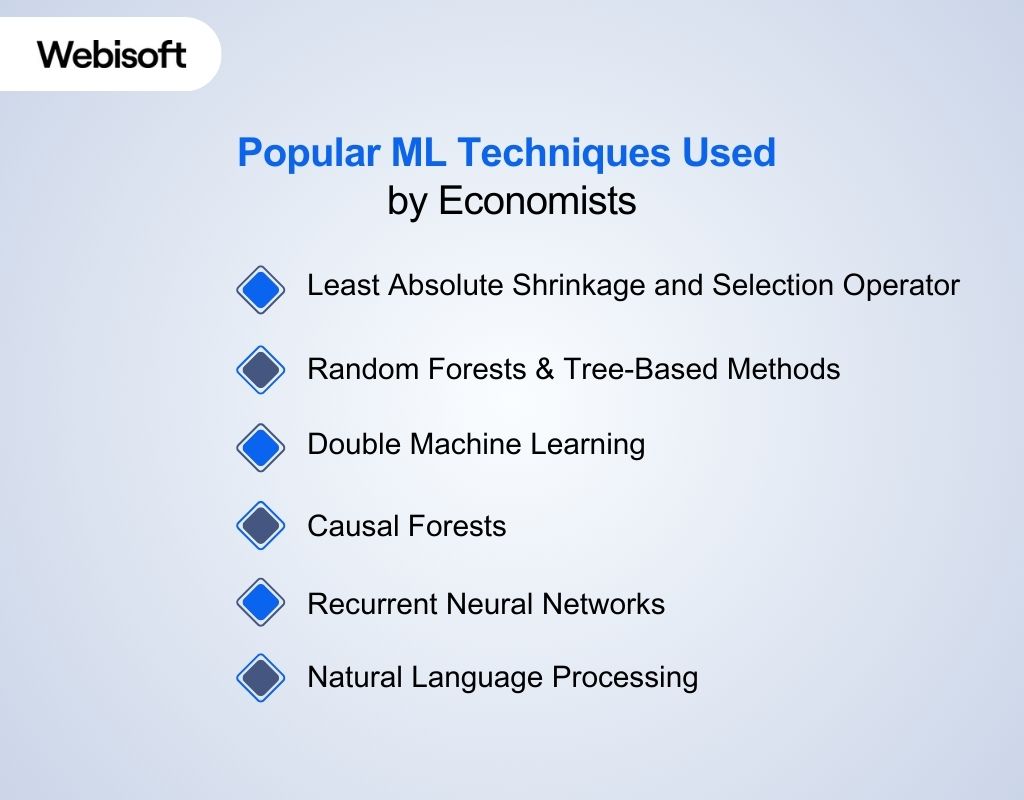
To excel as a modern economist, you need to master tools that connect data science with economic theory. Researchers today rely on machine learning to analyze huge datasets, uncover complex patterns, and measure causal impacts that traditional methods often miss. Here are some of the most important ML techniques:
1. LASSO (Least Absolute Shrinkage and Selection Operator)
Economists often face thousands of potential variables but only limited data. LASSO automatically selects the most important variables by reducing the effect of less relevant ones to zero. This simplifies models and highlights the key drivers of economic outcomes without overcomplicating the analysis.
Here’s how LASSO works in practice: → Automatically picks the most important variables from large datasets → Reduces less relevant variables to zero → Highlights key drivers of economic outcomes
2. Random Forests & Tree-Based Methods
Random Forests handle non-linear relationships. These are situations where variables don’t follow a straight-line pattern. By combining hundreds of decision trees, they capture complex interactions. Such as how education and geography together affect wages, which simple averages can’t show.
Key benefits of Random Forests include: → Captures complex, non-linear relationships → Combines hundreds of decision trees for better predictions → Reveals patterns that simple averages or linear models miss
3. Double Machine Learning (DML)
DML is the gold standard for measuring causal effects. It uses two separate models to filter out confounding factors before estimating the true impact of a policy. For example, it ensures that when evaluating a tax change, you’re measuring the policy’s effect, not unrelated economic noise.
Here’s why DML is important: → Removes confounding factors to isolate true causal effects → Ensures accurate measurement of policy impacts → Uses two models to separate signal from noise
4. Causal Forests
Unlike standard forests that predict general outcomes, Causal Forests estimate the effect of a policy or intervention on specific individuals. Economists use this to spot differences in impact. For instance, showing a job training program may help younger workers 20% more than older workers.
Causal Forests allow economists to: → Estimate effects on individual participants, not just averages → Identify groups that benefit more or less from a policy → Support targeted and personalized interventions
5. Recurrent Neural Networks (RNN & LSTM)
For time-series data like inflation or stock prices, LSTMs (Long Short-Term Memory networks) track long-term trends while ignoring irrelevant noise. They can “remember” patterns in the economy over time, often outperforming traditional forecasting methods.
RNNs and LSTMs are useful because they: → Track long-term trends in time-series data → Remember relevant patterns and ignore noise → Improve forecasting for complex economic datasets
6. Natural Language Processing (NLP)
Economists now analyze text to “read” the economy. Using tools like BERT or transformer models, they process millions of news articles, speeches, or reports to turn qualitative information into measurable indicators, like economic sentiment or policy uncertainty.
NLP helps economists by: → Analyzing news, speeches, and reports at scale → Converting qualitative text into measurable economic indicators → Capturing sentiment and policy uncertainty that numbers alone can’t show
How to Implement Machine Learning in Economic Analysis?
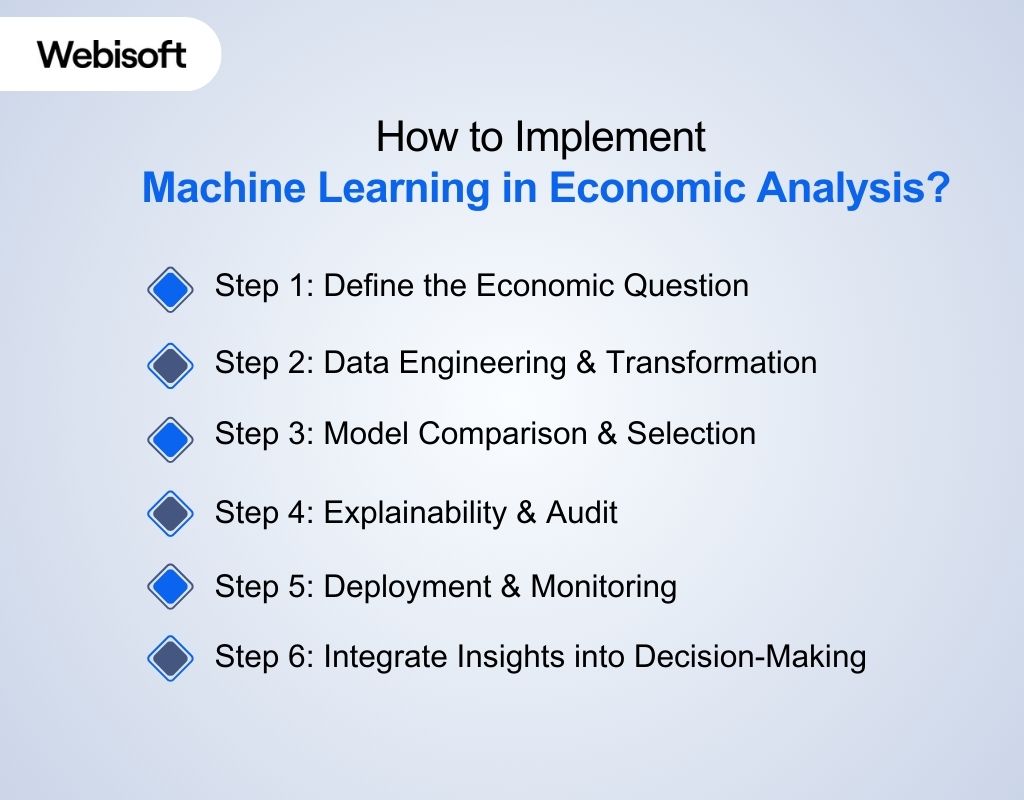
Machine learning helps economists turn complex data into actionable insights. By uncovering patterns, predicting trends, and measuring causal effects, it guides smarter policies, business decisions, and research outcomes.
Step 1: Define the Economic Question
Every successful project starts with a clear question. Are you trying to predict something like next month’s inflation rate or measure the impact of a policy like a tax reform?
- Prediction problems: ML is ideal here, as it can forecast future trends from past patterns.
- Causal problems: Require advanced techniques like Double Machine Learning to separate real effects from coincidental correlations.
- Avoiding pitfalls: A vague question can lead the model to detect “spurious correlations”. These look real statistically, but have no real-world logic.
Example: Instead of asking, “What affects the economy?” a precise question would be, “How will a 1% increase in interest rates affect consumer spending next quarter?”
Step 2: Data Engineering & Transformation
Economic data is often messy, incomplete, or in different formats. Preparing it correctly is critical. Here are some key steps:
- Cleaning: Remove errors, duplicates, and extreme outliers that could mislead the model.
- Feature Engineering: Transform raw data into meaningful variables. Such as creating “lagged inflation” to capture past price trends or “moving averages” of unemployment.
- Transforming unconventional data: Convert text like news articles, central bank speeches, and images, or sensor data into numeric features.
Why it matters: High-quality data ensures the model can learn real economic patterns instead of being misled by noise.
Step 3: Model Comparison & Selection
Machine learning offers many ways to analyze data. Instead of relying on a single model, compare multiple options to find the best fit.
- Test multiple models: Compare traditional methods like OLS regression with ML techniques such as Random Forests or LASSO.
- Cross-Validation: Split your data into training and testing sets to check how well the model generalizes to unseen data.
- Performance metrics: Evaluate accuracy, robustness, and economic interpretability.
Example: When forecasting inflation, a Random Forest might outperform OLS because it can capture non-linear relationships between oil prices, interest rates, and consumer spending.
Step 4: Explainability & Audit
Economic decisions require justification. A model is only useful if you understand why it made a prediction.
- Transparency with SHAP: Break down contributions of each variable, like interest rates, employment, or fuel prices, to see what drove the prediction.
- Sensitivity Analysis: Test how the model reacts to extreme events, like a sudden market crash, to ensure stability.
- Audit trails: Keep a record of model logic and decisions for stakeholders or regulators.
Why it matters: Policymakers and economists need confidence that recommendations are sound and understandable, not opaque.
Step 5: Deployment & Monitoring
A model’s work isn’t done after training. Real-world conditions evolve, and models must adapt.
- Live Tracking: Continuously monitor model performance against actual economic outcomes.
- Retraining: Update the model regularly with new data to account for changing patterns, such as shifts in consumer behavior or market conditions.
Step 6: Integrate Insights into Decision-Making
Machine learning adds value only when it informs action:
- Decision support: Use predictions to guide fiscal or monetary policy, investment strategies, or targeted social programs.
- Scenario planning: Simulate “what-if” situations, like the economic impact of a new tax, to test potential outcomes before implementation.
- Continuous feedback loop: Feed real-world results back into the model to improve its accuracy over time.
Key insight: Treat machine learning as a partner in decision-making, providing data-driven recommendations while leaving final judgment to human experts.
Advantages of Machine Learning in Economics
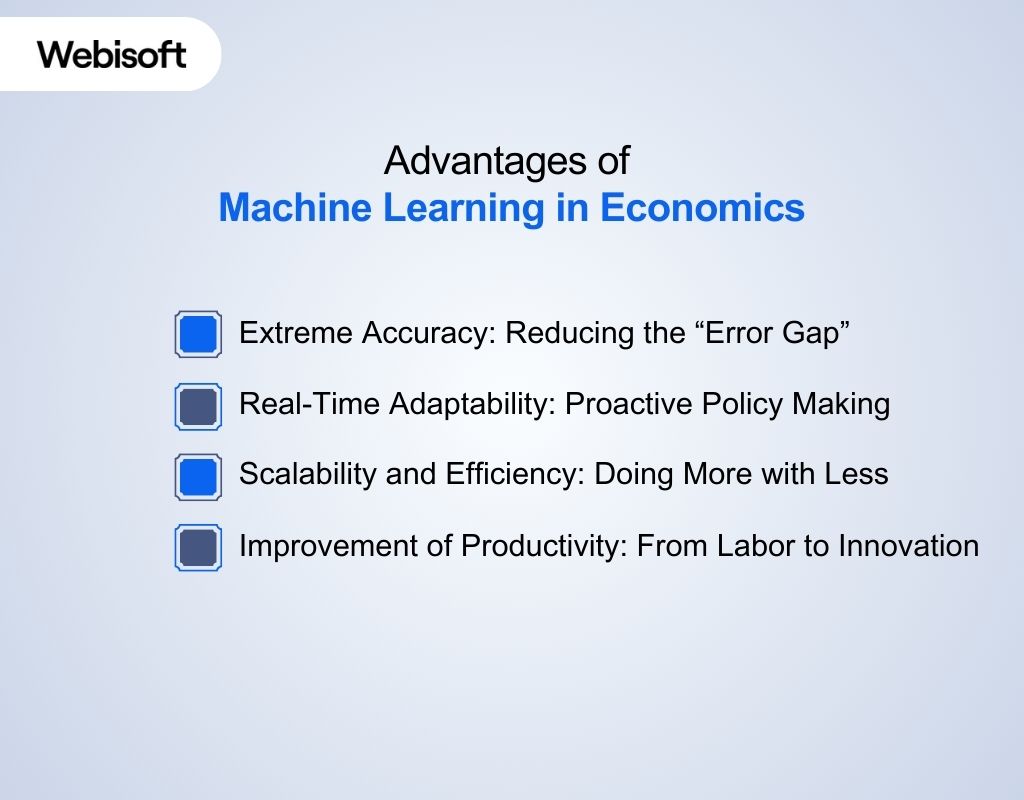
Machine learning gives economists three major advantages:
- Higher predictive accuracy
- Real-time adaptability
- And the ability to analyze unstructured data like text or images.
By going beyond rigid linear formulas, these tools help model the complexity of the real economy with far more precision than traditional methods.
1. Extreme Accuracy: Reducing the “Error Gap”
Traditional economic models often struggle with non-linear events, where small changes can offer big outcomes. Machine learning thrives in these complex situations.
- Superior Results: Studies show ML can improve policy outcome predictions by up to 25% compared to standard econometric models.
- Profitability Insights: In corporate finance, ML forecasting cuts average error rates by 7%, outperforming traditional “random walk” methods.
2. Real-Time Adaptability: Proactive Policy Making
Economic conditions can change in seconds, but government reports often take months to compile. Machine learning provides “Nowcasting” capabilities that offer a live view of the economy.
- Speed to Insight: ML detects market shifts and regulatory changes significantly faster than manual analysis.
- Dynamic Budgeting: Governments can adjust spending immediately based on real-time data flow. This agility could boost global GDP by an estimated $600 billion by 2030 (Source: World Bank via Upubscience).
3. Scalability and Efficiency: Doing More with Less
Machine learning in operation automates the most tedious parts of economic research. It can “read” millions of news articles or process petabytes of transaction data without human intervention.
- Resource Efficiency: New methods like “Reservoir Computing” deliver high-fidelity forecasts using only a fraction of the computing power required by older AI models.
- Unlocking Hidden Data: ML extracts value from “alternative data”, such as satellite photos or social media posts that traditional spreadsheets simply cannot process.
4. Improvement of Productivity: From Labor to Innovation
Machine learning multiplies human effort by taking over repetitive or high-cognitive tasks. In 2026, this is most visible in knowledge-intensive sectors, where AI handles research groundwork and data analysis.
- Accelerated Cycles: AI is shortening workflow times in finance and consulting by about 1.3%–1.6% of total work hours. (Source: World Economic Forum 2026)
- Focus on Value: By automating routine tasks like data entry and basic reporting, workers can spend more time on creative problem-solving. Some sectors report up to a 40% speed increase in these foundational tasks. (Source: Wharton Budget Model)
- Economic Boost: Widespread AI adoption could increase annual labor productivity growth by up to 1.3%, helping offset challenges from aging workforces. (Source: Vanguard 2025)
Note: If you want to achieve similar productivity gains, predictive insights, and real-time adaptability for your own business, partnering with Webisoft’s machine learning development team is the next best step. Our team of AI specialists and software engineers can help you turn raw data into actionable strategies and automate complex workflows.
Limitations of Machine Learning in Economics
Machine learning is a powerful tool, but it isn’t perfect. In economics, it can struggle in areas where human judgment, context, and ethical reasoning are essential.
Key Challenges of ML in Economics
Confusing Correlation with Causation: ML finds patterns in data, but it often cannot tell if one factor actually causes another. This can lead to flawed or risky policy decisions.
- The “Black Box” Problem: High-performing models are sometimes opaque. Regulators or policymakers may not understand why a loan was denied or why a forecast was made.
- Data Bias and Inequality: If historical data contains biases, ML models can repeat and even amplify these issues. It affects hiring, credit scoring, or other economic outcomes.
- Overfitting to Historical Trends: Models trained too closely on past data may fail during unprecedented events, like pandemics or financial crises, because they focus on past “noise.”
- Lack of Clear Statistical Confidence: Unlike traditional econometric methods, many ML models do not provide standard errors or confidence intervals, making it hard to gauge the reliability of predictions.
- High Data Requirements: Advanced ML techniques often need millions of data points to work well. This makes them less reliable in niche markets or emerging economies with limited data.
Future Trends: The Next Frontier of Machine Learning in Economics
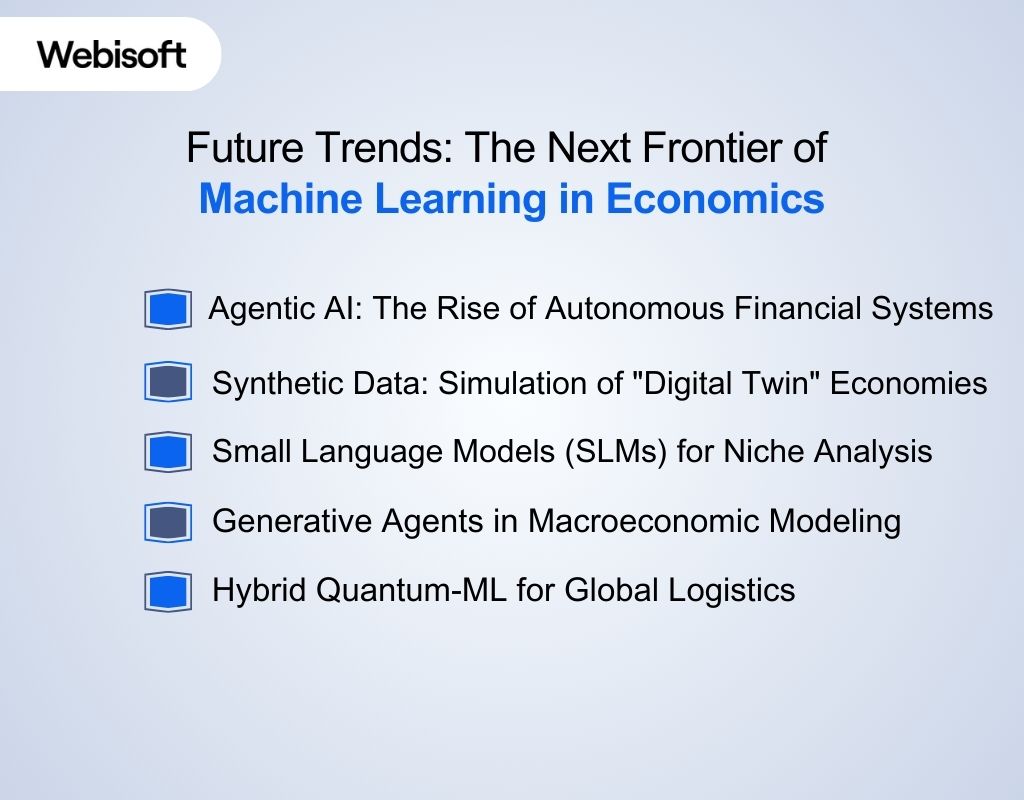
The upcoming years mark a shift from simple data analysis to autonomous economic systems that simulate, predict, and act on global market shifts in real-time.
1. Agentic AI: The Rise of Autonomous Financial Systems
The most significant trend is the transition toward Agentic AI. Unlike traditional tools, these agents execute complex economic tasks without constant human input. In banking, they are becoming “Autonomous CFOs” that manage liquidity, predict cash flow gaps, and automatically rebalance portfolios to maximize returns.
2. Synthetic Data: Simulation of “Digital Twin” Economies
Economists are increasingly using Synthetic Data to model markets without compromising privacy. By creating “Digital Twins” of supply chains or cities, researchers can stress-test how economies react to disruptions like pandemics or energy shortages in a safe, virtual environment.
3. Small Language Models (SLMs) for Niche Analysis
The trend is moving away from giant models toward domain-specific SLMs. By 2027, economists will primarily use lightweight models trained exclusively on financial filings and economic terminology. These models are faster, more cost-effective, and provide the high level of accuracy required for regulatory compliance.
4. Generative Agents in Macroeconomic Modeling
Central banks are beginning to use generative AI to act as “economic agents” within simulations. By assigning AI to mimic the behavior of households or firms, researchers can observe how real people might respond to interest rate changes, providing a more realistic view than traditional mathematical formulas.
5. Hybrid Quantum-ML for Global Logistics
As we enter 2027, the fusion of Quantum Computing and Machine Learning is expected to solve optimization problems that are currently impossible. This includes perfectly mapping global trade routes and predicting materials science breakthroughs that could lower the cost of green energy production.
How Webisoft Applies Machine Learning in Business
Webisoft is a leading North American team of software engineers and AI specialists focused on advancing intelligent digital systems for real-world business impact. Since 2016, we have combined deep technical expertise with a business-first mindset to turn raw data into high-performance, intelligent architectures.
Why Webisoft Stands Out
- Top 1% Engineering Talent: Over 90% of our team are senior-level specialists. This ensures that your economic models are built by veterans who understand both the code and the underlying statistical rigor.
- Economic Domain Expertise: We don’t just write code; we understand market signals. Our work on projects like Maxa AI integrates deep financial intelligence into ERP systems for real-world predictive power.
- Full-Lifecycle MLOps: We manage the entire journey, from “Data Refinement” (cleaning messy market noise) to “Blueprinting” and “Continuous Monitoring” to prevent model drift as the economy changes.
- Bespoke over “Off-the-Shelf”: We build custom neural networks and non-linear models tailored to your specific industry constraints rather than relying on generic, biased tools.
- Nearshore Efficiency & Open Dialogue: Based in Montreal, we provide local, senior talent in your timezone with a commitment to transparent, non-robotic communication throughout the development process.
To Conclude
Machine learning in economics is transforming how businesses and governments predict trends, optimize decisions, and boost productivity. By analyzing complex, real-time data and automating routine tasks, organizations can achieve greater accuracy and efficiency than ever before.
To unlock these advantages for your own operations, partner with Webisoft and build a custom, production-ready machine learning solution that drives measurable business impact.
Frequently Asked Questions
It improves both. Machine learning in economics not only predicts market trends but also automates routine tasks, freeing human analysts to focus on strategy and creative problem-solving.
Machine learning in economics allows policymakers to analyze real-time data, predict economic trends, and allocate resources more efficiently. It helps governments respond faster to crises and optimize budgets.
Yes. Even small businesses can use machine learning in economics to forecast demand, optimize pricing, and streamline operations, gaining insights that were once only available to large corporations.
Economists use structured data like GDP and employment figures, along with unstructured data such as satellite imagery, social media, and transaction logs, to uncover patterns and improve predictions.