Machine learning in DevOps brings predictive intelligence into software delivery pipelines. Instead of relying only on fixed rules and static thresholds, teams use data-driven models to evaluate deployment risk, detect anomalies, and optimize infrastructure decisions. It strengthens automation by adding adaptive, pattern-based decision support to existing DevOps workflows. If you manage CI/CD pipelines, monitor production systems, or oversee infrastructure reliability, you’ve likely seen how quickly complexity grows.
Releases move faster, logs multiply, and small misconfigurations can trigger major outages. You need more than scripts. You need systems that learn from past behavior. This article explains how machine learning in DevOps works, where it integrates, what changes operationally, and what risks to consider. If you are looking to move from reactive troubleshooting to predictive control, this guide addresses exactly that shift.
What is Machine Learning in DevOps
Machine learning in DevOps refers to applying data-driven models within software delivery environments to improve how operational decisions are made. DevOps focuses on automating development, deployment, and infrastructure management through CI/CD pipelines and continuous monitoring.
Machine learning introduces pattern recognition and predictive analysis into that automated ecosystem. In traditional DevOps, systems execute predefined rules and respond to fixed thresholds.
When machine learning is introduced, decisions are informed by learned patterns from historical operational data rather than static logic alone. The goal isn’t to replace automation but to strengthen it with data-based intelligence. In simple terms, machine learning in DevOps adds adaptive decision-making to an already automated delivery framework.
Why Machine Learning in DevOps Is Needed Today
Modern software systems operate at a scale where rule-based automation alone is no longer sufficient. High deployment velocity, distributed architectures, and massive telemetry streams create complexity that traditional DevOps workflows struggle to manage. Machine learning in DevOps addresses these pressures by converting raw operational data into actionable intelligence. Here’s why it is needed today:
- Explosion of operational data: Continuous logs, metrics, traces, and deployment records generate volumes that exceed manual analysis and static rule processing.
- Rising architectural complexity: Microservices and distributed systems introduce interdependent components where small failures cascade across services.
- Accelerated release cycles: Frequent deployments increase exposure to hidden defects, making predictive evaluation critical.
- Alert fatigue from static monitoring: Threshold-based alerts generate noise, delaying identification of meaningful incidents.
- Unpredictable workload patterns: Traffic spikes and seasonal demand shifts require adaptive capacity planning rather than reactive scaling.
- Business demand for reliability: Organizations depend on near-continuous uptime, pushing DevOps to move from reactive response to anticipatory stability.
How Machine Learning Integrates into DevOps Architecture
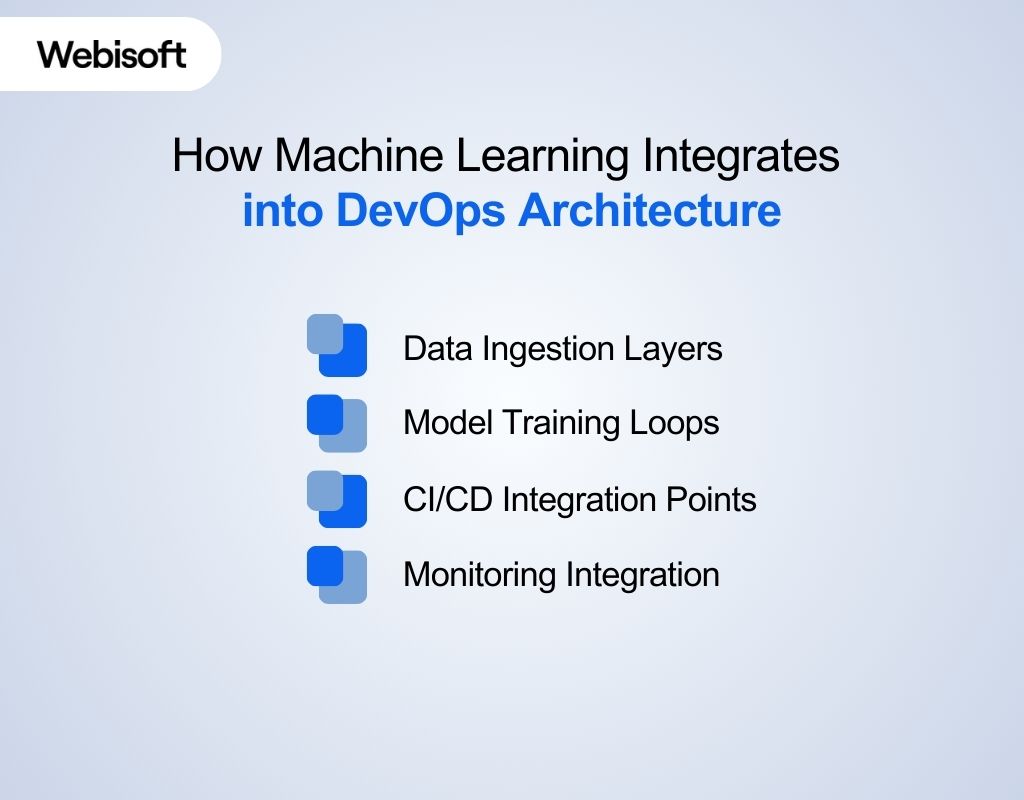
Machine learning in DevOps integrates directly into the structural layers of the DevOps stack rather than operating as a separate system. The integration occurs across data pipelines, model lifecycle processes, and execution workflows inside delivery and monitoring tools. Here’s how:
Data Ingestion Layers
DevOps environments continuously generate logs, metrics, traces, deployment records, and infrastructure telemetry. These data streams are routed into ingestion pipelines where they are cleaned, structured, and stored. This layer standardizes raw operational signals into datasets that can be consumed by machine learning models.
Model Training Loops
Collected operational data feeds into training workflows. Models are trained using historical build results, incident records, system metrics, and usage trends. Retraining cycles are scheduled or triggered based on new data availability, ensuring models remain aligned with evolving system behavior.
CI/CD Integration Points
Machine learning models connect to CI/CD systems through APIs or pipeline stages. Build metadata, test outcomes, and deployment statistics are exposed to model services, allowing pipeline components to reference model outputs during execution without altering core automation logic.
Monitoring Integration
Monitoring platforms interface with trained models by streaming live telemetry into inference endpoints. Model outputs are surfaced within observability dashboards or alert management systems, enabling DevOps tools to incorporate learned evaluation alongside existing monitoring frameworks.
What Changes When Machine Learning Is Applied in DevOps
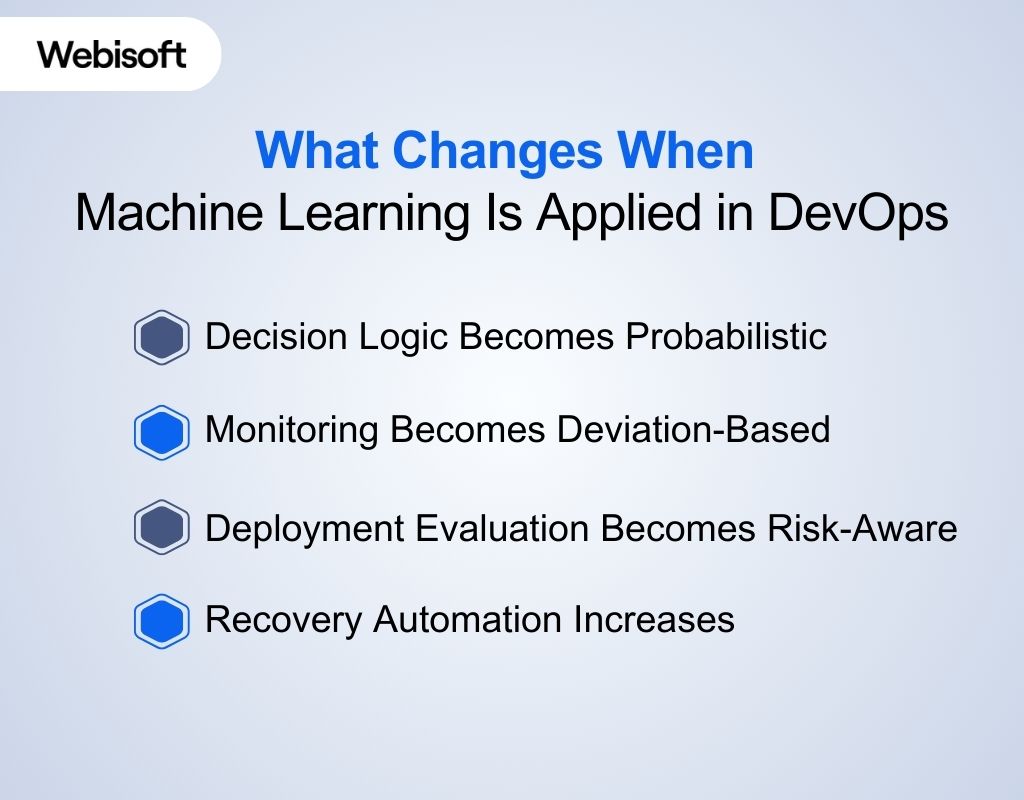
When machine learning in DevOps is active, day-to-day operations stop relying only on fixed rules and static thresholds. As a result, you’ll notice the following behavioural changes in the workflow:
Decision Logic Becomes Probabilistic
Instead of treating every event as a yes-or-no trigger, workflows begin using confidence and risk levels. Actions are guided by probability scores, which makes operational decisions more nuanced than simple rule execution.
Monitoring Becomes Deviation-Based
Traditional monitoring asks, “Did a metric cross a limit?” With learned baselines, monitoring asks, “Is the system behaving unusually right now?” This shifts detection from hard thresholds to behavior deviation, helping surface problems that don’t immediately break predefined limits.
Deployment Evaluation Becomes Risk-Aware
Releases are no longer evaluated as equal. Deployment workflows begin separating low-risk and high-risk changes based on historical patterns. Validation and release control becomes more selective, improving release discipline without slowing every deployment.
Recovery Automation Increases
Repeatable incidents can trigger predefined recovery actions with less human intervention. Engineers spend less time executing routine fixes and more time supervising system health, escalation rules, and operational guardrails.
Tools Used in Machine Learning DevOps
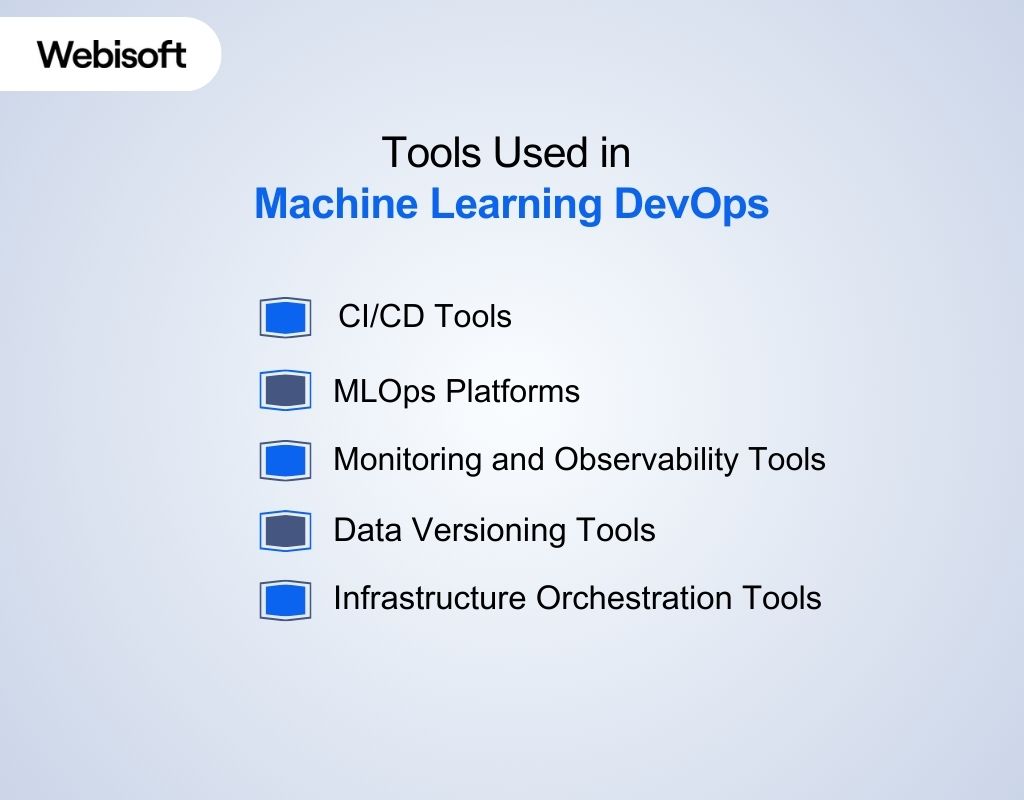
ML in DevOps depends on a layered toolchain that supports automation, model lifecycle management, observability, and infrastructure control. Each category plays a specific role in enabling intelligent delivery workflows.
CI/CD Tools
CI/CD tools expose build logs, test results, deployment metadata, and rollback history that serve as training signals for models embedded in delivery pipelines. They also provide execution stages where model evaluation or risk scoring can be inserted before release approval. This allows ML outputs to influence pipeline decisions without replacing existing automation.
MLOps Platforms
MLOps platforms manage model artifacts, retraining cycles, and deployment of inference services. This layer ensures that models influencing operational workflows are version-controlled, reproducible, and consistently deployed across environments.
Monitoring and Observability Tools
Observability systems stream real-time telemetry into model inference services. Logs and metrics collected from applications and infrastructure are processed as live inputs, enabling ML-driven anomaly detection within operational monitoring stacks. These tools also surface model outputs alongside system metrics for unified visibility.
Data Versioning Tools
Machine learning models require stable, traceable datasets. Data versioning tools track dataset changes used for training and retraining within DevOps environments. This ensures that any model-driven operational decision can be traced back to the exact data state that produced it.
Infrastructure Orchestration Tools
Infrastructure orchestration platforms host model training jobs, inference services, and CI/CD workloads. They enable scalable compute allocation required for infrastructure optimization using ML, ensuring that model services and delivery pipelines scale in alignment with system demand.
Business Impact of Machine Learning in DevOps
When you implement machine learning in DevOps correctly, the impact shows up in measurable operational and financial metrics. This is not a theoretical improvement. It directly affects uptime, recovery speed, release stability, and cost structure.
- Reduced downtime: Early detection prevents minor performance issues from escalating into full outages, protecting uptime and user experience.
- Lower MTTR: Incident resolution accelerates, shrinking recovery windows and reducing service disruption.
- Improved deployment success rate: Release outcomes become more predictable, especially through CI CD optimization using machine learning, reducing rollback frequency and production instability.
- Infrastructure cost optimization: Cloud spending becomes more predictable by reducing unnecessary overprovisioning.
- Developer productivity gains: Engineers spend less time firefighting and more time delivering new features.
- Higher system reliability: System performance remains consistent under fluctuating workloads and traffic conditions.
How Machine Learning Changes DevOps Team Structure
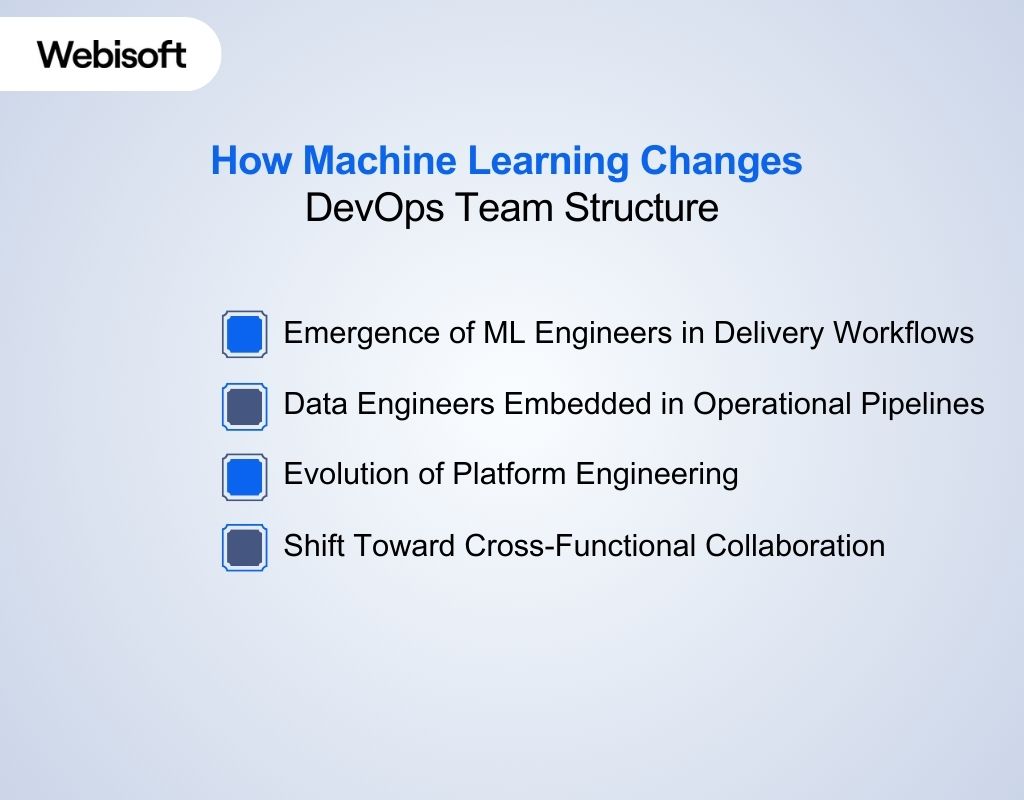
As machine learning in DevOps matures, the impact goes beyond tools and pipelines. It reshapes how teams are structured, how responsibilities are divided, and how collaboration happens across engineering functions.
Emergence of ML Engineers in Delivery Workflows
DevOps teams increasingly work alongside machine learning engineers who specialize in model design, validation, and performance monitoring. These professionals are not separate from delivery operations. They integrate directly into release workflows to support DevOps automation with machine learning, ensuring predictive systems remain reliable in production environments.
Data Engineers Embedded in Operational Pipelines
Operational data becomes a strategic asset. As a result, data engineers play a larger role inside DevOps ecosystems. They design ingestion pipelines, manage feature preparation, and maintain data quality standards that directly influence model accuracy and delivery stability.
Evolution of Platform Engineering
Platform teams expand their responsibilities to support model hosting, retraining infrastructure, and inference endpoints. The internal developer platform begins supporting both application delivery and machine learning lifecycle management within the same operational framework.
Shift Toward Cross-Functional Collaboration
The boundary between development, operations, and data teams becomes less rigid. Collaboration models evolve toward shared ownership of automation, telemetry, and decision systems. DevOps no longer operates in isolation. It becomes a convergence point between infrastructure engineering and applied machine intelligence.
Key Use Cases of Machine Learning in DevOps
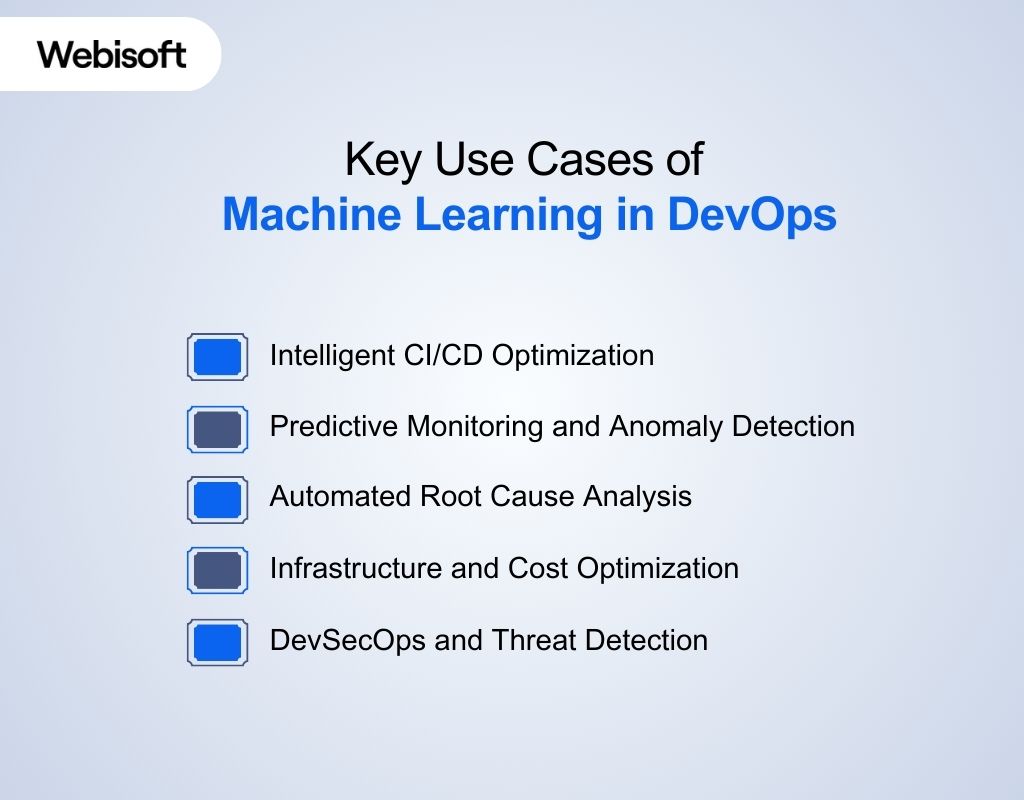
Machine learning changes how pipelines, monitoring systems, and infrastructure behave in real production environments. Below are the practical areas where it delivers measurable operational impact:
Intelligent CI/CD Optimization
Machine learning in DevOps evaluates commit metadata, historical test outcomes, and build duration patterns to optimize validation strategy. Instead of executing test suites uniformly, models prioritize components with higher historical defect density. This improves pipeline efficiency without weakening quality gates.
Predictive Monitoring and Anomaly Detection
Operational metrics such as latency, memory usage, and request throughput are modeled to establish statistical baselines. Through predictive monitoring in DevOps, systems detect deviations based on variance and distribution shifts rather than fixed thresholds. This improves early detection of irregular system behavior.
Automated Root Cause Analysis
Incident data, logs, and traces are clustered using similarity scoring techniques. Machine learning in DevOps identifies recurring failure signatures by comparing new events against historical incident datasets. This narrows investigation scope and reduces manual log correlation effort.
Infrastructure and Cost Optimization
Workload metrics and seasonal usage data feed forecasting models that guide capacity planning. Through infrastructure optimization using ML, scaling decisions are based on predicted demand curves rather than reactive triggers. This stabilizes performance while reducing excess resource allocation.
DevSecOps and Threat Detection
Access logs, API calls, and network activity patterns are analyzed to detect abnormal behavior profiles. Machine learning in DevOps classifies anomalies using probabilistic models, enabling earlier identification of suspicious activity without relying solely on static security rules.
Machine Learning in DevOps vs MLOps
Many teams confuse ML in DevOps with broader model lifecycle management practices. The distinction matters. One focuses on improving software delivery using predictive intelligence. The other focuses on managing the lifecycle of machine learning models themselves. Understanding DevOps vs MLOps helps clarify where each discipline operates and why they are not interchangeable:
| Aspect | Machine Learning in DevOps | MLOps |
|---|---|---|
| Primary Goal | Improve software delivery and operations using ML insights | Manage end-to-end lifecycle of ML models |
| Focus Area | CI/CD pipelines, monitoring, infrastructure optimization | Model training, validation, deployment, governance |
| Data Usage | Uses operational telemetry from DevOps workflows | Uses datasets for training and retraining models |
| Integration Point | Embedded into delivery and monitoring systems | Embedded into ML experimentation and production workflows |
| Ownership | DevOps and platform engineering teams | Data science and ML engineering teams |
| Outcome | More adaptive and risk-aware delivery processes | Reproducible, scalable, and governed model deployment |
In short, machine learning in DevOps enhances operational decision-making inside delivery pipelines, while MLOps ensures machine learning models are built, deployed, and maintained correctly.
Skills Required for Machine Learning in DevOps
Implementing machine learning in DevOps requires a blend of automation expertise and data literacy. A DevOps engineer with machine learning skills must understand both pipeline mechanics and how models influence operational decisions.
- Strong CI/CD expertise: Ability to design, maintain, and optimize automated build and deployment pipelines.
- Infrastructure as Code proficiency: Experience with tools like Terraform or CloudFormation to manage scalable environments programmatically.
- Data handling and preprocessing knowledge: Understanding how logs, metrics, and telemetry can be structured and prepared for model training.
- Basic machine learning fundamentals: Familiarity with supervised learning, anomaly detection, model evaluation, and performance metrics.
- Model deployment and integration skills: Capability to integrate inference services into CI/CD workflows and monitoring systems.
- Observability and monitoring expertise: Ability to interpret telemetry, track model outputs, and maintain visibility across environments.
- Scripting and automation fluency: Strong command of languages like Python or Bash to automate workflows and integrate ML components.
It means you need someone skilled to implement ML in DevOps. If you want to introduce machine learning in your DevOps team, contact machine learning experts at Webisoft today!
Risks and Limitations of Machine Learning in DevOps
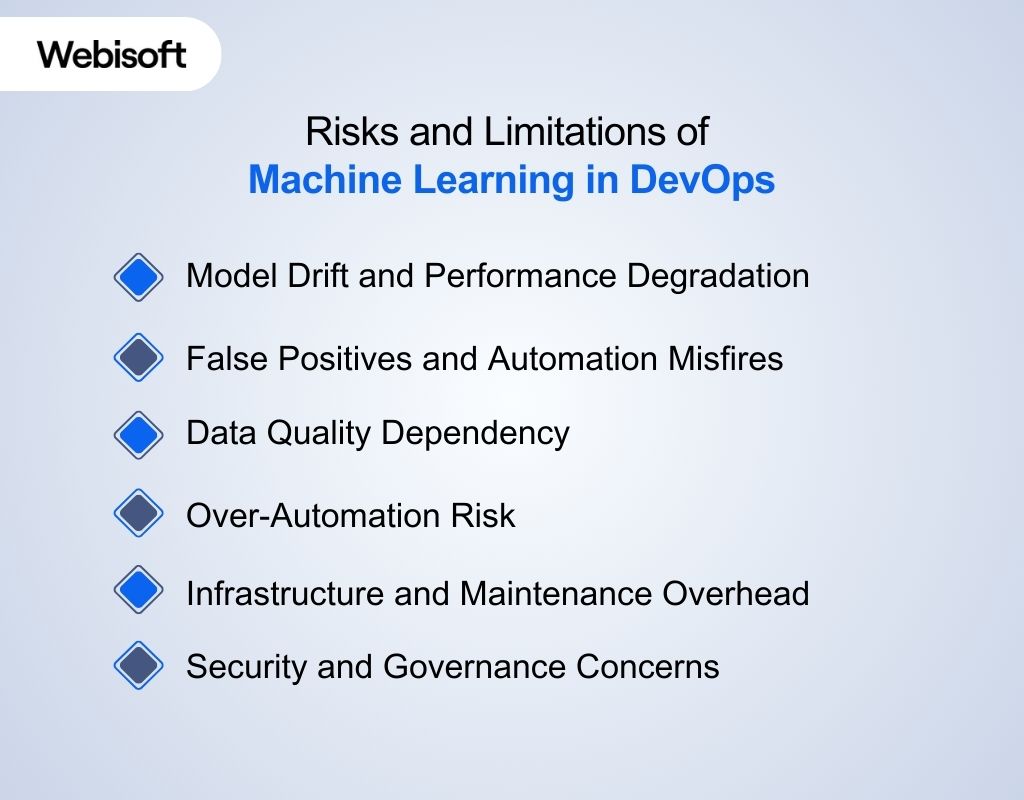
Machine learning in DevOps improves operational intelligence, but it also introduces new points of failure. Model-driven systems are not automatically reliable. They require governance, monitoring, and disciplined oversight.
Model Drift and Performance Degradation
Operational environments change constantly. Traffic patterns shift, services evolve, and deployment strategies adjust. Over time, models trained on historical data may lose accuracy. If drift goes unnoticed, decisions become less reliable while appearing technically valid.
False Positives and Automation Misfires
Anomaly detection is probabilistic. That means it can be wrong. Incorrect signals may trigger unnecessary rollbacks or alert storms. Poorly tuned models can reintroduce instability instead of reducing it.
Data Quality Dependency
Machine learning systems depend entirely on telemetry quality. Incomplete logs, inconsistent metrics, or biased historical data can produce misleading outputs. Weak data pipelines weaken model decisions.
Over-Automation Risk
As automation becomes more adaptive, teams may reduce manual oversight. Excessive reliance on automated remediation can delay escalation during unfamiliar failure scenarios.
Infrastructure and Maintenance Overhead
Model retraining, storage, monitoring, and inference services add operational overhead. Machine learning systems require their own lifecycle management alongside DevOps workflows.
Security and Governance Concerns
Model endpoints and data pipelines expand the attack surface. Without proper governance, model decisions may lack traceability and audit transparency.
Where Machine Learning in DevOps Is Headed
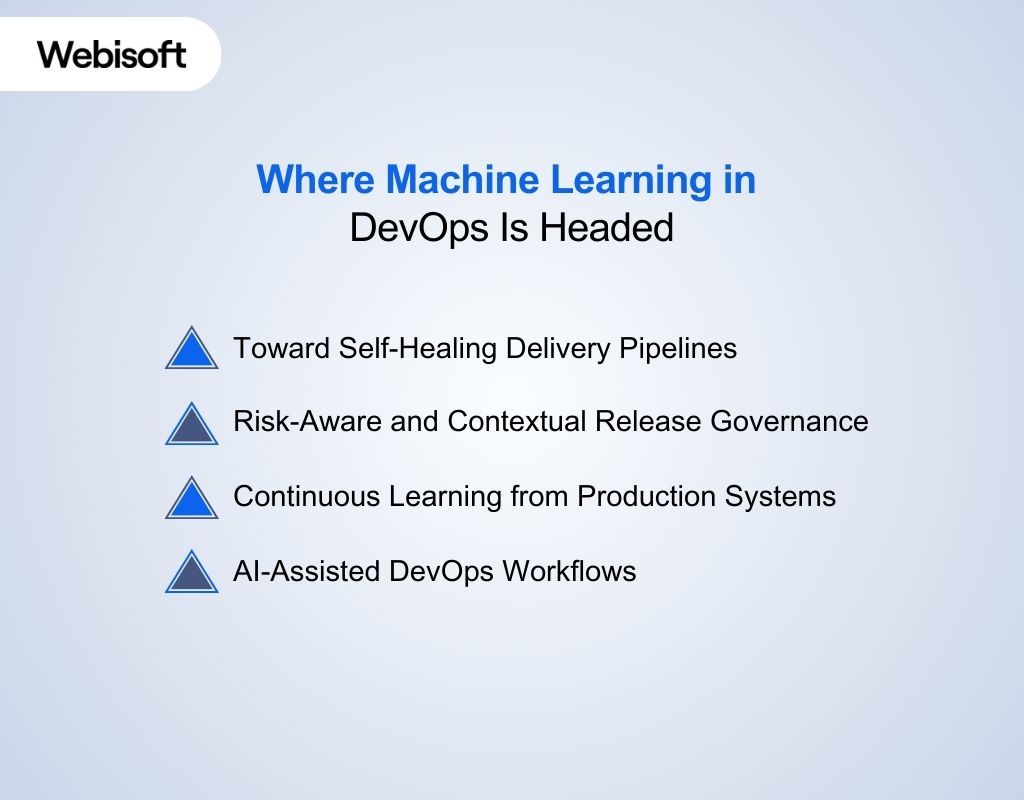
Machine learning in DevOps is still evolving. Most teams today use it for anomaly detection, deployment risk analysis, and operational insights. The next phase will focus less on isolated optimizations and more on coordinated intelligence across the entire delivery lifecycle.
Toward Self-Healing Delivery Pipelines
Current automation handles predefined failure scenarios. The next stage moves toward pipelines that learn from past incidents and adjust remediation strategies dynamically. Instead of executing the same rollback script every time, systems will adapt recovery actions based on historical resolution patterns.
Risk-Aware and Contextual Release Governance
Release decisions will increasingly factor in contextual signals such as traffic conditions, recent incident history, and infrastructure load. Governance will shift from static approval gates to dynamic release control informed by learned risk patterns.
Continuous Learning from Production Systems
Operational data will feed ongoing retraining cycles. Deployment environments will not remain static. As production systems evolve, models will refine decision support continuously, allowing delivery processes to mature over time.
AI-Assisted DevOps Workflows
Engineers will rely more on intelligent assistance within pipelines and monitoring systems. Rather than replacing human judgment, AI will provide risk scoring, alert prioritization, and remediation suggestions that accelerate operational decisions.
How Webisoft Delivers Machine Learning in DevOps Solutions
When machine learning in DevOps moves from theory to production, execution discipline becomes everything. Most teams struggle not with ideas, but with safe integration, model governance, and architectural alignment.
That’s where Webisoft steps in. We don’t just experiment with intelligent automation. We engineer production-ready systems that align predictive intelligence with real-world DevOps environments. Here’s what you gain by choosing Webisoft:
- Strategic DevOps–ML Integration: We identify secure integration points within your CI/CD pipelines and operational workflows to embed predictive intelligence without disrupting stability.
- Production-Grade Data Pipelines: We design structured ingestion and feature engineering workflows that convert operational telemetry into reliable training signals.
- Model Validation and Governance Controls: We implement validation layers, drift monitoring, and controlled retraining cycles to maintain model reliability in evolving environments.
- Risk-Aware Deployment Enablement: We integrate model-driven evaluation stages inside release pipelines to strengthen deployment confidence.
- Scalable Infrastructure Architecture: Our team ensures your infrastructure supports model inference, retraining, and delivery orchestration without performance limitations.
- Long-Term Operational Stability: We build solutions that enhance DevOps resilience rather than introduce experimental risk.
Machine learning in DevOps requires engineering precision, not experimentation. Webisoft delivers intelligent systems designed for performance, reliability, and measurable operational impact.
Conclusion
In conclusion, machine learning in DevOps strengthens modern software delivery by turning static automation into adaptive operational intelligence. It enhances deployment stability, monitoring precision, infrastructure efficiency, and risk evaluation without replacing existing DevOps foundations.
As systems grow more complex, predictive decision-making becomes essential rather than optional. Organizations that integrate machine learning into their DevOps workflows position themselves for more resilient, scalable, and performance-driven engineering outcomes.
FAQs
Here are some commonly asked questions by people regarding machine learning in DevOps:
It doesn’t always require massive datasets. Consistent logs, build histories, and monitoring metrics are often enough. Data quality, structure, and continuity matter more than raw volume for meaningful operational insights.
Yes, small teams can adopt machine learning in DevOps gradually. Starting with targeted use cases like anomaly detection or deployment risk scoring allows controlled experimentation without large infrastructure investments.
Implementation timelines vary based on CI/CD maturity and data readiness. Basic predictive integrations can be introduced incrementally, while deeper architectural embedding may require multiple development cycles and structured planning.