
The security team of your company is not struggling to find alerts but they are unsure about which alert matters the most. When all your tools are firing at once, rule-based detection can turn into constant reactive work. And attackers will take this chance to slip through your system. That’s where machine learning in cyber security helps. It learns from real activity in your environment, builds a baseline of normal behavior, and flags patterns that look off. It’s useful for catching threat variants and spotting behavior-based risk. Want to know about the working process of ML in cyber security, its benefits and learning methods? You’ll get all the answers here, so you know what to expect before you invest in it.
What Is Machine Learning in Cyber Security?
Machine learning in cyber security is the application of artificial intelligence algorithms that enable computer systems to automatically learn from data and improve threat detection without explicit programming. Essentially, it teaches computers to recognize patterns in network traffic, user behavior, and system activities to identify potential security risks. Machine learning in cyber security works by training models on historical data to distinguish between normal and malicious activities. These models analyze millions of data points from login attempts to file transfers learning what constitutes typical behavior versus suspicious anomalies. The technology encompasses various techniques, including supervised learning for known threat classification, unsupervised learning for discovering new attack patterns, and deep learning for complex threat analysis, fundamentally transforming how organizations defend against cyber threats.
Rule-Based Security vs Machine Learning vs AI in Cyber Security
Rule-based security is the old reliable that functions on pre-set commands. It works best when the signal is clear and already known. But if attackers change tiny details all the time, you’ll need to add new rules to cover every case. However, with machine learning in cyber security, you add fewer and lean more on behavior models. It can still flag suspicious activity even when the attack does not look identical. Now, in cyber security, “AI” often means one of two things:
- ML models doing detection and scoring
- Assistants and automation that help triage, summarize, and trigger response steps
So, it means that ML is a key subset in cybersecurity and artificial intelligence. Here’s a comparison table to breakdown the differences in a more understandable way:
| Factors | Rule-based detection | Machine learning | AI in cybersecurity |
|---|---|---|---|
| What it runs on | Human-written rules | Data-trained models | A broad label that often includes ML plus automation and assistants |
| Best at | Known bad and policy violations | Behavior patterns and variants | Speeding up triage and response work, sometimes with ML signals |
| Main weakness | Breaks when attackers change details | Can drift if “normal” changes | Can sound confident while being wrong if it lacks good evidence |
| Typical output | Alert or block | Risk score, anomaly flag, grouped events | Summaries, recommended actions, playbook triggers |
If you’re looking for an expert developer for AI ML development service, Webisoft can be your trusted and reliable partner.
Benefits of Machine Learning in Cyber Security: What It Fixes and What You Gain
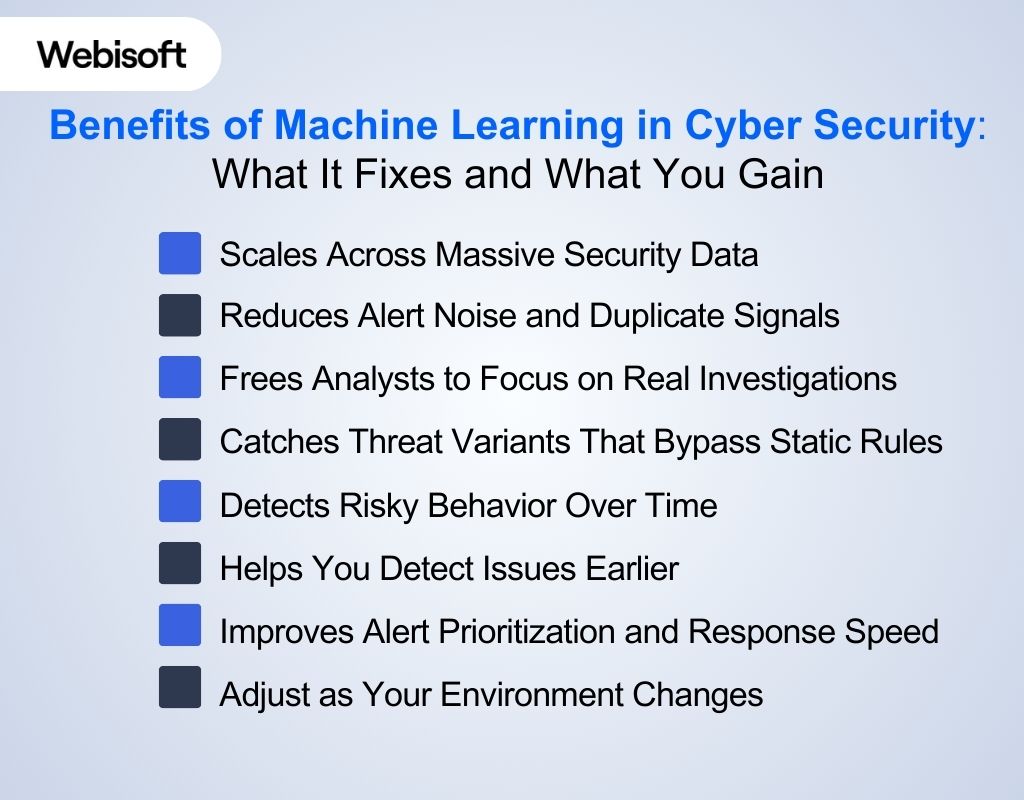
If you’ve ever looked at a security dashboard, you know the feeling of anxiety. Alerts keep coming, and most of them lead nowhere. Machine learning helps you sort that noise faster. Here are benefits of ML in cyber security:
Scales Across Massive Security Data
Cloud apps, remote access, APIs, and SaaS tools generate nonstop logs. ML systems can process that volume faster than manual review or basic filters, so you get clearer visibility instead of drowning in raw events.
Reduces Alert Noise and Duplicate Signals
A SOC (Security Operations Center) can get thousands of alerts in a day. Many are repeats or low value. ML can group related events, spot patterns across them, and push the most suspicious activity to the top.
Frees Analysts to Focus on Real Investigations
Good analysts move fast, but they still get overloaded. ML handles repetitive pattern checks and initial triage, so your team spends more time validating real threats and less time chasing junk.
Catches Threat Variants That Bypass Static Rules
Rules and signatures work for known attacks. But attackers tweak tools, timing, and infrastructure to slip past them. ML is better at spotting suspicious behavior even when the exact indicator changes.
Detects Risky Behavior Over Time
Instead of hunting for one “known bad” signal, ML watches behavior trends. It can notice odd login chains, unusual access paths, or slow data pulls that look normal in isolation.
Helps You Detect Issues Earlier
Many incidents get worse because attackers stay hidden. ML can flag suspicious activity earlier in the chain, which gives you a chance to respond before damage spreads.
Improves Alert Prioritization and Response Speed
Not every alert deserves the same urgency. ML can score events by risk, so analysts start with the highest-impact cases first.
Adjust as Your Environment Changes
New employees, new apps, and new workflows show up constantly. ML models adapt to shifting “normal” behavior through ongoing monitoring, threshold tuning, and periodic retraining. These are processes that require active oversight rather than happening fully automatically.
How Machine Learning Works in Cyber Security (Step by Step)
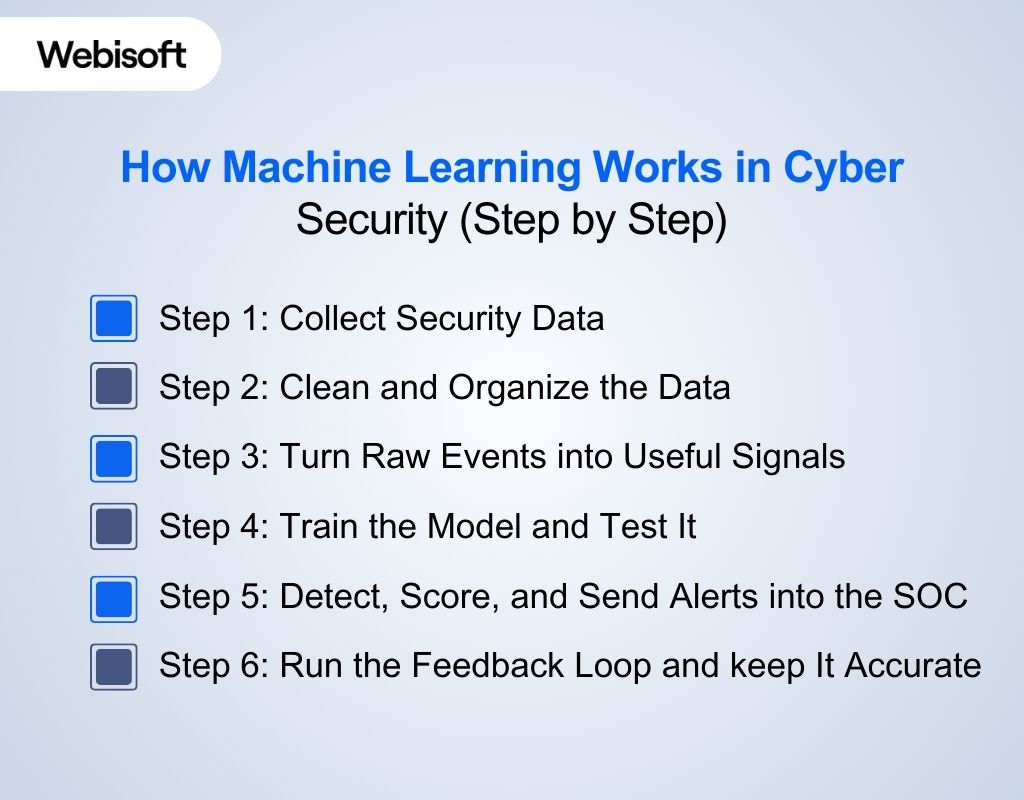
Machine learning works in a repeatable process that turns everyday security activity into a risk signal your team can act on. Here is the step-by-step working process of machine learning in cyber security:
Step 1: Collect Security Data
Everything starts with telemetry. You pull identity logs, endpoint events, email signals, cloud activity, and network traffic. ML in network security often depends on flow logs, proxy logs, firewall logs, and DNS patterns. Some data is structured, like “user, IP, time.” Other data is unstructured, like an email body or a command line string.
Step 2: Clean and Organize the Data
After collecting data, the system organizes them. Duplicate events, missing fields, and inconsistent timestamps can create fake “anomalies.” If your data is messy, the model learns the wrong lessons.
Step 3: Turn Raw Events into Useful Signals
Raw logs are not useful on their own. So you convert them into signals the model can measure. For example, “failed logins per hour,” “new device logins,” “files touched in five minutes,” or “bytes sent to an unfamiliar domain.” Once you do that, the model is not reading raw text logs anymore. It is comparing behavior patterns across time and users.
Step 4: Train the Model and Test It
Training means the model studies past data and learns patterns. Testing checks whether it works on data it has not seen before. You will usually use supervised and unsupervised learning in cyber security depending on the problem. Supervised learning uses labeled examples like “phishing” vs “not phishing.” Unsupervised learning learns a baseline first, then flags unusual behavior.
Step 5: Detect, Score, and Send Alerts into the SOC
Once live, the model scores new activity in near real time. Outputs are usually a risk score, an anomaly flag, or a cluster of related events. When a threshold is crossed, an alert is created. Then it needs to land in the tools your team uses, like a SIEM or case system. An analyst triages it, pulls context, and decides if it is real. If it is, they act, like killing a session, isolating a host, or opening an incident.
Step 6: Run the Feedback Loop and keep It Accurate
Your environment changes, and attackers shift tactics. Without monitoring, you get model drift, rising false alerts, and blind spots. So you review outcomes, tune thresholds, retrain when needed, and track what the model misses. That ongoing maintenance is what keeps machine learning in cyber security reliable instead of noisy. Without this loop, detections drift and trust drops.
What “Patterns” Mean in Cyber Security
When people say “patterns,” they usually mean one simple thing. A repeated behavior that shows up in your data. In security, that behavior can be normal, suspicious, or somewhere in between. Such as:
Behavioral Patterns
This is about how users and systems normally act. For example, maybe your finance lead logs in from the same city, uses the same laptop, and checks the same tools each morning. That is a pattern. If that same account suddenly starts pulling a huge number of files at 2 a.m., the pattern changes.
Statistical Anomalies
These patterns are about numbers that jump outside a typical range. It can be a spike in failed logins, a sudden burst of outbound traffic, or a user hitting systems they never touched before. This is where anomaly detection in cyber security is useful. It helps surface activity that is rare in your environment, even if it is not on a known blocklist.
Timing and Sequence Patterns
When there is an issue with order of events, the system detects this pattern. The situation for this pattern can include a password reset, then a new device login, then an admin permission change, then a large download. That chain is a pattern of machine learning worth attention. Here are simple log-style examples so you can picture it:
Normal behavior
- 09:05 login_success user=emma ip=NY device=known
- 09:12 access_app app=invoice-tool
- 09:20 download file_count=3
Suspicious behavior
- 02:14 login_success user=emma ip=RU device=new
- 02:16 privilege_change user=emma role=admin
- 02:20 download file_count=480
- 02:23 outbound_transfer bytes=2.1GB destination=unknown
Where Machine Learning Gets Its Data in Cyber Security
Machine learning only works as well as the data you feed it. In security, that data is mostly telemetry. It is the trail of actions happening across your systems all day. Besides telemetry, there are other sources too. For example:
-
Network Telemetry
This comes from firewalls, proxies, VPNs, and flow logs. You see who talked to whom, when, and how much data moved. It helps spot unusual destinations, strange traffic spikes, and repeated beacon-like connections.
-
Endpoint Activity
Endpoints show what actually ran on a device. Process launches, command lines, file writes, registry edits. If malware hits, the endpoint usually tells the story first.
-
Identity and Access Logs
These logs track logins, MFA prompts, session changes, and privilege updates. They are key for spotting account takeover and risky access patterns, especially in cloud-heavy orgs.
-
Email Data
Headers, sender reputation, links, attachment signals, and message content. Email is still a top entry point, so these signals matter.
-
Cloud and SaaS Audit Logs
CloudTrail, Azure logs, Google Workspace, Okta, M365. You see actions like new keys created, permissions changed, unusual downloads, and odd admin behavior.
-
DNS Behavior
DNS logs show what domains users and systems try to reach. This helps catch new domains, suspicious lookups, and automated domain patterns that do not look human.
Machine Learning Methods in Cyber Security: Techniques and Algorithms Explained
When people talk about ML in security, they often mix up techniques and algorithms. Techniques are the job you want done. Algorithms are the engines that do the job. Both work in different ways, such as:
Common Techniques and What They Do
Classification
- Data: Emails, files, URLs, login events.
- Outcome: A clean decision like “malicious” or “safe.” This is one of the most common applications of machine learning in cyber security because it fits problems like phishing detection and malware scoring.
Clustering
- Data: Alerts, endpoint events, authentication logs.
- Outcome: Grouping similar events so you can see one incident instead of 300 alerts. This is great for triage when your SOC is buried.
Anomaly detection
- Data: Login activity, access behavior, traffic volumes.
- Outcome: Flagging behavior that does not match the usual baseline. It is useful when you do not have labels for every threat.
NLP
- Data: Email text, ticket notes, threat reports, URL strings.
- Outcome: Spotting risky language in phishing emails, extracting indicators from reports, or detecting weird URL patterns.
Graph ML
- Data: Relationships between users, devices, IPs, domains, and apps.
- Outcome: Catching suspicious chains, like one compromised account touching many systems quickly. It helps when a single event looks harmless, but the connections tell a different story.
Time-series models
- Data: Activity over time like DNS lookups, outbound traffic, login frequency.
- Outcome: Detecting spikes, slow data exfiltration patterns, or repeated beacon behavior.
Common Algorithms behind Those Techniques
Now the engines. These are the machine learning algorithms in cyber security that show up often because they work well on security data.
- Decision trees and random forests: Great for structured data like login fields and event metadata. They are also easier to interpret than many deep models.
- Linear models and similar simple classifiers: Useful for fast scoring at scale, especially when you need speed and transparency.
- Neural networks: Often used when data is complex, like text, files, or high-volume behavioral signals. Keep expectations realistic though. They still need good data and careful tuning.
Practical Use Cases of Machine Learning in Cyber Security
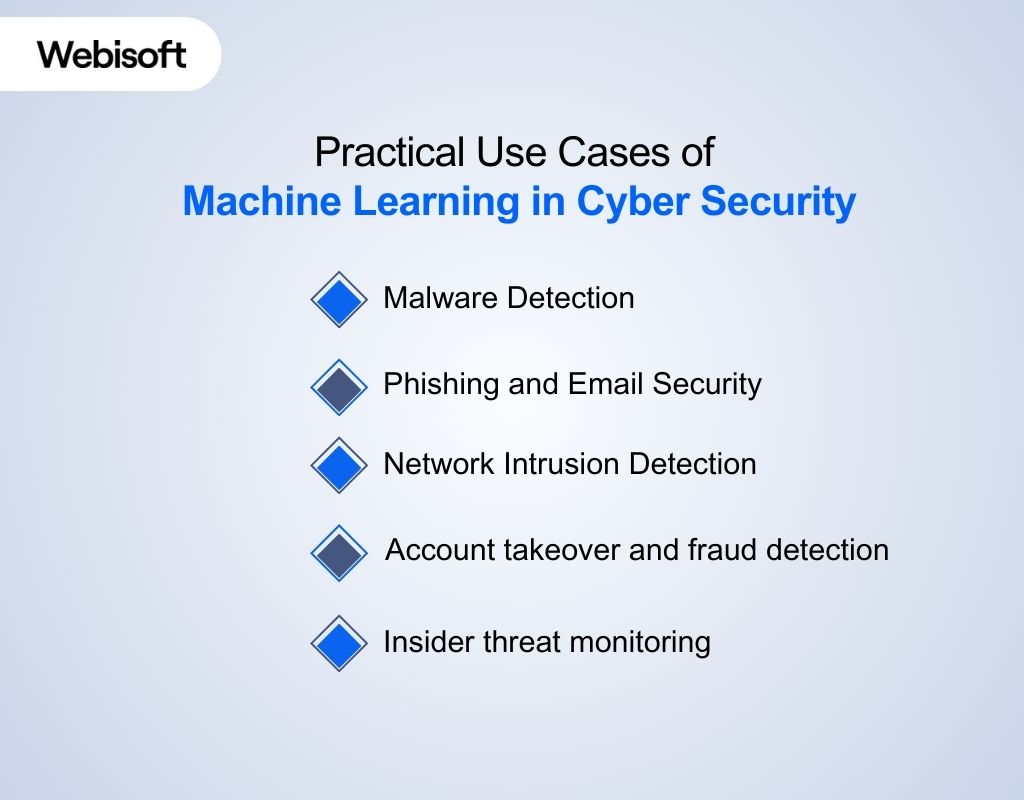
Here are the most common use cases, with the data they rely on, the pattern they look for, and what the model typically outputs:
Malware Detection
Data source:
Endpoint telemetry like process launches, command lines, file writes, DLL loads, registry changes, and sometimes file metadata or sandbox behavior.
Pattern detected:
Malware rarely announces itself with one obvious event. The pattern is usually a chain, like a document spawning PowerShell, PowerShell reaching out to a new domain, then a process injecting into another process, followed by suspicious file writes. Even if the file hash is new and unknown, the behavior can still look wrong.
Model output:
- A risk score for the file or process
- A “malicious vs benign” label
- A grouped incident timeline that links related events
What this means for your team:
You can catch malware variants that do not match an existing signature, and you can prioritize the endpoint that shows the strongest malicious behavior.
Phishing and Email Security
Data source:
Email headers, sender reputation signals, domain age data, link features, attachment attributes, and message content. NLP can also be used on the email text.
Pattern detected:
Phishing often follows familiar patterns, like urgent language, impersonation cues, odd sender domains, mismatched display name and domain, lookalike URLs, or attachments that behave like droppers. Some emails look clean at first glance, but a combination of weak signals adds up.
Model output:
- A phishing probability score
- URL or attachment risk scoring
- Auto-tagging for quarantine or extra review
What this means for your team:
You stop relying only on blocklists and keyword rules, which attackers can sidestep. Instead, you get scoring based on multiple signals that reflect how real phishing campaigns operate.
Network Intrusion Detection
Data source:
Network telemetry such as NetFlow, firewall logs, proxy logs, DNS logs, and sometimes packet metadata. This often includes destination IPs, ports, byte counts, timing patterns, and domain lookups.
Pattern detected:
Intrusions tend to produce patterns like lateral movement, repeated scanning, unusual east-west traffic, repeated beaconing to a command-and-control host, or data moving out in odd bursts.
Model output:
- Anomaly flags for suspicious flows
- Risk scoring for a host or session
- Clusters that group related connections into one story
What this means for your team:
Instead of hundreds of disconnected alerts, you can see a network narrative. This is especially useful for catching slow-moving attackers who avoid obvious spikes.
Account takeover and fraud detection
Data source:
Authentication logs, MFA events, device fingerprints, session behavior, IP and location patterns, privilege changes, and application access logs.
Pattern detected:
Account takeover typically looks like a behavioral shift. A new device appears. Login time changes. MFA prompts spike. The user accesses apps they never touch. Or you see impossible travel patterns, followed by high-risk actions like changing recovery settings or creating new API tokens.
Model output:
- A login risk score
- A “likely compromised” classification
- Step-up authentication triggers or alert recommendations
What this means for your team:
You can react before damage happens. For example, you can force re-authentication, lock a session, or prioritize that user in the SOC queue.
Insider threat monitoring
Data source:
File access logs, DLP signals, endpoint activity, cloud storage audits, identity logs, and sometimes HR-driven context like role changes or offboarding status.
Pattern detected:
Insider risk is hard because many actions are technically allowed. The pattern detects a sudden increase in sensitive file reads, mass downloads, access to unusual folders, new external sharing behavior, or repeated attempts to bypass controls.
Model output:
- Anomaly detection alerts on user behavior
- Risk scoring for a user or department
- Event clustering that shows a suspicious sequence over time
What this means for your team:
You can focus on high-risk behavior without accusing everyone. The goal is early signal and careful review, not automatic punishment.
Challenges of Machine Learning in Cyber Security
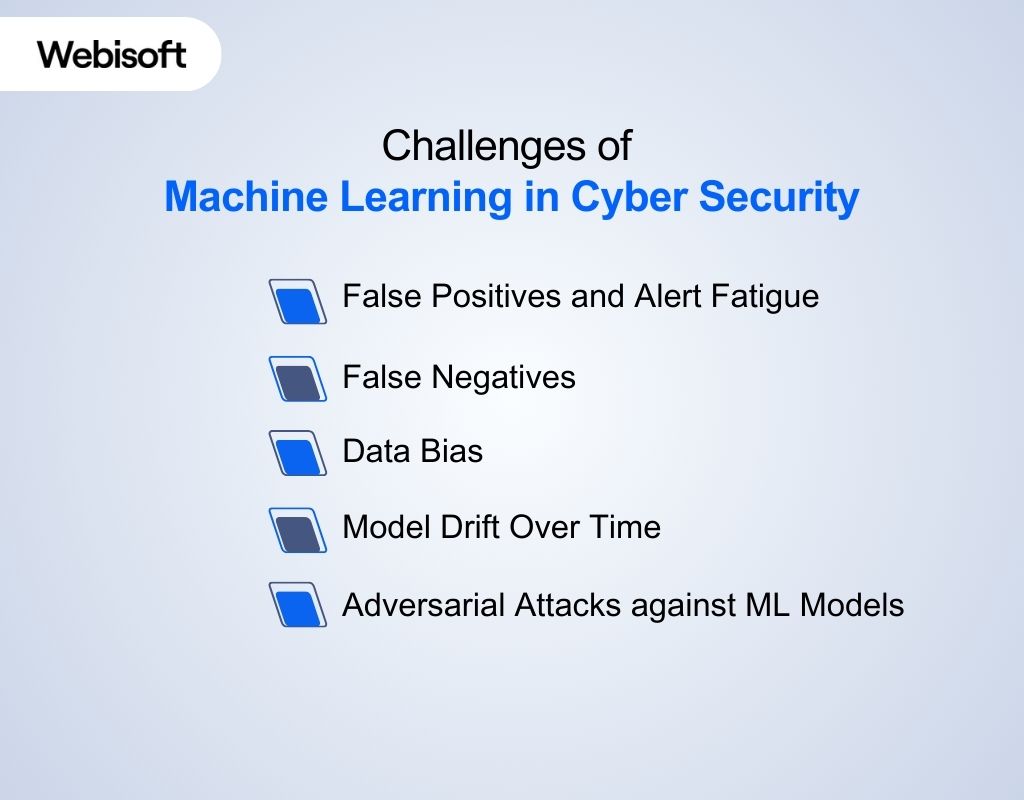
Machine learning can help a lot. But there are some common challenges. Consult with a company with machine learning cybersecurity certification to face them. These challenges are:
False Positives and Alert Fatigue
These happen when the model flags too many “maybe” threats. Normal changes can look suspicious, like a new tool rollout, a team working late, or a sudden spike in VPN usage. When analysts keep seeing low-quality alerts, trust drops fast, and real threats can get ignored.
False Negatives
False negatives are the flip side. A real attack gets missed because it blends into normal behavior, uses new tactics not in training data, or the model is tuned too tightly to reduce false positives.
Data Bias
It comes from uneven or messy data. If training data over-represents one department, region, or system type, the model learns a skewed “normal.” Bad labels make it worse. If older alerts were marked wrong, the model learns the wrong signals.
Model Drift Over Time
Model drift shows up as your environment changes. New apps, new users, new access patterns. Yesterday’s baseline stops matching today’s reality.
Adversarial Attacks against ML Models
These problems arise when attackers try to game the model, mimic normal behavior, or probe thresholds. In some cases, they can even poison the data the model learns from.
Who Needs Machine Learning in Cyber Security?
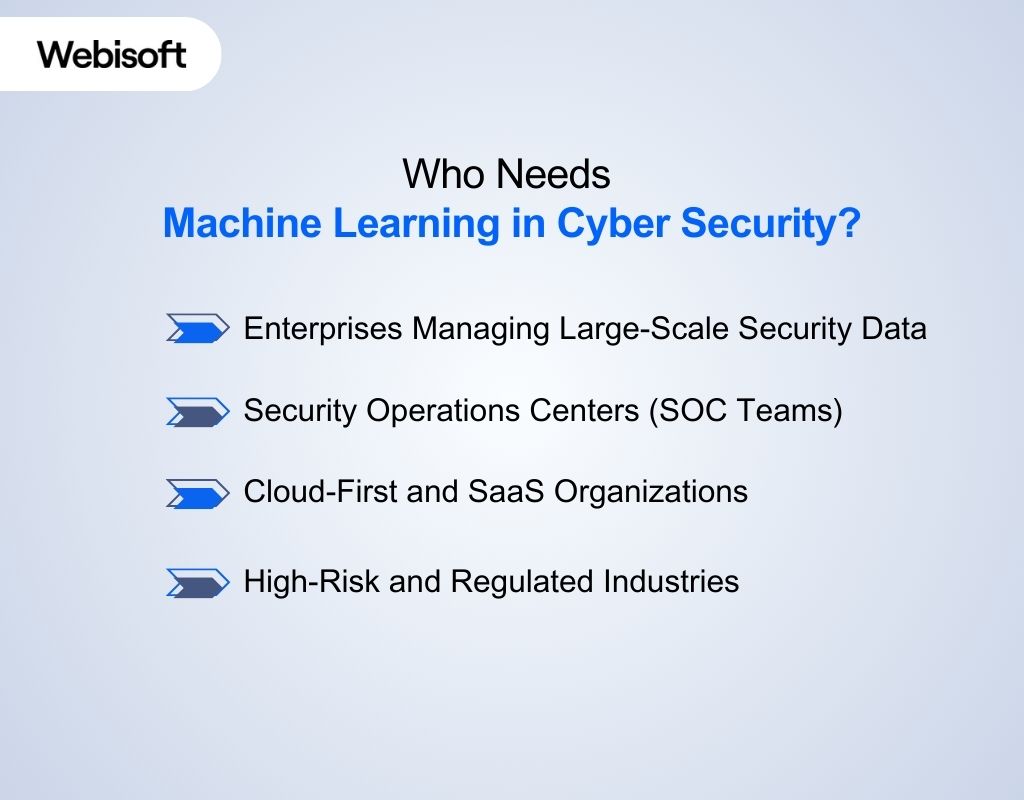
Not every company needs machine learning to stay safe. But if your environment is noisy, fast-changing, or high-risk, rules alone start to crack. That’s when machine learning becomes less of a nice-to-have and more of a practical tool. Here’s who needs ML in cyber security projects:
Enterprises Managing Large-Scale Security Data
If you generate mountains of logs, you already know the struggle. Alerts stack up, storage grows, and investigations slow down. ML helps you keep visibility when the volume gets out of hand. It can score activity across many systems at once, so your team is not stuck chasing every small spike. This matters even more in cloud and hybrid setups where behavior changes daily.
Security Operations Centers (SOC Teams)
SOC teams live in triage mode. The hard part is not finding alerts. ML helps by ranking alerts, grouping related events, and spotting patterns that show up across tools. That can save analyst time and reduce burnout. It also helps you move faster when something real hits.
Cloud-First and SaaS Organizations
Cloud and SaaS environments change quickly. New apps, new permissions, new devices, new access paths. Rules get outdated fast. ML fits well here because identity and access behavior tells the story. When an account starts acting off, the model can flag it even if the exact details have never shown up before.
High-Risk and Regulated Industries
Banks, healthcare, and critical infrastructure face higher stakes. A small miss can turn into big damage, plus compliance fallout. These orgs benefit from ML because it can spot early signs of fraud, account takeover, and unusual data access. It also helps teams prove they are watching for risky behavior, not just blocking known bad lists.
When Machine Learning Is Not the Right Choice
Before you invest in machine learning in cyber security, it helps to know when rules and basic monitoring are actually enough. Here are some cases when you can skip ML:
- Small or low-traffic environments: If you have few users and limited activity, simple rules and alerts often cover the real risks without added complexity.
- Static systems: If workflows rarely change, rule-based detection stays stable and easier to maintain than a model.
- Poor data quality: Missing fields, inconsistent logs, and messy timestamps create bad signals. The model learns noise and produces noisy alerts.
- Immature security operations: If you lack basic monitoring, response playbooks, and alert ownership, ML will not “fix” the program. It will add confusion.
- Why rules may be enough: Known bad indicators and clear policy violations are often better handled with direct rules.
How Webisoft Helps Organizations Apply Machine Learning in Cyber Security
Want to bring machine learning in cyber security into your company? Then you need a partner who understands your environment, your data, and how your security team actually works. Whether you want to build an AI product for security or develop machine learning into your current stack, Webisoft helps you move from an idea to a system your team can use. Here’s why Webisoft is a strong choice for you:
- Webisoft helps you cut alert noise and raise confidence, by tuning detections around signal quality instead of raw alert volume.
- They connect telemetry across cloud, identity, endpoints, and network sources, so your ML detections see the full attack path, not isolated events.
- Webisoft delivers the data engineering layer ML needs, building ingestion, normalization, storage, and access controls that keep security telemetry reliable and usable.
- Their service includes cleaning and standardizing messy logs, fixing duplicates, broken timestamps, and missing fields that create false anomalies.
- They build production-ready ML pipelines, turning raw events into features, scores, and clear outputs your security team can act on.
- Webisoft integrates ML outputs into your existing stack, including SIEM, EDR, case management, and SOAR, so analysts do not have to change tools.
- Their post service keeps models accurate over time, with monitoring, threshold tuning, and drift control as your environment and attacker tactics shift.
If you want to apply machine learning without guessing, contact Webisoft today and discuss your requirements to get started!
Conclusion
To sum up, machine learning in cyber security scales detection across massive logs, catching anomalies rules miss through pipelines like data → features → model → alerts → SOC workflow → feedback. It reduces noise for SOC teams but demands tuning to fight drift and false positives, which assists analysts. Ready to implement? Rely on Webisoft for expert ML-driven security pipelines and integration with precision.
FAQs
Here are some commonly asked questions regarding machine learning in cyber security:
If your logging is already solid, you can get early wins in weeks. If telemetry is fragmented, most time goes into data cleanup and integration before models help.
Start with identity logs, endpoint telemetry, and cloud audit logs. If those are consistent and time-synced, you can get value fast. Missing fields and bad timestamps create noisy detections.
Track false positives, true positives, time to triage, and missed incidents discovered later. Also watch analyst trust. If the team ignores alerts, the system is failing even if the model looks “accurate” on paper.
No. ML supports those systems. It helps with scoring, grouping, and surfacing suspicious behavior, but response still needs human judgment and strong operational workflow.