Machine learning in automotive industry means using data algorithms to help vehicles and factories learn from real-world inputs. These systems analyze sensor data, driving behavior, and production metrics to improve performance automatically. This technology improves road safety, reduces maintenance costs, and increases vehicle efficiency. Automakers also use it to speed up design testing and optimize battery performance in electric vehicles.
However, companies face challenges like cybersecurity threats, high computing costs, and strict safety regulations. They must also integrate AI systems with older hardware and legacy automotive software. In this blog, we will explain how machine learning works in modern vehicles and manufacturing. We will also explore its applications, benefits, risks, and future trends shaping the industry.
What machine learning in the Automotive Industry Really Means
Machine learning in automotive industry means vehicles and production systems learn from data instead of fixed code. Traditional automotive software follows predefined rules. Learning systems analyze data, detect patterns, and adjust decisions automatically. This technology works by training algorithms on large datasets such as camera feeds, radar signals, engine logs, and driver inputs. Engineers first feed labeled or historical data into a model.
The model then predicts outcomes, such as detecting a pedestrian or forecasting engine failure. This shift matters because rule-based systems break in complex traffic. Real roads contain unpredictable behavior, weather changes, and rare accident scenarios. Learning models adapt because they improve after processing more real-world examples. For example, self-driving systems rely heavily on computer vision in automotive platforms.
Neural networks analyze camera frames to classify objects like cars, lane markings, and traffic lights. As vehicles become software-defined systems, data-driven learning replaces static programming at both the vehicle and plant levels. In simple terms, machine learning in the automotive industry represents a move from mechanical control to intelligent decision systems powered by real-time data.
The Data Pipeline Inside Modern Vehicles
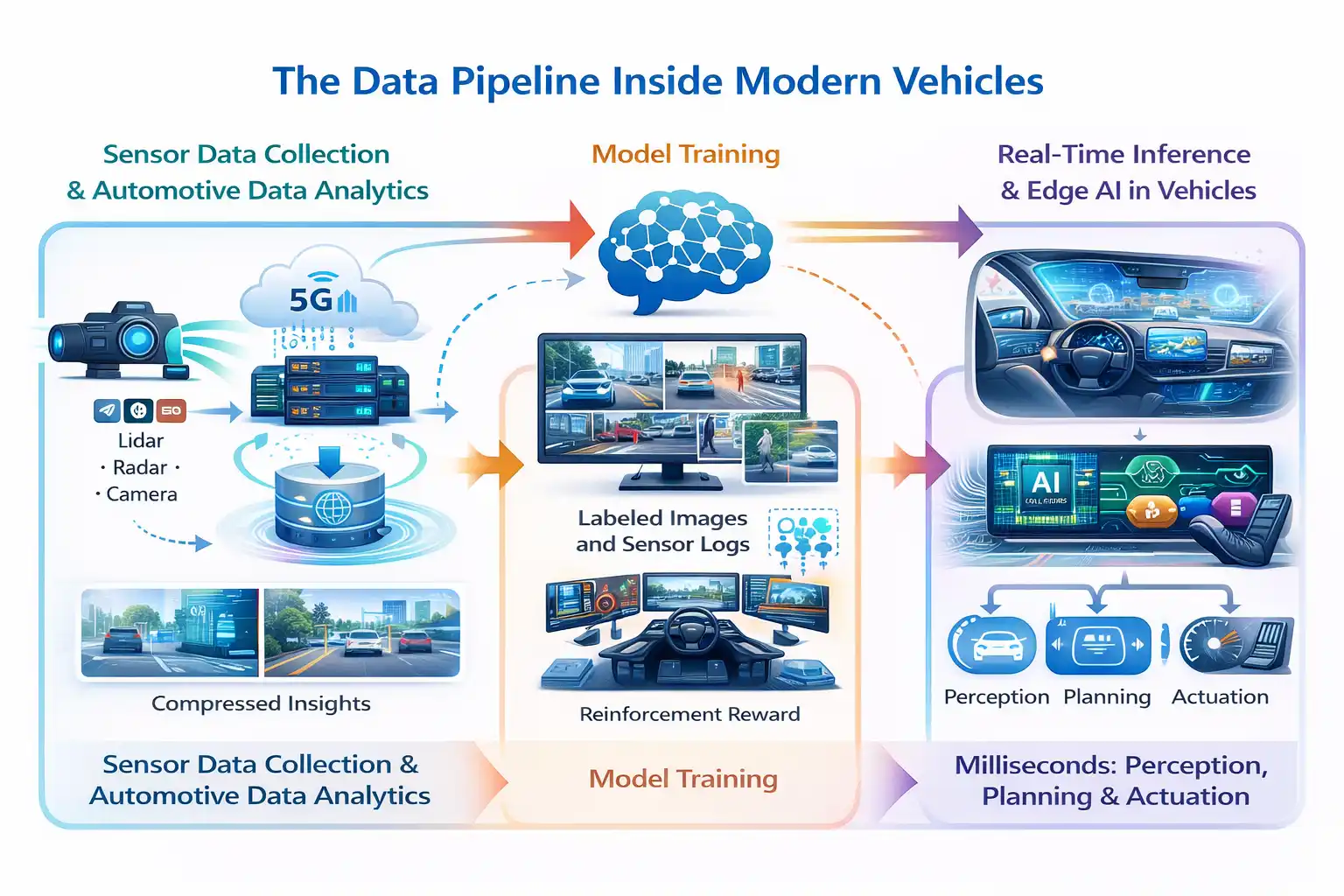
Modern vehicles run on data, not just engines. The pipeline starts with raw signals and ends with a driving action. Engineers design it to collect, clean, process, and interpret data in milliseconds. Each stage affects safety, accuracy, and system reliability.
Sensor Data Collection and Automotive Data Analytics
The pipeline starts by managing massive data loads. While a vehicle’s suite generates roughly 15 to 40 terabytes of raw data daily, only a fraction is stored or transmitted. Automotive data analytics at the “Edge”uses intelligent triggering. It discards routine data and only preserves high-value “edge cases,” such as near-misses or sensor anomalies. These compressed “insights” are then sent via 5G to the cloud, ensuring the system remains cost-effective and responsive.
Model Training for autonomous vehicles machine learning
Model training answers another question: how does the vehicle learn from collected data? Engineers use supervised training to teach models using labeled images and sensor logs. Annotators mark pedestrians, vehicles, and lane lines before the system learns patterns. Reinforcement learning teaches decision logic through trial and reward cycles. The model tests actions in simulation and improves based on feedback.
According to research, validating performance with traditional road testing would require extremely high mileage (~hundreds of billions of miles) due to the rare nature of accidents and edge cases. Simulators can generate these scenarios more efficiently. Rare event handling remains critical for autonomous vehicles machine learning systems. Engineers specifically search for edge cases like sudden pedestrian crossings or unexpected lane changes. Targeted labeling improves safety performance more than random data selection.
Real-Time Inference and edge AI in vehicles
Real-time inference answers the final question: how fast can the vehicle react? Safety systems often require response times under 100 milliseconds for braking decisions. Delays can increase stopping distance and collision risk. Edge AI in vehicles processes data inside the car instead of sending everything to the cloud. This approach reduces latency and keeps critical decisions local.
Cloud systems still support updates and fleet analysis, but not split-second control. Hardware constraints define how much intelligence fits inside a vehicle. Platforms like NVIDIA Orin deliver up to 254 trillion operations per second for automotive workloads, according to NVIDIA’s official technical brief.
This hardware allows perception, planning, and safety checks to run simultaneously. Engineers must balance power usage, heat limits, and cost while maintaining performance. The pipeline only works when software and hardware align precisely.
Application of Machine Learning in the Automotive Industry
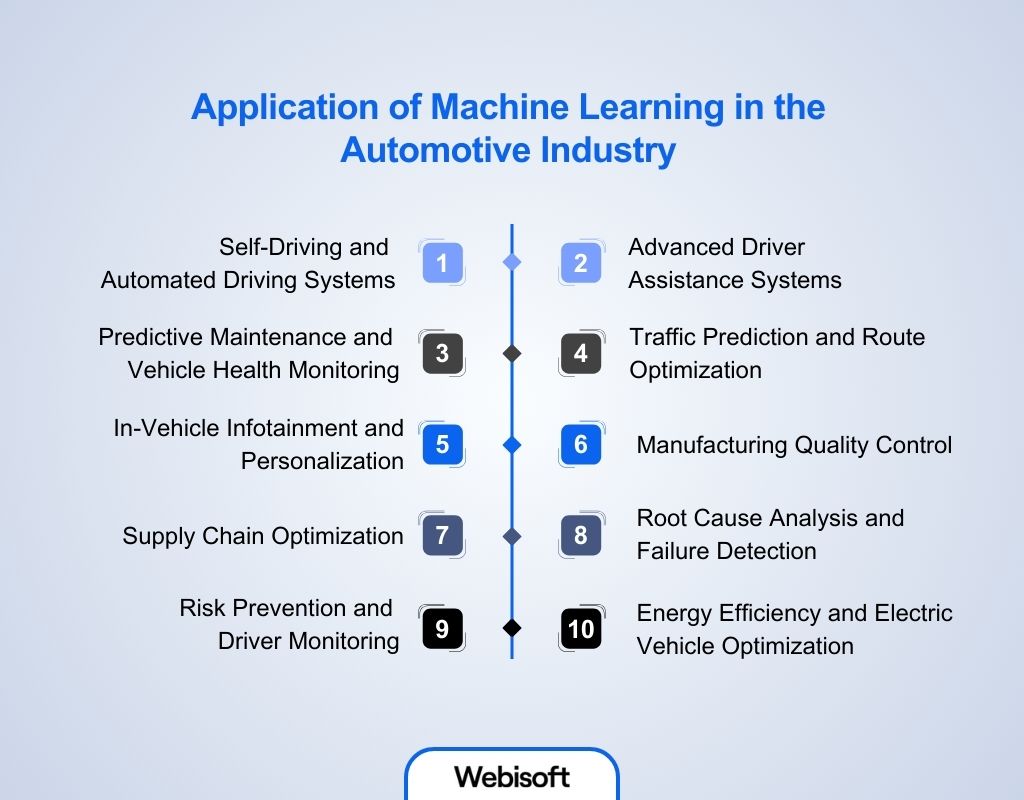
Machine learning in the automotive industry solves real driving and manufacturing problems. Companies use it to improve safety, reduce costs, and make vehicles smarter. Each use case connects directly to data collected from cars and factories.
Self-Driving and Automated Driving Systems
Self-driving systems answer one clear question: how can a vehicle understand the road without human control? Engineers use deep learning models to process camera, LiDAR, and radar data in real time. These systems detect objects, read traffic signs, and track moving vehicles. Autonomous miles found an 85% lower injury-reported crash rate compared to a human driver baseline, including urban operations in Phoenix.
This result shows that trained perception and planning models can improve safety when deployed in controlled environments. Automated driving systems also support lane keeping, adaptive cruise control, and automatic parking. These features rely on supervised learning models trained on millions of labeled frames.
Advanced Driver Assistance Systems
Advanced Driver Assistance Systems focus on reducing human error. Machine learning models power automatic emergency braking and blind spot detection. These systems analyze speed, distance, and object movement within milliseconds. They trigger alerts or braking before a driver reacts. Forward collision warning with automatic braking reduces front-to-rear crashes by about 50%. This reduction proves that real-time prediction models save lives on the road.
Predictive Maintenance and Vehicle Health Monitoring
Vehicles collect engine temperature, vibration signals, battery health, and fuel efficiency logs. Machine learning models study patterns and flag anomalies before a breakdown happens. Predictive maintenance can increase equipment uptime by 10%-20% and reduce maintenance costs by 5%-10%.
Fleet operators use these models to schedule service before a vehicle stops working. Connected vehicles now send health data to cloud platforms for analysis. Engineers compare thousands of vehicles to detect common failure trends. This method helps manufacturers fix design issues early.
Traffic Prediction and Route Optimization
Traffic prediction focuses on reducing travel time and fuel waste. Machine learning models analyze GPS logs, weather data, and road congestion patterns. They update routes in real time. Ensemble learning models achieved over 93.5 % accuracy in short-term traffic flow prediction in urban networks.
That level of precision supports dynamic navigation systems in modern cars. Ride-sharing and delivery fleets use these predictions daily. Algorithms adjust routes based on traffic spikes or road closures. This logic reduces idle time and fuel cost.
In-Vehicle Infotainment and Personalization
Machine learning models study music choices, seat settings, and navigation history. They recommend routes and adjust cabin preferences automatically. Voice assistants rely on natural language processing to interpret spoken commands. According to Statista’s 2025 mobility outlook, over 98% of new vehicles in developed markets include connected infotainment systems.
This adoption rate shows strong demand for intelligent interfaces. Mercedes-Benz and BMW integrate learning systems that remember driver profiles. These systems adjust temperature, lighting, and media based on past usage. The result improves driver comfort without manual setup each time.
Manufacturing Quality Control
Quality control systems focus on defect detection during production. Cameras inspect parts on assembly lines at high speed. Machine learning models detect surface cracks, alignment errors, and paint defects within milliseconds. Manufacturers also apply anomaly detection models to machine sensors. These systems flag unusual vibration or temperature shifts in production equipment. Maintenance teams act early to avoid shutdown.
Supply Chain Optimization
Machine learning models analyze sales data, supplier timelines, and regional trends. They forecast inventory needs across distribution centers. AI-driven forecasting improves demand prediction accuracy by 20 to 50 percent compared to traditional statistical methods.
Better forecasts reduce stock shortages and excess inventory. Automakers use these models to manage parts across global suppliers. Algorithms identify potential delays and suggest alternative sourcing plans. This logic strengthens supply stability during disruptions.
Root Cause Analysis and Failure Detection
Root cause analysis finds out why a defect occurred. Engineers collect sensor logs, service records, and testing data. Machine learning models compare thousands of cases to identify common patterns. Natural language processing also analyzes technician service notes. Models extract keywords and connect them with system logs. This approach uncovers hidden patterns across large fleets.
Risk Prevention and Driver Monitoring
Risk prevention systems monitor driver alertness and behavior. Cameras track eye movement and head position. Steering patterns and pedal usage also provide signals. Machine learning models evaluate micro-patterns in driver behavior. They compare live input with historical safe driving profiles. Alerts activate when risk rises.
Energy Efficiency and Electric Vehicle Optimization
Energy management sees how to extend battery range. Machine learning models analyze driving style, terrain, and temperature. They adjust power distribution and regenerative braking settings. Electric vehicles rely on battery health prediction models. These systems estimate degradation over time. Manufacturers use insights to refine warranty and charging policies.
Benefits of machine learning in automotive industry
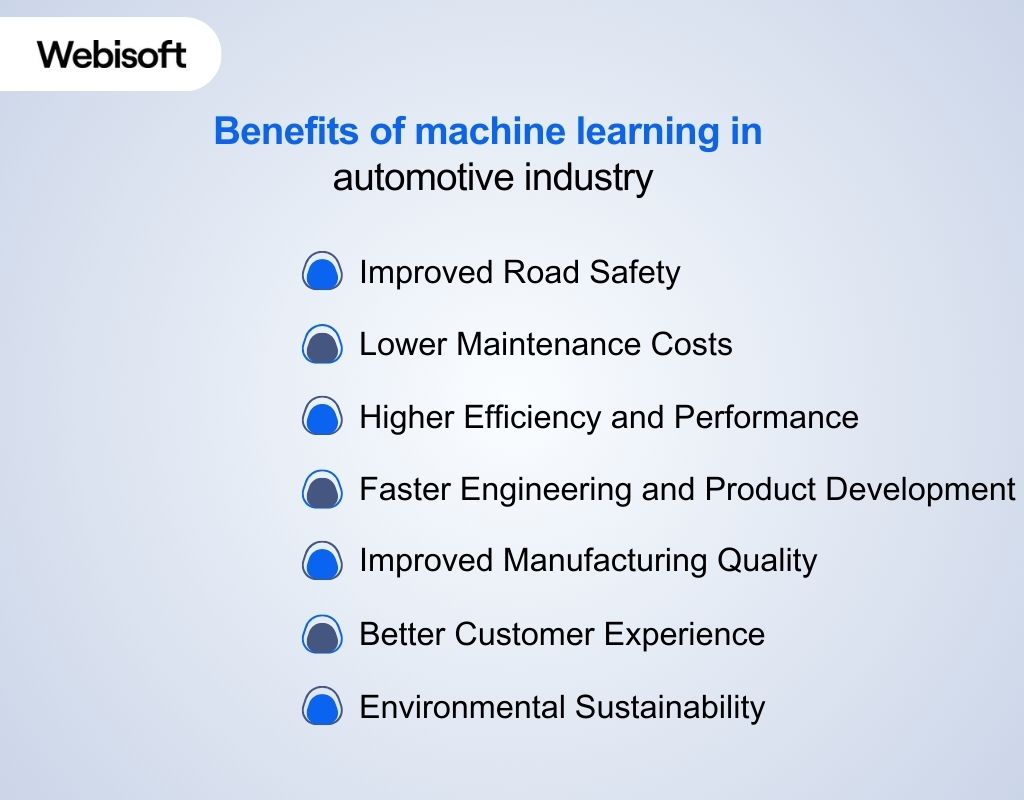
Machine learning in automotive industry delivers clear gains in safety, cost control, efficiency, and sustainability. Automakers now rely on data-driven systems to improve both vehicles and factories. These improvements define the real impact of AI in automotive industry today.
Improved Road Safety
Improved safety means fewer accidents. Modern Advanced Driver Assistance Systems use perception models trained on millions of driving miles to detect vehicles, pedestrians, and road signs in real time. Forward collision warning with automatic emergency braking reduces rear-end crashes by about 50%.
This result shows how autonomous driving technology built on machine learning directly lowers risk. Driver monitoring systems also improve response time. These systems analyze eye movement and steering behavior to detect fatigue. Early alerts prevent loss-of-control events.
Lower Maintenance Costs
Cost reduction in predictive maintenance in automotive saves money. Machine learning models analyze engine vibration, battery health, and brake wear signals continuously. They flag unusual patterns before failure happens. Fleet managers benefit most from this shift. Data-based service scheduling extends vehicle life and improves asset utilization.
Higher Efficiency and Performance
Automotive data analytics helps vehicles adjust acceleration, braking, and energy use in real time. These decisions reduce fuel waste and improve battery range. Smart energy allocation increases driving range per charge. Route optimization also improves efficiency. Traffic-aware systems reduce idle time in congested cities.
Faster Engineering and Product Development
Development speed answers how companies shorten innovation cycles. Engineers now use simulation models and digital twins supported by machine learning in automotive manufacturing. These tools reduce dependency on repeated physical tests. Faster iteration allows more testing within the same timeline. Shorter development cycles improve competitiveness. Manufacturers release updated vehicle models more quickly.
Improved Manufacturing Quality
Quality improvement helps factories reduce defects. Computer vision systems inspect welds, paint finishes, and assembly alignment using pattern recognition models. AI-driven robotics improve precision and consistency in high-volume automotive production. Automated inspection reduces human error and material waste. Also, lower defect rates reduce recall risk. That improvement protects brand value and customer trust.
Better Customer Experience
Customer experience helps vehicles adapt to user preferences. Connected car technology uses machine learning to personalize infotainment, navigation, and climate settings. Personalized features increase driver satisfaction and loyalty. Voice assistants powered by natural language processing simplify control. Drivers interact without distraction.
Environmental Sustainability
Sustainability answers how machine learning in automotive industry supports emission reduction. Route optimization and energy control systems reduce unnecessary fuel consumption. Fleet-wide data analysis also improves traffic coordination. Digital traffic optimization can reduce urban congestion and lower emissions when deployed widely. Smart traffic systems create measurable environmental benefits.
Data-driven production planning also reduces material waste. Efficient resource management supports cleaner manufacturing practices. Machine learning in automotive industry therefore improves safety, reduces cost, increases efficiency, supports innovation, and lowers environmental impact. These measurable outcomes explain why investment in automotive AI solutions continues to grow globally.
Challenges and Risks in machine learning in the Automotive Industry
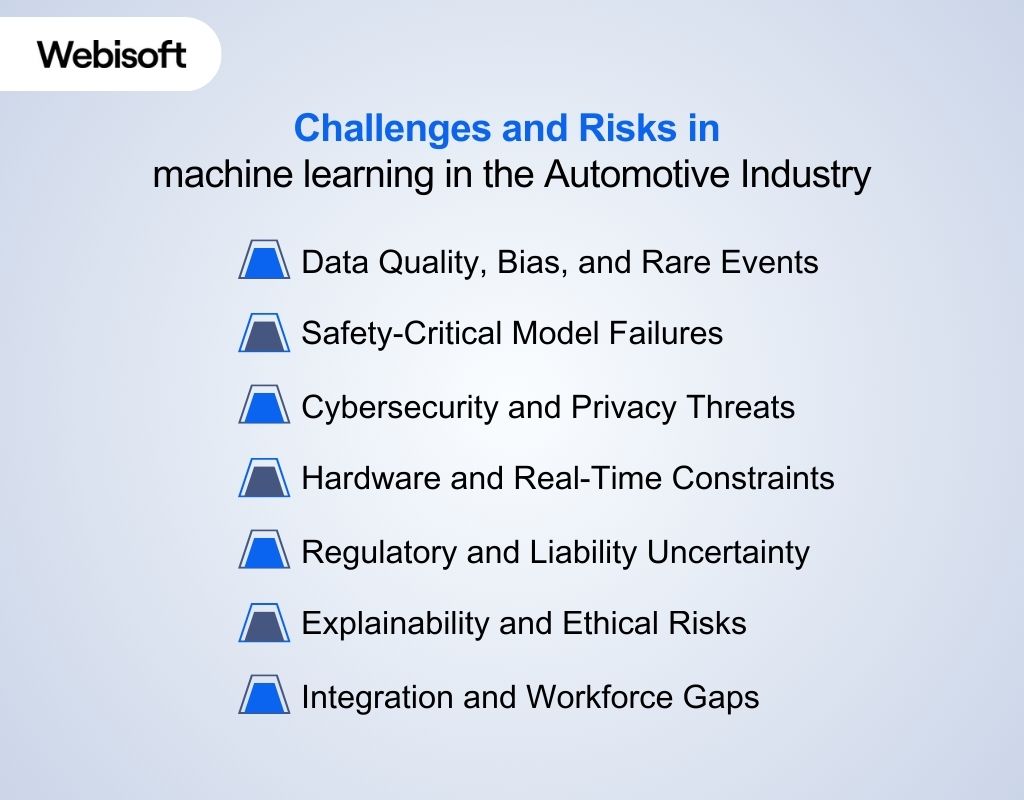
Machine learning in automotive industry creates smarter vehicles, but it also introduces technical and legal risks. Cars now rely on software for perception, braking, steering, and monitoring. When a model fails, the outcome affects real people on real roads.
Data Quality, Bias, and Rare Events
Systems that support autonomous vehicles machine learning depend on diverse driving datasets. If training data lacks rare weather events or uncommon road layouts, prediction accuracy drops in those conditions. Long-tail scenarios remain a major challenge in self-driving research. Rare pedestrian behavior and unusual traffic patterns often appear underrepresented in datasets. Bias also affects safety performance. If a model trains mostly on urban roads, it may misclassify rural objects. This gap increases risk when vehicles expand into new regions.
Safety-Critical Model Failures
Safety risk sees what happens if a prediction goes wrong. Systems powered by computer vision in automotive platforms must detect obstacles within milliseconds. A small misclassification can delay braking or steering correction. The U.S. National Transportation Safety Board documented multiple investigations where driver assistance systems failed to detect stationary objects.
These reports show that partial automation still requires strict human supervision and validation. Model drift also increases risk over time. Road environments change, and vehicle software updates modify behavior. Without retraining, models may degrade in accuracy.
Cybersecurity and Privacy Threats
Cybersecurity answers how secure connected vehicles really are. Modern cars exchange data through cloud systems and over-the-air updates. This connectivity expands the attack surface. Cyber incidents targeting smart vehicles continue to grow as connectivity increases.
Attackers target remote keyless systems, telematics units, and update channels. Data privacy also creates compliance pressure. Vehicles collect driver behavior signals and location history. Regulations such as GDPR require strict controls over personal data storage and sharing.
Hardware and Real-Time Constraints
Hardware limits answer how much intelligence fits inside a moving vehicle. Real-time inference for edge AI in vehicles must meet strict latency thresholds, often under 100 milliseconds for braking decisions. High-performance chips generate heat and increase power demand.
Autonomous systems may require hundreds of trillions of operations per second to process sensor data. Engineers must balance compute performance with energy efficiency and cost. This trade-off defines scalability in production vehicles.
Regulatory and Liability Uncertainty
Regulation answers who carries responsibility when automation fails. Deployment of AI in automotive industry systems must comply with UNECE safety frameworks and national transport rules. These standards require traceability, validation logs, and functional safety compliance.
Liability remains complex in mixed-control systems. If a driver and an automated system share control, accident responsibility may involve both parties. Legal ambiguity slows large-scale rollout.
Explainability and Ethical Risks
Explainability answers why a model made a specific decision. Deep learning models often operate as black-box systems. Engineers cannot always trace the internal reasoning behind an output. According to research, explainable AI improves public trust and regulatory acceptance in safety-critical environments.
Transparent logic helps investigators review system behavior after incidents. Ethical challenges also appear in unavoidable crash scenarios. Developers must define how systems prioritize safety in complex events. These design decisions require documented governance frameworks.
Integration and Workforce Gaps
Integration answers how automakers merge new AI systems with legacy vehicle platforms. Many factories and control units still rely on decades-old architectures. Integrating advanced analytics into those systems requires specialized engineering skill. Webforum listed AI and machine learning engineering among the fastest-growing global roles. Talent shortages slow deployment timelines in complex automotive programs.
Webisoft addresses these risks through structured validation, secure deployment pipelines, and continuous monitoring frameworks. The team focuses on building scalable AI systems that align with automotive safety and compliance standards. This approach ensures innovation moves forward without compromising reliability or accountability.
Future Trends of machine learning in Automotive Industry
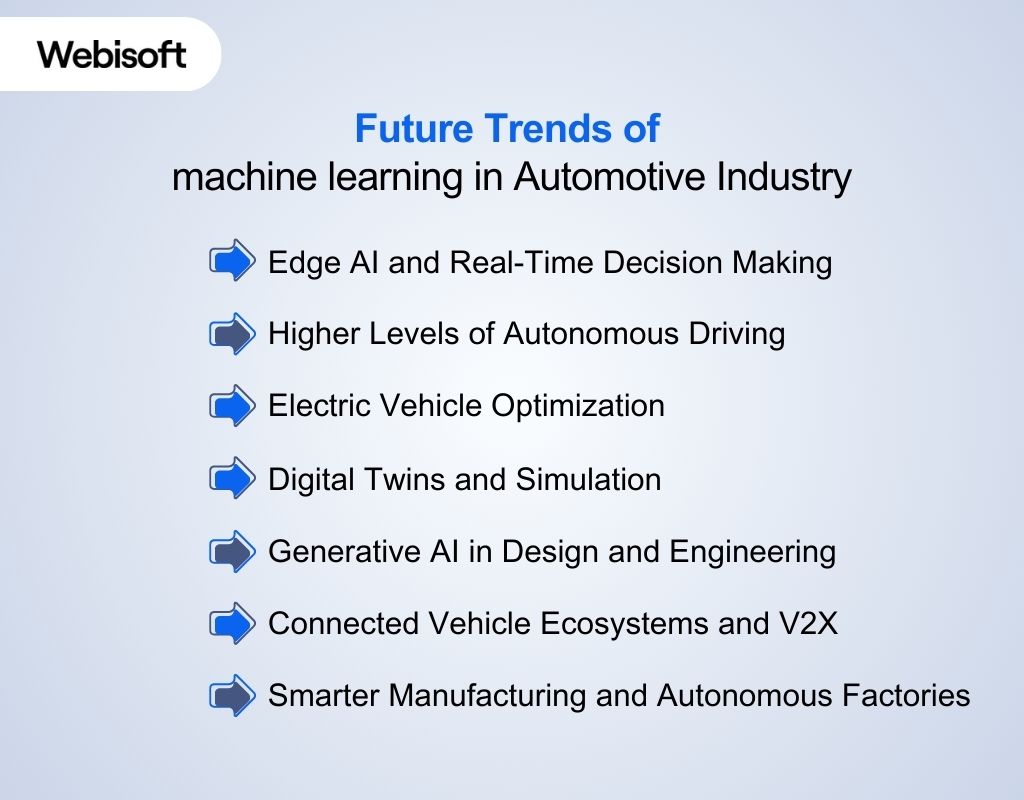
Machine learning in automotive industry is moving toward faster decisions, deeper automation, and smarter mobility systems. Automakers now invest heavily in edge intelligence, advanced chips, and connected ecosystems. These trends show where automotive AI will head in the next five years.
Edge AI and Real-Time Decision Making
Edge computing answers how vehicles will react faster. Automakers now process sensor data directly inside the vehicle instead of sending everything to the cloud. Level 3 systems require millisecond-level decision speed for safe highway automation. Real-time inference inside the car reduces latency and improves reliability in low-signal areas.
Advanced automotive chips from companies like NVIDIA and Qualcomm now support trillions of operations per second. These processors allow edge AI in vehicles to handle perception, planning, and control simultaneously.
Higher Levels of Autonomous Driving
Full autonomy answers where autonomous systems are heading. Machine learning models now combine camera, radar, and LiDAR data through advanced sensor fusion. Moreover, several manufacturers are expanding Level 3 autonomous deployment in premium vehicle segments.
Wider rollout depends on regulatory approval and system validation. Improved autonomous vehicles machine learning models now train on rare driving events using simulation and synthetic data. This approach improves safety coverage without requiring billions of real-world miles.
Electric Vehicle Optimization
Global EV sales are still growing fast. In 2024, electric vehicle sales rose about 25% to reach nearly 18 million units worldwide Machine learning also improves energy routing. Vehicles adjust speed and regenerative braking to maximize range.
Digital Twins and Simulation
Digital twins answer how automakers reduce physical testing. Engineers now create virtual vehicle replicas to simulate stress, airflow, and crash impact. According to McKinsey, digital twin adoption in manufacturing continues to expand as companies seek faster design cycles.
Virtual simulation reduces the number of costly physical prototypes. Simulation acceleration through surrogate models speeds up wind tunnel and crash prediction workflows. This method shortens R&D timelines significantly.
Generative AI in Design and Engineering
Generative AI answers how future vehicles will be designed. Engineers now use AI models to propose optimized shapes, lighter structures, and efficient layouts. Generative design tools help reduce development time and material usage. Faster design iteration lowers engineering costs. These models analyze engineering constraints and propose new structures that meet safety and performance targets.
Connected Vehicle Ecosystems and V2X
Vehicle-to-everything communication answers how cars will interact with infrastructure. Machine learning models analyze traffic signals, road hazards, and nearby vehicle movement. Intelligent traffic systems improve urban traffic coordination when connected vehicle data supports city infrastructure. Smarter coordination reduces congestion and improves safety. Future vehicles will continuously exchange data to predict traffic flow and road risk.
Smarter Manufacturing and Autonomous Factories
Factory automation answers how production will evolve. Machine learning systems now monitor robotics, assembly accuracy, and supplier logistics in real time. AI-driven robotics adoption continues to rise in automotive production.
Smart factories reduce defects and optimize supply chains. Self-correcting production systems use anomaly detection to prevent downtime. This approach increases throughput and quality control.
How Webisoft Implements Machine Learning for Automotive Industries
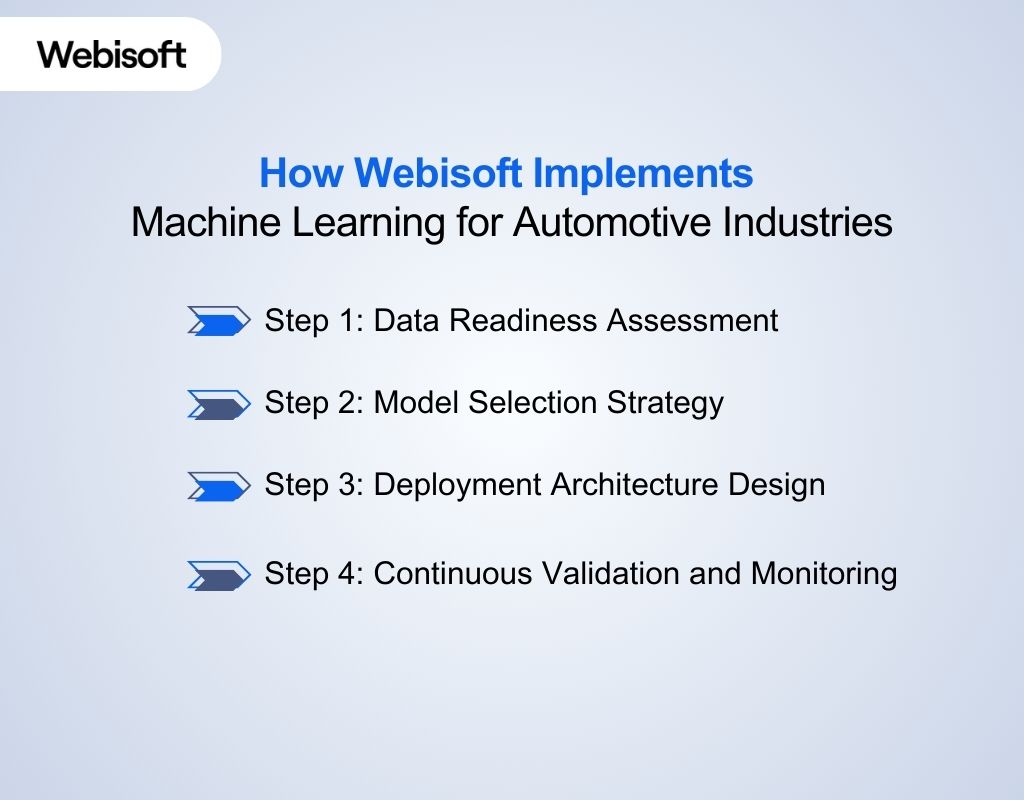
Webisoft implements machine learning in automotive industry through a structured, production-ready framework. The focus stays on safety, scalability, and measurable performance improvement. Every step aligns with real vehicle systems and factory environments.
Step 1: Data Readiness Assessment
Data readiness answers whether AI can perform reliably in real conditions. Webisoft audits camera feeds, LiDAR signals, radar inputs, ECU logs, and CAN bus streams before any model training begins. Sensor calibration errors can reduce perception accuracy.
Our engineers validate timestamp sync, remove noise, and structure raw telemetry for reliable vehicle data processing. Data infrastructure answers long-term scalability. The team designs cloud pipelines and edge filters to support connected vehicle analytics without overwhelming storage systems.
Step 2: Model Selection Strategy
Model selection answers which architecture solves the problem efficiently. Webisoft uses CNNs for computer vision tasks like lane detection and object recognition in ADAS development. The team applies RNNs and Transformers for time-series modeling, including battery health tracking and driver behavior analytics.
Each model aligns with automotive AI solutions and embedded system limits. On-device constraint analyzes performance feasibility. Webisoft applies model compression, pruning, and quantization to fit within automotive-grade hardware.
Step 3: Deployment Architecture Design
Deployment architecture answers where inference should run. We prioritize on-device processing for safety-critical features like collision detection and adaptive cruise control. Hybrid deployment fulfills scalability needs.
The system combines edge inference with cloud-based fleet learning for continuous intelligent vehicle systems improvement. OTA updates answer continuous improvement requirements. Webisoft integrates secure over-the-air pipelines to upgrade models without replacing hardware components.
Step 4: Continuous Validation and Monitoring
Continuous monitoring see how performance remains stable. Webisoft builds feedback loops that collect edge-case scenarios and anomaly patterns from live fleets. Model retraining ensures long-term adaptability.
Automated pipelines update perception and prediction models to maintain automotive software intelligence accuracy. This structured implementation ensures machine learning in automotive industry delivers reliable, secure, and scalable results across vehicles and smart manufacturing systems.
Conclusion
Machine learning in automotive industry now defines how vehicles are built, driven, and improved over time. It powers driver assistance systems, predictive maintenance, electric vehicle optimization, and smart manufacturing workflows.
These systems convert raw data into faster decisions and measurable operational gains. At the same time, automakers must address cybersecurity risks, regulatory compliance, hardware limits, and safety validation challenges. Companies that combine innovation with strict testing and responsible AI practices will lead the next phase of mobility.
FAQs
While a vehicle’s internal sensors generate terabytes of raw data daily, only a small fraction is transmitted to the cloud. Engineers use Edge AI to filter out “boring” data, transmitting only critical telemetry, system health alerts, and specific “edge case” snapshots needed to retrain machine learning models.
Yes, automakers update models through over-the-air software updates. These updates improve perception, safety logic, and battery management without replacing hardware.
No, machine learning supports traditional engineering. Engineers still rely on physics-based models and safety testing, but AI speeds up prediction and optimization.
Engineers use simulation environments, closed-track testing, and real-world pilot programs. They also follow safety standards such as ISO 26262 for functional safety compliance.
Machine learning changes job roles rather than eliminating them. It increases demand for AI engineers, data scientists, and cybersecurity specialists in automotive companies.
