Machine learning in agriculture refers to the use of data-driven algorithms to improve farm decisions. These systems analyze weather records, soil conditions, crop images, and market trends to predict outcomes like yield, disease risk, and price movement.
Instead of relying only on past experience, farmers use structured data to guide planting, irrigation, and harvesting strategies. However, farming today faces serious pressure. Climate variability disrupts growing cycles. Input costs for fertilizer, water, and fuel continue to rise.
Labor shortages slow operations, and unpredictable market prices reduce profit margins. Many farmers collect large amounts of data but struggle to convert it into clear action. This gap between available data and usable insight creates frustration and risk.
In this blog, we will discuss how machine learning systems actually work on farms. We will also discuss the core applications driving results, the real benefits they deliver, and the challenges farms must overcome to implement them successfully.
What Does Machine Learning in Agriculture Mean?
Machine learning in agriculture means using data and algorithms to guide farm decisions. These systems study patterns in weather data, soil reports, crop images, and past harvest records. Farmers then use those insights to plan planting, irrigation, and crop protection.
This concept belongs to AI in agriculture, which covers different intelligent systems used on farms. However, machine learning focuses mainly on prediction and pattern recognition. That is why it plays a central role in artificial intelligence in agriculture solutions.
One clear example is crop yield prediction using machine learning. The Food and Agriculture Organization reports that climate extremes continue to reduce crop productivity in several regions, which increases the need for data-driven forecasting. Another example is disease detection in crops using AI.
According to a report, thousands of labeled leaf images identify infections early. Research shows that deep learning models can reach accuracy rates above 90 percent under controlled testing conditions. In simple terms, machine learning in agriculture converts raw farm data into clear actions.
It connects sensors, models, and decision tools inside intelligent farming systems. As a result, farms respond faster to risks and reduce uncertainty in daily operations.
How Machine Learning Systems Work on a Farm
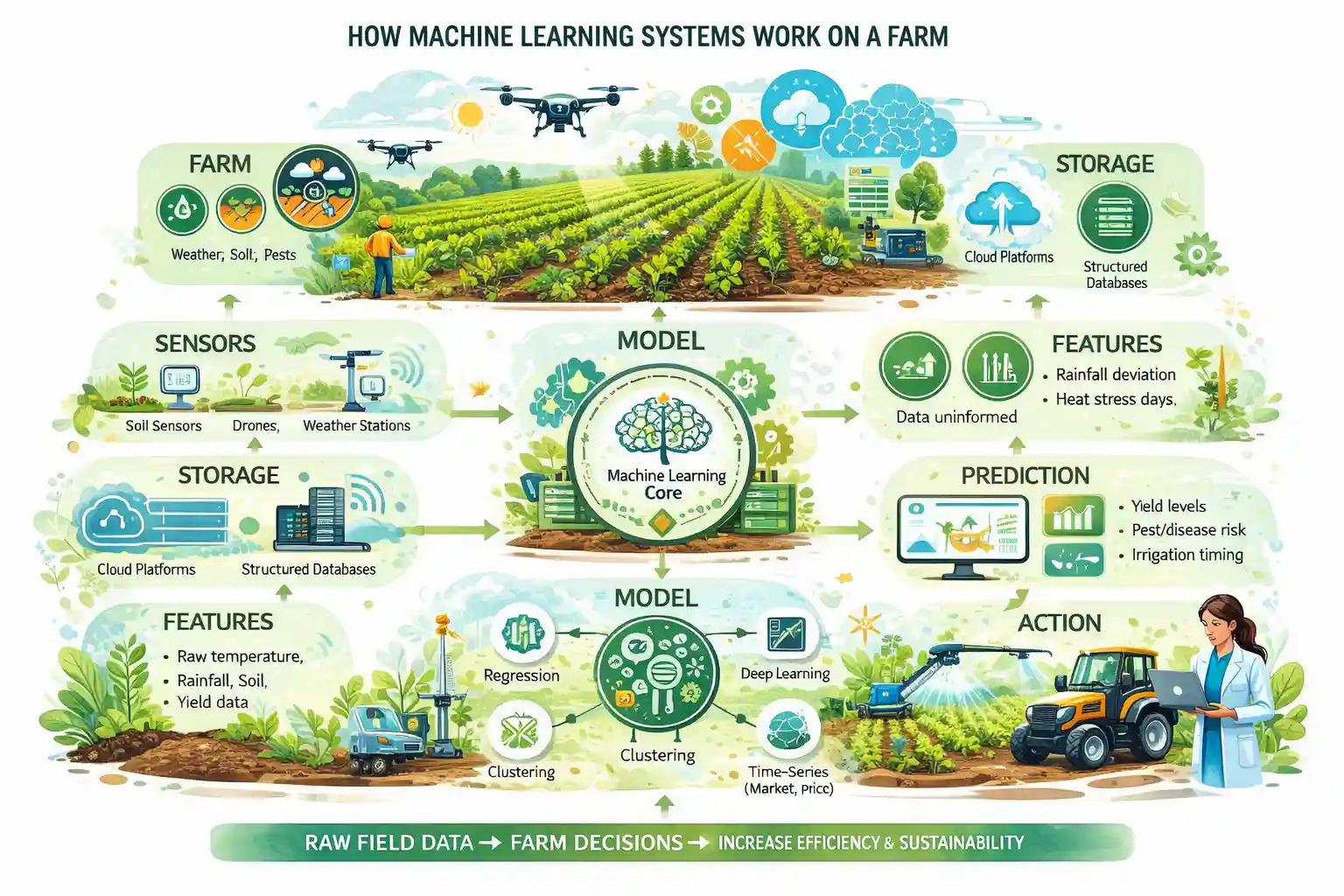
Machine learning in agriculture follows a structured pipeline. The process moves step by step from raw field data to real farm decisions. Each stage connects clearly to the next.
Farm: Where Data Is Created
The pipeline starts in the field. Crops grow under changing weather, soil conditions, and pest pressure. Farmers deal with uncertainty every season. Field conditions generate large amounts of usable data. Soil moisture, nutrient levels, crop stage, and temperature all change daily.
These signals form the foundation of agricultural data analytics. Climate risk makes this data even more important. The FAO reports that climate variability continues to reduce crop productivity in many regions. Because of that, farms now rely more on machine learning in agriculture to reduce uncertainty.
Sensors: Capturing Field Signals
Sensors collect measurable information from the farm. Soil probes record moisture and nutrient levels. Weather stations track rainfall, humidity, and temperature. Drones and satellite systems capture crop images. These images support satellite imagery analysis for farming, which helps measure crop health at scale.
Many systems also perform NDVI analysis using machine learning to detect plant stress before visible damage appears. Internet-connected devices strengthen this layer. IoT and machine learning in agriculture work together to stream real-time data into farm systems.
This constant data flow allows timely decision-making instead of seasonal guesswork. Precision systems show measurable impact. The European Parliament reports that precision spraying tools can reduce pesticide use by 20 to 30 percent when guided by accurate field data. That efficiency begins with reliable sensors.
Storage: Organizing the Data
Collected data must be stored safely. Farms use cloud platforms or on-site servers depending on infrastructure. Storage allows long-term tracking and comparison across seasons. Centralized storage improves decision quality. When weather data, soil readings, and yield history sit in one system, patterns become visible.
The World Bank notes that integrated digital agriculture platforms improve planning by combining multiple data streams. Good storage also supports scalability. As farms expand operations, structured databases help maintain consistent analysis. This step lays the groundwork for intelligent farming systems.
Features: Preparing Data for Learning
Raw data cannot directly train a model. Systems must clean and structured first. This stage converts raw inputs into usable features. For example, instead of storing daily rainfall alone, the system may calculate rainfall deviation from seasonal averages. I
nstead of raw temperature readings, it may compute heat stress days. These transformations improve model performance. Feature engineering strengthens prediction accuracy.
Well-prepared features significantly improve crop yield forecasting results. This stage supports predictive analytics in agriculture by improving signal quality before modeling begins.
Model: Learning Patterns from History
The model forms the core of the pipeline. It studies historical data to identify patterns between inputs and outcomes. Then it learns how those variables interact. For yield forecasting, farms apply regression models in agriculture. These models analyze relationships between rainfall, soil nutrients, and output per hectare.
This process supports crop yield prediction using machine learning. For disease monitoring, farms use deep learning. A CNN for plant disease detection analyzes thousands of labeled leaf images to classify infections. Other systems rely on pattern grouping.
Farms use clustering in precision farming to divide fields into zones based on soil similarity. These zones then guide fertilizer application rates. Market forecasting requires time-series learning. LSTM for price prediction helps estimate future commodity price movement using historical trends and demand signals.
This supports better harvest planning and storage strategy. Machine learning dominates agricultural AI solutions. Future Market Insights estimates that machine learning accounts for 47 percent of the AI in the agriculture market in 2025. That share reflects its central role in modern farm analytics.
Prediction: Producing Clear Outputs
After training, the model generates predictions. It may forecast yield levels, estimate pest risk, or recommend irrigation timing. These outputs directly influence farm planning. For example, disease detection in crops using AI can alert farmers before visible symptoms spread across the field.
Similarly, pest detection using machine learning can identify risk hotspots based on weather and image patterns. Livestock systems also rely on predictive models. Farms apply livestock monitoring using AI to track animal movement, feeding behavior, and early illness signals.
Early alerts help reduce mortality and improve herd productivity. Prediction adds clarity to complex conditions. Instead of reacting after damage occurs, farms act based on forecasted risk.
Action: Converting Insight into Operations
The final stage converts predictions into action. Systems trigger automated irrigation systems when soil moisture drops below a safe range. Smart sprayers adjust chemical use based on weed mapping results. This direct link defines precision agriculture.
Farmers no longer treat entire fields the same way. Instead, they apply inputs exactly where needed. Soil systems also respond to model guidance. Farms rely on soil health monitoring using ML to adjust fertilizer plans and rotation cycles.
These data-driven adjustments improve sustainability and reduce waste. This pipeline only delivers value when each layer connects seamlessly, from data capture to real farm action. Many farms struggle not with data collection, but with integration and long-term reliability.
Webisoft works within this structure by engineering stable, production-ready systems that connect analytics with field operations, ensuring machine learning in agriculture performs consistently under real-world conditions.
Models Behind machine learning in agriculture
Different problems on a farm require different models. Some models work best with numbers like rainfall and yield. Others work best with images or time-based data. That is why machine learning in agriculture does not rely on one single algorithm. Instead, it uses a mix of models based on the task, the data type, and the required accuracy.
1. Neural Network-Based Models
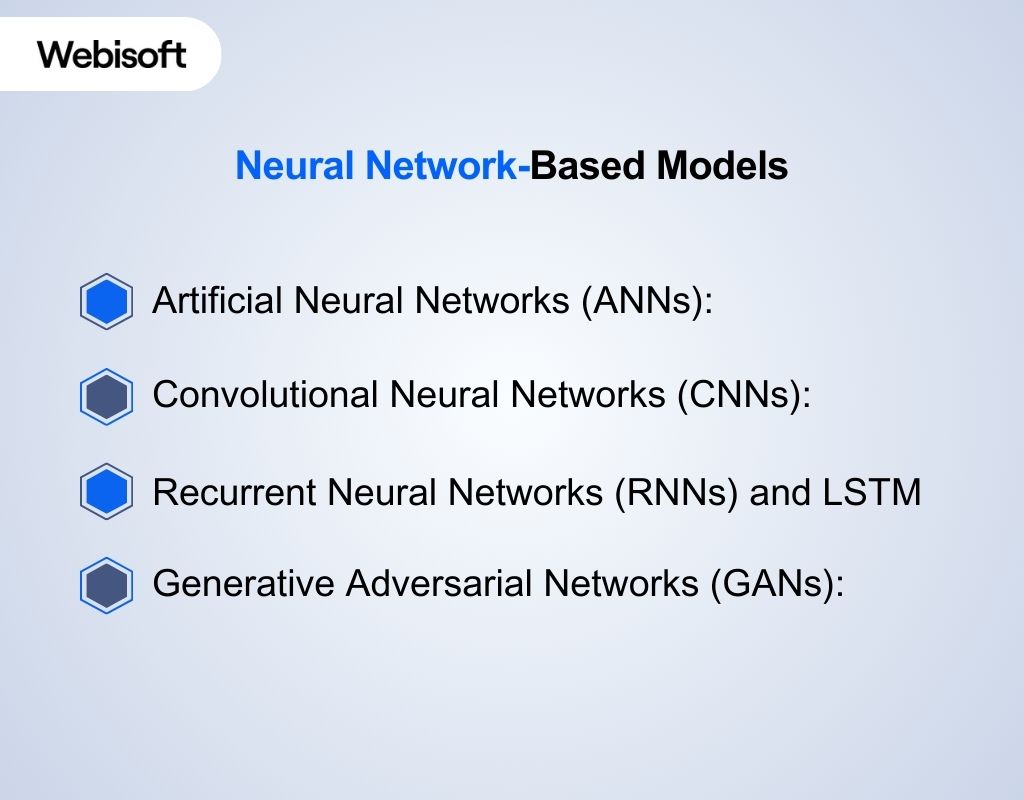
Neural network models handle complex and layered farm data. They detect patterns that simple equations often miss. This makes them important for advanced prediction systems.
Artificial Neural Networks (ANNs):
ANNs process multiple environmental variables at once, such as soil nutrients, rainfall, and temperature. They capture non-linear relationships between inputs and crop output. Farms use them for yield prediction when many factors interact together.
Convolutional Neural Networks (CNNs):
CNNs specialize in image recognition tasks. They scan leaf photos, drone footage, and field images to detect disease spots, weeds, or pest damage. These models power many crop monitoring and robotic spraying systems.
Recurrent Neural Networks (RNNs) and Long Short-Term Memory (LSTM):
RNNs analyze data that changes over time. LSTM improves this by remembering long-term seasonal trends like rainfall patterns. Farms apply them for time-based forecasting such as yield estimation and price movement analysis.
Generative Adversarial Networks (GANs):
GANs generate realistic synthetic data. They help when farms lack enough labeled examples, especially for rare crop diseases. This improves model training quality without waiting for new field data.
2. Ensemble Learning Models
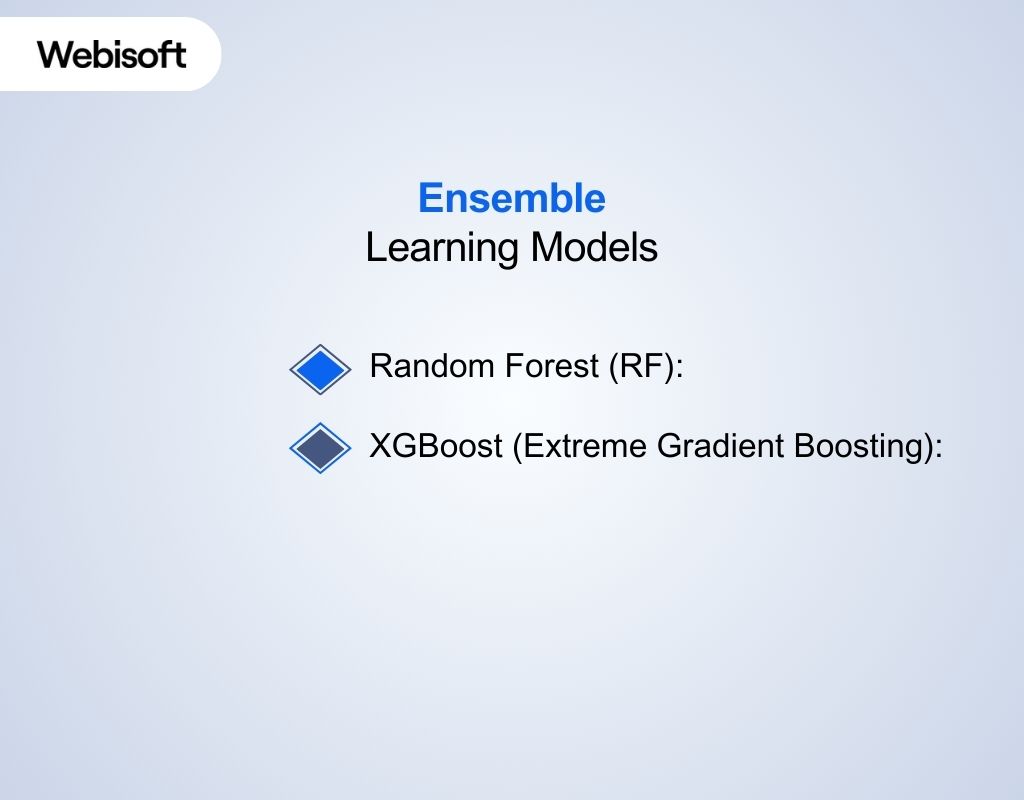
Ensemble models combine multiple algorithms to improve reliability. Instead of trusting one prediction, they average results from several models. This reduces errors and improves stability.
Random Forest (RF):
Random Forest builds many decision trees and combines their outputs. It handles structured data like soil readings and weather records very well. Farms use it for yield estimation and soil classification.
XGBoost (Extreme Gradient Boosting):
XGBoost improves predictions step by step. Each new model reduces the error of the previous one. It is often chosen when farms need higher precision in forecasting tasks.
3. Classical Machine Learning Models
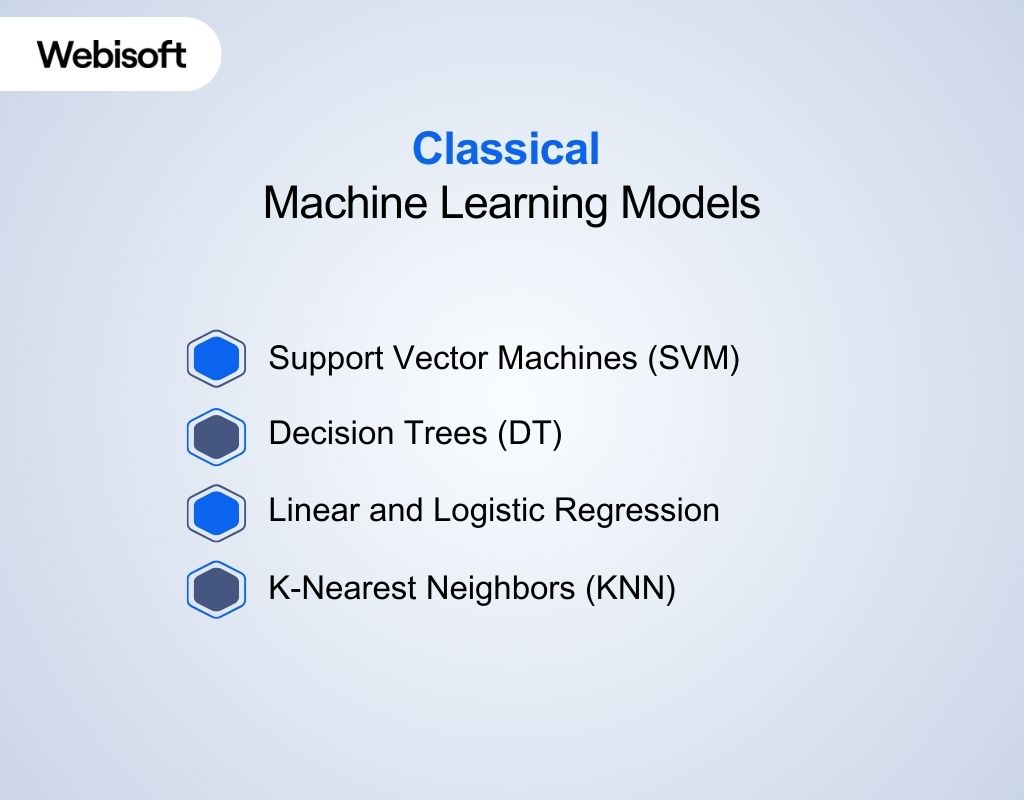
Classical models remain useful because they are simple and easy to interpret. They require less computing power than deep learning systems. Many farms use them for basic forecasting and classification tasks.
Support Vector Machines (SVM):
SVM separates data into categories using defined boundaries. Farms apply it to classify crop types, soil classes, or disease presence. It performs well when patterns are clearly separable.
Decision Trees (DT):
Decision trees map decisions into logical steps. Each branch represents a condition, such as moisture level or nutrient threshold. Agronomists prefer them when they need clear explanations for predictions.
Linear and Logistic Regression:
Linear regression predicts numerical outcomes like yield per hectare. Logistic regression predicts probabilities, such as the chance of infection. These models support straightforward forecasting tasks.
K-Nearest Neighbors (KNN):
KNN compares new observations with similar past data points. It classifies plant species or soil zones based on similarity. This model works well for small to medium datasets.
Core Applications of machine learning in agriculture
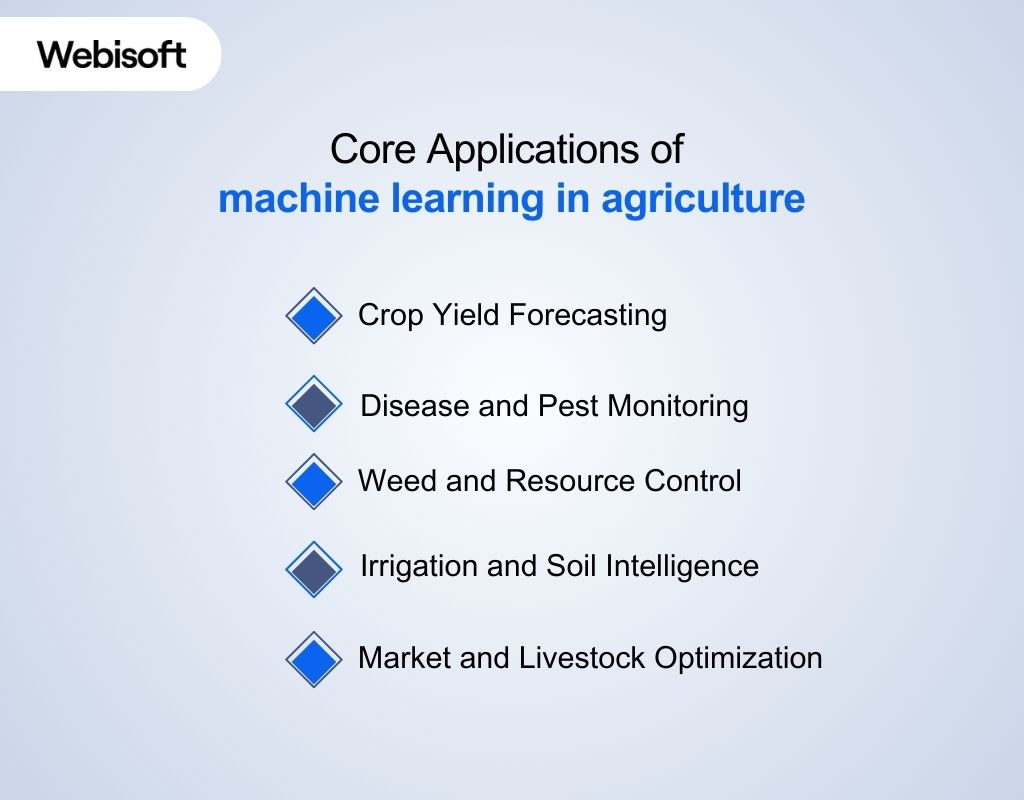
Farms do not struggle with data. They struggle with decisions. That is where machine learning in agriculture makes a real impact. Each application follows a clear chain. A problem appears in the field.
Data explains the situation. A model processes that data. The system produces an output. Then a decision is made on the ground. Let’s break down the core areas where this pipeline delivers real value.
Crop Yield Forecasting
Yield uncertainty keeps farmers awake at night. A small shift in rainfall or heat stress can cut output sharply. To solve this, farms gather multi-season data. Rainfall history, soil nitrogen levels, planting density, and temperature trends feed into the system.
This dataset powers crop yield prediction using machine learning. Here, regression models in agriculture map how each variable influences final output. The result is a yield forecast before harvest.
Disease and Pest Monitoring
Consider what happens when farms use image data. Leaf photos from smartphones, drones, or tractors enter the system. Those images support disease detection in crops using AI. At the core sits a CNN for plant disease detection.
This model scans patterns in leaf texture, color variation, and lesion shape. That is how computer vision in agriculture identifies infection even before the human eye notices subtle changes. Pest outbreaks follow a similar path.
Weather shifts and humidity spikes increase insect risk. Through pest detection using machine learning, farms combine environmental signals with image recognition to flag early infestation zones.
Weed and Resource Control
Weeds compete for water, sunlight, and nutrients. Blanket spraying treats the symptom but wastes resources. That approach also increases environmental stress.
High-resolution cameras now scan fields row by row. These images enable weed detection using computer vision, which separates crop plants from unwanted growth. Instead of guessing, the system marks exact weed locations. Soil variability also matters.
One section of land may require more nutrients than another. Through clustering in precision farming, the system groups field zones based on similar soil properties.
Irrigation and Soil Intelligence
Soil moisture sensors record real-time field conditions. Nutrient probes measure nitrogen, phosphorus, and potassium levels. This data supports soil health monitoring using ML. Models analyze moisture patterns, evapotranspiration rates, and weather forecasts.
That is where predictive analytics in agriculture turns raw sensor data into irrigation recommendations. The output suggests when and how much to irrigate. Fields no longer rely on fixed schedules. With automated irrigation systems, valves respond to model recommendations and adjust flow instantly.
Market and Livestock Optimization
Historical price trends and seasonal demand patterns feed into forecasting systems. Through price forecasting in agriculture, farms analyze long-term movement and short-term volatility. A common method includes LSTM for price prediction, which studies time-based patterns in commodity data.
The output shows projected price ranges. Farmers adjust harvest timing or storage strategy accordingly. That small change often protects margins. Livestock operations face a different challenge.
Illness spreads fast in dense herds. Manual observation misses early warning signs. Sensors track animal movement, feeding behavior, and body temperature. With livestock monitoring using AI, models detect irregular patterns that signal stress or disease.
Benefits of Using machine learning in agriculture
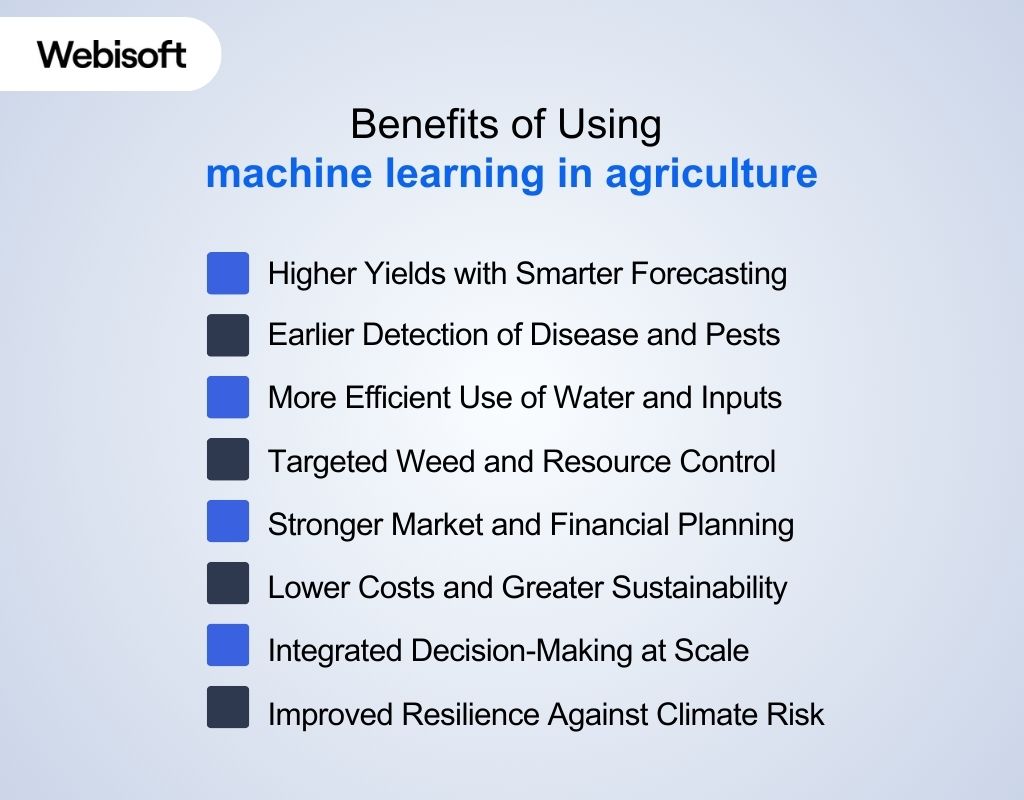
Farming runs on tight margins and high uncertainty. Weather shifts, pest outbreaks, and market swings can erase months of effort. That is why machine learning in agriculture matters today.
The value does not sit in technology alone. The real benefit appears when data turns into smarter daily decisions. Below are the six core advantages that define its impact:
Higher Yields with Smarter Forecasting
Stronger forecasting improves production stability. Farms use historical weather logs, soil readings, and satellite data to estimate harvest output early.
This process supports crop yield prediction using machine learning. Many systems rely on regression models in agriculture to measure how rainfall, temperature, and nutrients influence yield.
When farmers see projected output months ahead, they adjust fertilizer timing and labor allocation. That early adjustment protects revenue and reduces surprise losses.
Earlier Detection of Disease and Pests
Crop damage spreads quickly when it goes unnoticed. Visual inspection alone often misses early-stage infection. This is where disease detection in crops using AI changes the process. Image-based systems powered by a CNN for plant disease detection scan leaf patterns and detect abnormalities before visible damage spreads.
This method falls under computer vision in agriculture, which allows real-time monitoring through drones and field cameras. Insect outbreaks follow a similar pattern.
Through pest detection using machine learning, farms combine humidity trends, temperature shifts, and image signals to identify risk zones. Instead of spraying entire fields, farmers treat only affected areas.
More Efficient Use of Water and Inputs
Water remains one of agriculture’s most limited resources. Traditional irrigation often follows fixed schedules rather than real field conditions. With data-driven systems, that approach changes. Sensors track moisture, temperature, and evapotranspiration rates.
Models apply predictive analytics in agriculture to determine when crops truly need water. As a result, automated irrigation systems activate only when thresholds are crossed. Soil condition also improves under structured monitoring.
Through soil health monitoring using ML, farms track nutrient balance and organic matter trends. This prevents over-fertilization and protects long-term soil productivity.
Targeted Weed and Resource Control
Weeds compete aggressively for nutrients and sunlight. Blanket herbicide spraying treats the symptom but increases expense and environmental strain. Precision tools offer a better path. High-resolution imaging enables weed detection using computer vision, which isolates unwanted plants at row level.
Meanwhile, farms apply clustering in precision farming to divide land into management zones based on soil similarity. This approach supports precision agriculture, where inputs vary by location rather than treating fields uniformly.
Sprayers target specific patches, and fertilizer rates adjust by zone. That targeted response cuts waste and improves crop health.
Stronger Market and Financial Planning
Through price forecasting in agriculture, systems analyze historical market movement and seasonal demand patterns. Many platforms use LSTM for price prediction, which studies time-based trends across months or years. The output provides projected price ranges instead of guesswork.
Farmers adjust storage strategy or harvest timing accordingly. That planning stabilizes income during volatile cycles. Livestock operations benefit as well.
Through livestock monitoring using AI, farms track animal health, feeding behavior, and movement patterns. Early detection of stress or illness improves herd productivity and reduces medical costs.
Lower Costs and Greater Sustainability
Targeted irrigation reduces energy and water usage. Zone-based spraying lowers pesticide consumption. These adjustments shrink operational expenses over time. Environmental benefits follow naturally. Reduced chemical runoff protects nearby ecosystems.
Efficient water use aligns with global sustainability goals. The World Bank continues to highlight that agriculture consumes the largest share of freshwater globally. Efficient systems built on machine learning in agriculture help reduce that burden without sacrificing output.
Integrated Decision-Making at Scale
Disconnected data often leads to slow decisions. Modern platforms integrate forecasting, soil analytics, disease alerts, and market signals in one dashboard. That integration forms part of broader digital agriculture systems. When farms connect IoT sensors with analytics tools, they create unified workflows.
This combination of IoT and machine learning in agriculture supports faster responses across operations. Managers see actionable insights instead of scattered data points.
Improved Resilience Against Climate Risk
Climate variability increases production stress. Extreme heat, drought, and irregular rainfall create unstable growing conditions. Data-driven systems help farms prepare rather than react. Forecasting tools identify seasonal risk trends.
Soil analytics reveal vulnerability to nutrient depletion. Together, these insights reduce exposure to unpredictable shocks. Over time, farms shift from reactive management to structured planning. That transformation defines the long-term benefit of machine learning in agriculture.
Challenges of Implementing machine learning in agriculture
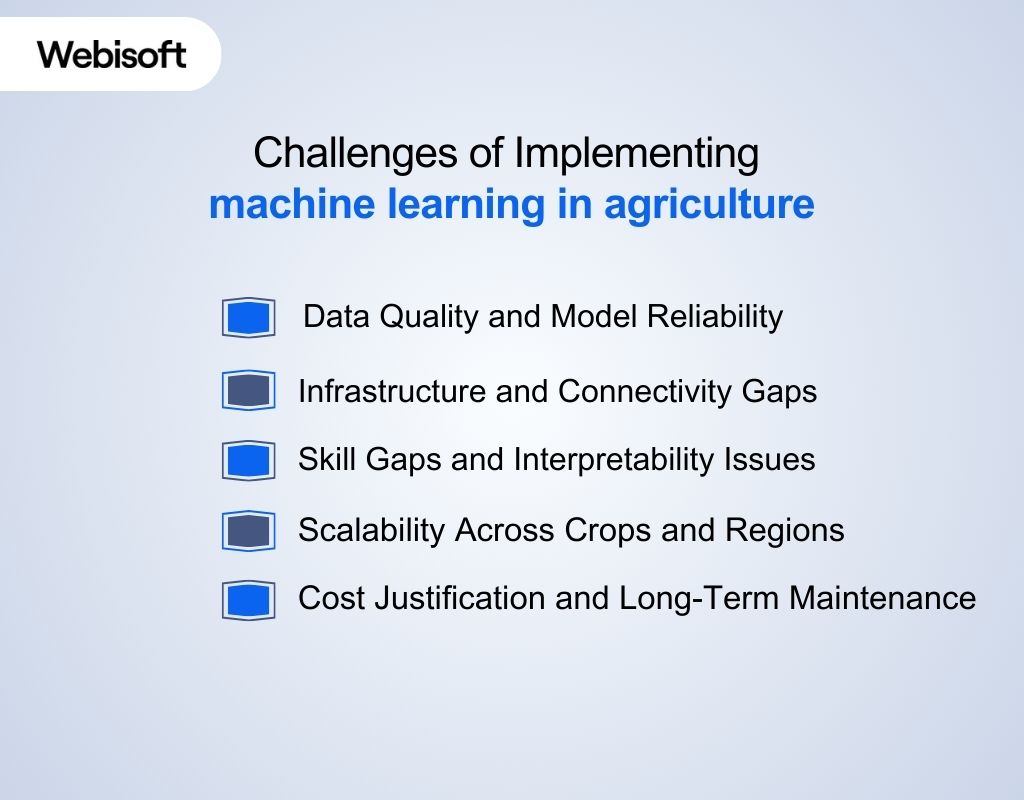
The benefits of machine learning in agriculture are clear. Yet real-world adoption is not simple. Farms face technical, financial, and operational barriers before systems deliver value. Below are the five core challenges that slow or complicate implementation:
Data Quality and Model Reliability
Accurate models depend on clean and diverse data. Many farms collect soil readings, weather logs, and images, but the data often lacks structure or consistent labeling. When training data comes from only one season or one region, predictions fail under new conditions.
This problem affects tools like crop yield prediction using machine learning. If a model learns patterns from a wet season, it may misjudge output during drought years. Without strong agricultural data analytics, prediction accuracy declines over time.
Infrastructure and Connectivity Gaps
Technology requires physical infrastructure. Sensors, drones, cloud storage, and processing systems require capital investment. Smaller farms often hesitate because upfront costs remain high. Reliable internet access also matters.
Many rural areas still struggle with broadband coverage, which affects real-time analytics. Without stable connectivity, systems that rely on IoT and machine learning in agriculture cannot function smoothly.
Skill Gaps and Interpretability Issues
Advanced tools such as CNN for plant disease detection often operate as black-box systems. Farmers see results but do not always understand how the system reached them. This reduces trust in recommendations from computer vision in agriculture platforms.
Interpretability matters because decisions affect cost and yield. When a system recommends adjusting fertilizer rates or irrigation timing, managers want clear reasoning. Transparent dashboards and simplified explanations help build confidence.
Scalability Across Crops and Regions
Agricultural diversity creates scalability challenges. A model trained on wheat fields in one region may not perform well in rice farms elsewhere. Soil structure, humidity, and crop genetics vary significantly. This affects systems like clustering in precision farming, where zoning depends heavily on local soil characteristics.
Applying the same cluster model to a different region often requires retraining. Even forecasting tools face limits. Price forecasting in agriculture models that rely on regional demand signals may fail in international markets. Farms must localize models before expanding operations.
Cost Justification and Long-Term Maintenance
Return on investment remains a major concern. Farms must weigh the machine learning agriculture cost against measurable benefits. Savings from reduced inputs or optimized irrigation may take multiple seasons to appear. Ongoing maintenance adds another layer.
Models supporting soil health monitoring using ML require periodic updates as soil conditions change. Similarly, livestock systems using livestock monitoring using AI demand sensor upkeep and data validation.
How Webisoft Implements Machine Learning in Agriculture
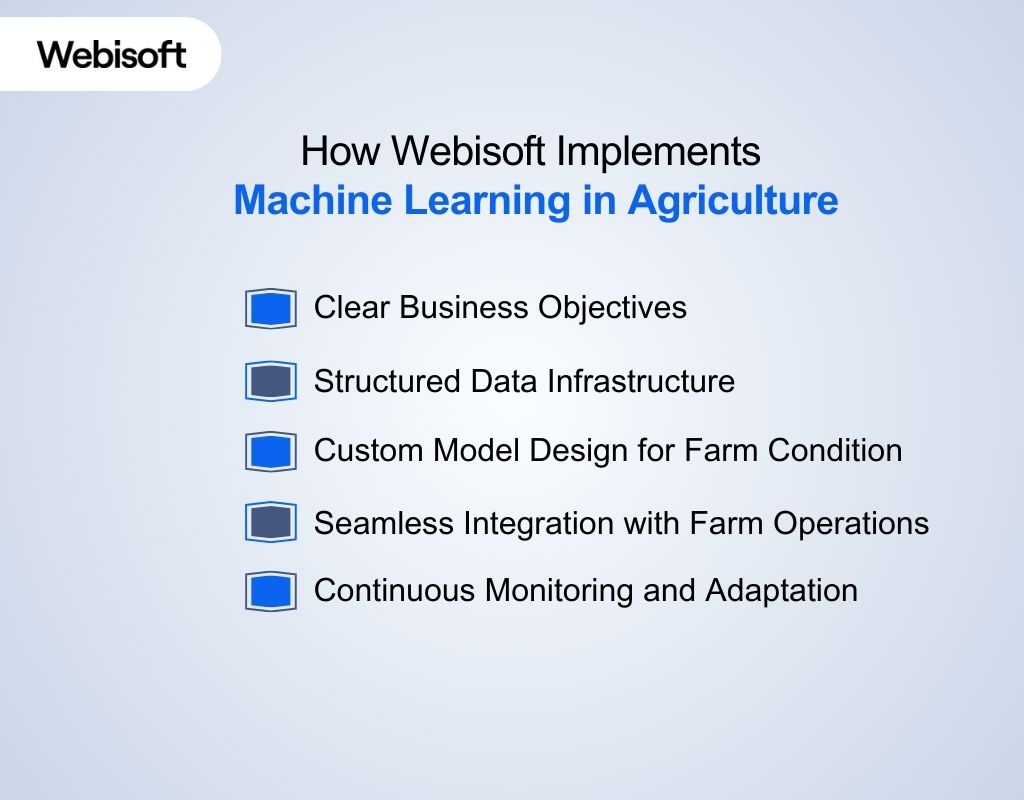
Webisoft approaches machine learning in agriculture as a complete operational system. Farms deal with unpredictable weather, sensor failures, and tight margins. Any solution must work under real field conditions, not just in theory.
Clear Business Objectives
Every implementation starts with defined farm goals. Some operations focus on yield forecasting, while others prioritize irrigation efficiency or disease control. The technical roadmap follows those priorities. Operational workflows and cost pressures are reviewed first. This ensures the solution targets measurable outcomes instead of generic automation. Strategy guides architecture from day one.
Structured Data Infrastructure
Reliable performance depends on clean, connected data. Soil sensors, drone imagery, and weather feeds often exist in separate systems. Integration brings them into one structured pipeline. Automated ingestion, cleaning, and feature engineering prepare the data for modeling.
Strong preprocessing reduces error rates and increases prediction stability. A solid foundation prevents downstream failures.
Custom Model Design for Farm Condition
Different agricultural problems require different model types. Yield estimation, irrigation timing, and image-based disease detection do not rely on the same architecture. Model selection always matches the task and data structure. Historical validation tests performance before deployment.
Confidence scoring and clear output explanations increase transparency. This improves trust in the system’s recommendations.
Seamless Integration with Farm Operations
Adoption becomes easier when insights appear inside familiar dashboards and equipment displays. Existing mobile apps and management tools remain part of the workflow. New intelligence enhances operations without disruption. Field conditions also demand resilience.
Connectivity interruptions and sensor inconsistencies occur regularly. System architecture accounts for these realities to maintain reliability.
Continuous Monitoring and Adaptation
Agricultural environments change over time. Climate variability and soil shifts influence model accuracy. Continuous evaluation prevents performance decline.
Scheduled retraining cycles update models with new data. Controlled rollouts validate improvements before full deployment. This protects farm operations from unexpected disruptions.
Webisoft treats machine learning in agriculture as a long-term capability, not a one-time deployment. Clean data, reliable integration, and ongoing optimization ensure that farm insights remain accurate and actionable as conditions evolve.
Conclusion
Farming no longer runs on instinct alone. Data now shapes planting schedules, irrigation timing, disease control, and market strategy. When used correctly, machine learning in agriculture turns complex field signals into practical, timely decisions.
It helps farms reduce waste, manage risk, and respond faster to climate and price volatility. However, success depends on clean data, proper infrastructure, and ongoing monitoring.
Technology alone does not guarantee results. Farms that combine domain knowledge with structured analytics gain the most value.
As agriculture faces rising pressure from climate change and cost instability, data-driven systems will define the next phase of resilient, sustainable farming.