Many blockchains today face scalability issues, resulting in slow transaction speeds and high fees, which hinder user adoption and limit business growth.
To fix these problems, layer 2 blockchain solutions were created.
They work by moving some transactions away from the main blockchain without changing how it works. This lets transactions happen faster and cheaper, making blockchain easier and better to use solving the blockchain trilemma by a lot.
In this article, we will explain everything about layer 2 solutions including how layer 2 solutions work, why they are important for blockchain’s future, and more.
What Are Layer 2 Blockchain Solutions?
A blockchain is a secure digital ledger. It records every transaction in a chain. But as more people use it, it slows down. The network becomes crowded and costly. This is where Layer 2 solutions come in.
Layer 2 solutions are secondary protocols built on top of a blockchain. They increase transaction capacity without weakening security. By doing so, they relieve the main blockchain from overload. This balance keeps the system fast and trustworthy.
Simply put, layer 2 makes blockchain more affordable and accessible.
Webisoft provides layer 2 blockchain solutions that make blockchains faster and keep them safe, so everything runs smoothly.
Key Features and Benefits of Layer 2
Layer 2 brings good things like faster speed and lower cost. This part shows what makes Layer 2 special and why it matters.
- Off-Chain Transaction Processing: Transactions are processed outside the main blockchain to reduce load and increase speed.
- Batching Transactions: Multiple transactions are bundled together before submitting to Layer 1, reducing on-chain data and fees.
- Cryptograph ic Proofs: Proofs like zero-knowledge proofs or fraud proofs ensure transaction validity without revealing all details.
- Fast Transaction Finality: Users experience quicker confirmations and low-cost transactions compared to Layer 1.
- Security Anchored to Layer 1: Periodic proofs and state updates are submitted to Layer 1 to maintain strong security guarantees.
- Deposit and Withdrawal Mechanisms: Smooth and secure movement of assets between Layer 1 and Layer 2.
- Scalability: Handles a higher volume of transactions, improving overall blockchain throughput.
- Maintaining Decentralization: Relies on Layer 1’s consensus and security, preserving blockchain’s decentralized nature.
Different Types of Layer 2 Scaling Solutions
Layer 2 scaling solutions come in different forms, each designed to make blockchains faster, cheaper, and more efficient while still relying on Layer 1 for security.
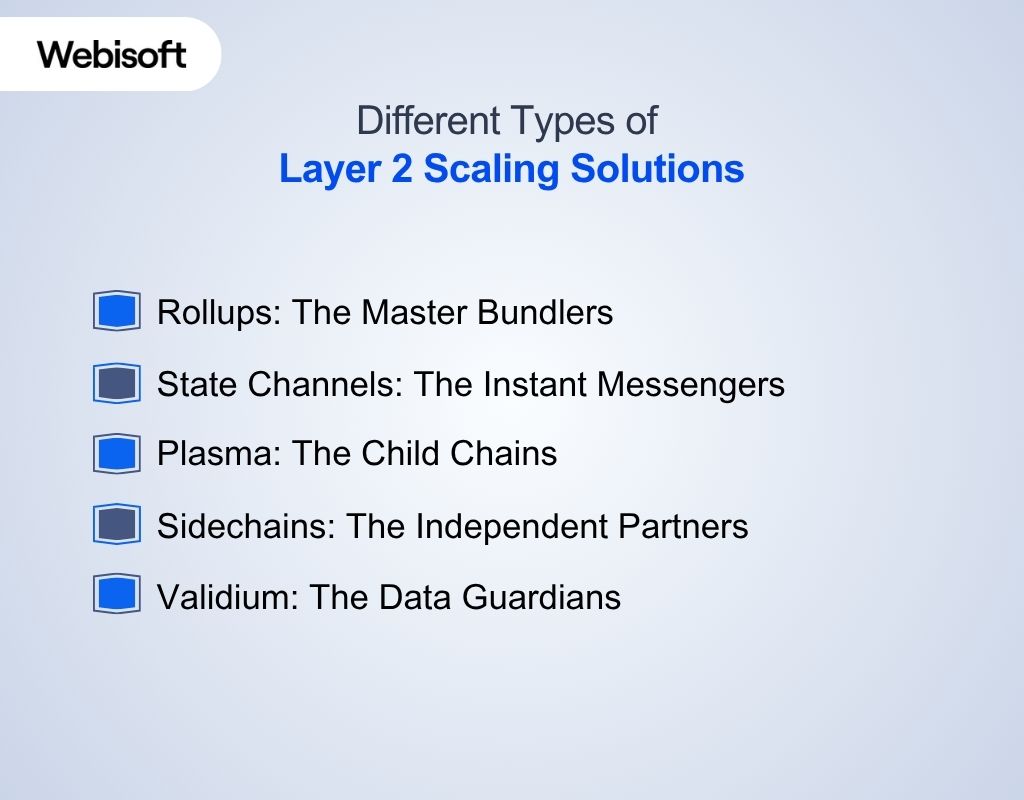
Rollups: The Master Bundlers
Rollups gather a crowd of transactions off-chain, then send a compact proof back to Layer 1. This means fewer messages on the main chain but with the same rock-solid security you expect.
Here are two kinds of rollups:
- Optimistic Rollups: They assume transactions are valid unless challenged during a dispute period. If fraud is detected, fraud proofs are submitted to revert the invalid transaction.
- Zero-Knowledge (ZK) Rollups: These use zero-knowledge cryptographic proofs (such as zk-SNARKs or zk-STARKs) to validate transaction batches without revealing private data, enabling privacy and speed.
State Channels: The Instant Messengers
Imagine chatting with a friend without telling the whole group every message. State channels let two or more users trade back and forth off-chain instantly, only updating the main blockchain when they’re done. Perfect for games, micro-payments, or any rapid back-and-forth where waiting isn’t an option.
Plasma: The Child Chains
Plasma is a Layer 2 framework that enables developers to create smaller, application-specific blockchains known as child chains that operate under a main Ethereum chain. These child chains handle large volumes of transactions independently, but always check back with Layer 1 by periodically submitting state commitments that can be verified through fraud proofs.
Think of them as local deputies managing transactions in their domain while reporting crucial updates back to headquarters. Plasma offers high scalability, though it comes with trade-offs like delayed exits and potential data unavailability risks.
Sidechains: The Independent Partners
Sidechains are full blockchains that run parallel to the main chain but talk to it through a secure bridge. They let users move assets freely back and forth while offloading heavy traffic from Layer 1. It’s a partnership built for scaling, more freedom, more power.
Validium: The Data Guardians
Validium is a scaling solution closely related to ZK Rollups, as both use zero-knowledge proofs to ensure transaction validity. However, unlike ZK Rollups, Validium keeps data off-chain, typically relying on external data availability providers or committees.
This approach significantly boosts scalability by reducing the data load on the main blockchain. Validium ensures correctness with cryptographic proofs, maintaining trust in transaction validity even when the underlying data is stored outside the Ethereum network.
How Layer 2 Blockchain Solutions Work
Step by step, this part shows how Layer 2 handles a transaction. From start to finish, see what really happens behind the scenes.
- Layer 2 takes transactions off the crowded main chain to speed things up and lower costs, so it bundles these transactions into batches to reduce the load sent to Layer 1.
- By bundling, Layer 2 can create a compact cryptographic proof that confirms all transactions in the batch are valid, which is then sent to Layer 1 for verification.
- Layer 1 quickly verifies the proof to ensure correctness, and after verification, it updates its ledger to secure the final transaction state.
- Since most work happens off-chain, users enjoy fast, low-cost transactions on Layer 2, but when stronger security is needed, users can move their assets back to Layer 1.
- This cycle repeats continuously, combining Layer 2’s speed with Layer 1’s trust to provide a safe blockchain experience for everyone.
To deliver effective blockchain solutions for your business, Webisoft develops strong systems designed specifically for you.
Layer 1 vs. Layer 2: Key Differences
Layer 1 and layer 2 blockchain solutions are not the same. They work together but do different things. This part shows how they are different in simple words.
| Feature | Layer 1 Blockchain | Layer 2 Blockchain |
|---|---|---|
| Purpose | Handles transactions and consensus directly on the main chain | Improves scalability and speed by processing off-chain |
| Examples | Bitcoin, Ethereum, Binance Smart Chain | Lightning Network, Polygon, Optimism |
| Transaction Speed | Relatively slower due to on-chain consensus | Faster due to off-chain or sidechain processing |
| Scalability | Limited by block size and consensus speed | Significantly increased by offloading transactions |
| Security | High, secured by the main chain’s consensus mechanism | Depends on Layer 1 security, may vary by design |
| Complexity | More complex, handles all operations natively | Less complex, handles specific tasks off-chain |
| Cost | Higher transaction fees (gas fees) | Lower fees as transactions are bundled or processed off-chain |
| Consensus Mechanism | Uses proof-of-work, proof-of-stake, etc. | Usually inherits Layer 1 consensus or uses simplified mechanisms |
| Data Storage | All data recorded on-chain | Only minimal data or proofs submitted on-chain |
| Use Cases | Secure asset transfer, decentralized apps, smart contracts | Microtransactions, instant payments, scalability solutions |
Challenges and Solutions in Layer 2
Layer 2 has problems too like safety, speed, and tools. But teams are fixing these. Let’s look at what’s hard and how people are solving it.
| Problem | What It Means | How It’s Fixed |
|---|---|---|
| Not fully strong | Some Layer 2 systems are not as strong as the main chain | Use cryptographic proofs (like ZK or fraud proofs) and anchor to Layer 1 for final security guarantees |
| Hard to use | People feel confused using Layer 2 apps or wallets | Improve UX with intuitive interfaces, mobile-friendly wallets, and abstracted gas/payment flows |
| Controlled by few | Some Layer 2s are run by only a few people or groups | Slowly move to control by many people |
| Missing information | Some info is not kept safe and could disappear | Keep important info in trusted places or networks |
| Layers don’t talk well | Hard to move coins or info between Layer 1 and Layer 2 | Use good connections that link both sides properly |
| Different token rules | Coins or NFTs act different on different layers | Make common rules that work everywhere |
| Long waiting time | Sometimes it takes days to move money back to Layer 1 | Use new systems that do not need waiting |
Examples and Real-World Use Cases of Layer 2
Layer 2 is not just an idea, it’s being used today. In payments, games, and more. Here are real examples that show how layer 2 blockchain solutions work in daily life.
| Layer 2 Solution | Works With | Real Example | What It’s Used For |
|---|---|---|---|
| Lightning Network | Bitcoin | Strike, El Salvador | Fast and cheap Bitcoin payments (like buying coffee with Bitcoin) |
| Polygon | Ethereum | Nike .Swoosh, Lens Protocol | Cheaper and faster apps and NFTs (like games and digital art) |
| Arbitrum | Ethereum | Uniswap, GMX | Trading tokens or using DeFi apps without high gas fees |
| Optimism | Ethereum | Synthetix, Coinbase Base | Making Ethereum apps faster and cheaper to use |
| zkSync | Ethereum | Argent Wallet, zkNFTs | Private and low-cost payments or NFTs |
| StarkNet / StarkEx | Ethereum | dYdX, Sorare | Trading and games with fast, secure transactions |
| OMG Network | Ethereum | Used by Tether (USDT) | Sending stablecoins like USDT with lower cost |
| Loopring | Ethereum | Loopring Wallet | Fast crypto payments and trading with very low fees |
Webisoft builds custom Layer 2 solutions that keep things decentralized while making them faster and able to handle more users using the latest layer-2 scaling technology.
Current Trends in Layer 2 Solutions
Things are changing quickly. Some Layer 2 tools are rising, others slowing down. In this part, we look at what’s popular and what’s new right now.
- Rollups Are Rising: Rollups (like Optimistic and ZK-rollups) are getting popular because they bundle many transactions at once, making things faster and cheaper.
- Better ZK Proofs: Zero-Knowledge proofs are getting easier, faster, and less costly, which means ZK-rollups are becoming a strong choice.
- More Blockchains Exploring Layer 2: While Ethereum led the way, other blockchains are now trying out their own Layer 2 ideas.
- User Friendliness is Key: Projects are working hard to hide the technical details so that using Layer 2 feels as simple as using any regular app.
- Lower Fees: Thanks to better data tools, the fees on transactions are dropping, making it more affordable for everyone.
- More Decentralized Networks: Efforts are being made to let more people help run and control Layer 2 networks, reducing central points of control.
- Growing Ecosystems: New apps, games, and tools are popping up on Layer 2 platforms, creating busy and vibrant communities.
- Stronger Bridges: Moving money between Layer 1 and Layer 2 or between different Layer 2s is becoming easier and safer.
The Future of Layer 2 Solutions
Layer 2 is growing fast. More people are using it, and new tools are coming. What will happen next? Let’s take a quiet look at where it’s going.
- Used by Everyone: As more people and businesses use blockchain, layer 2 blockchain solutions will help handle all the extra activity smoothly.
- Faster and Smarter Proofs: The math used to check if transactions are real will get better making things quicker and cheaper.
- No More Waiting or High Fees: Layer 2 will make using blockchain feel like using any fast app instant payments, low fees, no delays.
- Works Across Many Blockchains: In the future, Layer 2 systems will talk to each other, letting users move assets easily between networks.
- Big Companies Will Join In: More businesses will use Layer 2 for payments, contracts, tracking, and more without worrying about high costs.
- New Apps Will Be Possible: Fast games, smart tools, and real-time services will grow thanks to Layer 2 speed.
- Keeps the Network Strong and Fair: By taking pressure off Layer 1, it helps keep blockchain safe, simple, and open for everyone.
- Better for the Planet: Less energy is used because fewer things are written to Layer 1, making blockchain more eco-friendly.
Layer 2 Blockchain Made Easy by Webisoft
At Webisoft, we believe this technology should be easy for everyone to use. So, we put together layer 2 blockchains that work for what you need- no matter if it’s fast payments, apps that can grow with you, or safe ways to handle digital assets.
Here’s what you get:
- Layer 2 blockchains made to grow smoothly with your business.
- Smart contracts are set up carefully and checked to keep things safe.
- Easy ways to connect Layer 2 tools with your current systems.
- Digital tokens that open new doors by turning real assets into online form.
- Layer 2 apps built for your area, like finance, gaming, and more.
- Fast, low-cost transactions you can trust every time.
With Webisoft, Layer 2 blockchain stops being complicated and becomes a handy tool to move forward and try out new things.
Conclusion
So, we’ve reached the end with a clear view of layer 2 blockchain solutions. These are not just extra parts but are important, especially when blockchains are slow or cost too much.
By handling more work in a smarter way, Layer 2 improves performance without changing the main system.
And at Webisoft, we provide strong blockchain services for teams ready to move forward without limits. No matter if you’re starting new or fixing an old one, we’re always here to support you with proven expertise.
Frequently Asked Questions
zkSync uses zero-knowledge proofs to confirm transactions without revealing user data. By sending only proofs to Ethereum, it cuts processing time and fees. This approach boosts privacy and speed, making Ethereum more efficient and user-friendly.
Plasma chains send only final transaction results to Ethereum, limiting complex uses since full data stays off-chain. Rollups, especially ZK-Rollups, send compressed data or proofs to Ethereum, allowing secure, detailed verification. This makes Rollups stronger for scaling and complex apps.
Yes, Layer 2 solutions group many transactions off-chain and submit proofs to Ethereum. This reduces network load and costs, making transactions faster while keeping Ethereum’s security intact. Layer 2 brings Ethereum closer to mass use.