Blockchain data is public and permanent, but understanding it is rarely straightforward. With endless transactions, anonymous wallets, and complex smart contracts, the real challenge is knowing how to analyze blockchain data in a way that leads to clear, useful insights.
Many teams struggle to extract meaningful patterns. The data is there, just unused or misread. That’s where Webisoft can help, offering expert support to structure, visualize, and translate blockchain activity into actionable information.
This guide walks you through the entire process, from defining your goals to analyzing and interpreting blockchain data with confidence.
Types of Blockchain Data to Analyze
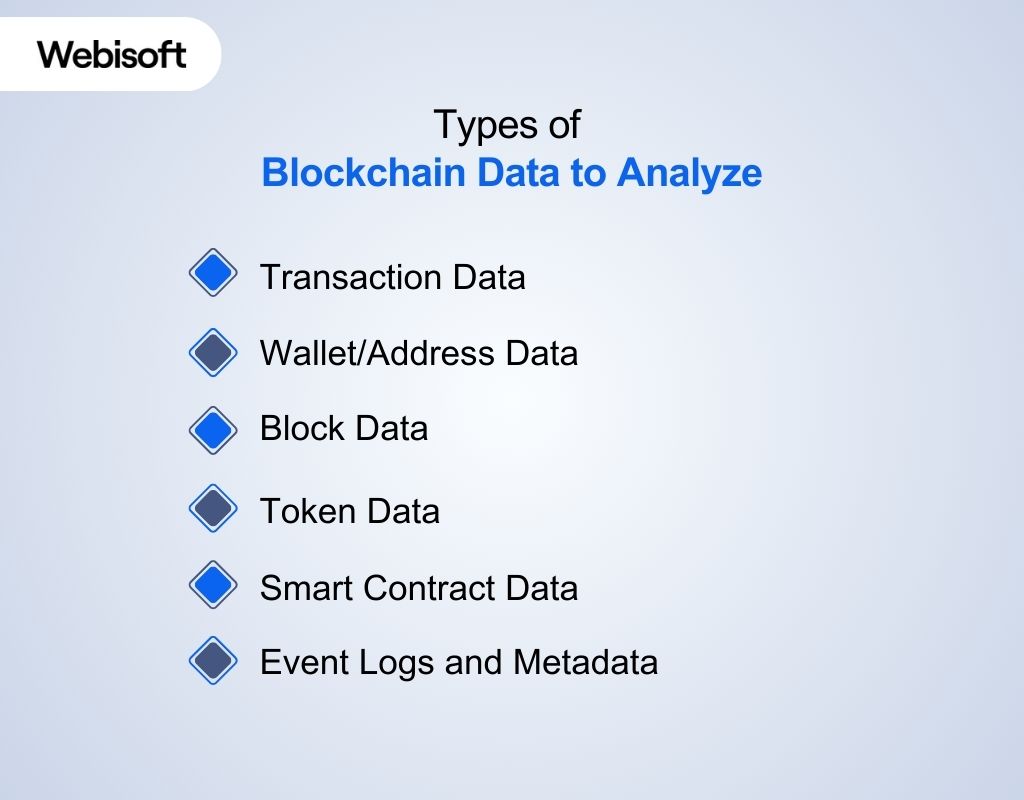
Before you analyze blockchain data, it’s important to know the kinds of data available, such as transaction records and smart contract details. This helps focus your efforts in the right direction.
- Transaction Data: Records of value sent between addresses, showing who sent what, when, and the fees paid. Analyzing transactions helps track fund movement and spot patterns.
- Wallet/Address Data: Shows a wallet’s balance, token holdings, and transaction history. This reveals how active or valuable a wallet is.
- Block Data: Blocks group transactions and include a unique number and timestamp. Studying blocks helps understand blockchain growth and transaction frequency.
- Token Data: Details about digital assets like cryptocurrencies or NFTs, including transfers, balances, and supply. This tracks token ownership and usage.
- Smart Contract Data: Includes contract addresses, function calls, and outcomes. Analyzing this reveals how contracts are used and if they work properly.
- Event Logs and Metadata: Logs record special actions from smart contracts during transactions, offering deeper insight into contract activities beyond basic transfers.
Best Tools to Analyze Blockchain Data Effectively
Knowing how to analyze blockchain data starts with choosing the right tools. The right tools make blockchain transaction analysis easier and more accurate. Here, you’ll find popular and user-friendly tools to help you manage blockchain data.
| Tool Name | Best For | Platform/Blockchain Supported |
|---|---|---|
| Etherscan | Viewing Ethereum transactions | Ethereum |
| Dune Analytics | Custom dashboards & SQL queries | Ethereum, Polygon, Optimism, others |
| Covalent | API access to multi-chain data | Ethereum, Binance Smart Chain, Polygon, Avalanche, and many more |
| Moralis | Real-time data & APIs | Ethereum, Binance Smart Chain, Polygon, Avalanche, Solana, others |
| Bitquery | Advanced data querying | Multiple blockchains including Bitcoin, Ethereum, Binance Smart Chain |
| The Graph | Indexing & querying blockchain | Ethereum, IPFS, Polygon, others |
| Google BigQuery | Large-scale blockchain analysis | Ethereum, Bitcoin, Binance Smart Chain |
| Nansen | Wallet & token analytics | Ethereum, Binance Smart Chain, Polygon |
| Blockchair | Multi-blockchain explorer | Bitcoin, Ethereum, Ripple, Bitcoin Cash, Litecoin |
Step-by-Step Guide to Analyze Blockchain Data
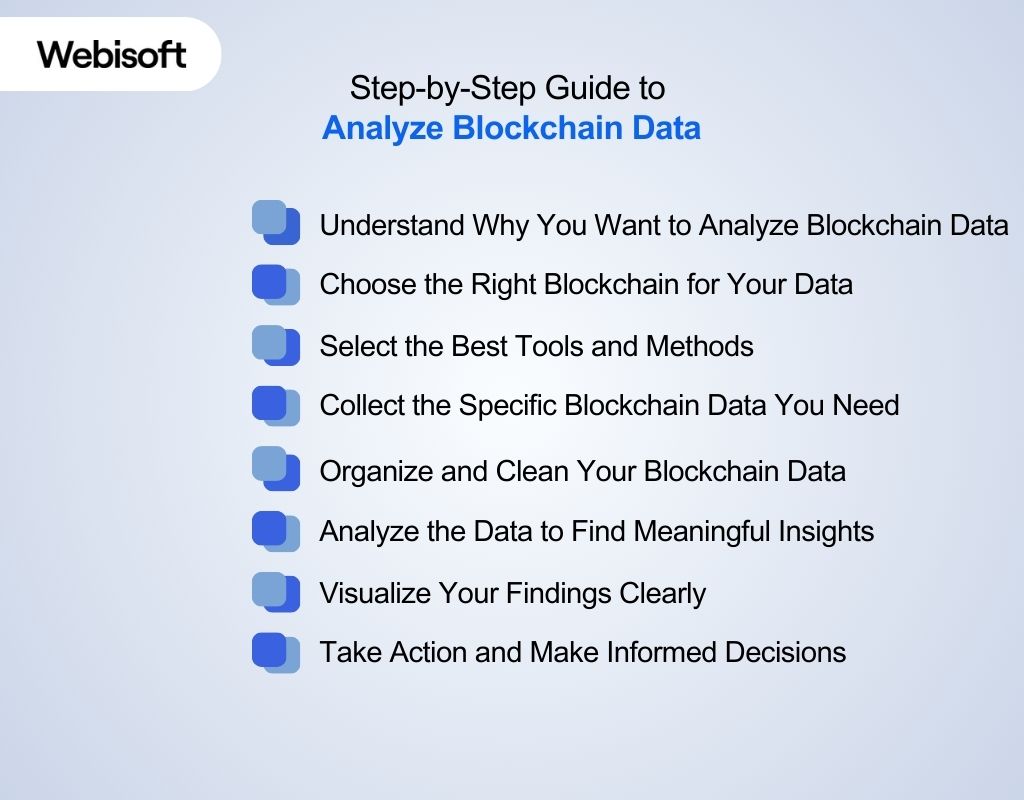
Learn how to analyze blockchain data with clear steps from collecting to interpreting it. This guide breaks down the process so you can confidently work with blockchain information.
Step 1: Understand Why You Want to Analyze Blockchain Data
Every successful analysis begins with a clear intention. The blockchain is like a vast ocean of data, filled with information on wallets, tokens, contracts, gas fees, and more.
But without a purpose, it’s easy to get overwhelmed or distracted. So pause and ask yourself: What am I honestly trying to learn or find? Defining your ‘why’ will shape what data you look at, what tools you use, and how deep you go
Common reasons people analyze blockchain data:
- Track wallet activity: Understand how specific wallets spend, receive, or hold assets.
- Follow token movements: See how a particular token is being used or distributed.
- Monitor smart contracts: Analyze who is interacting with a contract and how often.
- Study transaction patterns: Spot trends like gas fee spikes, trading volume, or unusual behaviors.
Knowing your goal saves time, keeps your focus sharp, and helps you extract insights that actually matter.
Well, once your purpose is clear, the next move is to choose the right blockchain where this data exists because not all chains work the same or hold the same kinds of information.
Step 2: Choose the Right Blockchain for Your Data
Not all blockchains are the same. Each one stores different types of data and supports different tokens, contracts, and users. To get useful information, you must pick the blockchain that fits your analysis goal.
For example, if you want to track Ethereum-based tokens, you’ll focus on the Ethereum blockchain. If you’re interested in faster, cheaper transactions, a chain like Binance Smart Chain or Polygon might be better.
Factors to consider when choosing a blockchain:
- Does it support the tokens, wallets, or contracts you want to study?
- What type of data is publicly available on its explorer?
- How active is the network—does it have enough transactions to analyze meaningful patterns?
- Are there good tools or APIs that can help access this blockchain’s data easily?
Choosing the right blockchain saves time and ensures you’re analyzing the right data for your questions.
After choosing the blockchain, decide on the best tools and methods to collect and examine the data.
Step 3: Select the Best Tools and Methods to Access Blockchain Data
Once you know which blockchain to analyze, the next step is to choose the right tools to collect and explore the data. Blockchain data can be complex and vast, so using the right tools makes your work easier and more effective.
Some tools offer user-friendly interfaces, while others provide powerful APIs for custom analysis.
What to consider when selecting tools:
- Are you comfortable with coding, or do you need a no-code solution?
- Do the tools provide real-time data or historical records?
- Can they access the specified data types you need (wallet activity, token transfers, smart contract calls)?
- Are there dashboards, charts, or export options to help visualize and use the data?
Picking the right tools lets you focus on understanding the data instead of struggling to get it.
With tools in place, you’re ready to collect the specific blockchain data that answers your questions.
Step 4: Collect the Specific Blockchain Data You Need
Now that you have chosen your tools, it’s time to collect the exact data that aligns with your analysis goals. This could be transaction histories, wallet balances, smart contract interactions, or token transfers. Focus on collecting only the data relevant to your purpose to avoid overload.
Tips for effective data collection:
- Use filters to narrow down data by addresses, time frames, or transaction types.
- Export data in formats you can easily analyze (like CSV or JSON).
- Double-check that the data covers the period and scope you want.
- Be mindful of data limits or API rate restrictions if using automated tools.
Collecting focused, clean data helps you avoid confusion and speeds up your analysis.
Once you have your data, the next step is to organize and clean it so you can draw clear insights.
Step 5: Organize and Clean Your Blockchain Data
Raw blockchain data can be messy and hard to understand. Organizing and cleaning your data means arranging it in a clear format and removing any errors or irrelevant information. This step makes your analysis accurate and easier to perform.
What to do when organizing and cleaning data:
- Sort data by date, wallet address, or transaction type to spot patterns.
- Remove duplicates or incomplete records that could skew your results.
- Fill in any missing values if possible or mark them clearly.
- Format data into tables or spreadsheets for easier handling.
Cleaning your data ensures your conclusions are based on reliable and easy-to-read information.
After your data is ready, you can start the real work — analyzing the data to find meaningful insights.
Step 6: Analyze the Data to Find Meaningful Insights
With your clean and organized data ready, now it’s time to look closely and find patterns, trends, or unusual activities that answer your original questions. Analysis helps you turn raw numbers into useful knowledge.
Focus areas during analysis:
- Identify transaction trends such as volume spikes or frequent transfers.
- Track wallet behaviors to spot active or suspicious accounts.
- Examine token flows to understand how tokens move through the network.
- Look for smart contract usage patterns or repeated calls.
Effective analysis reveals valuable stories behind the data, helping you make informed decisions or predictions.
After analysis, you’ll want to visualize your findings to communicate them clearly to others.
Step 7: Visualize Your Findings Clearly
After analyzing your blockchain data, presenting it visually makes your insights easier to understand and share. Charts, graphs, and dashboards can highlight important trends and patterns in a way that’s clear for anyone to grasp—even those new to blockchain.
Why visualization matters:
- Helps spot trends and outliers quickly.
- Makes complex data accessible and understandable.
- Supports better communication with team members or stakeholders.
- Enables informed decision-making based on clear evidence.
Use tools like Excel, Tableau, or blockchain-specific dashboards to create visuals that best suit your data and audience.
With your findings visualized, the final step is to take action or make decisions based on your analysis.
Step 8: Take Action and Make Informed Decisions
Now that you have analyzed and visualized your blockchain data, it’s time to use these insights to make smart decisions. Whether you’re tracking investments, improving security, or optimizing blockchain projects, your analysis guides your next moves.
What to do with your insights:
- Adjust your strategies based on transaction trends or wallet behaviors.
- Identify risks or suspicious activities and take preventive measures.
- Improve or optimize smart contracts or token management.
- Share findings with your team or community to align everyone’s efforts.
Taking action based on data turns information into real-world value and progress.
Real-World Use Cases of Blockchain Data Analysis
Discover practical examples of blockchain data analysis in use today. This section highlights how businesses apply blockchain analytics to improve security and efficiency.
| Use Case | Description | Example Scenario | Key Benefits |
|---|---|---|---|
| Fraud Detection | Detects unusual or suspicious transactions to prevent scams and theft | Identifying fake ICO transactions or phishing wallets | Protects users, reduces financial losses |
| Market Trends Analysis | Analyzes token trading volumes, price movements, and user behavior | Tracking DeFi token popularity and price trends | Helps investors make data-driven decisions |
| Compliance & Auditing | Monitors transactions to ensure adherence to regulations like AML/KYC | Generating audit trails for regulatory bodies | Ensures legal compliance and transparency |
| Network Performance | Evaluates block times, transaction throughput, and fee patterns | Detecting congestion or delays on Ethereum network | Optimizes network efficiency and user experience |
| DeFi Risk Management | Assesses smart contract interactions and liquidity risks | Monitoring lending protocols to avoid defaults | Minimizes financial risks and improves trust |
| NFT Ownership Tracking | Verifies provenance and transfer history of digital collectibles | Tracking ownership history of popular NFTs like CryptoPunks | Builds user trust and protects creators’ rights |
| User Behavior Insights | Studies wallet activity and transaction patterns to improve applications | Understanding user engagement in a Web3 game | Improves app features and increases retention |
| Token Distribution | Monitors distribution fairness and concentration among holders | Ensuring fair token launch by analyzing holder distribution | Supports governance and prevents centralization |
Common Challenges in Blockchain Data Analysis
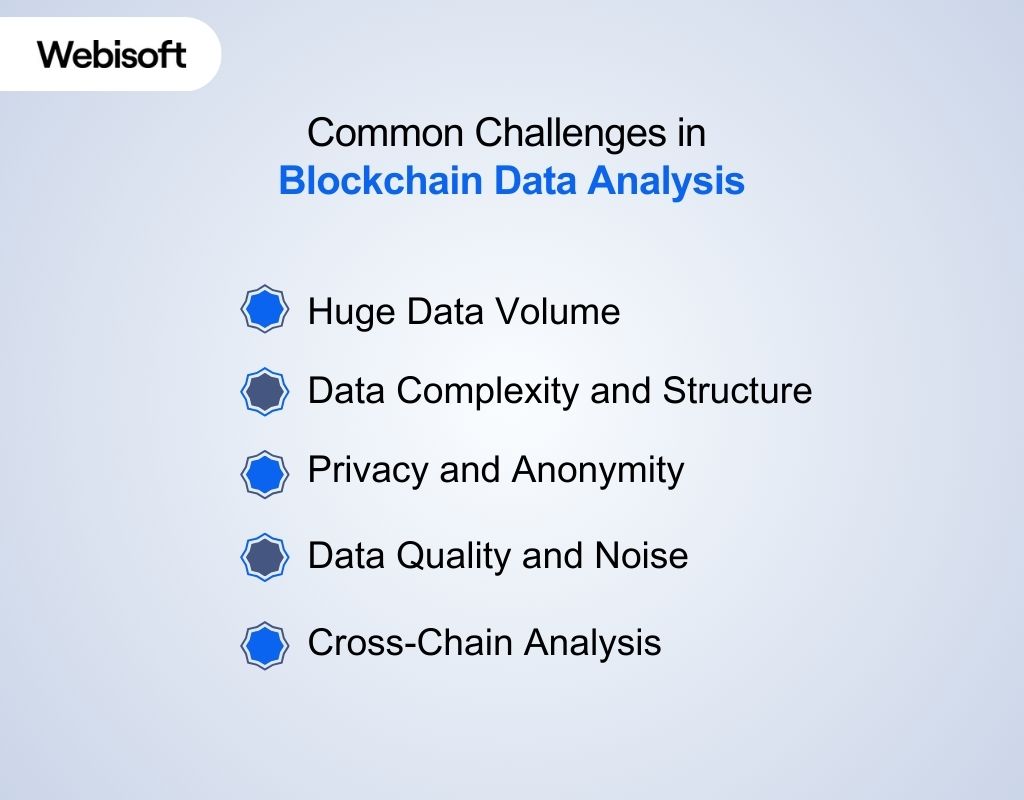
When you analyze blockchain data, you may face issues like data size or privacy concerns. This part explains common problems and how to handle them effectively.
- Huge Data Volume: Blockchains keep growing as new blocks and transactions are added every second. This huge amount of data requires powerful storage and computing resources, or else analysis becomes slow and difficult.
- Data Complexity and Structure: Blockchain data isn’t stored like regular databases; it’s linked in blocks using cryptography. Understanding this complex structure needs special knowledge and varies between different blockchains.
- Privacy and Anonymity: Blockchain addresses don’t reveal who owns them, making it hard to connect data to real people. This complicates identifying bad actors and requires combining blockchain data with off-chain information.
- Data Quality and Noise: Blockchains record everything, even failed transactions and extra metadata. Filtering out this noise is essential to find meaningful patterns, but it can be challenging.
- Cross-Chain Analysis: Many blockchains exist with different formats and rules, so analyzing data across multiple chains is tricky. It often needs specialized tools or custom solutions to integrate and compare data properly.
Advanced Techniques in Blockchain Data Analytics
Explore advanced ways of how to analyze blockchain data, such as using machine learning and pattern detection, to get deeper insights and improve your blockchain projects.
- Graph Analysis: Graph analysis views wallets as points and transactions as connections, helping uncover hidden relationships. This approach can spot fraud rings, coordinated attacks, and key influencers in token flows.
- Machine Learning and AI: Machine learning learns from past blockchain data to find patterns and predict future behavior. It’s useful for detecting suspicious transactions, forecasting market trends, and automating alerts.
- Natural Language Processing (NLP): NLP helps analyze text data related to blockchain, like contract comments or social media posts. By understanding language context, it reveals user sentiment and improves risk evaluation.
- Clustering and Classification: These methods group similar wallets or transactions to identify types of users and activities. This insight helps customize services and detect unusual behaviors more effectively.
- Time-Series Analysis: Looking at blockchain data over time uncovers trends, cycles, and sudden changes. This helps track transaction volumes, fee fluctuations, and supports better planning for future events.
Why Analyzing Blockchain Data Is Crucial for Web3 Success
Looking at blockchain data analytics helps you understand how Web3 projects work better. In fact, a recent report shows that 72% of successful Web3 projects rely heavily on data-driven insights to optimize their platforms and user experience.
Well, this part explains why blockchain data analysis is important for making good decisions and building strong apps.
- Build Trust and Transparency: Blockchain data is public but often hard to understand. By analyzing it carefully, you can prove transactions and smart contracts work correctly, which builds user trust and confidence.
- Enhance User Experience: Users may face issues like high fees or slow transactions without realizing why. Studying their interactions helps developers fix these problems, making the platform easier and more enjoyable to use.
- Monitor Network Health and Security: Blockchains rely on many computers working together smoothly. Regular data analysis helps spot delays or suspicious activity early, protecting the network from failures or attacks.
- Guide Smart Business Decisions: Understanding how tokens move and how users behave gives projects valuable insights. These insights help teams make better choices about marketing, features, and growth.
- Support Regulatory Compliance: Governments require clear records to prevent fraud and money laundering. Analyzing blockchain data creates transparent reports that help projects follow laws and avoid legal trouble.
How Webisoft Helps You Analyze Blockchain Data
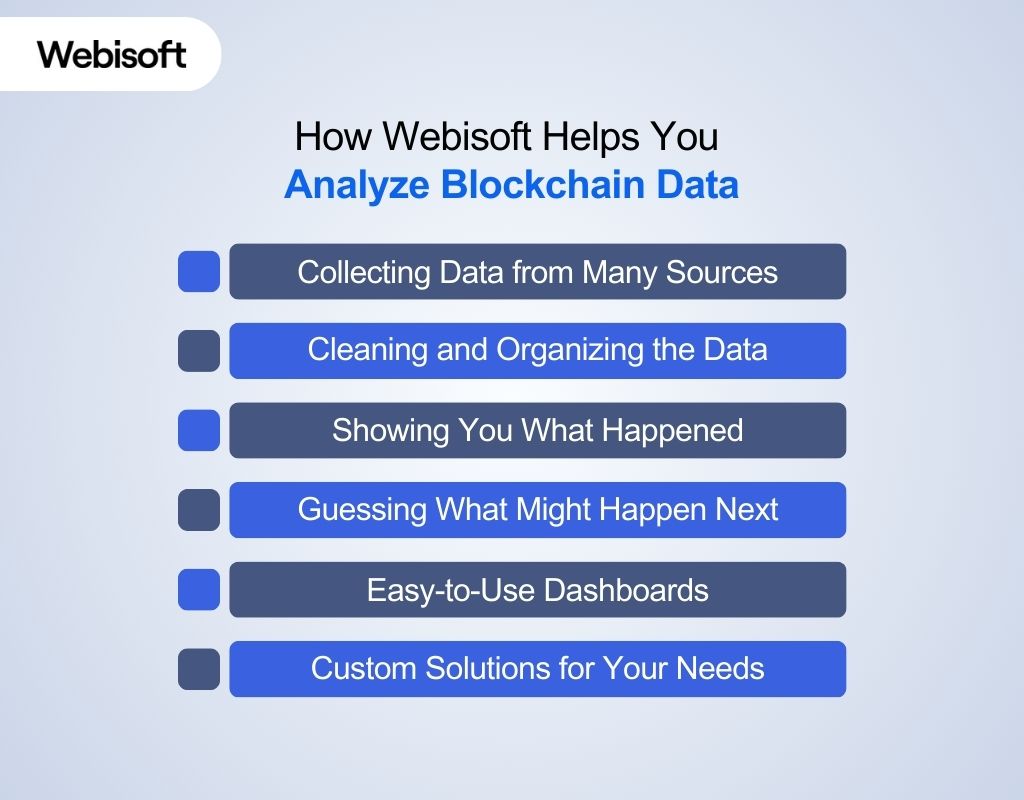
At Webisoft, we turn complex blockchain data into simple and useful information. Our skilled team uses smart tools and deep knowledge to help you understand your data, reduce risks, and find new chances to grow in the Web3 world. So why you should consider Webisoft’s data analytics services:
- Collecting Data from Many Sources: We bring together data from blockchains, smart contracts, and other tools—all in one place for you.
- Cleaning and Organizing the Data: Blockchain data can be messy. We fix it, remove errors, and put it in the right format so it’s easy to use.
- Showing You What Happened: We make reports and charts that show past data. This helps you understand how your project or token has been used over time.
- Guessing What Might Happen Next: We use smart tools like machine learning to guess future trends. This helps you prepare for risks or grab new chances early.
- Easy-to-Use Dashboards: We build dashboards that show wallet activity, contract use, token movement, and more—all in real time and in a clear way.
- Custom Solutions for Your Needs: Whether you need reports for investors or want to track project growth, we create tools just for you.
In Closing
Knowing how to analyze blockchain data is important to find useful information from blockchain networks. To start with, looking closely at transactions and activity helps you understand what is actually happening.
Step by step, this guide shows you an easy way to analyze blockchain data so you don’t get lost in the details.
When you want to go further, Webisoft’s data analytics services are ready to provide expert help and tools. With our support, turning blockchain data into clear insights becomes simple and useful.
Frequently Asked Questions
Basic coding skills can help, especially for using tools or writing scripts. But some platforms offer easy-to-use interfaces that don’t require coding.
Blockchain analytics can help detect suspicious activities early, which helps reduce fraud. While it can’t stop fraud completely, it improves security by spotting unusual patterns.
It can be challenging at first because blockchain data is different from regular data. But with practice and good learning resources, beginners can understand and analyze blockchain data.
Yes, but it is more complex because each blockchain has its own structure. Specialized tools or platforms can help combine and analyze data across different blockchains.
You can learn from online courses, tutorials, blockchain blogs, and websites like Coursera, Udemy, or official blockchain project docs. Also, following Webisoft’s resources can be helpful.