Share


How Does Stablecoin Work? Everything You Need to Know

- BLOG
- Blockchain
- October 13, 2025
Stablecoins solve one of the biggest problems in cryptocurrency—volatility. Unlike Bitcoin or Ethereum, which can swing wildly in price, stablecoins are designed to hold a steady value.
This makes them ideal for payments, trading, and savings. But how does stablecoin work?
A stablecoin maintains its value by being pegged to a stable asset, such as the U.S. dollar, gold, or a basket of currencies. This stability is achieved through fiat reserves, crypto collateral, or algorithmic mechanisms. Stablecoins are widely used in crypto trading, DeFi, and cross-border transactions.
But not all stablecoins are the same. Some are backed by real assets, while others rely on complex algorithms. Keep reading to find out the differences and comprehensive details about stablecoin.
Contents
- 1 How Does Stablecoin Work?
- 2 Create Your Own Stablecoin with Webisoft Now!
- 3 How Do Stablecoins Make Money?
- 4 Centralized vs. Decentralized: Who Controls Stability?
- 5 The Process of Issuing and Redeeming Stablecoins
- 6 Stablecoin vs Bitcoin vs Ethereum: What’s the Difference?
- 7 Best Stablecoins for Transactions and Trading
- 8 Conclusion
- 9 Create Your Own Stablecoin with Webisoft Now!
- 10 FAQs
How Does Stablecoin Work?

The stablecoin working mechanism varies based on the type of backing. The answer depends on the mechanism behind their price stability.
1. Reserve-Backed Stability (Fiat & Commodity-Backed Stablecoins)
Fiat-backed stablecoins, like USDT (Tether) and USDC (USD Coin), maintain their value by holding equivalent reserves in cash, bonds, or other assets. For every 1 USDT issued, there’s $1 in reserves backing it.
The same applies to gold-backed stablecoins like PAXG, which holds physical gold reserves to maintain value. How does it work?
- A company issues new stablecoins only if they have equivalent reserves.
- Users can redeem stablecoins for fiat currency, keeping the price stable.
2. Over-collateralization (Crypto-Backed Stablecoins)
Some stablecoins, like DAI, are backed by cryptocurrencies such as Ethereum. Since crypto prices are volatile, these stablecoins require more collateral than their actual value. For example:
- If you want to mint 100 DAI, you might need to deposit $150 worth of ETH as collateral.
- If ETH drops in value, the system automatically liquidates assets to maintain the peg.
3. Algorithmic Adjustments (Non-Collateralized Stablecoins)
One of the types of stablecoins is algorithmic stablecoins. It doesn’t have any reserves. Instead, they use smart contracts to control the supply and demand of coins. If the price rises above $1, new coins are minted to increase supply and lower the price.
In case the price drops below $1, coins are burned (removed from circulation) to reduce supply and push the price up.
However, this method is riskier—as seen in the TerraUSD (UST) collapse, where the algorithm failed to maintain the peg.
4. Arbitrage Mechanisms
Traders also help keep stablecoin prices stable through arbitrage. If a stablecoin drops below $1, traders buy it cheap and redeem it for $1 worth of reserves, profiting in the process. This demand pushes the price back to $1.


Create Your Own Stablecoin with Webisoft Now!
Reach out to Webisoft for comprehensive solutions in creating and managing stablecoins.
How Do Stablecoins Make Money?
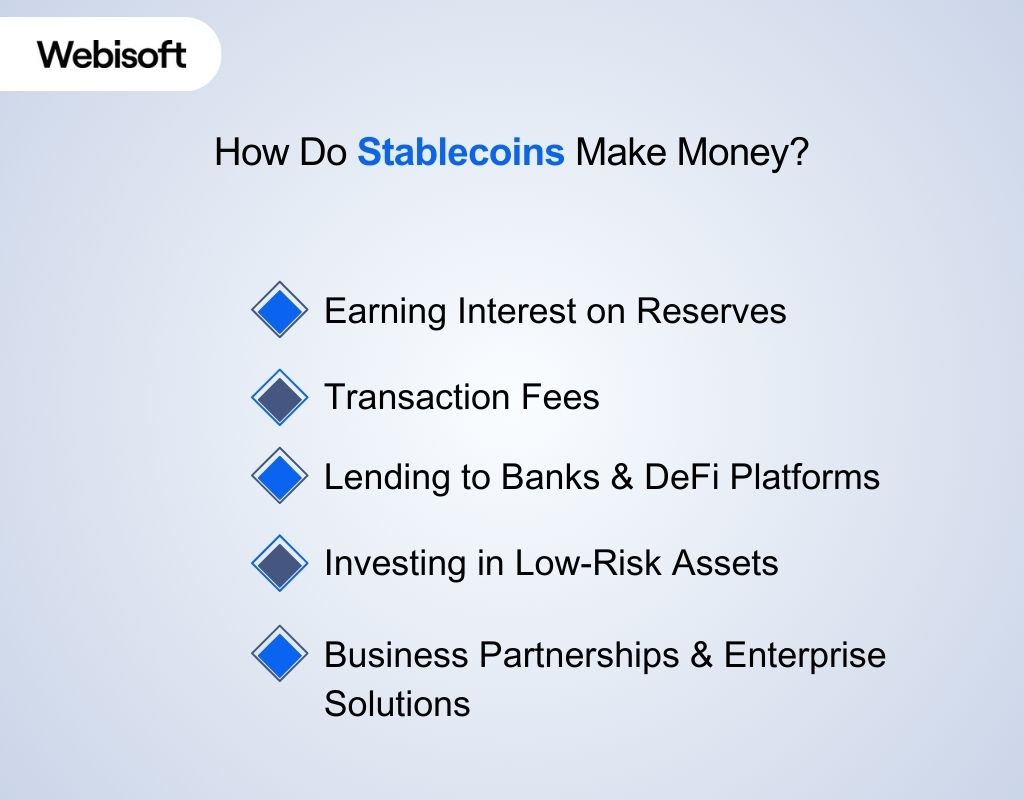
Stablecoins don’t increase in value, but issuers like Tether (USDT), Circle (USDC), and MakerDAO (DAI) still make billions in revenue each year. Here’s how they do it:
1. Earning Interest on Reserves
Stablecoin issuers hold billions in cash reserves in banks and government bonds that generate interest.
When you buy 1 USDC for $1, Circle holds that $1 in a bank and earns 2–5% interest annually—keeping the profits. The more stablecoins in circulation, the more interest they earn.
2. Transaction Fees on Conversions and Transfers
Some stablecoins charge fees when users buy, redeem, or transfer stablecoins across blockchains.
For example, USDC charges a 0.1% cash-out fee, and USDT charges up to $100 for direct withdrawals. With millions of transactions daily, these small fees add up fast.
3. Lending to Banks & DeFi Platforms
Stablecoin issuers lend reserves to banks, financial institutions, and DeFi platforms to earn interest. They provide liquidity for loans and yield farming, making money as borrowers pay interest.
Tether, for instance, lends part of its $80 billion reserves for higher returns.
4. Investing in Low-Risk Assets
Instead of keeping all reserves in cash, issuers invest in U.S. Treasury bonds and short-term securities, which generate safe, steady returns.
If Tether invests $50 billion in government bonds at a 3% yield, it earns $1.5 billion annually—without issuing new coins.
5. Business Partnerships & Enterprise Solutions
Stablecoin companies partner with banks, crypto exchanges, and payment providers to offer liquidity solutions, stablecoin payments, and custom financial services.
For example, Visa works with Circle (USDC) to enable global stablecoin payments. These partnerships create new revenue streams beyond just crypto users.
Centralized vs. Decentralized: Who Controls Stability?
Stablecoins can be centralized or decentralized, which impacts their transparency, trust, and risk factors.
Centralized stablecoins are controlled by private companies that issue and manage reserves. In contrast, decentralized stablecoins rely on algorithms and smart contracts to function autonomously.
| Type | Control | Transparency | Risk Level |
| Centralized Stablecoins (USDT, USDC) | Controlled by companies (Tether, Circle) | Audited reserves (varies by issuer) | Risk of regulation & mismanagement |
| Decentralized Stablecoins (DAI, FRAX) | Algorithmic & community-controlled | On-chain transparency | Smart contract failures, market crashes |
Centralized stablecoins like USDT and USDC are easier to use and widely accepted, but they require trust in the issuer. If the company behind a stablecoin fails to maintain adequate reserves or faces regulatory issues, users may lose confidence in its stability.
Decentralized stablecoins like DAI and FRAX, on the other hand, operate on public blockchains with transparent smart contracts. However, they are exposed to market risks, smart contract vulnerabilities, and liquidity issues.
The Process of Issuing and Redeeming Stablecoins
Stablecoins are issued when users deposit collateral (fiat or crypto) into the system, and they are redeemed when users exchange their stablecoins back for the original collateral.
There are three common ways to obtain stablecoins: buying from crypto exchanges, minting directly from issuers, and earning them through DeFi platforms.
When users want to cash out stablecoins, they can either convert them to fiat on exchanges, redeem them directly from the issuer (if supported), or swap them for other cryptocurrencies.
Fiat-backed stablecoins like USDC can be redeemed for cash directly, whereas crypto-backed stablecoins like DAI require users to unlock their collateralized assets before withdrawing funds.
Stablecoin vs Bitcoin vs Ethereum: What’s the Difference?
All three are cryptocurrencies, but their purpose and functionality vary significantly. Here is the key difference between them:
| Feature | Stablecoins (USDT, USDC) | Bitcoin (BTC) | Ethereum (ETH) |
| Volatility | Low (stable value) | High (price fluctuates) | Moderate (varies with demand) |
| Use Case | Payments, trading, DeFi | Store of value, investment | Smart contracts, dApps |
| Backing | Fiat, crypto, or algorithmic | No backing (decentralized) | No backing (network utility) |
If you’re looking for price stability in crypto transactions, stablecoins are the go-to option.
Best Stablecoins for Transactions and Trading
If you’re looking for reliable stablecoins, here are some of the most widely used options:
- USDT (Tether) – Most popular, but has faced transparency concerns.
- USDC (USD Coin) – Fully backed by cash reserves, widely trusted.
- DAI – A decentralized option with crypto backing.
- BUSD (Binance USD) – Regulated and approved by U.S. authorities.
- PAXG – Best if you prefer a gold-backed stablecoin.
Conclusion
Stablecoins have changed digital payments by bringing stability and efficiency. You can use them for secure transactions, trading, and DeFi applications without worrying about price swings.
As regulations evolve and CBDCs enter the market, stablecoins will play a bigger role in finance. They offer a bridge between traditional banking and digital assets.
If you’re looking to develop a stablecoin or integrate one into your business, Webisoft can help. Their blockchain expertise makes the process smooth and secure.
Create Your Own Stablecoin with Webisoft Now!
Reach out to Webisoft for comprehensive solutions in creating and managing stablecoins.
FAQs
Here are some FAQs that’ll help you understand how does stablecoins work better:
How do stablecoins maintain their price stability?
Stablecoins achieve stability through three main mechanisms: fiat-backed (holding reserves in banks), crypto-backed (collateralized by other cryptocurrencies), and algorithmic (using smart contracts to control supply based on market conditions).
Are stablecoins safe to use?
Stablecoins are generally safer than volatile cryptocurrencies, but risks exist, including depegging, lack of transparency, regulatory challenges, and centralization concerns. Choosing reputable stablecoins with proper audits and backing can reduce risks.
How do stablecoins differ from regular cryptocurrencies like Bitcoin?
Unlike Bitcoin, which fluctuates based on market demand, stablecoins are designed to maintain a steady value, making them ideal for payments, remittances, and trading without worrying about price swings.
Why do people use stablecoins instead of traditional fiat currency?
Stablecoins offer the stability of fiat currency while providing the benefits of blockchain technology, such as fast transactions, low fees, global accessibility, and decentralized finance (DeFi) applications.
How do stablecoins generate yield or interest?
Many stablecoins can be staked or lent in DeFi protocols, centralized exchanges, or lending platforms, where users earn interest through lending, liquidity pools, or yield farming.
