Share


Ultimate Guide to Hire AI Developer Effectively

- BLOG
- Artificial Intelligence
- October 8, 2025
Almost everyone’s using AI now. In fact, 78% of global companies say it’s part of their daily work. That number sounds impressive, but here’s the twist: Forbes warns that up to 85% of AI models may fail. And when you look closer, it’s not usually the technology that breaks. It’s hiring. The wrong developers, the wrong expectations, the wrong setup. So, hire AI developer talent wisely to close the skill gaps and turn ideas into real business growth. Importantly, PwC predicts AI could add $15.7 trillion to the world economy by 2030. Trillions on the table, but most businesses never reach the finish line. Why? Because the skills gap is real. Without the right people building and scaling systems, AI stays a shiny idea on a whiteboard.
Contents
- 1 Who Are AI Developers and What Are Their Responsibilities?
- 2 Don’t let hiring slow your AI projects!
- 3 Why an AI Developer Is Key to Your Business Growth
- 4 Must-Check Skills Before Hiring an AI Developer
- 5 Step by Step Process to Hire AI Developer
- 5.1 Step 1: Define Your AI Needs
- 5.2 Step 2: Prepare a Detailed Job Description
- 5.3 Technical skills
- 5.4 Experience
- 5.5 Soft skills
- 5.6 Responsibilities
- 5.7 Step 3: Source Candidates
- 5.8 Step 4: Screen Resumes and Portfolios
- 5.9 Step 5: Conduct Technical Assessments
- 5.10 Step 6: Technical Interview
- 5.11 Step 7: Evaluate Cultural and Team Fit
- 5.12 Step 8: Make the Offer and Onboard
- 5.13 Step 9: Continuous Assessment
- 6 Engagement Models That Work for AI Developer Recruitment
- 7 Mistakes to Avoid When Hiring AI Talent
- 8 Expert Tips for Recruiting the Right AI Developer
- 9 When Hiring AI Developers Feels Risky, Webisoft Steps In
- 10 Don’t let hiring slow your AI projects!
- 11 Endnote
- 12 Frequently Asked Questions (FAQs)
- 12.1 Can AI developers work effectively without a strong math background?
- 12.2 How do I assess a candidate’s understanding of neural networks and deep learning?
- 12.3 Is prior experience with open-source AI frameworks necessary?
- 12.4 Can AI developers work on multiple AI projects simultaneously?
- 12.5 How important is knowledge of data preprocessing and feature engineering?
Who Are AI Developers and What Are Their Responsibilities?
AI developers are professionals who design and build systems that can learn, adapt, and solve problems using data. They sit at the intersection of software engineering and machine learning, translating business needs into intelligent applications. Unlike traditional developers who mainly write code to follow fixed instructions, AI developers create models that improve over time as they’re exposed to new data. Their responsibilities are:
- Collect and clean messy raw data until it’s usable for training
- Build and train machine learning or deep learning models from scratch
- Fine-tune algorithms so they’re accurate, fast, and scalable
- Plug AI models into existing systems or new products so they actually work in practice
- Keep track of deployed models, monitor performance, and update them when needed
- Collaborate with engineers, analysts, and product teams to keep AI aligned with business needs
- Document workflows clearly so experiments can be repeated and improved
- Stay sharp by following research, testing new tools, and adopting fresh frameworks


Don’t let hiring slow your AI projects!
Talk to Webisoft – Get Full-Stack AI Support From Day One.
Why an AI Developer Is Key to Your Business Growth
Business growth today isn’t just about having more people or bigger budgets. It’s about doing things smarter and faster than the competition. And that’s exactly where hiring an AI developer comes in. With the right developer, you can turn raw data into strategy, slow processes into seamless flows, and complex problems into new opportunities. Now, if you’re wondering what kind of growth impact we’re talking about, let’s dig in.
- Faster product cycles: When AI developers bring automation into engineering, things move faster. One study with 300 engineers found a 31.8% cut in review cycles, which bumped code shipments up by 28%. That’s not just numbers on a chart, its speed to market, which means beating competitors to customer hands.
- Efficiency at scale: AI isn’t just about clever algorithms. It’s about shaving time and cost across the board. McKinsey estimates AI could add $4.4 trillion in value to the global economy by 2030, mostly through productivity gains. Imagine a leaner operation that delivers more, without hiring a small army.
- Sharper decisions: Business moves fast, and waiting weeks for reports is a recipe for missed chances. An AI developer helps you embed analytics directly into operations through AI consulting and development, so you’re not just tracking what happened, you’re anticipating what comes next.
- Staying ahead of the pack: Companies that invest in AI experience higher growth in sales, employment, and market valuations, primarily through increased product innovation. This growth underscores the importance of having skilled AI developers to drive innovation.
- The market reality: The global AI market is expected to hit $1.81 trillion by 2030, growing at 32.9% annually. That’s a tidal wave, and businesses without skilled AI developers will be left paddling on the sidelines.
Well, it’s not just about having someone who can code models. It’s about having someone who can bridge the gap between technology and business. Someone who understands that behind every dataset is a customer, behind every efficiency is a margin boost, and behind every prediction is a strategic decision waiting to be made. So if growth is really on your agenda, hire AI developer isn’t a “nice-to-have.”
Must-Check Skills Before Hiring an AI Developer
Not every AI developer can actually build, deploy, and maintain models effectively. Before you start the interview process, make sure they have the specific skills that matter for real-world AI projects.
- Proficiency in the programming language that you want to build your AI.
- Experience with R, Java, or C++ (if relevant to project)
- Hands-on with TensorFlow, PyTorch, or scikit-learn
- Data cleaning, preprocessing, and feature engineering
- Building, training, and evaluating machine learning models
- Deploying models using APIs and cloud platforms (AWS, Azure, GCP)
- Hyperparameter tuning and model optimization
- Problem-solving with incomplete or noisy data
- Ability to explain AI concepts to non-technical stakeholders
- Collaboration with engineers, data scientists, and product teams
- Staying updated with AI research, tools, and best practices
- Domain-specific knowledge (e.g., NLP, computer vision, healthcare, finance)
Step by Step Process to Hire AI Developer
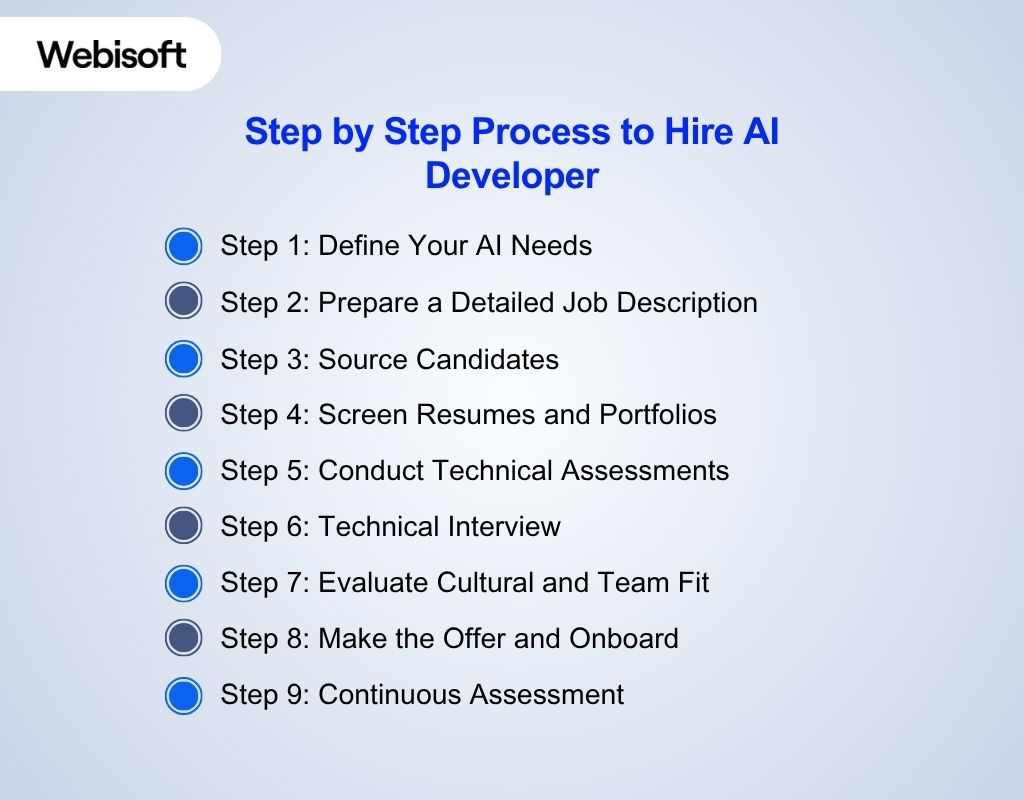 It’s a process that combines technical precision, team dynamics, and strategic planning. Each step builds on the previous, so missing one can slow down your project or even derail it. Let’s go through the steps in detail.
Step 1: Define Your AI Needs
Before reaching out to anyone, it’s crucial to be precise about what your project demands. Think about this as setting the blueprint. Without clarity, even a talented developer might deliver solutions that don’t fit.
- Scope the project: Determine if you need machine learning for predictions, deep learning for image recognition, NLP for text understanding, computer vision, or a more general AI system. Each area requires different skill sets.
- Identify technical requirements: Specify programming languages such as Python, R, or Java. Note the frameworks and tools like TensorFlow, PyTorch, Keras, scikit-learn, Hugging Face, OpenCV. This keeps your search focused.
- Decide engagement type: Full-time, freelance, part-time, hybrid, or outsourcing. The type of engagement influences candidate availability and project speed.
- Set measurable outcomes: Define what success for the hire looks like. Accuracy, deployment speed, and system efficiency are good benchmarks.
This step forms the foundation. Once these needs are clear, it naturally leads to crafting a job description that communicates them precisely. Quick comparison table:
| Requirement Type | Details | Priority |
| Programming | Python, R | High |
| Frameworks | TensorFlow, PyTorch | High |
| Tools | scikit-learn, OpenCV | Medium |
| Engagement | Full-time / Freelance | Medium |
| Success Metrics | Accuracy > 90%, Deployment < 2 weeks | High |
Step 2: Prepare a Detailed Job Description
Think of a job description as your roadmap. Without it, you might end up attracting candidates who aren’t really the right fit, wasting both their time and yours. And honestly, we’ve all seen postings that sound like a laundry list of “must-have” skills, but when you read between the lines, nobody knows what they actually want. So, what should you actually put in there? Let’s break it down.
Technical skills
You need to spell out what tools and platforms matter.
- Are you working with Python, R, or maybe even Julia?
- Which ML frameworks- TensorFlow, PyTorch, scikit-learn, do they need to know?
- And cloud platforms like AWS SageMaker, Azure ML, or GCP AI? Yeah, these are the ones that actually make your AI project run without hiccups.
You don’t have to list everything under the sun, just the essentials that match your project.
Experience
Here’s where people trip up- being too vague. Years in AI/ML aren’t just numbers. Think about whether you need someone who has handled full pipelines: data preprocessing, model training, evaluation, and deployment. Did they actually launch a model that others use? That matters. And yes, even small projects count, as long as the candidate can explain what they did and why it worked or didn’t. This is where businesses often hire expert AI developer talent to get things right.
Soft skills
And we can’t forget the human stuff. AI rarely works in a vacuum.
- Can they solve problems when things go sideways?
- Can they communicate with teammates who aren’t ML experts?
Collaboration is key. Sometimes, a candidate with slightly less experience but excellent problem-solving and teamwork will outperform someone with just raw technical chops.
Responsibilities
Be specific. Are they building new models, improving existing ones, or integrating AI into a product? Short, concrete bullet points help a lot here. Nobody wants to read “and other duties as assigned” and guess what their day might look like. Notice something here? Each piece connects. The technical skills justify the experience you ask for. The experience ties into the responsibilities. And soft skills make all of it work in a team. Once you lay all this out clearly, finding candidates isn’t just easier, it’s faster and less painful. And let’s be real, who doesn’t want that?
Step 3: Source Candidates
Finding the right AI developer doesn’t happen by luck. You need to go where the talent actually hangs out. Otherwise, you’re just throwing a net in the wrong pond.
AI platforms
GitHub, Kaggle, and Stack Overflow are great places to start. You can peek at actual code, real projects, and see how they solve tricky problems. Then there are AI-focused job boards like AIJobs or Toptal AI. Candidates there are already looking for AI work, so you’re not sifting through general tech resumes.
University and research connections
Sometimes, the best ideas come from fresh minds. Students, interns, or researchers may not have ten years of experience, but they often bring hands-on knowledge and creative solutions. They might surprise you with approaches even seasoned pros haven’t considered. This is a smart way to hire AI talents who bring new perspectives.
Employee referrals
Your network matters more than you think. Someone in your circle probably knows a talented developer you wouldn’t find otherwise. Referrals are useful because you already have a hint about their skills and how they work with others.
Outreach campaigns
Not everyone is actively looking for a job. That’s why LinkedIn messages, tech meetups, or carefully targeted emails can make a difference. You reach people who are skilled but happy in their current roles. Sometimes a thoughtful approach can spark interest where you least expect it. Once you have your pool of candidates, the next step is screening. This is where you start separating the ones who are actually capable from those who only look good on paper. Taking the time here saves headaches later and makes the hiring process smoother.
Step 4: Screen Resumes and Portfolios
At this stage, you look beyond resumes. Skills on paper are just the start. Real evidence matters.
- Check for real AI projects: Contributions to open-source, Kaggle competitions, published papers, or deployed models indicate practical experience.
- Match technical skills: Ensure candidates know the programming languages, frameworks, and domains relevant to your project.
- Assess learning ability: AI evolves fast. Look for people who adapt quickly and stay current.
- Evaluate soft skills: Communication, leadership, and teamwork often differentiate good developers from great ones.
Screening example:
| Candidate | Projects | Frameworks | Learning Ability | Soft Skills |
| A | 2 Kaggle, 1 deployment | TensorFlow, PyTorch | High | Excellent |
| B | Open-source contribution | PyTorch | Medium | Good |
| C | No practical project | TensorFlow | Low | Average |
With a shortlist ready, you can now assess skills practically, moving beyond theory.
Step 5: Conduct Technical Assessments
A resume can tell you a lot, but it only tells one side of the story. The real insight comes when candidates roll up their sleeves and actually do the work. That’s what technical assessments are for.
- Coding tests: Give them exercises in Python or R, or small tasks involving algorithms and data manipulation. You’ll quickly see if they can think through problems, write clean code, and handle the kind of data your project uses.
- Model tasks: Ask them to build or improve a model using a sample dataset. This shows not just coding skill but also their understanding of AI pipelines from preprocessing to evaluation. It’s one thing to know TensorFlow syntax; it’s another to tune a model so it actually works.
- Problem-solving exercises: Include applied challenges like predicting outcomes, detecting anomalies, or analyzing data patterns. These reveal their ability to approach real-world problems logically rather than just memorizing formulas.
- Code review: Take a careful look at readability, scalability, and documentation. Can someone else pick up their code easily? Is it structured in a way that can grow with your project? These subtle things often separate good developers from great ones.
The key here is relevance. Make exercises reflect the work they’ll actually do. That way, you’re not testing trivia or textbook knowledge. While doing this stage please keep in mind the experience of the candidate. Because while an experienced candidate should have thought about these qualities, a fresher can get some exceptions. Pass this stage, and you naturally move into the technical interview, where you can dig even deeper into their thought process and approach. And yes, this is how you effectively hire AI ML developers or hire top developers for your AI initiatives.
Step 6: Technical Interview
This is the stage where thinking and communication meet raw skill. A candidate might have strong technical chops, but if they can’t explain their approach or adapt to problems on the fly, it can become a bottleneck. The goal here is to understand not just what they know, but how they think.
- Deep-dive questions: Ask about AI architecture, model selection, hyperparameter tuning, and deployment strategies. You’re not trying to trick them, but you want to see their reasoning. How do they decide which model fits a problem? Can they justify their choices clearly?
- Scenario discussions: Bring in real business problems. Ask how they’d tackle them with AI. It’s one thing to talk about models in theory, another to apply them to messy, real-world data. These discussions reveal problem-solving skills and creativity in action.
- Frameworks and tools check: Confirm their hands-on experience with TensorFlow, PyTorch, ML pipelines, APIs, or cloud platforms. Sometimes a candidate can name the tools but doesn’t truly understand how to integrate them end-to-end. This step helps spot that.
- System design evaluation: Look at their grasp of data flow, model lifecycle, and deployment challenges. Can they envision the full journey from raw data to a production model? Understanding this flow separates someone who codes models from someone who builds AI solutions.
Notice how this step naturally leads to team fit. Brilliant technical skills matter, but they have to align with your team culture. Can they collaborate? Can they communicate? Can they learn from others? These are the subtle but crucial questions that make this stage more than just a technical check.
Step 7: Evaluate Cultural and Team Fit
Technical skills get someone in the door, but they don’t guarantee success on the team. Collaboration, adaptability, and mindset often matter just as much, if not more. This step is about seeing how well a candidate will actually work with others and thrive in your environment.
- Collaboration: Can they work smoothly with engineers, product managers, and data scientists? AI projects involve many moving parts, and a brilliant coder who can’t coordinate with teammates might slow things down.
- Communication: It’s not enough to build a model; they also need to explain it. Can they break down complex AI concepts for non-technical stakeholders without confusing everyone? Clear communication saves time, prevents mistakes, and builds trust.
- Problem-solving mindset: AI rarely comes with perfect data. How does the candidate handle incomplete or ambiguous datasets? Do they find clever solutions, or do they get stuck waiting for ideal conditions? This shows practical thinking and resilience.
- Adaptability: Projects evolve, priorities change, and models sometimes fail. Are they willing to experiment, learn, and adjust? Someone flexible and curious keeps the project moving, even when things get messy.
When a candidate demonstrates both technical skill and strong cultural fit, they’re ready to contribute from day one. This is when you can hire AI developer confidently.
Step 8: Make the Offer and Onboard
Once you’ve found the right candidate, how you bring them on board sets the tone for their entire experience. A smooth start can make the difference between a productive, engaged developer and someone who struggles to find their place.
- Competitive compensation: Make sure the offer matches their experience, location, and specialization. It shows respect for their skills and signals that you value their contribution from day one.
- Clear role expectations: Outline responsibilities, reporting lines, and KPIs clearly. When candidates know what’s expected, there’s less confusion and they can start contributing confidently.
- Access to tools: Provide all the necessary resources like hardware, software, cloud platforms, and datasets. Nothing slows down productivity faster than hunting for the right environment or missing access to critical tools.
- Mentorship: Pair them with senior developers or team leads who can guide them, answer questions, and accelerate integration. A mentor can help them navigate both technical challenges and team dynamics.
Smooth onboarding doesn’t just improve productivity, it also boosts retention. Once they’re settled, keep supporting and engaging them. Regular check-ins, feedback, and recognition help your new hire feel part of the team and motivated to grow.
Step 9: Continuous Assessment
AI moves fast, and so should your approach to team development. Even after hiring AI developers, continuous evaluation ensures your developers stay aligned, motivated, and growing.
- Monitor early deliverables: Keep an eye on initial tasks or pilot projects. Early progress gives insight into how someone works under real conditions. It’s not about micromanaging, it’s about spotting issues before they snowball.
- Maintain a feedback loop: Regularly discuss blockers, challenges, and potential improvements. Open conversations help solve problems quickly and make team members feel supported.
- Encourage upskilling: AI technologies, tools, and techniques change constantly. Encourage courses, certifications, reading research papers, or internal knowledge sharing sessions. Continuous learning keeps skills sharp and ideas fresh.
- Provide growth opportunities: Let team members take on innovative projects, recognize their achievements, and outline clear career paths. Motivation often comes from knowing there’s room to grow and a path forward.
Consistent check-ins and evaluations prevent surprises, keep goals aligned, and sustain motivation. In a field like AI, staying static isn’t an option, and fostering a culture of continuous learning ensures your team and your projects stay ahead.
Engagement Models That Work for AI Developer Recruitment
Top talent isn’t waiting around for job postings; they’re evaluating your company just as much as you’re evaluating them. Engage the wrong way, and the candidate vanishes. Engage smartly, and you build a team that drives innovation instead of firefighting.
| Engagement Model | Description | Ideal For | Key Benefits |
| Freelance AI Developers | Hired for specific short-term AI tasks. | One-off or quick projects. | Flexible, cost-effective, global talent. |
| Full-Time AI Developers | In-house developers for ongoing AI projects. | Continuous development needs. | Dedicated expertise, faster problem-solving. |
| Part-Time AI Developers | Works on AI tasks without full-time commitment. | Small projects or testing AI adoption. | Cost-effective, flexible access to specialists. |
| Dedicated AI Team | Multiple specialists on one project. | Large/full-stack AI initiatives. | Full control, diverse skills, efficient collaboration. |
| AI Outsourcing | The external firm handles AI projects end-to-end. | No internal AI team or fast delivery needed. | Reduced costs, top-tier talent, faster completion. |
| Hybrid Model | Combines in-house and external developers. | Projects needing scale + control. | Balanced cost, custom solutions, scalable. |
| Project-Based Engagement | Short-term contracts or pilots. | Testing new hires or AI initiatives. | Evaluate outputs, reduce hiring risk. |
| Remote-First | Fully remote or hybrid roles. | Access talent globally. | Larger talent pool, flexibility. |
| University / Research Partnerships | Internships, mentorships, joint projects. | Access emerging AI talent. | Long-term talent pipeline, early engagement. |
| Open-Source / Community | Engage on GitHub, Kaggle, AI forums. | Find passionate contributors. | Identify skilled, ecosystem-active developers. |
| Employee Referrals | Incentivized referrals from current employees. | Specialized skills via trusted networks. | Hidden talent, more reliable hires. |
| Upskilling & Career Growth | Learning opportunities, conferences, internal labs. | Retaining motivated AI developers. | Growth potential, higher retention. |
| Hackathons & Challenges | Competitions to test AI skills. | Employer branding or scouting talent. | Real-world skill evaluation, visibility boost. |
Choosing an engagement model is only half the decision. The real test is who you work with. Webisoft fits in across setups, from pilots to full outsourcing. Need GPT integration, decision systems, or full-stack AI? They make it real, not experimental.
Mistakes to Avoid When Hiring AI Talent
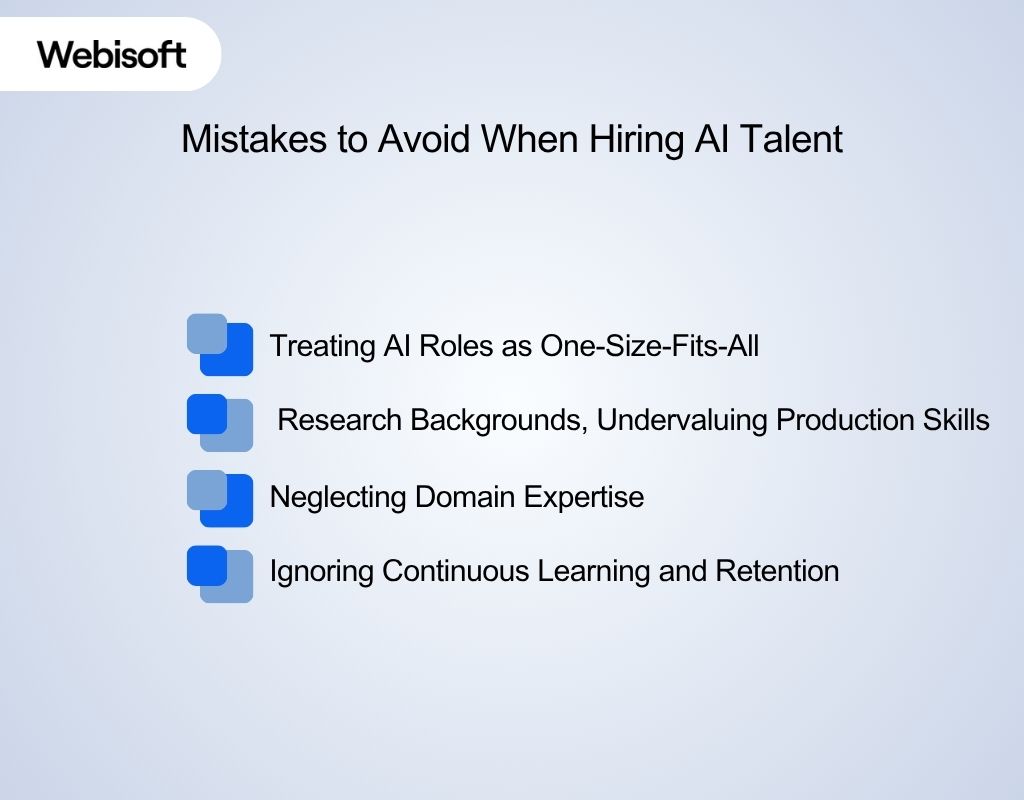 A wrong choice can stall projects for months, eat budgets, and leave leadership frustrated when nothing makes it to production. And honestly? It’s not usually the algorithms that fail, it’s the hiring decisions around them. Add to that recent data showing that between 70% and 85% of current AI initiatives fail to deliver expected outcomes, and you see how fragile this field is. Let’s dig into the specific traps many organizations fall into.
Treating AI Roles as One-Size-Fits-All
Think about it: would you ask a database admin to design a mobile app front end? Probably not. Yet with AI, people often pile data wrangling, model design, infrastructure, and deployment onto one person under the label “AI engineer.” In reality, machine learning engineers, data scientists, and research scientists each have distinct strengths. Mix those up, and you’ll see talent burned out before results appear. So, choosing who to hire artificial intelligence developers wisely prevents this.
Overvaluing Research Backgrounds, Undervaluing Production Skills
Academic brilliance looks shiny on paper. But papers aren’t products. A candidate with 20 publications might still struggle to get a model into a live system. What matters in business settings is the ability to write production-ready code, handle CI/CD pipelines, debug scaling issues, and integrate models with existing systems. If that’s missing, the work never escapes the Jupyter notebook.
Neglecting Domain Expertise
AI isn’t magic dust you sprinkle everywhere. Fraud detection in finance doesn’t look anything like defect detection in manufacturing. A generic “AI person” might know the math, but without domain context, their models often miss what really matters. Domain expertise acts as the compass that keeps models aligned with business reality. This is why it’s crucial to hire AI developer professionals who understand both the tech and the domain.
Ignoring Continuous Learning and Retention
AI is a moving target. One year your team is using sklearn + TensorFlow; the next year, there’s a new paradigm (say, diffusion models, graph neural nets). If you don’t support ongoing learning- conferences, peer research, experimentation, your developers feel stuck. And when they feel stuck, they leave. Remember: talent retention is as much a strategic priority as hiring.
Expert Tips for Recruiting the Right AI Developer
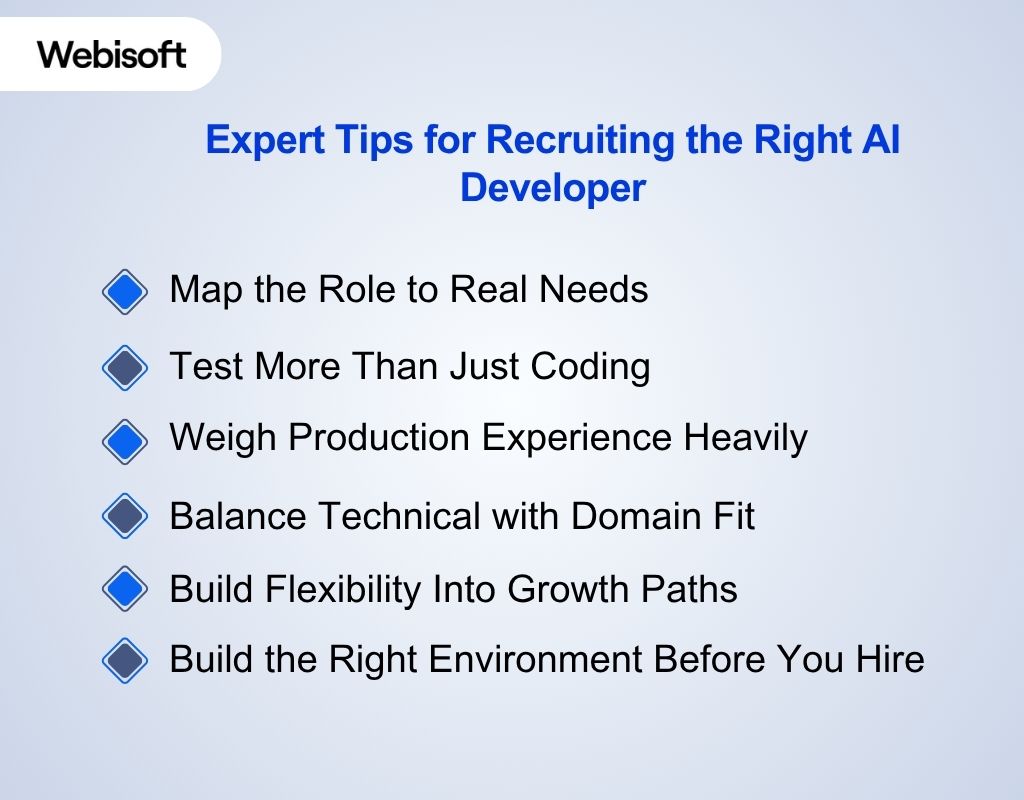 So how do you avoid these pitfalls? The goal isn’t just to “fill a role,” it’s to build a setup where AI talent can actually deliver. That means rethinking the hiring playbook.
Map the Role to Real Needs
Start with clarity. If the main work is data pipelines and model serving, you need an ML engineer. If it’s exploratory analysis and feature design, a data scientist might fit better. And if you’re testing new architectures or novel methods, then a research scientist makes sense. Matching the title to the actual workload avoids false expectations on both sides. One reason this matters: many AI projects never make it to production. S&P Global reports that 42 % of firms abandoned most of their AI initiatives this year- up from 17 % last year.
Test More Than Just Coding
Of course, coding skills matter, but they’re not the whole story. A solid process looks at how candidates approach real-world problems: Do they ask the right questions about data quality? Can they design experiments that reveal trade-offs? Can they explain results in plain terms to non-technical colleagues? These skills matter as much as raw technical power.
Weigh Production Experience Heavily
If the plan is to get working systems into production, check whether candidates have dealt with CI/CD pipelines, containerization (Docker, Kubernetes), or model monitoring tools. A candidate who has shipped models that survive in production is worth more than someone who’s only tinkered in research.
Balance Technical with Domain Fit
Sometimes, the best hire isn’t the one who knows every AI framework but the one who knows your industry well. For example, a developer who understands clinical workflows in healthcare or compliance issues in finance will move faster and avoid naive mistakes. A mix of technical depth and domain instinct is often where the magic happens.
Build Flexibility Into Growth Paths
In interviews, ask: “What new frameworks or methods have you been curious about?” If the answer is blank, that’s a red flag. Make room for side experiments, internal R&D, or “20 % time” to pick up new skills. That shows you invest in their growth. This also helps those curious about how to become AI developer themselves.
Build the Right Environment Before You Hire
Finally, think of it like this: hiring an AI developer without proper infrastructure is like hiring a pilot without giving them a plane. Make sure the team already has tools for version control, GPUs, data storage, and monitoring. That way, when the hire joins, they can build instead of wasting time lobbying for resources.
When Hiring AI Developers Feels Risky, Webisoft Steps In
Finding the right AI developer is not as simple as posting a job. Many companies stumble trying to hire AI developer who can actually build, deploy, and scale AI solutions. Even if you find talent, the challenges don’t stop there. Onboarding, infrastructure setup, and ongoing support can slow things down more than you expect. If you’ve been in that situation, you know the frustration. And that’s where Webisoft comes into play. Instead of waiting and hoping a hire works out, Webisoft offers full-stack AI services that give you the expertise you need right away as an AI development company. Think of it as having a ready-to-go AI team, without the hiring risks or long ramp-up times. Here’s how Webisoft can help your business get AI right:
- Custom AI Development Services: Build solutions from prototypes to production, fully tailored to your business. You don’t just get code, you get a system that works for your goals.
- AI Strategy Consultation: Decide what AI really needs to do for you. We make sure every model and tool is meaningful and actionable.
- LLM/GPT Integration: Use advanced language models to enhance user interaction, automate insights, and make faster data-driven decisions.
- Automated Decision Systems: Handle massive datasets in real time and optimize processes without waiting for manual input.
- Document Digitization (OCR): Turn paper-based workflows into accurate, searchable digital processes that save time and reduce errors.
- Model Context Protocol (MCP): Give your team access to contextual insights, so AI decisions are smarter and aligned with your business reality.
- Rapid Time-to-Value: No hiring cycles, no long interviews. Just start using AI capabilities immediately.
- Continuous Support & Optimization: AI isn’t “set it and forget it.” We monitor, refine, and scale your systems as your business grows.
So, if hiring feels like a gamble, Webisoft lets you unlock AI-driven growth without waiting for the perfect developer. It’s like having a skilled AI team on demand, someone who turns ideas into results while you focus on growing the business.
Don’t let hiring slow your AI projects!
Talk to Webisoft – Get Full-Stack AI Support From Day One.
Endnote
At the end of the day, the question isn’t whether your company should use AI, it already is part of daily business life for most industries. The real question is whether you’ll hire AI developer talent that can actually deliver. And yes, hiring matters more than the hype. Get it right, and you move with the 78% who are already building real workflows around AI. Get it wrong, and you add to the 85% who never ship.
Frequently Asked Questions (FAQs)
Can AI developers work effectively without a strong math background?
Yes, they can. Strong coding skills, practical ML experience, and logical thinking often outweigh heavy math. Basic statistics help, but frameworks handle much of the complex computation. The key is knowing how to implement and troubleshoot models.
How do I assess a candidate’s understanding of neural networks and deep learning?
Instead of asking only theory, see how they explain a small model’s layers, activation functions, or backpropagation. Ask them to walk through a real dataset scenario. Their reasoning and clarity often reveal more than memorized definitions.
Is prior experience with open-source AI frameworks necessary?
It helps, yes, but it isn’t everything. A developer who quickly picks up TensorFlow or PyTorch can catch up fast if they grasp model logic. Curiosity and adaptability often outweigh prior exposure when projects move fast.
Can AI developers work on multiple AI projects simultaneously?
They can, but timing and context matter. If projects are complex or data-heavy, switching too often can slow results. Good developers structure their workflow, prioritize tasks, and use collaboration tools to keep everything on track.
How important is knowledge of data preprocessing and feature engineering?
It’s essential. Clean, well-prepared data determines whether a model succeeds or fails. Developers who overlook this spend hours chasing errors. A strong understanding here ensures models are accurate, efficient, and scalable for real-world applications.
