Generative AI in healthcare has moved far beyond lab demos and headline hype. Advanced artificial neural networks have been authorized by regulatory bodies to assist doctors in management of documentation, communication, and complex medical data. This shift is already visible in adoption patterns. Recent hospital data shows 31.5 percent of U.S. hospitals already use generative AI within electronic health record workflows.
While 24.7 percent plan adoption within one year. This rapid uptake reflects growing pressure from administrative workload and unstructured medical data. To make sense of this shift, this article explains what generative AI means in healthcare and where it is already being used. It also covers the benefits organizations are seeing and the limitations they must manage as adoption continues to expand.
What Is Generative AI in Healthcare?
Generative AI in healthcare refers to artificial intelligence systems that create new content such as text, images, simulations, or structured data from datasets. These systems include large language models and multimodal models designed to handle complex medical information. In healthcare, generative AI produces human readable outputs that support clinical, research, and operational tasks.
Generative AI in healthcare examples include drafting clinical summaries, assisting with medical imaging outputs, synthesizing insights from large datasets, and supporting early stage research. Unlike traditional AI focused on prediction or classification, generative AI creates new information for professional review. At its core, generative AI in healthcare acts as an augmentation tool, supporting professionals while requiring human oversight to maintain accuracy, safety, and responsibility.
Why Generative AI Is Gaining Attention in Healthcare Now
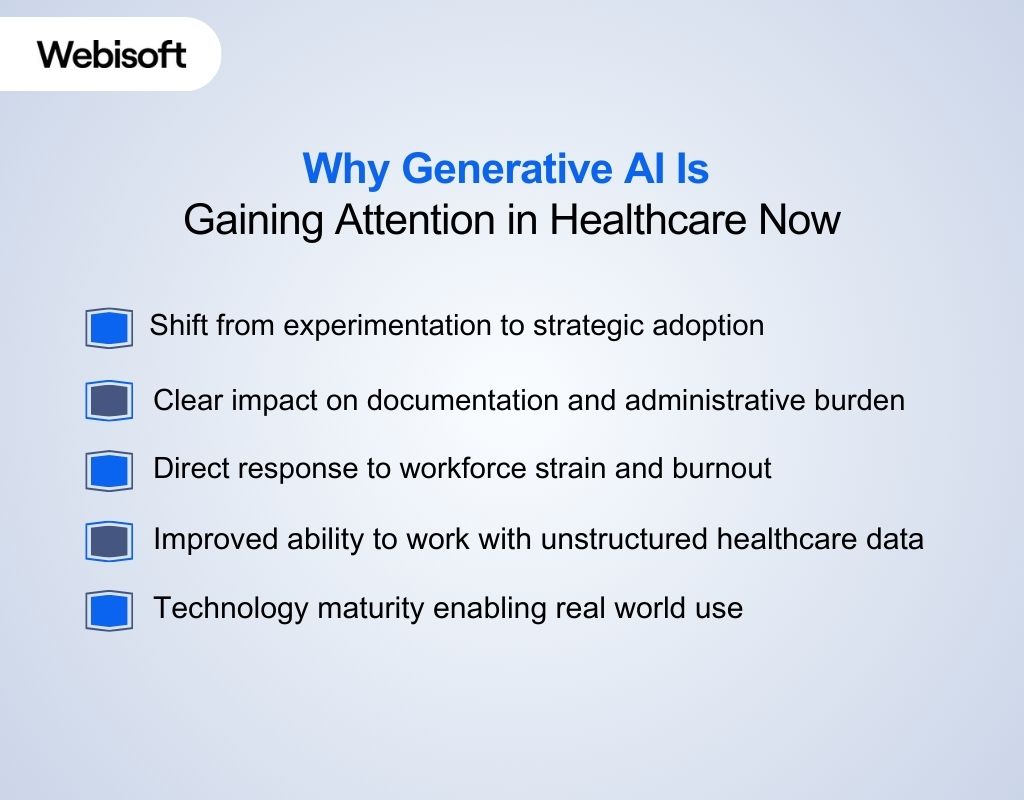
The role of generative AI in healthcare is gaining attention now because hospitals and health systems are moving beyond experimentation into real adoption. Leaders see practical use cases that can reduce administrative burden, assist clinical workflows, and support operational efficiency.
Shift from experimentation to strategic adoption
Healthcare organizations are no longer viewing generative AI as an experimental technology. Many are treating it as a strategic capability tied to productivity, care quality, and operational resilience. This shift reflects growing confidence that generative AI can deliver measurable value in real healthcare environments.
Clear impact on documentation and administrative burden
Generative AI is gaining attention because it can reduce time spent on documentation and administrative work. Tasks such as summarizing patient records, drafting clinical notes, and supporting back office workflows are consuming clinician time. Automating parts of this work creates immediate and visible benefits.
Direct response to workforce strain and burnout
Healthcare systems continue to face staffing shortages and clinician burnout. Documentation demands and decision support needs add pressure to already strained teams. Generative AI is being explored as a way to ease cognitive and administrative load without changing clinical responsibilities.
Improved ability to work with unstructured healthcare data
Healthcare data is largely unstructured and difficult to use efficiently. Generative AI models can process clinical notes, reports, and narratives more effectively than earlier systems. This capability makes them useful for tasks that previously required extensive manual effort.
Technology maturity enabling real world use
Recent progress in large language and multimodal models has improved reliability and contextual understanding. These advances make generative AI more suitable for healthcare workflows. As a result, organizations are more willing to test and integrate it into production systems.
Key Use Cases of Generative AI in Healthcare Industry
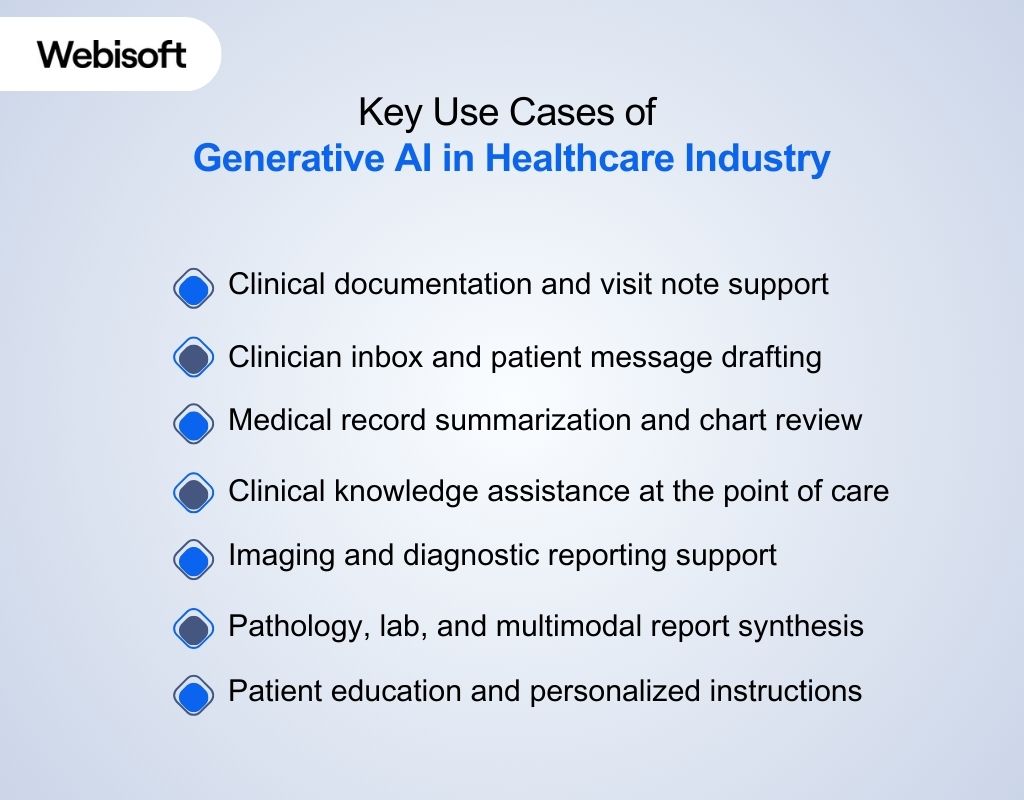
As healthcare organizations move from interest to action, attention is shifting toward where generative AI delivers tangible value. The focus is now on concrete use of generative AI in healthcare that support clinicians, streamline operations, and improve how complex healthcare information is handled daily.
Clinical documentation and visit note support
Generative AI is used to draft progress notes, discharge summaries, and after visit summaries from visit context and EHR data within healthcare software development environments. Many deployments focus on reducing documentation time while keeping clinicians in control of final edits. Ambient note tools are a major driver of adoption in real settings.
Clinician inbox and patient message drafting
Health systems use generative AI to draft replies to patient portal messages and summarize long message threads. This supports faster turnaround while reducing cognitive load for care teams. It also improves consistency in tone and patient instructions when reviewed by staff.
Medical record summarization and chart review
Generative AI can summarize large volumes of unstructured clinical notes into problem focused timelines. It can surface relevant history, medications, labs, and recent changes for quick review. This is useful for handoffs, consults, and transitions of care.
Clinical knowledge assistance at the point of care
Care teams use generative AI to answer questions using curated clinical sources, internal policies, and guidelines. The goal is faster access to trusted information, not independent medical decision making. Many implementations rely on approved references to reduce unsafe outputs.
Imaging and diagnostic reporting support
Generative AI is used to draft radiology style narratives and convert findings into structured sections for review. It helps improve report consistency and summarize comparisons with prior studies. Clinician review remains a required control layer.
Pathology, lab, and multimodal report synthesis
When data comes from multiple sources, generative AI can combine text, lab results, and imaging context into unified summaries. This supports case discussions and improves coordination across care teams. Multimodal use is gaining attention in advanced deployments.
Patient education and personalized instructions
Generative AI rewrites complex clinical language into patient friendly explanations. It can generate discharge instructions, care plans, medication guidance, and follow up steps. Clinical review is typically applied to maintain safety and accuracy.
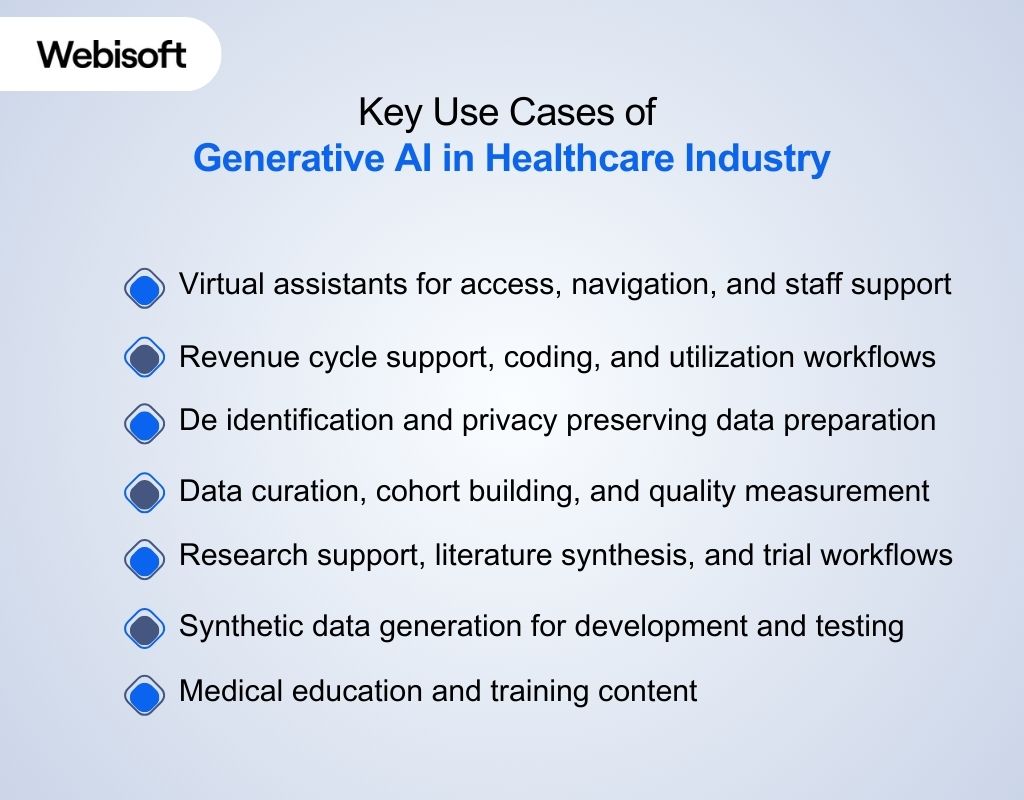
Virtual assistants for access, navigation, and staff support
Hospitals use generative AI chat interfaces to answer common questions from patients and employees. Patient focused uses include appointment preparation and navigation guidance. Staff focused uses include internal IT, HR, and policy support.
Revenue cycle support, coding, and utilization workflows
Generative AI assists with documentation for coding workflows and record summarization for review. It can also support prior authorization preparation and appeals by pulling relevant clinical context. These use cases are common in payer and provider roadmaps.
De identification and privacy preserving data preparation
Healthcare NLP systems use generative AI to remove or mask protected health information across unstructured text. This supports safer secondary data use for analytics, model development, and research activities.
Data curation, cohort building, and quality measurement
Generative AI converts unstructured clinical documents into structured fields for registries and cohorts. It can extract diagnoses, medications, procedures, and outcomes at scale. This improves readiness for analytics and population health initiatives.
Research support, literature synthesis, and trial workflows
Research teams use generative AI to summarize biomedical literature and compare findings. It also supports protocol drafting and early trial planning tasks. These applications typically operate under strict governance due to downstream risk.
Synthetic data generation for development and testing
Generative models create synthetic datasets that reflect real world patterns for testing and development. This approach reduces reliance on direct patient data in certain scenarios. Careful validation is required to manage bias and data fidelity.
Medical education and training content
Generative AI supports simulated patient interactions and case based learning. It can generate scenario variations and structured feedback for learners. Medical education is a recurring application area discussed in academic research.
Benefits of Generative AI in Healthcare
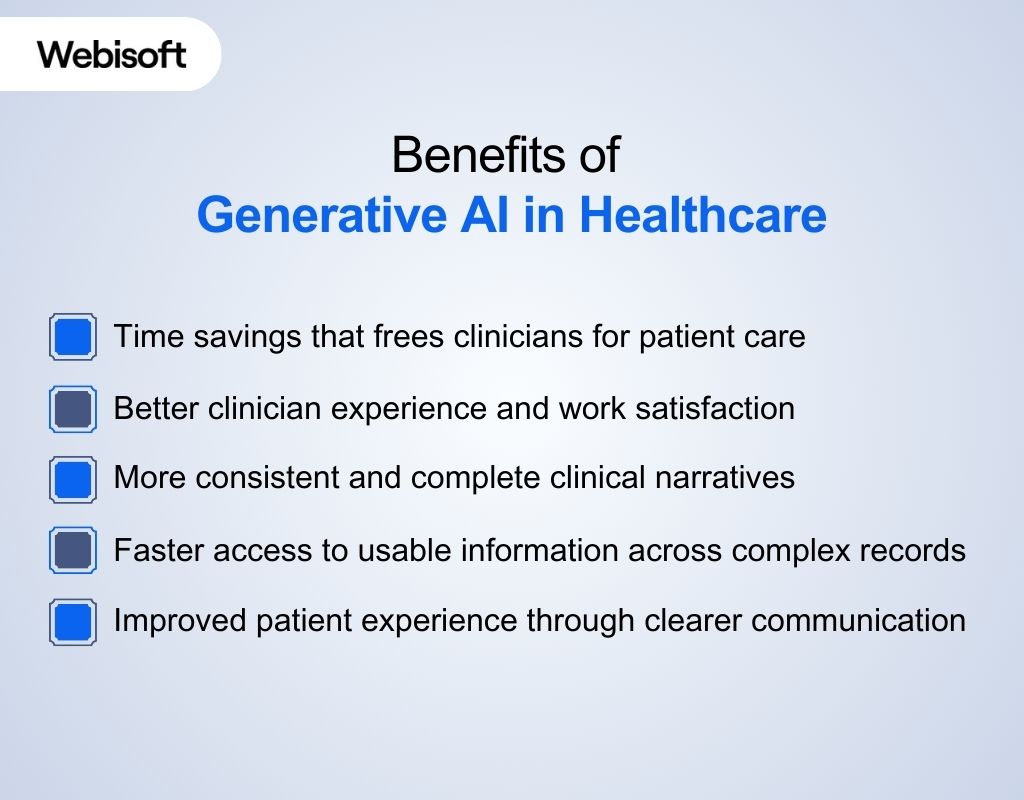
Once healthcare teams identify where generative AI fits, the next question is what they gain from it. Early deployments often show time savings, stronger clinician focus, and more consistent information flow in documentation heavy workflows.
Time savings that frees clinicians for patient care
Generative AI can reduce the time clinicians spend on documentation and related follow up work. In one reported AI scribe implementation, physicians saved 15,791 hours equal to 1,794 eight hour workdays enabling more time for direct patient care.
Better clinician experience and work satisfaction
When routine documentation pressure drops, clinicians report improved day to day experience. Reported outcomes include improved physician satisfaction and better patient physician interactions tied to reduced note taking burden.
More consistent and complete clinical narratives
Generative AI can help standardize the structure and completeness of clinical text outputs. That consistency improves handoffs, follow ups, and downstream administrative processes that rely on clear documentation.
Faster access to usable information across complex records
Healthcare work is slowed by unstructured notes spread across systems and long timelines. Generative AI helps convert scattered information into summaries that are easier to review, which supports quicker decision making and coordination.
Improved patient experience through clearer communication
When outputs are reviewed and approved by care teams, generative AI can help produce clearer, more consistent patient facing explanations and follow up instructions. This supports better understanding and smoother care journeys, especially when patient communication volume is high.
Realizing these benefits consistently requires more than tools alone. Webisoft’s Generative AI Development Services help healthcare organizations design, integrate, and scale production-ready AI systems that fit clinical workflows, data constraints, and long-term operational goals.
Risks and Limitations of Generative AI in Healthcare
As adoption grows, benefits only matter if the downsides are managed. Applications of generative AI in healthcare can fail in ways, so teams must understand accuracy, privacy, security, and accountability limits before scaling beyond pilots.
- Clinical accuracy and hallucinations: Generative AI can produce fluent but incorrect clinical statements. In healthcare settings, these errors can affect documentation quality and create safety risks if not carefully reviewed.
- Privacy exposure and data leakage: Improper handling of prompts, outputs, or logs can lead to unintended exposure of protected health information. Strong access controls and data handling policies are required.
- Bias and uneven performance: Models trained on incomplete or skewed data may perform inconsistently across patient populations. This can reinforce disparities and affect care quality if not monitored.
- Automation bias in clinical workflows: When people rely too heavily on AI generated content, critical review can decrease. This increases the chance that incorrect information enters clinical records or influences decisions without proper verification.
- Limited transparency and explainability: Generative models often lack clear reasoning paths for their outputs. This makes it difficult to justify decisions or investigate errors in regulated healthcare environments.
- Expanded cybersecurity attack surface: Integrating generative AI into clinical systems introduces new entry points for attacks. Model access, integrations, and dependencies must be secured as part of overall system security.
All of these issues could be solved with human intervention. Researchers are on the hunt for a more automated solution. And regulatory boards are also keen in refining the process. But currently these issues needs to be dealt with
Future of Generative AI in Healthcare
After weighing benefits against risks, healthcare leaders are planning what comes next. The future points to multimodal models, lifecycle governance, and agent-like systems that connect to tools, while staying within regulatory expectations and safety controls.
- Multimodal care support becomes more common: More systems will combine text with medical images and other data types, enabling richer clinical context and more capable assistance across documentation and interpretation tasks.
- Agent-like systems will connect generative AI to clinical tools: The next wave will focus on models that complete structured steps, retrieve context, and trigger actions through approved tool integrations, not generating text.
- Lifecycle governance becomes a default requirement: Healthcare AI will increasingly be managed through ongoing lifecycle controls, not one-time deployment decisions, especially for regulated device-related software functions.
- Standardized GenAI risk controls mature into repeatable playbooks: More organizations will align governance to formal risk frameworks that include GenAI-specific risks and recommended actions, improving consistency across vendors and health systems.
- Regulators also adopt AI internally, shaping expectations: Public sector usage is expanding, including internal deployment to streamline review work, which may influence how safety, documentation, and oversight are expected across the ecosystem.
Webisoft as a Generative AI Partner for Healthcare Organizations
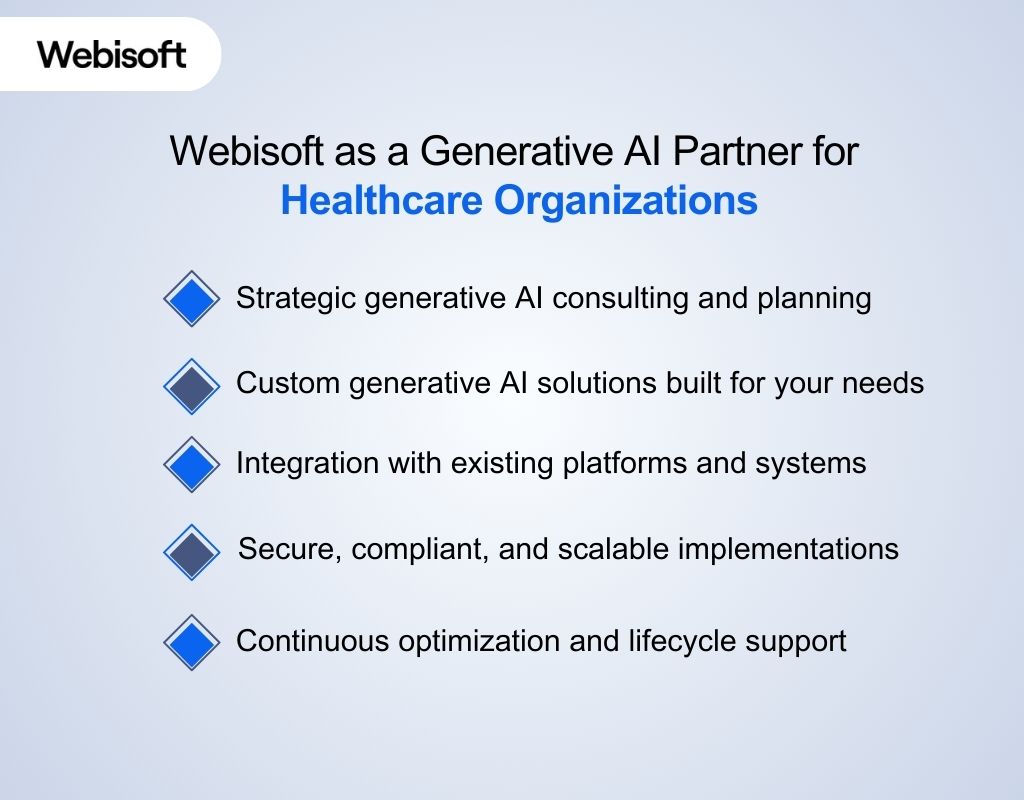
Generative AI in healthcare sounds impressive on paper, but value only appears when it survives real workflows and real constraints. That is where Webisoft steps in, helping healthcare teams move from experiments to systems that actually hold up in daily operations.
Strategic generative AI consulting and planning
We start by understanding your healthcare workflows, data landscape, and performance goals to shape a clear AI strategy. Our consulting ensures that every initiative is rooted in business value and clinical relevance rather than experimentation.
Custom generative AI solutions built for your needs
Our team develops domain-specific AI models that adapt to healthcare data nuances, generate contextual clinical outputs, and automate routine documentation tasks. These solutions integrate smoothly with your systems to deliver real operational impact.
Integration with existing platforms and systems
We embed generative AI capabilities into your existing healthcare infrastructure, such as EHRs and decision support systems, ensuring interoperability and minimal disruption to workflows. This seamless integration supports adoption and sustained value.
Secure, compliant, and scalable implementations
Our solutions are built with enterprise-grade security, privacy, and governance in mind, aligning with healthcare compliance needs and risk controls while allowing growth over time.
Continuous optimization and lifecycle support
We don’t stop at delivery. Our long-term support includes performance monitoring, retraining, and optimization to ensure your generative AI systems evolve with your data, workflows, and organizational needs.
This is where many healthcare teams decide whether generative AI becomes a working system or another stalled initiative. A conversation with Webisoft helps clarify next steps, align priorities, and plan secure implementation across clinical and operational workflows.
Conclusion
Generative AI in healthcare has shown where it delivers value and where caution is required. Its role is now clearer across documentation, data handling, and operational support, making thoughtful adoption and ongoing oversight essential for long term success.
With these realities in view, the next step is execution. Webisoft helps healthcare organizations move from understanding generative AI to running it reliably. Building secure and scalable systems that align with real workflows and continue delivering value over time.
Frequently Asked Question
No, generative AI does not require perfectly structured healthcare data because it is designed to process free text and inconsistent records. It can analyze clinical notes, reports, and narratives, though better data quality still improves reliability and safety.
Yes, generative AI can support multilingual healthcare communication by translating and simplifying medical information for different languages. This helps patients understand instructions and care plans, but professional review remains essential to ensure clinical accuracy, cultural sensitivity, and appropriate context.
No, generative AI does not replace existing healthcare software. It usually integrates with current systems like EHRs and workflow tools, adding supportive capabilities such as summarization and drafting. While relying on established platforms for data storage, compliance, and core clinical functions.