The automotive industry is under pressure to build vehicles faster, smarter, and with far greater software complexity than ever before. As software-defined vehicles become the norm, traditional development and validation models are showing clear limits. Generative AI in automotive is emerging as a practical response to these challenges, enabling teams to generate designs, simulations, software artifacts, and insights at scale.
Investment levels across global automakers signal that this shift is already underway, driven by the need for speed, efficiency, and differentiation. In this blog, we will discuss what generative AI means for automotive teams, where it delivers value today, and the risks involved. We will also discuss how organizations can adopt it responsibly.
What Is Generative AI in Automotive Industry
Generative AI in automotive refers to AI systems that create new outputs instead of only analyzing existing data. These systems generate vehicle designs, engineering simulations, software code, and synthetic test data using patterns learned from large automotive datasets. This makes generative AI in the automotive industry different from traditional automotive AI. Traditional AI in vehicles focuses on prediction and classification.
Examples include object detection in ADAS, fault prediction, and demand forecasting. Generative AI automotive use cases go further by producing original outputs such as design alternatives, virtual driving scenarios, or draft software logic. It is important to note that not all AI used in cars is generative. Computer vision models that detect lanes or pedestrians do not generate new content. Rule-based control systems also fall outside this category.
Automotive generative AI applications apply only when AI creates something new. Today, generative AI in automotive design, manufacturing, and software development supports faster iteration, controlled experimentation, and data-efficient testing under human oversight.
Why Automotive Companies Are Evaluating Generative AI
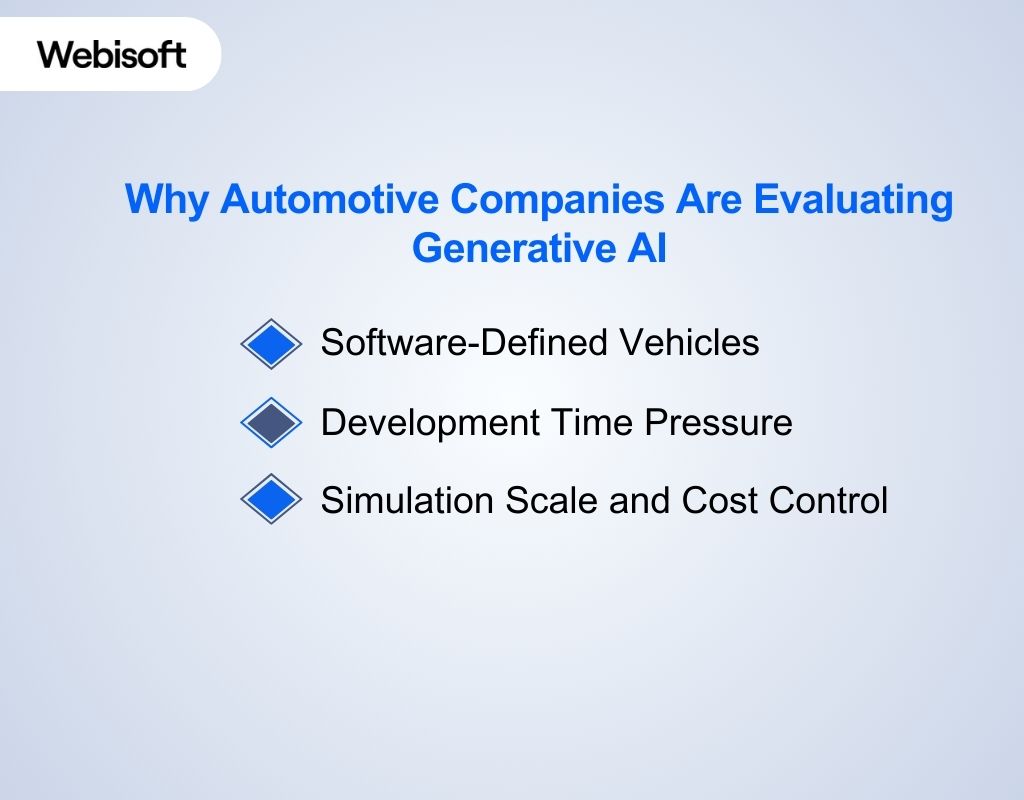
Automotive leaders are assessing generative AI in automotive because existing development models no longer match industry demands. Vehicles are becoming software-centric, development cycles are shrinking, and validation workloads are growing faster than teams and budgets. In this context, generative AI in the automotive industry is viewed as a practical response to structural pressure, not an experimental upgrade.
Software-Defined Vehicles
The shift toward software-defined vehicles increases system complexity across design, engineering, and operations. Hardware decisions now depend on software behavior, updates, and long-term maintainability. Generative AI automotive software development supports this shift by assisting with code generation, test creation, and documentation under human control. This reduces friction in software-heavy workflows without replacing engineering accountability.
Development Time Pressure
Traditional sequential design methods struggle to meet compressed timelines. In generative AI automotive engineering, teams can evaluate thousands of design options simultaneously instead of iterating one version at a time. This allows faster convergence on viable designs while staying within safety and manufacturing constraints. Automakers using automotive generative AI applications report meaningful reductions in development cycles.
Simulation Scale and Cost Control
Modern vehicles require extensive virtual testing across safety, performance, and edge scenarios. Physical testing alone cannot scale. Generative AI automotive simulation enables synthetic scenario generation and broader test coverage, which reduces dependence on costly prototypes.
For executives, generative AI in automotive addresses simulation scale and cost control together, which explains why adoption discussions now involve engineering, finance, and product leadership. Please contact Webisoft to build the most reliable automotive ERP for your company.
Core Generative AI Use Cases in Automotive
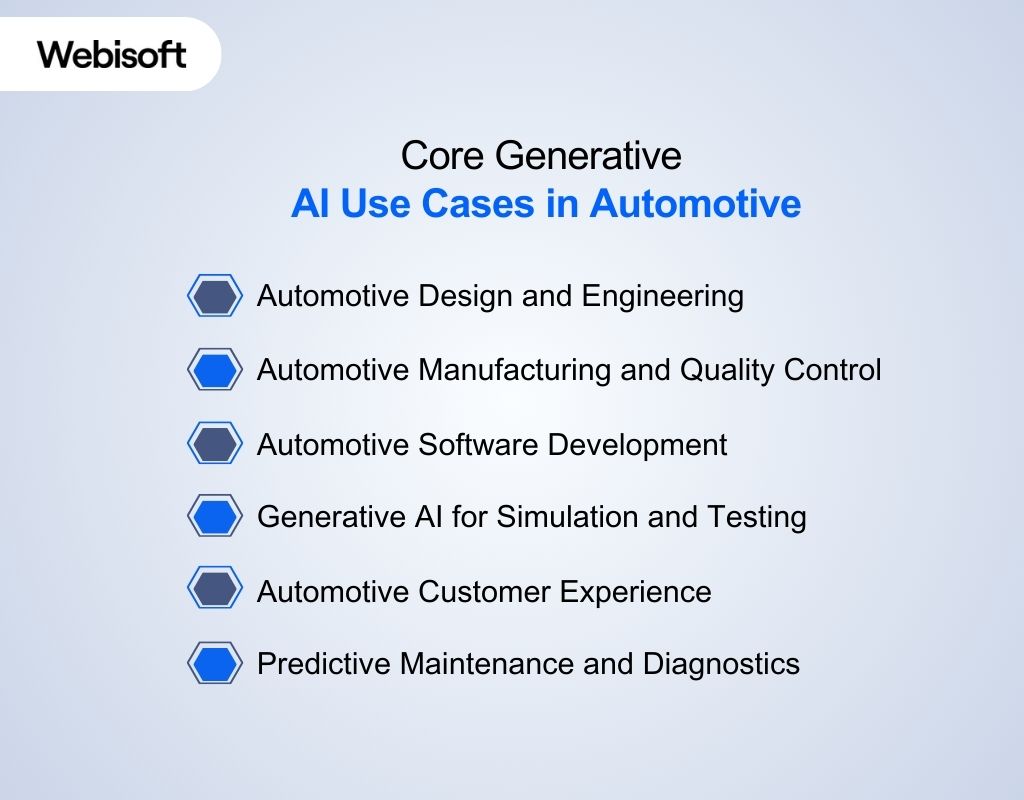
Automakers are applying generative AI in automotive across a limited set of high-impact areas where content, data, or design generation creates clear operational value. Even 75% of automakers plan to integrate generative AI into operations within the next year. The following automotive generative AI applications represent the most established and distinct areas of adoption today.
Automotive Design and Engineering
In generative AI automotive engineering, models generate multiple component and system designs based on constraints such as weight, strength, cost, and sustainability. Engineers can explore thousands of variations in parallel instead of relying on sequential iterations.
This approach supports rapid prototyping, aerodynamic optimization, and material selection, which shortens development cycles while improving structural efficiency. Generative AI in automotive design is especially valuable during early-stage concept validation.
Automotive Manufacturing and Quality Control
Within generative AI for automotive manufacturing, models analyze production data to generate optimized layouts, process adjustments, and defect patterns. Synthetic defect generation improves inspection accuracy, while pattern learning helps detect quality issues earlier in the production line. These generative AI automotive use cases support cost control, waste reduction, and consistent output quality without replacing existing control systems.
Automotive Software Development
As vehicles become software-driven, generative AI automotive software development assists teams by generating code drafts, test cases, and technical documentation. These systems operate under human oversight and help reduce time spent on repetitive development tasks. This use case improves software productivity while maintaining traceability and safety requirements expected in automotive environments.
Generative AI for Simulation and Testing
Modern vehicles require large-scale virtual testing. Generative AI automotive simulation creates synthetic driving scenarios, digital twins, and edge-case conditions that are difficult to capture in real-world testing. This improves coverage in safety validation, autonomous system training, and performance testing while reducing dependence on physical prototypes.
Automotive Customer Experience
In generative AI automotive customer experience, models generate personalized content across in-vehicle systems, digital touchpoints, and support channels. This includes adaptive voice interactions, tailored infotainment, and customized buying experiences. These applications focus on generating context-aware responses rather than static recommendations.
Predictive Maintenance and Diagnostics
Generative AI automotive diagnostics models generate maintenance insights by learning patterns from sensor data and service history. They support battery health estimation, component failure forecasting, and service scheduling.
This use case helps reduce unplanned downtime while improving long-term vehicle reliability. Together, these use cases define where generative AI in the automotive industry delivers practical value today without overlapping with traditional AI systems.
Benefits of Generative AI in Automotive
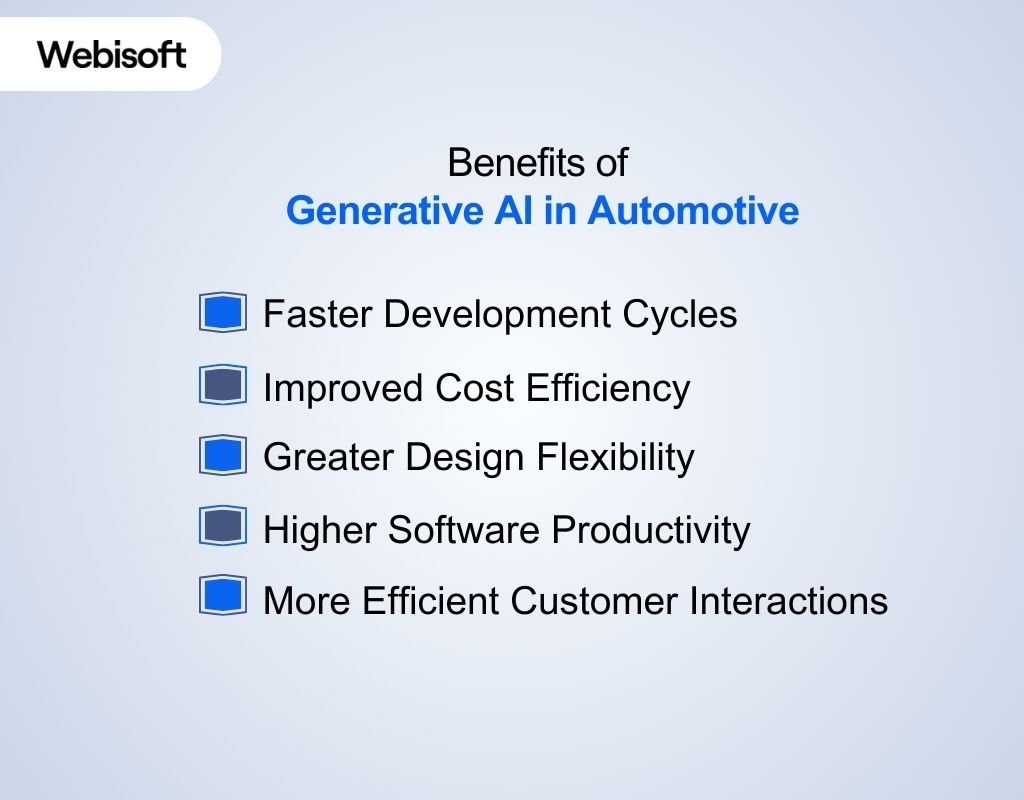
Automotive leaders evaluate generative AI in automotive because it produces measurable improvements across development, engineering, and customer-facing operations. Unlike experimental technologies, these benefits are already visible in controlled deployments. For buyers, generative AI in the automotive industry supports faster execution, tighter cost control, and better alignment between software, hardware, and customer expectations.
Faster Development Cycles
One of the clearest benefits of generative AI automotive engineering is development speed. Design teams use generative models to explore thousands of component and system variations in parallel rather than through sequential iterations. Virtual prototyping and simulation reduce dependency on physical builds, which shortens validation timelines. As a result, new vehicle programs move from concept to production with fewer delays.
Improved Cost Efficiency
Generative AI automotive use cases support cost efficiency by optimizing material usage, energy consumption, and production workflows. In manufacturing environments, models generate process adjustments and defect patterns that reduce rework and waste. Development teams also lower costs by relying more on simulation and less on repeated physical testing, which improves budget predictability.
Greater Design Flexibility
In generative AI in automotive design, engineers work within constraints while still exploring unconventional configurations. Models generate design alternatives that balance performance, safety, and sustainability without locking teams into legacy architectures. This flexibility is valuable as vehicle platforms evolve to support electrification and new mobility requirements.
Higher Software Productivity
As vehicles become software-centric, generative AI automotive software development improves productivity by generating code drafts, test cases, and documentation under human review. This reduces time spent on repetitive tasks while preserving traceability and safety controls required in automotive systems.
More Efficient Customer Interactions
In generative AI automotive customer experience, models generate personalized content for in-vehicle systems, digital sales channels, and service support. These applications improve response relevance and consistency without increasing operational overhead, which supports scalable customer engagement.
Technical, Safety, and Compliance Challenges

Automotive decision-makers approach generative AI in automotive with caution because failures in this domain carry safety, legal, and reputational consequences. While the technology offers clear benefits, its deployment introduces technical and organizational risks that must be addressed before scaling. These challenges explain why adoption discussions often extend beyond engineering teams to legal, compliance, and executive leadership.
Safety, Validation, and Embedded System Constraints
Safety remains the primary concern in generative AI in the automotive industry, especially for systems connected to vehicle control, ADAS, or autonomous functions. Embedded automotive software follows strict validation cycles, while generative models operate probabilistically.
This mismatch complicates verification. Engineers must prove that AI-generated outputs behave consistently under all operating conditions, which is difficult when models do not produce deterministic results. Limited model transparency further increases validation complexity, particularly when regulators require traceable decision logic.
Data Quality, Model Reliability, and Infrastructure
Effective automotive generative AI applications depend on large volumes of clean, well-labeled data. In practice, automotive data is often fragmented across legacy systems and organizational silos. Poor data quality reduces model reliability and increases the risk of incorrect outputs.
Infrastructure also presents a barrier. Training and running generative models require high-performance computing, secure storage, and resilient networking. These requirements raise implementation costs and delay returns, which affects internal approval.
Governance, Compliance, and Oversight Requirements
Governance is critical for generative AI automotive use cases that interact with customer data or safety-relevant systems. Connected vehicles generate sensitive information, which raises privacy and cybersecurity concerns.
Companies must comply with evolving regulations while defining accountability for AI-assisted decisions. Clear oversight models, human review processes, and documentation standards are required to manage liability, regulatory audits, and long-term operational risk.
How to Implement Generative AI in the Automotive Sector
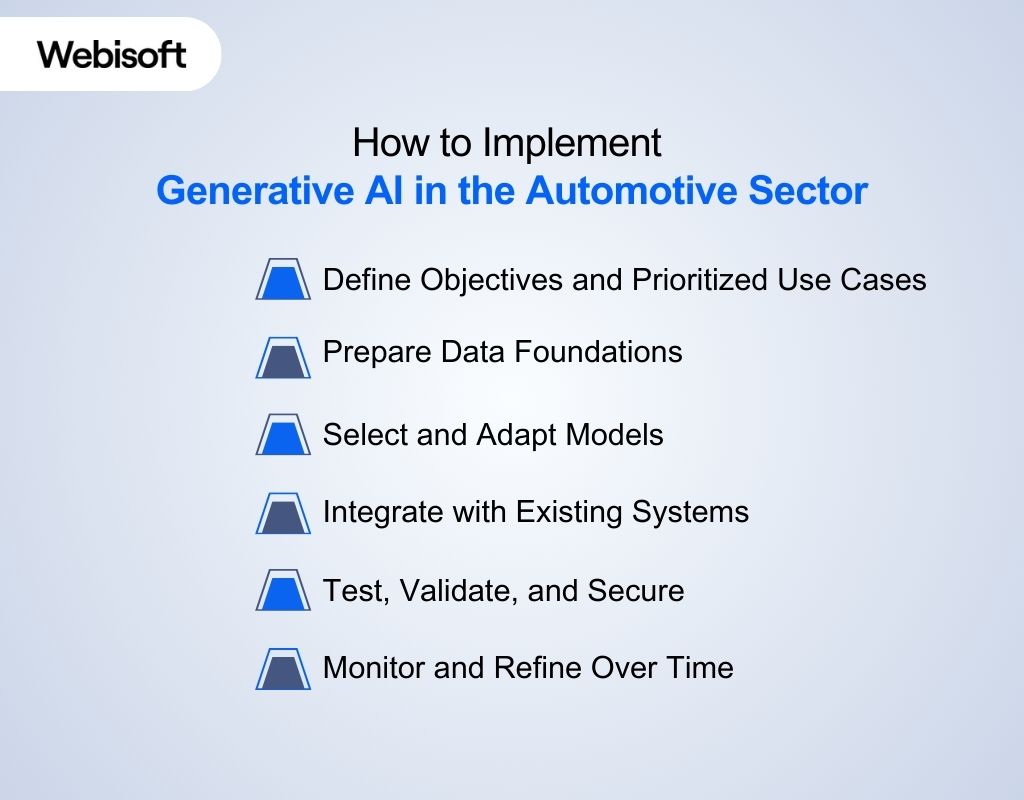
Implementing generative AI in automotive requires a structured approach that aligns technical feasibility with safety, cost, and regulatory expectations. Automotive environments differ from general enterprise AI because systems interact with physical assets, regulated processes, and long product lifecycles. The steps below reflect how generative AI in the automotive industry is typically introduced in controlled, production-oriented settings.
Define Objectives and Prioritized Use Cases
The first step is to clarify what problems automotive generative AI applications are expected to solve. Objectives often include faster design iteration, improved simulation coverage, software productivity, or more responsive customer systems.
Use cases should be selected based on impact, data availability, and risk exposure. Early focus areas commonly include generative AI in automotive design, simulation, or internal software workflows rather than safety-critical control systems.
Prepare Data Foundations
Data readiness determines model reliability. Teams must collect relevant datasets from engineering, manufacturing, vehicle telemetry, or customer systems and resolve quality gaps. For generative AI automotive engineering and diagnostics, this often involves normalizing sensor data, CAD files, and historical logs. Fragmented or poorly labeled data limits model accuracy and slows deployment.
Select and Adapt Models
Model choice depends on the use case. Some generative AI automotive use cases rely on large pretrained models adapted with automotive-specific data, while others require domain-trained models for simulation or design generation. Model selection should consider transparency, compute requirements, and integration constraints rather than raw capability alone.
Integrate with Existing Systems
Generative models must fit within established automotive toolchains. This includes integration with PLM systems, simulation platforms, manufacturing software, or customer-facing applications. In generative AI automotive software development, models typically operate as assisted tools under human review, which preserves traceability and safety controls.
Test, Validate, and Secure
Testing focuses on consistency, failure modes, and alignment with real-world scenarios. Validation is critical before scaling, especially where outputs influence engineering or operational decisions. Security controls are applied to protect proprietary designs and customer data, which is essential for generative AI in automotive deployments.
Monitor and Refine Over Time
After deployment, performance monitoring and periodic retraining help maintain relevance as data and requirements change. Feedback from engineers, operators, and users guides incremental refinement. This approach allows generative AI in the automotive industry to mature without disrupting existing safety and governance structures.
How Webisoft’s Generative AI Platform Transforms the Automotive Industry
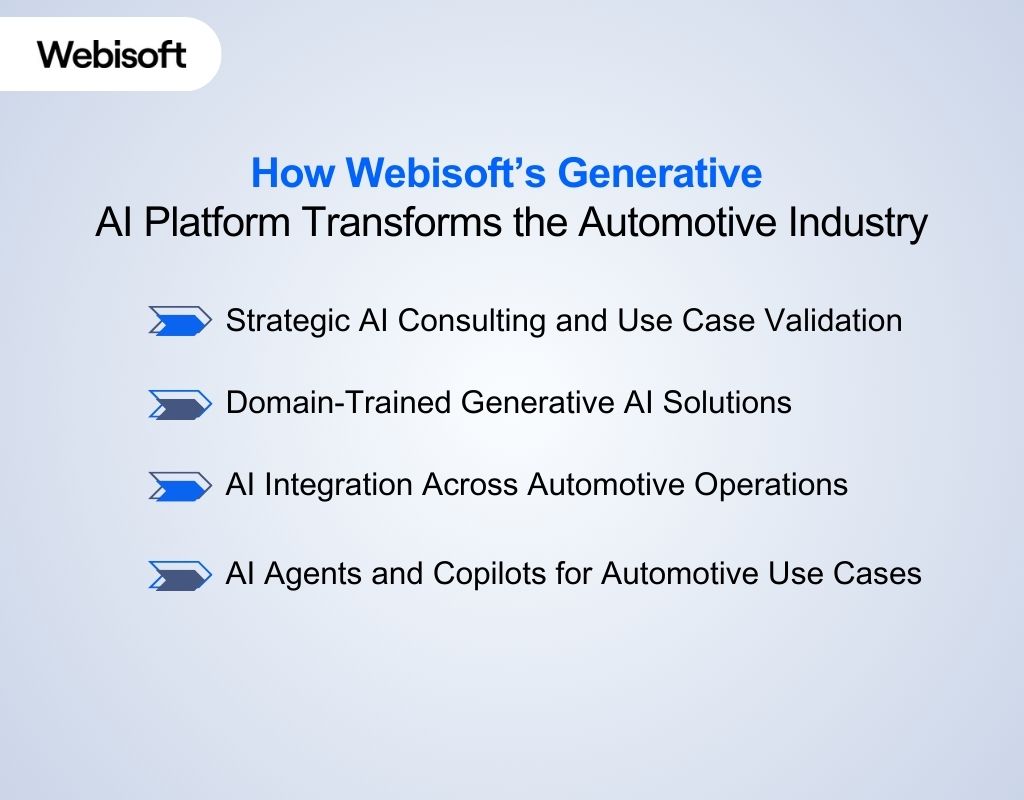
Webisoft applies generative AI in automative through a structured, domain-specific approach focused on real production, engineering, and operational environments. Instead of generic AI deployments, Webisoft designs solutions around automotive data, safety constraints, and existing enterprise systems. This ensures generative AI in the automotive industry delivers measurable value without disrupting established workflows.
Strategic AI Consulting and Use Case Validation
Webisoft begins with strategic AI and ML consulting to identify where automotive generative AI applications deliver the highest impact. Through Proofs of Concept and MVPs, automotive companies test generative AI in real scenarios such as component design, production planning, or diagnostics. This phased approach reduces risk and aligns AI investments with operational goals.
Domain-Trained Generative AI Solutions
In generative AI automotive engineering and manufacturing, Webisoft fine-tunes large language models on automotive terminology, CAD data, engineering documentation, and process logs. This improves output accuracy and relevance compared to general-purpose models. These solutions support parts design, assembly line configuration, and simulation analysis while respecting industry validation standards.
AI Integration Across Automotive Operations
Webisoft ensures generative AI for automotive manufacturing and design integrates seamlessly with existing PLM systems, simulation tools, and production software. AI outputs remain traceable and reviewable, which supports engineering oversight and compliance. This integration improves decision speed without replacing established safety controls.
AI Agents and Copilots for Automotive Use Cases
Webisoft develops AI agents and copilots that support daily automotive operations. These include design and simulation assistants, manufacturing monitoring tools, predictive maintenance support, and in-vehicle personalization systems.
By embedding generative AI automotive use cases into operational workflows, Webisoft enables automotive organizations to improve efficiency, reliability, and customer experience at scale.
Conclusion
Generative AI in automotive is reshaping how vehicles are designed, built, operated, and experienced. As models mature and governance improves, generative AI in automotive will continue to support safer vehicles, more efficient operations, and software-driven innovation across the value chain.
Companies that adopt it with clear use cases and controls will be better positioned to compete as mobility becomes increasingly digital.
Frequently Asked Questions
Challenges include data quality issues, high infrastructure costs, model transparency limits, regulatory uncertainty, and integration with legacy systems. Addressing these requires strong governance, validation processes, and a phased implementation strategy aligned with automotive safety standards.
Generative AI in the automotive industry refers to AI systems that create new outputs such as designs, simulations, software code, or synthetic data. Unlike traditional AI that focuses on prediction or classification, generative AI produces original artifacts that support design, engineering, testing, and customer-facing applications.
In manufacturing, generative AI is used for process optimization, defect pattern generation, quality inspection support, and production planning. It helps teams analyze large volumes of production data, reduce waste, improve consistency, and support faster decision-making without replacing existing control systems.
Generative AI can be safe when applied to non-control and decision-support use cases under human oversight. Safety-critical systems require strict validation, traceability, and governance. For this reason, generative AI is commonly used in design, simulation, diagnostics, and software assistance rather than direct vehicle control.
Key benefits include faster development cycles, lower reliance on physical prototypes, improved software productivity, cost efficiency, and more personalized customer experiences. These advantages help automotive companies manage complexity as vehicles become increasingly software-driven.