The AI landscape shifted quickly with the arrival of powerful generative models that automate parts of creativity and reasoning. What surprised many leaders was how fast these capabilities moved from research into real business settings.
For organizations, the conversation is no longer about curiosity or experimentation. It is about whether these systems can support new services, better decisions, and scalable operations. This shift has pushed generative AI for enterprises into boardroom discussions across industries.
Executives now ask where value exists, where risk lives, and what adoption should actually look like. In this blog, we will discuss real enterprise use cases, architecture choices, benefits, risks, and how to implement generative AI responsibly.
What generative AI for enterprises actually refers to
Generative AI for enterprises refers to applying generative models, which are machine learning systems that learn patterns from existing data and generate new outputs. This can be text, code, images, or structured results under probabilistic rules.
The generative models are applied within large organizations under defined operational, legal, and governance constraints. These systems generate new outputs such as text, code, images, audio, video, and structured processes by learning patterns from existing data. In an enterprise context, enterprise generative AI is fundamentally different from consumer tools.
Consumer systems accept open prompts and return unconstrained outputs. Enterprises cannot operate this way due to sensitive data, compliance requirements, and accountability obligations. As a result, generative AI in enterprises is embedded into controlled workflows, connected to approved data sources, and monitored through access controls and audit mechanisms.
The system assists work, but responsibility always remains with people. Unrestricted models introduce reliability and ownership risks at scale. Outputs may sound confident while lacking factual grounding or proper context.
There are also intellectual property and regulatory concerns when generated content influences business decisions. This is why enterprise GenAI emphasizes validation, traceability, and human review. The goal is not creative experimentation. The goal is dependable support that fits enterprise systems, risk tolerance, and decision processes.
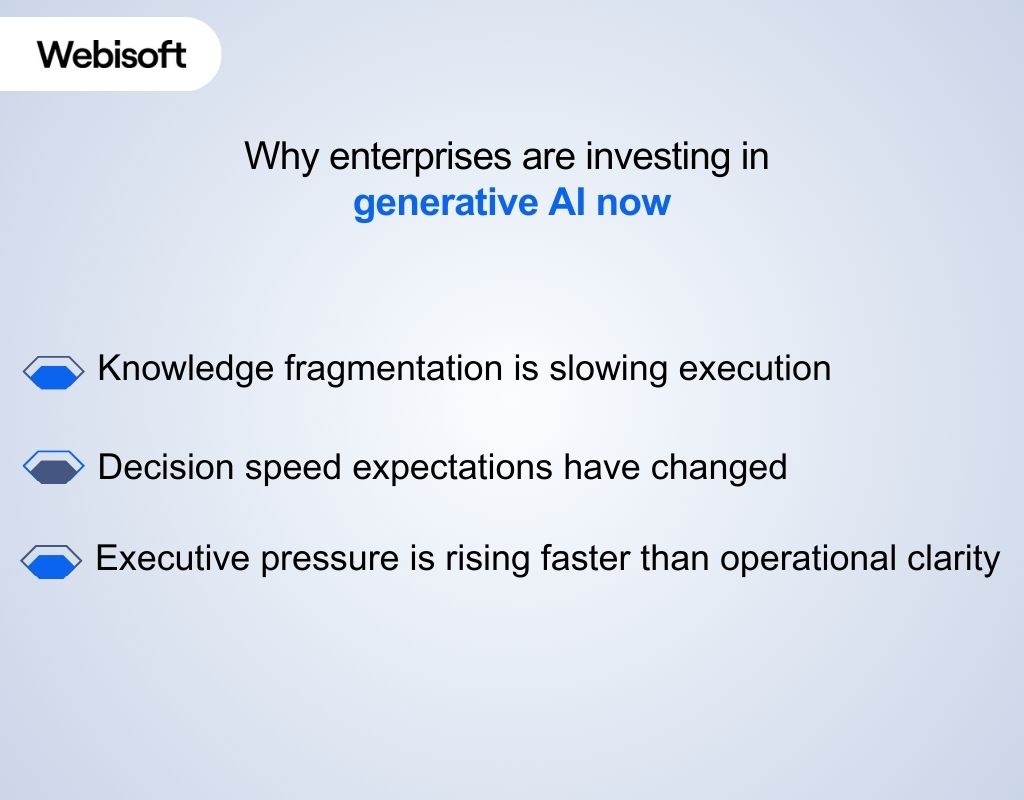
Why enterprises are investing in generative AI now
A McKinsey survey found that about 62% of companies have adopted at least one form of AI in a business function Enterprise interest in generative AI is driven by practical pressure, not novelty. Organizations face rising complexity, tighter timelines, and increasing expectations from leadership. These forces are pushing teams to look for scalable ways to improve execution and decision quality.
Knowledge fragmentation is slowing execution
Large enterprises manage information across many systems, teams, and formats. Critical context is scattered across documents, dashboards, emails, and legacy platforms. This fragmentation slows work and increases dependency on manual coordination.
Generative AI for enterprises helps synthesize information across sources without replacing core systems. Teams can access relevant context faster, reduce rework, and operate with less reliance on informal knowledge that does not scale.
Decision speed expectations have changed
Leadership teams now expect faster insights and shorter planning cycles. Market shifts and customer demands leave little room for slow analysis. Traditional analytics tools often require rigid queries and predefined models, which limits responsiveness.
Enterprise generative AI supports quicker interpretation of complex data through summarization and analysis assistance. This improves speed while keeping decision ownership with people.
Executive pressure is rising faster than operational clarity
Boards increasingly view generative AI in enterprises as a competitive requirement. Many organizations still lack mature deployment and governance models, creating tension between ambition and execution. This pressure is driving investment now to establish foundations, define an enterprise AI strategy, and avoid falling behind peers.
Where enterprises are already using generative AI
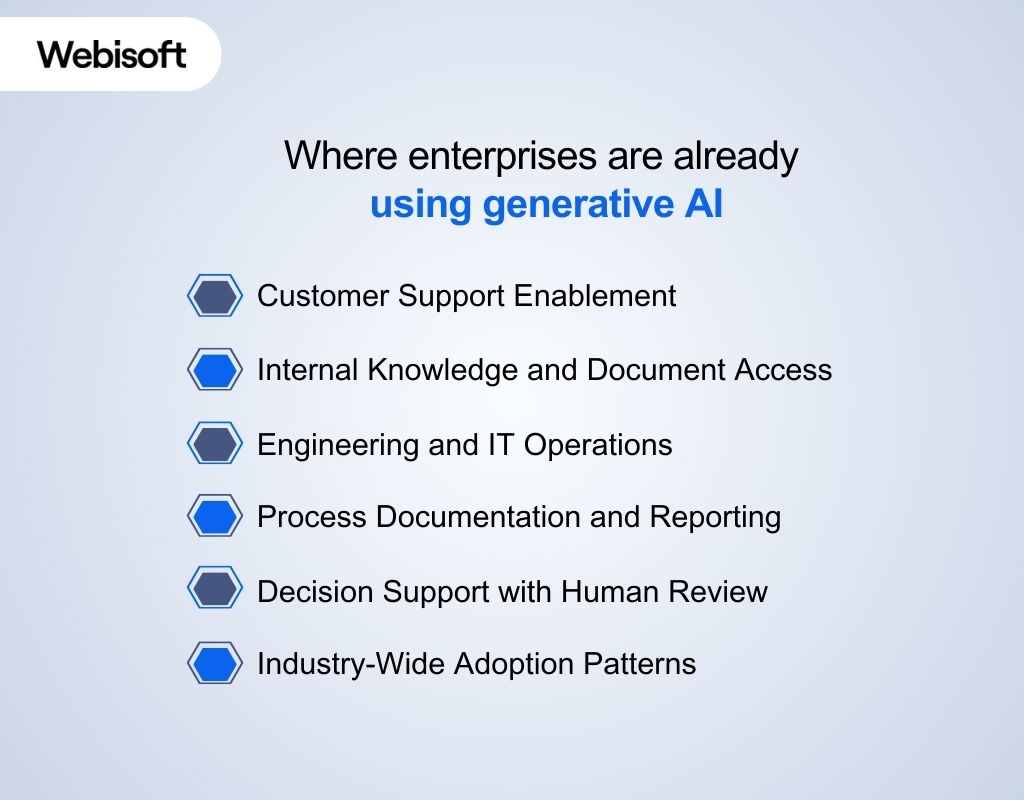
Enterprise adoption is broad but disciplined. Organizations deploy generative systems where value is measurable, ownership is clear, and risk can be controlled. This is where generative AI for enterprises is already embedded into production workflows rather than isolated experiments.
Customer Support Enablement
Customer support is the most mature use case. Enterprises apply enterprise automation with AI to assist agents with response drafting, conversation summaries, and policy retrieval. AI improves speed and consistency, while humans retain control over final customer communication.
Internal Knowledge and Document Access
Large organizations struggle with fragmented information. Enterprise AI architecture enables generative systems to retrieve and summarize approved internal documents only. This supports faster access to policies, contracts, and reports while maintaining permissions, auditability, and data boundaries.
Engineering and IT Operations
Software and IT teams use enterprise large language models to accelerate development and maintenance tasks. Common uses include code scaffolding, test generation, documentation drafting, and incident analysis. Accountability stays with engineers through review and deployment controls.
Process Documentation and Reporting
Operations and finance teams rely on AI driven decision support to generate reports, procedures, and compliance documentation. Outputs follow predefined templates and approval workflows, reducing manual effort while preserving governance standards.
Decision Support with Human Review
Executives use human in the loop AI systems to summarize data, compare scenarios, and prepare briefings. These tools support analysis, not authority. Final decisions remain human-led, which aligns with enterprise risk and compliance expectations.
Industry-Wide Adoption Patterns
Across sectors, enterprises deploy enterprise AI infrastructure in technology, finance, healthcare, retail, manufacturing, logistics, and private equity. While use cases vary, the pattern remains consistent. Generative AI augments work, integrates with core systems, and operates under clear governance.
Enterprise generative AI architecture explained
Enterprise generative AI architecture explains how large organizations turn generative AI models into dependable business systems. Instead of using AI as isolated tools, enterprises design a connected architecture that controls how data, models, and applications interact.
This structure ensures generative AI delivers consistent, secure, and business-aligned outputs across teams. Generative AI for enterprises runs inside a layered system designed for integration, governance, security, and scale.
This Enterprise Generative AI architecture connects large language models with enterprise data, access controls, and validation layers to deliver reliable outcomes, not raw outputs. Direct access to enterprise large language models is unsafe in production. Open prompts introduce data leakage, hallucinations, and accountability gaps.
Instead, enterprises rely on retrieval augmented generation RAG to ground outputs in approved internal sources such as ERP systems and knowledge bases, ensuring factual, business-aligned responses. Validation is built into the workflow. Outputs pass through rules, confidence checks, or human review. This human in the loop AI approach protects high-impact processes while limiting hallucinations.
Every interaction is identity-bound, enforced through role-based access and enterprise AI security controls that mirror existing authorization models. Finally, traceability is mandatory. Inputs, retrieved data, outputs, and actions are logged to support audits, compliance, and AI model governance. This architecture transforms generative AI from experimental tools into dependable enterprise systems that scale across teams and use cases.
Top Generative AI Tools for Enterprises
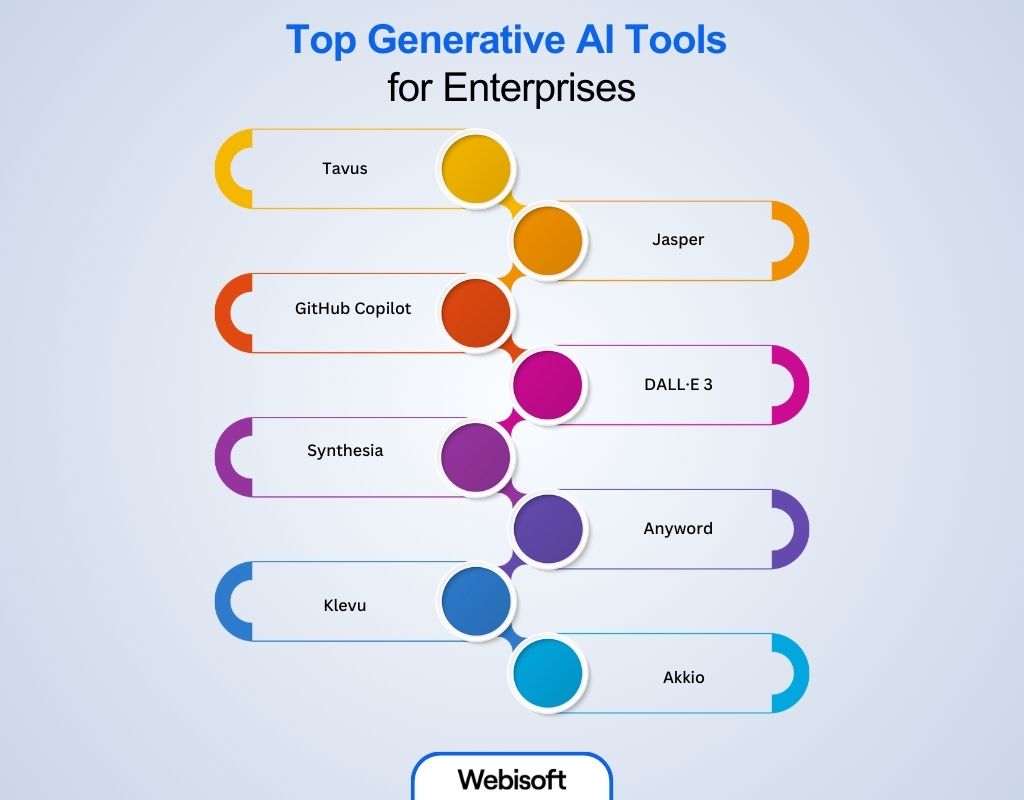
Modern organizations use these tools to automate workflows, improve decision-making, enhance customer experiences, and scale content, code, and design production. In the following section, we will discuss the most widely adopted generative AI tools used by enterprises today:
Tavus (Conversational Video Interface)
Tavus delivers real-time, humanlike video conversations using multimodal generative and agentic AI. Enterprises use it to build interactive digital humans for support, sales, training, and personalized experiences at scale. Pros
- Real-time, low-latency conversational video
- Photorealistic facial expressions and lip sync
- Supports bring-your-own LLM and RAG
- Strong enterprise security and compliance options
Cons
- Requires thoughtful design for effective use cases
- Advanced features increase implementation complexity
Jasper
Jasper is an enterprise-focused content generation platform designed for marketing and brand teams. It emphasizes brand voice consistency, collaboration, and campaign-scale content production. Pros
- Strong brand voice training
- Built for enterprise marketing workflows
- Team collaboration and governance features
Cons
- Limited outside marketing-focused use cases
- Costs scale quickly with large teams
GitHub Copilot
GitHub Copilot provides AI-powered coding assistance embedded directly into developer environments. It supports code generation, refactoring, testing, and documentation at enterprise scale. Pros
- Deep IDE integration
- Boosts developer productivity significantly
- Supports large, shared codebases
Cons
- Requires governance for secure usage
- Suggestions still need human review
DALL·E 3
DALL·E 3 enables enterprises to generate high-quality images from text prompts. Design and marketing teams use it for concept art, campaigns, and product visuals. Pros
- High-resolution, brand-aligned images
- API access for integration
- Commercial usage rights
Cons
- Limited control compared to full design tools
- Image costs scale with heavy usage
Synthesia
Synthesia focuses on template-driven AI video creation for internal and external communications. It is commonly used for training, onboarding, and simple corporate messaging. Pros
- Easy-to-use video creation
- Multilingual support
- Suitable for non-technical teams
Cons
- Limited realism and motion quality
- Less flexible for high-end production
Anyword
Anyword combines generative AI with performance prediction for marketing copy. It helps teams optimize content based on expected conversion outcomes. Pros
- Predictive performance scoring
- A/B testing support
- Data-driven copy optimization
Cons
- Results vary by industry
- Higher tiers required for full value
Klevu
Klevu applies generative AI to e-commerce search and discovery. It improves product findability through smarter search, recommendations, and merchandising. Pros
- Strong e-commerce specialization
- Personalized product discovery
- API-first architecture
Cons
- Limited beyond retail use cases
- Pricing transparency is low
Akkio
Akkio offers no-code AI modeling for enterprise analytics and prediction. Business users can build and deploy models without deep data science expertise. Pros
- No-code, user-friendly interface
- Fast model deployment
- Strong for predictive analytics
Cons
- Limited creative GenAI capabilities
- Less control for advanced ML teams
What enterprises intentionally avoid using generative AI for
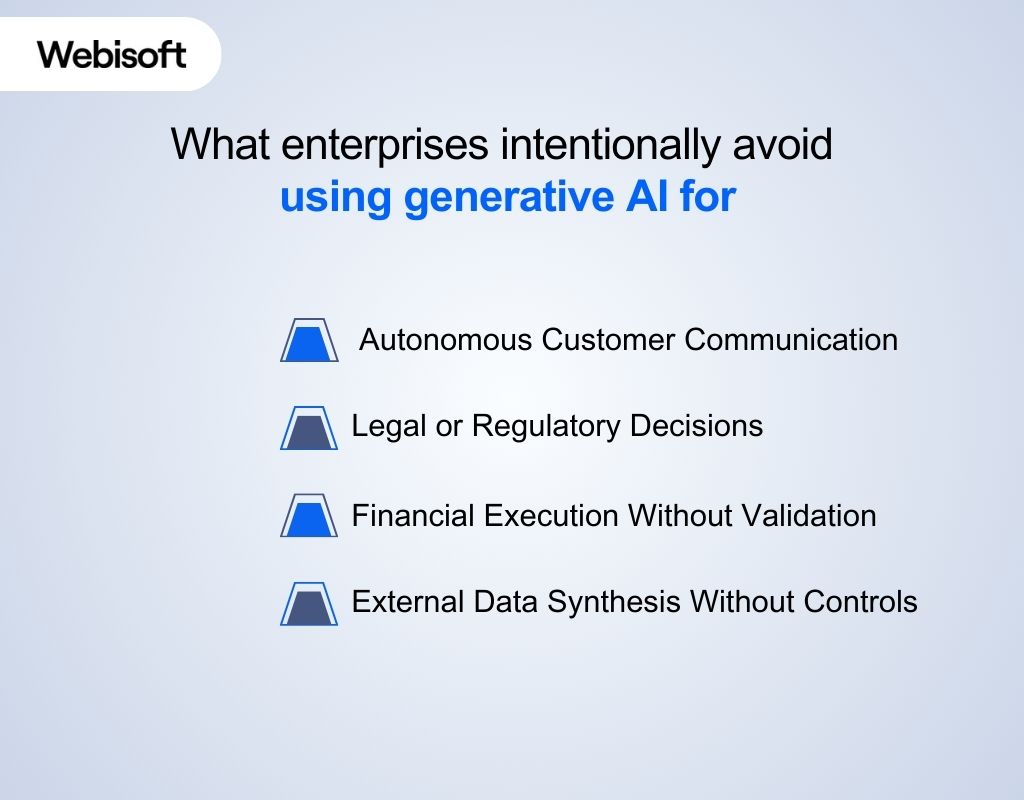
Adoption is not about using AI everywhere. It is about knowing where the risk outweighs the return. Mature organizations define red lines early because mistakes here scale fast. This discipline is central to generative AI for enterprises, even though many competitors avoid discussing it.
Autonomous Customer Communication
Enterprises avoid letting AI communicate with customers on its own. One incorrect promise or misquoted policy can create legal exposure. From an enterprise trust and safety perspective, customer-facing communication always requires human approval. AI may assist, but it never owns the final message.
Legal or Regulatory Decisions
Legal decisions demand interpretation, precedent, and accountability. Regulated enterprise AI is limited to research support or draft preparation. Final judgments stay with licensed professionals to avoid compliance breaches and audit risks.
Financial Execution Without Validation
AI can analyze financial data, but it cannot execute transactions independently. Enterprises block autonomous payments, trades, and approvals. Strong financial AI governance ensures every action is reviewed, logged, and authorized by humans.
External Data Synthesis Without Controls
Pulling open web data introduces accuracy and privacy risks. Enterprises restrict synthesis to approved sources under enterprise data governance frameworks. Uncontrolled aggregation breaks auditability and introduces silent errors.
Webisoft helps enterprises design generative AI systems with built-in boundaries. Instead of copying consumer tools into sensitive workflows, we build AI solutions that align with compliance, security, and real operational ownership.
Benefits of generative AI for enterprises
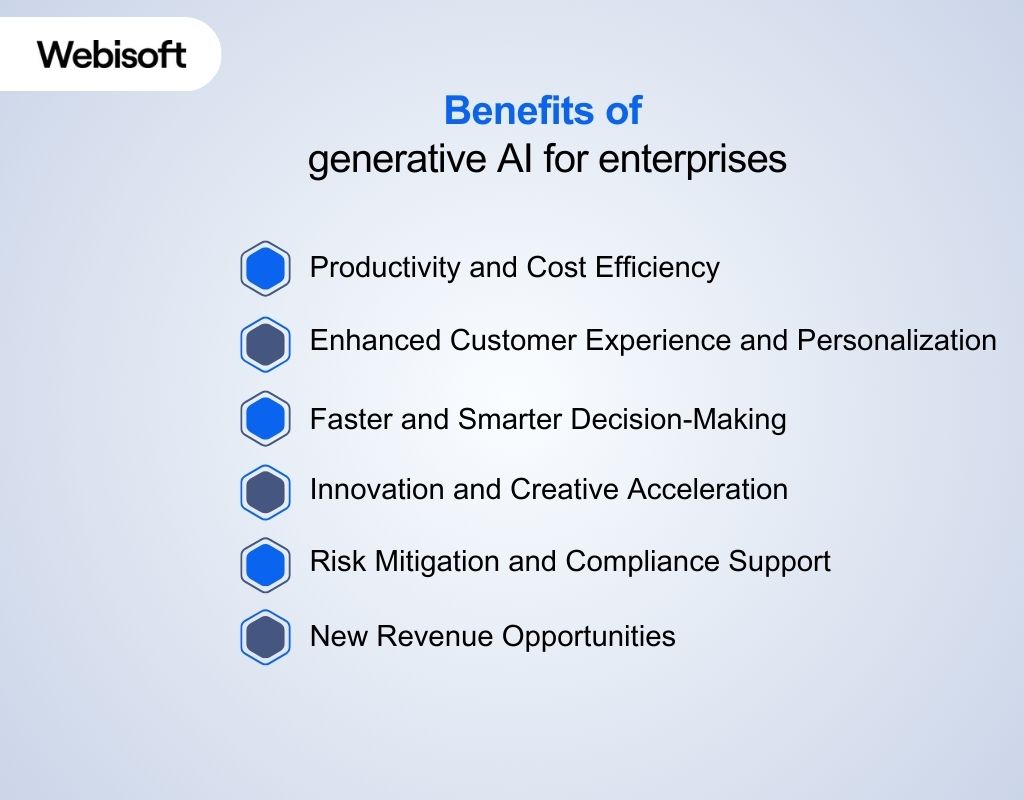
Enterprises invest in AI when the benefits are tied directly to performance, cost, and competitiveness. The value of generative AI for enterprises comes from practical gains across productivity, decision quality, customer experience, and risk control. When deployed correctly, these benefits compound across departments rather than staying isolated.
Productivity and Cost Efficiency
One of the strongest benefits is operational efficiency. Generative AI operational efficiency improves when repetitive work such as reporting, documentation, code generation, and data analysis is automated. Teams spend less time on manual tasks and more time on execution and improvement. This directly supports generative AI cost control by reducing labor overhead and rework.
Enhanced Customer Experience and Personalization
Enterprises use enterprise automation with AI to deliver consistent, personalized experiences at scale. AI-powered assistants and recommendation systems tailor interactions based on behavior and context. This level of personalization increases engagement, retention, and long-term customer value without adding operational complexity.
Faster and Smarter Decision-Making
Generative systems support leaders by summarizing large datasets, comparing scenarios, and highlighting risks. AI driven decision support allows teams to move faster without sacrificing judgment. Decisions remain human-led, but insight arrives sooner and with better context.
Innovation and Creative Acceleration
Generative models support ideation in marketing, product design, and service development. By generating multiple options quickly, teams explore more possibilities in less time. This accelerates experimentation while keeping the final direction in human hands.
Risk Mitigation and Compliance Support
Enterprises apply generative AI risk management to detect anomalies, surface compliance issues, and monitor operations. When paired with generative AI compliance controls, AI helps reduce exposure rather than increase it.
New Revenue Opportunities
Some organizations also unlock new revenue by creating digital assets, personalized offerings, or data-driven services. These opportunities emerge only after core operations are stable and governed. In practice, the benefits of generative AI scale when it is embedded into workflows, measured against outcomes, and aligned with enterprise priorities.
Why most enterprise generative AI pilots fail
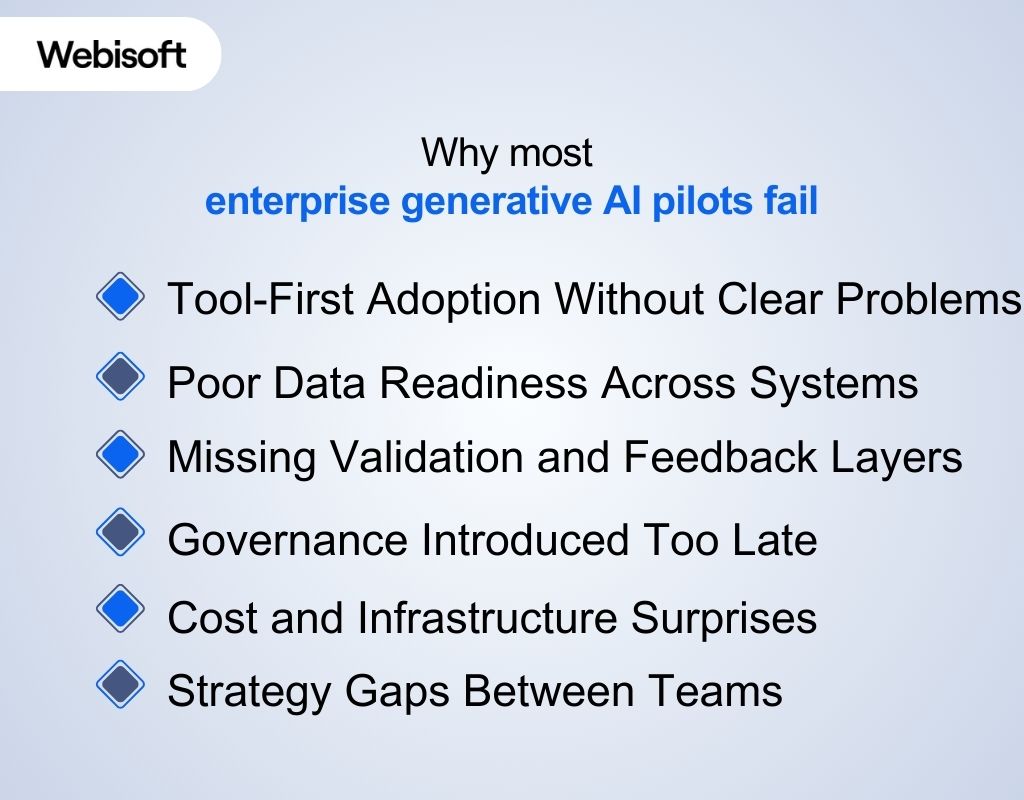
Enterprise skepticism around AI is earned. Most pilots collapse not because the technology is weak, but because organizations rush deployment without fixing deeper issues. Generative AI for enterprises magnifies structure, culture, and data maturity. When those are weak, failure becomes visible fast.
Tool-First Adoption Without Clear Problems
Many teams start with tools instead of outcomes. A chatbot gets deployed before anyone maps the workflow it should support. This leads to enterprise AI pilot failure where usage stays optional and value stays unmeasured. AI becomes a side experiment, not part of daily work.
Poor Data Readiness Across Systems
Generative systems depend on clean, trusted inputs. Most enterprises underestimate how fragmented their data really is. Outdated documents, duplicate sources, and unclear ownership create unreliable outputs. Without enterprise data readiness, AI only scales inconsistency.
Missing Validation and Feedback Layers
Speed often wins over safety in early pilots. Teams skip review steps to show progress. That breaks trust when hallucinations appear. Mature programs design human-in-the-loop AI systems from the start, especially for sensitive workflows.
Governance Introduced Too Late
Legal, compliance, and security teams are often brought in after pilots spread. At that point, risk freezes momentum. Strong enterprise AI governance frameworks must exist before rollout, not after incidents.
Cost and Infrastructure Surprises
Pilot costs look small. Production costs are not. Compute usage, integrations, monitoring, and support grow quickly. Without planning for enterprise AI infrastructure, budgets collapse before ROI appears.
Strategy Gaps Between Teams
MIT research shows alignment matters more than algorithms. When departments chase different goals, AI accelerates misalignment. This is why many enterprise GenAI initiatives never scale beyond demos.
How To Implement Generative AI For Enterprises
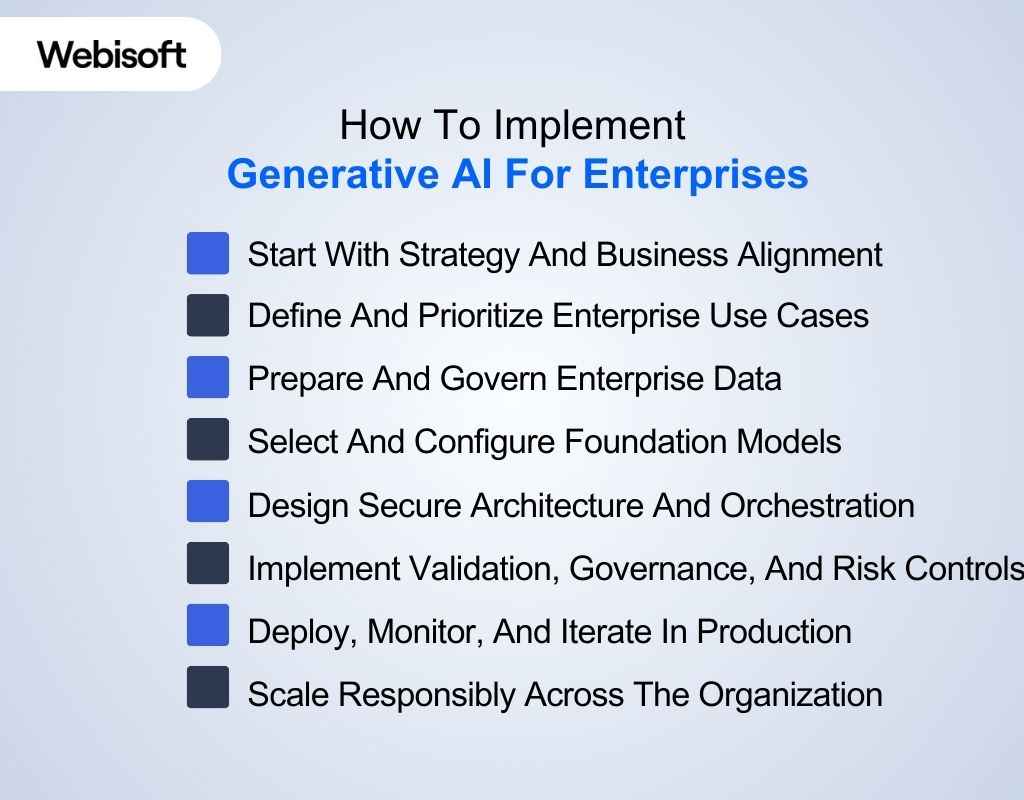
Implementing AI at enterprise scale is not about experimentation. It is about building a controlled, repeatable capability that fits existing systems, data, and accountability models. Generative AI for enterprises requires structured execution across strategy, data, architecture, governance, and operations to move from pilot to production.
Start With Strategy And Business Alignment
Implementation begins with clarity on outcomes. Enterprises define where AI supports revenue, efficiency, risk reduction, or decision quality. A clear enterprise AI transformation goal prevents disconnected pilots and aligns teams around measurable value instead of novelty.
Define And Prioritize Enterprise Use Cases
Teams translate strategy into specific use cases. Each candidate is assessed for impact, feasibility, data readiness, and integration effort. Successful programs prioritize generative AI enterprise use cases in operations, engineering, analytics, and internal workflows where ownership is clear.
Prepare And Govern Enterprise Data
Data readiness determines success. Enterprises inventory, clean, and structure internal data before model use. Strong controls around enterprise data privacy AI ensure sensitive information remains protected during training and inference.
Select And Configure Foundation Models
Enterprises choose models based on control, scalability, and domain needs. Many rely on foundation models for enterprises fine-tuned with internal data, while regulated environments favor domain specific LLMs with tighter boundaries.
Design Secure Architecture And Orchestration
Models operate within a layered system. A secure enterprise AI architecture includes retrieval, validation, and routing components. An AI orchestration layer manages prompts, integrations, and policy enforcement across applications.
Implement Validation, Governance, And Risk Controls
Before rollout, guardrails are defined. Generative AI governance establishes approval workflows, monitoring, and escalation paths. Generative AI risk management addresses hallucinations, bias, misuse, and compliance before scale.
Deploy, Monitor, And Iterate In Production
Deployment includes logging, monitoring, and feedback loops. AI model governance tracks performance, drift, and impact. Human oversight remains part of high-risk workflows to preserve accountability.
Scale Responsibly Across The Organization
As value is proven, enterprises expand cautiously. Scaling generative AI in enterprises requires shared standards, reusable components, and cost visibility to avoid fragmentation and uncontrolled spend.
Agentic AI VS. Generative AI: How They Work Together
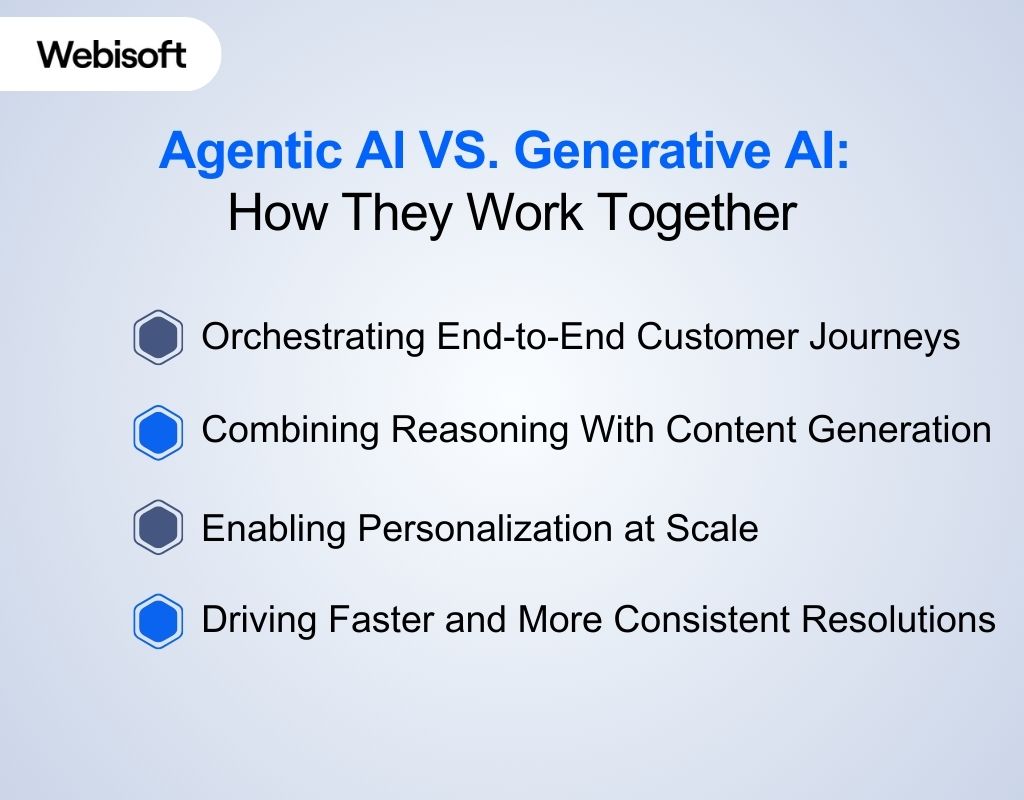
Generative AI and Agentic AI work together to automate complete customer service workflows while preserving personalization and context. Agentic AI acts as the decision-maker and coordinator, identifying customer intent, reasoning through the problem, and determining which actions are required. Generative AI supports this process by producing the content needed at each step, such as responses, confirmations, summaries, or follow-up messages.
Orchestrating End-to-End Customer Journeys
Agentic AI manages the overall flow of a customer interaction from start to finish. It interprets user input, tracks conversation context, and decides how to proceed. As it moves through each step, it calls on Generative AI to generate natural language responses that explain actions, request information, or confirm outcomes. This coordination allows complex issues to be resolved without breaking the conversational experience.
Combining Reasoning With Content Generation
While Agentic AI focuses on reasoning and execution, Generative AI enables clear and human-like communication. As the agentic system verifies data, updates records, or triggers backend actions, Generative AI continuously generates context-aware messages. This ensures customers receive timely, relevant updates instead of generic or scripted replies.
Enabling Personalization at Scale
Agentic AI maintains short- and long-term memory, allowing it to understand customer history and preferences. Generative AI uses this contextual information to tailor language, tone, and content for each interaction. Together, they deliver personalized experiences across thousands of conversations without manual effort.
Driving Faster and More Consistent Resolutions
By working in tandem, Agentic AI and Generative AI reduce resolution times and operational overhead. Tasks that once required multiple handoffs can be completed autonomously, with Generative AI communicating progress and outcomes throughout the process. The result is a scalable system that resolves issues efficiently while maintaining customer trust and satisfaction.
How Webisoft Helps Enterprises Implement Generative AI
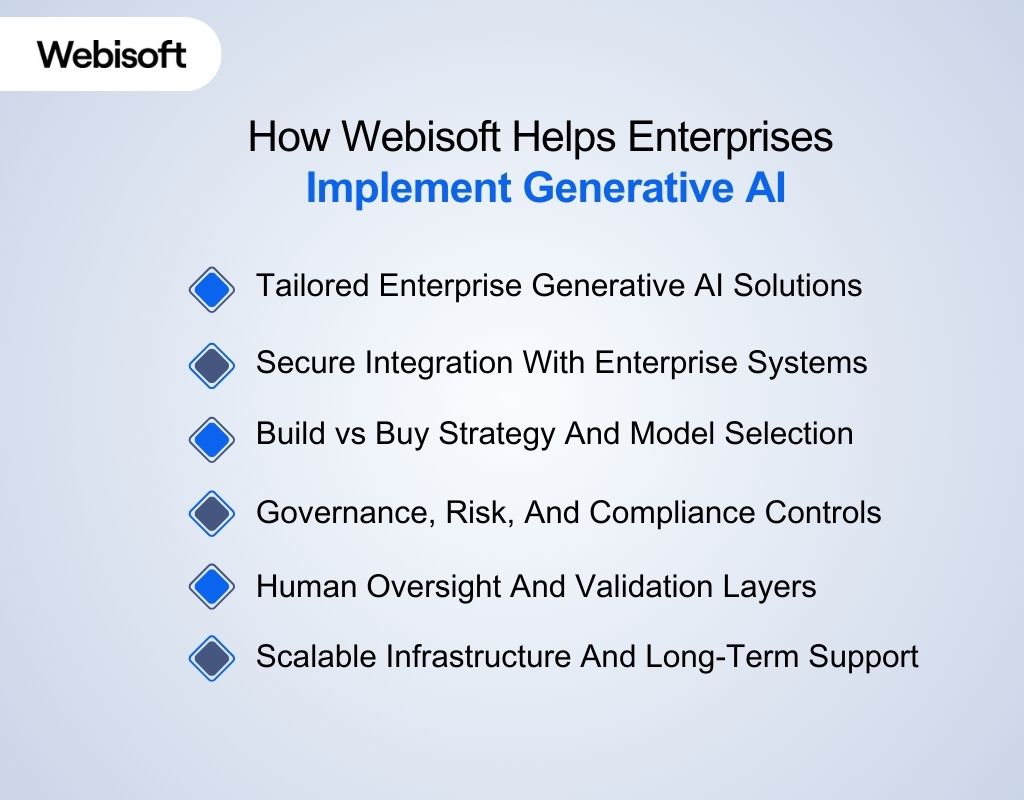
Implementing AI at scale requires discipline, not experimentation. Webisoft helps organizations turn generative AI for enterprises into a production-ready capability that aligns with security, governance, and real operational goals.
Tailored Enterprise Generative AI Solutions
Webisoft designs enterprise generative AI systems around defined business problems, not generic tooling. We build solutions that support analytics, automation, and decision workflows while respecting data sensitivity. Where needed, we develop domain specific LLMs tuned to enterprise context.
Secure Integration With Enterprise Systems
AI creates value only when it fits existing platforms. Webisoft integrates solutions into ERP, CRM, and internal systems using a scalable enterprise AI architecture. This avoids silos and ensures AI supports daily operations.
Build vs Buy Strategy And Model Selection
Choosing the wrong stack creates long-term friction. Webisoft advises on build vs buy generative AI decisions across applications, platforms, data engines, and models. This helps balance speed, control, and cost without locking enterprises into rigid systems.
Governance, Risk, And Compliance Controls
Webisoft embeds generative AI governance from the start. We design approval workflows, audit trails, and generative AI risk management controls to reduce hallucinations, bias, and misuse. Enterprise AI security and compliance are treated as core requirements.
Human Oversight And Validation Layers
High-impact workflows always include review. Webisoft implements human in the loop AI to preserve accountability and decision ownership while still improving speed and efficiency.
Scalable Infrastructure And Long-Term Support
Webisoft builds solutions that grow with the organization. Our focus on enterprise AI infrastructure ensures performance, cost visibility, and adaptability as usage expands. Ongoing monitoring and optimization keep systems reliable over time. This approach is grounded in real delivery experience. Webisoft has applied the same architectural, governance, and scalability principles across enterprise-grade platforms that demand reliability, security, and operational discipline. Our Relevant Enterprise-Aligned Projects
- Formula E: High Voltage
Enterprise-scale data processing and real-time analytics foundations applicable to generative AI for enterprise decision workflows.
- World Mobile
Secure, distributed infrastructure design supporting governed data access and large-scale AI system integration.
Conclusion
Generative AI is reshaping how large organizations operate, compete, and innovate at scale. The real value comes from disciplined adoption, not unchecked experimentation. When implemented with clear strategy, governance, and accountability, generative AI for enterprises supports efficiency, better decisions, and new growth paths.
The challenges around data, ethics, and risk are real, but manageable with the right foundations. Enterprises that treat generative AI as a long-term capability, not a shortcut, position themselves for sustained impact.
Frequently Asked Questions
Yes, when deployed correctly. Enterprises use private models, access controls, and data isolation to prevent leakage. Public tools without guarantees are avoided for sensitive workloads.
They ground models in approved internal data and add validation layers. Human review is used for high-impact outputs. This limits unsupported or fabricated responses.
Initial pilots can take weeks, but production rollout often takes months. Timelines depend on data readiness, governance, and integration complexity.
Start with internal workflows that have clear ownership and low external risk. Knowledge access, reporting, and decision support are common entry points.
Generative AI drives revenue by personalizing customer experiences, improving conversion rates, and automating sales and marketing content. It enhances lead qualification, supports pricing optimization, and enables new AI-powered products.