Data science vs machine learning often gets treated as a technical debate, but it is really a decision about how you use data to drive outcomes. Data science focuses on understanding data and guiding decisions, while machine learning focuses on automating decisions at scale.
They are connected, but they solve different problems. If you have ever wondered whether you need dashboards or deployed models, or insights or automation, you are not alone. Many teams struggle because both terms are used interchangeably, even though they lead to very different workflows, costs, and expectations.
The real challenge is choosing the right approach for your situation. This guide breaks down the differences clearly, so you can decide what actually fits your goals.
What Is Data Science?
A clear Data science definition starts with intent. Data science is the practice of using data to understand what is happening, why it is happening, and what that information means for decisions.
You aren’t focused on prediction at this point. Instead, you work with existing data, question its reliability, test assumptions, and look for patterns that explain real outcomes. The purpose is clarity, not automation. When teams rely on data science, they stop guessing. They replace assumptions with evidence and use that evidence to guide planning, strategy, and operational changes.
Key components of data science
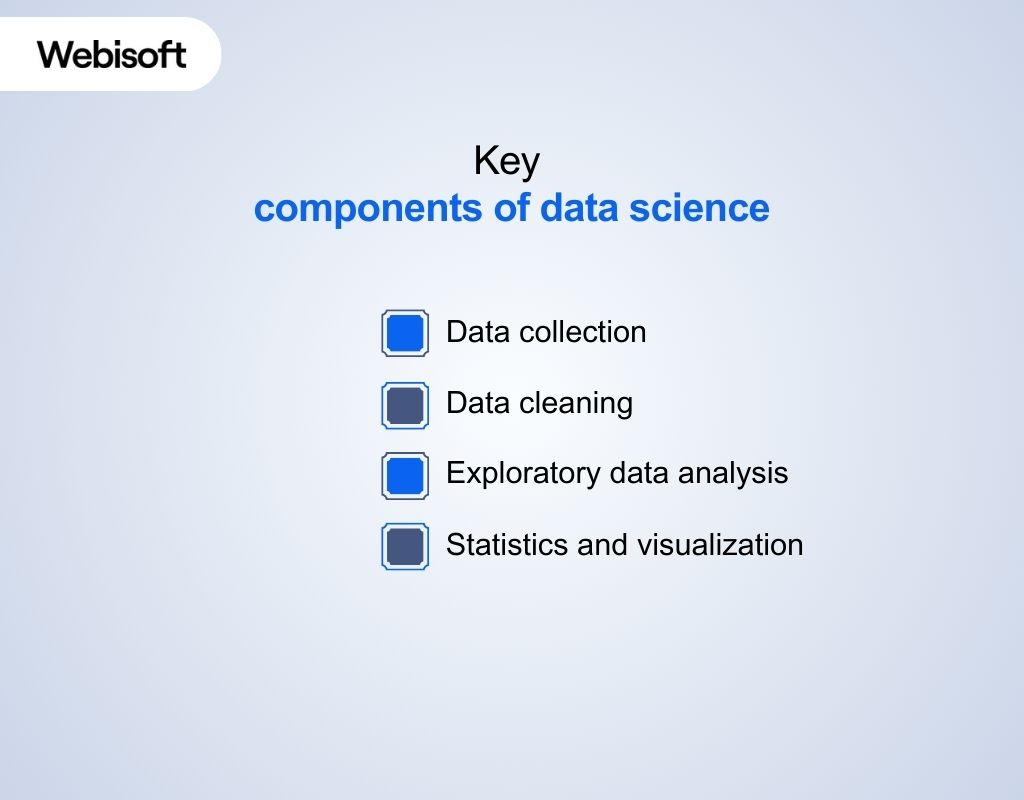
Data science works as a sequence, not a single task. Each component supports the next, and skipping any step usually leads to weak or misleading results.
1. Data collection
Everything begins with gathering data from relevant sources. This might include databases, spreadsheets, APIs, system logs, or third-party platforms. The choice of source matters because it defines what questions you can realistically answer.
2. Data cleaning
Once the data is collected, problems surface quickly. Missing values, duplicate records, inconsistent formats, and unexpected outliers are common in real datasets. Cleaning isn’t a technical detail you rush through. It’s the step that determines whether the results can be trusted.
3. Exploratory data analysis
After cleaning, you start examining the data more closely. This is where you look for trends, irregularities, and relationships that are not obvious at first glance. Simple charts, summaries, and comparisons help reveal what the data is actually saying. At this stage, you are learning the behavior of the data, not trying to predict future outcomes.
4. Statistics and visualization
Statistics help you confirm whether patterns are meaningful or just a coincidence. Visualization helps communicate those findings clearly to people who were not involved in the analysis.
Typical outputs of data science
Data science produces outputs designed for people, not systems. These often include reports, dashboards, insights, and clear recommendations that guide decisions. The common thread is understanding first, action second.
What Is Machine Learning?
Machine learning is used when decisions need to happen repeatedly and at scale. Instead of analyzing data to explain outcomes, you train systems to recognize patterns and act on them without constant human input. The purpose isn’t understanding for its own sake.
It’s consistency and speed. Once trained, an ML model applies what it has learned to new data, even when conditions keep changing. This is why machine learning shows up in products and systems, not reports.
Types of machine learning
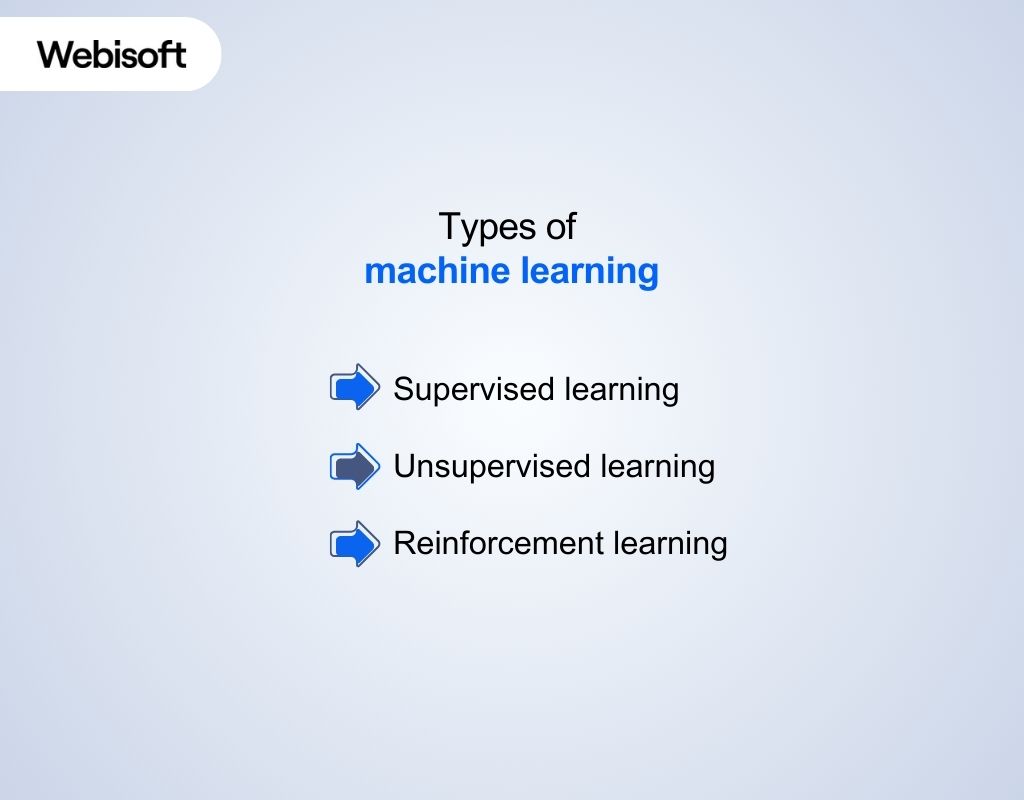
Machine learning works through repeated feedback. Each mistake becomes a lesson. Hence, the learning methods differ based on how much guidance the system receives during training. Here are the types of machine learning:
1. Supervised learning
In supervised learning, the data already includes correct outcomes. The model learns by comparing its predictions with known results and correcting itself. This approach works well when past examples clearly define success, such as forecasting demand or detecting fraud.
2. Unsupervised learning
Unsupervised learning starts without predefined labels. The system looks for structure on its own, identifying groups, similarities, or unusual behavior. You use this approach when discovery matters more than prediction.
3. Reinforcement learning
Reinforcement learning focuses on sequences of decisions. The system interacts with an environment, receives feedback, and adjusts future actions based on rewards or penalties. It fits problems where each decision influences what happens next.
Typical outputs of machine learning
Machine learning produces operational outputs. These are trained models that score data, classify inputs, recommend actions, or trigger responses automatically. Once deployed, these models run continuously in the background, shaping outcomes without direct human involvement.
Data Science vs Machine Learning: A Detailed Comparison Table
After understanding the data science and machine learning definition, you may have a general idea of what they are. Still, definitions alone aren’t enough to break down the practical differences between data science vs machine learning. Here’s a quick comparison table you should look at before getting into the detailed comparison:
| Aspect | Data Science | Machine Learning |
|---|---|---|
| Main goal | Understand data and support decisions | Automate decisions using learned patterns |
| Decision maker | Humans interpret and decide | Systems decide automatically |
| Type of work | Exploratory and analytical | Predictive and execution-focused |
| Data tolerance | Can work with messy or limited data | Needs clean, consistent data |
| Typical outputs | Reports, dashboards, insights | Deployed models in live systems |
| Speed requirement | Decisions can take time | Decisions must happen fast |
| Scaling approach | Scale insights across teams | Scale automation through infrastructure |
| Risk handling | Review and discussion | Monitoring and model controls |
Data Science vs Machine Learning: 17 Key Functional Differences
The definitions and table give you a starting point, but they don’t fully explain the differences. Here’s the detailed data science and machine learning comparison for better understanding:
Execution Differences between Data Science and Machine Learning
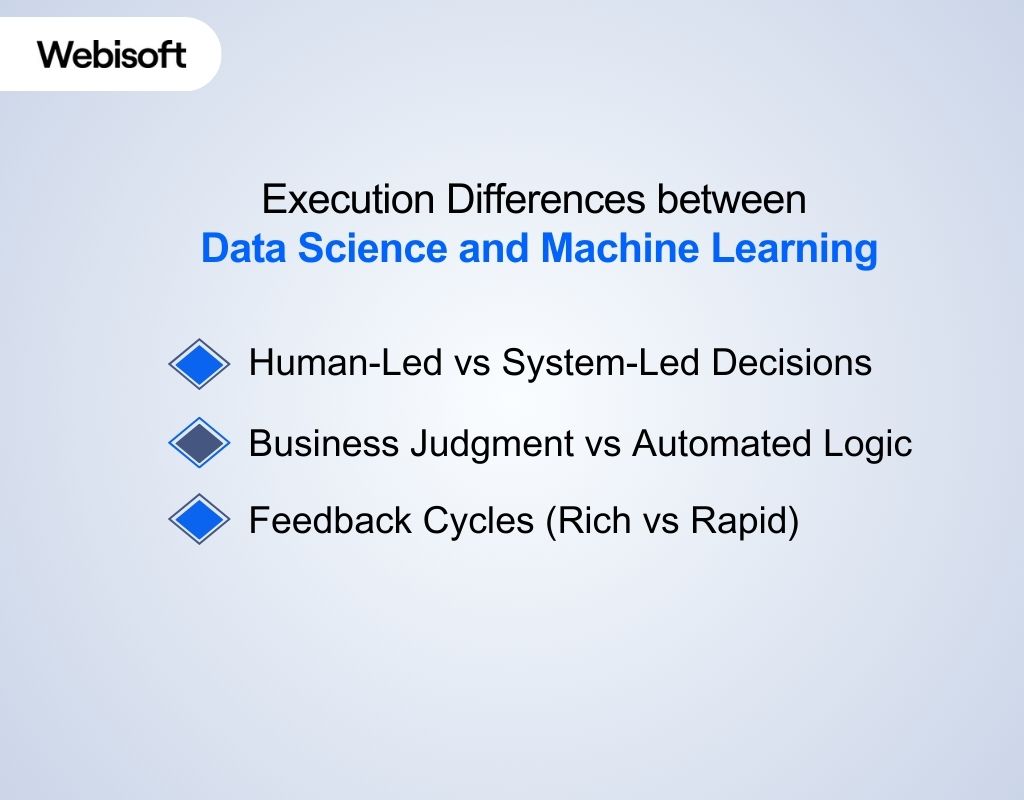
Human-Led vs System-Led Decisions
When teams rely on data science, decisions remain human-led. Analysts review results, interpret patterns, and decide what actions make sense based on context, constraints, and business judgment. With machine learning, that judgment is encoded into a system.
Decisions are made automatically using learned patterns, often without manual review, especially when speed or volume makes human involvement impractical. What changes in practice: Data science supports decision-making, while machine learning replaces repeated decision-making once confidence is high.
Business Judgment vs Automated Logic
Data science allows more flexibility. Analysts can question results, adjust assumptions, and explore alternatives when new questions arise. Machine learning prioritizes consistency. Once deployed, the same logic is applied across thousands or millions of events, producing predictable behavior at scale.
What changes in practice: Data science adapts easily to new questions, while machine learning excels when the same decision must be made over and over.
Feedback Cycles (Rich vs Rapid)
In data science workflows, feedback is slower but richer. Results are reviewed, discussed, and refined before actions are taken. On the other hand, in machine learning systems, feedback is faster but narrower.
Models are evaluated using performance metrics, retrained when accuracy drops, and updated without discussion. What changes in practice: Data science improves decisions through reflection, while machine learning improves outcomes through iteration.
Differences Across Project Lifecycle
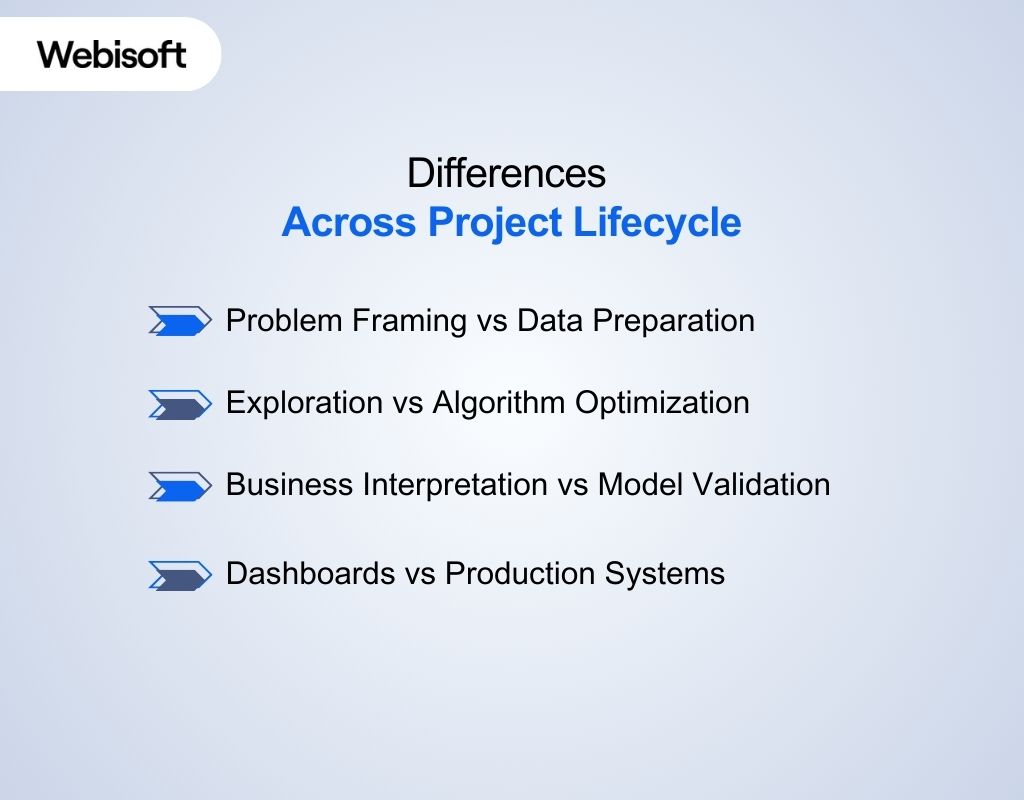
Problem Framing vs Data Preparation
Data science projects begin with business uncertainty. Teams define what needs to be understood, what decisions are unclear, and which data might help. Data preparation follows those questions, even if the data is messy or incomplete. Machine learning projects begin with technical clarity.
Inputs, outputs, and constraints are defined first so a system can learn consistently. Data preparation is stricter because inconsistency directly affects model behavior. What changes in practice: Data science frames work around decisions, machine learning frames work around learnable structure.
Exploration vs Algorithm Optimization
Data science development is exploratory. Analysts test assumptions, change direction, and adjust methods as insights evolve. Flexibility matters more than repeatability. Machine learning development is structured.
The focus is algorithm selection, parameter tuning, and controlled experiments to improve performance. What changes in practice: Data science adapts to questions, machine learning refines behavior.
Business Interpretation vs Model Validation
In data science, evaluation centers on usefulness. Results are judged by clarity, relevance, and how well they support planning, especially in data science vs machine learning for business contexts.
On the contrary, in machine learning, evaluation is metric-driven. Accuracy, error rates, and stability determine success, not narrative explanation. What changes in practice: Data science measures value through impact, machine learning through performance thresholds.
Dashboards vs Production Systems
Data science outputs are shared through dashboards, reports, or presentations. Scaling means broader access to insight, not automated execution. Machine learning deployment means embedding models into live systems. Scaling involves reliability, latency, and monitoring under real usage. What changes in practice: Data science scales understanding, machine learning scales action.
What Each Approach Delivers and How ROI Is Measured
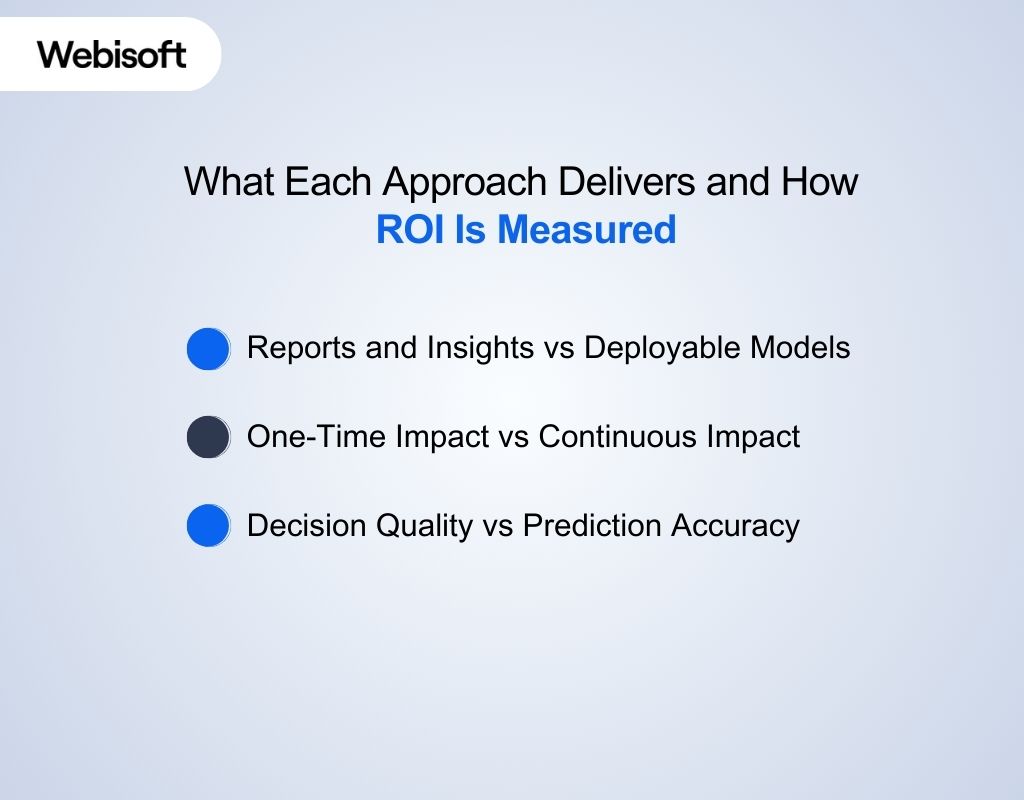
Reports and Insights vs Deployable Models
Data science delivers artifacts meant to be reviewed. Reports, dashboards, and written insights help teams understand situations and decide next steps. These outputs are often shared across stakeholders and revisited as context changes. Machine learning delivers deployable models.
These artifacts live inside systems and operate continuously, producing predictions or actions without manual review. What changes in practice: Data science delivers decision-support material, while machine learning delivers components that run inside products.
One-Time Impact vs Continuous Impact
Data science typically creates impact at specific moments. An insight leads to a decision, a strategy update, or a process change. The value is real but often tied to a particular time window. Machine learning creates ongoing impact. O
nce deployed, models influence outcomes repeatedly as new data flows through the system. What changes in practice: Data science drives targeted improvements, while machine learning compounds value over time.
Decision Quality vs Prediction Accuracy
Data science ROI is measured by decision quality. If teams make clearer choices, reduce uncertainty, or avoid costly mistakes, the work succeeds. Machine learning ROI is measured by prediction accuracy and stability. Performance metrics determine whether the system delivers reliable outcomes at scale.
This maps to data scientist (analysis/communication) vs ML engineer (modeling/deployment) skills, where analytical judgment contrasts with model optimization. What changes in practice: Data science improves how decisions are made, machine learning improves how often correct decisions happen.
Explainability, Trust, and Risk Exposure
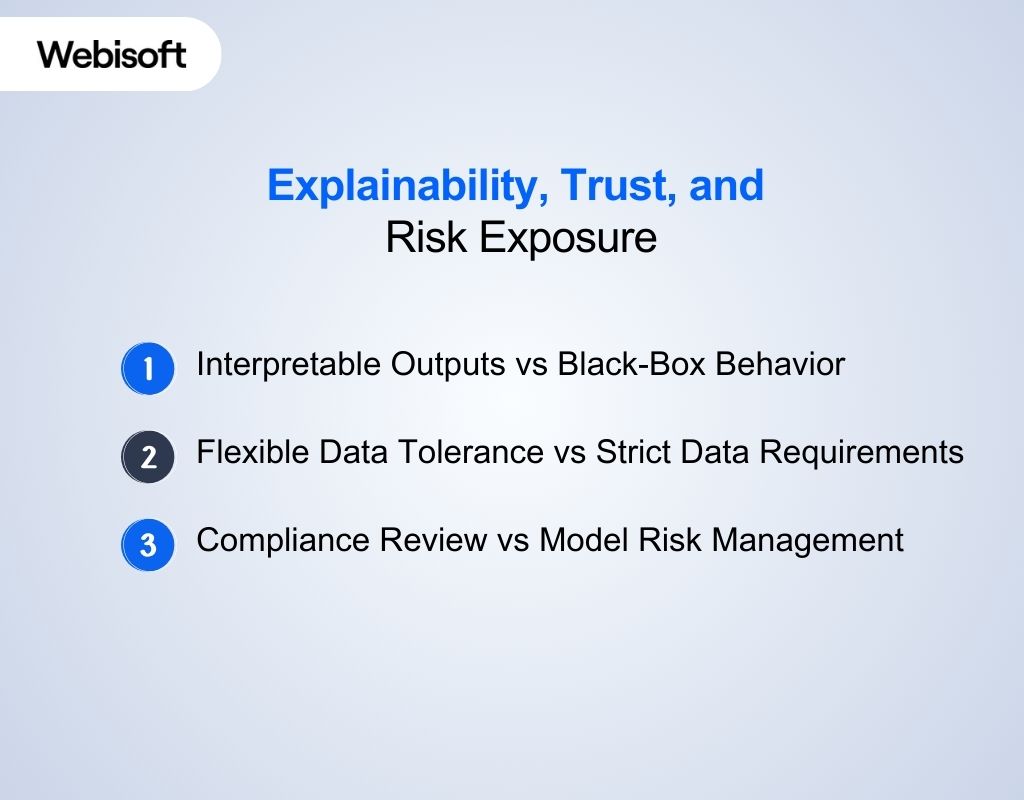
Interpretable Outputs vs Black-Box Behavior
One of the most visible risks in data science vs machine learning shows up when decisions must be explained. Data science results are usually interpretable. Teams can trace how conclusions were reached, question assumptions, and explain outcomes to stakeholders when decisions are challenged.
Machine learning models, especially complex ones, can be harder to interpret. Decisions may be accurate but difficult to explain, which creates trust gaps when outcomes are unexpected. What changes in practice: Data science makes reasoning visible, while machine learning can trade transparency for performance.
Flexible Data Tolerance vs Strict Data Requirements
Data science can work with imperfect data. Analysts can flag gaps, adjust methods, and explain limitations without breaking the workflow. Machine learning is less tolerant. Models depend on consistent, high-quality data, and small shifts can degrade performance quickly. What changes in practice: Data science manages uncertainty through judgment, while machine learning demands tighter data control.
Compliance Review vs Model Risk Management
Data science risk is handled through review. Findings are checked, debated, and approved before actions are taken. Machine learning risk is handled through monitoring. Models require ongoing validation, bias checks, and rollback plans once deployed. What changes in practice: Data science relies on review processes, while machine learning relies on continuous risk controls.
Teams, Tools, and Enterprise Scalability
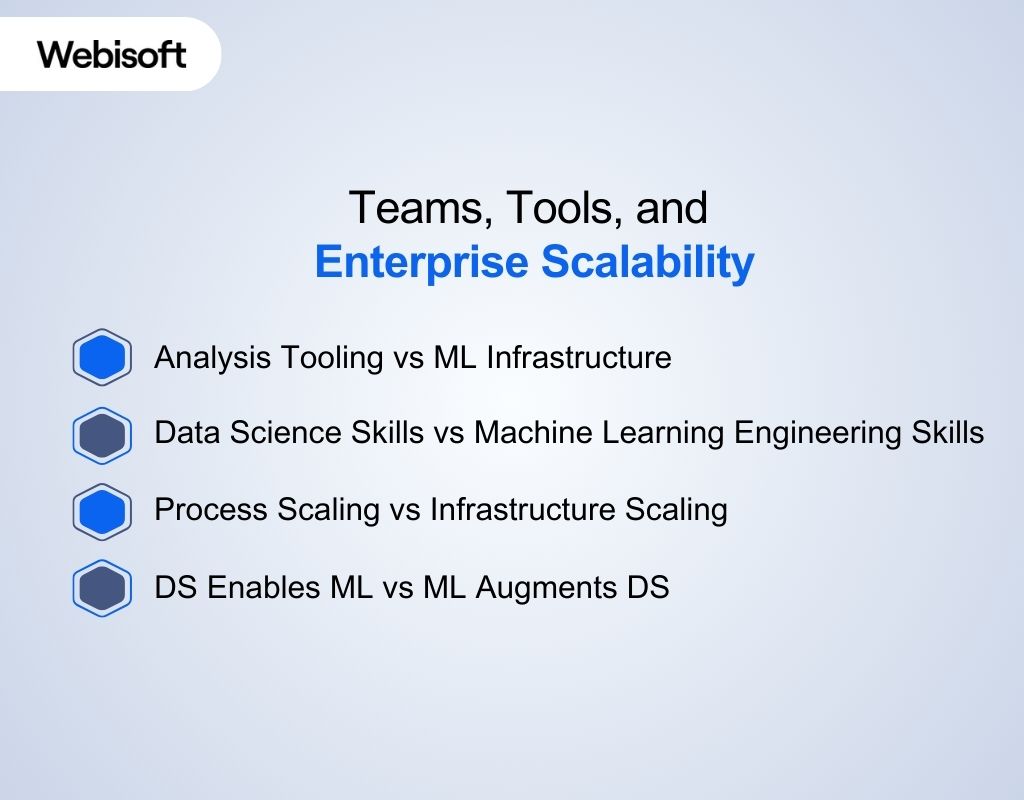
Analysis Tooling vs ML Infrastructure
Data science relies on tools built for exploration and explanation. These include notebooks, SQL environments, spreadsheets, and BI tools where analysts can test ideas, visualize results, and revise assumptions quickly. These tools favor flexibility and human interaction over automation.
Machine learning depends on infrastructure designed for reliability and repetition. Model training frameworks, version control for models, deployment pipelines, and monitoring systems are required so predictions run consistently without manual input.
What changes in practice: Data science tools help people ask better questions, while machine learning tools help systems make the same decision thousands of times without failing.
Data Science Skills vs Machine Learning Engineering Skills
Data science roles emphasize analysis, statistical reasoning, and business communication. The work depends on asking the right questions and interpreting results. Machine learning engineering focuses on building reliable systems.
Skills shift toward software engineering, optimization, and maintaining models in production. What changes in practice: Data science depends on analytical judgment, machine learning depends on engineering discipline.
Process Scaling vs Infrastructure Scaling
Scaling data science means standardizing processes. Shared methods, reusable analyses, and consistent reporting help teams work faster without heavy automation. Scaling machine learning means expanding infrastructure.
Systems must handle more data, higher traffic, and continuous retraining without breaking. What changes in practice: Data science scales through process maturity, machine learning scales through technical capacity.
DS Enables ML vs ML Augments DS
In most organizations, data science comes first. It defines problems, validates assumptions, and identifies patterns worth automating. Machine learning builds on that foundation. It takes proven insights and turns them into systems that operate continuously. What changes in practice: Data science enables machine learning, while machine learning extends the impact of data science at scale.
How Data Science and Machine Learning Work Together
You now know the difference between data science vs machine learning, but they can also work together. Data science and ML form a symbiotic relationship where each amplifies the other’s strengths. Here’s how:
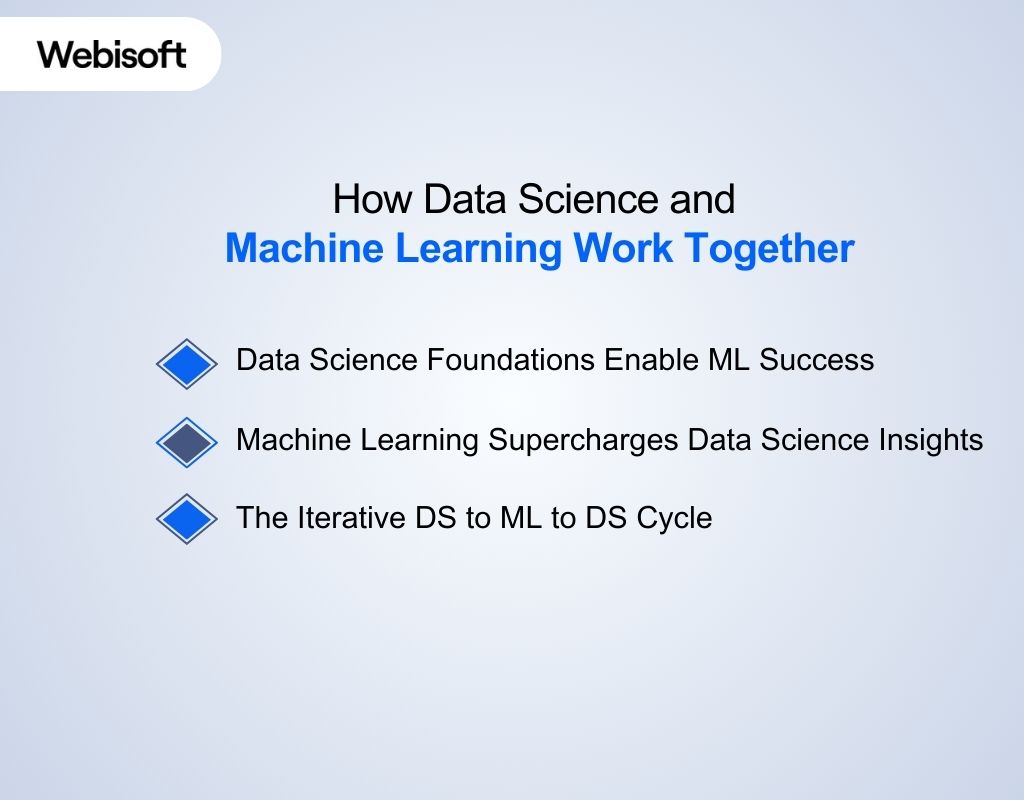
Data Science Foundations Enable ML Success
Most machine learning projects fail for non-technical reasons. Poor data quality, unclear objectives, or weak assumptions usually come first. This is where the difference between data science and machine learning becomes operational. Data science lays the groundwork by cleaning data, validating signals, and framing problems in business terms. Without that foundation, models learn noise instead of patterns.
Machine Learning Supercharges Data Science Insights
Once patterns are validated, machine learning can take over repetitive execution. Insights that would normally sit in a report can be applied continuously inside systems. This is often when to use data science vs machine learning together. Data science identifies what matters. Machine learning applies it at scale, across thousands or millions of decisions.
The Iterative DS to ML to DS Cycle
The relationship does not stop after deployment. Models generate new data, expose edge cases, and surface failures that feed back into analysis. This loop is where Data science vs machine learning explained in practical terms. Data science improves logic. Machine learning tests it in the real world. The results then return to data science for refinement.
Data Science vs Machine Learning: Which One Is Right for Your Business?
This section helps you decide based on real constraints, not hype. Budget, data, team skills, and decision speed matter more than trends.
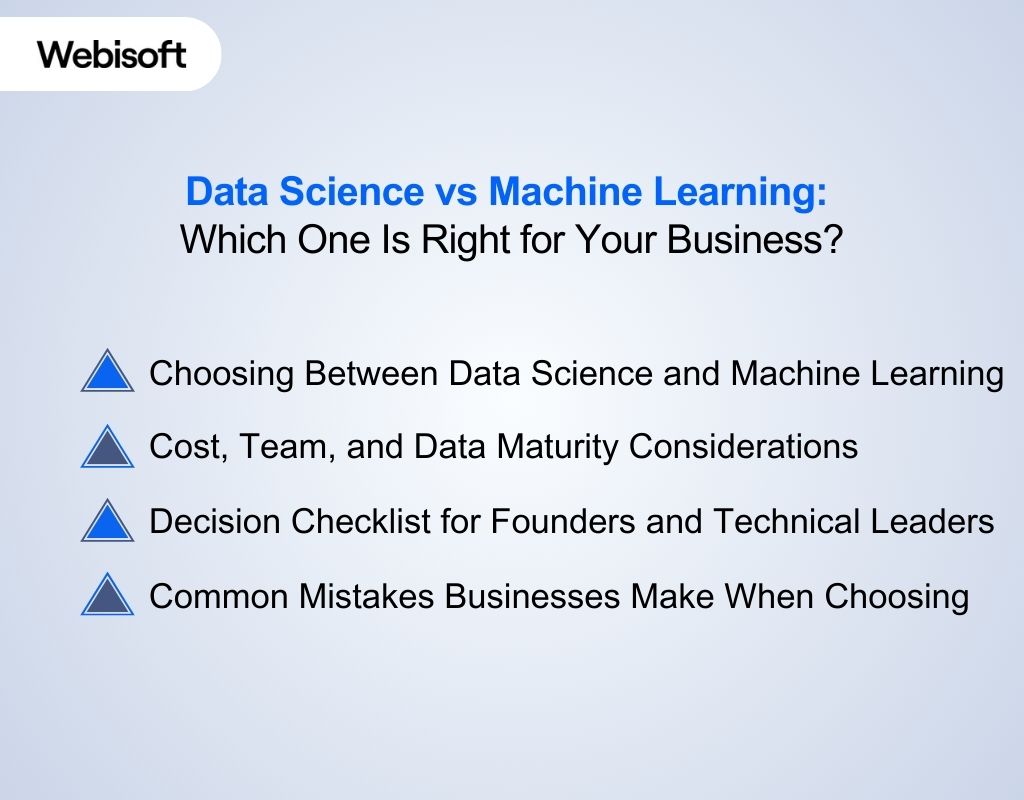
Choosing Between Data Science and Machine Learning
Choosing between these approaches depends on decision speed and scale. This table shows when to use data science vs machine learning, based on whether your business needs understanding and judgment first, or automated, repeatable decisions at scale.
| Situation | Choose Data Science | Choose Machine Learning |
|---|---|---|
| Goal | Understanding and explanation | Prediction and automation |
| Decision frequency | Occasional or strategic | Frequent and repetitive |
| Human involvement | High | Minimal |
| Data quality | Messy or incomplete | Clean and consistent |
| Output | Insights and recommendations | Live system decisions |
Cost, Team, and Data Maturity Considerations
Data science usually has lower upfront costs. The primary investment is analyst time and analytical tooling. Once insights are delivered, ongoing costs remain relatively stable. Machine learning requires more commitment.
Beyond initial development, teams must support pipelines, monitoring, retraining, and production reliability. Costs increase as usage and scale grow. Data maturity matters just as much. Data science can still work with incomplete or messy data if limitations are understood. Machine learning needs consistent, well-structured data to remain reliable.
Decision Checklist for Founders and Technical Leaders
Start by examining how decisions are made today. If people still review results, discuss trade-offs, and apply judgment, automation may be premature. Next, assess speed requirements. If decisions must happen instantly or repeatedly without review, automation may be justified. Finally, confirm ownership. Without a team ready to maintain models, machine learning quickly becomes a liability.
Common Mistakes Businesses Make When Choosing
Most mistakes happen when teams treat this as a tooling decision instead of a problem-solving one. The following issues show up repeatedly in real projects:
- Skipping understanding: Teams jump straight into models before clarifying the problem. Machine learning then amplifies weak assumptions instead of correcting them.
- Overengineering: Some challenges only need insight, but teams build complex systems that never reach production.
- Ignoring long-term ownership: Models require monitoring, updates, and maintenance. Treating them as one-time efforts creates hidden risk and cost.
If this guide still doesn’t make it easier to choose between data science vs machine learning, consulting with ML experts at Webisoft can help you evaluate the right approach through a focused discussion.
How Webisoft Helps With Data Science and Machine Learning Projects
Webisoft partners with teams that want practical outcomes. The approach focuses on understanding your data, choosing the right level of automation, and building solutions that fit how your business actually makes decisions. Here’s how Webisoft help you:
- Clarifies the problem first: Helps you define the right business questions, assess data quality, and validate assumptions before any modeling begins.
- Builds strong data science foundations: Delivers exploratory analysis, insights, and decision-ready outputs that reduce risk and prevent wasted engineering effort.
- Provides end-to-end machine learning services: Designs, trains, deploys, and maintains machine learning models built for real production use, not isolated experiments.
- Implements production-ready machine learning: Focuses on deployment, monitoring, retraining, and reliability so models continue to perform as conditions change.
- Chooses the right approach for your context: Advises when insight is enough and when automation will actually deliver ROI, avoiding hype-driven decisions.
- Aligns tech with how decisions are made: Ensures solutions fit your workflows, team structure, and decision speed, not just technical possibilities.
- Supports end-to-end execution: Covers the full path from analysis to deployment, scaling only what needs to scale.
Not only in the machine learning field, webisoft can also help you with AI app development with ML models according to your business needs.
Conclusion
In conclusion, data science vs machine learning is not a choice between two competing technologies, but a decision about how your business understands and applies data. Data science brings clarity and context.
Machine learning brings speed and scale. The strongest results come when teams use insight first, then automation where it truly fits, based on real needs rather than trends. Contact Webisoft to implement the right approach for your business.
FAQs
Here are a few commonly asked questions regarding data science vs machine learning:
Machine learning is often considered a subset of data science, but they are not the same thing. Data science covers the broader process of understanding data, asking questions, and supporting decisions. Machine learning fits inside that process when automation or prediction is needed.
Yes, but it is risky. Without data science, teams may train models on poor data or unclear assumptions. This often leads to unreliable results, hidden bias, or systems that fail once deployed. Data science reduces that risk by validating the foundation first.
No. Many data science projects deliver value through analysis, visualization, and insights alone. Machine learning is only needed when decisions must be automated or repeated at scale.
Both have strong futures, but they grow in different ways. Data science remains critical because businesses will always need interpretation, judgment, and problem framing. Machine learning grows as automation increases, but it depends on solid data science foundations to succeed long term.
Start with data science. Data science builds foundational skills like data cleaning, statistics, and problem framing. These skills help you understand what data represents and whether automation is even needed. Machine learning becomes effective only after you understand data behavior and decision context.