Are you struggling to choose between Cosmos and MongoDB? Don’t worry; we’re here to help.
Cosmos is a versatile database service that stands out for its flexibility. It offers support for various APIs and accommodates multiple data models, making it an excellent choice for a wide range of use cases.
On the other hand, MongoDB is a renowned NoSQL database known for its adaptability and scalability. It excels in handling large volumes of unstructured or semi-structured data.
However, this comparison provides only a basic overview. Cosmos and MongoDB offer unique features and capabilities that go beyond just numbers and user counts.
Join us as we start on an in-depth comparison between Cosmos and MongoDB, where we’ll explore their special features, strengths, and differences. Let’s begin this exploration together!
What is Cosmos?
Cosmos, also known as the Cosmos Network, is an open-source blockchain ecosystem that aims to solve the problem of blockchain interoperability. It was developed to enable various blockchains to communicate and transfer assets seamlessly, creating a more interconnected and efficient network of blockchains.
It was officially launched in March 2019 by Tendermint Inc., a blockchain development company. It provides a framework for building and connecting sovereign blockchains, each with its own consensus mechanism and governance structure.
The primary goal of Cosmos is to enable secure and scalable cross-chain communication, maintaining interoperability between different blockchain networks. The Cosmos Network uses the Tendermint consensus algorithm to ensure the security and reliability of its interconnected blockchains.
Features of Cosmos
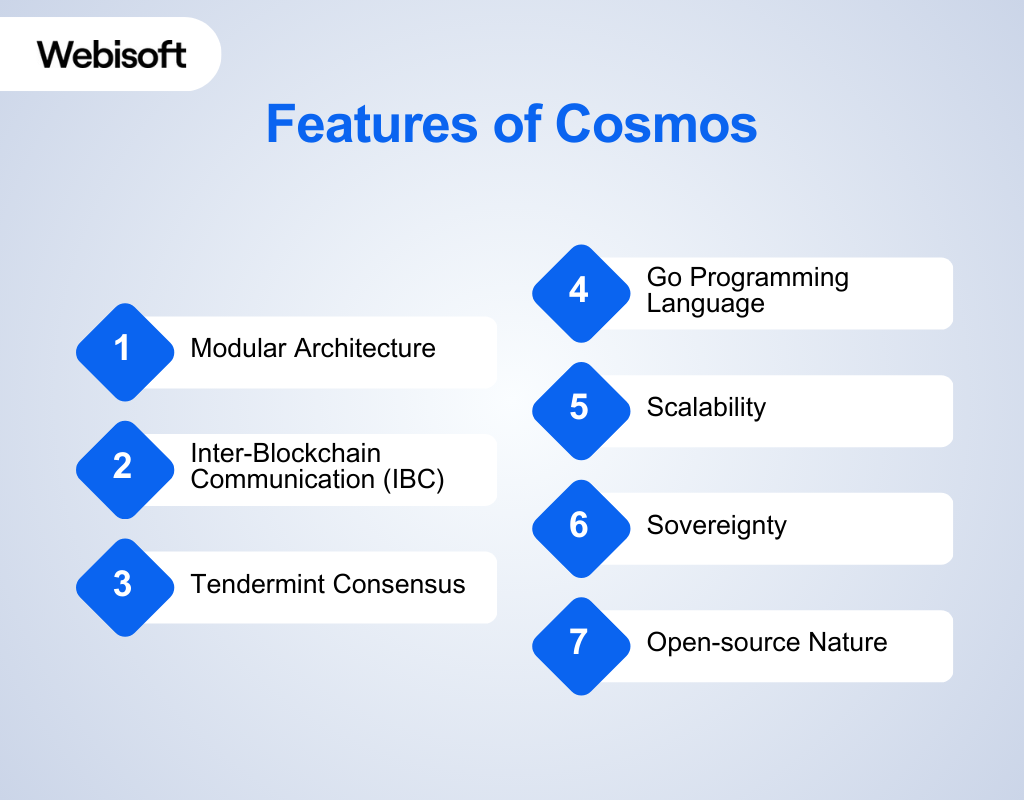
Cosmos, as a blockchain ecosystem, offers several key features, such as:
Interoperability
Cosmos is designed to facilitate interoperability between different blockchains. Its Inter-Blockchain Communication (IBC) protocol allows for secure and efficient communication and asset transfers across various blockchains within the Cosmos network.
Customizable Sovereign Chains
Cosmos emphasizes the sovereignty of individual blockchains within its ecosystem. Each blockchain can have its own consensus mechanism, governance structure, and features, offering flexibility and customization.
Tendermint Consensus
The Cosmos Network relies on the Tendermint consensus algorithm, known for its security and efficiency in block validation, ensuring the network’s stability.
Scalability
Cosmos enables the creation of multiple interconnected blockchains, allowing for increased scalability as new chains are added to the network.
Developer-Friendly
Cosmos provides a user-friendly Software Development Kit (SDK) that simplifies the process of building custom blockchains and applications within the ecosystem.
Governance Mechanisms
Cosmos incorporates on-chain governance mechanisms that allow token holders to participate in decision-making processes, including network upgrades and parameter adjustments.
Security
The focus on interoperability includes security measures to ensure safe cross-chain interactions and asset transfers within the Cosmos Network.
Cross-Platform Compatibility
Cosmos is compatible with various platforms and operating systems, making it accessible for developers in different environments.
Ecosystem Growth
Cosmos has a growing ecosystem of interconnected blockchains, each serving different purposes and use cases, contributing to the overall strength and utility of the network.
Staking and Incentives
Users can stake their tokens within the Cosmos Network, participating in network security and earning rewards for their contributions.
Flexible Token Management
Cosmos allows the creation of custom tokens with specific properties and functionalities, facilitating the development of unique token economies within the network.
Pros and Cons of Cosmos
Now, we’ll explore the pros and cons of Cosmos, focusing on its strengths and areas where it may have limitations:
| Pros | Cons |
|---|---|
| Pre-built modules | Limited native functionality |
| Seamless communication between databases | Moderate learning curve for advanced customization |
| Independent database scaling | |
| Cosmic consensus, open-source | |
| JavaScript language and active community |
What is MongoDB?
MongoDB is a popular and widely used NoSQL (non-relational) database management system. It is designed to store, manage, and retrieve data in a flexible, scalable, and high-performance manner.
MongoDB is known for its document-oriented approach, where data is stored in JSON-like documents, making it suitable for handling unstructured or semi-structured data.
It was first released in 2009 and has since gained popularity in the software development community due to its ease of use and its ability to handle diverse data types and workloads. It is an open-source database system and is available in both community and enterprise editions.
Features of MongoDB
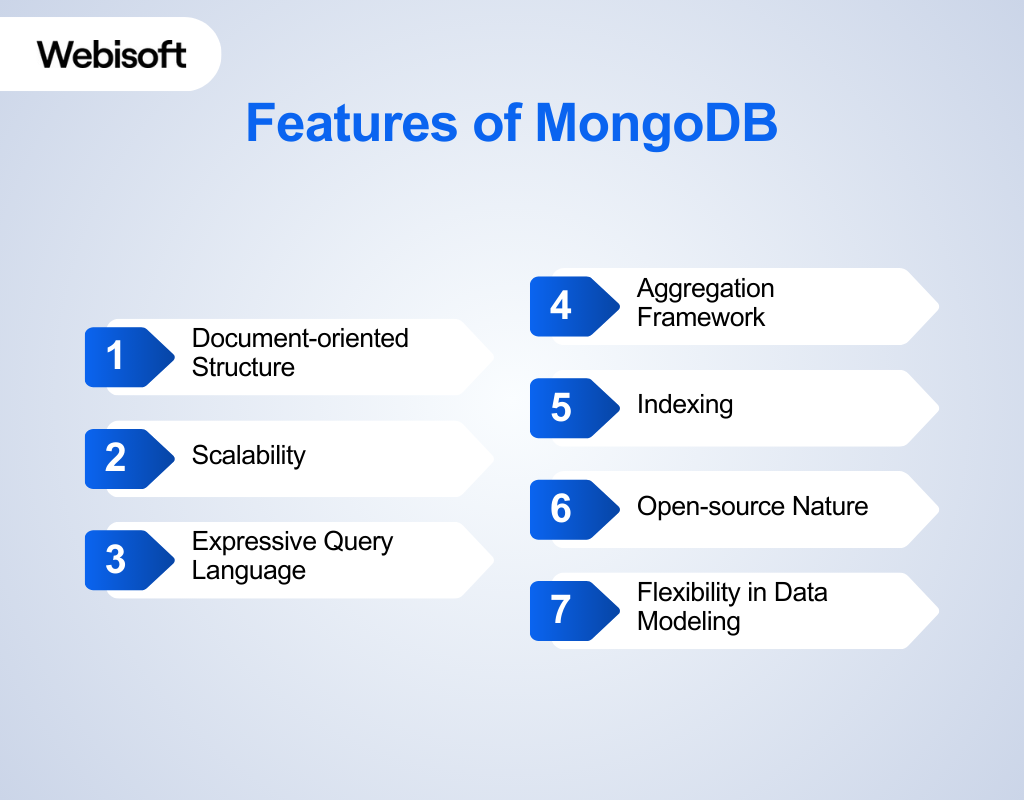
MongoDB offers a range of features that make it a popular choice for database management, especially in applications requiring flexibility and scalability:
Document-Oriented
MongoDB stores data in flexible, JSON-like documents, allowing developers to work with data in a format that mirrors their application’s data model.
NoSQL Database
As a NoSQL database, MongoDB can handle unstructured, semi-structured, and structured data, making it versatile for a variety of data types and workloads.
Scalability
MongoDB supports horizontal scaling, making it suitable for applications with growing data volumes. It can distribute data across multiple servers or clusters for improved performance.
High Availability
MongoDB offers replica sets, ensuring data redundancy and high availability. If one server fails, another can seamlessly take over, minimizing downtime.
Flexible Schema
Unlike traditional relational databases, MongoDB allows for dynamic and evolving schemas, making it easy to accommodate changes in data structure over time.
Ad Hoc Queries
MongoDB supports ad-hoc queries, enabling users to search for and retrieve data without predefined schemas or complex joins.
Indexes
MongoDB allows the creation of indexes on fields to improve query performance. Indexes can be customized based on specific query patterns.
Geospatial Data
MongoDB includes geospatial indexing and querying capabilities, making it suitable for location-based applications.
Aggregation Framework
MongoDB provides a powerful aggregation framework for performing complex data transformations and analytics within the database.
Security
MongoDB offers security features such as authentication, authorization, encryption, and auditing to protect data and access.
Community and Enterprise Versions
MongoDB is available in both community (open source) and enterprise versions, offering options for various project needs.
Active Community
MongoDB has a large and active community of developers and users, providing resources, documentation, and support.
Pros and Cons of MongoDB
Now let’s explore the pros and cons of MongoDB:
| Pros | Cons |
|---|---|
| Flexible document-oriented structure | Potential complexity in large-scale data relationships |
| Horizontal scalability for high-volume transactions | Learning curve for developers new to NoSQL databases |
| Expressive query language | |
| Aggregation framework for data analysis | |
| Active open-source community |
Cosmos vs MongoDB: Key Comparison Table
Here’s a detailed comparison table to highlight Cosmos and MongoDb’s distinct features, helping you in making informed choice:
| Features | Cosmos | MongoDB |
|---|---|---|
| Database Type | Blockchain Ecosystem | NoSQL Database Management System |
| Interoperability | Multi-model, supports various data types | Document-oriented, JSON-like documents |
| Consensus Mechanism | Tendermint Consensus (BFT) | N/A (Traditional database, not blockchain) |
| Scalability | Supports scalable interconnected blockchains | Horizontal scaling with replica sets |
| Schema Flexibility | Supports customizable blockchain schemas | Schema-free, dynamic data structure |
| Query Language | Specific blockchain query languages | Query using MongoDB Query Language (MQL) |
| Use Cases | Blockchain networks and applications | Wide range of applications, including web, mobile, analytics, content management, and more |
| Document Storage | Blockchains with transactions and smart contracts | Documents with flexible schemas |
| High Availability | Achieves high availability through consensus | Offers high availability with replica sets |
| Community Support | Growing blockchain community | Large MongoDB developer and user community |
| Community-Driven Development | Security considerations for blockchain | Comprehensive security features for databases |
Cosmos vs MongoDB: In-depth Analysis
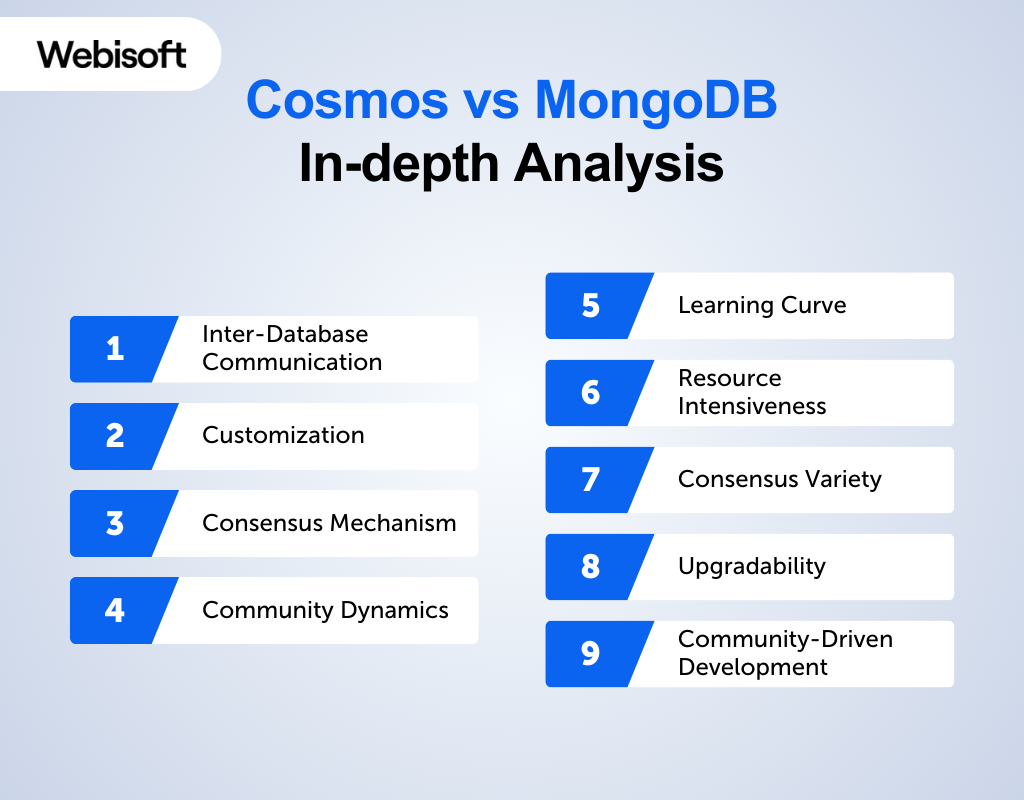
In the world of database development, Cosmos and MongoDB offer unique strengths. Let’s explore their major distinctions, highlighting the special features that define their roles in the database arena:
1. Inter-Database Communication
Cosmos is designed to enable seamless inter-database communication, making it well-suited for applications that require data sharing and synchronization across multiple databases. While MongoDB primarily focuses on single-database operations and may require additional middleware for inter-database communication.
2. Customization
Cosmos offers customization options, but within the constraints of its multi-model framework, allowing developers to choose from various data models. On the other hand, MongoDB provides extensive customization through its flexible document-oriented data model, enabling developers to design database schemas tailored to their specific needs.
3. Consensus Mechanism
Cosmos relies on a globally distributed consensus mechanism to ensure data consistency across regions, making it suitable for globally distributed applications. In contrast, MongoDB, as a document-oriented database, does not have built-in consensus mechanisms for global distribution but can achieve strong consistency within a single replica set.
4. Community Dynamics
Both Cosmos and MongoDB have active and growing communities. Cosmos DB benefits from being a Microsoft Azure service, fostering integration with Azure services and a dedicated user base. MongoDB boasts a vibrant open-source community and a rich ecosystem of third-party tools and extensions.
5. Learning Curve
Cosmos may have a more vertical learning curve for developers due to its multi-model capabilities and global distribution features. While MongoDB, with its document-oriented approach, maybe more intuitive for developers familiar with JSON-like data structures, potentially resulting in a shorter learning curve.
6. Resource Intensiveness
Cosmos optimizes resource utilization for globally distributed data, making it efficient for such scenarios. However MongoDB’s resource utilization depends on the deployment and sharding configurations, and it may require more resources for certain workloads.
7. Consensus Variety
Cosmos offers a consistent globally distributed consensus mechanism suitable for its multi-model capabilities. On the other hand, MongoDB, being a document-oriented database, does not provide a variety of consensus mechanisms but focuses on data consistency within individual replica sets.
8. Upgradability
Cosmos is a managed service, simplifying the upgrade process and minimizing disruptions during updates. MongoDB may require more effort and planning for upgrades, especially in self-hosted deployments.
9. Community-Driven Development
Both Cosmos DB and MongoDB engage their respective communities in the development process. Cosmos DB benefits from its integration with Microsoft Azure’s ecosystem and user feedback. MongoDB’s open-source nature encourages community contributions, driving innovation and improvement.
Cosmos vs MongoDB: Which One Should You Go For
Choosing between Cosmos and MongoDB is a crucial decision when it comes to database solutions for your project. Let’s delve into the strengths and use cases of each database system to help you make an informed choice.
Choose Cosmos If
Now, if your project requires a globally distributed, highly available, and scalable database, Cosmos DB is an excellent pick. Microsoft’s Cosmos offers multi-region replication, low-latency access, and automatic scaling to meet the needs of modern, globally distributed applications. It supports multiple data models, including SQL, NoSQL, and graph data models, providing flexibility for various use cases.
Choose MongoDB If
Conversely, if your project values flexibility, ease of development, and open-source solutions, MongoDB may be the right fit. MongoDB is renowned for its ability to handle unstructured or semi-structured data, making it suitable for projects where the data schema evolves or isn’t well-defined upfront. With a strong developer community and a vast ecosystem of third-party tools, MongoDB is a popular choice for web and mobile applications.
Is There Any Better Alternative to Cosmos and MongoDB?
Both Cosmos and MongoDB have different alternatives. Let’s check them below:
Alternatives to Cosmos
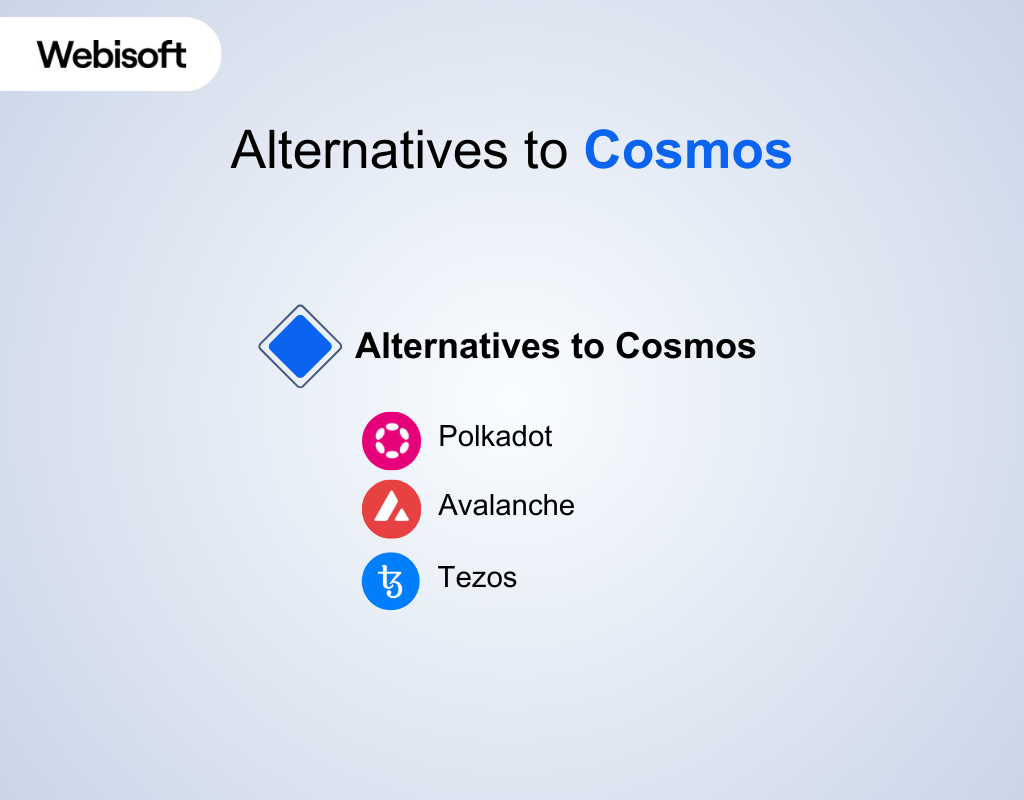
If you’re looking the alternatives to Cosmos check the below segment.
| Feature | Polkadot | Avalanche | Tezos |
|---|---|---|---|
| Interoperability | Unique multi-chain framework | High throughput, unique consensus | On-chain governance, self-amending |
| Custom Blockchain | Substrate framework | Custom chains with speed, flexibility | Self-amending, Liquid Proof-of-Stake |
| Consensus | Not specified | Avalanche consensus for speed, efficiency | Liquid Proof-of-Stake |
| Governance | Not specified | Not specified | Strong focus on governance |
| Unique Features | Multi-chain framework | High throughput, unique consensus | Self-amending ledger |
| Use Cases | Versatile collaboration | Projects needing speed, flexibility | Stability, governance, efficiency |
Polkadot
Polkadot, much like Cosmos, places a strong emphasis on making different blockchains platforms work together seamlessly, as explained in the cosmos vs polkadot comparison. Polkadot not only connects blockchains but also provides a toolkit for creating your own customized blockchains. So, if you have unique needs for your project, Polkadot gives you the tools to build precisely what you require.
Avalanche
Avalanche stands out for being lightning-fast and super scalable. It’s perfect for applications that need to process transactions quickly and efficiently. Whether you’re dealing with payments, games, or anything else that demands speed, Avalanche’s high-speed consensus protocol ensures everything runs smoothly.
Tezos
Tezos takes a distinctive approach by putting a lot of emphasis on how the blockchain is governed. This focus on smooth upgrades makes it an excellent choice for projects that value stability and want to evolve without major disruptions. Plus, it uses a consensus mechanism called Liquid Proof-of-Stake (LPoS) to ensure both security and efficiency, making it a valuable choice for a wide range of blockchain applications.
Alternatives to MongoDB
Are you looking for some alternatives to MongoDB? Here are 3 competitive alternatives.
| Feature | CouchDB | Neo4j | ArangoDB |
|---|---|---|---|
| Database Type | Document-oriented NoSQL | Graph | Multi-model (Doc, Graph, KV) |
| Replication | Multi-master | Yes | Yes |
| Schema | Schema-free | Schema-based for graphs | Multi-model (Schema-flexible/Graph) |
| Data Modeling Flexibility | High | Limited | High |
| Interconnected Data Handling | Not specialized | Specialized for complex relationships | Supports interconnected data |
| Query Language | MapReduce | Cypher (Graph) | AQL (Flexible) |
| Native Graph Support | No | Yes | Yes (native) |
| Transaction Support | Yes | Yes | Yes |
| Use Cases | Flexible data structures | Network-centric applications | Versatile with various data models |
CouchDB
CouchDB is a NoSQL database with a unique approach to data storage. It’s renowned for its multi-master replication, which simplifies distributed data storage.
The schema-free design is where it truly shines, giving developers the flexibility they need for diverse data structures. If your project requires adaptability and the ability to distribute data efficiently, CouchDB is worth considering.
Neo4j
Neo4j specializes in managing interconnected data using its graph database architecture. It excels at handling complex relationships, making it a top choice for applications that heavily rely on networks and connections between data points.
What sets Neo4j apart is its Cypher query language, which makes retrieving information from interconnected datasets incredibly straightforward and expressive.
ArangoDB
ArangoDB adopts a multi-model approach, supporting documents, graphs, and key-value pairs. This versatility means developers can choose the most suitable data model for their specific use case.
ArangoDB truly stands out with its native support for graph traversals and transactions, facilitated by the ArangoDB Query Language (AQL). This combination of features provides both power and flexibility in querying your data.
Conclusion
To wrap it up, in this detailed comparison of Cosmos and MongoDB, we’ve explored two powerful tools that serve different purposes in managing data.
When deciding between Cosmos and MongoDB, it’s crucial to understand your project’s specific needs, the structure of your data, and how much scalability you require. Consider factors like data complexity, the flexibility of data schemas, and development speed.
For personalized guidance and support in making the right choice and crafting a data strategy, Webisoft is here for you. You can contact the developers of Webisoft today for better further guidance.
FAQs
Yes, Cosmos and MongoDB can be used together in a project, depending on your specific requirements. You can use Cosmos for blockchain-related functionalities and MongoDB for data storage and retrieval, allowing flexibility in handling different aspects of your project.
Cosmos and MongoDB address data security through authentication, authorization, and encryption mechanisms. They protect data at rest and in transit to ensure privacy. Both have strong security features to safeguard against unauthorized access and data breaches.
Yes, there are industry-specific preferences. Cosmos is favored for blockchain and finance applications, while MongoDB is popular in web and mobile development and data analytics.
Cosmos handles cross-chain transactions by using the Inter-Blockchain Communication (IBC) protocol, ensuring secure communication between blockchains. In contrast, MongoDB is a database system and doesn’t handle cross-chain transactions as it focuses on data storage and retrieval within a single database.
Both Cosmos and MongoDB have active communities with comprehensive documentation supporting their respective SDKs, consensus mechanisms, and query languages.