Key takeaways
- Building your own blockchain means either configuring a network on an existing framework, a matter of weeks, or writing a new protocol from scratch, a serious distributed systems project involving consensus design, peer-to-peer networking, and cryptography.
- Most teams that think they need a new chain only need an existing framework, and many need neither, since a smart contract on an existing chain often solves the problem at a fraction of the cost.
- A blockchain is an append-only database replicated across many independent computers, where each block stores transaction data, its own cryptographic hash, and the hash of the previous block.
- Transactions inside a block are organized into a Merkle tree, so changing one byte alters the Merkle root and block hash and breaks every later block's back reference, making tampering immediately detectable.
- Hash chaining only makes tampering evident; what makes the ledger practically immutable is replication plus consensus across many independent nodes.
- The guide walks the full decision path: when a custom chain is justified, which platforms and frameworks to build on, and the ten steps from requirements document to production network.
Building your own blockchain means one of two things. Either you configure and launch a network on an existing framework, which is measured in weeks, or you write a new protocol from scratch, which is a serious distributed systems project involving consensus design, peer-to-peer networking, and applied cryptography. Most teams that believe they need a new blockchain actually need the first option, and a surprising number need neither: a smart contract deployed on an existing chain often solves the problem at a fraction of the cost.
This guide covers the full decision path: what a blockchain actually is under the hood, when a custom chain is justified, which platforms and frameworks to build on, and the ten steps that take a network from a requirements document to production.
What Is a Blockchain?
A blockchain is an append-only database replicated across many independent computers. Data is grouped into blocks, and each block carries three essential parts: the transaction data itself, a cryptographic hash that uniquely identifies the block, and the hash of the previous block. That last field is what forms the chain: every block commits to the entire history before it.
Inside a block, transactions are typically organized into a Merkle tree, so a single root hash in the block header commits to every transaction in the block. Change one byte in any transaction and the Merkle root changes, the block hash changes, and every later block's back-reference breaks. Tampering is therefore immediately detectable.
The hash chain alone only makes tampering evident, not impossible. What makes the ledger practically immutable is replication plus consensus: many independent nodes hold the same history, and rewriting it would require convincing the network to accept the altered version. On a proof-of-work chain that means redoing the accumulated computation of every block after the edit. On a proof-of-stake chain it means controlling most of the staked capital, and validators who sign conflicting histories have that stake destroyed.
How Does Blockchain Work?
The clearest way to understand a blockchain is to follow one transaction through its lifecycle:
- A user signs a transaction with their private key and broadcasts it to the network.
- Receiving nodes validate the signature and check the transaction against protocol rules: sufficient balance, correct nonce, valid format.
- Valid transactions wait in a mempool until a block producer selects them for a candidate block.
- The consensus mechanism determines which candidate block the network accepts. In proof of work, miners compete to find a valid hash; in proof of stake, a validator is chosen to propose and others attest.
- The accepted block is appended to the chain and propagated, and every node updates its local copy of the ledger.
- After enough confirmations, or immediate finality on BFT-style protocols, the transaction is treated as irreversible.
No single machine owns this ledger. The protocol rules, enforced identically by every node, replace the central operator. That property is the entire point of the technology, and it is also the source of its costs: replication and consensus are expensive compared to a conventional database, which is why the first design question is always whether you need them at all.
Do You Actually Need Your Own Blockchain?
Before committing to a build, place your project on this ladder. Each rung down adds control and cost.
- Smart contracts on an existing public chain. If your requirement is programmable logic with shared state (tokens, escrow, registries, marketplaces), deploy contracts on Ethereum or a comparable network. You inherit its security, tooling, and liquidity, and you ship in weeks instead of quarters.
- A rollup or application-specific chain. Frameworks such as the OP Stack, Arbitrum Orbit, Cosmos SDK, and the Polkadot SDK let you launch a chain with its own blockspace, fee rules, and governance while reusing battle-tested consensus and execution code. This is the right rung when you need custom throughput or economics but not a novel protocol.
- A permissioned enterprise network. Hyperledger Fabric and Hyperledger Besu are built for consortium settings where participants are known, data access must be restricted, and regulators want auditability. Identity, private channels, and pluggable consensus come out of the box.
- A new layer 1 from scratch. Justified only when the protocol itself is the product: a novel consensus algorithm, a custom virtual machine, or research work. Expect to solve networking, state sync, fork choice, and incentive design yourself, and to carry the security burden alone.
The ten-step process later in this guide applies to the bottom three rungs; the deeper you go, the more of each step you own.
Different Types of Blockchain Platforms
If you build on or fork an existing platform, its architecture becomes your foundation. These are the ones that matter for most projects:
| Platform | Description | Key Features | Use Cases |
|---|---|---|---|
| Ethereum | Open-source platform for decentralized applications | EVM smart contracts, the largest developer ecosystem, proof of stake | DeFi, NFTs, tokenization |
| Bitcoin | The original blockchain, focused on sound digital money | Proof of work, maximal decentralization, minimal scripting | Digital currency, settlement, store of value |
| Hyperledger Fabric | Permissioned framework for enterprise consortiums | Modular architecture, private channels, identity management | Supply chain, finance, healthcare |
| Cosmos SDK | Framework for building sovereign application-specific chains | Tendermint BFT consensus, IBC cross-chain protocol | Appchains, custom L1s |
| Solana | High-throughput chain optimized for low latency | Parallel execution, sub-second block times, low fees | DeFi, payments, consumer apps |
| Polkadot | Multi-chain network with shared security | Parachains, cross-chain messaging, on-chain governance | Interoperable appchains |
| BNB Chain | Low-cost, EVM-compatible network | Ethereum tooling compatibility, fast blocks | DeFi, trading platforms |
The practical test when comparing platforms: does it support your consensus and permissioning requirements natively, and can you hire developers who already know its stack?
Understanding Blockchain Types
Independent of platform, every network falls into one of four access models. The choice drives your consensus options, your compliance posture, and who bears operating costs.
- Public blockchain: Anyone can run a node, submit transactions, and read the full history. Maximum transparency and censorship resistance, but you give up privacy and control over throughput and fees.
- Private blockchain: A single organization controls who participates. Fast and private, but the trust model is close to a conventional database; the chain mainly adds tamper evidence and audit trails.
- Consortium blockchain: A defined group of organizations shares validation. No single member can rewrite history, which suits industry groups, clearing networks, and supply chains where competitors must cooperate.
- Hybrid blockchain: Sensitive data stays on a permissioned layer while proofs or summaries anchor to a public chain, combining confidentiality with public verifiability.
How to Build Your Own Blockchain Step by Step
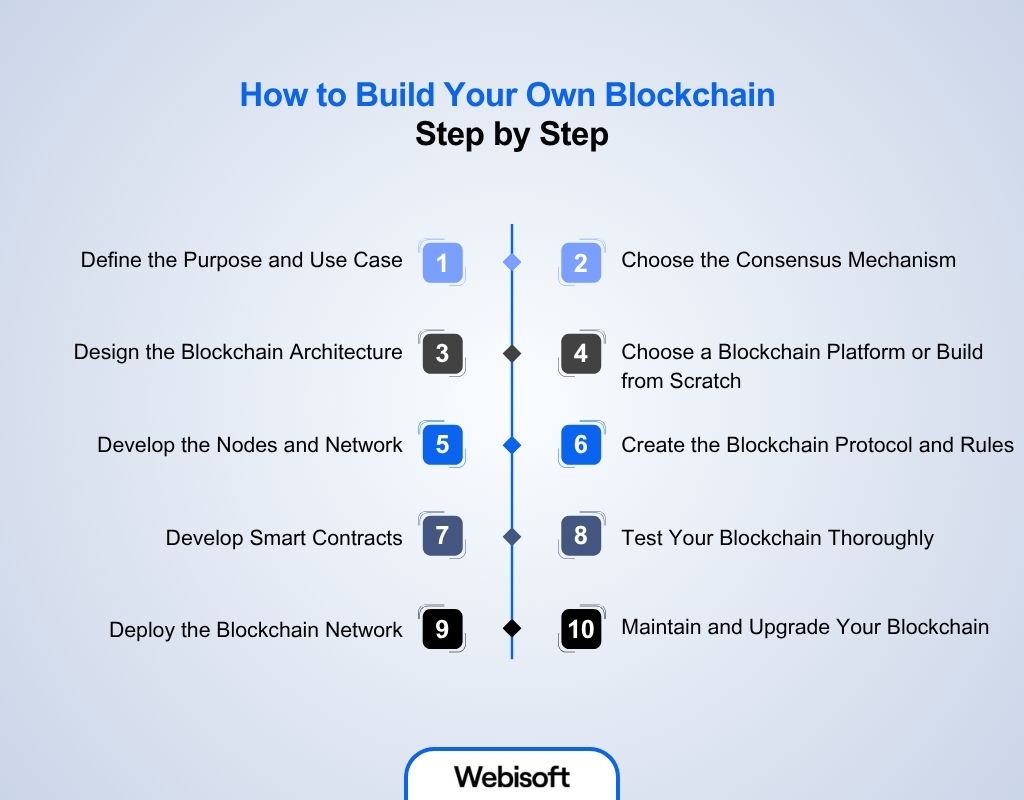
Whatever rung of the ladder you chose, the build follows the same sequence. Each step constrains the next, so shortcuts taken early surface as rework later.
Step 1: Define the Purpose and Use Case
Write down the specific problem the chain solves and why a shared, tamper-evident ledger is required to solve it. This document governs every later decision. Pin down:
- What data or assets the network manages, and their expected volume.
- Who the participants are: anonymous users, vetted partners, or internal teams.
- What must remain private, and what must be publicly verifiable.
- Throughput and latency targets, stated as numbers your architecture must hit.
These answers determine the access model (public, private, consortium, hybrid) and eliminate most platform options before you evaluate any of them.
Step 2: Choose the Consensus Mechanism
Consensus is how the network agrees on the next block, and it is the least reversible decision you will make. The main families trade off differently:
- Proof of work: Strongest track record for open, adversarial networks, but slow finality and high energy use. Ethereum's own documentation reports that its switch from proof of work to proof of stake cut the network's energy consumption by roughly 99.95%.
- Proof of stake: Validators bond capital and lose it for misbehavior. Efficient and fast, but requires careful economic design around staking, rewards, and slashing.
- BFT variants (PBFT, Tendermint, Raft-based orderers): Deterministic finality within seconds among a known validator set. The default for permissioned and consortium networks, where identity replaces open competition.
- Proof of authority: A small set of named validators. Cheap and fast, appropriate only where participants already trust the operators.
If your validators are anonymous, you need PoW or PoS. If they are known organizations, a BFT protocol gives you finality and throughput that open mechanisms cannot match.
Step 3: Design the Blockchain Architecture
With consensus fixed, specify the machine that runs it:
- Block size and block interval: Larger or faster blocks raise throughput but increase propagation time and the hardware needed to run a node, which centralizes the network.
- Node roles: Validators produce blocks; full nodes verify everything; light clients verify headers only. Decide which roles exist and their hardware profile.
- State model: UTXO (Bitcoin-style) is simple and parallelizable; account-based (Ethereum-style) is easier for contract logic.
- Data formats: Transaction structure, address scheme, serialization, and how state is stored and pruned over time.
Document this as a protocol specification. It becomes the reference for implementation, testing, and every future upgrade debate.
Step 4: Choose a Blockchain Platform or Build from Scratch
Now map the specification to a codebase. If an existing framework satisfies it, use the framework: Cosmos SDK or Polkadot SDK for sovereign chains, OP Stack or Arbitrum Orbit for rollups, Fabric or Besu for permissioned networks, or a fork of a mature client if you need an EVM chain with modified parameters. Building from scratch is defensible only when your specification demands something no framework provides, and it means owning networking, mempool logic, fork choice, and state sync yourself. The honest comparison is total cost over five years, including security review and maintenance, not initial build time.
Step 5: Develop the Nodes and Network
Nodes are the software participants actually run, so treat operability as a feature:
- Implement or configure the peer-to-peer layer: peer discovery, gossip, and connection limits (libp2p and devp2p are the common foundations).
- Define how a new node joins and syncs: from genesis, from snapshots, or via fast sync, and how it authenticates in a permissioned setting.
- Ship the boring essentials: configuration files, metrics endpoints, structured logs, and container images. Networks with painful node operations end up with few nodes, which defeats the design.
Step 6: Create the Blockchain Protocol and Rules
Encode the rules every node enforces identically: what makes a transaction valid, what makes a block valid, how conflicts between competing chains are resolved (fork choice), and what economic incentives or penalties apply. In an open network this includes the fee market and issuance schedule; in a permissioned one it includes membership governance, how a member is added or expelled and by what quorum. Any ambiguity here becomes a consensus failure later, when two correct implementations disagree about the same block.
Step 7: Develop Smart Contracts (if applicable)
If the platform supports programmable logic, this is where application behavior lives: token issuance, escrow, access rules, automated settlement. Contracts are immutable once deployed on most chains, so engineering discipline matters more than speed: keep contracts small, use audited standard libraries rather than novel code, and decide upfront whether contracts are upgradeable and who controls the upgrade key, because that key is effectively an admin backdoor. Professional smart contract development treats every external call and every arithmetic operation as a potential exploit path until proven otherwise.
Step 8: Test Your Blockchain Thoroughly
Testing a blockchain means testing a distributed system under failure, not just running unit tests:
- Unit and integration tests for transaction validation, block production, and contract logic.
- A persistent public or internal testnet where real participants exercise the network for weeks.
- Adversarial testing: partition the network, kill validators mid-block, replay old transactions, and flood the mempool, then verify the chain recovers without splitting.
- Independent security audits of consensus-critical code and every smart contract before mainnet.
Bugs found after launch may require a coordinated hard fork to fix. Every dollar spent on testing is cheap against that.
Step 9: Deploy the Blockchain Network
Launch is a coordinated event, not a server deployment:
- Finalize the genesis block: initial state, initial validator set, and chain parameters, then distribute it to all participants.
- Run a key ceremony so validator keys are generated and stored securely (HSMs or hardware wallets, never plaintext on disk).
- Bring validators online against the same genesis, confirm block production and finality, then open the network to transactions.
- Stand up monitoring from day one: block height and finality lag, peer counts, mempool depth, and validator participation, with alerts on all of them.
Step 10: Maintain and Upgrade Your Blockchain
A live chain is an ongoing operation. Patch client vulnerabilities quickly but in coordination, since validators running different rules will split the chain. Plan the upgrade path explicitly: version negotiation between nodes, backward compatibility windows, and a governance process that decides when a hard fork is acceptable. Watch validator economics as usage changes; a chain whose validators quietly become unprofitable loses security long before anyone notices. Requirements will evolve, and the specification from Step 3 is what keeps upgrades deliberate instead of improvised.
Benefits of Using Blockchain
Blockchain technology earns its operating cost when several of these properties matter at once:
- Tamper-evident records: Confirmed history cannot be silently edited; any change is cryptographically visible.
- No mandatory intermediary: Parties who do not trust each other can transact against shared, verified state.
- Transparency with selective privacy: Public chains give full auditability; permissioned designs restrict reads while preserving integrity.
- Traceability: Every asset carries its full custody history, valuable in supply chains, provenance, and compliance.
- Automation through smart contracts: Settlement, escrow, and enforcement logic execute exactly as written, removing manual reconciliation.
- Resilience: The ledger survives the failure or compromise of individual nodes because every participant holds a copy.
The honest caveat: a blockchain is slower and more expensive per write than a centralized database. If a single trusted operator is acceptable for your use case, a database is the better engineering choice. The benefits above apply where that trust does not exist.
Blockchain Use Cases
These are the domains where the trust model has proven out in production:
| Use Case | Description | Example |
|---|---|---|
| Cryptocurrency | Peer-to-peer digital money without a central issuer | Bitcoin, Ethereum |
| Supply chain tracking | Shared provenance records from origin to consumer | Food traceability networks such as IBM Food Trust |
| Healthcare | Auditable consent and integrity for patient data exchange | Medical record integrity platforms |
| Tokenized finance | Faster settlement and programmable financial assets | Bank-issued settlement tokens, on-chain funds |
| Smart contracts | Self-executing agreements with automatic enforcement | Ethereum-based escrow and DeFi protocols |
| Identity management | User-controlled credentials verified without a central registry | Self-sovereign identity and verifiable credential projects |
| Intellectual property | Timestamped proof of ownership and licensing history | Art and media provenance registries |
If you are planning a build, start from the row closest to your problem and study what those systems got right and wrong before designing your own.
Blockchain Security Tips and Best Practices
A blockchain's security is only as strong as its weakest layer, and most real losses come from keys and contracts rather than consensus. Priorities, in order:
- Protect private keys above all: hardware security modules or hardware wallets for validators, multi-signature control for treasuries, and documented recovery procedures.
- Audit smart contracts before deployment, combining manual expert review with automated analysis, and re-audit after any change.
- Use proven cryptography (SHA-256, ECDSA, Ed25519) from maintained libraries; never design your own primitives or implementations.
- Match the consensus mechanism to the threat model: open networks need Sybil resistance (work or stake); permissioned networks need strong identity.
- Apply role-based access control in permissioned networks and audit membership regularly.
- Validate all external inputs, especially oracles; an attacker who controls a price feed controls every contract that reads it.
- Rate-limit and monitor: defend the peer-to-peer layer against DDoS and eclipse attacks, and alert on abnormal mempool or validator behavior.
- Patch in coordination: track upstream client vulnerabilities and roll out fixes across validators on a shared schedule.
- Train the humans: key handling mistakes and phishing compromise more networks than protocol flaws do.
How Webisoft Helps You Build Your Blockchain
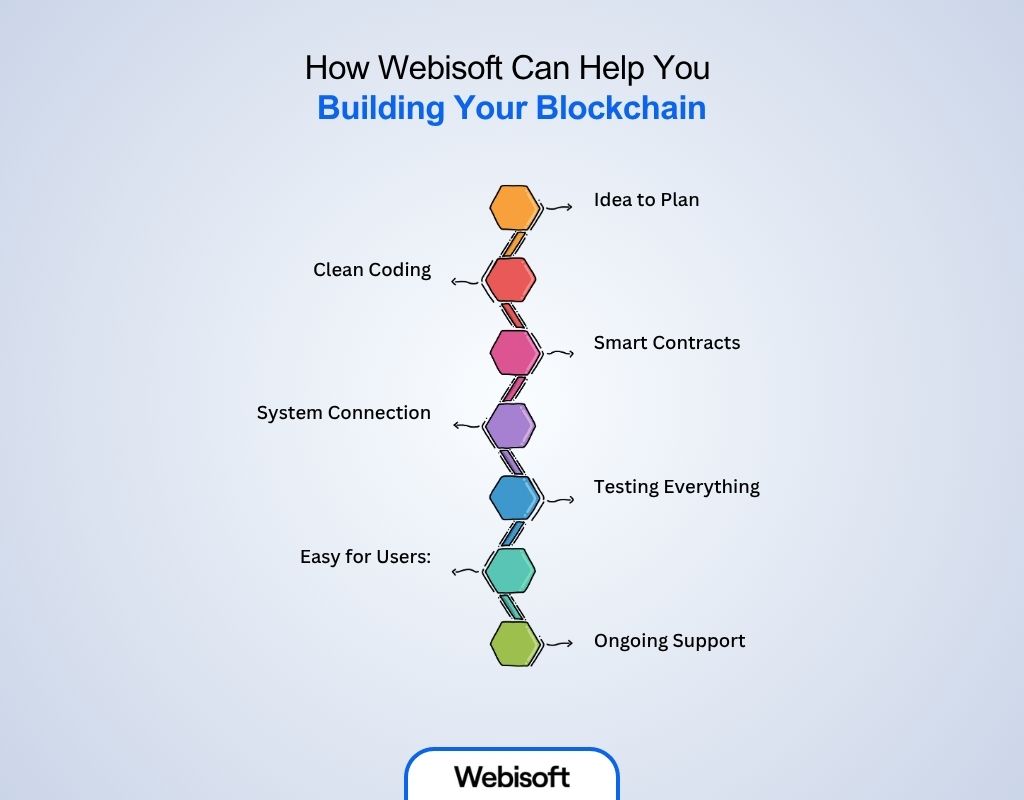
Every step above involves decisions that are expensive to reverse. Webisoft is a Montreal-based engineering firm that designs and builds blockchain systems end to end, from the architecture decision through mainnet operations.
What that covers in practice:
- Architecture and feasibility: an honest assessment of whether you need a custom chain, a rollup, a permissioned network, or contracts on an existing platform, before any code is written.
- Protocol and network engineering: consensus configuration, node infrastructure, and the peer-to-peer layer, built on proven frameworks rather than reinvented primitives.
- Smart contract development: contracts written defensively, tested against known exploit classes, and prepared for independent audit.
- Systems integration: connecting the chain to your existing applications, data pipelines, and identity systems so it functions as part of your stack, not beside it.
- Testing and launch: testnet operation, adversarial testing, genesis and key ceremony, and a monitored mainnet launch.
- Ongoing support: upgrades, incident response, and protocol maintenance after the network is live.
Conclusion
Building a blockchain is a sequence of constrained decisions: purpose defines the access model, the access model narrows the consensus options, consensus shapes the architecture, and the architecture determines what you build on. Teams that respect that ordering ship working networks; teams that start from a platform choice usually rebuild.
Start by proving you need a shared ledger at all, choose the highest rung of the ladder that satisfies your requirements, and spend your budget disproportionately on testing and key management, because that is where real systems fail. For expert help at any stage, from the feasibility question to a production network, Webisoft's blockchain development services cover the full cycle.
Frequently Asked Questions
Core protocol clients are commonly written in Go and Rust, with C++ in older codebases such as Bitcoin Core. Smart contracts use Solidity or Vyper on EVM chains, Rust on Solana and many Cosmos-based chains, and Go or JavaScript for Hyperledger Fabric chaincode.
It depends on the path. Deploying smart contracts on an existing chain takes weeks. Launching a permissioned network or an appchain on a framework like Cosmos SDK or Hyperledger Fabric typically takes a few months including testing. A new layer 1 built from scratch is a multi-year engineering effort with ongoing maintenance after launch.
Most projects do not need a new chain. If you need programmable shared state, smart contracts on an established network are cheaper, faster to ship, and more secure. A custom chain is justified when you need control over throughput, fees, privacy, or governance that existing networks cannot provide, or when the protocol itself is your product.
A fork reuses an existing, battle-tested codebase with modified parameters or rules, so you inherit its security properties and tooling. Building from scratch means implementing consensus, networking, and state management yourself, which offers total design freedom but leaves you solely responsible for finding and fixing protocol-level bugs.
Focus on the layers where real losses happen: protect validator and treasury keys with hardware modules and multi-signature control, audit every smart contract before deployment, use proven cryptographic libraries, and run adversarial tests on a testnet before launch. After launch, monitor validator behavior and patch client vulnerabilities in coordination across the network.