Blockchain began as the ledger behind peer-to-peer digital cash. It has since matured into general purpose infrastructure for any situation where multiple organizations need to agree on shared records without trusting a single operator.
The properties that matter are easy to state. Records are append-only. Every participant can verify them independently. No single administrator can rewrite history. Applied to the right problem, those properties eliminate reconciliation work, shorten settlement cycles, and remove intermediaries whose only job is to vouch for data.
Applied to the wrong problem, blockchain adds cost and complexity for nothing. This guide explains how the technology actually works, where it is producing results across industries, and the trade-offs to weigh before committing to it.
How Blockchain Works: A Step-by-Step Breakdown
A blockchain is a database replicated across a network of computers, called nodes, that records transactions in batches and links those batches cryptographically. Four mechanisms make the whole thing work.
Step 1: Transactions Are Grouped into Blocks
- A block is a container for a batch of transactions plus a header that carries a timestamp, a reference to the previous block, and a Merkle root: a single hash that summarizes every transaction in the batch.
- Because each header references the block before it, the blocks form an ordered chain reaching back to the first block the network ever produced.
Step 2: Nodes Keep the Ledger Decentralized
- Every full node holds a complete copy of the ledger and validates each new block against the network's rules before accepting it.
- No single machine is the source of truth. If one node fails or misbehaves, the rest of the network carries on. That redundancy is what makes the system resistant to outages and to unilateral tampering.
Step 3: Hashes Make Tampering Detectable
- Each block is identified by a cryptographic hash, a fixed length fingerprint computed from its contents.
- Change one character in an old transaction and that block's hash changes, which breaks the reference stored in every block after it. An attacker would have to rebuild the entire chain faster than the honest network extends it, which is impractical on any established network.
Step 4: Consensus Decides What Gets Written
- Before a block is appended, the network must agree it is valid. Public networks use mechanisms such as proof of work, where miners spend computation to earn the right to propose blocks, or proof of stake, where validators post collateral that is destroyed if they cheat.
- Permissioned enterprise networks typically use committee-based protocols such as IBFT or Raft instead, trading open participation for higher throughput and immediate finality.
- Once consensus is reached, the block is broadcast to every node and becomes part of the permanent record.
When Blockchain Is the Right Tool
Most database problems do not need a blockchain. The technology earns its cost when several conditions hold at the same time:
- Multiple writers. Several independent organizations need to write to the same records.
- No trusted middleman. There is no intermediary every party is willing to depend on, or the intermediary that exists is slow and expensive.
- Verification matters. Participants need to prove to each other, or to auditors and regulators, that records have not been altered after the fact.
The trade-offs are just as concrete. Base layer public chains process far fewer transactions per second than a centralized database, which is why scaling layers and sidechains exist. Smart contract code is difficult to patch once deployed, so defects have to be caught in audits rather than fixed in production. And immutability cuts both ways: personal data belongs off chain, with only hashes or proofs written to the ledger, or privacy obligations become impossible to meet.
Top Blockchain Use Cases by Industry
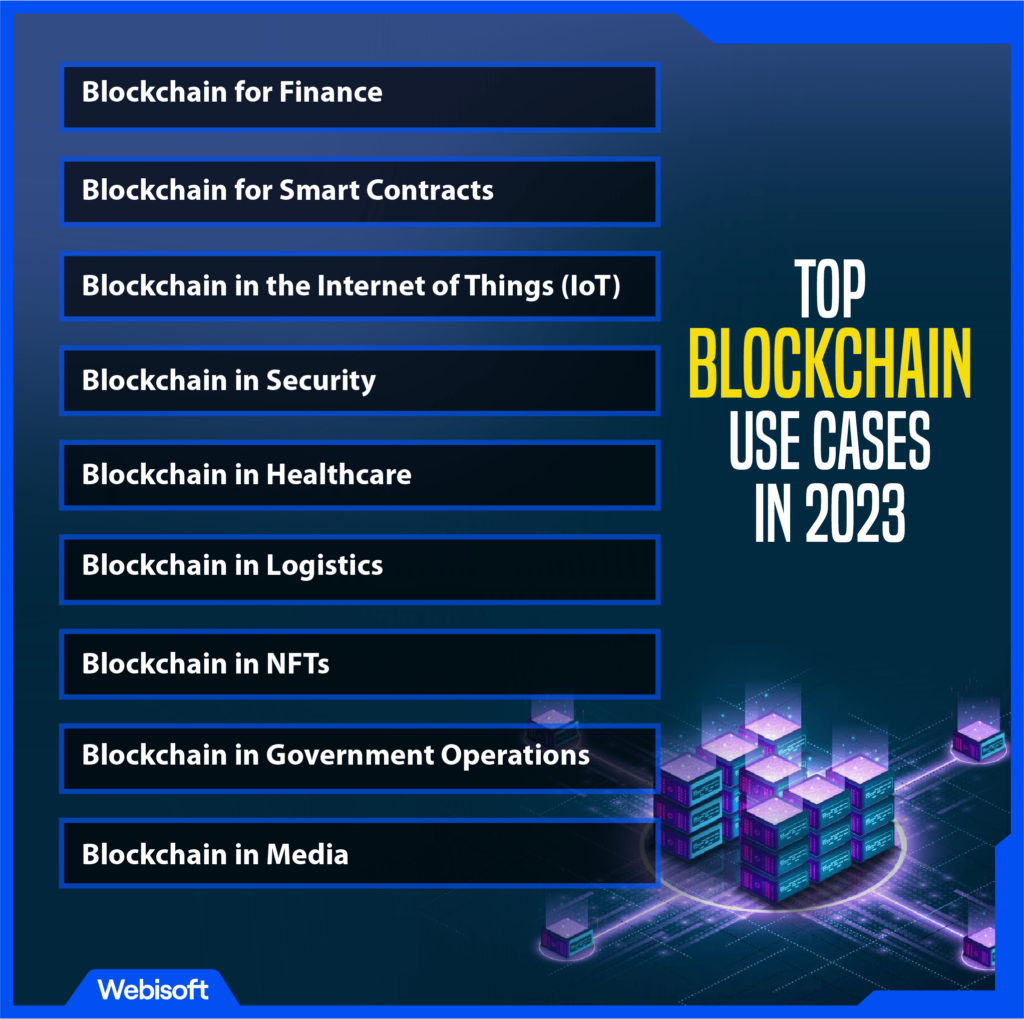
The sections below cover the industries where blockchain has moved past pilots and into production, with the specific mechanism each one exploits and representative companies building in the space.
Blockchain in Finance
Finance is where blockchain has the deepest footprint, because the industry's core problem, moving value between institutions that do not fully trust each other, is exactly the problem the technology was built to solve.
Cross-border payments show the mechanics clearly. A traditional international transfer hops between correspondent banks, each holding funds, charging a fee, and adding settlement delay that can stretch to days. A transfer on a high throughput network such as Solana or Polygon settles in seconds for a negligible fee, because the ledger update is the settlement. There is no separate clearing step to wait for. Stablecoins, tokens redeemable one for one for a fiat currency, make that speed usable for ordinary payments rather than only for crypto trading.
Companies working in this space include:
Chainalysis
New York based Chainalysis supplies blockchain analytics to governments and financial institutions. Its tools trace illicit funds across chains, flag money laundering patterns, and support sanctions and compliance screening, which is the plumbing regulated institutions need before they can touch digital assets at all.
Circle
Circle issues USD Coin (USDC), a dollar backed stablecoin, and provides the accounts, APIs, and settlement rails businesses use to accept and move it. Stablecoin payments give companies near instant settlement while keeping balances denominated in a familiar currency.
Algorand
Algorand runs a proof of stake Layer 1 network designed for financial applications: fast finality, low fees, and built-in support for issuing assets and running smart contracts. It is used for tokenized securities, supply chain records, and digital credentials.
Blockchain for Smart Contracts
A smart contract is code deployed on a blockchain that executes automatically when its conditions are met. Instead of two companies each maintaining their own copy of an agreement and reconciling disputes afterward, both interact with a single program whose behavior neither side can quietly change after deployment.
A simple escrow illustrates the value. Funds are locked in the contract, and release happens only when a delivery condition is confirmed. No escrow agent takes a percentage, and neither party can stall the payout once the condition is met. The discipline this demands is real: contract code is public and effectively permanent, so professional audits before deployment are not optional.
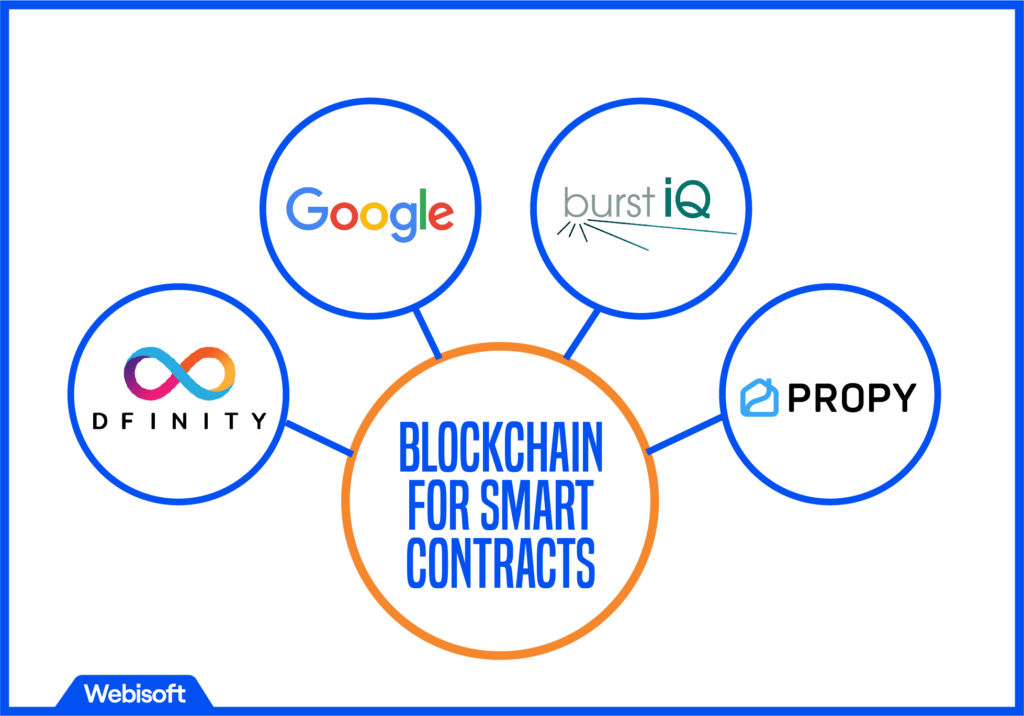
DFINITY
DFINITY develops the Internet Computer, an open source network for running decentralized applications and Web3 services. It supports scalable smart contracts, low latency consensus, and integration with the Bitcoin network.
Google Cloud's Blockchain Node Engine gives Web3 teams fully managed blockchain nodes, so they can deploy smart contracts and relay transactions without running their own node infrastructure or the DevOps burden that comes with it.
BurstIQ
Denver based BurstIQ applies smart contracts to sensitive health data. Its platform lets individuals own their data and set the rules for how it is used in personalized health products, services, and research marketplaces.
Propy
Propy runs a real estate transaction platform where offers, payments, and title records ride on blockchain rails. Recording the transaction on a tamper-evident ledger reduces exposure to title fraud, and the platform supports purchases settled in cryptocurrency.
Blockchain in the Internet of Things (IoT)
Every connected sensor, camera, and thermostat is a potential entry point into a network, and the traditional defense, a central credential server, is a single point of failure that attackers only need to breach once.
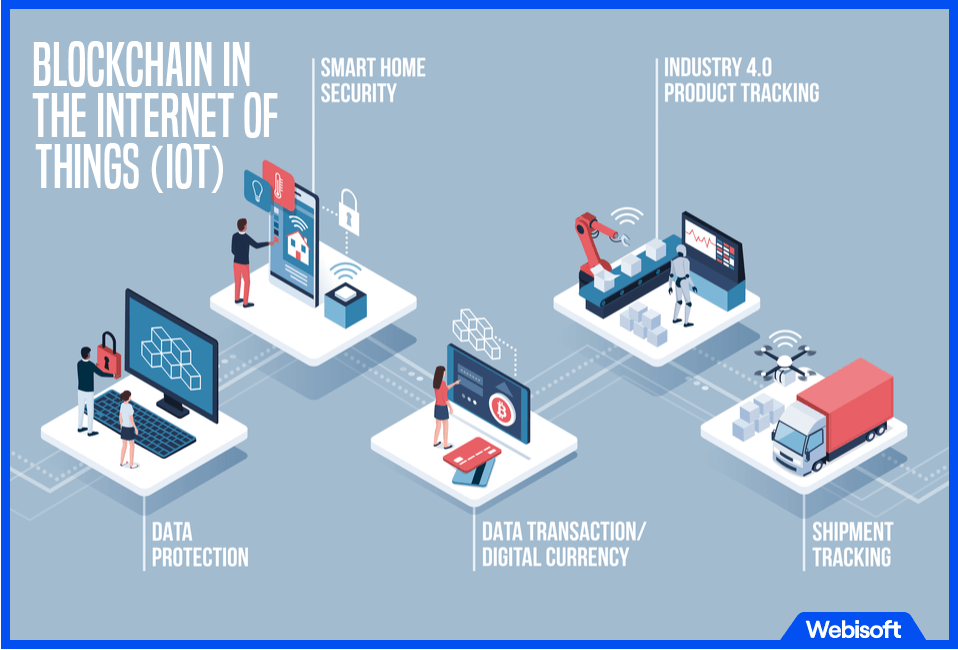
Blockchain changes the model to decentralized device identity. Each device carries its own cryptographic credentials, verified against a distributed ledger rather than a central password database. Compromising one node no longer hands an attacker the keys to the whole fleet.
HYPR
New York based HYPR provides passwordless, decentralized authentication. Credentials stay on the device instead of sitting in a central store, which removes the honeypot that credential stuffing and database breaches depend on.
Xage Security
Xage builds a blockchain-backed security fabric for industrial operations in energy, transportation, and manufacturing. It enforces multi-factor authentication and tamper-evident access policies across large fleets of field devices, including equipment that predates modern security standards.
Helium
Helium operates a decentralized LoRaWAN wireless network built from independently owned hotspots whose operators earn tokens for providing coverage. The network carries low bandwidth sensor traffic for asset tracking, smart agriculture, utilities, and logistics without a single telecom owning the infrastructure.
Blockchain in Digital Identity and Security
Identity fraud remains one of the most expensive problems on the internet, and most of it traces back to the same root cause: personal data concentrated in centralized databases that attackers only need to breach once.
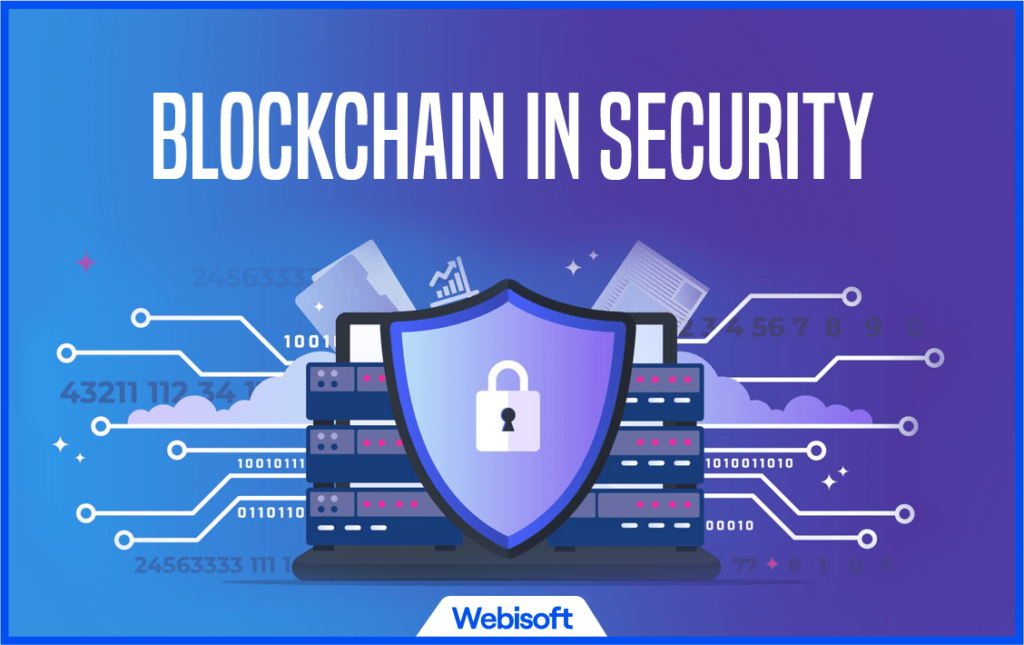
Blockchain based identity inverts the model. Users hold verifiable credentials in their own wallets and present cryptographic proofs instead of raw documents. Zero-knowledge proofs push this further: a person can prove a specific claim, such as being over eighteen or holding a valid license, without revealing anything else about themselves.
Civic
Civic provides blockchain based identity tooling that lets individuals build reusable Web3 identity profiles and lets businesses plug identity verification and access tokens into their applications instead of building verification flows from scratch.
Ligero
Ligero develops scalable protocols for secure multiparty computation and zero-knowledge proofs. Its work supports confidential transactions, private smart contracts, secure auctions, and verifiable machine learning, the cryptographic building blocks that make privacy preserving systems practical at scale.
Blockchain in Healthcare
Healthcare's data problem is fragmentation under heavy regulation: records scattered across providers, insurers, and labs, none of which share a common source of truth. The production use cases keep the sensitive data off chain and use the ledger for what it is good at, proving provenance and controlling access.
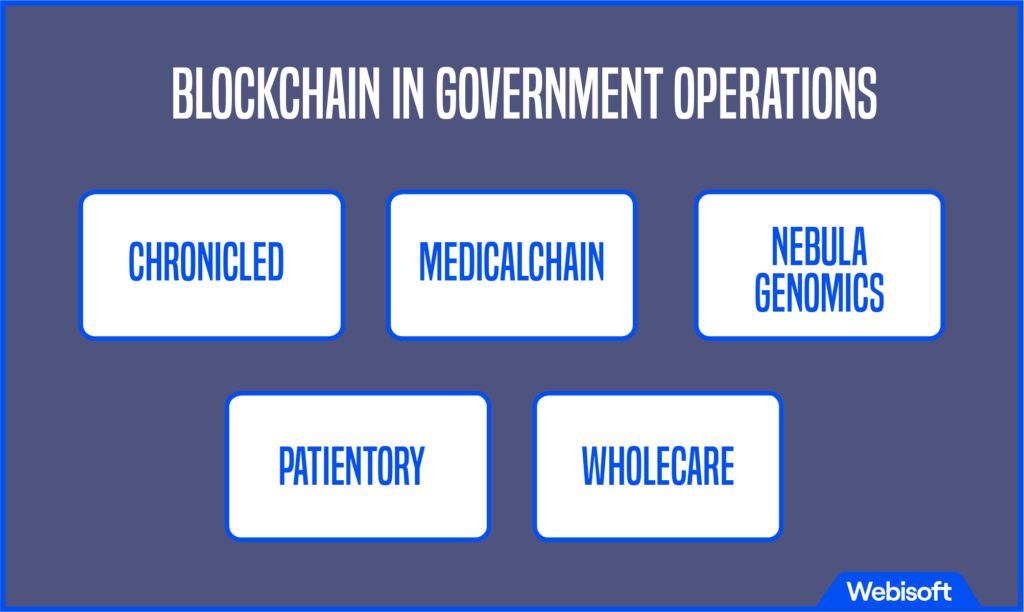
Chronicled
Chronicled's MediLedger network connects pharmaceutical manufacturers, wholesalers, and dispensers on a shared ledger for product verification and contract settlement. It supports compliance with the US Drug Supply Chain Security Act, which requires participants to verify prescription drugs as they move through the supply chain.
Nebula Genomics
Nebula Genomics offers whole-genome DNA sequencing with blockchain-managed access control. Customers decide who can use their genomic data and under what terms, rather than surrendering it to the sequencing provider.
Patientory
Atlanta based Patientory provides a blockchain-backed medical record platform that gives patients and clinicians a secure, consistent channel for health data, with HIPAA compliant handling of the underlying records.
Blockchain in Logistics
A single international shipment can pass through a dozen hands: shipper, freight forwarder, ocean carrier, customs brokers, terminal operators, and the consignee. Each keeps its own records, and disputes get settled by comparing paperwork after the fact.
A shared ledger replaces that reconciliation with one tamper-evident record of custody and milestones that every party reads and writes. Combine it with IoT sensors and the record extends to condition data, such as continuous temperature logs for pharmaceuticals and food, where a broken cold chain has to be provable, not just suspected.
Oracle
Oracle's Intelligent Track and Trace application uses blockchain to give supply chain partners visibility across multiple tiers. It has been applied to food provenance, temperature monitoring, and equipment shipment tracking.
Chain.io
Chain.io builds cloud integration infrastructure for supply chains and logistics, connecting the systems of freight forwarders, shippers, and their partners so that milestone updates, shipping documents, and freight operations flow between parties automatically.
DHL
DHL has been among the earliest large logistics operators to pilot blockchain, including blockchain-backed shipment ledgers and joint research with Accenture on pharmaceutical serialization, where each package's journey is recorded end to end to keep counterfeits out of the supply chain.
Blockchain in NFTs and Digital Assets
A non-fungible token is a blockchain record certifying that a specific address owns a specific unique item. Standards such as Ethereum's ERC-721 define how these tokens are minted and transferred, which is what lets any wallet or marketplace recognize them.
The 2021 market demonstrated what provable digital ownership could command. The Nyan Cat meme sold as an NFT for 300 ETH in February 2021, and Beeple's collage Everydays: the First 5000 Days sold at Christie's for 69.3 million dollars the following month.
The speculative churn has cooled since then, and the durable applications look more like infrastructure: event ticketing that kills scalping bots, loyalty programs with transferable rewards, software licensing, and tokenized ownership of real-world assets.
Dapper Labs
Dapper Labs partnered with the NBA to launch NBA Top Shot, a platform where fans buy and trade officially licensed video highlights as digital collectibles, one of the first NFT products to reach a mainstream sports audience.
OpenSea
New York based OpenSea operates one of the largest NFT marketplaces by volume, covering art, photography, gaming assets, and collectibles, with tooling for creators to mint and sell directly.
Blockchain in Government Operations
Governments run registries: land titles, business licenses, procurement records, vital statistics. Those registries are exactly the multi-party, audit-heavy record keeping that tamper-evident ledgers are suited to, and moving them on chain reduces paperwork while making the audit trail public by default.
Kaleido
Raleigh based Kaleido provides an enterprise blockchain platform used to stand up permissioned networks for public sector and institutional workloads, including projects in public health, education, customs, and payments. Organizations including the United Nations and the World Wide Fund for Nature have built on its stack.
Voatz
Boston based Voatz pairs mobile voting with biometric verification and a blockchain-backed audit trail. West Virginia used it to let military service members and other citizens abroad cast ballots from mobile devices, one of the first state level deployments of blockchain-supported voting in the United States.
Blockchain in Media
The media industry's persistent problems are rights and royalties: usage data is opaque, payments are slow, and the metadata describing who owns what is inconsistent across labels, publishers, and platforms. A shared rights registry with programmable royalty splits addresses all three, because payment logic can execute automatically the moment usage is recorded.

Madhive
New York based Madhive built its advertising platform on a private blockchain that tracks, stores, and reports campaign activity. Advertisers get a verifiable record of where their spend went, which directly targets the ad fraud and measurement disputes that plague digital media buying.
Open Music Initiative
The Open Music Initiative, a Boston based nonprofit launched out of Berklee College of Music, is building an open source protocol for identifying music rights holders so that artists are recognized and paid correctly. Members span the music industry and major media platforms.
How Webisoft Helps You
Webisoft is a Montreal based software development firm that builds blockchain products end to end: evaluating whether a ledger belongs in your architecture at all, selecting the protocol, developing and testing smart contracts, and integrating the chain with the backends, APIs, and web or mobile applications your business already runs on.
That first step is the one most projects skip. A blockchain that solves no trust problem is just a slow database, so we start by pressure testing the use case against the criteria covered in this guide before writing any code.
If you are weighing a blockchain project, or want a second opinion on one already in flight, contact Webisoft and talk it through with our engineering team.
Finance leads by a wide margin. Payments, settlement, and stablecoins are in daily production use because they attack the industry's core cost: moving value between institutions that do not fully trust each other. Supply chain traceability and digital identity are the next most mature categories.
Look for three conditions at once: multiple independent organizations writing to the same records, no intermediary all parties are willing to depend on, and a real need to prove records have not been altered. If a single company controls all the data, a conventional database is cheaper and faster.
Public chains suit applications that need open participation or interoperability with existing digital asset markets. Permissioned networks suit consortiums of known businesses that want higher throughput, immediate finality, and control over who can read and write. Many enterprise systems combine both, anchoring proofs from a private network onto a public chain.
Sensitive data stays off chain. Production systems keep the data in conventional, access controlled storage and write only cryptographic hashes or proofs to the ledger. That preserves verifiability while keeping privacy and deletion obligations achievable, since the on-chain record contains nothing personal to expose.
Deployed contract code is public and effectively permanent, so a defect cannot be quietly patched the way server code can. The standard mitigations are independent security audits before deployment, extensive testing on test networks, and designing upgrade paths or circuit breakers into the contract architecture from the start.