Artificial intelligence rarely fails because of technology. It fails because teams apply it in the wrong place. Models get built, tools get bought, and expectations rise, yet real problems remain untouched. Search suggestions, fraud alerts, and system recommendations feel ordinary now.
AI use cases in daily life make them work quietly by handling repetitive decisions, large datasets, and patterns humans cannot track consistently at scale.
This article explains how businesses identify meaningful applications, where they deliver value across industries, and how to approach adoption without guesswork. You will leave with clarity, examples, and practical direction for applying AI where it actually matters.
Why AI Use Cases Matter For Businesses
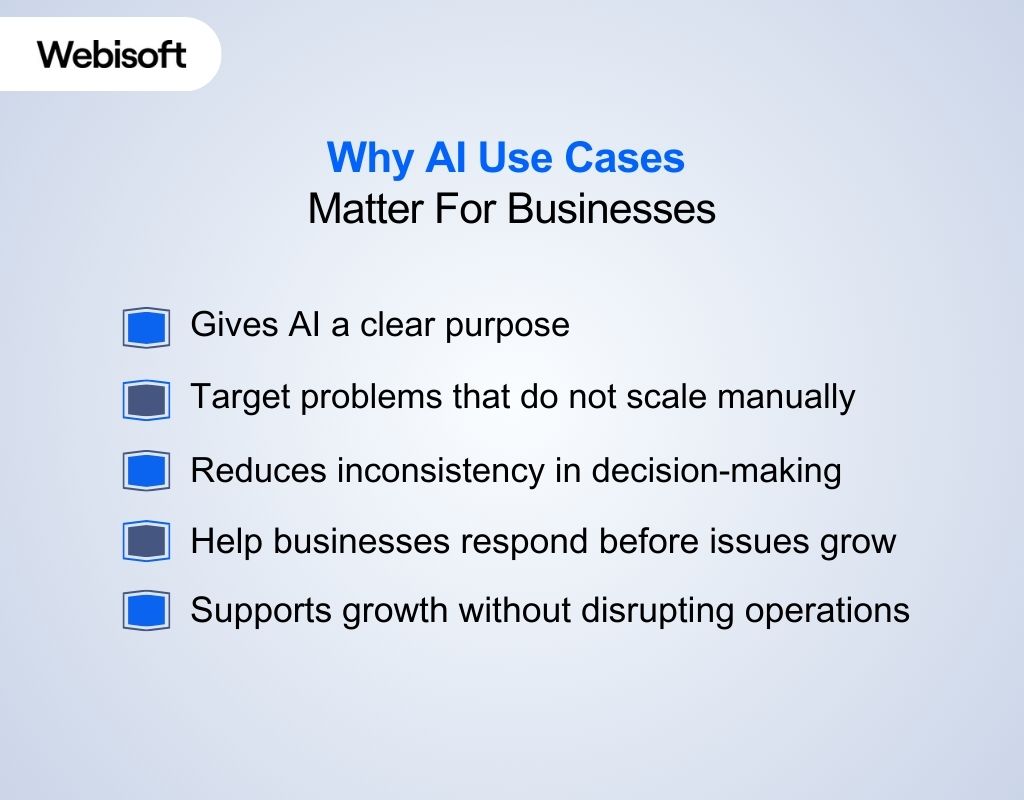
Artificial intelligence is everywhere, but its impact depends on where it is applied. AI use cases matter because they clarify which problems are worth solving and which are not. Here are the reasons businesses prioritize them before investing further.
Gives AI a clear purpose
AI by itself does nothing for a business. A use case defines where AI fits, what problem it addresses, and what success looks like. This prevents unfocused experimentation and keeps effort aligned with business priorities.
Target problems that do not scale manually
Many business processes break as volume increases. Reviews, tickets, documents, and decisions pile up faster than teams can handle. AI use cases are built around these pressure points, where automation or assistance removes bottlenecks.
Reduces inconsistency in decision-making
Manual decisions often vary between people, shifts, and teams. AI use cases apply the same logic across large datasets, producing consistent outputs. This matters in areas like risk assessment, support handling, and operational monitoring.
Help businesses respond before issues grow
Reactive work is expensive. Predictive use cases identify patterns that signal risk or opportunity early. That allows teams to intervene sooner, when fixes cost less and options remain open.
Supports growth without disrupting operations
As businesses grow, internal processes often strain first. AI use cases increase output per employee by assisting rather than replacing teams. This helps companies grow while keeping service quality and response times stable.
Best AI Use Cases Across Industries and Business Functions
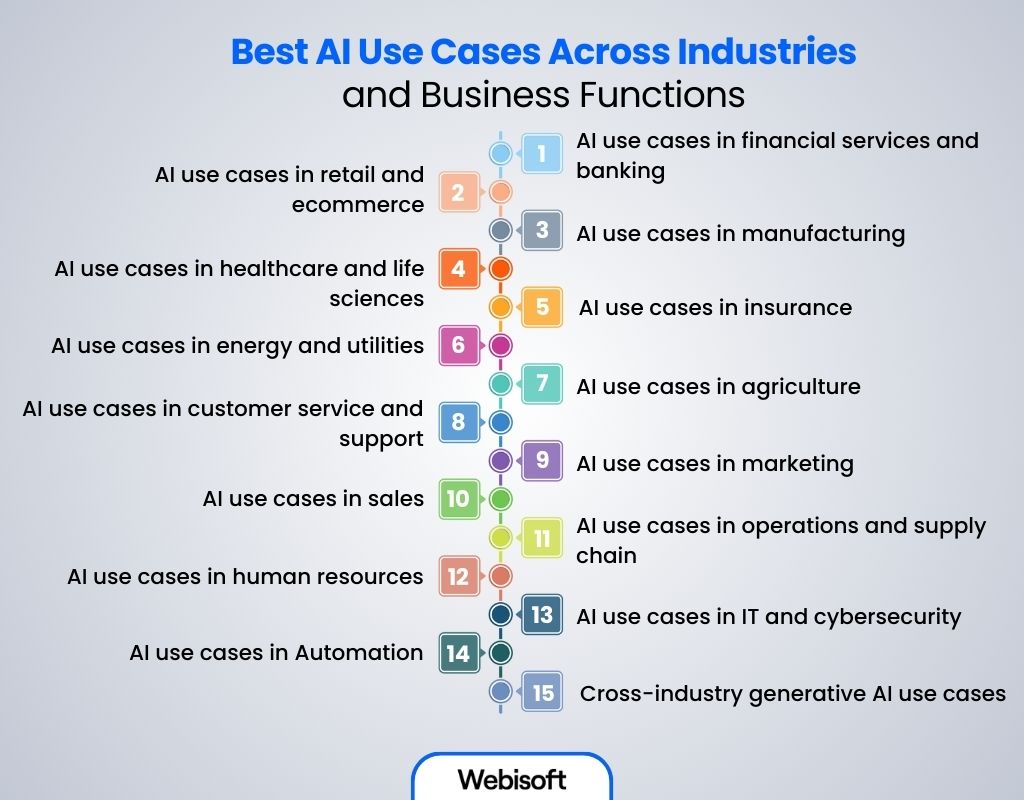
AI use cases apply learning systems to situations where volume, uncertainty, or complexity makes human-only decision-making inefficient. Across industries and internal teams, these use cases succeed when AI augments judgment, accelerates action, or reduces variability in outcomes.
AI use cases in financial services and banking
- Fraud detection: AI models learn baseline transaction behavior across users, merchants, and time periods, then surface deviations that indicate misuse. This reduces false positives while catching complex fraud patterns earlier.
- Credit risk assessment: Predictive models evaluate repayment likelihood by learning relationships between borrower behavior, income stability, and prior outcomes. This improves approval accuracy beyond static rules.
- Document analysis: Language models extract structured data from contracts and filings, then compare values across documents to detect inconsistencies or missing disclosures. This shortens review cycles.
- Regulatory monitoring: AI systems track transaction flows and account activity to detect patterns associated with compliance risk before violations escalate.
AI use cases in retail and ecommerce
- Product recommendations: AI learns how users navigate, compare, and purchase items, then predicts which products best match intent at each session stage. This increases relevance and reduces choice overload.
- Demand forecasting: Models learn seasonal patterns, promotions, and external signals to anticipate demand shifts, allowing inventory to align with real consumption patterns.
- Dynamic pricing: AI evaluates how price changes affect conversion and revenue under different conditions, adjusting prices to balance margin and volume.
- Customer lifetime value prediction: AI estimates long-term value by learning which early behaviors correlate with retention and repeat purchases.
AI use cases in manufacturing
- Visual defect detection: Vision models learn subtle defect patterns from production imagery that humans miss at scale, enabling earlier intervention and consistent quality control.
- Predictive maintenance: AI models correlate sensor readings with past failures to estimate remaining useful life, reducing unplanned downtime.
- Production optimization: Simulation-based models evaluate thousands of schedule permutations to reduce bottlenecks under labor and capacity constraints. 12. Energy usage analysis: AI identifies abnormal consumption patterns that indicate inefficiency or mechanical issues.
AI use cases in healthcare and life sciences
- Medical image analysis: Deep learning models learn visual markers associated with disease, supporting earlier and more consistent interpretation.
- Patient risk stratification: Predictive systems identify patients more likely to deteriorate by learning patterns across clinical histories and vital signals.
- Clinical documentation support: Language models extract key clinical facts and structure them for billing, compliance, and care coordination.
- Drug discovery support: AI predicts molecular behavior by learning interactions between chemical structure and biological response.
AI use cases in insurance
- Claims intake automation: AI extracts damage details and policy attributes from images and text, reducing manual triage time.
- Fraud pattern detection: Models learn normal claim behavior and flag deviations that indicate coordinated or repeat abuse.
- Risk pricing models: Predictive systems combine environmental and behavioral data to estimate exposure more precisely.
AI use cases in energy and utilities
- Equipment failure prediction: AI learns degradation patterns across assets to forecast breakdowns before performance drops.
- Demand forecasting: Models integrate historical usage and weather patterns to anticipate load fluctuations.
- Safety monitoring: AI analyzes sensor and video feeds to detect unsafe operating conditions in real time.
AI use cases in agriculture
- Crop disease detection: Vision models learn disease signatures from leaf images, enabling early intervention.
- Yield prediction: AI correlates soil, climate, and historical output data to forecast production levels.
- Smart irrigation planning: Models optimize watering schedules by learning how environmental factors affect crop health.
AI use cases in customer service and support
- Ticket classification: Language models learn intent patterns to route issues accurately without manual tagging.
- Virtual assistants: Conversational models generate responses by learning from historical interactions and knowledge sources.
- Agent assistance: AI predicts next-best responses by analyzing conversation context and prior resolutions.
- Conversation summarization: Language models extract outcomes, commitments, and follow-ups from interactions.
AI use cases in marketing
- Audience segmentation: AI clusters users based on shared behavioral patterns rather than fixed demographics.
- Churn prediction: Models identify early disengagement signals, enabling timely intervention.
- Campaign forecasting: AI predicts likely outcomes by learning from historical performance under similar conditions.
- Content testing: Models evaluate message effectiveness by comparing engagement patterns at scale.
AI use cases in sales
- Lead scoring: AI predicts conversion likelihood by learning which attributes correlate with closed deals.
- Deal outcome prediction: Models assess pipeline health by identifying risk signals tied to historical losses.
- Sales call analysis: Language models extract objections and intent from conversations to inform coaching.
- Proposal drafting: Generative systems structure proposals by learning patterns from successful past submissions.
AI use cases in operations and supply chain
- Inventory optimization: AI aligns stock levels with demand forecasts to reduce waste and shortages.
- Supplier risk analysis: Models learn indicators of delay or disruption across vendor performance data.
- Route optimization: AI evaluates constraints and real-time conditions to select efficient delivery paths.
AI use cases in human resources
- Resume parsing: NLP models extract skills and experience into structured profiles.
- Candidate matching: AI evaluates role fit by learning which skills predict performance.
- Attrition prediction: Models identify turnover risk by learning patterns across engagement and performance data.
- Workforce forecasting: AI estimates hiring needs by correlating growth trends and workload signals.
AI use cases in IT and cybersecurity
- Threat detection: AI learns baseline system behavior to surface anomalies indicating intrusion.
- Log analysis: Models cluster event patterns to surface root causes faster.
- Alert prioritization: AI ranks incidents by predicted impact to reduce response fatigue.
- IT helpdesk automation: AI resolves repeat issues by learning from past solutions.
Cross-industry generative AI use cases
- Document summarization: Generative models compress long documents while preserving key information.
- Knowledge assistants: AI retrieves and synthesizes answers from internal data sources.
- Report drafting: Generative systems produce structured drafts based on prior templates.
- Meeting note extraction: AI identifies decisions and actions from spoken or written discussions.
Generative AI Use Cases vs Traditional AI Use Cases
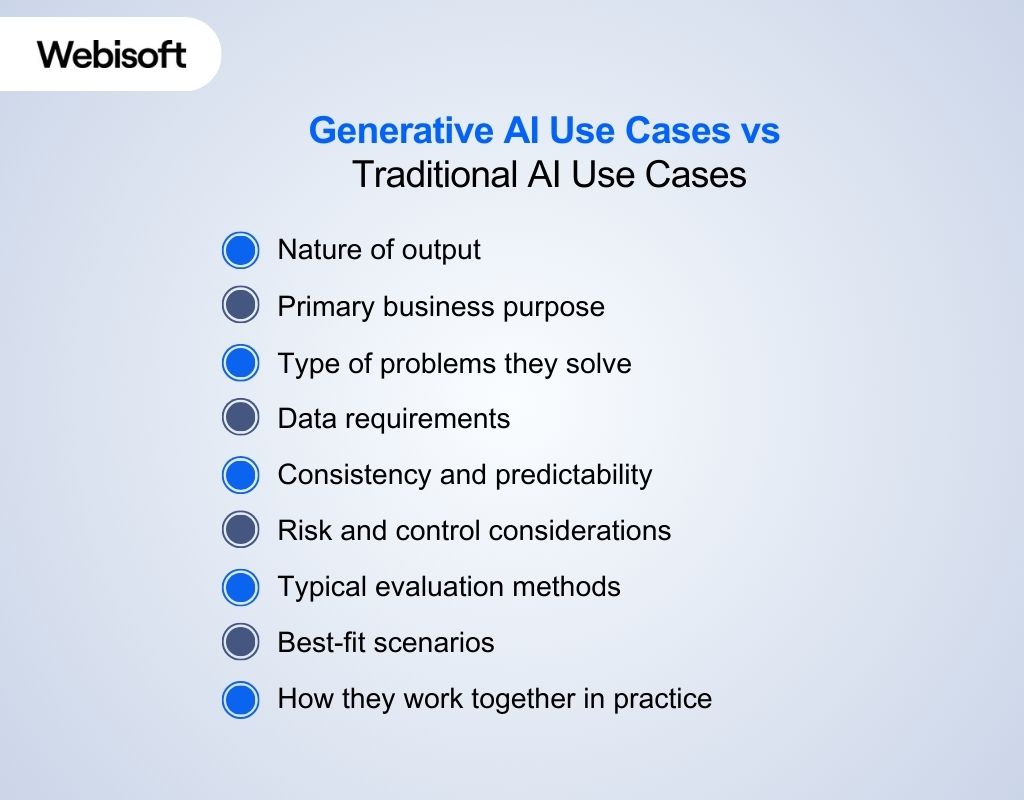
AI use cases today generally rely on two different approaches. Generative AI focuses on producing new content and language-based outputs, while traditional AI focuses on prediction and classification. Comparing them by core capabilities helps clarify where each type fits best.
Nature of output
- Generative AI use cases: Produce new outputs such as text, summaries, explanations, or code based on learned language and patterns.
- Traditional AI use cases: Produce scores, labels, predictions, or decisions based on historical data patterns.
Primary business purpose
- Generative AI use cases: Support communication, knowledge work, and content-heavy tasks that require human-like responses.
- Traditional AI use cases: Support decision-making, risk assessment, forecasting, and process optimization.
Type of problems they solve
- Generative AI use cases: Handle open-ended problems where outputs are not strictly predefined.
- Traditional AI use cases: Handle well-defined problems with clear inputs, outputs, and evaluation criteria.
Data requirements
- Generative AI use cases: Rely on large, diverse datasets to learn language, structure, and context.
- Traditional AI use cases: Rely on structured, labeled historical data tied to specific outcomes.
Consistency and predictability
- Generative AI use cases: Can vary in output wording or structure, even for similar inputs.
- Traditional AI use cases: Produce consistent and repeatable outputs for the same inputs.
Risk and control considerations
- Generative AI use cases: Require safeguards to manage hallucination, tone, and output accuracy, supported by frameworks such as the Global Partnership on Artificial Intelligence that guide responsible governance.
- Traditional AI use cases: Require monitoring for bias, drift, and false predictions.
Typical evaluation methods
- Generative AI use cases: Evaluated using human review, relevance checks, and quality metrics.
- Traditional AI use cases: Evaluated using statistical metrics such as accuracy, precision, and recall.
Best-fit scenarios
- Generative AI use cases: Fit scenarios where explanation, synthesis, or content creation is required.
- Traditional AI use cases: Fit scenarios where prediction, classification, or optimization drives value.
How they work together in practice
- Generative AI use cases: Explain, summarize, or present outputs in human-readable form.
- Traditional AI use cases: Generate the underlying predictions or decisions that drive actions.
Ready to move from identifying AI use cases to implementing them correctly? Talk to Webisoft’s AI specialists to validate feasibility, design the right architecture, and turn high-value use cases into production-ready systems.
How to Expand AI Use Cases Across Your Business
Once initial AI use cases prove value, the next challenge is expanding them across teams and workflows. Expansion requires clear prioritization, strong data foundations, and organizational readiness so AI becomes part of everyday decision-making, not isolated experimentation.
Align AI expansion with business priorities
Expansion should start with clear business goals rather than technology interest. New AI use cases must map to measurable outcomes such as cost reduction, process efficiency, risk control, or customer experience improvement. This keeps expansion focused and defensible.
Identify repeatable problems across teams
The best expansion opportunities come from problems that appear in multiple departments. Tasks involving high volume, frequent decisions, or manual review are strong candidates. Reusability across teams reduces effort while increasing overall impact.
Assess data readiness before adding new use cases
AI expansion often fails due to weak data foundations. Before introducing new use cases, businesses must confirm data quality, availability, and ownership. Reliable data pipelines are essential for consistent AI performance across functions.
Build cross-functional ownership
AI use cases expand faster when business teams, data specialists, and engineers share responsibility. Business owners define success, technical teams ensure feasibility, and operations teams embed AI into workflows. This prevents misalignment during rollout.
Introduce governance early to manage risk
As AI use cases expand, governance becomes critical. Clear rules for model monitoring, human oversight, and responsible use help maintain trust, accuracy, and compliance while new use cases are added.
Expand incrementally and measure continuously
Expansion works best through controlled rollout rather than sudden scale. Each new AI use case should be piloted, measured against clear KPIs, refined, and then extended further. This approach limits risk while compounding value over time.
How Webisoft Supports AI Use Case Implementation
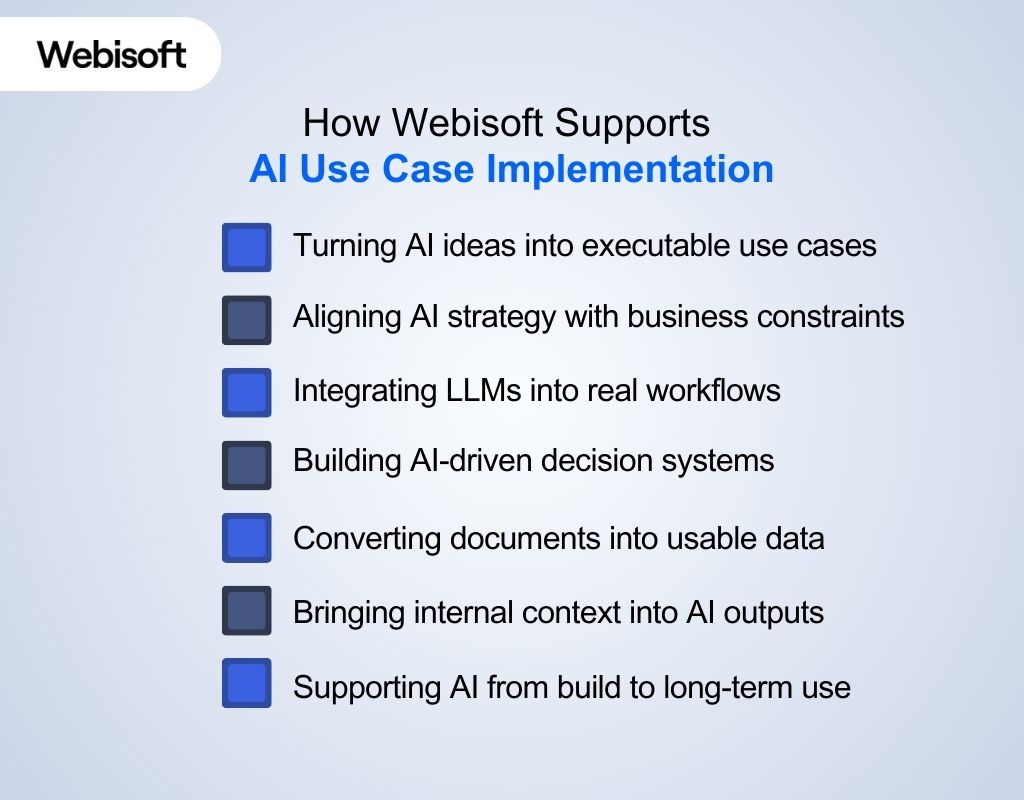
After you pick the right AI use case, execution decides results. Webisoft helps you move from idea to production by aligning goals, data, and workflows, then building, integrating, and maintaining AI systems inside your products.
Turning AI ideas into executable use cases
Webisoft begins by evaluating where AI can deliver measurable impact within your workflows. This step defines the problem, required data, success metrics, and operational changes needed so the use case is practical, not theoretical.
Aligning AI strategy with business constraints
Before development starts, Webisoft aligns the use case with your business goals, data availability, security requirements, and ownership model. This ensures the AI solution fits your environment and can be maintained after launch.
Integrating LLMs into real workflows
For language-driven use cases, Webisoft integrates LLM capabilities into products or internal tools to support summarization, search, and workflow assistance. These solutions are built using AI Model Development Services customized to your business context.
Building AI-driven decision systems
When use cases require prediction or classification, our engineers develop systems that process data and produce outputs teams can act on immediately. This moves AI from insight generation to operational execution.
Converting documents into usable data
For document-heavy processes, Webisoft applies OCR and data extraction to transform static files into structured, searchable inputs. This creates the foundation needed for AI automation and analytics-driven use cases.
Bringing internal context into AI outputs
Webisoft enables AI systems to work with your internal data, policies, and tools so responses reflect real organizational context. This ensures AI outputs stay relevant, accurate, and aligned with how your business operates.
Supporting AI from build to long-term use
Webisoft delivers AI solutions end to end, from development and integration to monitoring and ongoing improvement. This matters because AI use cases evolve as data, users, and business needs change.
Conclusion
AI use cases work best when they are grounded in real business needs rather than ambition alone. Clear goals, reliable data, and practical execution determine whether AI becomes a lasting advantage or another abandoned experiment.
When it is time to move from planning to execution, Webisoft helps bridge that gap. Our teams work closely with you to design, build, and integrate AI solutions that fit your operations, scale with your growth, and deliver results you can measure.
Frequently Asked Question
Yes, many AI use cases can work with imperfect data, but results depend on severity. Minor gaps can be handled through preprocessing and validation, while heavily incomplete or biased data usually reduces accuracy and limits reliability in real-world decisions.
Retraining frequency depends on data change and business volatility. Stable use cases may need updates quarterly or annually. While dynamic environments require frequent monitoring and retraining to prevent model drift and performance degradation over time.
Ownership should be shared. Business teams own outcomes and KPIs, data teams monitor model performance, and engineering teams manage infrastructure and integrations. Clear accountability across these roles ensures long-term reliability and adoption.