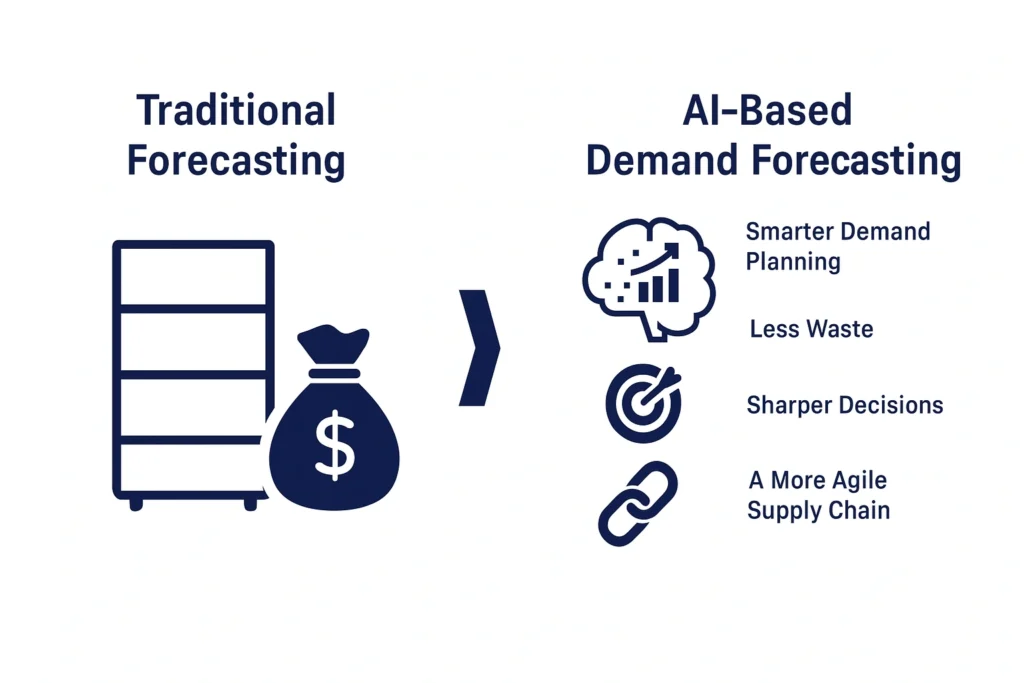
Traditional forecasting is falling behind fast. Consumer habits shift quickly. Markets face global disruptions. Trends change in an instant. Sticking to old methods often leads to empty shelves or unsold stock piling up. That means lost revenue knocking at your door.
AI-based demand forecasting changes the game. It uses machine learning and predictive analytics to spot hidden patterns. It reacts to real-time data. It delivers forecasts that actually hit the mark.
Here’s what AI in demand forecasting brings to your business:
- Smarter demand planning
- Less waste
- Sharper decisions
- A more agile supply chain
Each AI model analyzes data, predicts demand, adjusts plans, and learns over time, all with minimal human input. Want to know how AI can reshape your demand forecasting? Keep reading ahead.
Understanding AI-Based Demand Forecasting
AI-based demand forecasting is a major advancement in how businesses predict future demand. Unlike traditional methods that mostly use past sales and simple statistics, AI leverages advanced machine learning to analyze many types of data at once.
These data sources include internal information like sales history and inventory levels, as well as external factors such as economic indicators, weather, social media sentiment, and competitor activity. This broad view helps uncover patterns that traditional forecasting often misses.
At the core of AI forecasting are machine learning models like neural networks and time series algorithms. These models detect complex relationships and improve continuously as they process new data. This allows for real-time demand forecasting with AI, keeping predictions accurate even when markets change suddenly.
AI also uses advanced analytics like sentiment analysis to turn unstructured data into actionable insights. By including customer opinions and market signals, businesses can anticipate demand shifts more precisely and react proactively.
This approach helps companies optimize inventory, reduce waste, and align supply chain operations with actual market behavior. Additionally, explainable AI techniques provide transparency by showing how forecasts are generated, which builds trust and supports confident decision-making.
In short, AI-based demand forecasting combines powerful data analysis, adaptive learning, and human insight to deliver more accurate and agile predictions in today’s complex market.
How does AI demand forecasting differ from traditional forecasting methods?
The difference between AI demand forecasting and traditional forecasting methods is:
| Aspect | Traditional Forecasting | AI Demand Forecasting |
|---|---|---|
| Data Sources | Uses historical sales, seasonality, and limited external data. Simpler data needs. | Leverages internal and external data such as POS, ERP, weather, social media, and competitor pricing. Requires a robust data infrastructure. |
| Adaptability | Static models requiring manual updates, slower to respond to changes. | Self-learning models that adapt automatically to new trends and data. Can sometimes overreact to short-term noise. |
| Responsiveness | Poor at handling sudden market changes or disruptions. | Quickly adjusts to events, surges, or disruptions, providing more timely forecasts. May produce erratic outputs during extreme volatility. |
| Complexity Handling | Struggles with large, complex datasets and intricate patterns. | Handles high-dimensional, complex data effectively but needs specialized skills to develop and maintain models. |
| Accuracy | Limited accuracy in dynamic or volatile markets but often sufficient in stable environments. | High accuracy through real-time data analysis and pattern recognition. Can outperform traditional methods in complex markets. |
| Scalability | Less scalable; time-consuming and resource-intensive for large datasets. | Highly scalable with automation, suitable for large enterprises. May be costly for small businesses to implement. |
| Cost Efficiency | Lower initial costs but higher ongoing labor and maintenance expenses. | Automates many tasks, reducing long-term costs but requires significant upfront investment in technology and expertise. |
| Decision-Making | Basic scenario planning, easier to understand but limited in complexity. | Supports multiple complex scenario simulations and deeper insights but may require training for effective use. |
Core AI Models for Forecasting
Time series basics: ARIMA vs. Exponential Smoothing
In AI-driven demand forecasting, time series analysis remains fundamental. Two widely used statistical methods—ARIMA and exponential smoothing—serve as core building blocks, each with distinct mathematical foundations and application scopes.
ARIMA (Autoregressive Integrated Moving Average)
ARIMA models combine three components:
- Autoregression (AR): The model regresses the variable on its own lagged values, capturing temporal dependencies.
- Integration (I): Differencing is applied to the time series to achieve stationarity, removing trends or seasonality.
- Moving Average (MA): The model accounts for past forecast errors to smooth predictions.
Formally, an ARIMA(p, d, q) model is expressed as:
ϕp(B)(1−B)dyt=θq(B)ϵt
Where,
ϕp(B) and ϕp are polynomials of order p and q in the backshift operator B, d is the differencing order, yt is the observed value at time t, and ϵt is white noise.
Exponential Smoothing
Exponential smoothing methods forecast future values by weighting past observations with exponentially decreasing weights. The simplest form, Simple Exponential Smoothing (SES), is suitable for data without trend or seasonality:
y^t+1=αyt+(1−α)y^t
where α is the smoothing parameter (0 < α < 1).
More advanced variants include:
- Holt’s Linear Trend Method: Extends SES by adding components for trend estimation.
- Holt-Winters Method: Incorporates seasonality components, either additive or multiplicative.
Machine learning models: XGBoost vs. Random Forests
XGBoost and Random Forests are powerful machine learning models used in AI-driven forecasting. They are essential for handling complex, structured data with non-linear relationships and high dimensionality.
XGBoost (Extreme Gradient Boosting) is a boosting algorithm that builds trees sequentially, where each tree corrects the errors of the previous one. It combines several components:
- Gradient Boosting minimizes loss by adding trees that focus on previous residuals.
- Regularization (L1 and L2) controls model complexity to reduce overfitting.
- Parallel Processing and Sparsity Awareness improve computational efficiency and scalability.
XGBoost is especially useful when high accuracy is required on large datasets with mixed data types. It is widely applied in finance, credit risk scoring, and demand planning. Its strengths lie in predictive power and flexibility, although tuning hyperparameters can be resource-intensive.
Random Forests are based on bagging, where multiple trees are built independently and combined. They involve these elements:
- Bootstrap Sampling generates diverse training subsets by sampling with replacement.
- Random Feature Selection at each split enhances tree diversity and reduces correlation.
- Aggregation of Predictions by averaging or majority voting to improve robustness.
Random Forests perform well in noisy environments and handle nonlinear interactions. They provide feature importance metrics, useful for interpretability. Common applications include customer segmentation, recommendation systems, and sales forecasting. They are easy to use and less sensitive to parameter tuning.
Deep learning: LSTM, GRU, Temporal Fusion Transformers
Deep learning models like LSTMs, GRUs, and Temporal Fusion Transformers (TFTs) are key tools for time series forecasting. LSTMs and GRUs capture temporal dependencies in sequential data by using gated recurrent units to manage information flow and mitigate issues like vanishing gradients.
LSTMs employ input, forget, and output gates to learn long-term dependencies, though they can be computationally intensive and less efficient on very long sequences. GRUs simplify this with fewer gates, combining input and forget gates into a single update gate, offering faster training with slightly reduced complexity handling.
Temporal Fusion Transformers (TFTs) extend these concepts by integrating LSTM layers with Transformer-based attention mechanisms, enabling multi-horizon forecasting across heterogeneous inputs (past observations, known future inputs, and static features). TFTs use an encoder-decoder architecture that captures complex temporal patterns and provides interpretability via attention weights. However, they require more computational resources and careful tuning.
The Key Benefits of AI for Demand Forecasting
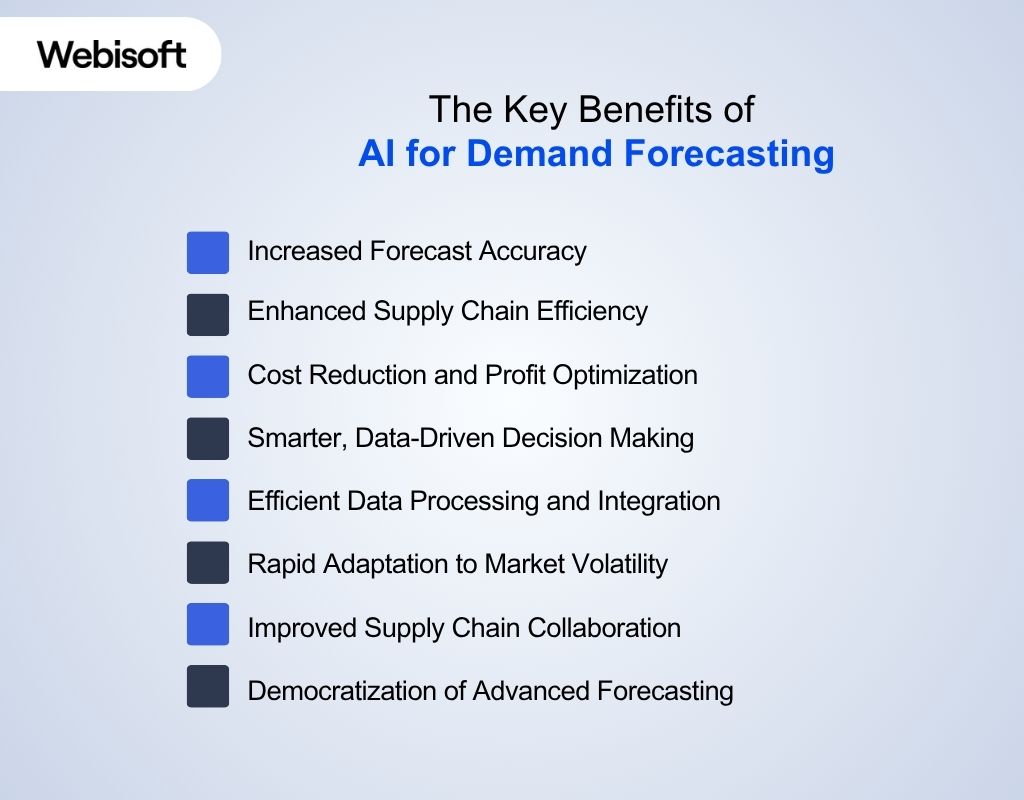
AI-powered demand forecasting is transforming how businesses predict and respond to customer demand. By leveraging advanced machine learning models and real-time data integration, AI demand forecasting overcomes many limitations of traditional forecasting methods and delivers significant advantages:
Increased Forecast Accuracy
AI-powered forecasting uses machine learning algorithms that continuously ingest and analyze real-time data. This dynamic approach enables models to detect subtle demand shifts and nonlinear relationships that static models miss.
For example, companies using AI in demand forecasting software report up to a 50% reduction in forecast errors, significantly lowering costs related to stockouts and excess inventory.
Enhanced Supply Chain Efficiency
AI systems integrate live sales data, warehouse inventory levels, and logistics inputs to provide continuous demand updates. Unlike traditional replenishment cycles based on fixed lead times, AI forecasts adjust dynamically.
It enables proactive inventory corrections before shortages or surpluses occur. This real-time responsiveness improves distribution network efficiency, shortens lead times, and strengthens overall supply chain resilience. The applications of ai in demand forecasting are especially evident in logistics and retail.
Cost Reduction and Profit Optimization
AI-driven demand forecasting aligns inventory levels closely with actual market demand, reducing waste and freeing up working capital. Additionally, AI-powered dynamic pricing models adjust prices based on current demand, competitor actions, and seasonality, helping retailers improve margins and reduce markdowns.
Smarter, Data-Driven Decision Making
Beyond improving forecast precision, AI transforms demand planning into a strategic tool. It enables scenario simulation by analyzing the impact of economic trends, competitor moves, or supply chain disruptions on future demand.
Generative AI models further enhance this by creating complex market simulations, allowing businesses to anticipate challenges and opportunities ahead of time. The use cases of AI in demand forecasting often include scenario planning and risk management.
Efficient Data Processing and Integration
AI excels at processing vast, heterogeneous datasets automatically, reducing manual data handling and human error. For instance, while traditional forecasting methods may use only a fraction of available data, AI models can analyze nearly 100% of relevant inputs in real time.
This includes structured data like sales and inventory, as well as unstructured sources such as social media sentiment and economic indicators. The ability to integrate diverse data streams enables AI to uncover causal relationships and demand drivers that conventional models overlook.
Rapid Adaptation to Market Volatility
In volatile markets, the ability to quickly adjust forecasts is critical. AI algorithms recalibrate predictions almost instantaneously in response to unexpected events like pandemics, geopolitical shifts, or supply chain disruptions.
This agility allows businesses to maintain operational continuity and respond effectively to changing consumer behavior, minimizing risk and maximizing opportunity.
Improved Supply Chain Collaboration
AI’s enhanced forecast accuracy helps reduce the bullwhip effect, where small changes in consumer demand amplify upstream in the supply chain. By providing more reliable demand signals, AI fosters better coordination among suppliers, manufacturers, and distributors.
This leads to optimized inventory levels, fewer order spikes, and smoother production schedules, ultimately stabilizing the entire supply chain ecosystem.
Democratization of Advanced Forecasting
Modern AI forecasting platforms automate complex model building and updates, making sophisticated demand prediction accessible to non-technical users. This lowers barriers to adoption and enables broader participation across business units. Teams can focus on strategic planning and interpretation rather than technical modeling, accelerating decision-making and improving organizational agility.
AI Demand Forecasting Across Industries
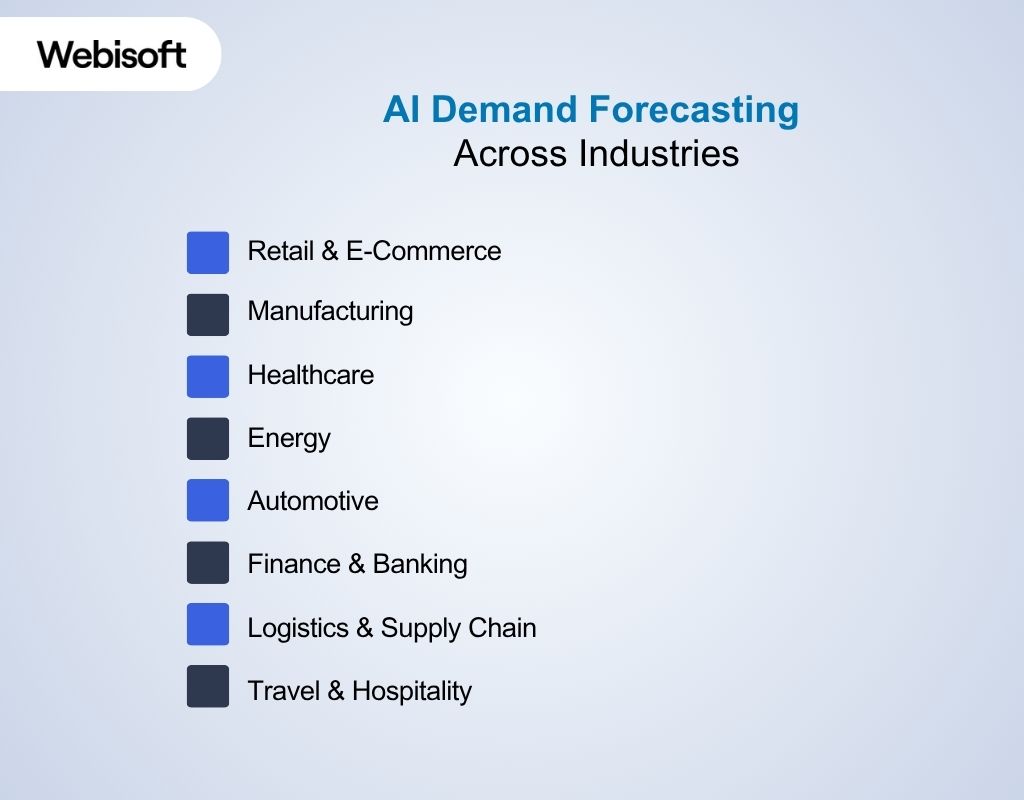
AI-based demand forecasting leverages machine learning (ML), deep learning (DL), and generative models to analyze multi-source datasets and deliver high-accuracy predictions. These systems enable industries to anticipate fluctuations, allocate resources efficiently, and optimize operational workflows at scale.
Retail & E-Commerce
Advanced ML models integrate real-time POS data, historical sales, seasonal effects, and third-party signals (social media, promotions) to forecast SKU-level demand. Reinforcement learning optimizes dynamic pricing strategies, while clustering techniques support granular customer segmentation.
Neural forecasting models enhance inventory planning by predicting local demand spikes and automating replenishment. Integration with ERP and SCM platforms ensures seamless logistics, return forecasting, and reverse supply chain alignment.
Manufacturing
Time-series forecasting, combined with probabilistic models, enables precise production scheduling. AI systems synthesize data from CRM, IoT devices, and MES platforms to predict order volumes, machine utilization, and supply disruptions.
Customized product forecasting uses NLP and image data to infer demand patterns for configurable items. AI also supports just-in-time inventory, minimizing overhead through predictive alignment of procurement and assembly cycles.
Healthcare
Predictive analytics models process EHRs, real-time admission data, and public health trends to anticipate patient inflow, ICU demand, and resource allocation. DL models forecast pharmaceutical consumption, medical device needs, and vaccine uptake with region-specific granularity.
Generative models simulate outbreak scenarios for proactive surge planning. Hospitals leverage these insights to dynamically schedule staff, allocate beds, and manage inventories through HL7/FHIR-integrated systems.
Energy
AI-driven load forecasting models analyze weather, sensor data, usage patterns, and macroeconomic inputs to predict short-term and long-term demand. LSTM and temporal convolutional networks provide high-resolution forecasts, enabling real-time adjustments in power generation and distribution. These systems optimize grid balancing, peak shaving, and renewable integration strategies, enhancing both efficiency and sustainability.
Automotive
AI forecasting integrates telematics, CRM inputs, and supply chain telemetry to predict vehicle demand, parts lifecycle, and configuration trends. Ensemble models align production with dealer-level demand, regional preferences, and customization requirements.
Predictive maintenance algorithms, powered by historical fault logs and real-time diagnostics, improve uptime and part availability. AI also supports lead time reduction through synchronized forecasting of raw materials and logistics.
Finance & Banking
Natural language processing (NLP) and sentiment analysis of financial news and customer communication augment traditional quantitative models for product demand prediction. AI models forecast usage trends across credit, savings, and investment products.
Time-series models optimize ATM cash logistics and branch staffing by analyzing transaction frequency, withdrawal patterns, and foot traffic. Personalized banking forecasts leverage graph ML and customer embeddings to tailor financial offerings.
Logistics & Supply Chain
AI models forecast shipment volumes, transport routes, and customs clearance durations using order history, geopolitical inputs, and carrier data. Bayesian networks and recurrent models help predict lead times, inventory turnover, and cross-border demand surges.
Warehouse optimization models utilize SKU movement and spatial analytics for layout and picking strategy improvements. AI-driven planning ensures agile supplier collaboration and end-to-end visibility across nodes.
Travel & Hospitality
Recurrent and attention-based models forecast booking behavior based on historical travel data, price elasticity, and external stimuli (events, climate). These forecasts inform revenue management systems (RMS), enabling dynamic pricing and overbooking mitigation.
AI also segments customer behavior using unsupervised learning for hyper-personalized offers. NLP and ML-driven chat systems adapt guest experiences in real-time based on predicted preferences and intent signals.
How to Implement AI in Demand Forecasting
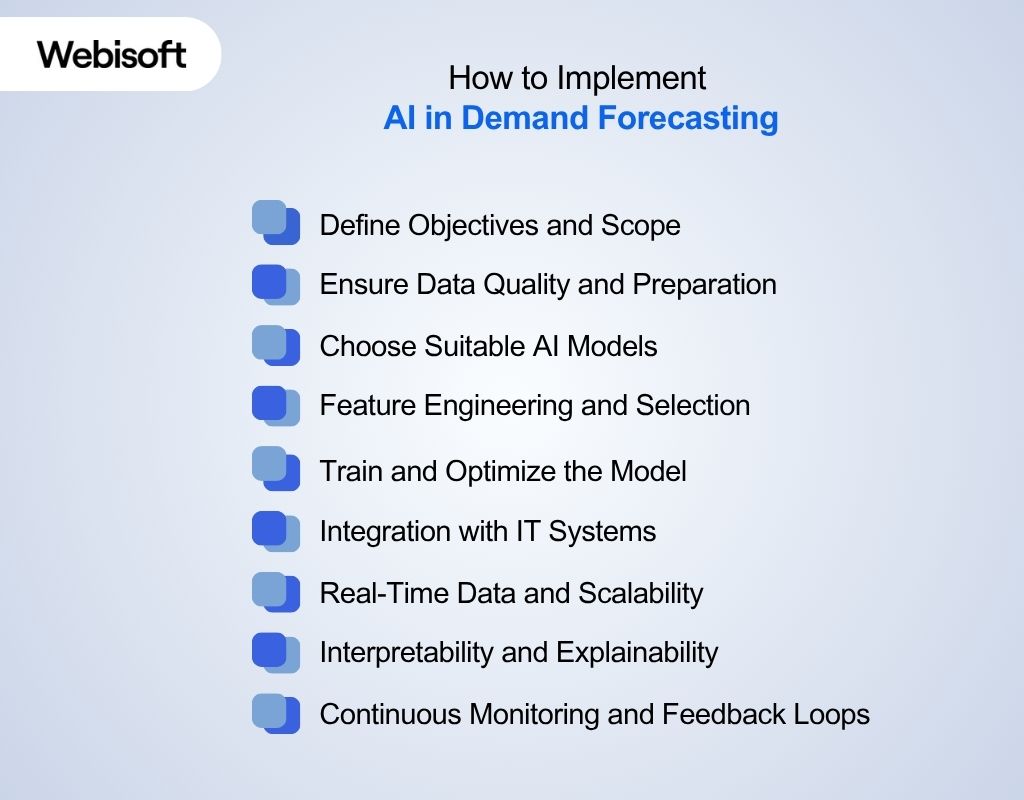
Implementing AI in demand forecasting involves a structured, technical approach to ensure accuracy, scalability, and integration into existing systems.
1. Define Objectives and Scope
Begin by clearly defining the use case. Identify target products, regions, or business functions where AI can improve forecasting. Set measurable KPIs to track success and align implementation goals with strategic priorities.
2. Ensure Data Quality and Preparation
Accurate forecasting starts with reliable data. Collect historical sales, market trends, and external variables like economic indicators or weather. Preprocess the data using:
- Normalization for uniform scaling
- Feature engineering to enhance input relevance
- Data cleaning to fix errors and fill gaps
- Outlier detection to remove anomalies
Robust preprocessing ensures the model learns from consistent, high-value information.
3. Choose Suitable AI Models
Select models based on complexity and data type. Options include:
- Linear regression for simple relationships
- Neural networks and LSTM for complex, time-dependent patterns
- Ensemble methods for improving generalization
Models must be trained on historical data, validated on separate datasets, and continuously evaluated against real outcomes.
4. Feature Engineering and Selection
Derive features that reflect underlying demand drivers. Combine and transform variables for deeper predictive value. Inputs should cover internal data (e.g., promotions, inventory) and external signals (e.g., holidays, competitor actions).
5. Train and Optimize the Model
Split data into training and validation sets. Use iterative optimization to fine-tune hyperparameters such as learning rate or model depth. Validate performance metrics like MAE or RMSE to gauge reliability.
6. Integration with IT Systems
Work with engineering teams to deploy models into production. Ensure compatibility with existing infrastructure, whether on-premises or cloud-based, using APIs or automated pipelines.
7. Real-Time Data and Scalability
Set up real-time data flows using ETL pipelines or streaming services. A scalable system must support growing data volumes, integrate new sources, and adapt to operational changes without performance loss.
8. Interpretability and Explainability
Select interpretable models where possible (e.g., decision trees) or use agnostic techniques like SHAP or PDPs to explain complex models. Visual dashboards or text explanations can help stakeholders understand results and build trust.
9. Continuous Monitoring and Feedback Loops
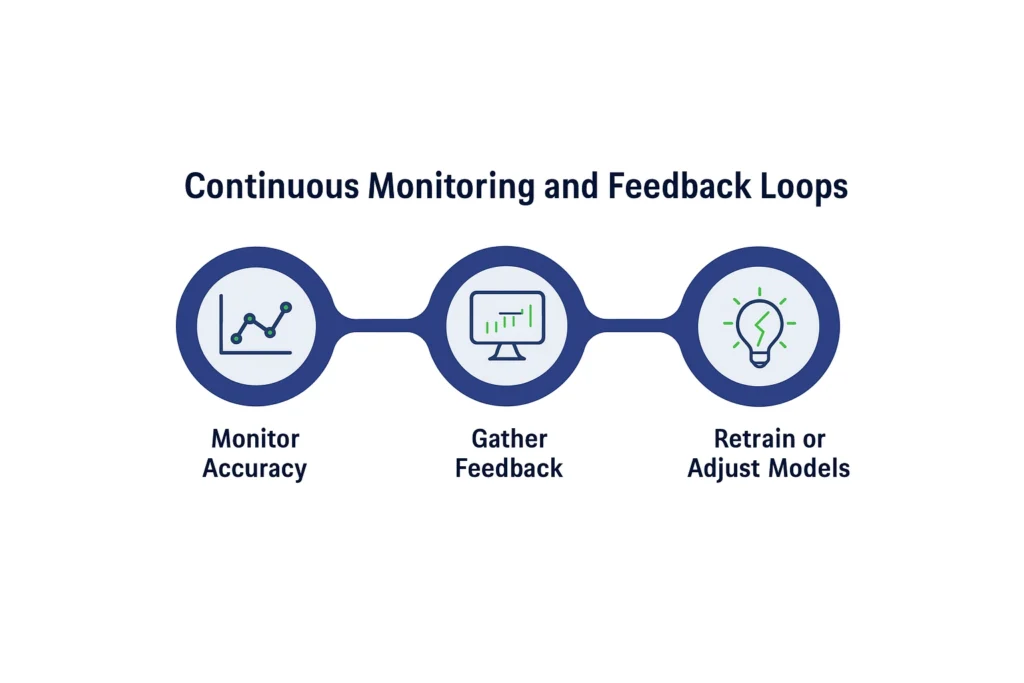
Forecasting models must evolve. Monitor accuracy regularly, compare against actual outcomes, and gather user feedback. Retrain or adjust models as new trends or anomalies emerge.
What are the Challenges in AI Implementation in Demand Forecasting
Implementing AI for demand forecasting comes with several challenges, but the three most critical ones are data quality and availability, high implementation costs and technical complexity, and market volatility with unpredictable events.
1. Data Quality and Availability
AI models require vast amounts of clean, consistent, and relevant data to generate accurate forecasts. Poor data quality directly leads to unreliable predictions, undermining trust in AI-driven forecasts.
Additionally, AI models trained solely on historical data may fail to capture sudden market shifts or new product demand patterns. Establishing strong data pipelines, thorough cleansing, and integration processes is vital to address this challenge effectively.
2. High Implementation Costs and Technical Complexity
Deploying AI-powered demand forecasting involves substantial investment in technology infrastructure, software, and skilled personnel. This financial barrier is especially challenging for small and medium-sized enterprises.
Moreover, integrating AI tools into existing legacy systems is a complex task that requires specialized expertise. Without proper planning and technical support, integration can disrupt workflows and reduce operational efficiency.
3. Market Volatility and Unpredictable Events
AI models primarily rely on patterns found in historical data. However, sudden and unforeseen events like economic downturns, pandemics, or geopolitical conflicts can cause dramatic demand shifts that AI struggles to predict.
This limitation means businesses must combine AI forecasts with human insight and agile strategies to respond effectively during volatile periods.
How can Webisoft help with your AI demand forecasting requirements?
Webisoft can be used to forecast demand, manage inventory, and generate actionable insights. You can automate planning, reduce waste, and improve responsiveness. Here’s how:
- Webisoft AI agents automatically analyze sales, market trends, weather, and social signals to generate highly accurate demand forecasts tailored to your business.
- Forecasts are delivered through intuitive, customizable dashboards and real-time monitoring tools, enabling quicker decision‑making.
- The system uses NLP and machine learning to detect subtle shifts in consumer behavior, adapting models dynamically to reduce stockouts or overstock.
Organizations can also use generative AI and other Webisoft services to enhance and scale forecasting agents. Webisoft helps you navigate data integration, model training, and deployment challenges with expert support and robust infrastructure. For example:
- Webisoft GenAI Forecast gives you enterprise-grade models, automated training pipelines, and secure APIs suited for predictive analytics.
- Webisoft Launchpad allows co‑development, testing, and deployment of forecasting workflows on scalable cloud infrastructure.
- Webisoft Adaptive Engine continuously re-trains your models in production, ensuring accuracy improves as more data flows in.
Final Words
Embracing AI in demand forecasting can greatly improve your business’s ability to predict customer needs and manage inventory efficiently. By leveraging advanced technology, you can reduce costs, minimize risks, and stay ahead of market changes.
Webisoft helps companies integrate AI-powered forecasting solutions tailored to their needs, making the shift to smarter, data-driven planning seamless and effective. As the business world becomes more data-driven, adopting AI forecasting is no longer optional but essential for growth and success.
Frequently Asked Questions
AI forecasts demand by analyzing data from sales, customer behavior, and market trends. It uses machine learning to find patterns, adjust predictions in real time, and automate inventory decisions. This helps businesses reduce stockouts, avoid overstocking, and respond quickly to changes.
AI is used in financial forecasting to analyze large sets of financial data and predict future trends. It uses tools like machine learning (ML) and predictive analytics to spot patterns, assess risks, and improve decision-making. This helps businesses plan budgets, manage investments, and reduce financial uncertainty.
An example of AI forecasting is using machine learning to predict product demand in retail. It analyzes past sales, market trends, and customer behavior to forecast how much stock is needed, helping businesses avoid overstock or shortages.