Market conditions have changed in ways that asset managers can no longer ignore. Fee pressure continues to rise, operating costs remain stubborn, and investment decisions must now account for faster market shifts and tighter oversight.
At the same time, teams are expected to process more data, react sooner, and justify every outcome with clarity. AI in asset management has become a response to these structural pressures rather than a future concept. Learning-based systems now support research, portfolio decisions, risk oversight, and reporting inside institutional environments.
They allow firms to move beyond static rules and manual workflows toward adaptive, data-driven decision support. This article explains how AI fits into modern asset management, where it delivers value, and what must be considered to apply it responsibly at scale.
What Is AI in Asset Management
AI in asset management refers to the use of learning-based systems by institutional and professional investment firms to support investment research, portfolio decisions, and risk analysis.
In practice, artificial intelligence in asset management applies data-driven models to detect patterns across market data, adjust assumptions as conditions change, and support human decision-making at scale.
These systems are used inside governed environments such as hedge funds, asset managers, pension funds, and insurers. It is important to separate automation from intelligence. Automation follows fixed rules.
Machine learning in asset management adapts model behavior based on new data. That adaptive capability is what defines AI-driven asset management, not simple process automation.
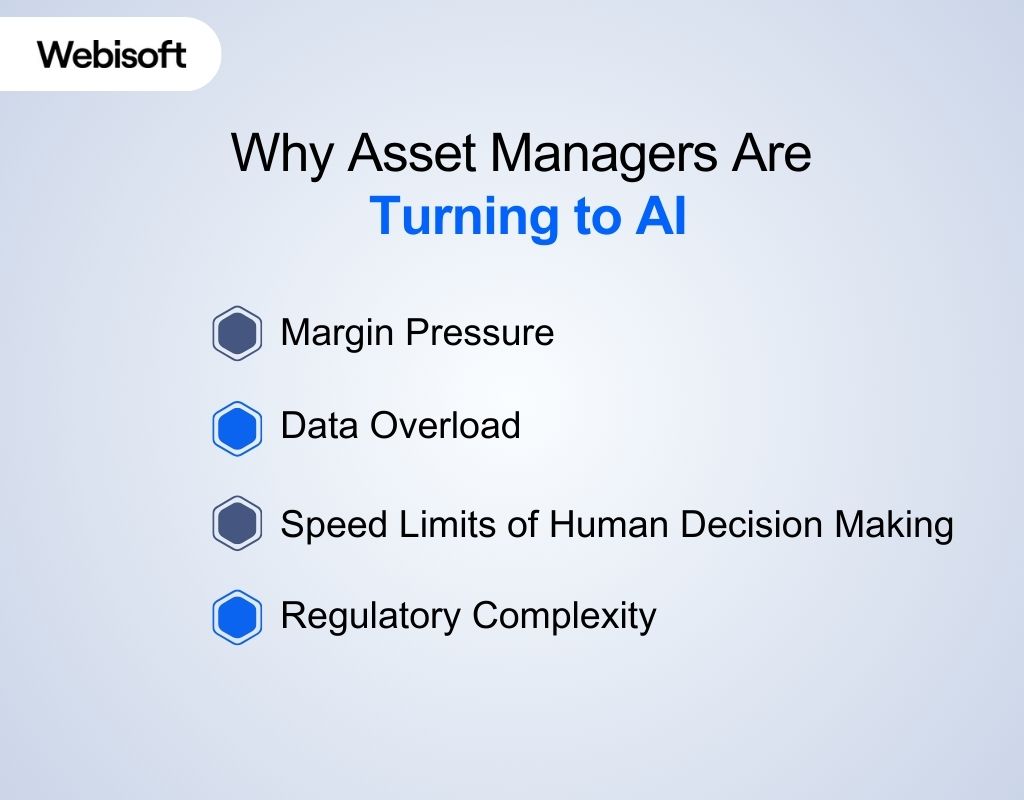
Why Asset Managers Are Turning to AI
91% of asset managers are using or planning to use AI in asset-class research and portfolio construction. Asset management is no longer a stable, slow-moving business. Markets shift faster, fees keep falling, and expectations from regulators and clients continue to rise.
At the same time, firms must process more data than ever before while proving control over every decision they make. This combination explains why AI in asset management has moved from experimentation to daily operations across institutional firms.
Margin Pressure
Profitability has come under sustained pressure as investor capital flows toward lower-fee passive products. Operating costs, however, continue to rise due to regulation, technology spend, and talent competition.
Industry data shows global assets under management rebounded after 2022, yet margins failed to recover at the same pace.
Artificial intelligence in asset management offers a way to scale productivity without adding proportional cost, allowing firms to defend margins while maintaining investment quality.
Data Overload
Modern investment decisions depend on far more than prices and balance sheets. Earnings transcripts, macro indicators, sentiment data, regulatory filings, and alternative datasets now influence portfolio outcomes. Human teams cannot consistently analyze this volume under time constraints.
Machine learning in asset management enables firms to process structured and unstructured data together, identify complex relationships, and surface signals that manual analysis would overlook.
Speed Limits of Human Decision Making
Markets react faster than traditional review cycles allow. Correlations break quickly, volatility clusters form without warning, and risks propagate across asset classes in hours.
Human-only workflows struggle to respond in time. AI investment management systems operate continuously, refreshing signals and monitoring exposures in real time, which allows portfolio managers to act with current information rather than delayed insight.
Regulatory Complexity
Regulators now focus as much on decision processes as on outcomes. Firms must demonstrate explainability, governance, and ongoing oversight of models and portfolios.
Black box logic increases compliance and reputational risk. AI-driven asset management, when paired with strong governance frameworks, supports audit trails, anomaly detection, and early risk identification, helping firms maintain control in a stricter regulatory environment.
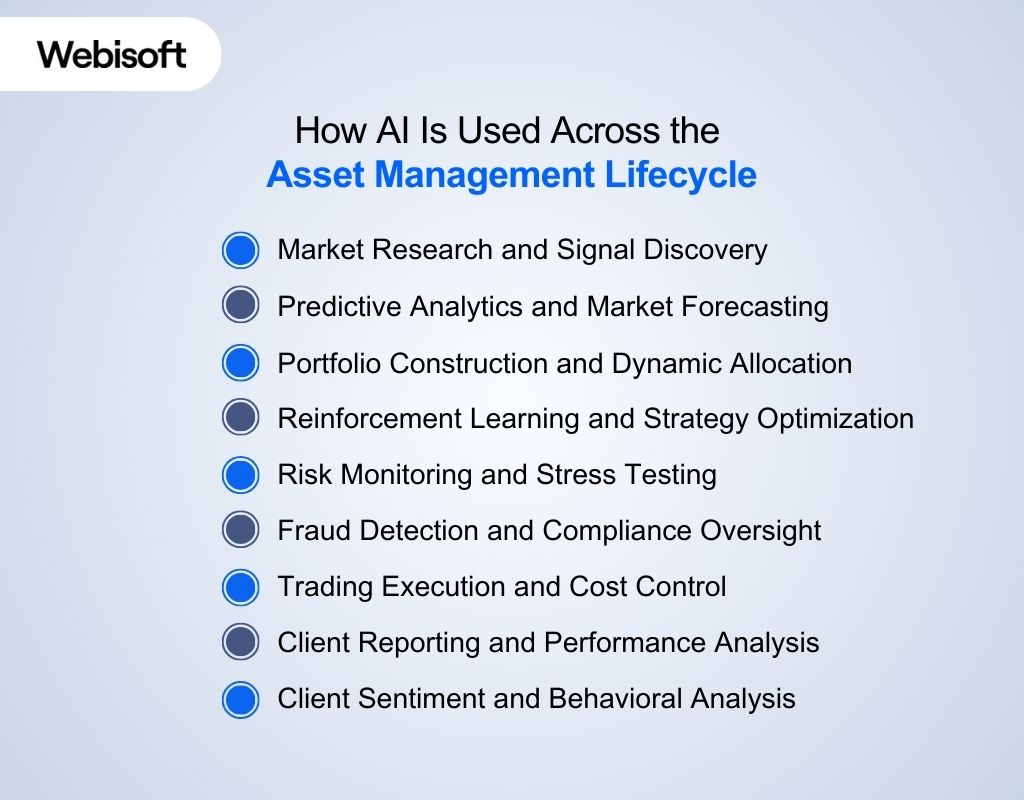
How AI Is Used Across the Asset Management Lifecycle
Within institutional firms, AI in asset management now operates across every stage of the investment process. Rather than a single system, AI appears as a collection of specialized capabilities, each designed to solve a specific limitation in traditional workflows.
This shift reflects how AI in financial services has moved from experimentation into core investment infrastructure.
Market Research and Signal Discovery
Research teams use AI investment research and machine learning models in finance to process large volumes of structured and unstructured data. Prices, fundamentals, macro indicators, earnings calls, regulatory filings, news, and sentiment feeds are analyzed together.
Through natural language processing in finance, systems interpret tone and narrative changes that often precede market moves. This enables earlier signal discovery. Rather than waiting for consensus views, AI signal generation connects proxy indicators and indirect patterns that analysts can then validate using domain expertise.
Predictive Analytics and Market Forecasting
Forecasting relies on predictive analytics in asset management, where models analyze decades of historical data alongside live inputs. These systems learn across market cycles, refining assumptions as outcomes unfold. For asset managers, this shifts positioning from reactive to proactive. Market scenarios are expressed as probability ranges, supporting better exposure decisions under uncertainty. This approach has become central to AI-driven investment strategies.
Portfolio Construction and Dynamic Allocation
With AI portfolio management, portfolio construction becomes adaptive rather than static. Algorithms continuously assess asset correlations, volatility, liquidity, and drawdown behavior, adjusting allocations as market structure evolves.
These systems also integrate constraints that were difficult to balance manually, including mandate rules, client risk profiles, and sustainability criteria. The result is tighter control without sacrificing flexibility, a core requirement for AI for institutional asset managers.
Reinforcement Learning and Strategy Optimization
Some firms apply reinforcement learning to refine strategies through feedback loops. Models learn from prior allocation outcomes, improving decisions over time without manual recalibration.
This approach allows strategies to evolve as market behavior changes, while remaining bounded by predefined risk and compliance parameters.
Risk Monitoring and Stress Testing
Risk teams rely on AI risk management and AI stress testing to simulate thousands of scenarios across asset classes. These models surface nonlinear risks and interaction effects that traditional frameworks often overlook.
Predictive risk modeling combines historical stress events with live signals, allowing teams to visualize vulnerabilities before losses appear. This supports earlier intervention rather than post-event correction.
Fraud Detection and Compliance Oversight
AI systems monitor transactions, communications, and behavioral patterns continuously. Machine learning detects anomalies that may signal fraud, policy breaches, or operational risk.
Unlike static rule-based systems, these models adapt as new risk patterns emerge, supporting stronger oversight under complex regulatory regimes.
Trading Execution and Cost Control
Execution platforms use AI to analyze market depth, order flow, spreads, and volatility in real time. Strategies adjust dynamically to reduce slippage and transaction costs.
For large institutional portfolios, even small execution improvements preserve meaningful value. This makes AI-supported execution a core operational requirement.
Client Reporting and Performance Analysis
AI automates performance reporting, attribution analysis, and ESG disclosures using live data feeds. Reports are generated faster, remain consistent across teams, and adapt to client-specific preferences.
This improves transparency and reduces manual effort, allowing investment teams to focus on decision-making rather than document production.
Client Sentiment and Behavioral Analysis
Client interactions now generate data that AI can interpret. Models analyze communication patterns, surveys, and engagement behavior to assess sentiment and risk tolerance changes.
These insights help firms adjust communication strategies, anticipate client concerns, and reduce churn before dissatisfaction escalates.
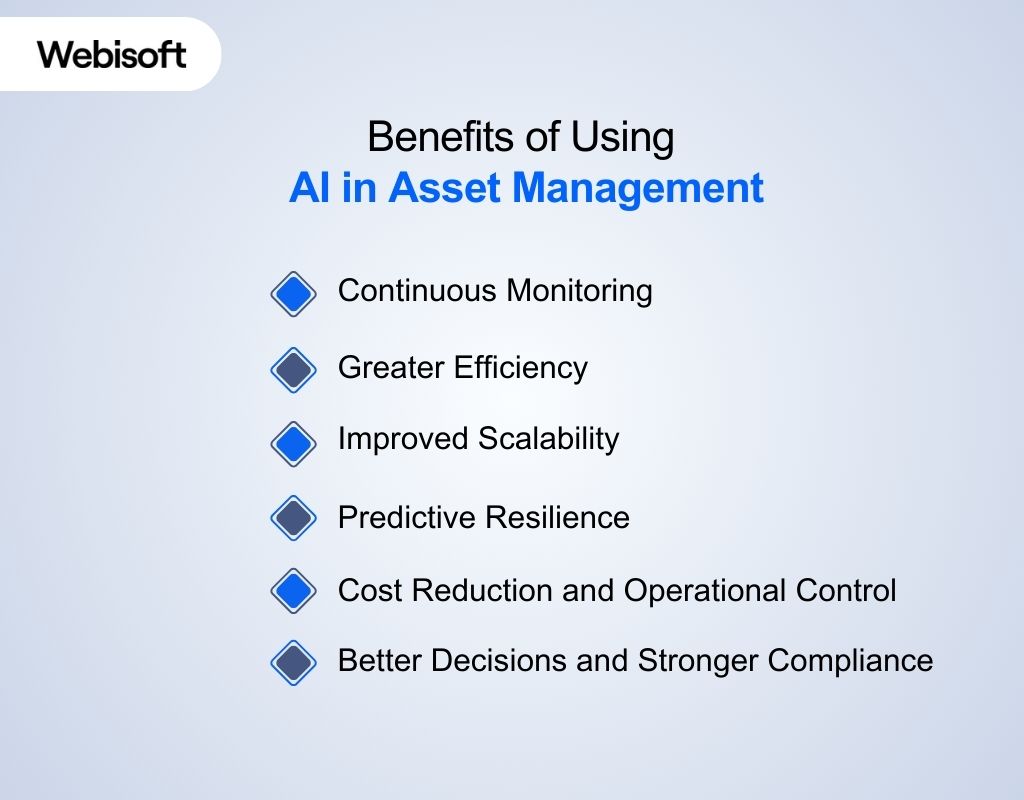
Benefits of Using AI in Asset Management
The value of AI in asset management is not theoretical. Asset managers adopt it because it removes friction from daily work and improves outcomes where human-only processes fall short.
The most visible benefits show up in monitoring, efficiency, scalability, resilience, and control. Each one addresses a real operational constraint that firms already face.
Continuous Monitoring
Traditional asset and portfolio oversight relies on periodic reviews. Weekly or monthly updates leave gaps where issues grow unnoticed. With artificial intelligence in asset management, monitoring becomes continuous.
Models process market signals, portfolio movements, and operational data as they emerge, not after the fact. That means performance shifts, risk buildups, or anomalies are flagged while action still matters. Instead of waiting for manual review, teams respond in near real time. This changes oversight from reactive to proactive.
Greater Efficiency
Manual workflows consume time without adding insight. Copying data, reconciling inconsistencies, and cleaning errors slow teams down. Machine learning in asset management handles these repetitive tasks in the background, allowing professionals to focus on analysis and decisions.
Industry research supports this shift. Mercer reports that most managers expect AI to increase productivity across asset operations. The efficiency gain does not come from working faster, but from removing low-value work entirely.
Improved Scalability
As portfolios grow, complexity multiplies. Data sources expand, systems fragment, and governance weakens under manual processes. AI-driven asset management applies consistent logic across thousands of assets or positions at once, without adding layers of review.
This consistency supports expansion. Firms can onboard new assets, enter new regions, or integrate new systems without redesigning workflows each time. Scale becomes manageable instead of fragile.
Predictive Resilience
Asset managers constantly ask what comes next. Market stress, regulatory shifts, or supply disruptions often surface before their impact becomes obvious. AI investment management models analyze broader patterns across demand, policy changes, and external signals to identify early warning indicators.
These insights allow teams to adjust budgets, hedges, or allocations before disruption hits. Resilience improves because responses are planned, not rushed.
Cost Reduction and Operational Control
Predictive analytics also reduces costs. AI-driven condition monitoring and maintenance planning have shown meaningful reductions in breakdowns and unnecessary spend. While implementation costs still require careful evaluation, the long-term benefit comes from better targeting, not blanket intervention.
Operational efficiency extends to sustainability as well. By linking asset condition with operating parameters, firms reduce waste and improve resource use. This aligns financial performance with environmental objectives.
Better Decisions and Stronger Compliance
Human judgment carries bias and inconsistency. AI portfolio management supports decisions by grounding them in data-driven modeling and probability analysis. This does not remove human oversight, but it improves consistency under pressure.
Compliance also benefits. AI systems flag suspicious transactions, misaligned risk profiles, or anomalous behavior automatically. When paired with governance frameworks, this strengthens auditability and reduces regulatory exposure without slowing operations.
At this stage, firms often realize that execution matters more than theory. This is where experienced partners like Webisoft help translate AI concepts into production-ready investment systems.
Challenges of AI in Asset Management
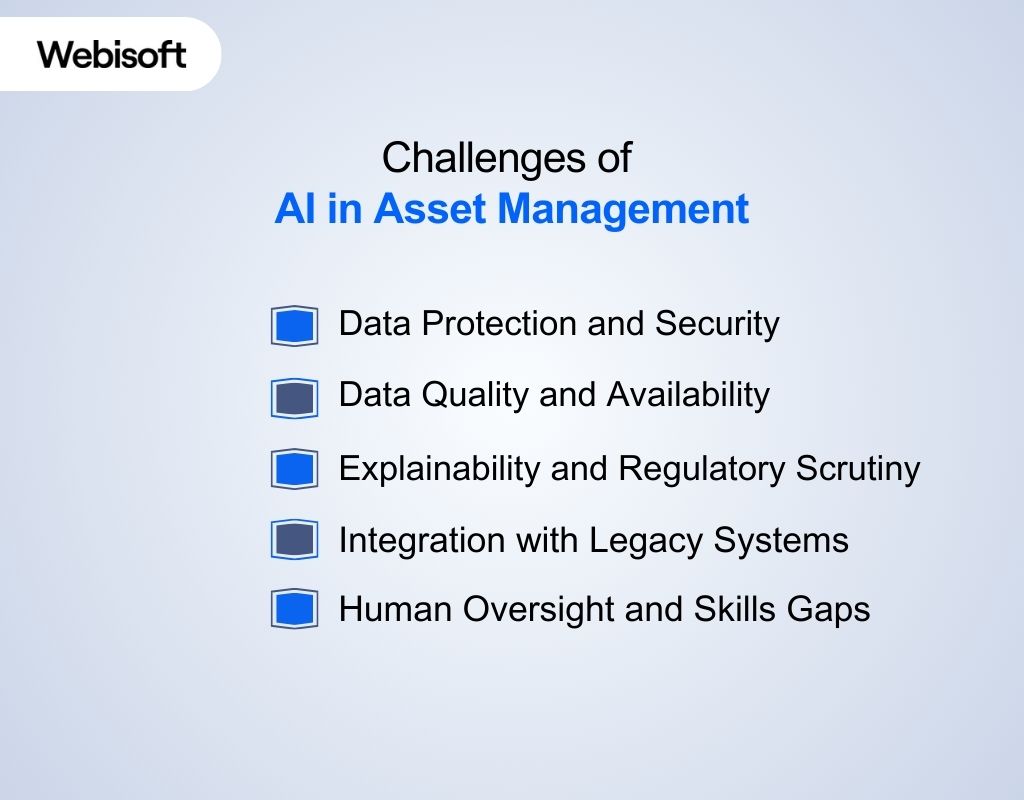
While the benefits are clear, AI in asset management introduces challenges that firms cannot afford to underestimate.
As AI systems become embedded across investment and operational workflows, they also introduce new risks related to data, regulation, infrastructure, and human oversight. These constraints explain why institutional adoption remains deliberate rather than aggressive.
Data Protection and Security
Financial data sits among the most sensitive information any organization holds. When firms deploy artificial intelligence in asset management, they increase the number of systems processing proprietary data. Poorly secured models risk data leakage, unauthorized exposure, or manipulation through injection attacks.
AI-generated workflows and code paths also create new security vectors. Without strict controls, firms expose themselves to reputational damage and regulatory scrutiny. This is why security governance must evolve alongside AI-driven asset management, not after deployment.
Data Quality and Availability
AI systems are only as reliable as the data they ingest. In practice, asset managers often operate with fragmented, inconsistent, or biased datasets sourced from multiple platforms.
These issues directly affect model accuracy. With machine learning in asset management, data flaws scale quickly.
Models learn patterns without context, meaning biased or incomplete data leads to distorted outputs. Cleaning, validating, and governing data remains one of the most resource-intensive barriers to effective AI adoption.
Explainability and Regulatory Scrutiny
Regulators now expect firms to explain not only outcomes, but also decision logic. Complex AI models often struggle to meet this requirement. Black-box behavior becomes especially problematic during audits, disputes, or market stress.
This creates tension within AI investment management. More advanced models may improve performance, but only if firms can demonstrate transparency and accountability. Without explainability, AI shifts from advantage to liability.
Integration with Legacy Systems
Most asset managers still rely on legacy infrastructure designed long before modern AI tools existed. Integrating AI into these environments is rarely seamless. Data pipelines may not align, systems may not communicate, and upgrades often demand significant time and capital.
For many firms, the real challenge of AI-driven asset management lies in integration, not modeling. Value creation stalls when tools cannot connect cleanly to existing research, trading, and reporting platforms.
Human Oversight and Skills Gaps
Automation without oversight introduces risk. Over-reliance on AI can produce decisions that are difficult to question or reverse, particularly during market shocks or rare edge cases where models behave unpredictably. At the same time, many organizations lack the internal skills to supervise AI effectively.
Portfolio managers may not fully understand model behavior, while technical teams may lack market context. AI portfolio management succeeds only when firms invest in training, clear governance, and defined accountability that keeps humans firmly in control.
How Webisoft Creates AI Models in Asset Management
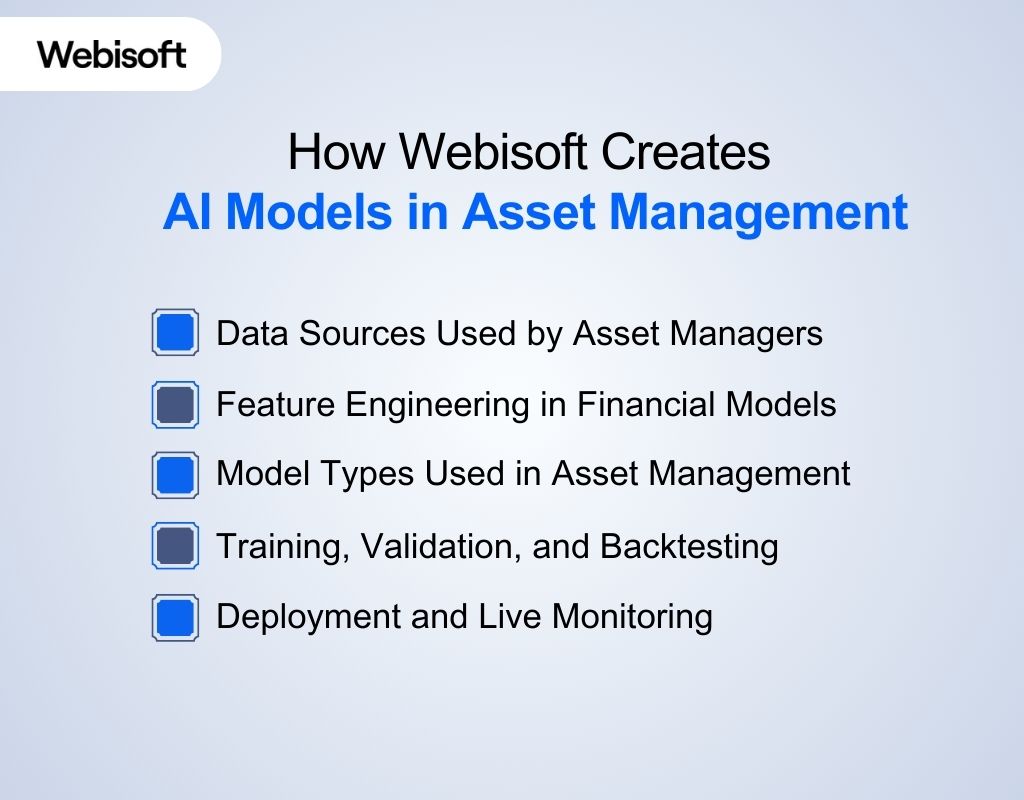
At Webisoft, building AI in asset management starts with discipline, not experimentation. Successful models are not defined by complexity, but by how well they align with investment strategy, regulatory expectations, and real operational constraints.
Every implementation follows a structured path that emphasizes data quality, governance, testing, and continuous improvement.
Data Sources Used by Asset Managers
Strong models depend on strong inputs. Webisoft begins by helping asset managers consolidate core market data, portfolio data, and operational records into a single, usable foundation. This typically includes prices, fundamentals, macro indicators, transaction histories, and risk metrics.
Where strategy allows, external and alternative datasets are layered in. Market sentiment, economic signals, and non-traditional sources such as geospatial or behavioral data are evaluated carefully. In artificial intelligence in asset management, more data does not always mean better data.
Relevance, structure, and timeliness matter more than volume. Data governance is treated as a requirement, not an add-on. Clear ownership, access controls, and compliance safeguards ensure data integrity and regulatory alignment from day one.
Feature Engineering in Financial Models
Raw data rarely produces usable signals. Webisoft focuses heavily on feature engineering, which is where domain knowledge meets modeling expertise. Financial variables are transformed, normalized, and structured to reflect real market behavior rather than theoretical assumptions.
This step is critical in machine learning in asset management. Poorly designed features introduce noise and bias, which explains why many AI projects fail before reaching production. By grounding features in investment logic and market structure, models remain interpretable and stable across regimes.
Model Types Used in Asset Management
Webisoft does not force a single modeling approach. Model selection depends on use case, data availability, and governance requirements. For research and forecasting, supervised learning models are often appropriate. For pattern detection and clustering, unsupervised techniques are applied.
Reinforcement learning is explored cautiously where feedback loops can be controlled. In AI investment management, sophistication is secondary to reliability.
Simpler models with clear behavior often outperform complex systems that cannot be explained or governed. Each model choice is tied directly to business outcomes, not technical preference.
Training, Validation, and Backtesting
Training and validation are treated as ongoing processes, not one-time steps. Webisoft helps teams define clear objectives before training begins, ensuring models optimize for the right outcomes. Historical backtesting is combined with forward testing to identify overfitting and fragile behavior.
This discipline is essential in AI-driven asset management, where markets change faster than static assumptions. Models are stress tested across multiple regimes, and performance metrics are monitored continuously. Feedback loops ensure systems improve rather than degrade over time.
Deployment and Live Monitoring
Deployment is where many AI initiatives fail. Webisoft prioritizes smooth integration with existing systems to avoid operational disruption. Models are deployed with monitoring layers that track performance, drift, and anomalies in real time.
Human oversight remains central. Alerts, dashboards, and controls allow teams to intervene when conditions change. In AI portfolio management, live monitoring ensures that intelligence supports decisions without removing accountability.
Conclusion
The asset management industry has reached a point where intelligent systems are no longer optional. Persistent margin pressure, growing data complexity, and tighter oversight demand faster, more consistent decision support than manual processes can provide.
When applied with structure, AI strengthens research, improves portfolio discipline, and restores control across operations. Success depends on clear objectives, strong governance, and continuous oversight rather than isolated tools.
AI in asset management delivers value only when it complements human judgment and fits real investment workflows. For firms ready to implement this responsibly at scale, Webisoft offers the technical depth and delivery discipline required to build durable, production-ready solutions.
FAQs
AI improves decisions by analyzing structured and unstructured data together, reducing noise, and highlighting probabilistic outcomes. This helps portfolio managers assess risks, test scenarios, and act with current information rather than delayed analysis.
No. AI supports portfolio managers rather than replacing them. It handles data processing, monitoring, and modeling, while humans remain responsible for judgment, strategy selection, and final decisions, especially during market stress.
Asset managers should begin with clearly defined use cases, strong data foundations, and pilot implementations. Gradual deployment, training, and performance monitoring help ensure AI delivers measurable value without disrupting existing investment processes.