Most operational waste in a business is invisible until you map it: data re-keyed between systems, documents read by hand, approvals waiting in inboxes, support tickets triaged one at a time. AI automation companies exist to remove that waste, either by selling you a platform to build automations on or by building the automation for you as a custom system.
Those are two very different purchases, and most listicles blur them together. This guide covers nine companies worth evaluating, explains which model each one follows, and gives you a concrete framework for choosing between a platform subscription and a development partner.
What We Consider When Evaluating AI Automation Companies
Feature lists look similar across vendors, so we weight the things that determine whether an automation is still running and still accurate a year after launch. For background on how these systems work under the hood, see our AI automation overview guide.
- Customization over templates: Pre-built workflows demo well but break on edge cases. We favor companies that model your actual process, exceptions included, rather than forcing your process into their template.
- Integration depth: The automation has to read from and write to the systems you already run: CRM, ERP, ticketing, data warehouse. API-level integration beats screen-scraping, which breaks every time a UI changes.
- Evidence of delivery: Named references, verifiable reviews, or a portfolio of shipped systems. Marketing claims about efficiency gains are not evidence.
- Failure handling: Serious vendors design for the day the model is wrong: confidence thresholds, human-in-the-loop review queues, audit logs, and rollback paths. Ask about this early; the answer separates engineering firms from demo shops.
- Ownership and exit: Who owns the code, the prompts, and the fine-tuned models when the engagement ends? Custom development you own ages better than a subscription you rent.
Top 9 AI Automation Companies List
The nine companies below split into custom development firms, which build systems tailored to one business, and product platforms, which sell software your team configures. Both models work; which one fits depends on how unusual your process is and how much engineering capacity you have in-house.
| Company | Model | Best fit |
|---|---|---|
| Webisoft | Custom development | Businesses that need LLM, OCR, and decision systems built into existing operations |
| Markovate | Custom development | Industry-specific automation in healthcare, insurance, and construction |
| Automation Anywhere | Enterprise platform | Large organizations standardizing RPA and agentic automation at scale |
| Automation House | Agency, no-code focus | Teams that want assistants and workflows without heavy engineering |
| DevsData | Development and staffing | Projects that pair automation with data engineering and team augmentation |
| HatchWorks AI | Custom development | Agentic AI initiatives with nearshore delivery teams |
| Axe Automation | Agency | Small and mid-size teams automating on their existing SaaS stack |
| Idea Link | Agency, no-code focus | GPT-based tools and support automation without in-house developers |
| AutomationEdge | Platform | RPA plus document processing in IT, banking, and insurance |
1. Webisoft
Webisoft is a Montreal-based software engineering firm that builds AI automation as custom product development rather than platform configuration. As a full-cycle AI automation agency, the team combines LLM integration, OCR document processing, and decision logic into systems that run inside your existing infrastructure, connected to your data instead of bolted on beside it.
Engagements start with process mapping: where work queues up, where humans re-enter data, where decisions follow rules that can be encoded. From there, senior engineers build and deploy the automation, instrument it, and refine it against production data. Because the deliverable is software you own, not a seat license, the economics improve as usage grows rather than scaling against you.
Key Features
- Custom AI strategy: Automation roadmap derived from your operations, prioritized by expected return, not by what a platform happens to support.
- LLM and GPT integration: Language-model capabilities wired into your products and internal tools, with retrieval over your own data.
- Automated decision systems: Rules and model-based logic that handle routine decisions in real time, with human review for low-confidence cases.
- Document digitization (OCR): Conversion of paper and unstructured documents into validated, structured data your systems can act on.
- Model Context Protocol (MCP): Standards-based connectors that give models governed access to your organization's data and tools.
- End-to-end delivery: Prototyping, deployment, integration, and ongoing refinement handled by one accountable team.
Proven Impact & Client Success
Client reviews consistently note Webisoft's attention to detail, engineering depth, and collaborative process. The firm's positioning is deliberately narrow: it does not resell a platform, so recommendations are not shaped by license commissions, and every system is designed around the client's stack.
2. Markovate
Markovate is a North American development firm focused on industry-specific AI automation, with delivered work in healthcare, insurance, manufacturing, and construction. Its projects center on high-volume document and decision work: claims intake, order processing, and blueprint analysis, where AI agents and document intelligence replace manual review.
The firm's stated approach is to validate before scaling: a discovery phase maps candidate processes, a small proof of concept tests whether the model performs on your real data, and only then does a full build proceed. That sequencing matters, because the most common automation failure is committing to a full deployment before anyone has measured accuracy on production inputs.
Key Features
- Discovery and use-case mapping: Early consulting to identify processes where automation has measurable impact.
- Proof of concept and MVP builds: Small pilots that validate accuracy and return before a full commitment.
- Full business automation: End-to-end deployment across departments once the pilot proves out.
- Industry-specific delivery: Prior work in healthcare, insurance, manufacturing, and construction rather than generic demos.
- Flexible tech stack: Tooling chosen to fit the client's environment instead of a fixed vendor stack.
3. Automation Anywhere
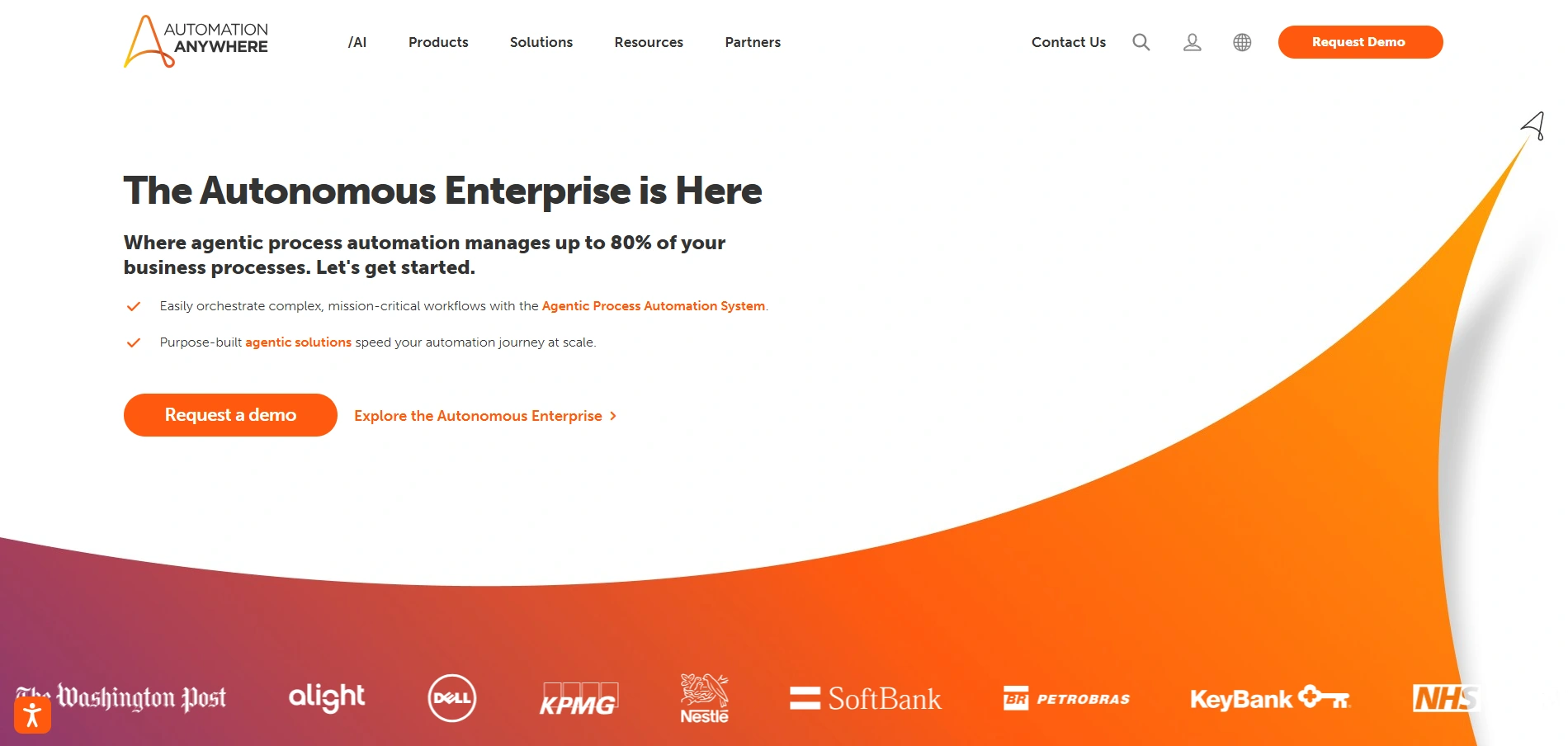
Automation Anywhere is one of the established enterprise players in robotic process automation, and its platform now layers generative AI on top of classic RPA. The company's Agentic Process Automation system lets teams describe a workflow in natural language and have the platform assemble the bots, rather than scripting each step by hand.
The trade-off with any large platform is the same: you get maturity, governance tooling, and a large connector ecosystem, and in exchange you accept per-seat or per-bot licensing and a dependency on the vendor's roadmap. For large organizations standardizing automation across many departments, that trade is usually worth it. For a single high-value process, a custom build is often cheaper over its life.
Key Features
- Generative AI automation: Natural-language prompts that generate bots and workflows without code.
- Document automation with OCR: Extraction, interpretation, and validation of data from unstructured documents.
- Process Reasoning Engine: Planning logic that sequences and optimizes automations based on context.
- Copilot and Autopilot assistants: Tools that suggest next steps or convert process maps into working automations.
- Built-in analytics: Dashboards for monitoring automation performance and utilization.
4. Automation House
Automation House targets teams that want automation without an engineering project. Its work is built around no-code and low-code tooling, and its AION offering packages pre-configured AI assistants for marketing, support, and operations that are then connected to the client's own data.
The no-code approach is a genuine trade-off, not a free lunch. It gets a working assistant in front of your team quickly and keeps maintenance accessible to non-developers, but it caps how deeply the automation can integrate with legacy systems and how much custom logic it can carry. It fits best where the processes being automated are common ones: lead routing, FAQ-style support, internal knowledge search.
Key Features
- No-code and low-code automations: Workflow builds that business teams can maintain without programming.
- Chatbot engines on your data: AI assistants that answer from the company's own knowledge base rather than generic training data.
- Business intelligence dashboards: Real-time reporting across operations, marketing, and HR.
- Cross-department workflows: Automation spanning finance, HR, sales, and internal operations.
- Custom AI tool integration: Purpose-built AI capabilities added where the no-code layer runs out.
5. DevsData
DevsData sits at the intersection of software engineering, data science, and technical recruiting. That mix matters for automation work because most AI automation projects fail on data plumbing, not on models: if the pipelines feeding the system are unreliable, the automation is unreliable. DevsData builds the ETL layers, data models, and infrastructure alongside the automation logic itself.
Engagement models range from full project delivery to team augmentation, which suits organizations that want to build automation capability in-house but need senior engineers to bootstrap it.
Key Features
- Full-stack development: Backend, frontend, and mobile engineering to host the automation, not just the model.
- Data and analytics engineering: Pipelines, data models, and ETL layers that feed automation logic with clean inputs.
- DevOps and cloud infrastructure: Scalable deployment, monitoring, and alerting for AI systems in production.
- Flexible engagements: Team augmentation through to fully delivered projects.
- Global delivery: Distributed teams for time-zone coverage and support.
6. HatchWorks AI
HatchWorks AI is a nearshore development firm specializing in agentic automation: systems where AI agents carry a workflow across multiple steps and decisions instead of automating one task in isolation. Its Generative-Driven Development approach uses AI throughout the engineering process itself, which the firm credits for faster delivery cycles.
Its solution accelerator format is worth noting as a pattern regardless of vendor: a short, fixed-scope engagement that produces a working prototype on your data. Fixed-scope pilots convert vendor claims into observed accuracy numbers before you sign a large contract, and any serious automation partner should be willing to work this way.
Key Features
- Agentic AI automation: Autonomous agents that manage multi-step workflows rather than single tasks.
- Generative-Driven Development: AI-assisted engineering process aimed at faster, lower-defect delivery.
- Solution accelerator engagements: Short fixed-scope prototyping of generative AI use cases on client data.
- Process intelligence: Analysis of the software lifecycle to find where automation pays off most.
- Stack-agnostic integration: Works within your existing systems and data architecture.
7. Axe Automation
Axe Automation is a boutique agency focused on removing manual hours from small and mid-size businesses. Its method starts with an automation audit: a structured pass over your tools and processes to rank opportunities by hours saved and implementation effort, so the first builds are the ones with the fastest payback.
The firm deploys on top of the client's existing SaaS stack rather than migrating tools, which keeps projects small and reversible. Post-launch, it treats automation as an ongoing service, iterating as the client's processes change, which is realistic: automations decay as the systems around them evolve, and unmaintained ones quietly stop working.
Key Features
- Custom workflows and AI agents: Automation built around your specific apps, tasks, and business logic.
- AI and automation audit: Process analysis that ranks opportunities by return before anything is built.
- Platform-agnostic deployment: Works with your current stack, no forced migrations.
- Fast-payback focus: Prioritizes automations with measurable time savings first.
- Continuous iteration: Post-launch optimization and training as processes evolve.
8. Idea Link
Idea Link builds GPT-based tools and support automation using primarily no-code and low-code methods. Its customer-support agents are trained on the client's own documentation and historical tickets, which is the difference between a chatbot that deflects customers and one that actually resolves their questions.
The firm runs discovery and design workshops up front to scope which workflows are worth automating, then delivers tools embedded in the client's infrastructure. For businesses without in-house developers, this model gets AI capability into production without hiring an engineering team.
Key Features
- AI process automation: Departmental workflows automated by agents tied to your knowledge base.
- AI-powered product development: GPT-integrated products taken from design through deployment.
- Internal AI tools: Embedded tooling for content, decisions, and insights inside your infrastructure.
- Discovery and design workshops: Collaborative scoping to identify the automation worth building.
- Support and maintenance: Iterative upgrades under a long-term engagement.
9. AutomationEdge
AutomationEdge sells a unified platform combining RPA, intelligent document processing, and conversational AI, with concentrations in IT service management, healthcare, banking, and insurance. Its positioning is closest to Automation Anywhere's: a platform your team licenses and configures, with pre-built connectors doing much of the integration work.
Document-heavy, regulated industries are where this class of platform earns its keep, because loan files, claims, and policy documents arrive in high volume and predictable formats. The evaluation question is connector coverage: if the platform already speaks to your core banking or claims systems, configuration is fast; if not, you are back to custom integration work anyway.
Key Features
- Universal automation agent: A digital workforce spanning RPA, ETL, and IT operations tasks.
- AI-powered automation: Generative, document, and conversational AI layered onto process automation.
- Orchestrator: Centralized management, monitoring, and scaling of automation workflows.
- Developer Studio: Low-code environment for building custom workflows and integrations.
- Extensive connector library: Pre-built integrations with common business applications.
Key Features to Look for in an AI Automation Company
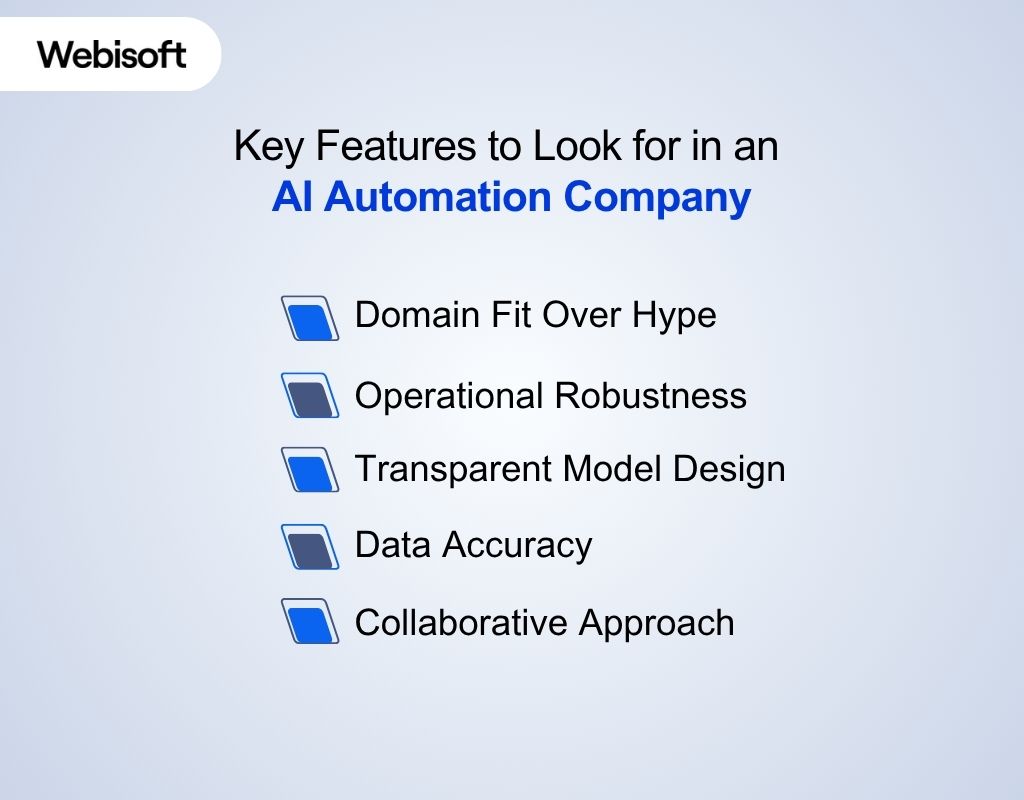
Shortlists are easy; the hard part is the evaluation. These are the criteria that predict whether an automation project delivers, based on how these projects actually fail.
- Domain fit over hype: Ask for work in your industry and, more specifically, on your process type. A vendor who has automated claims intake understands exception rates and regulatory audit trails in a way a generic AI shop does not.
- A pilot before a contract: Insist on a fixed-scope proof of concept run on your real data, with accuracy measured against your current manual process. Demo data always performs; production data is where models meet reality.
- Operational robustness: Ask what happens when the model is uncertain or wrong. Good answers involve confidence thresholds, human review queues, and audit logs. A vendor with no answer has not run automation in production.
- Transparent decisions: For any automation that touches money, customers, or compliance, you need to trace why the system decided what it decided. Explainability is an architecture choice made at the start, not a feature added later.
- Data pipeline ownership: Automation output quality is capped by input data quality. Prefer partners who audit and fix the pipelines feeding the system rather than treating your data as someone else's problem.
- Total cost over three years: Compare platform licensing (recurring, scales with usage) against custom development (higher upfront, owned outright). For one or two high-value processes, custom usually wins; for dozens of standardized processes, a platform usually does.
Work With Webisoft: One of the Most Trusted AI Automation Companies
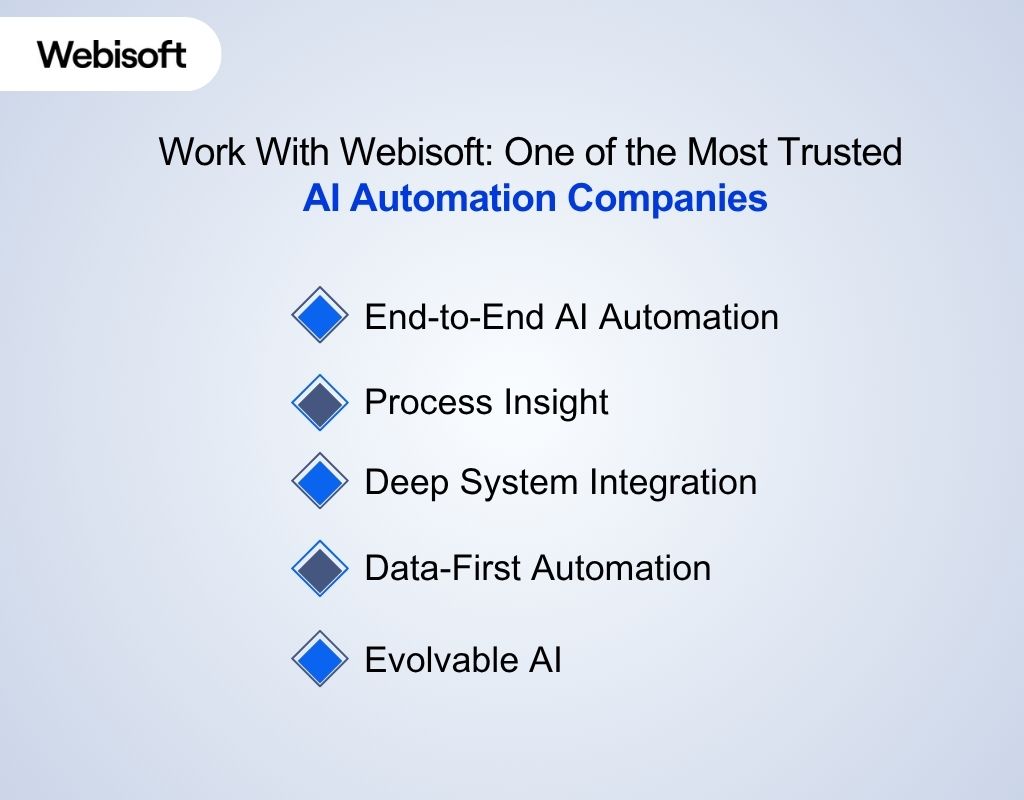
Choosing the right AI automation company determines whether automation becomes a durable operational advantage or an abandoned pilot. Webisoft approaches every engagement as an engineering problem first: map the process, measure the baseline, build the system, and prove the improvement.
- End-to-end delivery: Strategy, design, deployment, and maintenance handled by one accountable team.
- Process insight: Redundant workflows identified and converted into automated systems that adapt over time.
- Deep system integration: Automation wired into your CRMs, ERPs, and data platforms at the API level, minimizing disruption.
- Data-first builds: Systems built on clean, verifiable data pipelines so outcomes stay dependable in production.
- Owned, evolvable systems: You keep the code and the models; the system improves with your data instead of locking you into a license.
If you have a process that costs your team hours every week, that is the starting point. Contact Webisoft to scope an automation built around your operations.
Conclusion
The AI automation market rewards buyers who match the vendor model to the problem. Platforms like Automation Anywhere and AutomationEdge suit organizations standardizing many routine processes under central governance. Development firms like Webisoft, Markovate, and HatchWorks suit businesses whose highest-value processes are too specific for a template.
Whichever direction fits, apply the same discipline: pilot on real data, demand measurable baselines, and confirm you own what gets built. Automation chosen that way compounds; automation chosen from a feature list gets abandoned. Webisoft builds for the first outcome, and the conversation starts with your process, not a product demo.
Start with high-volume, rules-heavy work where humans currently re-enter or review data: document intake, claims or order processing, support ticket triage, and data transfer between systems. Good first candidates have measurable baselines, tolerable error costs with human review as a backstop, and enough volume that time savings compound quickly.
An AI automation company either builds custom software that removes manual work from your operations or sells a platform your team configures to do the same. Typical projects include document processing with OCR, customer support agents trained on your knowledge base, decision systems that handle routine approvals, and integrations that move data between your CRM, ERP, and other tools without human re-entry.
Choose a platform such as Automation Anywhere or AutomationEdge when you need to standardize many routine processes across a large organization and want central governance. Choose a custom development firm such as Webisoft when your highest-value processes are specific to your business, when you want to own the code and models outright, or when the automation must integrate deeply with systems a platform's connectors do not cover.
Run a fixed-scope pilot on your real production data and measure accuracy against your current manual process. Ask how the system handles low-confidence cases: look for human review queues, audit logs, and rollback paths. Confirm who owns the code, prompts, and models at the end of the engagement, and compare three-year total cost, since platform licensing recurs while custom development is owned after delivery.
It depends on scope and data readiness. A proof of concept on a single process is typically a matter of weeks; a full production deployment with integrations, review workflows, and monitoring takes longer. The largest schedule risk is usually data quality: if the pipelines feeding the system are unreliable, that plumbing has to be fixed before the automation can perform.