
AI anomaly detection acts as a monitoring layer that watches how systems, data, and models behave over time. Its role is not prediction, but early signal detection. It helps surface behavior that quietly deviates from expected patterns before those deviations turn into failures, risks, or blind spots.
If you manage live systems, this problem is familiar. Things rarely break all at once. Behavior shifts gradually. Metrics stay within range while something underneath starts to drift. You need visibility into these subtle changes, not just alerts when damage is already visible.
Do you know the types of anomalies an AI anomaly detection system can detect? How does it work and where does it fall short? Keep reading to find these answers with more details.
What is Anomaly Detection in AI?
Let’s understand the word ‘anomaly’ first. An anomaly is any data point or pattern that differs meaningfully from learned behavior.
It means AI anomaly detection is about spotting behavior that doesn’t match what a system has learned to expect. Not errors by definition. Just patterns that stand out enough to deserve attention.
At its core, AI anomaly detection uses machine learning to build a living picture of what “normal” looks like inside your data. That normal baseline is not fixed. It shifts as behavior changes, volumes grow, or environments evolve.
This data deviation can signal very different things. Such as:
- Fraud that does not follow past transaction habits
- A system failure starts quietly before crashing
- A cyber intrusion that blends into normal traffic
- Or even a positive spike, like unusual demand or performance gain
What Makes AI-Based Anomaly Detection Different?
Traditional systems rely on fixed rules, for example:
“If value X exceeds threshold Y, raise an alert.”
That breaks fast in real systems. But AI anomaly detection works differently and the process is set through training instead of applying fixed rules, for example:
- Models train on large volumes of historical data
- They learn patterns, relationships, and ranges that define normal behavior
- New data is scored against that learned baseline
- Anything that deviates beyond tolerance is flagged for review
This is why machine learning anomaly detection is used heavily in finance, cybersecurity, and manufacturing. Those environments change too fast for static logic.
Types of Anomalies in AI Systems
Not all anomalies look the same. Some show up as obvious spikes. Others hide across time, systems, or behavior patterns.
To understand ML approach for anomaly detection properly, you need to separate data-level anomalies from AI and system-level anomalies. They point to different problems and require different responses:
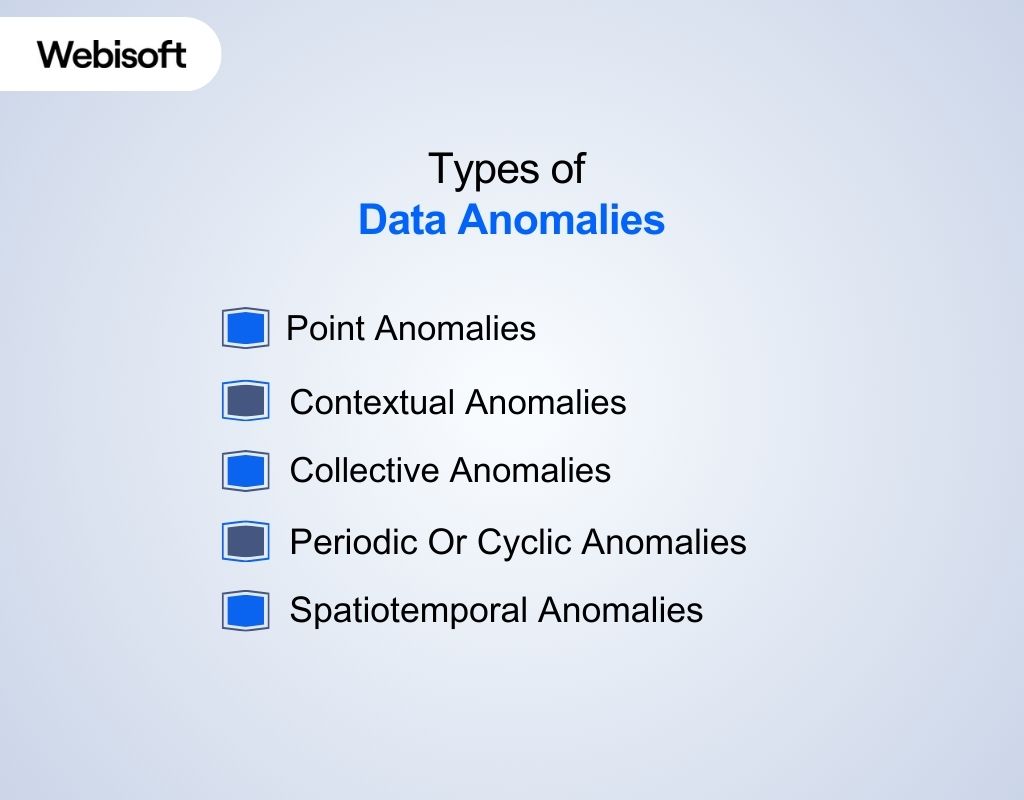
Types of Data Anomalies
These anomalies live inside the data itself. They describe how behavior differs from what the model has learned as normal. Such as:
Point Anomalies (Global Outliers)
A point anomaly is a single value that sits far outside expected ranges and triggers detection immediately. Examples include unusually large transactions or sensor readings beyond physical limits.
They are fast to detect due to extreme deviation, but they also carry a high false-positive risk when rare yet legitimate events mimic abnormal behavior.
Contextual Anomalies
These anomalies occur when values are normal in isolation but abnormal within a specific situation.
Timing, location, user role, or historical behavior define the contextual anomalies. Static thresholds fail here, while AI anomaly detection succeeds by learning behavior-specific baselines and identifying deviations that only appear under certain conditions.
Collective Anomalies
A collective anomaly emerges when individual data points look acceptable, but their combined pattern is abnormal.
These often appear as sequences, correlations, or coordinated shifts that only make sense when viewed together. They are dangerous because isolated checks miss them entirely.
Periodic Or Cyclic Anomalies
Periodic anomalies break expected rhythms in recurring patterns like daily usage, weekly traffic, or seasonal demand. When stable cycles shift without explanation, it often signals structural or behavioral change rather than random fluctuation.
Spatiotemporal Anomalies
These anomalies unfold across both location and time. They commonly appear in distributed systems where issues cluster geographically and evolve gradually, such as regional sensor failures or localized network degradation.
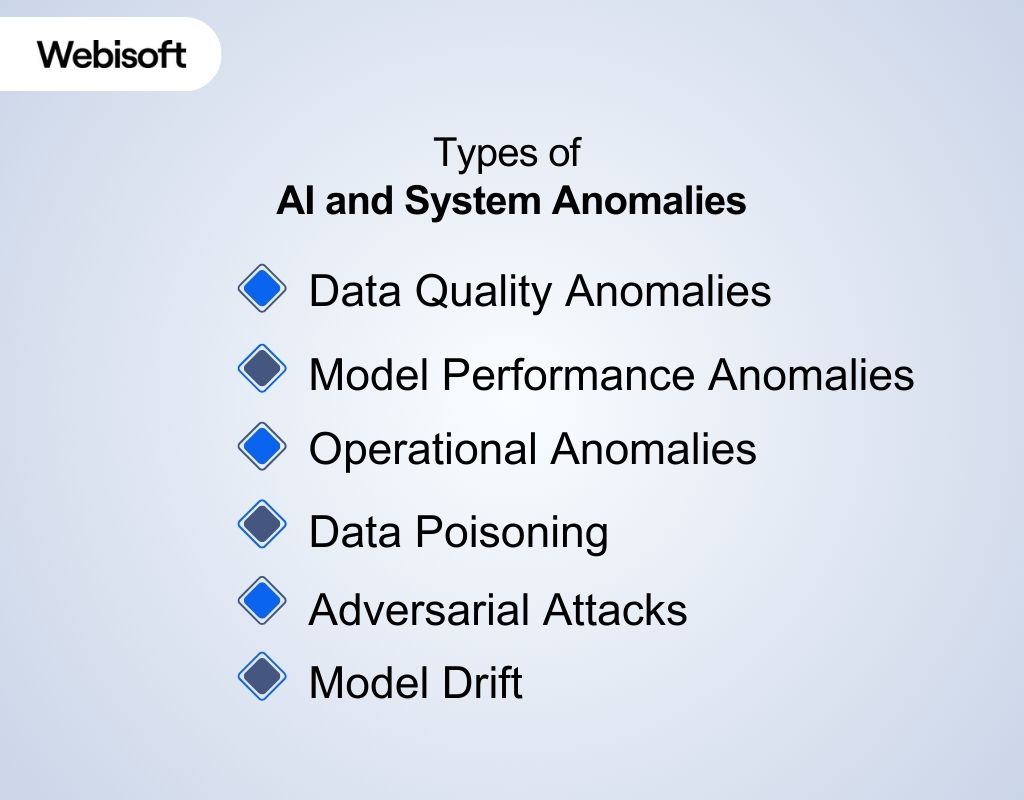
Types of AI and System Anomalies
While data anomalies distort inputs, AI anomaly detection systems face their own failures in the model, operations, or deployment. For example:
Data Quality Anomalies
Missing values, corrupted records, or unexpected format changes degrade the baseline silently. These issues rarely trigger immediate alerts but distort learning and scoring across the entire system.
Model Performance Anomalies
Here, the model continues running but decision quality erodes. Signs include falling accuracy, rising false alerts, or inconsistent predictions across similar inputs. These metrics often reveal deeper issues before outright failure.
Operational Anomalies
Operational anomalies stem from infrastructure and deployment problems such as resource exhaustion, pipeline breaks, or misconfigurations. They disrupt detection reliability regardless of model quality.
Data Poisoning
This anomaly involves injecting manipulated data into training pipelines to subtly redefine what the system considers normal. The model does not fail outright, but its trustworthiness erodes over time.
Adversarial Attacks
Adversarial attacks exploit model weaknesses using carefully crafted inputs that appear benign to humans. Small manipulations can bypass detection logic and cause systematic misclassification.
Model Drift
It occurs when practical behavior changes but the learned baseline of AI anomaly models does not. Over time, alerts lose relevance and reliability unless retraining and monitoring are handled precisely.
How Does AI Anomaly Detection Work?
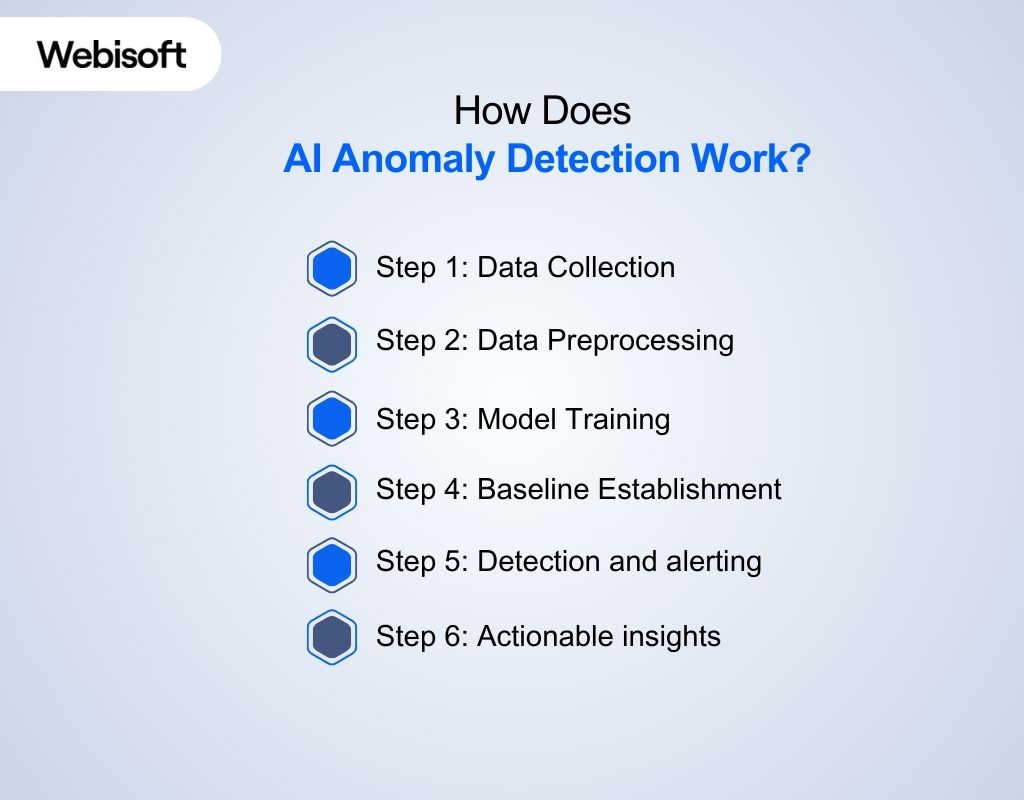
At a practical level, AI anomaly detection is a structured pipeline that turns raw data into signals you can act on. Every step is important, because mistakes made in the early stages affect the entire process. The working process of AI anomaly detection is:
Step 1: Data Collection
Everything starts with data flowing in from systems. This can include transaction logs, user activity, network traffic, or sensor readings. The goal is volume and coverage. The broader the data, the more accurately normal behavior can be learned.
Step 2: Data Preprocessing
Raw data is rarely usable as-is. Before learning begins, values are cleaned, normalized, and aligned across sources. Noise, missing fields, and inconsistent formats are handled here. If this step is weak, the system learns the wrong baseline from the start.
Step 3: Model Training
This is the stage where the system actually learns how to separate normal behavior from signals that deserve attention. The training approach depends on how much labeled data you have, and that choice directly limits what types of anomalies the model can catch. This usually breaks down into three paths:
- Unsupervised learning works without labeled anomalies, learning the natural structure of the data and flagging events that fall far from dense or familiar patterns
- Supervised learning relies on known examples of normal and abnormal behavior, making it effective for repeatable issues like fraud but weak against new anomaly types
- Semi-supervised learning starts by learning only normal behavior, then refines detection using a small set of labeled anomalies
Step 4: Baseline Establishment
Once trained, the system forms a statistical understanding of normal behavior. This baseline captures ranges, trends, sequences, and relationships. It is not static. Good systems allow this baseline to evolve as behavior changes.
Step 5: Detection and alerting
Live data is continuously compared against the learned baseline. Each new event receives a score that reflects how unusual it looks. When deviations cross defined thresholds, alerts are triggered for investigation.
This is where an anomaly detection system proves its value, filtering noise so teams focus on events that actually matter.
Step 6: Actionable insights
Modern setups go beyond alerts. They help explain what changed, where it happened, and why it matters. Instead of just flagging a spike, the system can point to a faulty sensor, a misconfigured service, or an unusual user pattern.
AI Anomaly Detection Techniques
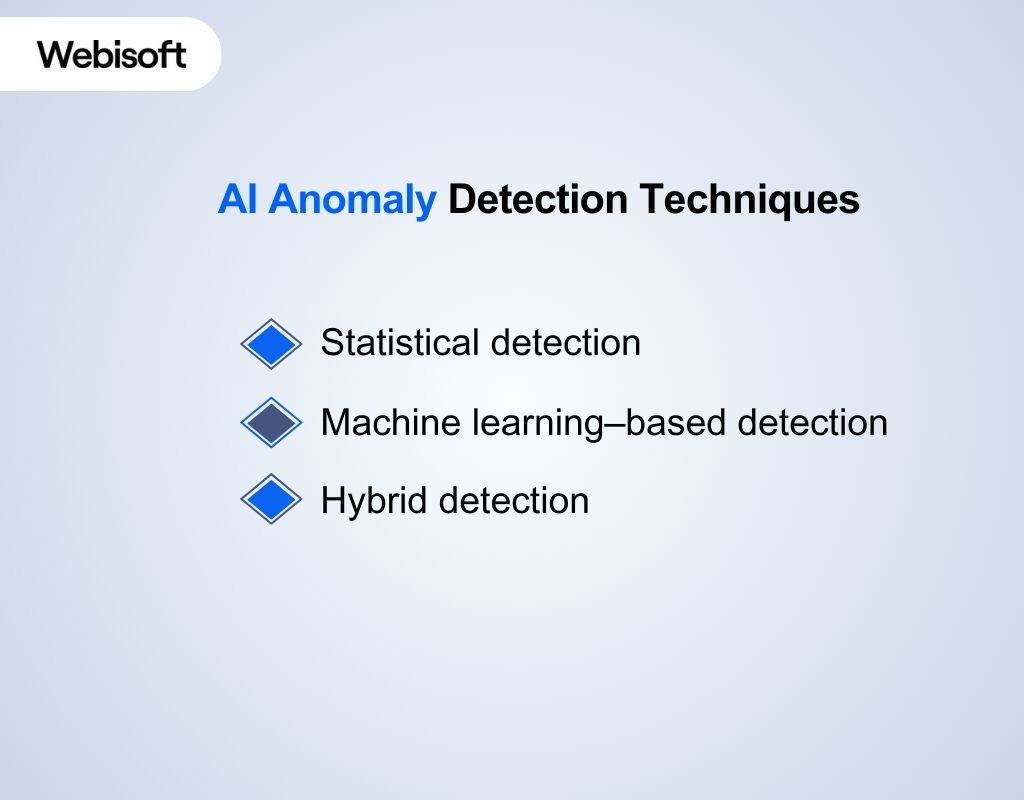
These techniques describe how abnormal behavior is identified, not which tools are used. In real systems, these techniques are rarely treated as exclusive choices. They act more like layers, each handling a different type of signal. AI anomaly detection techniques are:
1. Statistical detection
It relies on mathematical baselines such as averages, variance, or probability thresholds. Statistical anomaly detection works best when behavior is stable and patterns are predictable, making it useful for catching obvious shifts quickly.
Teams often use it as an early filter because it is fast, interpretable, and inexpensive to run.
2. Machine learning–based detection
ML–based detection learns normal behavior directly from historical data instead of following fixed rules.
It excels at recognizing complex relationships, contextual patterns, and subtle deviations that statistics alone miss. This layer becomes essential as data grows more dynamic and multi-dimensional.
3. Hybrid detection
Hybrid detection reflects how most production systems actually operate. Instead of choosing a single technique, teams combine them. Statistical logic catches clear anomalies early, machine learning handles nuanced behavior, and control layers reduce noise.
The decision is rarely about which technique to use, but how much of each is needed to balance speed, accuracy, and reliability
AI Anomaly Detection Learning Paradigm
Learning paradigms describe how an AI system is trained, based on the availability of labeled data. They shape what kinds of anomalies can be detected and how well the system adapts to change. Common learning paradigms are:
1. Supervised Learning
In supervised anomaly detection, the system is trained using labeled examples of both normal and abnormal behavior. This setup works well when anomaly types are already known and repeatable.
You see it most in controlled environments where historical incidents are well documented, but it struggles when new or unseen anomalies appear.
2. Unsupervised learning
Unsupervised anomaly detection learns normal behavior without any labeled anomalies. The system builds its own baseline from raw data and flags deviations from learned patterns.
This approach fits dynamic environments where anomalies are rare, evolving, or unknown in advance, though it often requires careful tuning to manage false alerts.
3. Semi-supervised learning
Semi-supervised anomaly detection sits between the two extremes. The system learns primarily from normal data, then refines detection using a small set of labeled anomalies. This balances flexibility and precision, making it useful when labeled data is limited but not entirely absent.
Key AI Anomaly Detection Algorithms and Models
This section moves from strategy to execution. Once you know how you want to detect anomalies, this is where you decide what to build with. These are the models engineers actually used in production systems. Such as:
Isolation Forest
It focuses on one simple idea that anomalies are easier to isolate than normal data points. Instead of modeling normal behavior directly, it separates data using random splits and flags points that get isolated too quickly.
You usually rely on Isolation Forest when:
- You need fast detection on large, high-dimensional datasets
- Anomalies are rare and clearly different from normal behavior
- Labels are unavailable or unreliable
It uses an isolation-based method, which makes it efficient and scalable, but less effective for subtle contextual patterns.
Autoencoders
They learn how to recreate normal data and treat reconstruction error as a signal. When the model fails to reconstruct an input accurately, that input is considered abnormal. They work best when:
- Data has complex, non-linear relationships
- Patterns are stable enough to learn normal structure
- Context and feature interaction matter more than raw thresholds
This follows a reconstruction-based method, which is powerful but sensitive to data drift if retraining is neglected.
One-Class SVM
It defines a boundary around normal data and flags anything that falls outside it. Instead of separating classes, it focuses on carving out what “normal” looks like. You typically use it when:
- The dataset is smaller and well-behaved
- Clear separation between normal and abnormal exists
- Interpretability of boundaries matters
It relies on a boundary-based method, which can struggle as data scales or becomes noisy.
Local Outlier Factor (LOF)
LOF compares the local density of a data point to that of its neighbors. Points that sit in low-density regions relative to their surroundings are flagged as anomalies. This model is useful when:
- Anomalies are local rather than global
- Data contains clusters with varying density
- Relative deviation matters more than absolute values
It applies a density-based method, making it strong for local patterns but computationally heavier on large datasets.
LSTM (for time-series anomalies)
These models focus on sequences rather than isolated points. They learn how patterns evolve over time and flag deviations in temporal behavior rather than single values, e.g., in RNNs handling log streams, sensor data, or sequential user activity. You reach for LSTM when:
- Order and timing are critical
- Gradual drift or delayed anomalies matter
- Data arrives as continuous sequences
This makes LSTM effective for temporal anomalies, but training and tuning require careful handling.
If you are confused about which model to choose, you can consult with Webisoft about your machine learning project.
Why Your AI System Should Have AI Anomaly Detection
Most AI systems are built to make predictions, not to question whether their behavior still makes sense. They ship with metrics, logs, and basic validation, but they lack AI anomaly detection as a dedicated safety layer.
That gap is where silent failures, drift, and misuse start. AI anomaly detection exists to watch what your core model does not. It learns what normal behavior looks like across data, outputs, and system activity, then flags differences in behavior.
You should add AI anomaly detection because:
- AI models assume stability: Practical behavior changes, users adapt, and data sources shift. Without detection, your system keeps operating on outdated assumptions.
- Failures are rarely obvious: Accuracy can degrade slowly. Outputs may look valid while decisions grow unreliable. Anomaly detection surfaces these issues early.
- Security threats blend in: Fraud, abuse, and adversarial behavior are designed to look normal. Detection systems focus on patterns, not just rules.
- Operational issues go unnoticed: Pipeline breaks, delayed jobs, or resource limits often degrade performance quietly before alerts fire.
- Trust requires visibility: When you can explain why something was flagged as unusual, teams respond faster and with more confidence.
Which Industry Must Have AI Anomaly Detection (Use Cases by Industry)
The performance of AI systems for some industries matters a lot because a missed anomaly can cause inconvenience. Even for some industries, it can cause financial loss, outages, or safety risks.
That’s why AI anomaly detection becomes mandatory in specific sectors, not optional. A few of these industries are as follows:
Finance and Banking
Finance systems handle huge numbers of transactions every second. Fraud doesn’t usually happen as an obvious action. It happens slowly through small changes that are easy to overlook.
Anomaly detection helps in identifying what normal spending looks like and flagging behavior that breaks that regular pattern. This allows banks to spot fraud and account misuse early.
Cybersecurity and IT Operations
Security incidents do not begin with alarms. They begin with behavior that looks almost normal. Unusual login times, unexpected access paths, or slow data movement often signal an attack in progress.
Machine learning in cybersecurity with anomaly detection allows security teams to identify weak signals early, before attackers gain full control or extract data.
Manufacturing and Industrial Systems
Manufacturing systems rely on machines working the same way every day. AI anomaly detection watches machine data and sensor readings to spot small changes early. This helps teams fix problems before machines fail, avoiding sudden shutdowns, safety risks, and expensive repairs.
Healthcare and Medical Systems
Healthcare data is dynamic and high-stakes. Patient vitals can shift gradually before emergencies occur. Data errors or unusual access patterns can affect treatment.
Anomaly detection supports early intervention by highlighting abnormal ups and downs in patient data, system usage, or access behavior without interrupting care delivery.
Cloud Infrastructure and SaaS Platforms
Cloud and SaaS systems comprise multiple services that work together, and they continually evolve as traffic increases or new features are introduced. Problems usually build up slowly as resources are overused, response times increase, or configurations drift.
AI anomaly detection helps teams identify these unusual patterns, allowing issues to be resolved before users experience slowdowns or outages.
Challenges in AI Anomaly Detection
When machine learning anomaly detection models move from labs to production, real-world complexities arise. Key challenges of AI anomaly detection include:
- Concept drift: User behavior, system loads, and data sources evolve continuously. Learned baselines become outdated without regular retraining.
- False positives: Normal activity triggers excessive alerts, causing analyst fatigue and ignored warnings.
- False negatives: Subtle anomalies blend into normal patterns until damage occurs.
- Data quality issues: Missing values, corruption, or format shifts silently distort baselines.
- Threshold tuning: Tight thresholds create noise, while loose threshold settings hide real risk.
- Limited explainability: Models flag anomalies without clear root cause reasoning.
- Operational complexity increases: Detection across large systems adds latency, cost, and maintenance.
- Human judgment remains critical: Automated alerts still require expert validation and response decisions.
Role of Human Expertise in AI Anomaly Detection
AI anomaly detection highlights unusual patterns, but it doesn’t understand intent, impact, or business context. That gap is where human expertise becomes essential and becomes a challenge. Here’s what humans need to do:
- Interpreting alerts: Humans decide whether an anomaly is a real issue, a rare but valid event, or noise.
- Setting thresholds: Experts balance sensitivity and risk, adjusting thresholds based on operational impact.
- Handling concept drift: Teams recognize when behavior has changed and trigger retraining or baseline updates.
- Validating data quality: Humans catch upstream data issues that models silently absorb.
- Prioritizing response: Not all anomalies matter equally; experts assess severity and urgency.
- Explaining outcomes: Stakeholders need clear reasons for alerts; humans provide context, models cannot.
- Improving systems over time: Feedback from investigations refines features, rules, and review workflows.
Ready to Strengthen Your AI Systems with Webisoft?
AI anomaly detection only works when ML models are trained, monitored, and updated with practical behavior. Many systems fail because ML models are deployed once and left untouched as data patterns change.
Webisoft helps in developing machine learning anomaly detection that stays reliable in production. We focus on how models learn normal behavior, how drift is detected early, and how alerts remain actionable instead of noisy.
From selecting the right learning paradigm to integrating detection into live systems, our approach connects ML theory with operational reality. Here’s how Webisoft strengthen your AI system:
- Detection Strategy Design: We help you decide where anomaly detection fits across data, models, and infrastructure
- Model and System Implementation: From statistical baselines to advanced ML-driven detection, we build solutions aligned with your risk profile
- Production-Ready Monitoring: We design detection pipelines that handle drift, false alerts, and scale without constant manual tuning
Book a machine learning consultation to clarify how AI anomaly detection should be implemented. However, if you’re exploring anomaly detection only to develop your AI system with it, Webisoft is ready to support you through the service and implementation process.
Conclusion
In summary, AI anomaly detection transforms raw data into proactive defense, catching fraud, failures, and threats before they spread across finance, cybersecurity, and manufacturing.
ML techniques, adaptive models, and human oversight work together to help organizations stay ahead of evolving risks. Don’t wait for the next breach; implement AI anomaly detection now to stay ahead of risks that evolve faster than your defenses.