AI agents are moving from crypto conference talk to production infrastructure. Funds use them to rebalance positions across chains, protocols use them to route liquidity, and Web3 teams use them to run research, monitoring, and support that would otherwise need round-the-clock staff.
This guide covers how crypto AI agents work under the hood, where they create measurable value, which platforms are worth evaluating, the legal and security risks that catch teams off guard, and a step-by-step implementation path. It is written for founders and technical leaders scoping a build, not for traders looking for signals.
What Are AI Agents in Crypto?
An AI agent in crypto is software that reads the state of a blockchain environment, decides on an action, and executes that action on-chain without a human approving every step. Three layers make that possible: a perception layer that ingests market and protocol data, a decision layer that runs a model or policy, and an execution layer that signs and submits transactions.
The execution layer is what separates an agent from an analytics tool. A dashboard tells you a lending rate dropped. An agent moves the position.
Learning is what separates an agent from a classic trading bot. A rule-based bot runs a fixed script: if the price crosses a threshold, sell. An agent maintains a statistical model of its environment and updates its behavior as conditions shift. Many current designs pair the two ideas: a machine learning model produces signals, a large language model handles orchestration and tool calls, and deterministic code with hard limits handles everything that touches funds. That last constraint matters, because a probabilistic system should never hold unbounded authority over a wallet.
Because actions settle on-chain, every decision an agent executes leaves a public, timestamped record. That auditability is one of the genuinely new properties crypto adds to agent systems: you can reconstruct exactly what the agent did and when, even if you disagree with why.
How Crypto AI Agents Work
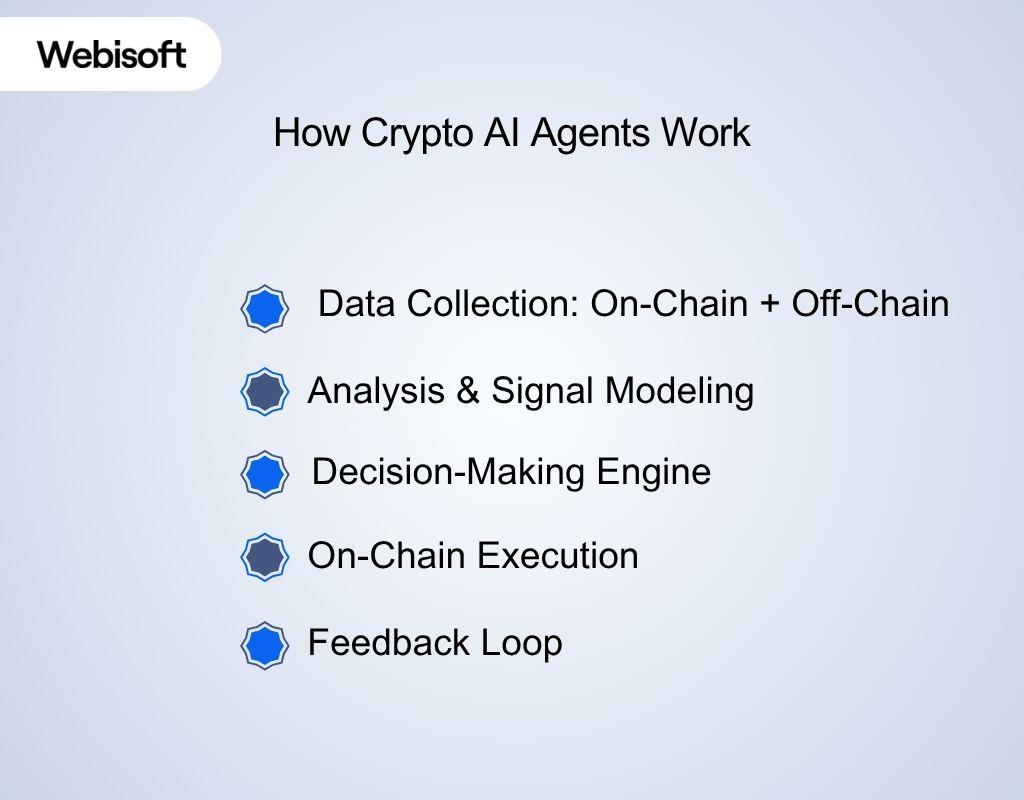
Most production agents follow the same five-stage loop, whatever the use case.
1. Data Collection: On-Chain and Off-Chain
The agent aggregates on-chain data first: token prices, pool depths, wallet flows, smart contract state, validator and governance events. Indexing providers such as Alchemy, Covalent, and Moralis expose this through APIs, so the agent does not need to run its own archive node. Off-chain signals come next: order book data from centralized exchanges, news, GitHub commit activity, and social velocity on X and Telegram. Crypto markets are narrative-driven, so sentiment often moves price before fundamentals do, and an agent that ignores it trades blind.
The trade-off at this stage is freshness versus cost. Mempool-level data lets an agent react within a single block, but streaming and processing it is expensive. A portfolio agent can work from minute-level snapshots; latency-sensitive execution cannot.
2. Analysis and Signal Modeling
Raw data becomes features: sentiment scores from text, anomaly flags from wallet flows, volatility and liquidity metrics from market data. Time-series models such as LSTMs and transformer-based architectures handle sequence prediction, while simpler gradient-boosted models often win on tabular features and are cheaper to retrain. The hard problem is non-stationarity: crypto regimes change fast, and a model fitted to last quarter's market can be confidently wrong in this one. Serious teams weight recent data, retrain on a schedule, and validate on out-of-sample periods rather than trusting a single backtest.
3. Decision Engine
Predictions are scored against explicit objectives: target yield, maximum drawdown, exposure limits per asset and per protocol. The engine then selects an action: execute a swap, move liquidity, stake, unwind, or do nothing. Doing nothing is a first-class decision, and most cycles of a well-tuned agent end without a transaction. Multi-step actions, such as unwinding a position on one chain, bridging, and redeploying on another, are planned as sequences with checkpoints, so a failure midway leaves funds in a known state rather than stranded.
4. On-Chain Execution
The agent constructs the transaction, simulates it against current chain state to verify the expected outcome, then signs and broadcasts it. Simulation before signing is a non-negotiable guardrail: it catches reverts, unexpected slippage, and malicious contract behavior before money moves. Execution logic also handles routing across multiple DEXs to reduce slippage, gas strategy, and protection against front-running through private transaction relays where the strategy warrants it.
Key management is the make-or-break design choice here. A production agent should not hold a raw private key with unlimited authority. Common patterns include a Safe multisig with the agent as one signer, session keys with spending caps and expiry, or MPC custody. The goal is the same in each case: a compromised agent can lose at most a bounded amount.
5. Feedback Loop
Every executed action is compared with its predicted outcome: fill price versus expected, realized yield versus projected. Divergence feeds back into retraining and into tighter risk limits. Agents that skip this step degrade silently as the market drifts away from their training data.
Use Cases of AI Crypto Agents
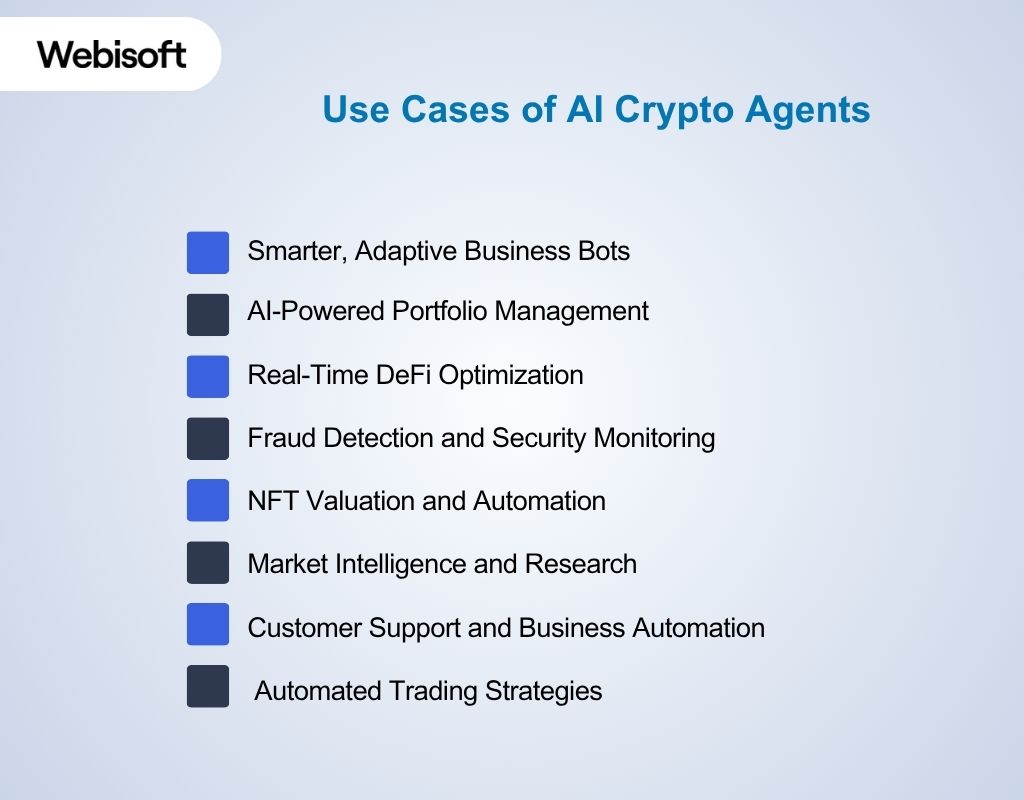
These are the areas where agents produce real results today, roughly ordered from most to least mature. For a broader view beyond crypto, see this overview of the applications of AI across industries.
1. Automated Trading Strategies
The most developed use case. Trading agents execute data-driven strategies without emotion: no panic selling, no chasing pumps. They monitor liquidity across venues, split large orders to reduce market impact, and can bridge assets mid-strategy when the opportunity justifies the cost. Platforms such as PAAL AI and Wayfinder expose configurable trading agents, and tools like HeyAnon let users define exactly which conditions permit a trade. The honest caveat: an agent enforces discipline and speed, it does not manufacture alpha. A bad strategy executed perfectly is still a bad strategy.
2. Portfolio Management Across Chains
Anyone holding LP tokens, staking positions, wrapped assets, and NFTs across several chains knows the operational drag of managing it all manually. Portfolio agents rebalance continuously against target allocations, factoring in price correlation, liquidity depth, and gas costs so that a rebalance never costs more than it recovers. Fetch.ai and Griffain both ship agents in this category.
3. Real-Time DeFi Yield Optimization
Lending rates and pool incentives shift hour to hour across Aave, Curve, Uniswap, and dozens of smaller protocols. A yield agent tracks the full opportunity set, nets out gas and bridging costs, and moves positions only when the improvement clears a defined threshold. That discipline matters: naive yield-chasing agents burn their edge on transaction costs and get farmed by incentive programs designed to attract exactly that behavior. Ocean Protocol is exploring this direction, using AI to surface deeper market signals for yield and liquidity strategies.
4. Fraud Detection and Security Monitoring
Monitoring agents watch contract interactions and wallet behavior for known attack patterns: sudden privilege escalations, abnormal token approvals, flash-loan-shaped transaction sequences. Dynamic risk scoring flags anomalies in real time, and some systems layer AML screening on top, blocking or escalating transactions that fail compliance rules. Traditional finance has run this class of system for years. On-chain transparency actually makes the crypto version more tractable, because every transaction is public.
5. NFT Valuation and Automation
NFT pricing depends on rarity, creator reputation, sales history, and fast-moving sentiment, which makes manual valuation unreliable. Valuation agents combine metadata analysis with social monitoring and price history to flag mispriced assets and forecast demand. Colle AI is building in this space, pairing valuation models with smart contract automation for cross-chain NFT trading.
6. Market Intelligence and Research
Research agents scrape block explorers, GitHub, X, and Telegram, then compress the noise into ranked, readable intelligence. AIXBT is the best-known example: it publishes narrative and momentum analysis generated by an agent, with access gated by its token. The value is time. An analyst gets a filtered view in minutes instead of monitoring twenty channels all day.
7. Customer Support and Business Automation
Web3 companies use platforms like Sensay to run Telegram-native support agents that handle onboarding, answer product questions, and escalate real issues to humans. For a small team serving a global, always-online user base, this is often the first agent deployment that pays for itself.
8. DAO Governance Participation
Governance agents summarize proposals, model their treasury impact, and can vote delegated tokens according to a stated policy. This addresses chronic voter apathy in DAOs, though it concentrates a new kind of influence in whoever writes the agent's policy, which delegators should evaluate before handing over voting power.
Top Platforms and Projects for AI Crypto Agents
Three models dominate the current landscape: autonomous agent networks, crowdsourced modeling, and hosted agents delivered as a service.
Autonomous Agent Networks: Fetch.ai and Virtuals Protocol
Fetch.ai is the most established autonomous-agent network. Agents built on it run on decentralized infrastructure, discover each other, negotiate, execute trades, and manage DeFi workflows as multi-agent systems. The FET token handles staking and ecosystem utility, and the project has expanded beyond DeFi into transport and smart-city pilots.
Virtuals Protocol takes a different angle: an ecosystem of tokenized agents, each performing a defined function such as trading, staking, or routing, with co-ownership and revenue sharing built into the token model. It is earlier-stage, but the modular design makes it a practical proving ground for teams testing agent concepts on-chain.
Crowdsourced Modeling: Numerai
Numerai runs a hedge fund on crowdsourced machine learning. Data scientists worldwide submit encrypted predictive models, the best-performing submissions influence the fund's live strategy, and contributors stake and earn Numeraire (NMR), with stakes burned when a model underperforms. It is the clearest demonstration to date that blockchain incentives can coordinate thousands of independent modelers into a single strategy.
Agent-as-a-Service (AaaS)
The AaaS model delivers agents through APIs. Instead of building from scratch, teams plug into hosted agents for trading, DeFi strategy execution, content generation, or in-game behaviors. Most are powered by large language models fine-tuned to interact with blockchain data and specific user intents. The appeal is speed to market; the cost is dependence on the host's infrastructure and security posture, which the comparison below reflects.
Comparison Table: AI Crypto Agent Platforms
| Platforms | Key Features | Tokenomics | Security Maturity | Open-Source |
|---|---|---|---|---|
| Fetch.ai | Decentralized autonomous agents, ML-driven workflows, DeFi integration | FET token; staking and utility in ecosystem | Medium-high (audits and testnets) | Partially open-source |
| Numerai | Crowdsourced ML hedge fund, encrypted model submission, payout in NMR | NMR token; burned on model staking | High (years of live operation) | Mostly proprietary |
| Agent-as-a-Service (AaaS) | Plug-and-play API access to LLM-based agents, flexible integration paths | Varies by platform; monetized via APIs | Low-medium (depends on host infrastructure) | Depends on provider |
Risks of AI Agents in Crypto
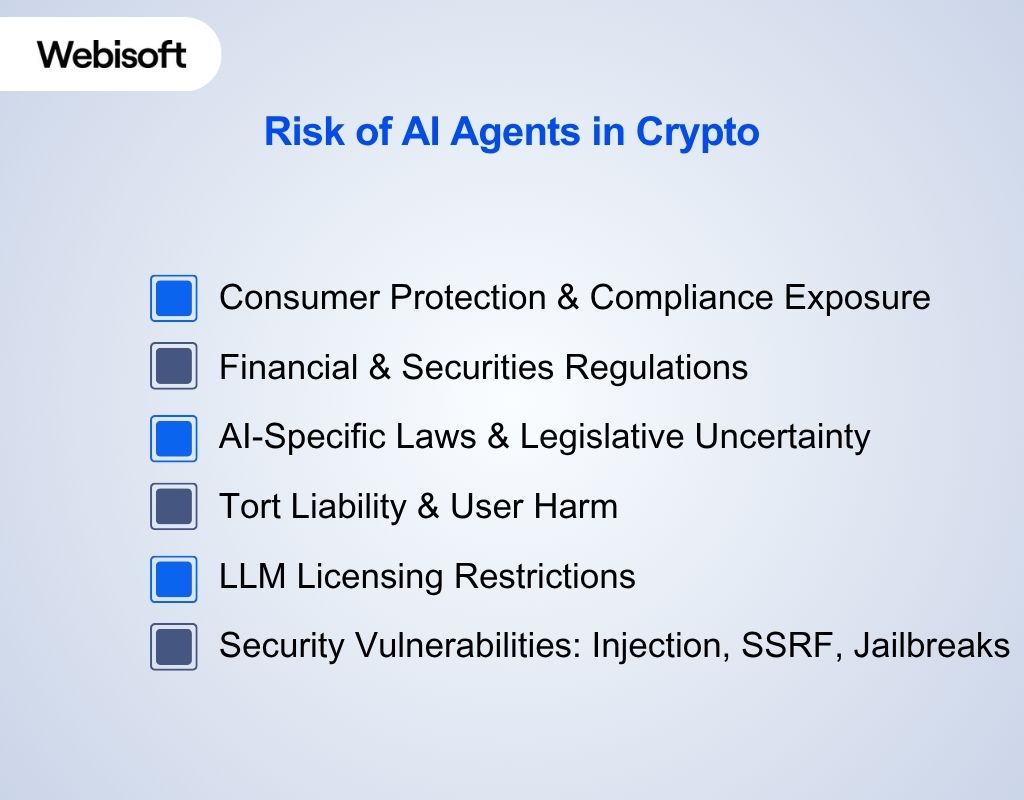
Speed and autonomy cut both ways. An agent that is poorly designed, unmonitored, or legally noncompliant can create losses and liability faster than any human operator. Six risk areas deserve attention before deployment.
1. Consumer Protection and Compliance Exposure
Using AI does not exempt a product from consumer protection law. The FTC has stated plainly that companies remain liable when an AI system misleads users, whether the deception is intentional or not, so overstating an agent's capability or reliability can itself qualify as a deceptive practice. Decisions that touch eligibility, creditworthiness, or access to financial services may fall under the Fair Credit Reporting Act, and California's SB 1001 requires chatbot disclosure in consumer interactions.
2. Financial and Securities Regulation
An agent that raises funds, manages assets on behalf of others, or generates investment recommendations can put its operator inside securities regulation even if the platform never touches fiat. The SEC and other regulators are watching AI-driven crypto trading closely. Automating a decision does not automate away the need for disclosures, licensing, or oversight; it only makes any violation happen faster and at greater volume.
3. AI-Specific Legislation
The AI legal landscape is moving quickly. California's AB 2013 and SB 942 impose training-data disclosure requirements and AI-output detection tooling. Colorado's SB 24-205 requires developers of high-risk AI systems, a category that can plausibly cover financial agents, to implement formal risk management programs. Most current obligations target foundation model developers, but application-level providers in financial services are the obvious next tier. Involve counsel during design, not after launch.
4. Tort Liability and User Harm
If an agent misroutes funds, produces a false compliance flag, or fails to prevent a preventable loss, its operator can be sued. Contractual protections help: warranty disclaimers, liability caps, arbitration clauses. Engineering protections matter more: clear user warnings, human-in-the-loop checkpoints for high-value actions, fallback modes, and decision logs complete enough to reconstruct why the agent acted. Courts and regulators respond very differently to "we cannot explain what it did" and "here is the full decision trace".
5. LLM Licensing Restrictions
Many agents are built on third-party language models, and model licenses frequently restrict use in financial decision-making, investment advice, or other high-risk applications. Violating those terms, even indirectly through a downstream feature, exposes the operator to breach-of-contract claims and sudden service termination. Review the license of every model in the stack before shipping, including open-weight models, whose terms are not uniformly permissive.
6. Security Vulnerabilities: Injection, SSRF, and Key Compromise
Crypto agents inherit every web application attack class, with irreversible consequences: a drained wallet cannot issue a chargeback. The prominent vectors are:
- Prompt injection and jailbreaking, where hostile content inside the agent's own data feed manipulates an LLM-driven agent into harmful actions
- Command injection and JSON injection through the agent's tool interfaces
- Server-side request forgery (SSRF) against internal infrastructure
- Data poisoning of the feeds a model trains or decides on, including manipulated oracle prices
- Key compromise, the terminal failure mode that custody design must bound
The mitigations are architectural: treat all external data as untrusted input, keep the language model out of the signing path, allowlist the contracts an agent may call, cap per-transaction and per-day spend, and simulate every transaction before signing it.
How to Implement AI Agents in Crypto
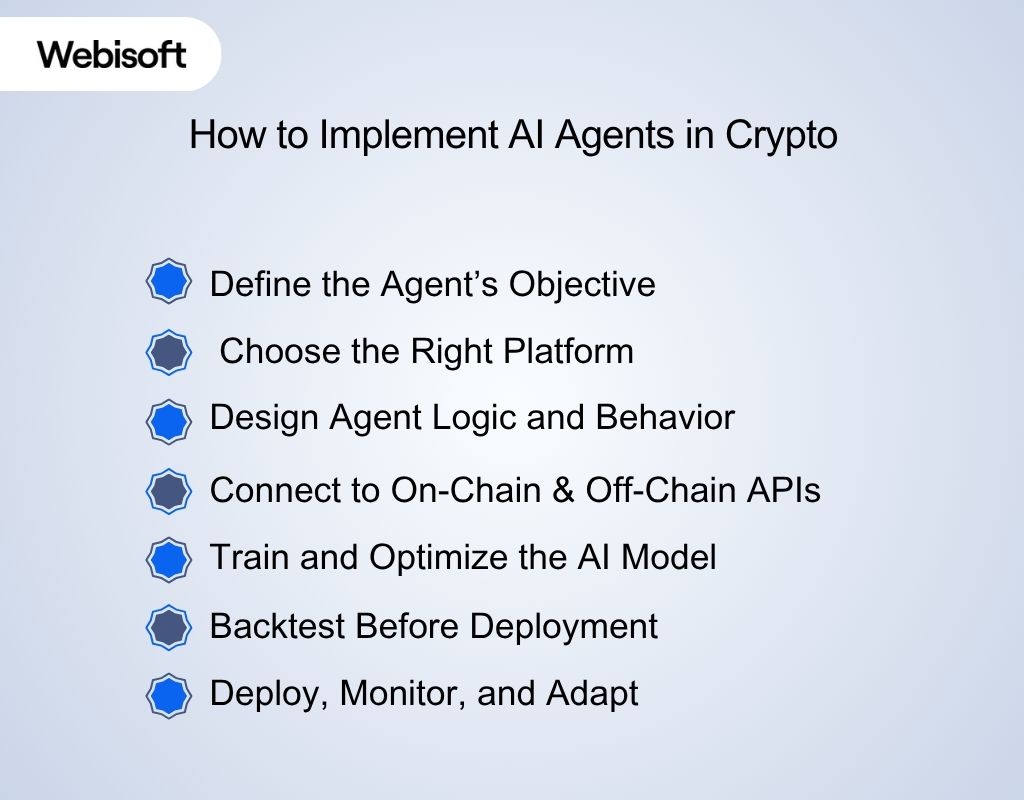
Here is the implementation path that produces an agent reliable enough to trust with real funds.
1. Define the Agent's Objective
Start with the problem the agent solves: automated trading, fraud monitoring, portfolio management. The objective drives every downstream choice, from data inputs to model selection to fail-safes.
A trading agent might be scoped to detect high-probability price movements, avoid positions beyond a risk budget, and exploit arbitrage between specific venues. An NFT agent might track minting events and buy under defined sentiment conditions.
Be specific. "Optimize yield" is too vague to engineer against. "Maximize staking returns by reallocating across five approved DeFi protocols weekly, moving at most a tenth of the portfolio per cycle" gives the agent a testable mission and gives you a way to measure failure.
2. Choose the Right Platform
Not every project should start from scratch. Match the stack to the use case and the team's engineering depth:
- Botpress suits conversational agents that connect to wallets or on-chain data.
- Olas enables on-chain deployment of fully autonomous agents with crypto-native tokenization and revenue sharing.
- ChainGPT offers ready-made tools such as smart contract generation and NFT launching, trading customization for speed.
The build-versus-buy trade-off is the usual one: hosted platforms get you live in weeks but constrain custody and logic, while building on open frameworks takes longer and leaves you in control of both.
3. Design Agent Logic and Behavior
Specify the agent's behavior in three parts:
- Inputs: what data the agent listens to, from wallet movements on-chain to posts on X off-chain
- Triggers: what prompts it to act, such as a token price spike or a new DAO proposal
- Actions: what it may do, such as execute a swap, cast a vote, or alert a human
A compliance agent might scan for suspicious transfers and alert the security team. A DeFi agent might shift liquidity between Curve and Aave when the net yield difference clears its threshold.
Add guardrails from day one: API rate limits, timeouts, spending caps, and multi-signature confirmation for actions above a value threshold. Runaway execution is a design failure, not bad luck.
4. Connect to On-Chain and Off-Chain APIs
The agent needs real-time reads and reliable writes.
For reading data:
- Covalent: fast access to data across 100+ chains through REST APIs
- Alchemy: mempool-level precision for latency-sensitive agents
- Moralis: NFT-focused endpoints with metadata and wallet tooling
For writing transactions:
- Ethers.js: lightweight JavaScript library to sign and execute smart contract calls
- WalletConnect: lets the agent request wallet-based signatures from users
- Safe SDK: multisig security and co-ownership models for agent-held funds
5. Train and Optimize the Model
Training depends on the goal. For trading agents:
- Use supervised learning on historical data with LSTM or transformer models
- Apply reinforcement learning methods such as DQN or PPO in simulated market environments
- Tune hyperparameters and cross-validate to control overfitting
Price history alone is a weak signal. Feeding the model technical indicators such as RSI and MACD, plus liquidity imbalance, token velocity, and sentiment features, gives it materially more to work with.
6. Backtest Before Deployment
Simulate the strategy on past data before it touches real funds, and know the traps. Backtesting pitfalls sink more agents than model quality does: look-ahead bias (using data the agent could not have had at decision time), survivorship bias (testing only on tokens that still exist), and ignoring fees, slippage, and failed transactions. Model all three or the backtest is fiction.
Use walk-forward testing, retraining and revalidating on rolling windows, so the evaluation resembles live operation. Measure risk-adjusted returns with the Sharpe ratio, worst-case exposure with maximum drawdown, and execution quality with fill accuracy against expected prices.
7. Deploy, Monitor, and Adapt
Deploy in stages: paper trading first, then capped live capital, then scale. If the agent goes fully on-chain, frameworks like Virtuals Protocol support tokenizing it, assigning co-ownership, and wiring it into DAOs and smart contracts.
Once live, use smart order routing to control slippage, monitor for anomalies in real time, retrain on fresh data on a schedule, and keep a kill switch that halts execution instantly. Every serious incident in this space has been made worse by the absence of that last item.
How Webisoft Helps You Implement AI Agents in Crypto
Implementing an AI agent means building a system that makes autonomous, secure, and accountable decisions in an adversarial environment. That is the kind of engineering Webisoft, a Montreal-based software and blockchain development firm, does full-cycle: architecture, build, hardening, and operation.
Strategy First: Defining the Right Use Case
The engagement starts by pinning down a clear, value-driven objective, whether that is market-making, staking optimization, DAO participation, or fraud monitoring. An agent that solves a real operational problem beats a flashy one that adds no utility.
Custom Agent Architecture
Webisoft engineers design agents that:
- Collect and process both on-chain and off-chain signals
- Apply AI models for prediction and optimization
- Interface with smart contracts through secure, bounded APIs
- Continuously learn and adapt from live outcomes
Frameworks such as Olas, LangChain, and Virtuals Protocol bring agents fully on-chain when the use case calls for it, or the agent integrates with your existing backend infrastructure.
Security and Compliance Built In
Security is a design input, not an afterthought. Agent logic ships with safety controls, audit trails, spending bounds, and real-time monitoring, hardened against prompt injection, data poisoning, and transaction spoofing. And because AI and financial regulation are both moving targets, compliance requirements are mapped before they become launch blockers.
Integration with Blockchain APIs and Tools
The team handles full integration with the standard stack: Ethers.js, WalletConnect, and Safe SDK for execution; Alchemy, Covalent, and Moralis for data ingestion; and native support for DAO frameworks and DeFi protocols. The result is an agent that acts, not just one that analyzes.
Launch, Monitor, and Scale
After deployment, Webisoft monitors agent performance, retrains models as market conditions drift, and scales the system to support more users, markets, or on-chain logic. Whether the goal is an MVP or a tokenized production agent, the system evolves with the business.
Conclusion
By combining real-time intelligence with autonomous execution, AI agents for business are changing how organizations interact with blockchain networks: watching everything, acting instantly, and never trading on emotion.
The technology is still maturing, but the direction is set. Agents are becoming core infrastructure in Web3, and the dividing line is already visible. Teams that treat agents as engineered financial infrastructure, with bounded authority, honest backtests, and monitored deployments, will capture the upside. Teams that ship unbounded wallets driven by prompts will supply the cautionary case studies.
An AI agent in crypto is software that reads blockchain and market data, decides on an action using a machine learning model or policy, and executes that action on-chain by signing and submitting transactions, all without a human approving every step. Typical jobs include trading, portfolio rebalancing, DeFi yield optimization, fraud monitoring, and DAO governance participation.
A trading bot executes fixed rules: if the price crosses a threshold, it sells. An AI agent maintains a model of the market and updates its behavior as conditions change, weighing on-chain data, liquidity, and sentiment signals together. Bots are cheaper and predictable; agents adapt to regime changes but require training, backtesting, and ongoing monitoring to stay reliable.
Only with bounded authority. A production agent should never hold a raw private key with unlimited control. Safe designs use a multisig with the agent as one signer, session keys with spending caps and expiry, or MPC custody, combined with contract allowlists, transaction simulation before signing, and a kill switch. Under that model, a compromised agent can lose at most a capped amount.
Some do, but the agent is not the edge; the strategy is. An agent adds discipline, speed, and around-the-clock coverage, and it removes emotional mistakes like panic selling. If the underlying strategy loses money, the agent will execute those losses efficiently. Honest backtesting that accounts for fees, slippage, and failed transactions is the only way to know before deploying capital.
Three categories dominate: security (prompt injection, data poisoning, key compromise, and manipulated price feeds), regulation (securities exposure when managing assets for others, consumer protection liability, and emerging state AI laws), and model failure (strategies fitted to past market regimes that break in new ones). Each is manageable with bounded custody, legal review during design, and scheduled retraining with out-of-sample validation.
It depends on scope. An agent assembled on a hosted platform such as Botpress or ChainGPT, with standard data APIs, can be live in weeks. A custom agent with its own models, on-chain execution, multisig custody, and a proper backtesting and paper-trading phase is a multi-month engineering project. The backtesting and staged rollout phases are the ones teams most often cut, and most often regret cutting.