Chatbots now sit at the front of most digital support operations. Deployed well, they answer routine questions instantly, run around the clock, and free human agents for work that needs judgment. Deployed badly, they trap frustrated customers in loops and damage the brand they were supposed to protect.
This guide covers the real advantages and disadvantages of chatbots: where the technology saves money, where it breaks, and the design decisions that separate a bot customers use from one they avoid.
First, Know Which Kind of Chatbot You Are Evaluating
The word "chatbot" covers three very different architectures, and most of the advantages and disadvantages below depend on which one you choose.
| Type | How it works | Strengths | Weaknesses |
|---|---|---|---|
| Rule-based | Scripted decision trees and keyword matching. Every path is written by hand. | Predictable, cheap to run, cannot invent false answers. | Brittle. Anything outside the script hits a dead end. |
| Intent-based (NLU) | A machine learning classifier maps each message to a predefined intent, extracts parameters, and triggers a scripted response or backend action. | Tolerates varied phrasing, integrates cleanly with order systems and CRMs. | Needs labeled training data. Capped by the intent catalog you build. |
| LLM-based (usually with retrieval) | A large language model generates answers, ideally grounded in documents retrieved from your knowledge base at query time. | Handles open-ended questions, multilingual by default, fast to extend by adding documents. | Can produce confident wrong answers without grounding and guardrails. Higher per-conversation cost. |
Most production systems today combine these: deterministic flows for transactions such as refunds and order changes, and a retrieval-grounded LLM layer for everything informational.
10 Advantages of Chatbots for Lowering Costs and Improving Efficiency
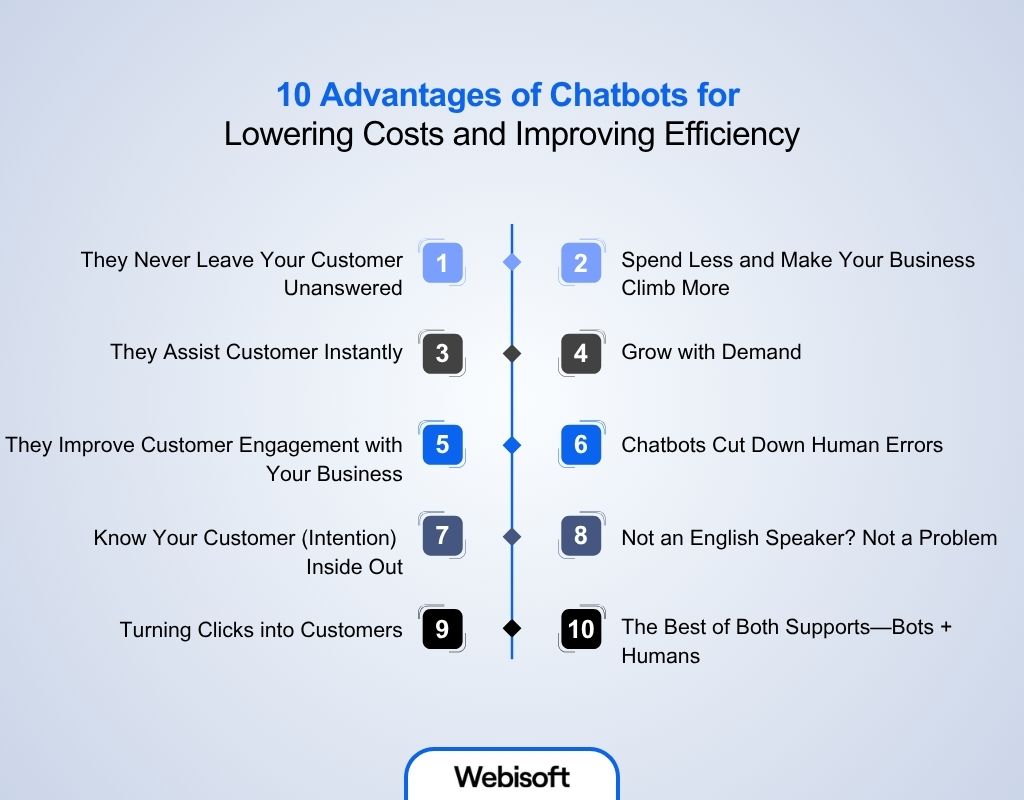
The business case for chatbots rests on a simple asymmetry: most inbound questions are repetitive, and software answers repetitive questions at near-zero marginal cost. Here is where that asymmetry pays off.
1. Customers Get an Answer at Any Hour
A chatbot does not keep business hours. Password resets, order status checks, and policy questions get answered at 2 a.m. on a holiday exactly as they would on a Tuesday morning.
This matters most for companies serving multiple time zones. Without automation, a customer in Singapore waits overnight for a team in Montreal to wake up. With it, the routine share of that queue clears itself, and only the cases that genuinely need a person wait for one.
Education platforms see the same effect: assignment questions, deadline reminders, and enrollment queries arrive around the clock, and a bot keeps students moving instead of stalled on a ticket.
2. Lower Cost per Resolved Contact
Human support scales linearly: more volume means more hiring, training, and management overhead. A chatbot's cost curve is nearly flat. Once built, the difference between handling one thousand and ten thousand routine conversations is mostly compute.
The savings come from deflection: every question the bot fully resolves is a ticket an agent never touches. The practical goal is not replacing the support team but shifting its time from copy-paste answers to the escalations, edge cases, and account work that justify a salary.
For universities and online learning platforms, the same logic cuts administrative load: routine student inquiries resolve automatically while staff handle exceptions.
3. Instant First Response
Customers judge support speed from the first reply, not the final resolution. A chatbot responds in seconds, pulling answers from a knowledge base, FAQ index, or retrieval pipeline instead of leaving the customer on hold.
For customers, the benefit is concrete: immediate access to information, guided troubleshooting, and transactions completed inside the chat window. Fewer people abandon a support request when the first response arrives before they can switch tabs.
Industries with high inquiry volume, such as e-commerce, banking, and telecom, feel this the most, because their queues are dominated by exactly the short, factual questions bots handle best.
4. Capacity That Grows with Demand
A human agent handles one conversation at a time, or a few chats in parallel at degraded quality. A chatbot handles an effectively unlimited number simultaneously.
That elasticity is most valuable during spikes: Black Friday, seasonal promotions, product launches, or an outage that floods the queue. Capacity that would take months to hire is available instantly and disappears just as fast when the spike ends.
The market is investing accordingly. MarketsandMarkets projects the conversational AI market to grow from USD 13.2 billion in 2024 to USD 49.9 billion by 2030. On the retail side, Salesforce data reported by Reuters credited AI-assisted shopping, including chatbots, with a meaningful share of the growth in US online holiday sales in 2024.
Education sees the same pattern during exam and enrollment seasons, when institutions absorb thousands of student inquiries in a short window.
5. More Relevant, Higher-Converting Interactions
Engagement is not just answering questions; it is answering the right next question. A chatbot with access to session context and purchase history can recommend products based on what the customer already bought, surface the relevant help article instead of a generic one, and follow up on an abandoned cart.
The same mechanism applies outside retail: education bots route students toward suitable courses, and healthcare bots handle appointment reminders and pre-visit questions. Relevance is what turns a chat widget from a cost center into a conversion channel.
6. Consistent Answers, Fewer Process Errors
Human agents get tired, misremember policy, and improvise under pressure. A chatbot gives the same answer to the same question every time, drawn from a single maintained source of truth.
That consistency is why regulated industries adopted the technology early. Banks such as Commonwealth Bank of Australia route a large share of routine customer inquiries through virtual assistants, where a scripted, auditable response is safer than an improvised one. The caveat: consistency is only a virtue when the underlying knowledge base is correct and current, which is a maintenance discipline, not a default.
7. Every Conversation Is Structured Customer Data
Support calls evaporate; chat logs persist. Every bot conversation is a structured record of what customers ask, in their own words.
Mined properly, those logs reveal:
- The questions asked most often, which are your documentation gaps.
- Recurring complaints, which are your product defects.
- The vocabulary customers actually use, which should inform your marketing and search copy.
Teams that review chat transcripts monthly consistently find product and content problems that surveys miss, because customers report friction to a bot they would never bother writing an email about.
8. Multilingual Support Without a Multilingual Team
Hiring fluent agents for every market is slow and expensive. LLM-based chatbots handle major languages natively, and even intent-based bots can be localized once and served everywhere.
The trade-off to watch: translation quality degrades for low-resource languages and domain-specific terminology, so companies serving regulated or technical products should have native speakers review the bot's answers in each target language before launch rather than trusting the model blindly.
9. A Sales Channel, Not Just a Support Desk
The same widget that deflects tickets can qualify leads. On a product page, a chatbot can:
- Ask about the visitor's use case and point them to the right product or plan.
- Surface a relevant offer at the moment of hesitation.
- Capture an email and the context of the conversation for the sales team.
Because the bot records why the visitor was interested, the leads it hands off arrive with qualification data attached, which is more than most contact forms deliver.
10. Hybrid Support Beats Either Extreme
The strongest argument for chatbots is not that they replace humans; it is that they change what humans work on. In a hybrid model, the bot resolves the repetitive majority and escalates the rest with full conversation context, so the agent never asks the customer to repeat themselves.
Companies that skip the escalation design and force everything through the bot get the worst of both worlds: frustrated customers and agents who inherit conversations already gone hostile.
5 Disadvantages of Chatbots for Companies
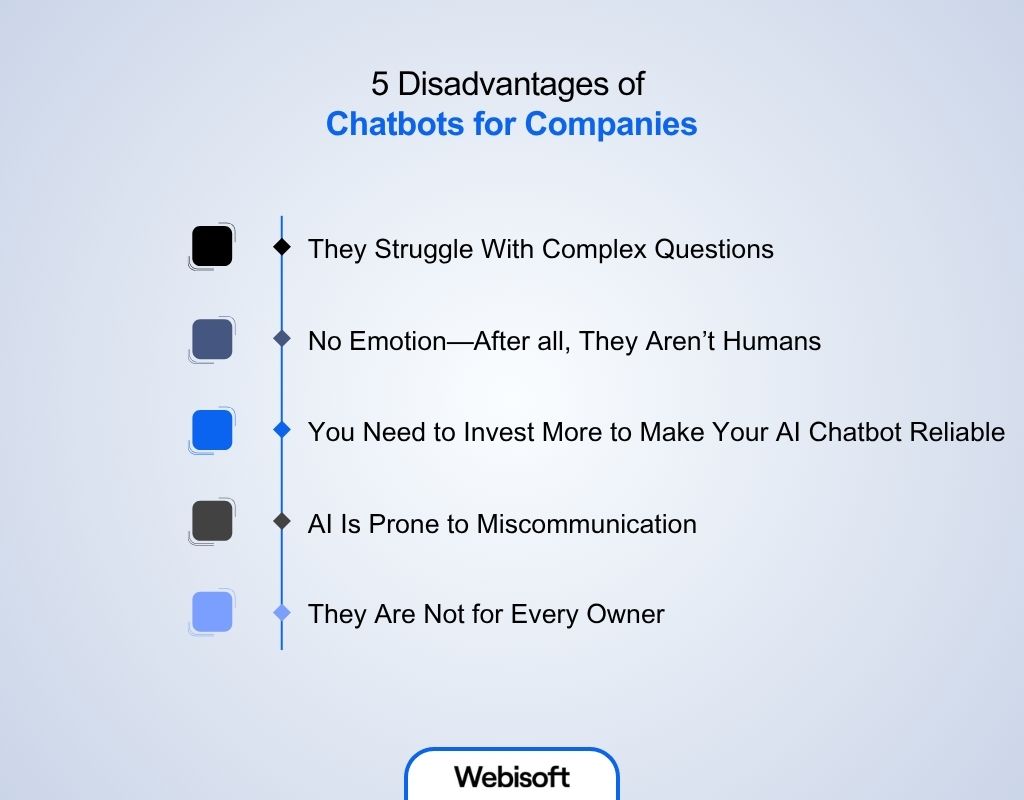
The failure modes are as real as the benefits, and most of them trace back to deploying the wrong architecture for the job or skipping the unglamorous work of maintenance and escalation design.
1. They Struggle with Complex and Ambiguous Questions
Rule-based bots only understand what they were scripted for. Slang, typos, compound questions, or an unusual situation produces an irrelevant canned reply or a dead end.
Even production systems at large companies misfire on context. Virgin Money's assistant publicly reprimanded a customer for typing the word "virgin" while asking about merging ISA accounts: a keyword filter firing on the bank's own brand name.
LLM-based bots handle phrasing far better, but they introduce the opposite risk: they will attempt an answer to almost anything, including questions they should refuse or escalate. Without retrieval grounding and evaluation against a test set of real customer questions, "more capable" quietly becomes "confidently wrong."
2. No Empathy, and Customers Notice
A chatbot can process a refund request quickly; it cannot make an angry customer feel heard. Interactions that involve frustration, grief, a billing dispute, or a complaint about the company itself need emotional judgment that no current system provides.
Klarna is the cautionary example. After moving aggressively to AI-first customer service, the company publicly acknowledged that service quality had suffered and shifted back toward a model with more human agents alongside the AI. The lesson is not that automation failed; it is that the boundary between bot work and human work was drawn in the wrong place.
3. Reliable AI Chatbots Are an Ongoing Investment, Not a Purchase
A demo chatbot takes an afternoon. A reliable one takes conversation design, integration with your order and CRM systems, a curated knowledge base, an evaluation pipeline, and monitoring. That work does not end at launch.
The recurring costs are the ones teams underestimate:
- Keeping the knowledge base synchronized with changing products, prices, and policies.
- Reviewing failed conversations and retraining or re-prompting accordingly.
- Regression-testing answers whenever the underlying model or documentation changes.
A bot maintained by nobody degrades into a liability: it keeps answering, but from an outdated script.
4. Generated Answers Can Be Confidently Wrong
LLM-based chatbots generate text; they do not look up truth. Ungrounded, they can produce plausible, wrong, or even harmful output, and the failure arrives with the same confident tone as a correct answer.
The risk is not hypothetical. In November 2024, Google's Gemini produced an abusive, threatening response to a student asking for homework help, telling her to "please die." For a company deploying a customer-facing bot, the equivalent failure is quieter but costly: a hallucinated refund policy, an invented product spec, or wrong dosage guidance in a healthcare context.
Mitigation is an architecture decision: ground answers in retrieved documents, constrain the bot to its domain, log everything, and route sensitive topics to humans by rule rather than by model discretion.
5. Some Businesses Should Not Lead with a Bot
High-touch services sell the human relationship itself. Luxury brands, mental health services, complex B2B sales, and dispute-heavy industries all have customer expectations that a widget cannot meet, and forcing a bot into the first position signals the opposite of the premium service being sold.
That does not mean zero automation. It means the bot belongs behind the scenes in those businesses: drafting replies for agents, summarizing case history, routing tickets, while a person stays on the front line.
How to Overcome Chatbot Limitations
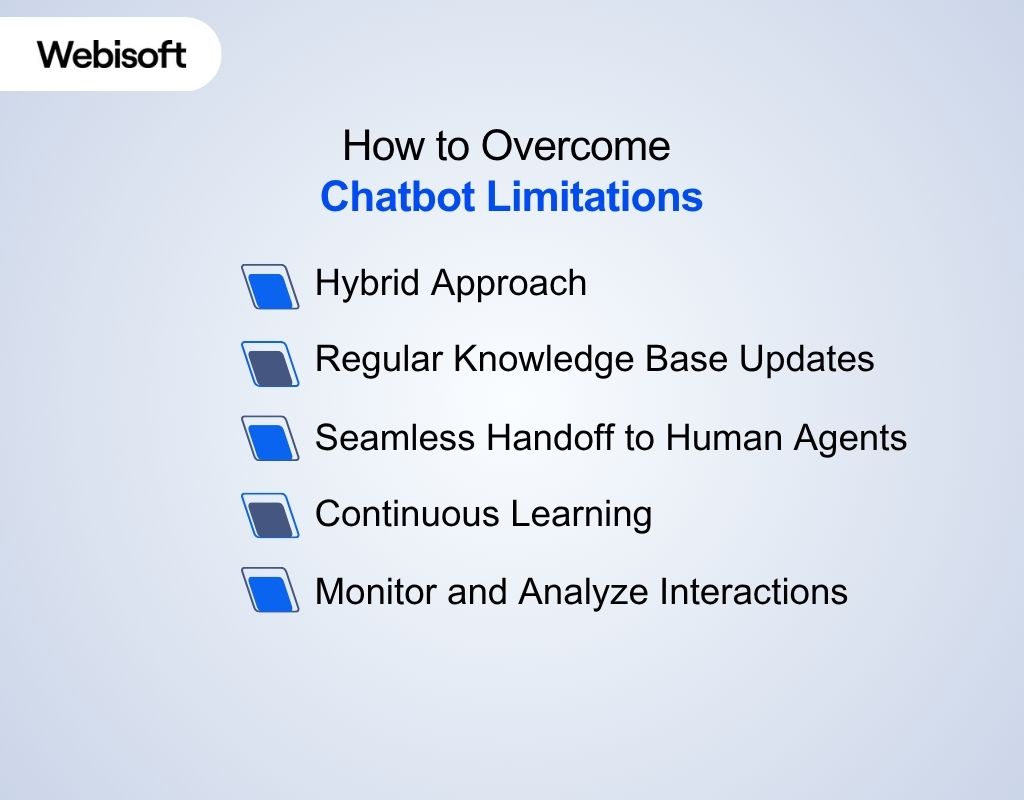
Every disadvantage above has a known engineering answer. The teams that get good results treat these as launch requirements, not future improvements.
- Design the escalation path first. Define the triggers that hand a conversation to a human: repeated failed answers, detected frustration, sensitive topics, high order values. Pass the full transcript so the customer never repeats themselves.
- Ground answers in your own documents. For LLM-based bots, retrieval-augmented generation constrains the model to answer from your knowledge base instead of its imagination, which is the single biggest defense against hallucinated policy.
- Keep the knowledge base as current as the product. Make documentation updates part of the release process. A bot reading stale docs gives stale answers at scale.
- Measure containment, not just volume. Track the share of conversations the bot fully resolves, where it fails, and what customers do next. Review failed transcripts weekly; they are a free, prioritized backlog.
- Regression-test before every change. Maintain a suite of real customer questions with approved answers, and run it whenever the model, prompt, or documentation changes, the same way you test code.
How Webisoft Helps You Build the Right Chatbot
Webisoft is a Montreal-based software development firm that builds custom software end to end, from scoping through deployment and maintenance. For conversational AI, that means choosing the right architecture for your actual ticket mix, integrating the bot with your order, CRM, and knowledge systems, grounding it in your own documentation, and putting the escalation and evaluation infrastructure in place so it stays reliable after launch.
For customer-facing automation powered by LLM and rule-based systems, Webisoft offers AI automation services to streamline repetitive workflows while preserving control and transparency. If you are weighing a chatbot project and want an engineering opinion on whether it will pay off for your support volume, contact Webisoft for a scoping conversation.
Conclusion
The advantages and disadvantages of chatbots come down to fit and follow-through. The technology reliably wins at repetitive, factual, high-volume work: instant answers, elastic capacity, lower cost per contact, structured data from every conversation. It reliably loses at ambiguity, emotion, and anything requiring judgment.
The companies that benefit are the ones that draw that boundary deliberately: automate the routine majority, escalate the rest with context, ground generated answers in maintained documentation, and measure the results. Treat the chatbot as a product with an owner, not a widget you install, and it earns its keep.
FAQs
Escalate quickly and transparently. Good implementations define hard triggers for handoff, such as two failed answers in a row, detected frustration, or a sensitive topic, and pass the full transcript to the human agent so the customer never repeats themselves. The worst pattern is looping the customer back to the same menu; it converts a routine question into a complaint.
Usually yes, if the support queue is dominated by repetitive questions. A small business does not need a custom AI build to start: a well-scripted rule-based bot covering the top ten questions, with a clear handoff to email or a human, already deflects a meaningful share of tickets. The investment case weakens when inquiry volume is low or when most conversations are consultative sales discussions that need a person anyway.
A rule-based chatbot follows scripted decision trees: every question and answer path is written by hand, so it is predictable but breaks on anything unscripted. An AI chatbot uses machine learning, either to classify the customer's intent and trigger a scripted action, or, in LLM-based systems, to generate answers from your documentation. AI bots handle varied phrasing and open-ended questions far better, but they require grounding, testing, and monitoring to stay accurate.
No, and companies that tried have walked it back. Klarna publicly shifted more human agents back into its customer service after an aggressive AI-first approach hurt quality. Bots excel at repetitive, factual questions; humans are needed for ambiguity, emotion, disputes, and judgment calls. The reliable model is hybrid: the bot resolves the routine majority and escalates the rest with full conversation context.
Four controls do most of the work: ground the model in your own documentation with retrieval-augmented generation so it answers from your content rather than its training data; restrict it to your domain and route sensitive topics to humans by rule; keep the knowledge base updated as part of every product release; and maintain a regression test suite of real customer questions that runs whenever the model, prompt, or documentation changes.