Share


On Demand Delivery App Development | An In-Depth Overview

- BLOG
- App Development
- October 20, 2025
A few taps. That’s all it takes for millions of people to move groceries, meals or packages across a city. And with the global on-demand delivery market projected to exceed USD 225 billion by 2030, convenience has become the expectation, not the exception.
You’re here because you see that shift accelerating. As users demand faster service and businesses push to stand out, building your own delivery platform becomes a strategic move rather than a technical project.
This guide on on demand delivery app development shows you how to turn that opportunity into a reliable product users trust, helping you move from idea to execution with clarity. Let’s begin.
Contents
- 1 What is an On-Demand Delivery App?
- 2 Types of On-Demand Delivery Apps & Business Models
- 3 Build your on demand delivery app with Webisoft today.
- 4 Why Build an On-Demand Delivery App?
- 5 Core Features & Functionalities of an On Demand Delivery App
- 5.1 User Registration, Profile and Smart Search
- 5.2 Real Time Order Tracking and Live Updates
- 5.3 Secure and Flexible Payment and Checkout
- 5.4 Multi Role Interfaces for Customers, Vendors, Couriers and Admin
- 5.5 Notifications, Communication and Support Tools
- 5.6 Ratings, Reviews and Feedback System
- 5.7 Scalability, Routing and Logistics Optimization
- 5.8 Admin Controls and Analytics
- 6 Development Process for Building an On-Demand Delivery App
- 6.1 Step 1: Market Research and Concept Validation
- 6.2 Step 2: Define Scope and Minimum Viable Product (MVP)
- 6.3 Step 3: UI and UX Design
- 6.4 Step 4: Select Tech Stack and Plan System Architecture
- 6.5 Step 5: Development of Core Features
- 6.6 Step 6: Quality Assurance and User Testing
- 6.7 Step 7: Deployment and Launch
- 6.8 Step 8: Monitoring and Continuous Improvement
- 6.9 Step 9: Scaling and Growth
- 7 Cost and Timeline for On Demand Delivery App Development
- 8 Challenges While Developing an On-Demand Delivery App
- 8.1 Scalability & Real-Time Performance
- 8.2 Complex Logistics and Delivery Coordination
- 8.3 Security & Data Privacy Concerns
- 8.4 Demand Fluctuation & Operational Instability
- 8.5 User Acquisition, Retention & Competition Pressure
- 8.6 Complexity of Managing Multiple User Roles
- 8.7 Regulatory Compliance and Service Quality Control
- 9 Working with Webisoft on Your On-Demand Delivery App
- 10 Build your on demand delivery app with Webisoft today.
- 11 Conclusion
- 12 Frequently Asked Question
What is an On-Demand Delivery App?
An on-demand delivery app is a mobile or web platform that lets you order goods or services and receive them quickly. You browse what you need, place an order, and track your delivery as it moves toward you.
The app gives you real-time updates so you always know where your order stands. These apps connect you with nearby stores, service providers, and delivery partners. The system manages ordering, payments, notifications, and customer updates, making the entire process simple for you.
You only interact with one interface while the app handles all the coordination behind the scenes. At its core, an on-demand delivery app reduces waiting time and brings essential items or services to you when you need them.
Types of On-Demand Delivery Apps & Business Models
On-demand delivery apps don’t all work the same way. Depending on who owns inventory, who fulfils delivery and how you monetise, you may adopt very different app types or business models.
Types of On Demand Delivery Apps:
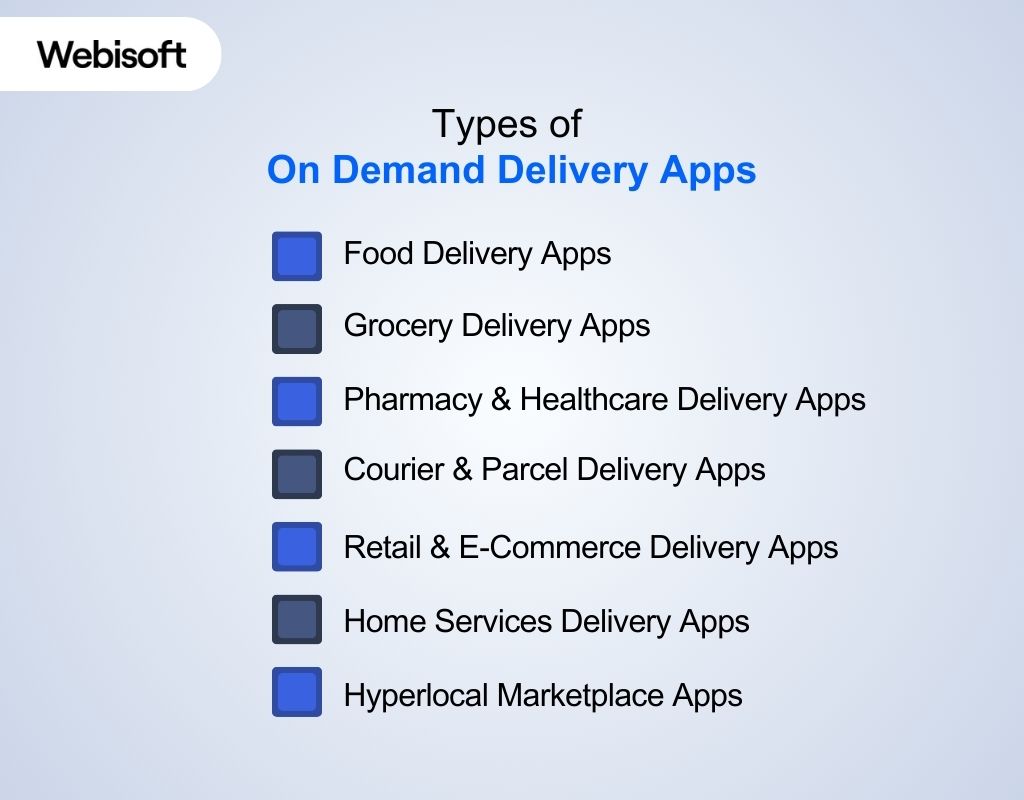
Food Delivery Apps
These apps let users order meals from restaurants and receive them quickly, They rely on menu management, accurate order routing and real-time tracking. Which is why many founders partner with an on demand food delivery app development company to ensure reliability at scale.
Grocery Delivery Apps
Built for everyday essentials, these apps help users order groceries and household items. They require inventory syncing, replacement rules and time-slot deliveries to meet expectations for freshness and reliability.
Pharmacy & Healthcare Delivery Apps
These platforms deliver medicines and medical supplies. Because the items are sensitive, they need verification flows, secure packaging tracking and dependable delivery coordination.
Courier & Parcel Delivery Apps
Ideal for sending documents, parcels or small goods across a city, these apps depend on courier assignment, optimized routing and flexible pick-up and drop-off systems.
Retail & E-Commerce Delivery Apps
Used by stores or marketplaces, these apps deliver retail products. They support catalog management, order batching, returns and multi-location inventory.
Home Services Delivery Apps
Instead of products, these apps deliver services like cleaning, repairs or beauty appointments. They require booking flows, provider scheduling and service tracking.
Hyperlocal Marketplace Apps
These apps combine multiple verticals: grocery, pharmacy, food, and retail in one platform. They need well-organized catalogues, fast delivery coordination and strong vendor management.
Business Models Used in On-Demand Delivery Apps:
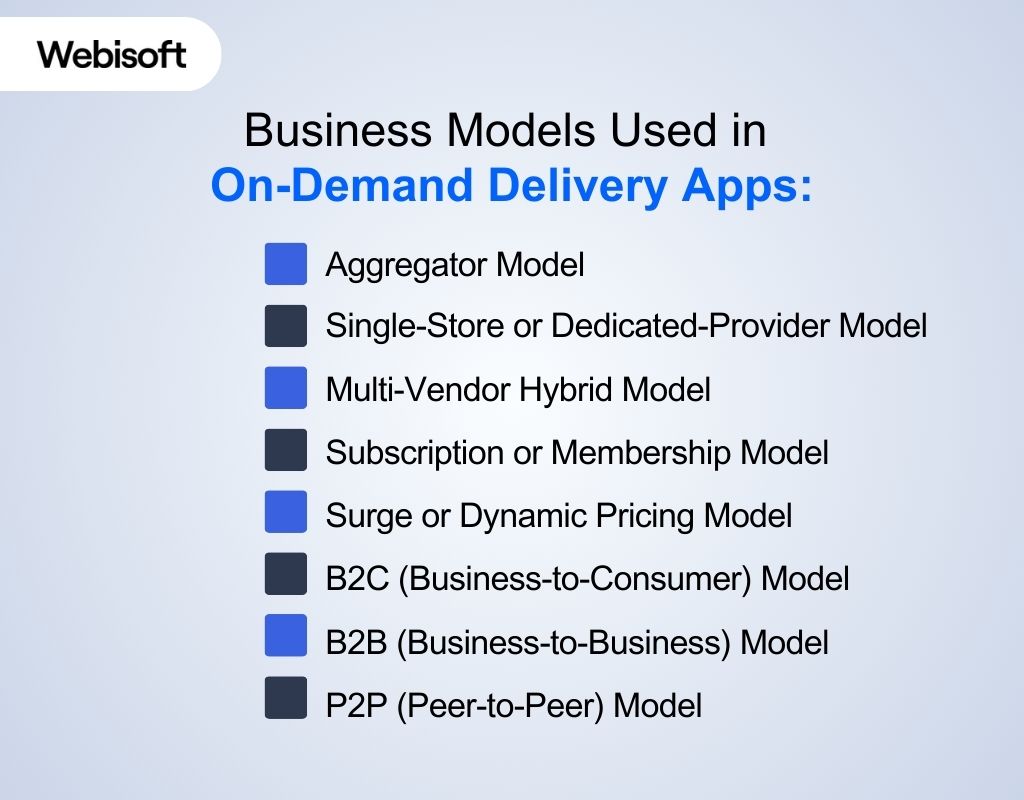
Aggregator Model
Your app acts as a marketplace connecting users with many vendors. You don’t own inventory; vendors list items and couriers fulfil orders. Revenue comes from commissions, fees and service charges.
Single-Store or Dedicated-Provider Model
The app represents a single business that manages its own stock and deliveries. It provides higher control and margins but requires you to handle logistics internally.
Multi-Vendor Hybrid Model
This combines marketplace variety with partial control over inventory or fulfilment. You host many vendors but manage key products or logistics to maintain quality.
Subscription or Membership Model
Users pay a recurring fee for faster delivery, free delivery or exclusive benefits. It creates predictable revenue and boosts repeat usage.
Surge or Dynamic Pricing Model
Delivery fees shift based on demand, time or location. It helps balance courier availability and peak usage but must be communicated carefully to maintain user trust.
B2C (Business-to-Consumer) Model
Businesses deliver products directly to consumers. This is common for food, retail, grocery and pharmacy apps where speed matters.
B2B (Business-to-Business) Model
Deliveries occur between businesses, such as suppliers sending goods to stores, offices or restaurants. It supports bulk orders and scheduled fulfilment.
P2P (Peer-to-Peer) Model
Individuals send items to other individuals using couriers for pick-ups and drop-offs. It suits personal parcels, urgent documents and same-city transfers.


Build your on demand delivery app with Webisoft today.
Book a free consultation and start turning your delivery idea into reality.
Why Build an On-Demand Delivery App?
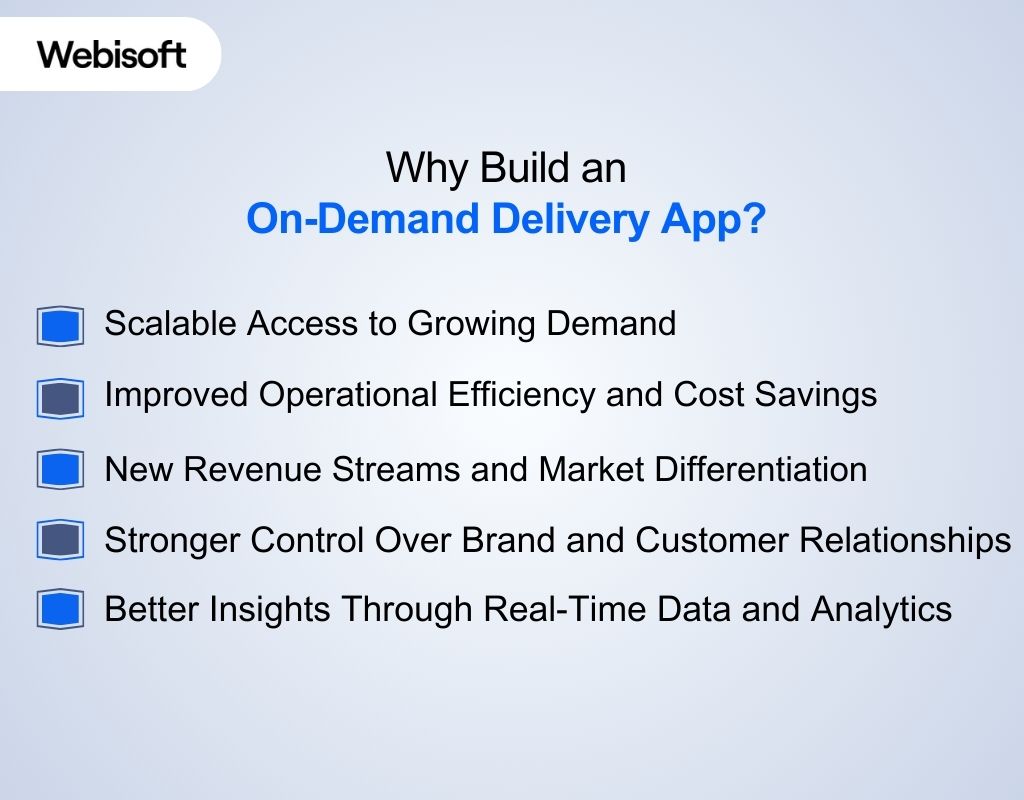 You’ve seen how on demand delivery app development differs by model and where they’re used across industries. The next step is understanding why businesses choose to build these apps in the first place, and how they create value in a competitive market.
Scalable Access to Growing Demand
Users expect instant ordering and fast delivery as smartphone adoption grows, which is why partnering with an on demand delivery app development company helps meet rising expectations. On-demand delivery apps let you reach this audience, expand beyond walk-in customers and grow without major physical infrastructure.
Improved Operational Efficiency and Cost Savings
Rather than maintaining your own delivery fleet or storefront logistics, an on-demand app can streamline operations and reduce overhead. It also converts fixed costs such as drivers, storage, and delivery management into variable costs aligned with demand.
New Revenue Streams and Market Differentiation
By offering quick delivery, subscription or membership perks, dynamic pricing, or customer-centric features, you can create multiple monetization paths. These may include commissions, delivery fees, or premium services that help you differentiate your business from competitors.
Stronger Control Over Brand and Customer Relationships
When you build your own delivery app, you no longer rely on third-party marketplaces that limit how you communicate with customers. You gain full control over branding, promotions, user experience, and customer data, allowing you to build direct relationships that support long-term loyalty and higher lifetime value.
Better Insights Through Real-Time Data and Analytics
An on demand delivery app development gives you access to detailed insights such as order trends, user behavior, delivery performance, and operational bottlenecks. With real-time data, you can make informed decisions, optimize staffing, adjust inventory, and refine offerings to increase efficiency and profitability.
Core Features & Functionalities of an On Demand Delivery App
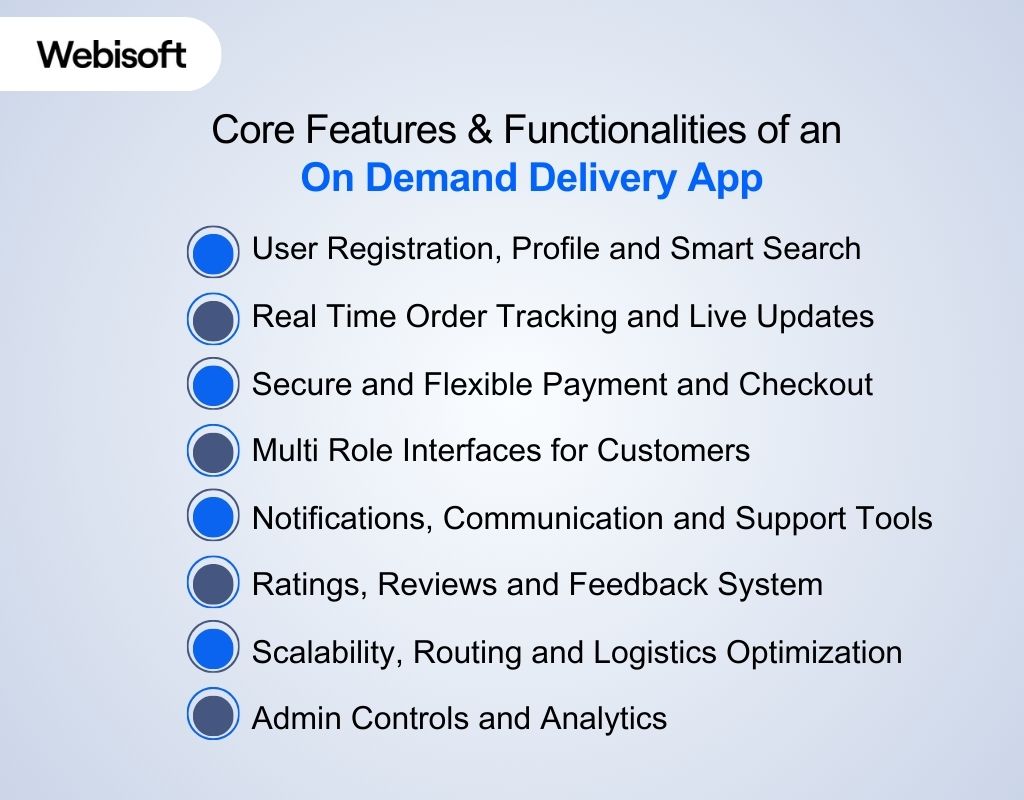 To build a truly competitive and reliable delivery platform, your app needs strong core features that serve users, vendors, couriers, and administrators. The list below outlines those essential functionalities, each ensuring smooth operations and great user experience.
User Registration, Profile and Smart Search
- Allow users to sign up using email, phone or social accounts and create profiles with saved addresses, payment methods and preferences.
- Provide a structured catalog with categories, filters and keyword search so users can find items or services quickly.
- Support features such as personalized recommendations, favourites, and reorder options to improve engagement.
Real Time Order Tracking and Live Updates
- Integrate GPS and geolocation tools so users can see their courier’s real-time movement.
- Generate accurate estimated arrival times and refresh them when route or traffic conditions change.
- Send push notifications at each major stage to maintain transparency.
Secure and Flexible Payment and Checkout
- Integrate secure payment gateways that follow SSL and PCI-DSS standards.
- Support multiple payment methods including cards, wallets, digital payments and cash on delivery when relevant.
- Provide a minimal-step checkout flow with saved payment details and clear confirmation screens.
Multi Role Interfaces for Customers, Vendors, Couriers and Admin
- Give customers tools for browsing, ordering, tracking and managing payments.
- Offer vendors dashboards for accepting orders, updating preparation status and managing menus or catalogs.
- Provide couriers with access to assignment information, navigation, barcode scanning and delivery status updates.
- Give administrators system controls for dispatch logic, user management, vendor oversight and platform settings.
Notifications, Communication and Support Tools
- Send order confirmation, preparation, assignment and delivery updates through push alerts, SMS or email.
- Offer in-app chat or communication features for quick interaction between customers, couriers and vendors.
- Include support tools such as ticketing workflows, automated responses and help sections.
Ratings, Reviews and Feedback System
- Allow users to rate vendors and couriers and submit detailed reviews after each delivery.
- Display ratings in the catalog so new users can make informed choices.
- Use collected feedback to monitor service quality and address recurring issues.
Scalability, Routing and Logistics Optimization
- Build a backend that supports high concurrency and real time data processing.
- Use delivery assignment logic that evaluates courier proximity, availability and route conditions.
- Implement route optimization engines to reduce travel time and improve courier productivity.
- Support system stability with load balancing, caching and asynchronous communication methods.
Admin Controls and Analytics
- Provide administrators with analytics on order trends, delivery times, courier efficiency and peak demand periods.
- Track vendor performance, item popularity and cancellation reasons to guide improvements.
- Include financial dashboards to monitor earnings, commissions, payouts and revenue trends.
- Offer real time operational metrics to support forecasting, staffing and long term planning.
Development Process for Building an On-Demand Delivery App
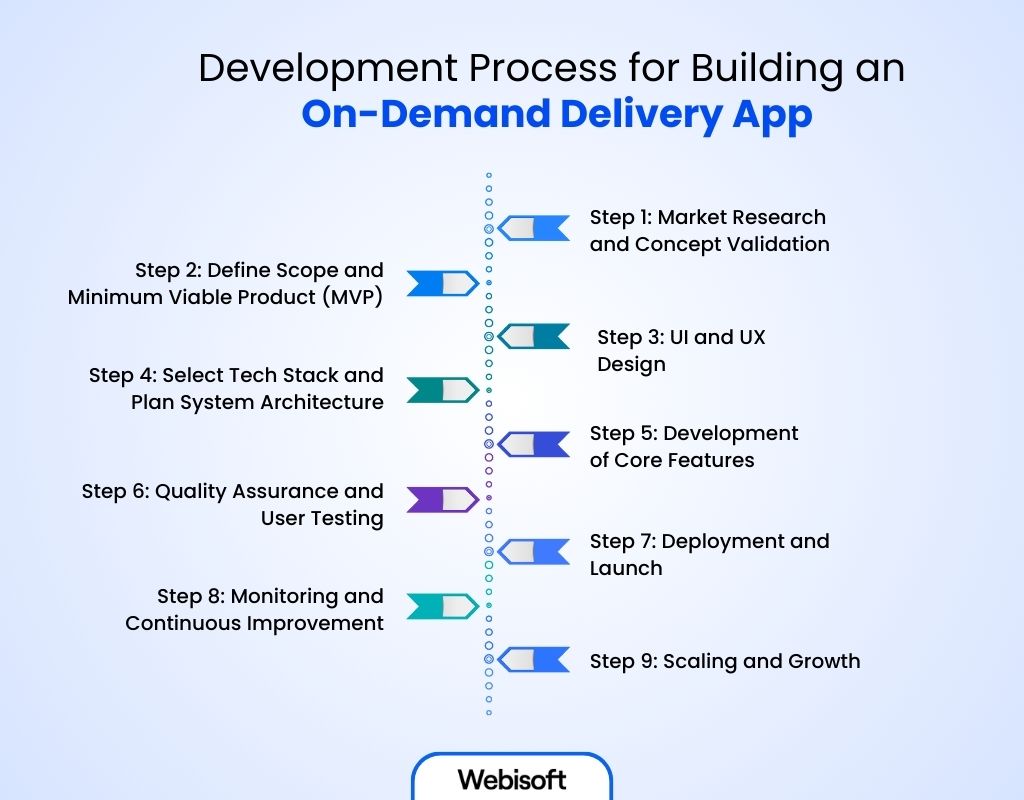 Building an on-demand delivery app follows a structured, multi-stage process that takes you from idea validation to launch and long-term scaling. Especially when you collaborate with an experienced app development agency. Understanding these steps helps you manage complexity, reduce risks and build a product that performs reliably for real users.
Step 1: Market Research and Concept Validation
- Identify the user groups you want to serve and understand their expectations around delivery speed, pricing and convenience.
- Study competing apps to learn which features users rely on and where gaps exist.
- Validate your concept by gathering early feedback so you know the idea solves a real problem.
Step 2: Define Scope and Minimum Viable Product (MVP)
- Choose the essential features you need for launch such as onboarding, browsing, ordering, payments and tracking.
- Define the main user types including customers, vendors, couriers and the admin team.
- Decide which platforms you will support at launch and outline basic user flows for each.
If you need support defining a focused MVP without inflating development costs, contact Webisoft, we can guide you during this early planning stage.
Step 3: UI and UX Design
- Create wireframes that map out how users browse items, place orders and track deliveries.
- Design clean and intuitive screens that allow each user type to complete tasks with minimal effort.
- Build simple prototypes to test navigation and adjust the experience before development begins.
To keep the interface visually consistent and appealing, you can use a creative font generator when refining typography choices for wireframes and early prototypes.
Step 4: Select Tech Stack and Plan System Architecture
- Choose backend, frontend and database technologies that support real time tracking and secure transactions, especially when building a complex web application.
- Plan how different components will work together, including payments, GPS, notifications and user roles.
- Identify the third party integrations you need so essential features work reliably from day one.
Step 5: Development of Core Features
- Build the main workflows for customers, vendors, couriers and the admin panel.
- Implement backend logic, APIs, payment processing, tracking updates and notification systems.
- Use an iterative development cycle that allows the team to test and refine features as they are completed.
Step 6: Quality Assurance and User Testing
- Test all ordering, tracking and payment flows to ensure they work correctly across devices.
- Check performance during busy periods to confirm the system handles load smoothly.
- Conduct beta testing with a small group of users to collect feedback before launch.
Step 7: Deployment and Launch
- Prepare cloud infrastructure, databases and monitoring tools for live usage.
- Publish mobile apps to the app stores and deploy the backend to production.
- Begin with a controlled rollout so you can monitor real orders and delivery flow before scaling.
Step 8: Monitoring and Continuous Improvement
- Track metrics such as delivery time, order volume, vendor performance and user retention.
- Use this data to improve user experience, refine logistics and fix issues quickly.
- Release updates regularly to keep the platform stable and competitive.
Step 9: Scaling and Growth
- Strengthen infrastructure to support more orders, more vendors and new service regions.
- Expand into new delivery categories or add additional features when demand grows.
- Improve routing and dispatch logic as your user base increases.
Cost and Timeline for On Demand Delivery App Development
The cost of an on demand delivery app development depends on your chosen features, technology decisions, development hours and overall system complexity. The table below outlines average industry costs and timelines so you can plan your project with realistic expectations.
| Component | Average Cost Range (USD) | Estimated Timeline |
| Discovery & Planning | 3,000 – 8,000 | 1–2 weeks |
| UI and UX Design | 6,000 – 25,000 | 2–5 weeks |
| Customer App (iOS + Android) | 20,000 – 60,000 | 5–10 weeks |
| Vendor App (Store App or Dashboard) | 12,000 – 35,000 | 3–7 weeks |
| Courier App (Delivery Partner App) | 10,000 – 30,000 | 3–6 weeks |
| Backend Development (APIs, DB, real-time tracking) | 18,000 – 50,000 | 4–8 weeks |
| Real-Time GPS Tracking & Maps Integration | 3,000 – 12,000 | 1–3 weeks |
| Payment Gateway Integration | 2,000 – 8,000 | 1–2 weeks |
| Notifications System (SMS, push, email) | 1,500 – 6,000 | 1–2 weeks |
| Admin Panel (Web Dashboard) | 8,000 – 20,000 | 3–6 weeks |
| Quality Assurance (QA Testing) | 5,000 – 18,000 | 2–6 weeks |
| DevOps, Deployment & App Store Launch | 3,000 – 8,000 | 1–2 weeks |
| Post-Launch Support (optional) | 2,000 – 10,000 per month | ongoing |
Challenges While Developing an On-Demand Delivery App
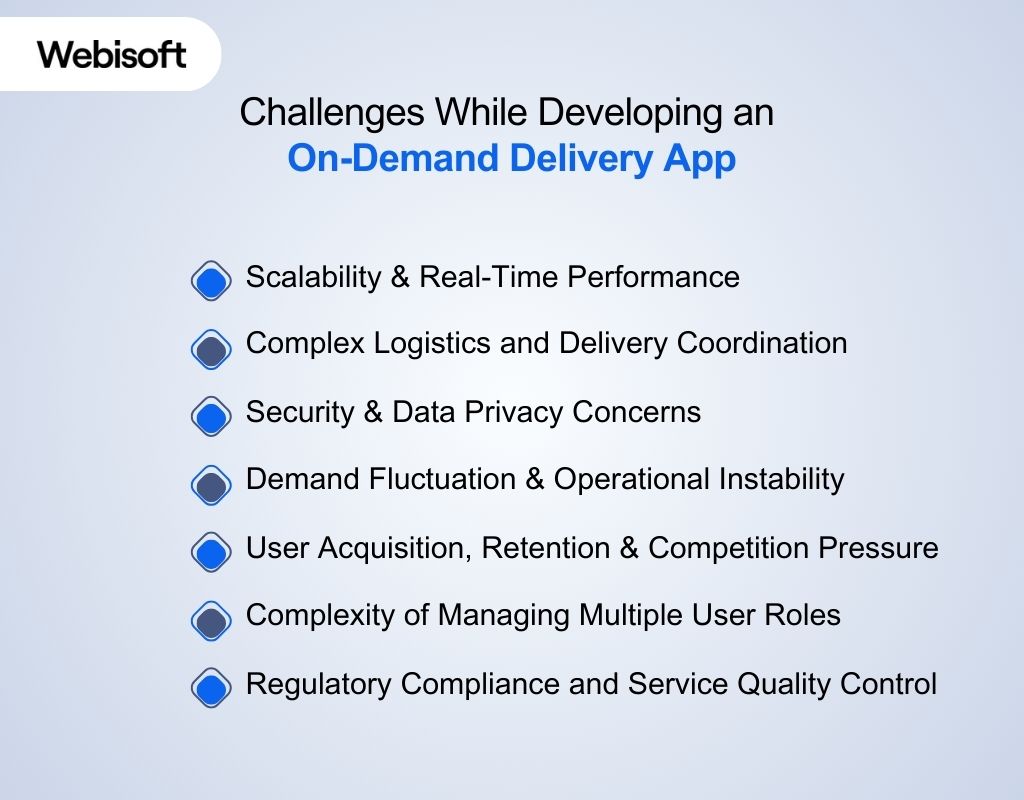 Even with a clear development plan and a realistic budget, you will face certain challenges while building an on-demand delivery app. Understanding these issues early helps you prepare better and maintain a smooth, predictable development journey.
Scalability & Real-Time Performance
As user numbers grow, your app must handle many simultaneous requests: orders, GPS tracking, and real-time updates without slowing down or crashing. Without a scalable backend architecture and efficient data handling, performance can degrade quickly.
To solve this, design the backend with scalable infrastructure (cloud, microservices, load balancing), use efficient data handling and caching, and test performance under load before launch.
Complex Logistics and Delivery Coordination
Coordinating delivery becomes complex when you need to match orders, assign couriers, calculate routes and handle delays. The difficulty increases as you manage more orders, vendors, couriers and changing conditions such as traffic, cancellations and real time updates.
Mitigation involves building strong dispatch logic, flexible workflows for handling cancellations or delays, real-time tracking, fallback systems, and clear communication channels between customers, vendors, and couriers.
Security & Data Privacy Concerns
Delivery apps handle sensitive user data: payments, addresses, personal info, making them targets for fraud or data breaches. To reduce risk, implement strong authentication, secure payment gateway integration, data encryption, safe storage, and follow best practices for user privacy and compliance from the start.
Demand Fluctuation & Operational Instability
On-demand apps often face unpredictable demand: peak times, sudden spikes, or seasonal variations. This can strain logistics, courier availability or backend systems. You should build flexibility into your operations: dynamic courier assignment, scalable infrastructure, load forecasting, and contingency plans for high demand.
User Acquisition, Retention & Competition Pressure
With many players in the on-demand delivery market, attracting and retaining users while maintaining quality is a common struggle. High competition, shifting user expectations, and cost sensitivity challenge new apps. Solving this includes focusing on user experience, reliability, transparent communication, consistent quality, and value-added services rather than competing only on price.
Complexity of Managing Multiple User Roles
Your app must serve different stakeholders: customers, vendors, couriers, and admins, each with unique interfaces, workflows and data needs. Designing and maintaining multiple role-based flows adds complexity. To handle this: plan clear user journeys, build modular components, test separately for each role, and ensure good coordination between all parties during development.
Regulatory Compliance and Service Quality Control
Depending on geography, services (e.g. food, medicine, courier), there may be regulatory standards (packaging, safety, data laws) and service-quality expectations. Failing to meet those harms reputation and legality. Ensure compliance reviews, quality standards for vendors/couriers, proper documentation, data protection policies, and regular audits.
Working with Webisoft on Your On-Demand Delivery App
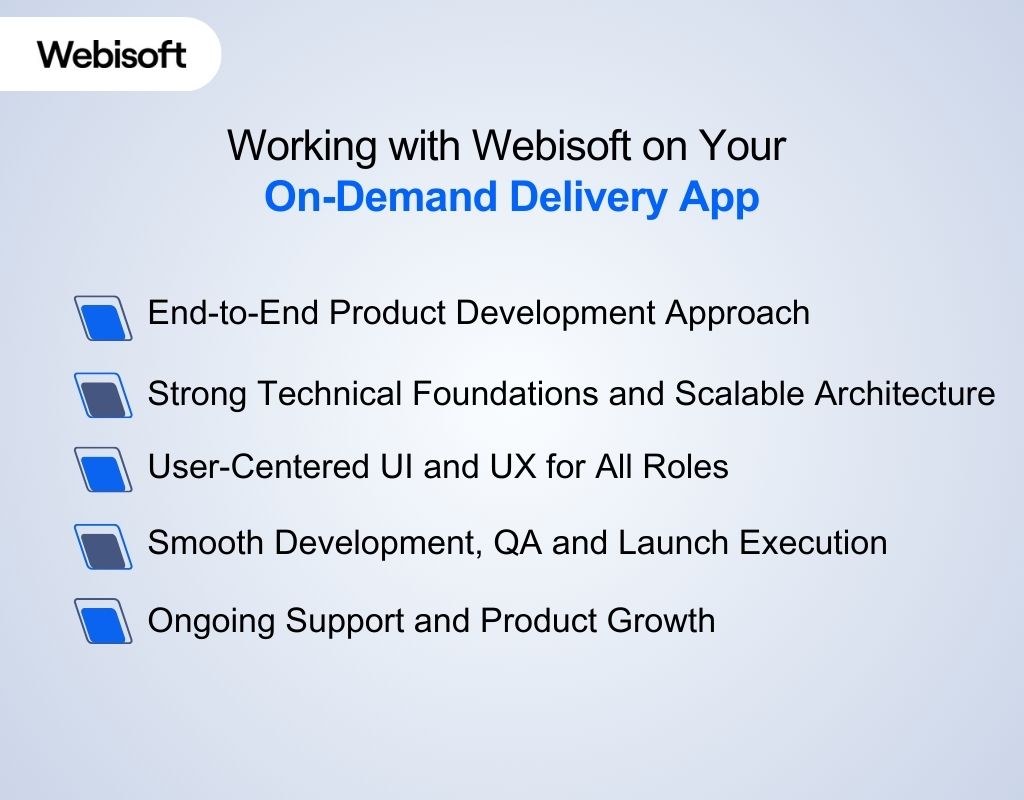 Once you know what it takes to build a delivery app, you need a team that can execute each stage with clarity and precision. Webisoft supports you through every phase, ensuring your product is built with long-term growth in mind.
End-to-End Product Development Approach
Webisoft supports your project from the earliest planning stages through design, development, testing and launch. You work with a single team that manages every layer of your product, which keeps communication clear and helps the project move forward without friction. This unified approach ensures your app stays aligned with your goals at each stage.
Strong Technical Foundations and Scalable Architecture
On demand delivery app development requires real-time data handling, stable performance and reliable integrations. Webisoft builds backend systems, APIs and cloud infrastructures that support high concurrency, location updates and multi-role interactions without slowing down. This gives you a strong foundation that can scale as your audience and order volume grow.
User-Centered UI and UX for All Roles
Every user in a delivery platform: customer, vendor, courier and admin needs an interface that feels easy to navigate. Webisoft creates thoughtful UI and UX flows that simplify ordering, task handling and management actions across all roles. Early prototypes help confirm usability before development, giving you confidence in your product’s experience thanks to solid app design and development services.
Smooth Development, QA and Launch Execution
Your project benefits from Webisoft’s structured development and testing process, which ensures features are built predictably and validated thoroughly. Before launch, we prepare your cloud environment, APIs, databases and app-store submissions so everything is ready for production. This reduces risk and helps your rollout feel controlled and stable.
Ongoing Support and Product Growth
Once your delivery app is live, Webisoft continues supporting you through updates, feature enhancements and performance improvements. As your business grows, we help you scale your infrastructure, introduce new capabilities and refine logistics to meet increasing demand. This long-term partnership keeps your app evolving with your users.
Build your on demand delivery app with Webisoft today.
Book a free consultation and start turning your delivery idea into reality.
Conclusion
As you reach the end of this guide, you now understand what it takes to succeed in on demand delivery app development. With a clear plan, the right features and a solid technical foundation, you are positioned to build something users rely on every day.
And if you want support turning your vision into a scalable, user-ready product, Webisoft can help you execute each step with precision. The opportunity is here, and your next move decides how far your app can go.
Frequently Asked Question
Can an on-demand delivery app work in multiple cities at launch?
Yes, but you need backend support for multi-region operations, separate delivery zones and flexible location settings. You also require scalable infrastructure and efficient vendor and courier onboarding processes so each new city can function independently without service disruption.
How do delivery apps handle cancellations or failed deliveries?
Delivery apps typically follow structured workflows that manage refunds, inform vendors, update users and reassign couriers when needed. They adjust order statuses in real time, helping maintain accurate tracking, reduce confusion and ensure smooth communication whenever an order cannot be completed successfully.
Do delivery apps require a special type of hosting?
Most delivery apps benefit from scalable cloud hosting that supports high traffic and real-time operations. Load balancing, caching and auto-scaling are essential to keep performance stable during peak hours, ensuring your app remains responsive as usage increases.
