Polkadot is a layer 0 protocol: a base network whose job is not to run applications itself, but to connect and secure many purpose-built blockchains at once. If you are evaluating platforms for a product that needs its own chain, or that needs to move assets and data between chains without trusting a third party, Polkadot is one of the few architectures designed for that problem from the start.
This guide covers what the Polkadot network is, why it exists, how the relay chain, parachains, and coretime model actually work, what the DOT token does, and where the platform is heading with Polkadot 2.0 and the proposed JAM upgrade.
What Is the Polkadot Network?
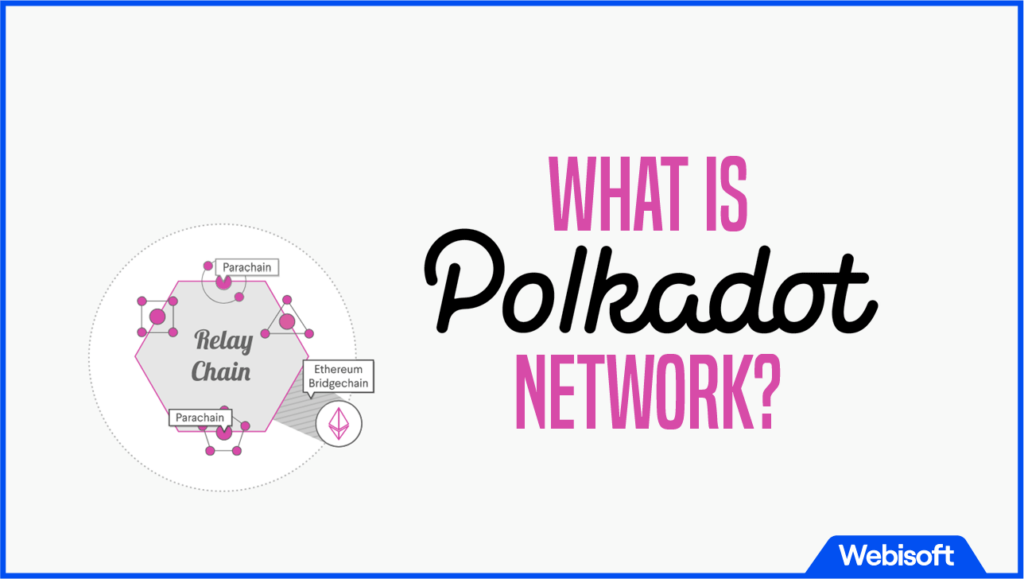
Polkadot is an open-source, proof-of-stake network that connects independent blockchains, called parachains, under a single security umbrella. Instead of every chain recruiting and paying for its own validator set, parachains lease security from Polkadot's central relay chain. In return they gain the ability to exchange tokens, messages, and arbitrary data with every other connected chain.
The project is stewarded by the Web3 Foundation, a Swiss nonprofit that funds development of decentralized web infrastructure. Gavin Wood published the original Polkadot whitepaper in 2016, and the mainnet launched in 2020. Three people founded the network:
- Dr. Gavin Wood. Co-founder and former CTO of Ethereum, creator of the Solidity smart contract language, and president of the Web3 Foundation. He coined the term Web3 and wrote the Polkadot whitepaper.
- Robert Habermeier. Co-founder with a background in cryptography, distributed systems research, and blockchain core development.
- Peter Czaban. Technology director at the Web3 Foundation, with a master's in engineering from Oxford and a focus on distributed technology.
The reference implementation is built by Parity Technologies, the engineering company Wood founded after leaving Ethereum. That lineage matters: much of Polkadot's design reads as a direct response to the scaling and upgrade problems Wood saw firsthand while building Ethereum.
Why Do We Need the Polkadot Network?
Most layer 1 blockchains are monolithic. A single chain handles execution, consensus, and data availability for every application it hosts, so every application competes for the same blockspace and inherits the same design compromises. A chain tuned for DeFi settlement makes a poor fit for a game or an identity registry, and vice versa.
The obvious alternative, launching an application-specific chain, has historically carried two costs. First, a new chain must bootstrap its own validator set, and a small validator set with a low-value token is cheap to attack. Second, that chain starts life as an island: it cannot read state from or send verified messages to any other network.
Bridges built as afterthoughts have been the standard workaround, and they have also been the weakest attack surface in the industry. Most rely on a small multisig or a trusted relayer set, which concentrates exactly the kind of risk blockchains are supposed to remove.
Polkadot addresses both problems at the protocol level. Every parachain is validated by the relay chain's full validator set, so a chain launched today inherits the economic security of the whole network on day one. And chains communicate through a native messaging protocol rather than bolted-on bridges, so interoperability is a property of the system, not a third-party service.
What Does the Polkadot Blockchain Network Provide?
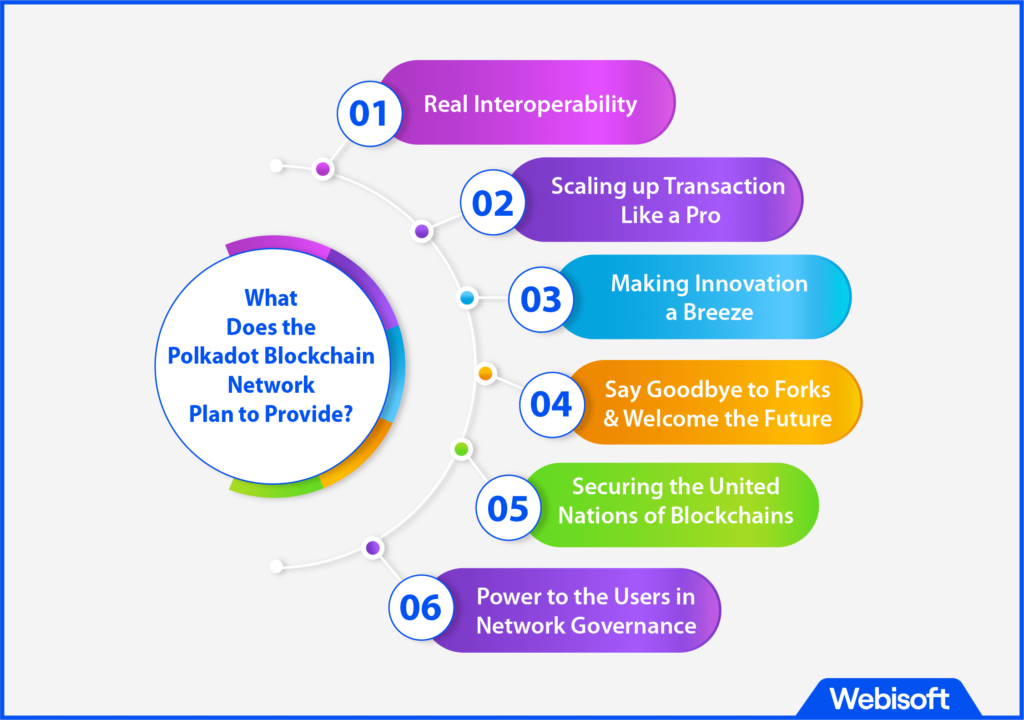
Native Interoperability
Polkadot chains communicate through XCM, a cross-consensus message format. XCM is not limited to token transfers: it can express arbitrary instructions, so a contract on one parachain can call a function on another, lock collateral remotely, or trigger a governance action across chains. This is what makes composable patterns like DeFi staking work across chain boundaries instead of inside a single chain.
Parallel Scalability
Because parachains execute in parallel, total network throughput scales with the number of connected chains rather than being capped by a single chain's block size. Recent protocol upgrades push this further: asynchronous backing shortened parachain block times, and elastic scaling lets a single busy parachain consume multiple relay chain cores at once when demand spikes.
Fast Chain Development
The Polkadot SDK (which grew out of the Substrate framework) provides networking, consensus, and a modular runtime library out of the box. Teams compose a chain from prebuilt pallets for balances, governance, staking, or NFTs, then write custom logic only where their product is actually different. This turns what used to be a multi-year protocol engineering effort into a focused product build.
Forkless Upgrades
A Polkadot chain's runtime is a WebAssembly blob stored on the chain itself. Upgrading the chain means submitting a new blob through governance; once approved, every node switches automatically at the same block. There is no hard fork, no node-operator coordination campaign, and no risk of a chain split over an upgrade.
Shared Security
Parachains keep their own state, logic, and governance, but their blocks are validated and finalized by the relay chain's validator set. Attacking any single parachain requires attacking Polkadot itself, which puts the full staked value of the network behind every connected chain.
On-Chain Governance
Since the OpenGov upgrade, every protocol change is decided by public referendum. Any DOT holder can propose a change, vote on it, and amplify their vote by locking tokens for longer periods, a mechanism called conviction voting. Approved proposals execute on chain automatically, so the network upgrades itself without any privileged committee signing off.
How Does the Polkadot Network Work?
Polkadot separates the job of agreeing on blocks from the job of producing them. Specialized chains produce blocks; the relay chain validates and finalizes them. Four components make this work:
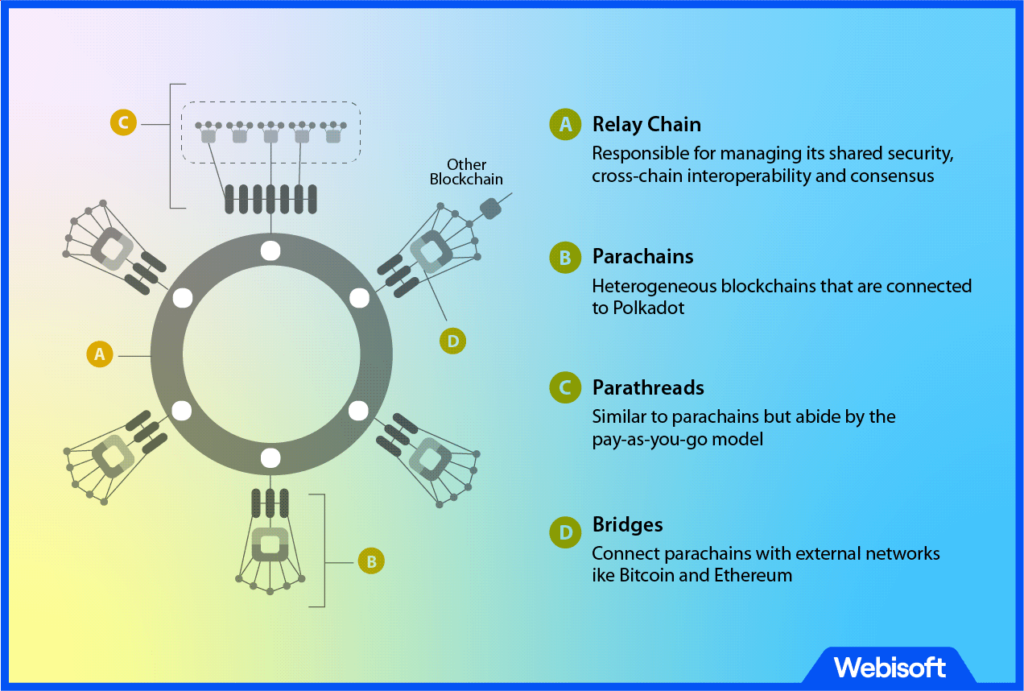
The Relay Chain
The relay chain is deliberately minimal: it does not run smart contracts or host applications. Its validators are selected through nominated proof of stake (NPoS), produce blocks through the BABE mechanism, and finalize them in batches through GRANDPA, a finality gadget that can catch up on many blocks at once. The relay chain's only jobs are consensus, validator coordination, and routing messages between parachains.
Parachains
Parachains are the application layer. Each one has its own state, its own transaction logic, and usually its own token. Nodes called collators gather transactions and produce candidate blocks, which a rotating subset of relay chain validators checks before the block becomes part of the canonical network state. A parachain can be a general smart contract platform, a DeFi venue, an identity network, or a fully private permissioned chain.
Coretime and On-Demand Chains
Originally, teams won long-term parachain slots through candle auctions, and lighter projects ran as pay-per-block parathreads. The Agile Coretime upgrade replaced that model: blockspace is now sold as coretime, either in bulk for teams that need continuous execution or on demand for chains that only need to produce blocks occasionally. This lowers the entry cost for new projects and lets busy chains buy extra capacity when they need it.
Bridges
Bridges connect Polkadot to external networks such as Ethereum and Bitcoin. The ecosystem's preferred designs are trust-minimized: light-client bridges verify the other chain's consensus on chain rather than trusting a custodian or a multisig, which is a materially stronger security model than most standalone bridge services offer.
| Component | Role | Runs applications? |
|---|---|---|
| Relay chain | Consensus, finality, shared security, message routing | No |
| Parachain | Application-specific execution with its own state and logic | Yes |
| On-demand coretime | Pay-as-you-go block production for low-traffic chains | Yes |
| Bridge | Verified connection to external networks like Ethereum | No |
What Does the DOT Token Do?
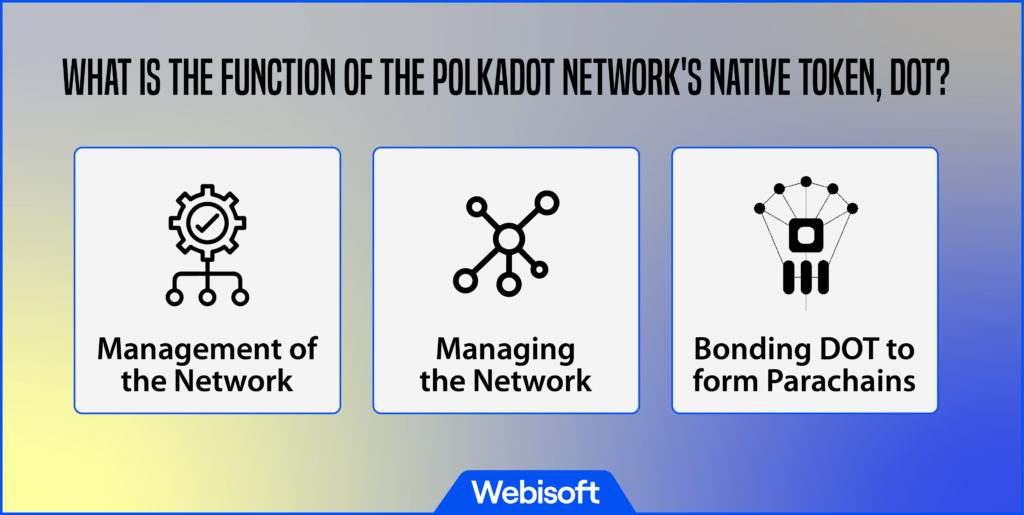
DOT is the network's native token, and it has three concrete jobs.
Governance
DOT holders control the protocol. Referenda decide fee schedules, treasury spending, runtime upgrades, and the rules of the coretime market. Voting power scales with the amount of DOT committed and the length of time a voter is willing to lock it, which rewards long-term conviction over short-term speculation.
Staking
Polkadot's security budget comes from staked DOT. Validators run the infrastructure and put their own stake at risk; nominators back validators they judge trustworthy with their own tokens. Both earn rewards when their validator behaves correctly, and both can be slashed, meaning a portion of their stake is destroyed, if the validator equivocates or goes offline. The economic logic is simple: honest participation pays, and attacks cost real money.
Securing Blockspace
DOT is the currency of the coretime market. Teams spend it to reserve continuous blockspace for their chains or to buy on-demand execution. Under the earlier auction model, projects bonded large amounts of DOT for the duration of a slot lease; coretime replaces that lockup with a more conventional purchase, which frees capital and simplifies planning for new teams.
Polkadot Services Webisoft Offers
Webisoft is a Montreal-based software engineering firm that builds blockchain products end to end, from architecture through deployment. Here is where we can help on Polkadot:
Smart Contract Development
We build and audit contracts for the Polkadot ecosystem, whether in ink! (the Rust-based contract language for Polkadot SDK chains) or in Solidity for EVM-compatible parachains. Cross-chain contract flows over XCM are part of that scope.
Custom Chain and Runtime Development
For products that outgrow a shared smart contract platform, we design and implement dedicated chains with the Polkadot SDK: custom pallets, tokenomics, governance configuration, and coretime strategy.
dApp Development
We build decentralized applications that read from and write to multiple parachains, including hybrid designs where a permissioned chain settles or verifies against a public one.
Exchange and DeFi Platforms
We develop exchange systems and DeFi protocols that move assets across chains through XCM and bridges, with the accounting and security reviews that cross-chain value transfer demands.
Wallet and Node Infrastructure
We set up and operate Polkadot nodes, build wallet integrations, and stand up the monitoring and key-management practices a production deployment needs.
Where Polkadot Is Headed
Polkadot's roadmap is unusually concrete because it is decided in public through OpenGov. Two threads matter most for anyone planning a build:
Polkadot 2.0. The umbrella term for the upgrades already rolling out: asynchronous backing for faster parachain blocks, Agile Coretime for flexible blockspace pricing, and elastic scaling so a single chain can burst across multiple cores. Together they shift Polkadot from a fixed-slot model to something closer to cloud-style capacity provisioning.
JAM. In 2024, Gavin Wood published a gray paper proposing the Join-Accumulate Machine, a redesign that would generalize the relay chain into a decentralized computer running arbitrary services, with parachains as one service type among many. JAM is designed to be compatible with existing parachains, and its rollout will be decided by governance. It signals that the core team is optimizing for generality and long-term flexibility rather than short-term feature races.
The honest caveat: Polkadot competes with rollup-centric ecosystems that solve overlapping problems with different trade-offs. Its differentiators are execution sovereignty for each chain, protocol-level messaging, and forkless upgrades. Whether those win depends on the applications teams ship on it, which is precisely the layer where builders have leverage.
Final Words
Polkadot is a serious piece of engineering aimed at a real problem: letting many specialized blockchains operate as one secure, interoperable system. Its shared security model removes the hardest part of launching a chain, XCM makes cross-chain applications practical, and the coretime model prices blockspace like the utility it is. For teams deciding between deploying contracts on a shared chain and running their own, Polkadot makes the second option genuinely viable.
If you are weighing a Polkadot build, from a single smart contract to a full custom chain, Webisoft's engineering team can scope it with you. Explore our blockchain development services and contact Webisoft to discuss your project.
Polkadot is a base network that connects many independent blockchains, called parachains, under one shared security system. Each parachain runs its own applications and logic, while Polkadot's central relay chain validates their blocks and lets them exchange tokens and data with each other.
Ethereum is a single chain where every application shares the same blockspace and execution rules. Polkadot is a network of many chains: each project can run its own purpose-built blockchain with custom logic, while the relay chain provides security and cross-chain messaging. Ethereum scales through rollups built on top of it; Polkadot builds parallel execution into the base protocol.
The original slot auction model was replaced by Agile Coretime. Instead of bonding large amounts of DOT to win a long lease, teams now buy blockspace as coretime, either in bulk for continuous operation or on demand for chains that only produce blocks occasionally. This lowers the cost of entry and frees locked capital.
DOT has three jobs: governance (holders vote on every protocol change through public referenda), staking (validators and nominators lock DOT to secure the network and earn rewards, with slashing for misbehavior), and blockspace (teams spend DOT to buy coretime for their chains).
Yes. Polkadot supports public, private, and permissioned chains. A permissioned chain can keep its data and access rules internal while still exchanging verified messages with public parachains, for example settling transactions or anchoring proofs on a public network.