AI now sits inside almost every stage of the entertainment pipeline. Recommendation models decide what shows up on your streaming home screen. Generative models draft storyboards, temp scores, and concept art. Game engines ship with machine learning tools for animation and upscaling built in.
The interesting questions are no longer whether AI belongs in entertainment, but where it creates real leverage, what it costs to run, and where it breaks. This article walks through the major applications across music, film and TV, gaming, and VR/AR, the mechanisms behind them, and the trade-offs studios and platforms have to manage.
The Impact of AI on the Entertainment Industry
Three capabilities drive most of the value: prediction, generation, and automation. Prediction models estimate what an audience will watch, listen to, or buy. Generative models produce candidate assets such as scripts, music, images, and animation. Automation models take over repetitive production work such as editing, tagging, and quality control.
Content Development
Studios and labels use predictive models trained on historical performance data, audience panels, and metadata to inform greenlighting, casting, and release timing. The models do not write hits. They narrow the option space: which of these forty concepts has an audience, which territories will respond, what budget band the projected demand supports. Human judgment still makes the call, but it makes the call with a quantified prior instead of instinct alone.
Interactive Storytelling
Large language models make characters conversational. A scripted NPC or virtual host can now respond to free-form input instead of a fixed dialogue tree. The engineering challenge is keeping that freedom inside the fiction: the model needs guardrails so a medieval innkeeper does not start explaining smartphones, and latency low enough that the exchange feels live. Most production systems combine a constrained model, a retrieval layer holding the character's canon, and hard filters on output.
Recommendation and Personalization
Recommendation is the most commercially proven application. Streaming platforms model each user from watch history, session context, and item embeddings, then rank a candidate pool in real time. Netflix's engineering leadership has reported that roughly 80 percent of hours streamed on the platform come from its recommender rather than direct search, a figure published in their ACM paper on the Netflix recommender system. For a subscription business, better recommendations translate directly into retention.
How AI Is Driving Growth in the Music Industry
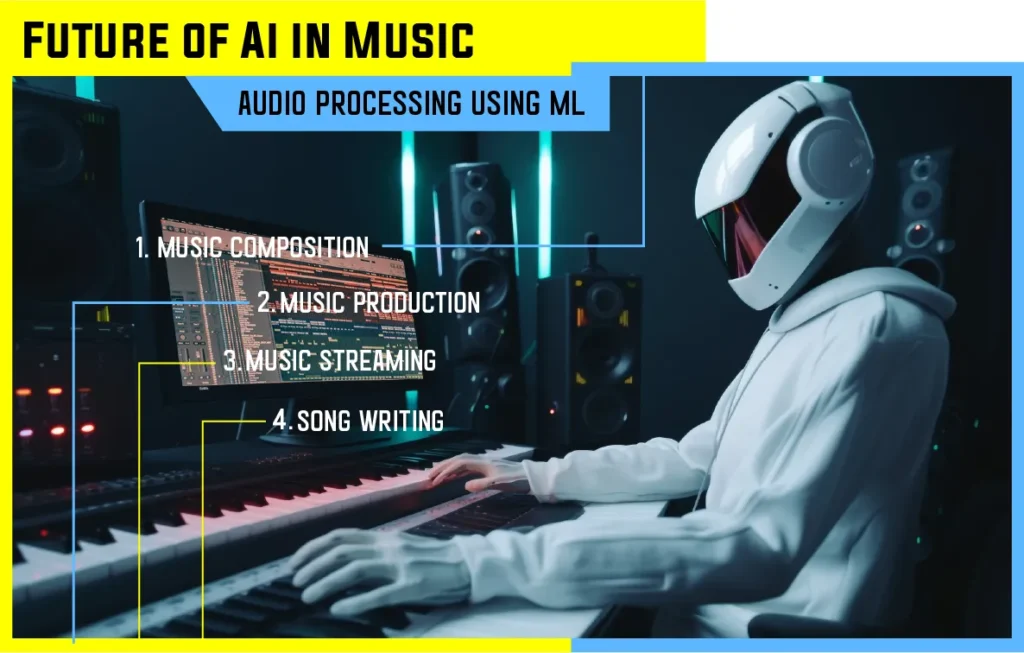
Music was an early adopter because audio is compact, heavily catalogued, and consumed at enormous volume through streaming. AI shows up in three places: creation, discovery, and production tooling.
AI-Generated Music
Generative music models, typically transformer or diffusion architectures trained on large audio or symbolic (MIDI) datasets, can produce original compositions in a requested style, tempo, and mood. The practical sweet spot today is functional music: soundtracks for games, ads, and video content where a producer needs sixty seconds of tension in a specific key by Friday, not a chart single.
The unresolved issue is training data. Models trained on copyrighted catalogs without licenses face legal challenges from rights holders, and platforms are still deciding how to label and monetize synthetic tracks. Teams building products in this space should treat licensing posture as an architecture decision, not an afterthought: models trained on licensed or public-domain corpora are slower to improve but far easier to commercialize.
Music Recommendation Systems
Streaming discovery combines collaborative filtering (users with similar listening histories) with content-based audio embeddings (what the track actually sounds like: tempo, timbre, energy). The hybrid matters. Collaborative filtering alone cannot recommend a brand-new track with no listening history, the classic cold-start problem, while audio embeddings can place it next to similar music from day one. This is also how recommendation systems surface emerging artists: a debut single with zero streams can still be routed to listeners whose taste profile matches its sound.
Production Tooling
Beyond composition, machine learning handles stem separation (isolating vocals, drums, and bass from a finished mix), automated mastering, and vocal transformation. Stem separation in particular unlocked an entire remix and sampling workflow that used to require the original multitrack session files.
What Is the Role of AI in the Film and TV Industry?

Film and TV apply AI across the full pipeline, from script coverage before a project is funded to dubbing after it ships.
Development and Pre-Production
Script analysis tools score screenplays on structure, pacing, character arcs, and comparable-title performance, giving development executives a first-pass filter over large submission volumes. Scheduling and budgeting tools use historical production data to flag scripts that will be expensive to shoot before a single location is scouted.
Visual Effects and Virtual Production
VFX is where AI saves the most labor. Machine learning now automates rotoscoping (isolating actors from backgrounds frame by frame), motion capture cleanup, crowd simulation, and face replacement or de-aging. Work that once took an artist days per shot runs in minutes, with the artist reviewing and correcting output instead of producing it from scratch. On virtual production stages, AI-assisted rendering keeps real-time backgrounds on LED walls responsive to camera movement.
Post-Production and Editing
Automated tools handle first-pass editing tasks: scene detection, color matching across shots, audio cleanup, and subtitle generation. None of this replaces an editor's judgment about rhythm and story, but it removes the mechanical work that sat between the editor and the creative decisions.
Localization and Dubbing
Speech models generate subtitles and synthetic dubs in dozens of languages, and newer systems match the dubbed audio to the actor's lip movements. This collapses the cost of releasing a title globally, which is why streaming platforms have leaned into non-English originals: the localization economics finally work.
Audience Analytics
Platforms instrument everything: completion rates, rewatch points, drop-off timestamps, artwork click-through. Those signals feed back into commissioning decisions, thumbnail selection, and marketing spend allocation. The trade-off is well documented: optimizing purely for engagement metrics can push commissioning toward safe, familiar formats, so the stronger studios treat the data as one input rather than the decision itself.
What Is the Role of AI in the Gaming Industry?
Games have shipped with "AI" for decades, but classical game AI (behavior trees, finite state machines, pathfinding) is hand-authored logic. The current shift is toward learned systems that adapt to the player.
Non-Player Characters
Traditional NPCs run on behavior trees: predictable, debuggable, and cheap at runtime. Learned NPCs, driven by reinforcement learning or language models, can produce emergent behavior and open-ended dialogue, but they cost more per interaction and are harder to quality-assure. Most studios blend the two: authored logic for anything that affects game progression, learned systems for ambient flavor and conversation, with strict output filtering so an NPC cannot break the game's fiction or its content rating.
Procedural Content Generation
Generative systems build levels, terrain, items, and quests from rules plus learned models, letting small teams ship large worlds. The design risk is sameness: purely procedural content tends toward statistical averageness. Effective pipelines generate volume with AI and curate with humans.
Dynamic Difficulty and Player Modeling
Player models track skill and behavior in real time and adjust difficulty, pacing, or hint frequency to keep players in a productive challenge zone. Done transparently this improves retention. Done invisibly in competitive or monetized contexts it invites backlash, so studios increasingly disclose when adaptive systems are active.
Production and Operations
Machine learning also works behind the scenes: automated playtesting bots that sweep levels for exploits and collision bugs, ML-based upscaling that renders at lower resolution and reconstructs a sharper image to save GPU budget, and anti-cheat and toxicity-moderation models that operate at a scale human moderators cannot match.
What Is the Role of AI in Virtual and Augmented Reality?

VR and AR are constraint-driven platforms: every frame must render twice (once per eye) at high refresh rates on limited hardware, and the system must understand the physical world around the user. AI addresses both constraints.
Tracking and Scene Understanding
Headsets use SLAM (simultaneous localization and mapping) with learned components to track their own position and reconstruct the room geometry. Computer vision models handle hand tracking, eye tracking, and object recognition, which is what lets virtual content sit convincingly on a real table or lets a user grab a virtual object with bare hands instead of controllers.
Rendering Efficiency
Foveated rendering pairs eye tracking with the fact that human vision is only sharp at the center of gaze: the system renders full detail where the user is looking and lower detail in the periphery, cutting GPU load substantially. ML-based supersampling reconstructs high-resolution frames from cheaper low-resolution renders. Together these techniques are what make standalone headsets viable without a tethered PC.
Natural Interaction
Speech recognition and gesture interpretation replace controller menus with direct interaction. The bar is unforgiving: recognition errors that would be minor annoyances on a phone break immersion completely in a headset, so on-device, low-latency models matter more here than raw accuracy benchmarks.
Benefits and Trade-Offs of AI in Entertainment
Every one of these capabilities carries an operating cost or a risk. A realistic view pairs them:
| Benefit | How it works | Trade-off to manage |
|---|---|---|
| Personalized recommendations | User and item embeddings ranked in real time | Filter bubbles; cold start for new content |
| Faster content creation | Generative models draft scripts, music, art | Training-data licensing; output quality control |
| Lower production costs | Automated VFX, editing, subtitling, QA | Workforce displacement; union agreements |
| Global reach | Automated translation and synthetic dubbing | Voice-likeness rights; cultural nuance loss |
| Content moderation at scale | Classifiers flag piracy and harmful content | False positives; adversarial evasion |
| Audience insight | Behavioral analytics feed commissioning | Metric-driven sameness in content |
The labor question is not hypothetical. The 2023 Hollywood strikes by the SAG-AFTRA actors' union and the Writers Guild put AI usage, consent, and compensation for digital replicas at the center of contract negotiations, and the resulting agreements now constrain how studios can deploy generative tools. Any serious AI strategy in this industry has to account for rights, consent, and disclosure from the start.
How AI Is Reshaping the Entertainment Experience: Real Examples
These are shipping products, not research demos:
Scriptbook
An analysis platform that ingests screenplays and produces predictions about commercial performance based on plot structure, character data, and market comparables. Studios use it as a triage layer over submission volume, not as a replacement for development executives.
AIVA
AIVA is an AI composition system that generates original scores for film, games, and advertising. It is notable for its legal footing: it was among the first AI composers registered with an authors' rights society, which matters for anyone who needs to license its output commercially.
DeepMotion
Uses machine learning for markerless motion capture: it extracts full-body character animation from ordinary video, no mocap suit or studio required. This pulls a capability that used to demand six-figure equipment budgets into the reach of independent studios.
Ziva Dynamics
Builds physics-based simulation of soft tissue such as muscle, fat, and skin, so digital characters deform realistically as they move. The technology, since acquired by Unity, is used for hero characters in films and games where anatomical believability is the difference between convincing and uncanny.
LyricFind
Operates a licensed lyrics database serving streaming platforms and music apps, using machine learning for lyric alignment and matching. It is a good example of unglamorous but commercially essential AI: rights-cleared data infrastructure that other products build on.
Future Trends in the Entertainment Industry
Several trajectories are already visible in production roadmaps:
- Generative pipelines move from novelty to infrastructure. Concept art, previsualization, temp audio, and localization are becoming AI-first workflows with human review, rather than human workflows with AI assistance.
- Interactive narrative matures. As language models get cheaper and faster, dialogue-driven games and companion experiences stop being tech demos and start being genres.
- Rights infrastructure becomes a product category. Consent registries, likeness licensing, provenance metadata, and content authenticity standards (such as C2PA) will be as much a part of the stack as codecs are today.
- Cross-platform personalization deepens. The same audience model increasingly follows a franchise across film, game, and social touchpoints, shaping what gets made for each.
- Regulation arrives. Disclosure requirements for synthetic media and constraints on training data are moving through legislatures in multiple jurisdictions, and platforms are building labeling systems ahead of enforcement.
How Webisoft Helps You Build AI Into Your Entertainment Product
Webisoft is a Montreal-based software engineering firm that designs and ships production systems end to end: AI integrations, recommendation and analytics pipelines, blockchain infrastructure for rights and royalties, and the web and mobile products around them. If you are evaluating where AI fits in your platform, whether that is a recommendation engine, a generative content workflow, or the data plumbing underneath, we can help you scope it, build it, and run it.
To discuss your project, contact Webisoft and talk through the architecture with our engineering team.
Conclusion
AI in entertainment is no longer a forecast. Recommenders drive the majority of what gets watched on major streaming platforms, machine learning has absorbed much of the repetitive labor in VFX and post-production, and generative models are settling into concept, scoring, and localization workflows. The winners will not be the companies that adopt AI fastest but the ones that pair it with the boring disciplines: licensed training data, human review where quality is non-negotiable, clear consent and rights handling, and honest measurement of whether the model actually improved the product.
AI is used across the entertainment pipeline in three main ways: prediction, generation, and automation. Predictive models power content recommendations and inform greenlighting and marketing decisions. Generative models produce music, scripts, concept art, and animation drafts. Automation handles repetitive production work such as VFX rotoscoping, editing, subtitling, dubbing, and content moderation.
Current systems replace tasks, not roles. Generative models draft functional assets such as temp scores, coverage notes, and background animation, while humans keep the creative decisions and final quality control. Labor terms are now contractual: the 2023 SAG-AFTRA and Writers Guild agreements set consent and compensation rules for how studios can use AI and digital replicas.
The biggest risks are legal and quality-related: training generative models on unlicensed copyrighted material, using a performer's voice or likeness without consent, shipping unreviewed generated content, and over-optimizing for engagement metrics until the catalog becomes uniform. Mature teams pair every AI capability with licensing checks, human review, and disclosure policies.
They combine collaborative filtering, which matches you with users who have similar viewing or listening histories, and content-based models, which represent each title or track as an embedding of its actual attributes. A ranking model scores candidates in real time using your history and session context. Netflix has reported that about 80 percent of hours streamed come from recommendations rather than search.
AI solves the two hard constraints of headsets: understanding the physical world and rendering efficiently. SLAM and computer vision models handle position tracking, room mapping, and hand and eye tracking. Foveated rendering and ML-based supersampling concentrate GPU power where the user is actually looking, which is what makes standalone headsets viable.
Webisoft is a Montreal-based software engineering firm that builds production systems end to end: AI integrations, recommendation and analytics pipelines, blockchain infrastructure for rights and royalties, and the web and mobile products around them. The team can scope, build, and operate the system with you, from architecture through deployment.